


Judges 7:2
Bible text: King James Version (1769 Blayney text) · Public domain
Bible text: King James Version with Strong's numbers · Public domain
Bible text: Berean Standard Bible · Public domain
Bible text: American Standard Version (1901) · Public domain
Bible text: World English Bible, Messianic edition · Public domain
Bible text: Geneva Bible (1599) · Public domain
Bible text: Young's Literal Translation · Public domain
- וַיֹּאמֶרvai·Yo·merand he saidH559Conj-w ¦ V-Qal-ConsecImperf-3msVerb Qal Consecutive Imperfect 3rd Singular Masculineוַandיֹּאמֶרhe said
- יְהוָהYah·wehYahwehH3068N-properNoun Proper Title
- אֶל'eltoH413PrepPreposition
- גִּדְעוֹןgid·'onGideonH1439N-proper-mNoun Proper Masculine
- רַבRav[is too] numerousH7227Adj-msAdjective Singular Masculine Absolute
- הָעָםha·'Amthe peopleH5971Art ¦ N-msNoun Singular Masculine Absoluteהָtheעָםpeople
- אֲשֶׁר'a·SherwhichH834RelParticle Relative
- אִתָּךְ'i·Takh[is] with youH854Prep ¦ 2msPreposition Definiteאִתָּ[is] withךְyou
- מִתִּתִּיmi·ti·Tithan I to giveH5414Prep-m ¦ V-Qal-Inf ¦ 1csVerb Qal Infinitive Constructמִthanתִּתִּto giveיI
- אֶת'et<obj.>H853DirObjMParticle Object Indicator
- מִדְיָןmid·YanMidianH4080N-properNoun Proper Location
- בְּיָדָםbe·ya·Damin their handH3027Prep-b ¦ N-csc ¦ 3mpNoun Singular common gender Constructבְּinיָדָhandםtheir
- פֶּןpenlestH6435PrtParticle Conditional
- יִתְפָּאֵרyit·pa·'Erit should glorify itselfH6286V-Hithpael-Imperf-3msVerb Hithpael Imperfect 3rd Singular Masculine
- עָלַי'a·Laiover meH5921Prep ¦ 1csPreposition Definiteעָלַoverיme
- יִשְׂרָאֵלYis·ra·'ElIsraelH3478N-properNoun Proper Location
- לֵאמֹרle·Mor<to> sayingH559Prep-l ¦ V-Qal-InfVerb Qal Infinitive Constructלֵ<to>אמֹרsaying
- יָדִיya·Dimy handH3027N-csc ¦ 1csNoun Singular common gender Constructיָדִhandיmy
- הוֹשִׁיעָהho·Shi·'ahit has deliveredH3467V-Hiphil-Perf-3fsVerb Hiphil Perfect 3rd Singular Feminine
- לִּיLi<to> <the> mePrep-l ¦ 1csSuffix Personal 1st Singular common genderלִּ<to> <the>יme
English is a literal word-by-word gloss of the Hebrew, not the KJV's wording. Why?
This is the original text the KJV's translators worked from — each Hebrew word with its own literal English meaning in this verse, prepared by scholars at Tyndale House, Cambridge. The KJV translates whole sentences, not word by word, so its wording differs: one Hebrew word can become several English words, and the KJV may choose “the LORD” where the gloss reads “Yahweh”. Both are faithful — they answer different questions. For the KJV's own rendering, switch to the KJV text.
Details
See on the biblical-era maps
Study this verse
Public-domain commentary
Matthew Henry
From his Commentary on the Whole Bible. Henry comments on passages, not single verses — this entry covers Judges 7:1–8. His three-level outline is real structure in the source text, so it is rendered as structure.
Here, I. Gideon applies himself with all possible care and industry to do the part of a good general, in leading on the hosts of Israel against the Midianites (Jdg 7:1): He rose up early, as one whose heart was upon his business, and who was afraid of losing time. Now that he is sure God is with him he is impatient of delay. He pitched near a famous well, that his army might not be distressed for want of water, and gained the higher ground, which possibly might be some advantage to him, for the Midianites were beneath him in the valley. Note, Faith in God's promises must not slacken, but rather quicken, our endeavours. When we are sure God goes before us, then we must bestir ourselves, Sa2 5:24.
II.God provides that the praise of the intended victory may be reserved wholly to himself, by appointing 300 men only to be employed in this service.
1.The army consisted of 32,000 men, a small army in comparison with what the Midianites had now brought into the field; Gideon was ready to think them too few, but God comes to him, and tells him they are too many, Jdg 7:2. Not but that those did well who offered themselves willingly to this expedition, but God saw fit not to make use of all that came. We often find God bringing great things to pass by a few hands, but this was the only time that he purposely made them fewer. Had Deborah lately blamed those who came not to the help of the Lord, and yet in the next great action must those be turned off that do come? Yes;
(1.)God would hereby show that when he employed suitable instruments in his service he did not need them, but could do his work without them, so that he was not indebted to them for their service, but they to him for employing them.
(2.)He would hereby put those to shame for their cowardice who had tamely submitted to the Midianites, and durst not make head against them, because of the disproportion of their numbers. They now saw that, if they had but made sure of the favour of God, one of them might have chased a thousand.
(3.)He would hereby silence and exclude boasting. This is the reason here given by him who knows the pride that is in men's hearts: Lest Israel vaunt themselves against me. Justly were those denied the honour of the success. My own hand hath saved me is a word that must never come out of the mouth of such as shall be saved. He that glories must glory in the Lord, and all flesh must be silent before him.
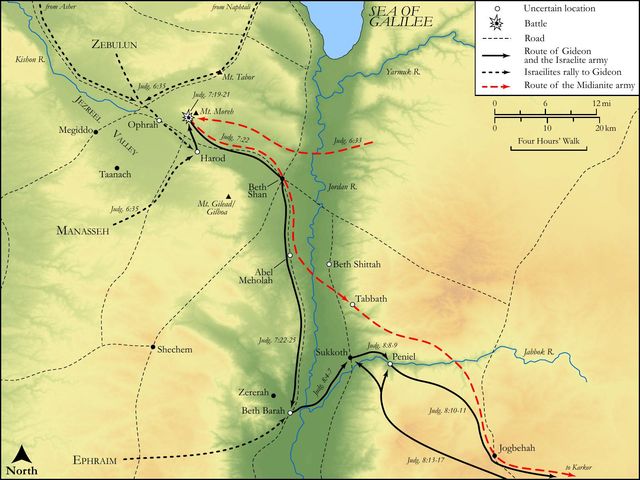
2.Two ways God took to lessen their numbers: - (1.) He ordered all that would own themselves timorous and faint-hearted to be dismissed, Jdg 7:3. They were now encamped on a mountain close to the enemy, called Mount Gilead, from Gilead, the common ancestor of these families of Manasseh, which were seated on this side Jordan (Num 26:30), and thence they might see perhaps the vast numbers of the enemy; those therefore who were disheartened at the sight were left to their liberty, to go back if they pleased. There was a law for making such a proclamation as this, Deu 20:8. But Gideon perhaps thought that concerned only those wars which were undertaken for the enlarging of their coast, not, as this, for their necessary defence against an invader; therefore Gideon would not have proclaimed this if God, who knew how his forces would hereby be diminished, had not commanded him. Cowards would be as likely as any, after the victory, to take the honour of it from God, and therefore God would not do them the honour to employ them in it. One would have thought there would be scarcely one Israelite to be found that against such an enemy as the Midianites, and under such a leader as Gideon, would own himself fearful; yet above two parts of three took advantage of this proclamation, and filed off, when they saw the strength of the enemy and their own weakness, not considering the assurances of the divine presence which their general had received of the Lord, and, it is likely, delivered unto them. Some think the oppression they had been under so long had broken their spirits, others, more probably, that consciousness of their own guilt had deprived them of their courage. Sin stared them in the face, and therefore they durst not look death in the face. Note, Fearful faint-hearted people are not fit to be employed for God; and, among those that are enlisted under the banner of Christ, there are more such than we think there are. (2.) He directed the cashiering of all that remained except 300 men, and he did it by a sign: The people are yet too many for me to make use off, Jdg 7:4. See how much God's thoughts and ways are above ours. Gideon himself, it is likely, thought they were too few, though they were as many as Barak encountered Sisera with (Jdg 4:14); and, had he not forced his way through the discouragement by dint of faith, he himself would have started back from so hazardous an enterprise, and have made the best of his own way back. But God saith, they are too many, and, when diminished to a third part, they are yet too many, which may help us to understand those providences which sometimes seem to weaken the church and its interests: its friends are too many, too mighty, too wise, for God to work deliverance by; God is taking a course to lessen them, that he may be exalted in his own strength. Gideon is ordered to bring his soldiers to the watering, probably to the well of Harod (Jdg 7:1) and the stream that ran from it; he, or some appointed by him, must observe how they drank. We must suppose they were all thirsty, and were inclined to drink; it is likely he told them they must prepare to enter upon action immediately, and therefore must refresh themselves accordingly, not expecting, after this, to drink any thing else but the blood of their enemies. Now some, and no doubt the most, would kneel down on their knees to drink, and put their mouths to the water as horses do, and so they might get their full draught. Others, it may be, would not make such a formal business of it, but as a dog laps with his tongue, a lap and away, so they would hastily take up a little water in their hands, and cool their mouths with that, and be gone. Three hundred and no more there were of this latter sort, that drank in haste, and by those God tells Gideon he would rout the Midianites, Jdg 7:7. By the former distinction none were retained but hearty men, that were resolved to do their utmost for retrieving the liberties of Israel; but by this further distinction it was provided that none should be made use of but, [1.] Men that were hardy, that could endure long fatigue, without complaining of thirst or weariness, that had not in them any dregs either of sloth or luxury. [2.] Men that were hasty, that thought it long till they were engaged with the enemy, preferring the service of God and their country before their necessary refreshment; such as these God chooses to employ, that are not only well affected, but zealously affected in a good thing. And also because these were the smaller number, and therefore the least likely to effect what they were designed for, God would by them save Israel. It was a great trial to the faith and courage of Gideon, when God bade him let all the rest of the people but these 300 go every man to his place, that is, go where they pleased out of his call, and from under his command; yet we may suppose those that were hearty in the cause, though now set aside, did not go so far out of hearing but that they were ready to follow the blow, when the 300 had broken the ice, though this does not appear. Thus strangely was Gideon's army purged, and modelled, and reduced, instead of being recruited, as one would think in so great an action it both needed and deserved to be. Now,
3.Let us see how this little despicable regiment, on which the stress of the action must lie, was accoutred and fitted out. Had these 300 been double-manned with servants and attendants, and double-armed with swords and spears, we should have thought them the more likely to bring something to pass. But, instead of making them more serviceable by their equipment, they are made less so. For,
(1.)Every soldier turns butler: They took victuals in their hands (Jdg 7:8), left their bag and baggage behind, and every man burdened himself with his own provision, which was a trial of their faith, whether they could trust God when they had no more provisions with them than they could carry, and a trial of their diligence, whether they would carry as much as they had occasion for. This was indeed living from hand to mouth.
(2.)Every soldier turns trumpeter. The regiments that were cashiered left their trumpets behind them for the use of these 300 men, who were furnished with these instead of weapons of war, as if they had been going rather to a game than to a battle.
Historical interpretation
Thirteen Centuries of Reception
2 surviving comments on this verse. Each one is dated, so this reads as a timeline rather than a list.
Select a marker to jump to its quote. Markers stagger vertically where authors wrote within a few decades of each other.
Against the Midianites, also, who, as the book of Judges relates, had filled all places like locusts, Gideon was ordered to lead a few men into battle. It was not that he did not have many in his army, but that he was forbidden to lead many into battle, lest the multitude might claim for itself some share of the victory. Hence, when he had gathered thirty thousand armed fighters, the Lord spoke thus to him: “the people with you are too many, and the Midianites shall not be given into their hands.”What happened next? He left only three hundred fighters to the man who was about to fight against countless thousands of barbarians. Indeed, he ordered the line of soldiers to be reduced to the smallest number in order that their fewness would not permit them to realize any credit from the prosecution of the divinely waged war. Why the Lord acted thus, he himself very clearly stated, saying, “lest Israel glory against me and say, ‘I am saved by my own strength.’ ” Let them hear, I say, let all the unjust and the presumptuous hear. Let all the powerful hear what God says when he says, “Lest Israel glory against me and say, ‘I am saved by my own strength.’ ”
I say, let them hear, all those who hurl blasphemies and statements contrary to the above, let them who place their hope in human beings hear these things. God says that all who presume they can be liberated by their own strength speak against him.
Lest Israel: By this we see that God will not choose for his instruments in great achievements, which depend purely on his grace, such as, through pride and self conceit, will take the glory to themselves.
Continue studying Judges 7:2 across the web’s major study libraries — every link below opens this exact verse, chapter, or book on the destination site.
Read & Compare
 BibleGatewayThis verse in more than 200 translations and 70 languages.
 Bible.comThe YouVersion reader — hundreds of translations, reading plans, and highlights.
 ESV.orgCrossway's official English Standard Version reader.
 NET BibleThe NET translation with 60,000+ translators' notes on every rendering decision.
 STEP BibleTyndale House's free study tool — original text, vocabulary, and scholarly resources.
 BibliaLogos Bible Software's free web reader.
 USCCBThe New American Bible (Revised Edition) with the U.S. bishops' study notes.
Commentaries
 BibleHub CommentariesDozens of classic commentaries on this verse, gathered on one page.
 StudyLightMore than 100 commentary sets — the largest collection on the web.
 BibleRefPlain-English commentary on what this verse means, verse by verse.
 Enduring WordDavid Guzik's free commentary on this chapter, widely used by Bible teachers.
 Bible Study ToolsVerse commentary alongside Greek and Hebrew study aids.
Original Language & Research
- BibleHub InterlinearThe verse word by word — original language, transliteration, and English.
- BibleHub LexiconEvery word's original-language definition and Strong's entry.
 Blue Letter BibleDeep-study tools — Strong's numbers, concordance, and word studies.
 SefariaThe Hebrew text with Rashi and centuries of Jewish commentary.
Sermons, Hymns & Audio


TrulyRandomVerse is not affiliated with these sites and doesn’t control their content. They’re linked because they’re genuinely useful.
Summary
Judges 7:2 articulates a foundational divine principle: God's deliberate reduction of Gideon's army from 32,000 to a mere 300 men. This seemingly counter-intuitive command was issued to prevent Israel from attributing the impending victory over the Midianites to their own strength or numerical superiority. God explicitly states that a larger force would inevitably lead to human boasting and self-glorification, thereby obscuring His sovereign hand and rightful glory in the deliverance. This pivotal moment profoundly underscores God's zealous commitment to ensuring that all praise and credit for salvation and triumph belong exclusively to Him.
Context
ShowHideLiterary Context
Judges 7:2 serves as a critical pivot point within the broader narrative of Gideon's judgeship, immediately following Israel's seven-year oppression by the Midianites and Amalekites, a direct consequence of their disobedience as detailed in Judges 6:1. Gideon, initially marked by hesitation and fear, had been divinely called and his commission repeatedly confirmed through miraculous signs, including the consumption of his offering by fire and the distinct tests of the fleece, as recorded in Judges 6:36-40. Having finally mustered a substantial army of 32,000 men to confront the overwhelming Midianite forces, later estimated at 135,000 in Judges 8:10, this verse initiates God's radical and divinely orchestrated process of reducing Gideon's forces. It meticulously sets the stage for a victory that would be undeniably supernatural, ensuring that the subsequent events described in Judges 7:3-22 would unequivocally demonstrate God's omnipotence over human might.
Historical & Cultural Context
The era of the Judges was characterized by a cyclical pattern of Israelite apostasy, divine judgment manifested as foreign oppression, the people's subsequent cries for deliverance, and God's merciful raising up of a judge to save them. The Midianites, nomadic desert tribes, had severely impoverished Israel through incessant and devastating raids, systematically destroying crops and livestock, as vividly described in Judges 6:3-6. In the warfare of that day, the size of an army was almost universally considered the primary indicator of its strength and likelihood of victory; a larger force was invariably preferred and sought after. God's command to drastically reduce Gideon's army directly challenged this deeply ingrained conventional military wisdom, subverting human expectations and cultural norms. This deliberate act served as a powerful, unforgettable object lesson for Israel, a people consistently prone to forgetting God's past deliverances and attributing successes to their own efforts or military prowess rather than to divine intervention.
Key Themes
ShowHideJudges 7:2 is replete with profound theological themes. Foremost among them is the theme of Divine Sovereignty and Power, emphasizing that true victory and salvation originate solely from God, entirely independent of human strength, numerical superiority, or strategic genius. God deliberately engineers circumstances to highlight His omnipotence and to demonstrate that His ways and thoughts are far beyond human comprehension. This leads directly to the theme of Humility and Dependence, as God intentionally diminishes Israel's visible resources to prevent them from "vaunting themselves" and attributing success to their own might, thereby fostering a spirit of absolute and unwavering reliance on Him. The explicit phrase "lest Israel vaunt themselves against me, saying, Mine own hand hath saved me" powerfully underscores God's Jealousy for His Own Glory. He unequivocally declares that He will not share His glory with anyone, a truth echoed profoundly in Isaiah 48:11. Finally, the passage champions Faith Over Sight, challenging the natural human tendency to depend on tangible resources and encouraging a profound trust in God's unseen power and provision, even when the odds appear overwhelmingly insurmountable.
Exposition and Analysis
ShowHideKey Word Analysis
ShowHideThis word (H7227) signifies not merely a large quantity but an excessive amount, particularly in a context where it would obscure God's action. God's assessment is that the 32,000 men are not just numerically significant, but are too many for His specific purpose of demonstrating undeniable divine intervention. The number itself would provide a plausible human explanation for victory, which God intends to remove, ensuring His glory is paramount.
This verb (H6286) means "to glorify oneself," "to boast," "to adorn oneself," or "to show off." It carries a strong connotation of self-exaltation, arrogance, and taking undue credit. God's concern is that if Israel won with a substantial army, they would inevitably attribute the victory to their own military prowess, thereby diminishing His rightful glory and claiming it for themselves.
This primitive word (H3027) refers to the physical hand, but is used extensively in a figurative sense to denote power, strength, means, and agency. In the phrase "Mine own hand hath saved me," "hand" represents human effort, capability, and self-reliance. It encapsulates the essence of human pride and the usurpation of God's role as the sole deliverer, a profound affront to His sovereignty.
Verse Breakdown
ShowHide"And the LORD said unto Gideon"
This opening immediately highlights divine initiative and direct, personal communication. The command originates solely from God, not from military strategy, human assessment, or Gideon's own counsel, thereby immediately setting the tone for a supernatural intervention. It underscores God's active, meticulous involvement in the affairs of His people and His precise, sovereign instructions for their deliverance.
"The people that [are] with thee [are] too many for me to give the Midianites into their hands"
This crucial clause reveals God's unique and counter-intuitive perspective on human strength. What appears to be an overwhelming advantage (a large army) is, in God's divine view, a significant hindrance to His specific purpose. The emphatic phrase "too many for me to give" underscores that the issue is not Israel's military capability, but God's unyielding intention to ensure His glory is unmistakably clear. Human numbers, if too great, would inevitably obscure the divine hand in the forthcoming victory.
"lest Israel vaunt themselves against me"
This is the core theological rationale and the primary concern behind the army's drastic reduction. God's paramount concern is the prevention of human pride, self-glorification, and arrogance. He foresees with divine omniscience that if Israel were to achieve victory with a large, seemingly capable force, they would inevitably boast and take credit for the triumph, thereby directly robbing God of the glory rightfully due to Him. The phrase "against me" signifies that such boasting is not merely a human failing but a direct, personal affront to God Himself.
"saying, Mine own hand hath saved me"
This specifies the precise nature and content of the boasting God seeks to prevent. It is the audacious claim of self-salvation or self-deliverance, attributing success, victory, or rescue to human effort, strength, wisdom, or military prowess rather than acknowledging God as the true and sole source of deliverance. This statement represents a direct challenge to God's absolute sovereignty and His exclusive right to receive all glory for His mighty, redemptive acts.
Literary Devices
ShowHideJudges 7:2 masterfully employs several potent literary devices to convey its profound theological message. Irony is prominently featured, as God declares that a large army, conventionally regarded as the ultimate source of strength and assurance in warfare, is paradoxically "too many" and thus a weakness or impediment to His divine purpose. This sets up the central paradox where human reduction leads directly to divine magnification. Anthropomorphism is present in God's statement that the numbers are "too many for me to give," attributing human-like considerations or limitations to God, though in this context, it powerfully communicates His strategic intent and meticulous planning rather than any actual divine limitation. The verse also functions as a powerful piece of Didacticism, teaching a clear, enduring, and non-negotiable lesson about divine sovereignty, the necessity of human humility, and the true nature of God-given deliverance. By explicitly stating the precise reason for the army's reduction, the text ensures that the reader grasps the profound theological principle at play. Furthermore, it serves as potent Foreshadowing, setting the stage for the miraculous and undeniable victory that follows, which will clearly demonstrate God's immeasurable power through minimal human means.
Theological and Thematic Connections
ShowHideJudges 7:2 articulates a foundational biblical truth that reverberates throughout the entirety of Scripture: God frequently chooses to work through human weakness, limited resources, and seemingly impossible odds to conspicuously demonstrate His boundless power and to ensure that all glory and praise redound exclusively to Him. This principle is not isolated to Gideon's narrative but resonates profoundly across the biblical canon, consistently challenging the human tendency to rely on visible strength, accumulated wealth, or intellectual prowess. It underscores God's unwavering and zealous commitment to His own glory, unequivocally revealing that He will not share His praise with anyone. His actions are always meticulously designed to magnify His name and to cultivate in His people an utter, unreserved dependence on Him, fostering a profound humility that recognizes His sovereign hand in every triumph and deliverance. This passage serves as a timeless, poignant reminder that true salvation and victory are never the result of human might, merit, or strategic genius, but are always a gracious, unmerited act of God, intended to prevent human boasting and to secure His rightful and supreme praise.
Reflection and Application
ShowHideJudges 7:2 offers profound and timeless guidance for believers navigating the complexities of life in a world that often values self-reliance, visible strength, and human achievement above all else. In our personal lives, our professional careers, our ministry endeavors, and indeed, our very spiritual walk, we are constantly tempted to "vaunt ourselves" or to subtly attribute success to our own efforts, talents, or accumulated resources. This verse serves as a powerful and necessary antidote to pride, urging us to recognize that any true and lasting achievement, any deliverance from overwhelming challenges, and most significantly, our very salvation, originates from God alone. When faced with seemingly insurmountable obstacles or daunting tasks, we are called not to despair over our limited resources or perceived inadequacies, but rather to embrace a deeper, more profound dependence on God's infinite power and wisdom. Like Gideon, we are invited to step back, relinquish control, and allow God to work in ways that defy human logic and conventional wisdom, thereby ensuring that when breakthroughs occur, His name alone is glorified. This requires a conscious, daily effort to cultivate humility, acknowledge God's hand in every blessing and success, and steadfastly resist the subtle, insidious allure of self-glory, remembering that our greatest strength is often found in our weakness, when it compels us to lean fully and unreservedly on Him.
Questions for Reflection
ShowHideFAQ
ShowHideWhy did God specifically say "too many for me to give..."?
ShowHideThis phrasing is crucial because it highlights God's active, sovereign role as the giver of victory and the one who meticulously orchestrates all events. It's not merely that Israel would boast, but that the large number of soldiers would obscure His hand in the deliverance. God's purpose was to demonstrate His power so clearly and undeniably that no one could reasonably attribute the victory to human strength, military strategy, or numerical superiority. The phrase "too many for me to give" emphatically conveys that the issue was not Israel's military capacity, but God's reputation and the absolute clarity of His divine intervention. He wanted the victory to be unequivocally His, ensuring His glory was supreme and unshared.
Was Gideon's initial army of 32,000 considered "large" in ancient warfare?
ShowHideRelatively speaking, 32,000 was indeed a significant force, especially when compared to the typical tribal levies that often comprised Israelite armies during the period of the Judges. However, when juxtaposed with the Midianite and Amalekite forces, which are later recorded as numbering 135,000 (see Judges 8:10), Gideon's army was already numerically at a severe disadvantage, clearly the underdog. Yet, God deemed even this "underdog" number too great for His specific, glory-exalting purpose. The critical point was not about the absolute size of the army, but about ensuring that the human element could not plausibly claim credit for such a decisive victory against overwhelming odds. God's standard for "too many" was not based on human military logic or conventional warfare principles, but solely on His divine intention to prevent human boasting and to magnify His own unparalleled power.
Does this mean God always prefers small numbers for victory?
ShowHideNot necessarily. While Judges 7:2 powerfully demonstrates God's willingness and strategic choice to work through the few and the weak to display His power and secure His glory, it does not establish a universal principle that God always prefers small numbers for victory. Throughout biblical history, God has demonstrably used both large armies (e.g., Joshua's campaigns to conquer Canaan, King David's formidable forces) and small groups or even individuals (e.g., David and Goliath, Samson's exploits) to achieve His divine purposes. The key, overarching principle here is not the numerical size itself, but rather the prevention of human pride and the assurance of divine glory. God's methods are infinitely adaptable and are always precisely tailored to His overarching goal of ensuring that He alone receives the credit and praise for salvation and victory, whether that requires strategically reducing numbers or miraculously empowering many.
Christ-Centered Fulfillment
ShowHideJudges 7:2, with its profound emphasis on God's strategic reduction of human strength and resources to secure His unshared glory, finds its ultimate and most profound fulfillment in the person and redemptive work of Jesus Christ. The entire narrative of salvation history unequivocally demonstrates that salvation is not achieved by human might, merit, or any form of self-effort, but is entirely by God's sovereign, gracious hand, precisely "lest Israel vaunt themselves against me, saying, Mine own hand hath saved me." Jesus, the eternal Son of God, willingly emptied Himself of His divine prerogatives, taking on the humble form of a servant and humbling Himself even to the ignominious death on a cross (Philippians 2:7-8). His triumphant victory over sin, death, and the grave was not achieved through military might, political power, or the mobilization of vast human armies, but through an act of ultimate, self-sacrificial weakness—a single man on a cross, seemingly defeated and utterly powerless. This divine strategy ensures that no human can ever boast in their own salvation, for it is unequivocally "by grace you have been saved through faith, and that not of yourselves; it is the gift of God, not of works, lest anyone should boast" (Ephesians 2:8-9). The cross, perceived as foolishness and weakness to the world, is in reality God's supreme power and wisdom, demonstrating that He "chose the foolish things of the world to shame the wise; God chose the weak things of the world to shame the strong" (1 Corinthians 1:27). Just as Gideon's army was dramatically reduced to highlight God's unparalleled power, so Christ's apparent weakness on the cross reveals the immeasurable, saving power of God unto salvation, ensuring that all glory belongs eternally to the Lamb of God, who alone takes away the sin of the world (John 1:29).