


Judges 7:4
Bible text: King James Version (1769 Blayney text) · Public domain
Bible text: King James Version with Strong's numbers · Public domain
Bible text: Berean Standard Bible · Public domain
Bible text: American Standard Version (1901) · Public domain
Bible text: World English Bible, Messianic edition · Public domain
Bible text: Geneva Bible (1599) · Public domain
Bible text: Young's Literal Translation · Public domain
- וַיֹּאמֶרvai·Yo·merand he saidH559Conj-w ¦ V-Qal-ConsecImperf-3msVerb Qal Consecutive Imperfect 3rd Singular Masculineוַandיֹּאמֶרhe said
- יְהוָהYah·wehYahwehH3068N-properNoun Proper Title
- אֶל'eltoH413PrepPreposition
- גִּדְעוֹןgid·'onGideonH1439N-proper-mNoun Proper Masculine
- עוֹד'OdstillH5750Adj-msAdjective Numerical Singular Masculine Absolute
- הָעָםha·'Amthe peopleH5971Art ¦ N-msNoun Singular Masculine Absoluteהָtheעָםpeople
- רָבrav[is] numerousH7227Adj-msAdjective Singular Masculine Absolute
- הוֹרֵדho·Redbring downH3381V-Hiphil-Imp-2msVerb Hiphil Imperative 2nd Singular Masculine
- אוֹתָם'o·Tam<obj.> themH853DirObjM ¦ 3mpParticle Object Indicatorאוֹתָ<obj.>םthem
- אֶל'eltoH413PrepPreposition
- הַמַּיִםha·Ma·yimthe waterH4325Art ¦ N-mpNoun Plural Masculine Absoluteהַtheמַּיִםwater
- וְאֶצְרְפֶנּוּve·'etz·re·Fe·nuso I may test itH6884Conj-w ¦ V-Qal-ConjImperf-1cs ¦ 3msVerb Qal Conjunction+Imperfect 1st Singular common genderוְsoאֶצְרְפֶI may testנּוּit
- לְךָle·Khafor <the> youPrep-l ¦ 2msSuffix Personal 2nd Singular Masculineלְfor <the>ךָyou
- שָׁםShamthereH8033AdvAdverb
- וְהָיָהve·ha·Yahand it will beH1961Conj-w ¦ V-Qal-ConsecPerf-3msVerb Qal Consecutive Perfect 3rd Singular Masculineוְandהָיָהit will be
- אֲשֶׁר'a·Sher[the one] whomH834RelParticle Relative
- אֹמַר'o·MarI will sayH559V-Qal-Imperf-1csVerb Qal Imperfect 1st Singular common gender
- אֵלֶיךָ'e·Lei·khato youH413Prep ¦ 2msPreposition Definiteאֵלֶיtoךָyou
- זֶהzehthis [one]H2088PrtParticle Demonstrative
- יֵלֵךְye·Lekhhe will goH1980V-Qal-Imperf-3msVerb Qal Imperfect 3rd Singular Masculine
- אִתָּךְ'i·Takhwith youH854Prep ¦ 2msPreposition Definiteאִתָּwithךְyou
- הוּאhu'heH1931Pro-3msPronoun Personal 3rd Singular Masculine
- יֵלֵךְye·Lekhhe will goH1980V-Qal-Imperf-3msVerb Qal Imperfect 3rd Singular Masculine
- אִתָּךְ'i·Takhwith youH854Prep ¦ 2msPreposition Definiteאִתָּwithךְyou
- וְכֹלve·Kholand everyH3605Conj-w ¦ N-msNoun Singular Masculine Absoluteוְandכֹלevery
- אֲשֶׁר'a·Sher[one] whomH834RelParticle Relative
- אֹמַר'o·MarI will sayH559V-Qal-Imperf-1csVerb Qal Imperfect 1st Singular common gender
- אֵלֶיךָ'e·Lei·khato youH413Prep ¦ 2msPreposition Definiteאֵלֶיtoךָyou
- זֶהzehthis [one]H2088PrtParticle Demonstrative
- לֹאlo'notH3808NegParticle Negative
- יֵלֵךְye·Lekhhe will goH1980V-Qal-Imperf-3msVerb Qal Imperfect 3rd Singular Masculine
- עִמָּךְ'i·Makhwith youH5973Prep ¦ 2msPreposition Definiteעִמָּwithךְyou
- הוּאhu'heH1931Pro-3msPronoun Personal 3rd Singular Masculine
- לֹאlo'notH3808NegParticle Negative
- יֵלֵךְye·Lekhhe will goH1980V-Qal-Imperf-3msVerb Qal Imperfect 3rd Singular Masculine
English is a literal word-by-word gloss of the Hebrew, not the KJV's wording. Why?
This is the original text the KJV's translators worked from — each Hebrew word with its own literal English meaning in this verse, prepared by scholars at Tyndale House, Cambridge. The KJV translates whole sentences, not word by word, so its wording differs: one Hebrew word can become several English words, and the KJV may choose “the LORD” where the gloss reads “Yahweh”. Both are faithful — they answer different questions. For the KJV's own rendering, switch to the KJV text.
Details
See on the biblical-era maps
Study this verse
Public-domain commentary
Matthew Henry
From his Commentary on the Whole Bible. Henry comments on passages, not single verses — this entry covers Judges 7:1–8. His three-level outline is real structure in the source text, so it is rendered as structure.
Here, I. Gideon applies himself with all possible care and industry to do the part of a good general, in leading on the hosts of Israel against the Midianites (Jdg 7:1): He rose up early, as one whose heart was upon his business, and who was afraid of losing time. Now that he is sure God is with him he is impatient of delay. He pitched near a famous well, that his army might not be distressed for want of water, and gained the higher ground, which possibly might be some advantage to him, for the Midianites were beneath him in the valley. Note, Faith in God's promises must not slacken, but rather quicken, our endeavours. When we are sure God goes before us, then we must bestir ourselves, Sa2 5:24.
II.God provides that the praise of the intended victory may be reserved wholly to himself, by appointing 300 men only to be employed in this service.
1.The army consisted of 32,000 men, a small army in comparison with what the Midianites had now brought into the field; Gideon was ready to think them too few, but God comes to him, and tells him they are too many, Jdg 7:2. Not but that those did well who offered themselves willingly to this expedition, but God saw fit not to make use of all that came. We often find God bringing great things to pass by a few hands, but this was the only time that he purposely made them fewer. Had Deborah lately blamed those who came not to the help of the Lord, and yet in the next great action must those be turned off that do come? Yes;
(1.)God would hereby show that when he employed suitable instruments in his service he did not need them, but could do his work without them, so that he was not indebted to them for their service, but they to him for employing them.
(2.)He would hereby put those to shame for their cowardice who had tamely submitted to the Midianites, and durst not make head against them, because of the disproportion of their numbers. They now saw that, if they had but made sure of the favour of God, one of them might have chased a thousand.
(3.)He would hereby silence and exclude boasting. This is the reason here given by him who knows the pride that is in men's hearts: Lest Israel vaunt themselves against me. Justly were those denied the honour of the success. My own hand hath saved me is a word that must never come out of the mouth of such as shall be saved. He that glories must glory in the Lord, and all flesh must be silent before him.
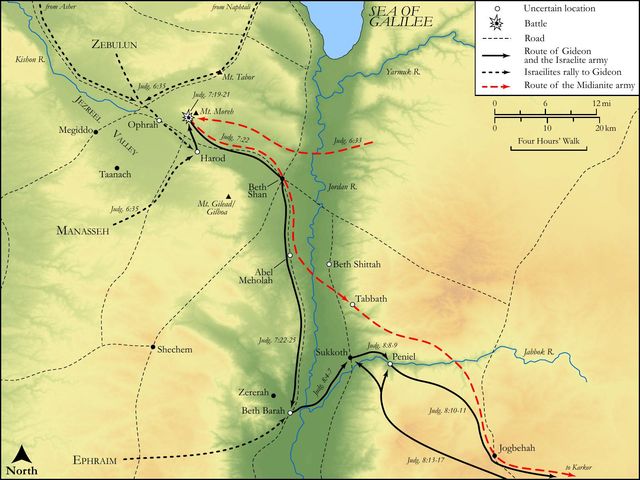
2.Two ways God took to lessen their numbers: - (1.) He ordered all that would own themselves timorous and faint-hearted to be dismissed, Jdg 7:3. They were now encamped on a mountain close to the enemy, called Mount Gilead, from Gilead, the common ancestor of these families of Manasseh, which were seated on this side Jordan (Num 26:30), and thence they might see perhaps the vast numbers of the enemy; those therefore who were disheartened at the sight were left to their liberty, to go back if they pleased. There was a law for making such a proclamation as this, Deu 20:8. But Gideon perhaps thought that concerned only those wars which were undertaken for the enlarging of their coast, not, as this, for their necessary defence against an invader; therefore Gideon would not have proclaimed this if God, who knew how his forces would hereby be diminished, had not commanded him. Cowards would be as likely as any, after the victory, to take the honour of it from God, and therefore God would not do them the honour to employ them in it. One would have thought there would be scarcely one Israelite to be found that against such an enemy as the Midianites, and under such a leader as Gideon, would own himself fearful; yet above two parts of three took advantage of this proclamation, and filed off, when they saw the strength of the enemy and their own weakness, not considering the assurances of the divine presence which their general had received of the Lord, and, it is likely, delivered unto them. Some think the oppression they had been under so long had broken their spirits, others, more probably, that consciousness of their own guilt had deprived them of their courage. Sin stared them in the face, and therefore they durst not look death in the face. Note, Fearful faint-hearted people are not fit to be employed for God; and, among those that are enlisted under the banner of Christ, there are more such than we think there are. (2.) He directed the cashiering of all that remained except 300 men, and he did it by a sign: The people are yet too many for me to make use off, Jdg 7:4. See how much God's thoughts and ways are above ours. Gideon himself, it is likely, thought they were too few, though they were as many as Barak encountered Sisera with (Jdg 4:14); and, had he not forced his way through the discouragement by dint of faith, he himself would have started back from so hazardous an enterprise, and have made the best of his own way back. But God saith, they are too many, and, when diminished to a third part, they are yet too many, which may help us to understand those providences which sometimes seem to weaken the church and its interests: its friends are too many, too mighty, too wise, for God to work deliverance by; God is taking a course to lessen them, that he may be exalted in his own strength. Gideon is ordered to bring his soldiers to the watering, probably to the well of Harod (Jdg 7:1) and the stream that ran from it; he, or some appointed by him, must observe how they drank. We must suppose they were all thirsty, and were inclined to drink; it is likely he told them they must prepare to enter upon action immediately, and therefore must refresh themselves accordingly, not expecting, after this, to drink any thing else but the blood of their enemies. Now some, and no doubt the most, would kneel down on their knees to drink, and put their mouths to the water as horses do, and so they might get their full draught. Others, it may be, would not make such a formal business of it, but as a dog laps with his tongue, a lap and away, so they would hastily take up a little water in their hands, and cool their mouths with that, and be gone. Three hundred and no more there were of this latter sort, that drank in haste, and by those God tells Gideon he would rout the Midianites, Jdg 7:7. By the former distinction none were retained but hearty men, that were resolved to do their utmost for retrieving the liberties of Israel; but by this further distinction it was provided that none should be made use of but, [1.] Men that were hardy, that could endure long fatigue, without complaining of thirst or weariness, that had not in them any dregs either of sloth or luxury. [2.] Men that were hasty, that thought it long till they were engaged with the enemy, preferring the service of God and their country before their necessary refreshment; such as these God chooses to employ, that are not only well affected, but zealously affected in a good thing. And also because these were the smaller number, and therefore the least likely to effect what they were designed for, God would by them save Israel. It was a great trial to the faith and courage of Gideon, when God bade him let all the rest of the people but these 300 go every man to his place, that is, go where they pleased out of his call, and from under his command; yet we may suppose those that were hearty in the cause, though now set aside, did not go so far out of hearing but that they were ready to follow the blow, when the 300 had broken the ice, though this does not appear. Thus strangely was Gideon's army purged, and modelled, and reduced, instead of being recruited, as one would think in so great an action it both needed and deserved to be. Now,
3.Let us see how this little despicable regiment, on which the stress of the action must lie, was accoutred and fitted out. Had these 300 been double-manned with servants and attendants, and double-armed with swords and spears, we should have thought them the more likely to bring something to pass. But, instead of making them more serviceable by their equipment, they are made less so. For,
(1.)Every soldier turns butler: They took victuals in their hands (Jdg 7:8), left their bag and baggage behind, and every man burdened himself with his own provision, which was a trial of their faith, whether they could trust God when they had no more provisions with them than they could carry, and a trial of their diligence, whether they would carry as much as they had occasion for. This was indeed living from hand to mouth.
(2.)Every soldier turns trumpeter. The regiments that were cashiered left their trumpets behind them for the use of these 300 men, who were furnished with these instead of weapons of war, as if they had been going rather to a game than to a battle.
Continue studying Judges 7:4 across the web’s major study libraries — every link below opens this exact verse, chapter, or book on the destination site.
Read & Compare
 BibleGatewayThis verse in more than 200 translations and 70 languages.
 Bible.comThe YouVersion reader — hundreds of translations, reading plans, and highlights.
 ESV.orgCrossway's official English Standard Version reader.
 NET BibleThe NET translation with 60,000+ translators' notes on every rendering decision.
 STEP BibleTyndale House's free study tool — original text, vocabulary, and scholarly resources.
 BibliaLogos Bible Software's free web reader.
 USCCBThe New American Bible (Revised Edition) with the U.S. bishops' study notes.
Commentaries
 BibleHub CommentariesDozens of classic commentaries on this verse, gathered on one page.
 StudyLightMore than 100 commentary sets — the largest collection on the web.
 BibleRefPlain-English commentary on what this verse means, verse by verse.
 Enduring WordDavid Guzik's free commentary on this chapter, widely used by Bible teachers.
 Bible Study ToolsVerse commentary alongside Greek and Hebrew study aids.
Original Language & Research
- BibleHub InterlinearThe verse word by word — original language, transliteration, and English.
- BibleHub LexiconEvery word's original-language definition and Strong's entry.
 Blue Letter BibleDeep-study tools — Strong's numbers, concordance, and word studies.
 SefariaThe Hebrew text with Rashi and centuries of Jewish commentary.
Sermons, Hymns & Audio


TrulyRandomVerse is not affiliated with these sites and doesn’t control their content. They’re linked because they’re genuinely useful.
Summary
Judges 7:4 captures a pivotal moment in Gideon's campaign against the Midianites, revealing the LORD's continued and deliberate reduction of Israel's fighting force. Even after 22,000 fearful men had departed, leaving 10,000, God declared this remaining number "yet too many." This divine pronouncement sets the stage for a unique, God-orchestrated test at the water, where the final contingent would be personally selected by the LORD. This intervention underscores God's absolute sovereignty over the battle's outcome, ensuring that the impending victory would be unequivocally attributed to His power and not to human strength or numerical superiority.
Context
ShowHideLiterary Context
This verse is a crucial turning point within the narrative of Gideon's call and military preparations, spanning Judges chapters 6 through 8. It immediately follows the initial, significant reduction of Gideon's army from 32,000 to 10,000 men, a command issued by the LORD in Judges 7:2-3 specifically to prevent Israel from claiming victory by their own strength. Judges 7:4 then introduces the second, even more unconventional, and divinely orchestrated test at the water, the details of which are elaborated in Judges 7:5-7. The subsequent narrative in Judges 7:16-25 recounts the astonishing victory of the remaining 300 men over the vast Midianite horde, serving as a dramatic fulfillment of the principle established in this verse: God's power is perfected in human weakness and dependence.
Historical & Cultural Context
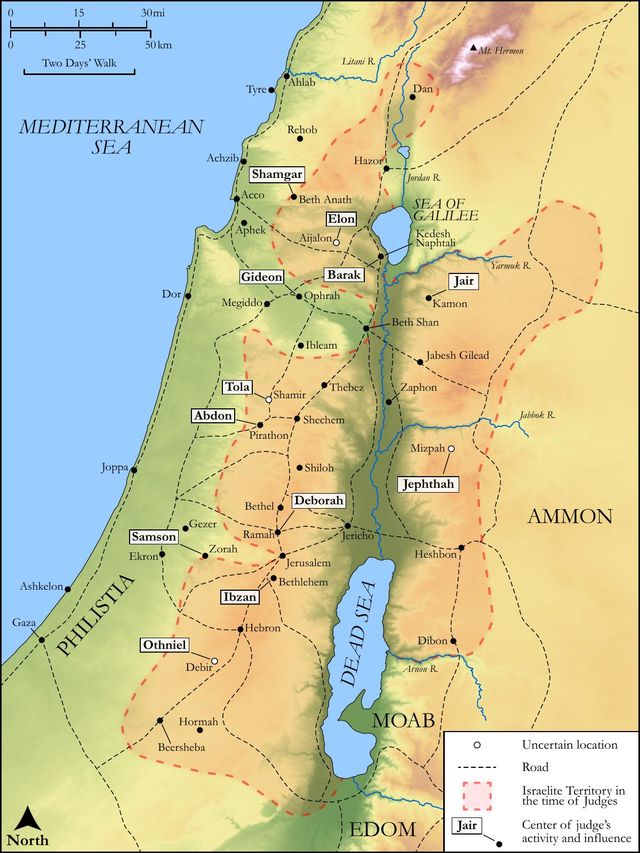
The period of the Judges (roughly 12th-11th centuries BC) was a tumultuous era for Israel, characterized by cycles of apostasy, foreign oppression, and divine deliverance through charismatic leaders. At this time, Israel was suffering under severe oppression from the Midianites, Amalekites, and "people of the East," who annually invaded their land, destroying crops and livestock, leaving the Israelites impoverished and demoralized, forcing them to hide in caves and strongholds, as described in Judges 6:1-6. In ancient warfare, military strength was almost universally measured by the size and might of an army. Therefore, God's insistence on such a minuscule fighting force was profoundly counter-cultural, strategically illogical from any human perspective, and designed to highlight His unique methodology. The setting for this test was likely near the spring of Harod, located in the strategically significant Valley of Jezreel, a common battleground, which further emphasized the daunting and humanly impossible odds Gideon faced against a numerically superior enemy.
Key Themes
ShowHideJudges 7:4 powerfully reinforces several overarching themes central to the book of Judges and the broader biblical narrative. Firstly, Divine Sovereignty and Initiative are paramount; God, not Gideon or the army, dictates the terms of engagement and the selection process. He is the ultimate strategist, ensuring His glory is magnified through the outcome. Secondly, the theme of Absolute Dependence on God is central; by drastically reducing the army, God compels Gideon and Israel to rely entirely on His supernatural intervention, rather than on their own might, wisdom, or numbers. This echoes the profound principle articulated later by the prophet Zechariah: "Not by might, nor by power, but by my spirit, saith the LORD of hosts" (Zechariah 4:6). Thirdly, God's Testing and Refinement are vividly displayed; the process at the water is not merely a selection but a divine trial designed to reveal the true character, vigilance, and readiness of the soldiers for God's specific, unconventional warfare. This divine scrutiny prepares individuals for effective service, demonstrating God's meticulous preparation of His chosen instruments.
Exposition and Analysis
ShowHideKey Word Analysis
ShowHideThe Hebrew word רַב (rab) means "abundant (in quantity, size, age, number, rank, quality)." In this context, when the LORD declares the people "yet too many," it is not a quantitative assessment of their actual numerical strength against the Midianites, but a qualitative judgment from God's perspective. The "too many" implies that their numbers still posed a significant risk for human pride to claim credit for the victory, thereby obscuring God's glory. It profoundly underscores God's unique methodology, which often operates inversely to human logic, valuing divine power and faithfulness over human abundance.
The verb צָרַף (tsâraph) signifies "to fuse (metal), i.e. refine (literally or figuratively); cast, (re-) fine(-er), founder, goldsmith, melt, pure, purge away." It is often used in the context of assaying metals to determine their purity, as seen in Psalm 66:10. Here, it indicates a rigorous, divine process of discernment and purification. God is not merely selecting based on a superficial characteristic but is actively scrutinizing the inner qualities, readiness, and perhaps even the spiritual state of the soldiers to determine who is truly fit for His specific, unconventional warfare. This testing reveals dependence, vigilance, and obedience.
The verb יָלַךְ (yâlak) means "to walk (literally or figuratively); causatively, to carry (in various senses)." Its repetition four times in the latter part of the verse ("This shall go with thee, the same shall go with thee; and of whomsoever I say unto thee, This shall not go with thee, the same shall not go") emphasizes the absolute authority and finality of God's decision. The selection is entirely divine; Gideon is merely the executor of God's explicit command. The simple act of "going" or "not going" becomes a profound act of divine election and human obedience, signifying either divine commissioning or divine dismissal.
Verse Breakdown
ShowHide"And the LORD said unto Gideon, The people [are] yet [too] many"
Even after the initial, significant reduction from 32,000 to 10,000 men (those who were fearful having departed as per Judges 7:3), the LORD reiterates that the remaining force is still too large for His divine purpose. This highlights God's unwavering commitment to ensuring that the impending victory would be undeniably His, preventing any human claim to glory or self-sufficiency.
"bring them down unto the water, and I will try them for thee there"
God commands Gideon to lead the men to a specific location—a water source, likely the spring of Harod. Crucially, God states, "I will try them," indicating that the test is not Gideon's to devise or execute, but God's own. This emphasizes God's active, personal involvement in the selection process, acting as the divine refiner to discern the true character, vigilance, and suitability of each man for the unique task ahead.
"and it shall be, [that] of whom I say unto thee, This shall go with thee, the same shall go with thee"
This clause establishes the absolute authority and specificity of God's pronouncement. The selection is entirely God's prerogative, communicated directly to Gideon. Those whom God designates to "go with" Gideon will indeed accompany him into battle, signifying divine approval, commissioning, and enablement for the task. The repetition of "shall go with thee" underscores the certainty and finality of God's choice.
"and of whomsoever I say unto thee, This shall not go with thee, the same shall not go"
Conversely, this clause reinforces the divine exclusion and dismissal. Those whom God determines are not to "go with" Gideon will be dismissed from the army. This demonstrates God's sovereign right to choose His instruments according to His own unique criteria, which often defy human logic or conventional military wisdom. The repetition of "shall not go" similarly emphasizes the certainty of their dismissal, leaving no room for human negotiation.
Literary Devices
ShowHideJudges 7:4 employs several potent literary devices to convey its profound theological message. Divine Command is central, as the LORD directly instructs Gideon, emphasizing His absolute authority and initiative in the unfolding events. The striking Repetition of "This shall go with thee, the same shall go with thee" and "This shall not go with thee, the same shall not go" serves to underscore the absolute certainty and finality of God's selection process, leaving no room for human appeal or doubt regarding the divine decree. This repetition also creates a strong sense of Parallelism between the chosen and the dismissed, emphasizing the clear, divinely mandated distinction. Furthermore, the statement that the army is "yet too many" after a significant reduction from 32,000 to 10,000 functions as powerful Irony from a human military perspective. A smaller force would typically be considered a severe disadvantage against a vast enemy. This irony highlights God's unconventional methods and His intention to work through apparent weakness to demonstrate His strength, a recurring motif throughout biblical narrative.
Theological and Thematic Connections
ShowHideJudges 7:4 is a profound theological statement on God's sovereignty, His unique methods, and His desire for His people's complete dependence. It powerfully illustrates that divine victory is not achieved through human strength, numerical superiority, or conventional military might, but through God's power working through chosen, often seemingly inadequate, instruments. This principle fundamentally counters human tendencies to rely on visible resources, impressive numbers, or self-sufficiency, and instead encourages radical trust in God's unseen hand and unconventional strategies. God's testing process here is not to gain information He doesn't already possess, but to reveal the hearts of the men and to further impress upon Gideon and all Israel that the battle belongs to the LORD alone. This concept of God deliberately choosing the weak, the few, or the seemingly foolish to accomplish His purposes is a recurring and foundational theme throughout Scripture, ensuring that all glory redounds to Him alone.
Reflection and Application
ShowHideJudges 7:4 offers a timeless and profoundly relevant lesson for believers navigating life's challenges and pursuing God's purposes in a world that often values size, strength, and impressive numbers. This verse serves as a powerful reminder that God's economy operates on principles fundamentally different from human logic. We are frequently tempted to rely on our own resources, intellect, perceived capabilities, or to feel inadequate when our resources seem insufficient for the task at hand. However, God intentionally orchestrates situations where our human limitations are exposed, not to discourage us, but to create undeniable space for His power to be gloriously demonstrated. This passage calls us to surrender our preconceived notions of what is "enough" or "necessary" and to courageously embrace God's often counter-intuitive strategies. It challenges us to trust that God can accomplish mighty things through a consecrated few, through seemingly weak means, or through processes that refine our character and deepen our dependence on Him. Our primary role is not to amass strength or numbers, but to be available for God's testing, to obey His specific and sometimes perplexing instructions, and to recognize that true victory comes solely from His hand.
Questions for Reflection
ShowHideFAQ
ShowHideWhy did God keep reducing the army, even after the fearful ones left?
ShowHideGod's primary and explicitly stated reason for continually reducing Gideon's army, as articulated in Judges 7:2, was to prevent Israel from boasting that they had saved themselves by their own strength. If 32,000, or even 10,000, men had defeated the vast Midianite army, Israel might have attributed the victory to their military prowess, numerical superiority, or strategic genius. By reducing the force to a mere 300 men, God ensured that the victory would be undeniably miraculous and solely attributable to His divine power. This drastic reduction served as a profound theological lesson in divine sovereignty, human humility, and complete dependence on God, magnifying His glory above all else.
Christ-Centered Fulfillment
ShowHideJudges 7:4, with its profound emphasis on God's deliberate choice of the few and the weak to accomplish His purposes, powerfully foreshadows the work of Christ and the counter-intuitive nature of His kingdom. Just as God chose a small, seemingly inadequate army to defeat a mighty foe, so too did God choose the "weakness" of the cross and the "foolishness" of the gospel to conquer sin, death, and the powers of darkness (1 Corinthians 1:23-25). Jesus, the ultimate Lamb of God, came not with legions of angels or worldly power, but as a humble servant, relying entirely on the Father's will and power, even to the point of death on a cross (Philippians 2:6-8). His earthly ministry began with a small band of twelve disciples, not a vast movement, demonstrating that God builds His kingdom not through human might, worldly influence, or impressive numbers, but through the Spirit's power working through humble, obedient, and often seemingly insignificant instruments (Acts 1:8). The church, as Christ's body, continues this divine pattern, called to rely on God's strength for spiritual warfare, knowing experientially that "my grace is sufficient for thee: for my strength is made perfect in weakness" (2 Corinthians 12:9). The ultimate victory is always the LORD's, secured by the Lamb who was slain, ensuring all glory belongs to Him alone, now and forever (Revelation 5:12-13).