


Judges 6:5
Bible text: King James Version (1769 Blayney text) · Public domain
Bible text: King James Version with Strong's numbers · Public domain
Bible text: Berean Standard Bible · Public domain
Bible text: American Standard Version (1901) · Public domain
Bible text: World English Bible, Messianic edition · Public domain
Bible text: Geneva Bible (1599) · Public domain
Bible text: Young's Literal Translation · Public domain
- כִּיkiforH3588PrtParticle Conditional
- הֵםhemtheyH1992Pro-3mpPronoun Personal 3rd Plural Masculine
- וּמִקְנֵיהֶםu·mik·nei·Hemand their livestockH4735Conj-w ¦ N-msc ¦ 3mpNoun Singular Masculine Constructוּandמִקְנֵיlivestockהֶםtheir
- יַעֲלוּya·'a·Luthey came upH5927V-Qal-Imperf-3mpVerb Qal Imperfect 3rd Plural Masculine
- וְאָהֳלֵיהֶםve·'o·ho·lei·Hemand their tentsH168Conj-w ¦ N-mpc ¦ 3mpNoun Plural Masculine Constructוְandאָהֳלֵיtentsהֶםtheir
- וּבָאוּvu·ba'uand they cameH935Conj-w ¦ V-Qal-ConsecPerf-3cpVerb Qal Consecutive Perfect 3rd Plural common genderוּandבָאוּthey came
- כְדֵיkhe·deiaccording to [the] abundance ofH1767Prep-k ¦ N-mscNoun Singular Masculine Constructכְaccording toדֵי[the] abundance of
- אַרְבֶּה'ar·Behlocust[s]H697N-msNoun Singular Masculine Absolute
- לָרֹבla·Rofor multitudeH7230Prep-l ¦ N-msNoun Singular Masculine Absoluteלָforרֹבmultitude
- וְלָהֶםve·la·Hemand [belonged] to themConj-w ¦ Prep-l ¦ 3mpSuffix Personal 3rd Plural Masculineוְandלָ[belonged] toהֶםthem
- וְלִגְמַלֵּיהֶםve·lig·ma·lei·Hemand to their camelsH1581Conj-w ¦ Prep-l ¦ N-mpc ¦ 3mpNoun Plural Masculine Constructוְandלִtoגְמַלֵּיcamelsהֶםtheir
- אֵין'einnotH369N-mscNoun Singular Masculine Construct
- מִסְפָּרmis·ParnumberH4557N-msNoun Singular Masculine Absolute
- וַיָּבֹאוּvai·ya·Vo·'uand they cameH935Conj-w ¦ V-Qal-ConsecImperf-3mpVerb Qal Consecutive Imperfect 3rd Plural Masculineוַandיָּבֹאוּthey came
- בָאָרֶץva·'A·retzin the landH776Prep-b ¦ N-fsNoun Singular Feminine Absoluteבָin theאָרֶץland
- לְשַׁחֲתָהּle·sha·cha·Tahto destroy itH7843Prep-l ¦ V-Piel-Inf ¦ 3fsVerb Piel Infinitive Constructלְtoשַׁחֲתָdestroyהּit
English is a literal word-by-word gloss of the Hebrew, not the KJV's wording. Why?
This is the original text the KJV's translators worked from — each Hebrew word with its own literal English meaning in this verse, prepared by scholars at Tyndale House, Cambridge. The KJV translates whole sentences, not word by word, so its wording differs: one Hebrew word can become several English words, and the KJV may choose “the LORD” where the gloss reads “Yahweh”. Both are faithful — they answer different questions. For the KJV's own rendering, switch to the KJV text.
Details
See on the biblical-era maps
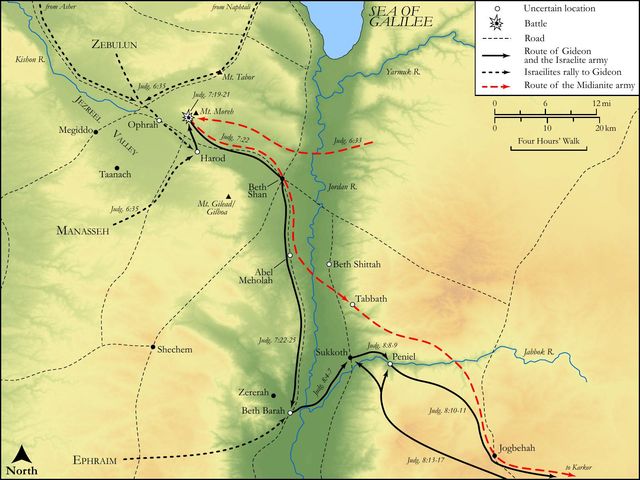
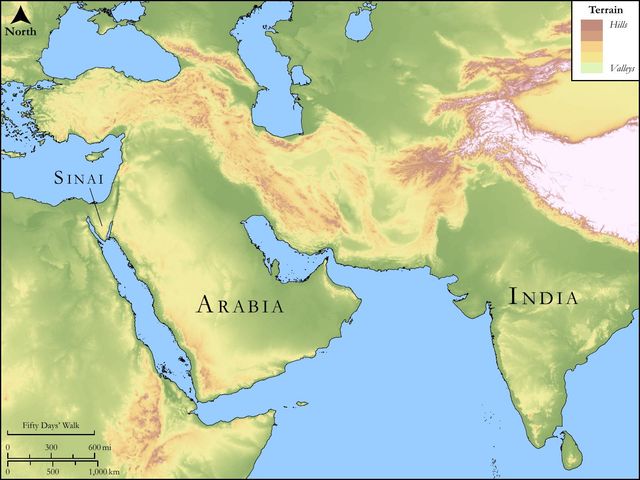
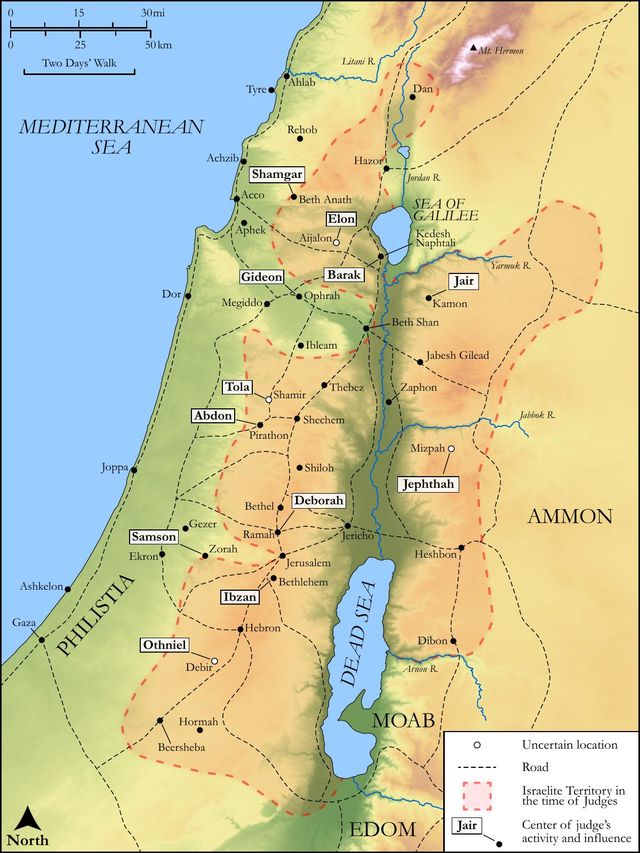
Study this verse
Public-domain commentary
Matthew Henry
From his Commentary on the Whole Bible. Henry comments on passages, not single verses — this entry covers Judges 6:1–6. His four-level outline is real structure in the source text, so it is rendered as structure.
We have here, I. Israel's sin renewed: They did evil in the sight of the Lord, Jdg 6:1. The burnt child dreads the fire; yet this perverse unthinking people, that had so often smarted sorely for their idolatry, upon a little respite of God's judgments return to it again. This people hath a revolting rebellious heart, not kept in awe by the terror of God's judgments, nor engaged in honour and gratitude by the great things he had done for them to keep themselves in his love. The providence of God will not change the hearts and lives of sinners.
II.Israel's troubles repeated.
This would follow of course; let all that sin expect to suffer; let all that return to folly expect to return to misery. With the froward God will show himself froward (Psa 18:26), and will walk contrary to those that walk contrary to him, Lev 26:21, Lev 26:24. Now as to this trouble,
1.It arose from a very despicable enemy. God delivered them into the hand of Midian (Jdg 6:1), not Midian in the south where Jethro lived, but Midian in the east that joined to Moab (Num 22:4), a people that all men despised as uncultivated and unintelligent; hence we read not here of any king, lord, or general, that they had, but the force with which they destroyed Israel was an undisciplined mob; and, which made it the more grievous, they were a people that Israel had formerly subdued, and in a manner destroyed (see Num 31:7), and yet by this time (nearly 200 years after) the poor remains of them were so multiplied, and so magnified, that they were capable of being made a very severe scourge to Israel. Thus God moved them to jealousy with those who were not a people, even a foolish nation, Deu 32:21. The meanest creature will serve to chastise those that have made the great Creator their enemy. And, when those we are authorized to rule prove rebellious and disobedient to us, it concerns us to enquire whether we have not been so to our sovereign Ruler.
2.It arose to a very formidable height (Jdg 6:2): The hand of Midian prevailed, purely by their multitude. God had promised to increase Israel as the sand on the sea shore; but their sin stopped their growth and diminished them, and then their enemies, though otherwise every way inferior to them, overpowered them with numbers. They came upon them as grasshoppers for multitude (Jdg 6:5), not in a regular army to engage them in the field, but in a confused swarm to plunder the country, quarter themselves upon it, and enrich themselves with its spoils - bands of robbers, and no better. And sinful Israel, being separated by sin from God, had not spirit to make head against them. Observe the wretched havoc that these Midianites made with their bands of plunderers in Israel. Here we have,
(1.)The Israelites imprisoned, or rather imprisoning themselves, in dens and caves, Jdg 6:2. This was owing purely to their own timorousness and faint-heartedness, that they would rather fly than fight; it was the effect of a guilty conscience, which made them tremble at the shaking of a leaf, and the just punishment of their apostasy from God, who thus fought against them with those very terrors with which he would otherwise have fought for them. Had it not been for this, we cannot but think Israel a match for the Midianites, and able enough to make head against them; but the heart that departs from God is lost, not only to that which is good, but to that which is great. Sin dispirits men, and makes them sneak into dens and caves. The day will come when chief captains and mighty men will call in vain to rocks and mountains to hide them.
(2.)The Israelites impoverished, greatly impoverished, Jdg 6:6. The Midianites and the other children of the east that joined with them to live by spoil and rapine (as long before the Sabeans and Chaldeans did that plundered Job, free-booters) made frequent incursions into the land of Canaan. This fruitful land was a great temptation to them; and the sloth and luxury into which the Israelites had sunk by forty years' rest made them and their substance an easy prey to them. They came up against them (Jdg 6:3), pitched their camps among them (Jdg 6:4), and brought their cattle with them, particularly camels innumerable (Jdg 6:5), not a flying party to make a sally upon them and be gone presently, but they resolved to force their way, and penetrated through the heart of the country as far as Gaza on the western side, Jdg 6:4. They let the Israelites alone to sow their ground, but towards harvest they came and seized all, and ate up and destroyed it, both grass and corn, and when they went away took with them the sheep and oxen, so that in short they left no sustenance for Israel, except what was privately taken by the rightful owners into the dens and caves. Now here we may see,
[1.]The justice of God in the punishment of their sin. They had neglected to honour God with their substance in tithes and offerings, and had prepared that for Baal with which God should have been served, and now God justly sends an enemy to take it away in the season thereof, Hos 2:8, Hos 2:9.
[2.]The consequence of God's departure from a people; when he goes all good goes and all mischiefs break in. When Israel kept in with God, they reaped what others sowed (Jos 24:13; Psa 105:44); but now that God had forsaken them others reaped what they sowed. Let us take occasion from this to bless God for our national peace and tranquillity, that we eat the labour of our hands.
III.Israel's sense of God's hand revived at last.
Seven years, year after year, did the Midianites make these inroads upon them, each we may suppose worse than the other (Jdg 6:1), until at last, all other succours failing, Israel cried unto the Lord (Jdg 6:6), for crying to Baal ruined them, and would not help them. When God judges he will overcome; and sinners shall be made either to bend or break before him.
Continue studying Judges 6:5 across the web’s major study libraries — every link below opens this exact verse, chapter, or book on the destination site.
Read & Compare
 BibleGatewayThis verse in more than 200 translations and 70 languages.
 Bible.comThe YouVersion reader — hundreds of translations, reading plans, and highlights.
 ESV.orgCrossway's official English Standard Version reader.
 NET BibleThe NET translation with 60,000+ translators' notes on every rendering decision.
 STEP BibleTyndale House's free study tool — original text, vocabulary, and scholarly resources.
 BibliaLogos Bible Software's free web reader.
 USCCBThe New American Bible (Revised Edition) with the U.S. bishops' study notes.
Commentaries
 BibleHub CommentariesDozens of classic commentaries on this verse, gathered on one page.
 StudyLightMore than 100 commentary sets — the largest collection on the web.
 BibleRefPlain-English commentary on what this verse means, verse by verse.
 Enduring WordDavid Guzik's free commentary on this chapter, widely used by Bible teachers.
 Bible Study ToolsVerse commentary alongside Greek and Hebrew study aids.
Original Language & Research
- BibleHub InterlinearThe verse word by word — original language, transliteration, and English.
- BibleHub LexiconEvery word's original-language definition and Strong's entry.
 Blue Letter BibleDeep-study tools — Strong's numbers, concordance, and word studies.
 SefariaThe Hebrew text with Rashi and centuries of Jewish commentary.
Sermons, Hymns & Audio


TrulyRandomVerse is not affiliated with these sites and doesn’t control their content. They’re linked because they’re genuinely useful.
Summary
Judges 6:5 vividly portrays the overwhelming and destructive invasion faced by Israel at the hands of the Midianites and their allies. This verse paints a dire picture of an innumerable horde, likened to a plague of locusts, arriving with their entire nomadic encampment of cattle and tents, not merely to raid but with the explicit intent to systematically devastate the land and its resources. It underscores the profound depth of Israel's distress and vulnerability, setting the stage for divine intervention.
Context
ShowHideLiterary Context
Judges 6:5 is situated within the cyclical narrative of the Book of Judges, which consistently depicts Israel's descent into idolatry, followed by divine judgment in the form of foreign oppression, leading to the people's cry for deliverance, and finally, God raising up a judge. The preceding verses Judges 6:1-4 establish the seven-year period of Midianite oppression as a direct consequence of Israel's turning away from the Lord. This specific verse intensifies the description of the invaders, detailing their sheer numbers and destructive purpose, thereby emphasizing the desperate situation from which God would eventually deliver His people through Gideon, whose call begins later in Judges 6:11. The overwhelming nature of this invasion serves to highlight Israel's utter helplessness apart from divine intervention, a recurring motif throughout the book that prepares the reader for God's miraculous deliverance.
Historical & Cultural Context
The Midianites, Amalekites, and "children of the east" Judges 6:3 were nomadic desert tribes. Their mode of warfare involved annual incursions during harvest season, bringing their entire encampments—"their cattle and their tents"—into the fertile agricultural lands of Israel. This was not merely a quick raid for plunder but a prolonged, systematic occupation and destruction of the land's produce and livestock. The mention of "camels" is significant, as these animals provided a distinct military advantage, allowing rapid movement across vast distances and the capacity to carry immense loads, making them formidable instruments of economic devastation against an agrarian society. Their strategy was to leave "no sustenance for Israel, neither sheep, nor ox, nor donkey" Judges 6:4, forcing the Israelites into hiding in "dens which are in the mountains, and caves, and strongholds" Judges 6:2.
Key Themes
ShowHideThis verse powerfully contributes to several key themes within Judges and the broader biblical narrative. Firstly, it highlights the overwhelming nature of divine judgment as a consequence of covenant disobedience, demonstrating how God can use seemingly insurmountable external forces to bring His people to repentance, as forewarned in Deuteronomy 28:15 and subsequent verses. Secondly, it underscores Israel's utter helplessness and desperation, emphasizing that their deliverance could only come from God, as human efforts were clearly insufficient against such a vast and destructive foe. The invaders' intent "to destroy it" points to the theme of economic devastation and famine, illustrating the severe material consequences of spiritual apostasy and the systematic dismantling of Israel's ability to sustain itself, driving them to extreme poverty and dependence. This dire situation sets the stage for God to demonstrate His power and faithfulness, even when His people are at their lowest point.
Exposition and Analysis
ShowHideKey Word Analysis
ShowHideThis term literally refers to a "locust" or "swarm of locusts" (H697). The choice of this word is incredibly potent, as locusts were a well-known ancient plague, capable of stripping a land bare of all vegetation in a short period. By comparing the Midianite invaders to locusts, the text conveys not only their immense, uncountable numbers but also their insatiable, consuming, and utterly destructive nature. It evokes a sense of unstoppable natural disaster, highlighting the complete devastation they wrought upon the land of Israel.
This primitive root (H7843) means "to decay, i.e., ruin (literally or figuratively); batter, corrupt, destroy, lose, mar, perish, spill, spoil, waste." The use of this strong verb reveals the Midianites' explicit and comprehensive intent. Their purpose was not merely to raid for sustenance or plunder, but to systematically lay waste to the land, its crops, and its capacity to sustain life. This highlights the severity of the oppression and the dire economic and existential threat faced by the Israelites, driving them to the brink of starvation and despair.
Verse Breakdown
ShowHide"For they came up with their cattle and their tents"
This clause describes the comprehensive and persistent nature of the Midianite invasion. It indicates that these were not mere raiding parties but entire nomadic clans, bringing their livestock (H4735, miqneh) and their temporary dwellings (H168, ʼôhel). This signifies a prolonged, systematic occupation rather than a quick hit-and-run, implying their intent to settle in the fertile lands during harvest season, consuming and destroying the produce of the Israelites as they went.
"and they came as grasshoppers for multitude"
This vivid simile powerfully illustrates the sheer numerical superiority of the invading forces. The comparison to "grasshoppers" (locusts, H697, 'arbeh) emphasizes their vast, uncountable numbers, their swarming movement, and the devastating, all-consuming effect they had on the land, akin to a natural plague that leaves nothing behind.
"for both they and their camels were without number"
This phrase further reinforces the previous simile, explicitly stating the immensity of the invading army and their crucial mode of transport. The inclusion of "camels" (H1581, gâmâl) is significant, as these animals allowed the Midianites to traverse vast desert distances, carry immense loads of plunder, and provided a tactical advantage in raiding. Their "countless" number (H4557, miçpâr for "number") emphasizes the overwhelming scale of the invasion, making any direct military confrontation by Israel seem impossible and instilling profound fear.
"and they entered into the land to destroy it"
This final clause explicitly states the destructive intent of the invaders. Their purpose was not merely to raid for sustenance or plunder, but to systematically lay waste to the land (H776, ʼerets), its crops, and its capacity to sustain life (H7843, shâchath). This highlights the severity of the oppression and the dire economic and existential threat faced by the Israelites, driving them to the brink of starvation and despair.
Literary Devices
ShowHideJudges 6:5 employs several powerful literary devices to convey the magnitude of Israel's oppression. The most prominent is Simile, evident in the phrase "they came as grasshoppers for multitude." This comparison to locusts vividly paints a picture of an overwhelming, consuming, and unstoppable force, evoking the imagery of a natural disaster that strips the land bare. Coupled with this is Hyperbole, particularly in the phrase "without number," which exaggerates the actual count to emphasize the truly countless nature of the invaders and their camels, thereby stressing the seemingly insurmountable odds faced by Israel. The verse also utilizes potent Imagery, creating a mental picture of a vast, moving horde, complete with their tents and livestock, descending upon the land with destructive intent. This combination of devices effectively communicates the utter desperation of Israel's situation and the immense scale of the threat, underscoring the profound need for divine intervention.
Theological and Thematic Connections
ShowHideJudges 6:5 serves as a profound theological statement on the consequences of covenant disobedience and the nature of divine judgment. The overwhelming oppression described is not merely a random historical event but a direct result of Israel's persistent idolatry and turning away from the Lord, fulfilling the curses outlined in the Mosaic Covenant. This verse illustrates God's sovereignty, even in allowing such devastating circumstances, using foreign nations as instruments of His righteous discipline to humble His people and draw them back to Himself. It underscores the principle that when a people forsakes their covenant with God, they become vulnerable to the very forces they once overcame, highlighting their utter dependence on divine intervention when human resources and strength are exhausted. The imagery of an innumerable, destructive foe also points to the broader biblical theme of humanity's helplessness against overwhelming spiritual forces without God's redemptive power.
Reflection and Application
ShowHideJudges 6:5, while detailing a historical event, resonates deeply with the human experience of feeling overwhelmed and helpless. Just as the Midianites came "as grasshoppers for multitude" and "without number," we often face situations in life—be they financial crises, health struggles, relational breakdowns, or spiritual attacks—that feel insurmountable, vast, and utterly destructive to our peace and well-being. This verse reminds us that sometimes, our "overwhelm" is a consequence of straying from God's path, a form of divine discipline designed to bring us to a place of desperate dependence on Him. However, it also offers profound hope: when human strength is exhausted and all appears lost, it is precisely then that God is poised to demonstrate His power. Our response should be to humble ourselves, acknowledge our helplessness, and cry out to the Lord, trusting that His power to deliver is infinitely greater than any "countless" foe or "destructive" circumstance we may face. It calls us to examine if our current struggles are a result of spiritual drift and to return to the Lord with full repentance and trust, knowing He is faithful to deliver.
Questions for Reflection
ShowHideFAQ
ShowHideWhy did God allow such severe oppression to happen to Israel?
ShowHideGod allowed this severe oppression as a direct consequence of Israel's repeated disobedience and idolatry. The Book of Judges consistently illustrates a cycle where Israel turns away from God to worship other deities, leading God to "sell them into the hand" of their enemies as a form of discipline Judges 6:1. This was not arbitrary punishment but a means to humble His people, remind them of their covenant obligations, and ultimately draw them back to Himself in repentance and dependence. The severity of the oppression, as described in Judges 6:5, was intended to be so overwhelming that Israel would have no recourse but to cry out to the Lord for deliverance.
What is the significance of the "grasshoppers" and "camels" in this verse?
ShowHideThe "grasshoppers" (locusts) are a powerful simile emphasizing the sheer, uncountable multitude of the invading forces. Just as a locust plague completely devours crops and leaves nothing behind, the Midianites and their allies were an unstoppable, consuming force that stripped the land of Israel bare, leading to widespread famine and destitution. The "camels" are significant because they were the primary means of transport for these nomadic desert tribes. Their presence "without number" highlights not only the vastness of the invading army but also their unique military and logistical advantage. Camels allowed them to traverse arid regions, carry immense amounts of plunder, and conduct prolonged, systematic raids on agricultural communities, making them uniquely effective instruments of economic devastation against Israel, as described in Judges 6:4.
Christ-Centered Fulfillment
ShowHideThe overwhelming oppression described in Judges 6:5, with its imagery of an innumerable, destructive foe laying waste to the land, powerfully foreshadows humanity's spiritual bondage to sin and death. Just as Israel faced an enemy "without number" that they could not overcome by their own strength, so too is humanity helpless against the pervasive power of sin and the ultimate enemy, death. This spiritual "devastation" leaves humanity impoverished and without hope, much like Israel hiding in caves. However, just as God raised up Gideon as a deliverer for His people from the Midianites, He ultimately sent His Son, Jesus Christ, as the true and ultimate Deliverer from the overwhelming power of sin and death. Jesus, through His sacrificial death and resurrection, disarmed the spiritual forces of evil and triumphed over them Colossians 2:13-15, freeing those who were held in slavery by their fear of death Hebrews 2:14-15. He offers true rest and freedom from the spiritual burdens that feel "without number," inviting all who are weary and burdened to find rest in Him Matthew 11:28. Thus, the desperate need for a deliverer from an overwhelming foe in Judges 6:5 finds its ultimate and perfect fulfillment in the person and work of Jesus Christ, who sets us truly free John 8:36.