


Judges 6:6
- וַיִּדַּלvai·yi·Daland it became lowH1809Conj-w ¦ V-Qal-ConsecImperf-3msVerb Qal Consecutive Imperfect 3rd Singular Masculineוַandיִּדַּלit became low
- יִשְׂרָאֵלYis·ra·'ElIsraelH3478N-properNoun Proper Location
- מְאֹדme·'OdveryH3966Adj-msAdjective Numerical Singular Masculine Absolute
- מִפְּנֵיmi·pe·Nei<from> because ofH6440Prep-m ¦ N-mpcNoun Plural Masculine Constructמִ<from>פְּנֵיbecause of
- מִדְיָןmid·YanMidianH4080N-properNoun Proper Location
- וַיִּזְעֲקוּvai·yiz·'a·Kuand they cried outH2199Conj-w ¦ V-Qal-ConsecImperf-3mpVerb Qal Consecutive Imperfect 3rd Plural Masculineוַandיִּזְעֲקוּthey cried out
- בְנֵיve·nei[the] people ofH1121N-mpcNoun Plural Masculine Construct
- יִשְׂרָאֵלYis·ra·'ElIsraelH3478N-properNoun Proper Location
- אֶל'eltoH413PrepPreposition
- יְהוָהYah·wehYahwehH3068N-properNoun Proper Title
English is a literal word-by-word gloss of the Hebrew, not the KJV's wording. Why?
This is the original text the KJV's translators worked from — each Hebrew word with its own literal English meaning in this verse, prepared by scholars at Tyndale House, Cambridge. The KJV translates whole sentences, not word by word, so its wording differs: one Hebrew word can become several English words, and the KJV may choose “the LORD” where the gloss reads “Yahweh”. Both are faithful — they answer different questions. For the KJV's own rendering, switch to the KJV text.
Details
See on the biblical-era map
Study this verse
Public-domain commentary
Matthew Henry
From his Commentary on the Whole Bible. Henry comments on passages, not single verses — this entry covers Judges 6:1–6. His four-level outline is real structure in the source text, so it is rendered as structure.
We have here, I. Israel's sin renewed: They did evil in the sight of the Lord, Jdg 6:1. The burnt child dreads the fire; yet this perverse unthinking people, that had so often smarted sorely for their idolatry, upon a little respite of God's judgments return to it again. This people hath a revolting rebellious heart, not kept in awe by the terror of God's judgments, nor engaged in honour and gratitude by the great things he had done for them to keep themselves in his love. The providence of God will not change the hearts and lives of sinners.
II.Israel's troubles repeated.
This would follow of course; let all that sin expect to suffer; let all that return to folly expect to return to misery. With the froward God will show himself froward (Psa 18:26), and will walk contrary to those that walk contrary to him, Lev 26:21, Lev 26:24. Now as to this trouble,
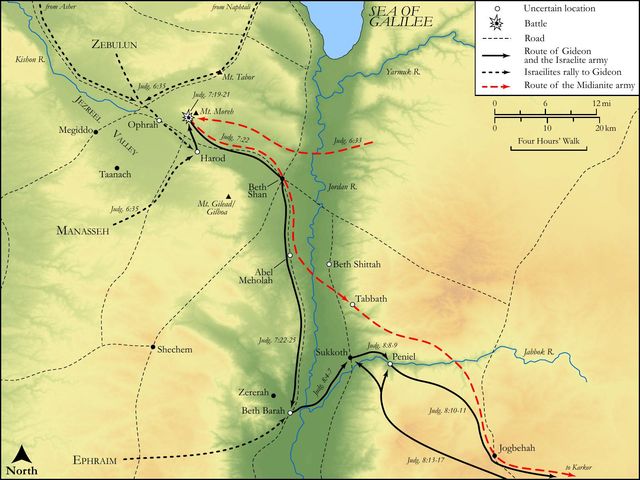
1.It arose from a very despicable enemy. God delivered them into the hand of Midian (Jdg 6:1), not Midian in the south where Jethro lived, but Midian in the east that joined to Moab (Num 22:4), a people that all men despised as uncultivated and unintelligent; hence we read not here of any king, lord, or general, that they had, but the force with which they destroyed Israel was an undisciplined mob; and, which made it the more grievous, they were a people that Israel had formerly subdued, and in a manner destroyed (see Num 31:7), and yet by this time (nearly 200 years after) the poor remains of them were so multiplied, and so magnified, that they were capable of being made a very severe scourge to Israel. Thus God moved them to jealousy with those who were not a people, even a foolish nation, Deu 32:21. The meanest creature will serve to chastise those that have made the great Creator their enemy. And, when those we are authorized to rule prove rebellious and disobedient to us, it concerns us to enquire whether we have not been so to our sovereign Ruler.
2.It arose to a very formidable height (Jdg 6:2): The hand of Midian prevailed, purely by their multitude. God had promised to increase Israel as the sand on the sea shore; but their sin stopped their growth and diminished them, and then their enemies, though otherwise every way inferior to them, overpowered them with numbers. They came upon them as grasshoppers for multitude (Jdg 6:5), not in a regular army to engage them in the field, but in a confused swarm to plunder the country, quarter themselves upon it, and enrich themselves with its spoils - bands of robbers, and no better. And sinful Israel, being separated by sin from God, had not spirit to make head against them. Observe the wretched havoc that these Midianites made with their bands of plunderers in Israel. Here we have,
(1.)The Israelites imprisoned, or rather imprisoning themselves, in dens and caves, Jdg 6:2. This was owing purely to their own timorousness and faint-heartedness, that they would rather fly than fight; it was the effect of a guilty conscience, which made them tremble at the shaking of a leaf, and the just punishment of their apostasy from God, who thus fought against them with those very terrors with which he would otherwise have fought for them. Had it not been for this, we cannot but think Israel a match for the Midianites, and able enough to make head against them; but the heart that departs from God is lost, not only to that which is good, but to that which is great. Sin dispirits men, and makes them sneak into dens and caves. The day will come when chief captains and mighty men will call in vain to rocks and mountains to hide them.
(2.)The Israelites impoverished, greatly impoverished, Jdg 6:6. The Midianites and the other children of the east that joined with them to live by spoil and rapine (as long before the Sabeans and Chaldeans did that plundered Job, free-booters) made frequent incursions into the land of Canaan. This fruitful land was a great temptation to them; and the sloth and luxury into which the Israelites had sunk by forty years' rest made them and their substance an easy prey to them. They came up against them (Jdg 6:3), pitched their camps among them (Jdg 6:4), and brought their cattle with them, particularly camels innumerable (Jdg 6:5), not a flying party to make a sally upon them and be gone presently, but they resolved to force their way, and penetrated through the heart of the country as far as Gaza on the western side, Jdg 6:4. They let the Israelites alone to sow their ground, but towards harvest they came and seized all, and ate up and destroyed it, both grass and corn, and when they went away took with them the sheep and oxen, so that in short they left no sustenance for Israel, except what was privately taken by the rightful owners into the dens and caves. Now here we may see,
[1.]The justice of God in the punishment of their sin. They had neglected to honour God with their substance in tithes and offerings, and had prepared that for Baal with which God should have been served, and now God justly sends an enemy to take it away in the season thereof, Hos 2:8, Hos 2:9.
[2.]The consequence of God's departure from a people; when he goes all good goes and all mischiefs break in. When Israel kept in with God, they reaped what others sowed (Jos 24:13; Psa 105:44); but now that God had forsaken them others reaped what they sowed. Let us take occasion from this to bless God for our national peace and tranquillity, that we eat the labour of our hands.
III.Israel's sense of God's hand revived at last.
Seven years, year after year, did the Midianites make these inroads upon them, each we may suppose worse than the other (Jdg 6:1), until at last, all other succours failing, Israel cried unto the Lord (Jdg 6:6), for crying to Baal ruined them, and would not help them. When God judges he will overcome; and sinners shall be made either to bend or break before him.
Continue studying Judges 6:6 across the web’s major study libraries — every link below opens this exact verse, chapter, or book on the destination site.
Read & Compare
 BibleGatewayThis verse in more than 200 translations and 70 languages.
 Bible.comThe YouVersion reader — hundreds of translations, reading plans, and highlights.
 ESV.orgCrossway's official English Standard Version reader.
 NET BibleThe NET translation with 60,000+ translators' notes on every rendering decision.
 STEP BibleTyndale House's free study tool — original text, vocabulary, and scholarly resources.
 BibliaLogos Bible Software's free web reader.
 USCCBThe New American Bible (Revised Edition) with the U.S. bishops' study notes.
Commentaries
 BibleHub CommentariesDozens of classic commentaries on this verse, gathered on one page.
 StudyLightMore than 100 commentary sets — the largest collection on the web.
 BibleRefPlain-English commentary on what this verse means, verse by verse.
 Enduring WordDavid Guzik's free commentary on this chapter, widely used by Bible teachers.
 Bible Study ToolsVerse commentary alongside Greek and Hebrew study aids.
Original Language & Research
- BibleHub InterlinearThe verse word by word — original language, transliteration, and English.
- BibleHub LexiconEvery word's original-language definition and Strong's entry.
 Blue Letter BibleDeep-study tools — Strong's numbers, concordance, and word studies.
 SefariaThe Hebrew text with Rashi and centuries of Jewish commentary.
Sermons, Hymns & Audio


TrulyRandomVerse is not affiliated with these sites and doesn’t control their content. They’re linked because they’re genuinely useful.
Summary
Judges 6:6 encapsulates a pivotal moment in Israel's history during the period of the Judges, depicting the nation's profound destitution and desperate turning point under severe Midianite oppression. After seven years of relentless raids that systematically stripped them of their livelihood, the Israelites reached a state of utter impoverishment, a divinely orchestrated consequence designed to break their self-reliance and idolatrous tendencies. This extreme hardship finally compelled them to abandon their false gods and, in a desperate cry for deliverance, turn back to the LORD, signaling a crucial, albeit often superficial, acknowledgment of their covenant God and setting the stage for divine intervention.
Context
ShowHideLiterary Context
Judges 6:6 is strategically placed within the well-established "cycle of Judges" that forms the structural backbone of the book. This cyclical pattern, first articulated in Judges 2:11-19, consistently unfolds as Israel's apostasy leads to divine discipline through foreign oppression, which in turn prompts Israel's desperate cry for help, followed by God raising a deliverer (a judge), and a subsequent period of peace, before the cycle inevitably repeats. Verse 6 specifically represents the "cry for help" stage, immediately following the detailed description of severe Midianite oppression in Judges 6:1-5. It serves as the narrative catalyst, highlighting the depth of Israel's suffering as the prerequisite for their turning back to Yahweh, and directly precedes the divine response through a prophet and the subsequent call of Gideon in Judges 6:7-12.
Historical & Cultural Context
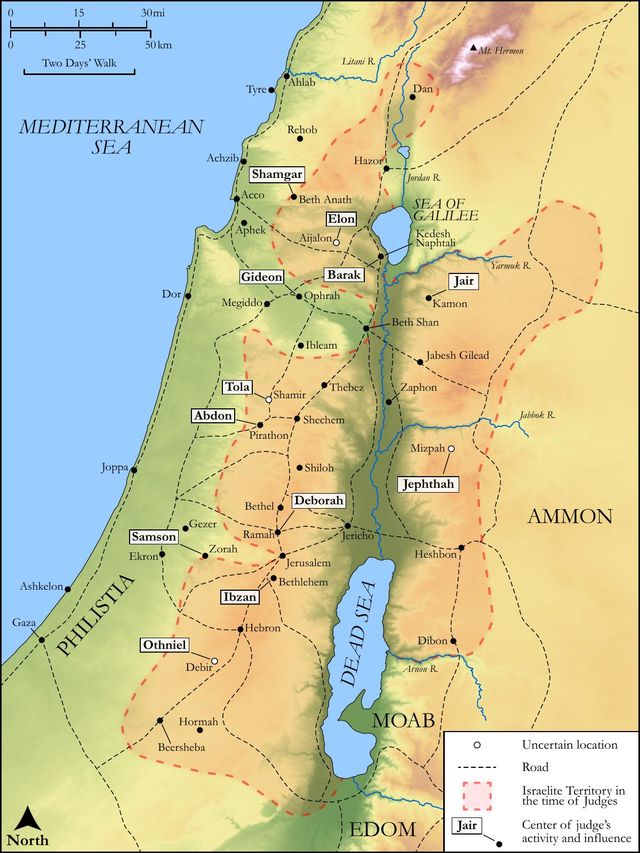
The era of the Judges (roughly 14th to 11th centuries BC) was characterized by a decentralized tribal confederacy in Canaan, lacking a unified central government or a standing army. This structural vulnerability made the Israelite tribes susceptible to predatory incursions from nomadic groups like the Midianites, Amalekites, and "children of the East," as vividly described in Judges 6:3-5. These groups were typically pastoralists who would sweep into the fertile valleys of Israel during harvest times, systematically destroying crops, livestock, and any means of sustenance. Their goal was to starve the Israelites into submission, effectively dismantling their agricultural economy. The phrase "greatly impoverished" in verse 6 thus reflects not merely economic hardship but a complete breakdown of their societal infrastructure, forcing the Israelites to seek refuge in caves and strongholds (Judges 6:2)—a stark and humiliating contrast to the promised land of abundance.
Key Themes
ShowHideThis verse powerfully underscores several foundational themes prevalent throughout the Book of Judges and the broader Old Testament narrative. Firstly, it starkly illustrates the consequences of disobedience to God's covenant, where Israel's profound suffering is presented as a direct, divinely permitted result of their idolatry and their turning away from Yahweh. Secondly, it highlights divine discipline as a means of restoration, demonstrating God's consistent use of hardship to draw His wayward people back to Himself, even when their initial motives for turning are rooted in desperation rather than genuine repentance. Thirdly, it emphasizes God's unwavering faithfulness and readiness to hear, revealing that despite Israel's repeated failures and their often-imperfect cries, God remains attentive and prepared to deliver His covenant people, foreshadowing His ultimate redemptive plan. This aligns with the repeated pattern of God's mercy seen in passages like Psalm 107:6 and Nehemiah 9:27.
Exposition and Analysis
ShowHideKey Word Analysis
ShowHideThe Hebrew verb דָּלַל (dâlal, H1809) means "to slacken or be feeble; figuratively, to be oppressed; bring low, dry up, be emptied, be not equal, fail, be impoverished, be made thin." Its use here, intensified by the adverb "greatly" (מְאֹד, mᵉʼôd, H3966), paints a vivid picture of Israel's extreme destitution. It signifies not merely a lack of resources but a complete draining of strength, vitality, and hope, leaving them utterly helpless and dependent. This state of being "brought low" is precisely what precipitates their cry to the LORD.
The Hebrew verb צָעַק (zâʻaq, H2199) is a strong, emphatic term meaning "to shriek (from anguish or danger); by analogy, (as a herald) to announce or convene publicly; assemble, call (together), (make a) cry (out), come with such a company, gather (together), cause to be proclaimed." It denotes a desperate, urgent, and often anguished outcry, typically in response to oppression, distress, or injustice. This is not a polite request or a casual prayer, but an impassioned, almost primal scream for intervention, indicating the depth of Israel's suffering and their realization that only divine power could rescue them from their dire circumstances. It is a cry of last resort, demonstrating their utter helplessness.
The phrase בְּנֵי יִשְׂרָאֵל (bên Yisrâʼêl, H1121 and H3478) literally means "sons of Israel." "Ben" (H1121) signifies "son" in a wide sense, including descendants or members of a group, while "Yisrael" (H3478) means "he will rule as God," referring to Jacob's new name and, typically, his posterity. This designation is profoundly significant as it underscores their covenantal identity. Despite their apostasy and suffering, they are still recognized as God's chosen people, reminding the reader of God's enduring covenant faithfulness even when His people are unfaithful. Their cry is thus the cry of God's own people, albeit a wayward one.
Verse Breakdown
ShowHide"And Israel was greatly impoverished because of the Midianites"
This opening clause establishes the dire economic, social, and spiritual reality of Israel. The adverb "greatly" (מְאֹד, me'od) underscores the severity and comprehensiveness of their destitution, affecting all aspects of their lives, from their crops and livestock to their very spirit. The direct cause is unequivocally attributed to "the Midianites" (מִדְיָן, Midyân, H4080), who, along with their allies, systematically plundered and destroyed Israel's agricultural output, leaving them without food, sustenance, or hope. This physical impoverishment serves as a tangible and painful consequence of their spiritual impoverishment and idolatry, a direct result of their turning away from the LORD.
"and the children of Israel cried unto the LORD"
This second clause marks the crucial turning point in the narrative cycle and in Israel's spiritual journey. The "children of Israel" (בְּנֵי יִשְׂרָאֵל, b'nei Yisra'el), a covenantal designation, indicates that despite their apostasy, they remain God's chosen people, heirs to His promises. Their "cry" (צָעַק, tsa'aq) is a desperate, anguished plea for help, born out of extreme suffering rather than necessarily deep, genuine repentance. Crucially, they cry "unto the LORD" (אֶל יְהוָה, el Yahweh, H3068), turning away from the false gods they had worshipped and acknowledging, even if only in crisis, the true God of their covenant. This act of crying out, regardless of its initial motivation, is the necessary precursor to God's intervention and deliverance, demonstrating His readiness to hear and respond to His people's distress.
Literary Devices
ShowHideJudges 6:6 effectively employs several literary devices to convey its powerful message. The overarching Cycle of Judges is profoundly evident, as this verse represents the "cry" stage, demonstrating the predictable pattern of Israel's relationship with God: apostasy, oppression, cry, and deliverance. Hyperbole is present in the phrase "greatly impoverished," emphasizing the extreme and pervasive nature of their suffering, which goes beyond mere hardship to complete destitution and despair. This exaggeration underscores the severity of God's discipline and the depth of their need, highlighting the complete collapse of their self-sufficiency. Furthermore, there is an implicit Contrast between Israel's initial state of prosperity and security in the Promised Land and their current abject poverty and vulnerability, which vividly illustrates the devastating effects of their disobedience. The verse also serves as Foreshadowing, as Israel's desperate cry sets the immediate stage for the divine response, leading directly to the prophetic word, the call of Gideon, and the subsequent deliverance, thus building narrative anticipation and reinforcing the theme of God's redemptive intervention.
Theological and Thematic Connections
ShowHideJudges 6:6 profoundly illustrates the theological principle that God, in His sovereign wisdom and covenant faithfulness, uses adversity to draw His people back to Himself. Israel's "great impoverishment" was not merely a random misfortune but a divinely permitted, indeed orchestrated, consequence of their covenant unfaithfulness and idolatrous allegiances. This severe discipline was designed to break their self-sufficiency and compel them to recognize their utter dependence on the God they had abandoned. Their desperate "cry unto the LORD" signifies a crucial moment of reorientation, acknowledging, even if out of desperation, their ultimate need for Yahweh. This recurring pattern throughout Judges reveals God's persistent love and unwavering faithfulness, demonstrating that His discipline, though painful, is always redemptive in purpose, aiming to restore fellowship, obedience, and a right relationship with His chosen people.
Reflection and Application
ShowHideJudges 6:6 offers a sobering yet profoundly hopeful mirror for contemporary believers. It reminds us that just as Israel's suffering was a direct consequence of their spiritual straying and idolatry, our own hardships can often be God's loving, albeit painful, means of drawing us closer to Him. When our own resources fail, when we feel "greatly impoverished" in spirit, finances, relationships, or health, it is precisely then that we are most likely to abandon our self-reliance and turn to the only true source of help. This verse challenges us to honestly consider the nature of our prayers: are they merely a last resort born of desperation, or do they flow from a consistent, devoted relationship with God? Regardless of the initial motive, God hears the cries of His people and is always ready to respond with mercy and deliverance. He invites us to a deeper, more authentic dependence on Him in all circumstances, not just in moments of crisis, trusting that His discipline, like His deliverance, is always for our ultimate good and His glory.
Questions for Reflection
ShowHideFAQ
ShowHideWhy did God allow Israel to suffer so severely under the Midianites for seven years before responding to their cry?
ShowHideGod's allowance of Israel's suffering was not arbitrary but served as a profound form of divine discipline, meticulously designed to bring His wayward people back to Himself. For seven prolonged years, the Midianites systematically destroyed Israel's livelihood, creating a state of "great impoverishment" that forced them to confront the utter futility of their idolatry and self-reliance. This extended period of hardship was necessary to break their stubbornness and lead them to a point of desperation where they would genuinely "cry unto the LORD." It highlights God's immense patience and His unwavering commitment to His covenant, demonstrating that He uses even painful and prolonged circumstances to restore His people to a right and dependent relationship with Him, as seen in the broader cycle described in Judges 2:11-19. God's ultimate goal was not punishment for its own sake, but restoration and renewed fellowship.
Christ-Centered Fulfillment
ShowHideJudges 6:6, with Israel's "great impoverishment" and desperate cry, powerfully foreshadows humanity's ultimate spiritual condition and the nature of Christ's redemptive work. Just as Israel was enslaved by external oppressors due to their internal sin and idolatry, all humanity is spiritually impoverished and enslaved by sin, utterly unable to deliver themselves from its devastating consequences (Romans 3:23). Our "cry unto the LORD" for salvation, though often born of desperation and a realization of our own helplessness, finds its perfect and eternal answer not in a temporary judge like Gideon, but in Jesus Christ, the ultimate Deliverer and Savior. He is the true Lamb of God who takes away the sin of the world, whose perfect life, atoning sacrifice on the cross, and victorious resurrection broke the power of sin and death, offering eternal freedom and spiritual abundance to all who believe (John 10:10). Through Christ, our desperate cry is met with divine mercy, transforming our spiritual destitution into a rich inheritance and an everlasting covenant of grace, fulfilling the deep longing for a deliverer that echoes throughout the Old Testament narratives (Hebrews 9:15). He is the one who truly sets the captives free and brings lasting peace.