


Judges 6:4
Bible text: King James Version (1769 Blayney text) · Public domain
Bible text: King James Version with Strong's numbers · Public domain
Bible text: Berean Standard Bible · Public domain
Bible text: American Standard Version (1901) · Public domain
Bible text: World English Bible, Messianic edition · Public domain
Bible text: Geneva Bible (1599) · Public domain
Bible text: Young's Literal Translation · Public domain
- וַיַּחֲנוּvai·ya·cha·Nuand they encampedH2583Conj-w ¦ V-Qal-ConsecImperf-3mpVerb Qal Consecutive Imperfect 3rd Plural Masculineוַandיַּחֲנוּthey encamped
- עֲלֵיהֶם'a·lei·Hemon themH5921Prep ¦ 3mpPreposition Definiteעֲלֵיonהֶםthem
- וַיַּשְׁחִיתוּvai·yash·Chi·tuand they destroyedH7843Conj-w ¦ V-Hiphil-ConsecImperf-3mpVerb Hiphil Consecutive Imperfect 3rd Plural Masculineוַandיַּשְׁחִיתוּthey destroyed
- אֶת'et<obj.>H853DirObjMParticle Object Indicator
- יְבוּלye·Vul[the] produce ofH2981N-mscNoun Singular Masculine Construct
- הָאָרֶץha·'A·retzthe landH776Art ¦ N-fsNoun Singular Feminine Absoluteהָtheאָרֶץland
- עַד'aduntilH5704PrepPreposition
- בּוֹאֲךָbo·'a·Khacoming youH935V-Qal-Inf ¦ 2msVerb Qal Infinitive Constructבּוֹאֲcomingךָyou
- עַזָּה'a·ZahGazaH5804N-properNoun Proper Location
- וְלֹאve·lo'and notH3808Conj-w ¦ NegParticle Negativeוְandלֹאnot
- יַשְׁאִירוּyash·'I·ruthey leftH7604V-Hiphil-Imperf-3mpVerb Hiphil Imperfect 3rd Plural Masculine
- מִחְיָהmich·YahsustenanceH4241N-fsNoun Singular Feminine Absolute
- בְּיִשְׂרָאֵלbe·Yis·ra·'Elin IsraelH3478Prep-b ¦ N-properNoun Proper LocationבְּinיִשְׂרָאֵלIsrael
- וְשֶׂהve·Sehand a sheepH7716Conj-w ¦ N-csNoun Singular common gender Absoluteוְandשֶׂהa sheep
- וָשׁוֹרva·Shorand an oxH7794Conj-w ¦ N-msNoun Singular Masculine Absoluteוָandשׁוֹרan ox
- וַחֲמוֹרva·cha·Morand a donkeyH2543Conj-w ¦ N-csNoun Singular common gender Absoluteוַandחֲמוֹרa donkey
English is a literal word-by-word gloss of the Hebrew, not the KJV's wording. Why?
This is the original text the KJV's translators worked from — each Hebrew word with its own literal English meaning in this verse, prepared by scholars at Tyndale House, Cambridge. The KJV translates whole sentences, not word by word, so its wording differs: one Hebrew word can become several English words, and the KJV may choose “the LORD” where the gloss reads “Yahweh”. Both are faithful — they answer different questions. For the KJV's own rendering, switch to the KJV text.
Details
See on the biblical-era maps
Study this verse
Public-domain commentary
Matthew Henry
From his Commentary on the Whole Bible. Henry comments on passages, not single verses — this entry covers Judges 6:1–6. His four-level outline is real structure in the source text, so it is rendered as structure.
We have here, I. Israel's sin renewed: They did evil in the sight of the Lord, Jdg 6:1. The burnt child dreads the fire; yet this perverse unthinking people, that had so often smarted sorely for their idolatry, upon a little respite of God's judgments return to it again. This people hath a revolting rebellious heart, not kept in awe by the terror of God's judgments, nor engaged in honour and gratitude by the great things he had done for them to keep themselves in his love. The providence of God will not change the hearts and lives of sinners.
II.Israel's troubles repeated.
This would follow of course; let all that sin expect to suffer; let all that return to folly expect to return to misery. With the froward God will show himself froward (Psa 18:26), and will walk contrary to those that walk contrary to him, Lev 26:21, Lev 26:24. Now as to this trouble,
1.It arose from a very despicable enemy. God delivered them into the hand of Midian (Jdg 6:1), not Midian in the south where Jethro lived, but Midian in the east that joined to Moab (Num 22:4), a people that all men despised as uncultivated and unintelligent; hence we read not here of any king, lord, or general, that they had, but the force with which they destroyed Israel was an undisciplined mob; and, which made it the more grievous, they were a people that Israel had formerly subdued, and in a manner destroyed (see Num 31:7), and yet by this time (nearly 200 years after) the poor remains of them were so multiplied, and so magnified, that they were capable of being made a very severe scourge to Israel. Thus God moved them to jealousy with those who were not a people, even a foolish nation, Deu 32:21. The meanest creature will serve to chastise those that have made the great Creator their enemy. And, when those we are authorized to rule prove rebellious and disobedient to us, it concerns us to enquire whether we have not been so to our sovereign Ruler.
2.It arose to a very formidable height (Jdg 6:2): The hand of Midian prevailed, purely by their multitude. God had promised to increase Israel as the sand on the sea shore; but their sin stopped their growth and diminished them, and then their enemies, though otherwise every way inferior to them, overpowered them with numbers. They came upon them as grasshoppers for multitude (Jdg 6:5), not in a regular army to engage them in the field, but in a confused swarm to plunder the country, quarter themselves upon it, and enrich themselves with its spoils - bands of robbers, and no better. And sinful Israel, being separated by sin from God, had not spirit to make head against them. Observe the wretched havoc that these Midianites made with their bands of plunderers in Israel. Here we have,
(1.)The Israelites imprisoned, or rather imprisoning themselves, in dens and caves, Jdg 6:2. This was owing purely to their own timorousness and faint-heartedness, that they would rather fly than fight; it was the effect of a guilty conscience, which made them tremble at the shaking of a leaf, and the just punishment of their apostasy from God, who thus fought against them with those very terrors with which he would otherwise have fought for them. Had it not been for this, we cannot but think Israel a match for the Midianites, and able enough to make head against them; but the heart that departs from God is lost, not only to that which is good, but to that which is great. Sin dispirits men, and makes them sneak into dens and caves. The day will come when chief captains and mighty men will call in vain to rocks and mountains to hide them.
(2.)The Israelites impoverished, greatly impoverished, Jdg 6:6. The Midianites and the other children of the east that joined with them to live by spoil and rapine (as long before the Sabeans and Chaldeans did that plundered Job, free-booters) made frequent incursions into the land of Canaan. This fruitful land was a great temptation to them; and the sloth and luxury into which the Israelites had sunk by forty years' rest made them and their substance an easy prey to them. They came up against them (Jdg 6:3), pitched their camps among them (Jdg 6:4), and brought their cattle with them, particularly camels innumerable (Jdg 6:5), not a flying party to make a sally upon them and be gone presently, but they resolved to force their way, and penetrated through the heart of the country as far as Gaza on the western side, Jdg 6:4. They let the Israelites alone to sow their ground, but towards harvest they came and seized all, and ate up and destroyed it, both grass and corn, and when they went away took with them the sheep and oxen, so that in short they left no sustenance for Israel, except what was privately taken by the rightful owners into the dens and caves. Now here we may see,
[1.]The justice of God in the punishment of their sin. They had neglected to honour God with their substance in tithes and offerings, and had prepared that for Baal with which God should have been served, and now God justly sends an enemy to take it away in the season thereof, Hos 2:8, Hos 2:9.
[2.]The consequence of God's departure from a people; when he goes all good goes and all mischiefs break in. When Israel kept in with God, they reaped what others sowed (Jos 24:13; Psa 105:44); but now that God had forsaken them others reaped what they sowed. Let us take occasion from this to bless God for our national peace and tranquillity, that we eat the labour of our hands.
III.Israel's sense of God's hand revived at last.
Seven years, year after year, did the Midianites make these inroads upon them, each we may suppose worse than the other (Jdg 6:1), until at last, all other succours failing, Israel cried unto the Lord (Jdg 6:6), for crying to Baal ruined them, and would not help them. When God judges he will overcome; and sinners shall be made either to bend or break before him.
Continue studying Judges 6:4 across the web’s major study libraries — every link below opens this exact verse, chapter, or book on the destination site.
Read & Compare
 BibleGatewayThis verse in more than 200 translations and 70 languages.
 Bible.comThe YouVersion reader — hundreds of translations, reading plans, and highlights.
 ESV.orgCrossway's official English Standard Version reader.
 NET BibleThe NET translation with 60,000+ translators' notes on every rendering decision.
 STEP BibleTyndale House's free study tool — original text, vocabulary, and scholarly resources.
 BibliaLogos Bible Software's free web reader.
 USCCBThe New American Bible (Revised Edition) with the U.S. bishops' study notes.
Commentaries
 BibleHub CommentariesDozens of classic commentaries on this verse, gathered on one page.
 StudyLightMore than 100 commentary sets — the largest collection on the web.
 BibleRefPlain-English commentary on what this verse means, verse by verse.
 Enduring WordDavid Guzik's free commentary on this chapter, widely used by Bible teachers.
 Bible Study ToolsVerse commentary alongside Greek and Hebrew study aids.
Original Language & Research
- BibleHub InterlinearThe verse word by word — original language, transliteration, and English.
- BibleHub LexiconEvery word's original-language definition and Strong's entry.
 Blue Letter BibleDeep-study tools — Strong's numbers, concordance, and word studies.
 SefariaThe Hebrew text with Rashi and centuries of Jewish commentary.
Sermons, Hymns & Audio


TrulyRandomVerse is not affiliated with these sites and doesn’t control their content. They’re linked because they’re genuinely useful.
Summary
Judges 6:4 vividly depicts the catastrophic economic and agricultural devastation inflicted upon Israel by the Midianites, Amalekites, and "children of the east." This verse underscores the severe consequences of Israel's persistent idolatry and disobedience, illustrating how God's disciplinary hand allowed external enemies to strip His people of their vital resources, leaving them in a state of extreme destitution, famine, and vulnerability, extending from their heartland all the way to the Philistine border, thereby setting the stage for their desperate cry for deliverance.
Context
ShowHideLiterary Context
Judges 6:4 is strategically placed at the outset of the Gideon narrative, following a period of relative peace under the judge Deborah. It serves as the immediate consequence of Israel's renewed apostasy, as stated in Judges 6:1, where they "did evil in the sight of the LORD." The preceding verses establish the Midianites' oppressive seven-year rule, characterized by annual incursions that systematically destroyed Israel's produce and livestock. Verse 4 precisely details the pervasive extent and severity of this plundering, painting a grim picture of Israel's suffering. This profound destitution is crucial for understanding the people's desperate cry to God in Judges 6:7 and the subsequent divine call of Gideon as their unlikely deliverer in Judges 6:11-16. The verse thus highlights the depth of their suffering, which was divinely orchestrated to drive them to repentance and seek Yahweh's intervention.
Historical & Cultural Context
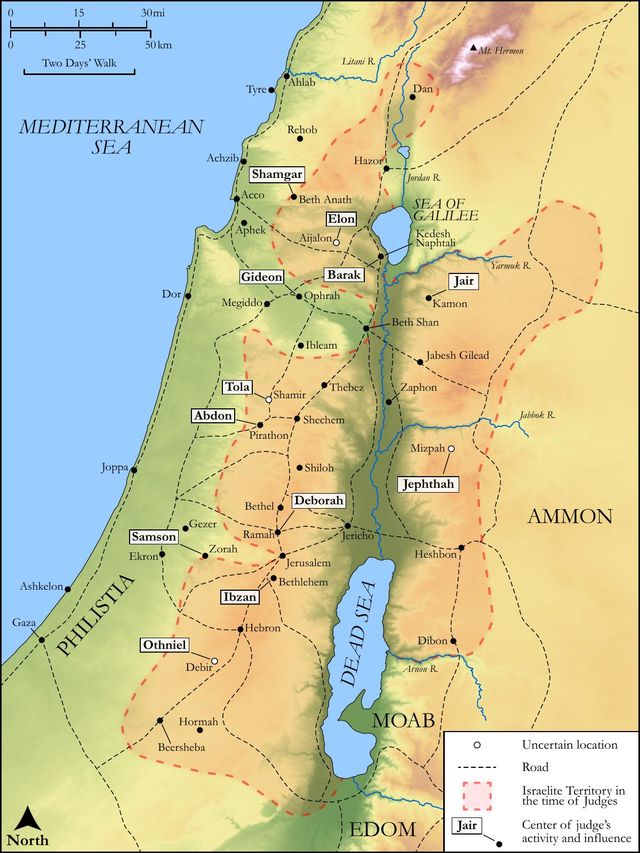
The era of the Judges (approximately 1375-1050 BC) was a turbulent period for Israel, marked by a decentralized tribal society without a unified monarchy or standing army. This made them highly susceptible to external threats. The Midianites, often allied with the Amalekites and other nomadic "children of the east" (likely desert tribes from the Arabian Peninsula), were formidable desert raiders. Their military strategy, as described here, was not to occupy Israelite territory but to conduct swift, devastating annual raids, meticulously timed to coincide with the harvest season. Riding camels, they would sweep through the fertile valleys, destroying crops, seizing all available livestock, and effectively crippling Israel's agricultural economy. This scorched-earth tactic reduced the Israelites to subsistence living or worse, often leading to famine. The geographical reference to "Gaza" is significant, indicating the vast reach of these raids, extending from the Jordan Valley across the central highlands to the southwestern coastal plain, demonstrating the widespread and comprehensive nature of the oppression.
Key Themes
ShowHideJudges 6:4 powerfully contributes to several overarching themes prevalent throughout the Book of Judges and the broader biblical narrative. Foremost is the theme of Divine Discipline, where God utilizes external adversaries as instruments to correct His disobedient people, fulfilling the covenant curses detailed in Deuteronomy 28. The verse vividly illustrates Economic and Agricultural Devastation, portraying the complete obliteration of Israel's livelihood, which serves as a tangible manifestation of their spiritual barrenness and separation from God's blessing. Furthermore, it underscores Israel's profound Vulnerability and Desperation during this era, highlighting their dire need for a divinely appointed deliverer and God's sovereign intervention. The widespread nature of the destruction, extending "till thou come unto Gaza," emphasizes the theme of Comprehensive Judgment, indicating that no region or segment of the population was untouched by the severe consequences of their collective sin and idolatry.
Exposition and Analysis
ShowHideKey Word Analysis
ShowHideThis primitive root signifies "to decay," and causatively, "to ruin" or "spoil." It implies more than mere consumption; it denotes a deliberate act of laying waste, corrupting, or rendering unusable. In the context of agriculture, it suggests a malicious intent to make the land unproductive, perhaps through trampling, burning, or simply ensuring nothing remained for the Israelites. This word emphasizes the thoroughness and destructive intent of the Midianite plundering, not just taking, but actively ruining.
This term refers to "produce," specifically the yield or crop of the earth. It encompasses all agricultural output—grains, fruits, and vegetables—which formed the very foundation of Israel's agrarian society and sustenance. The destruction of this "increase" meant the direct obliteration of their food supply, inevitably leading to widespread famine and starvation. It highlights the direct attack on their primary source of life.
This word denotes "preservation of life," hence "sustenance" or "victuals." It is broader than just "food," encompassing all provisions necessary for survival and livelihood. By stating that "no sustenance" was left, the text emphasizes the absolute deprivation Israel faced, indicating a complete economic collapse where not only food but also the means to produce it or trade for it were systematically removed, pushing the population to the brink.
Verse Breakdown
ShowHide"And they encamped against them,"
This opening clause, using the root H2583 (chânâh), establishes the aggressive posture and sustained presence of the Midianite coalition. "Encamped against them" implies a military-style operation, a hostile occupation or siege, rather than mere hit-and-run raids. It suggests a deliberate, organized, and prolonged campaign of oppression, indicating a strategic intent to dominate and deplete.
"and destroyed the increase of the earth,"
This is the core action of the invaders, utilizing H7843 (shâchath) and H2981 (yᵉbûwl). They systematically ruined the agricultural yield. This wasn't merely taking what was ripe; it was an act of scorched-earth policy, ensuring that future harvests would also be impacted. This deliberate destruction speaks to the thoroughness of their destructive intent, aiming to break Israel's economic backbone.
"till thou come unto Gaza,"
This geographical marker, mentioning H5804 (Azzâh), precisely defines the immense scope of the Midianite devastation. Gaza, a significant Philistine city on the southwestern coastal plain, traditionally marked the western boundary of Israel's sphere of influence. This phrase indicates that the Midianite raids extended across the entire breadth of Israelite territory, from the Jordan Valley to the Mediterranean coast, leaving no region untouched by their devastating campaigns.
"and left no sustenance for Israel,"
This clause, using H7604 (shâʼar) and H4241 (michyâh), summarizes the devastating outcome of the Midianite actions. "No sustenance" underscores the complete deprivation and destitution of the Israelites. It signifies that all means of survival—food, resources, and the ability to generate them—were systematically removed, pushing the population to the brink of starvation and rendering them utterly dependent.
"neither sheep, nor ox, nor ass."
This final enumeration, listing H7716 (seh), H7794 (shôwr), and H2543 (chămôwr), provides specific examples of the "sustenance" that was taken. These three animals represent the primary forms of livestock crucial for Israelite life: sheep for wool, meat, and milk; oxen for plowing, labor, and meat; and asses for transport and labor. Their removal meant the loss of immediate food, future agricultural capacity, and essential transportation, completing the picture of utter economic ruin and leaving Israel utterly helpless.
Literary Devices
ShowHideJudges 6:4 employs several potent literary devices to convey the depth of Israel's suffering and the severity of the Midianite oppression. Hyperbole is powerfully evident in the phrase "left no sustenance for Israel," which, while perhaps not implying literally zero provisions, vividly conveys the near-total obliteration of their resources and the extreme hardship they faced. This exaggeration serves to emphasize the profound severity of their plight. Vivid Imagery is masterfully used to paint a stark picture of desolation: the "destroyed increase of the earth" conjures images of barren fields and ruined harvests, while the specific enumeration of "neither sheep, nor ox, nor ass" evokes empty pastures, silent homesteads, and a complete absence of the vital components of an agrarian economy. The use of Merism in "neither sheep, nor ox, nor ass" functions as a comprehensive list, representing all categories of essential livestock, thereby underscoring the absolute and complete nature of the plunder. Finally, the Geographical Marker "till thou come unto Gaza" serves as a powerful rhetorical device, highlighting the vast and pervasive extent of the Midianite oppression, demonstrating that the entire land, from its eastern agricultural heartland to its western coastal boundary, was under siege and devastated.
Theological and Thematic Connections
ShowHideJudges 6:4 serves as a stark reminder of the covenantal consequences of disobedience, echoing the solemn warnings given to Israel in the Mosaic Law. The systematic destruction of their agricultural produce and livestock directly fulfills the curses promised for apostasy, where God warned that He would send enemies to consume their land's yield and livestock, leaving them destitute. This divine discipline was not arbitrary but purposeful, designed to humble Israel, expose the futility of their idolatry, and ultimately drive them back to a faithful relationship with their God. The verse underscores God's absolute sovereignty over nations and natural resources, demonstrating His ability to use even pagan invaders as instruments of His righteous judgment and redemptive plan for His people. It highlights the profound biblical principle that spiritual health directly impacts material well-being, and a departure from God's commands can lead to profound societal and economic breakdown, serving as a powerful call to repentance and reliance on Yahweh alone.
Reflection and Application
ShowHideJudges 6:4 offers a profound spiritual lesson for believers today, reminding us that while God's covenant with His New Testament people is one of grace and not law, the principle of consequences for spiritual drifting remains. Just as Israel's idolatry led to a "famine" of physical sustenance, our spiritual apathy, neglect of God's Word, and pursuit of worldly idols can lead to a "famine" in our souls—a loss of joy, peace, purpose, and spiritual vitality. This verse calls us to examine areas where we might be neglecting our relationship with God, allowing spiritual "Midianites" (distractions, unconfessed sin, worldly pursuits, or even spiritual complacency) to "destroy the increase" of our spiritual lives. It compels us to recognize that true sustenance and flourishing come from abiding in God, not from earthly possessions or perceived security. When we find ourselves in a state of spiritual barrenness, this passage encourages us to cry out to the Lord, just as Israel eventually did, trusting that He is a God who hears, delivers, and restores. Our greatest security is not in our material abundance, but in our unwavering dependence on His provision and faithfulness, which alone can satisfy the deepest longings of our souls.
Questions for Reflection
ShowHideFAQ
ShowHideWhat was the primary purpose of the Midianite raids described in Judges 6:4?
ShowHideThe primary purpose of the Midianite raids was not permanent territorial conquest but systematic economic devastation. They aimed to strip Israel of its agricultural produce and livestock, effectively destroying their means of livelihood and reducing them to a state of extreme poverty and famine. This annual plundering, meticulously timed after the harvest, served to prevent Israel from accumulating wealth or resources, keeping them in a state of weakness and dependence. In the biblical narrative, this severe oppression was a direct consequence of Israel's disobedience to God, intended by Him to humble them and drive them back to Him in repentance, as indicated in Judges 6:1 and Judges 6:7.
How does Judges 6:4 relate to the broader cycle of sin and deliverance in the Book of Judges?
ShowHideJudges 6:4 is a crucial and vivid depiction within the "sin-suffering-supplication-salvation" cycle that defines the narrative structure of the Book of Judges. It represents the intense "suffering" phase, detailing the severe consequences of Israel's "sin" (their idolatry and disobedience, as explicitly stated in Judges 6:1). The extreme economic devastation and famine described in this verse ultimately lead to Israel's desperate "supplication" or cry to the Lord (Judges 6:7), which then prompts God to raise up a "savior" or deliverer, in this case, Gideon (Judges 6:11), thus completing the cycle with "salvation" or deliverance. The severity of the suffering in verse 4 underscores the depth of their repentance and the urgency of God's miraculous intervention.
Christ-Centered Fulfillment
ShowHideJudges 6:4, with its stark depiction of Israel's utter destitution and lack of sustenance, powerfully foreshadows humanity's spiritual condition apart from Christ. Just as the Midianites stripped Israel of all physical provision, leaving them barren and famished, sin has left humanity spiritually bankrupt, unable to produce any "increase" that can truly satisfy or sustain the soul. We are left without "sustenance" for our deepest needs, facing a spiritual famine that no earthly resource or self-effort can alleviate. However, the overarching narrative of Judges, which consistently moves from despair and oppression to the raising of a deliverer, ultimately points to Jesus Christ. He is the true Lamb of God who takes away the sin of the world, the ultimate Judge and Deliverer, who rescues us not merely from physical oppression, but from the far greater tyranny of sin, death, and spiritual barrenness. He declares Himself to be the Bread of Life, promising that "Whoever comes to me shall not hunger, and whoever believes in me shall never thirst," thereby providing the eternal spiritual sustenance that the Midianites could never destroy. In Christ, the devastating famine of sin is overcome by an abundance of grace, forgiveness, and eternal life, fulfilling Israel's desperate need for a deliverer and provision in a way that transcends all earthly understanding and provides ultimate spiritual flourishing.