


Joshua 11:4
Bible text: King James Version (1769 Blayney text) · Public domain
Bible text: King James Version with Strong's numbers · Public domain
Bible text: Berean Standard Bible · Public domain
Bible text: American Standard Version (1901) · Public domain
Bible text: World English Bible, Messianic edition · Public domain
Bible text: Geneva Bible (1599) · Public domain
Bible text: Young's Literal Translation · Public domain
- וַיֵּצְאוּvai·ye·tze·'Uand they came outH3318Conj-w ¦ V-Qal-ConsecImperf-3mpVerb Qal Consecutive Imperfect 3rd Plural Masculineוַandיֵּצְאוּthey came out
- הֵםHemtheyH1992Pro-3mpPronoun Personal 3rd Plural Masculine
- וְכָלve·kholand allH3605Conj-w ¦ N-msNoun Singular Masculine Absoluteוְandכָלall
- מַחֲנֵיהֶםma·cha·nei·Hemtheir armiesH4264N-msc ¦ 3mpNoun Singular Masculine Constructמַחֲנֵיarmiesהֶםtheir
- עִמָּם'i·Mamwith themH5973Prep ¦ 3mpPreposition Definiteעִמָּwithםthem
- עַם'ama peopleH5971N-msNoun Singular Masculine Absolute
- רָבravnumerousH7227Adj-msAdjective Singular Masculine Absolute
- כַּחוֹלka·Chollike the sandH2344Prep-k ¦ N-msNoun Singular Masculine Absoluteכַּlike theחוֹלsand
- אֲשֶׁר'a·SherwhichH834RelParticle Relative
- עַל'al[is] onH5921PrepPreposition
- שְׂפַתse·fat[the] shore ofH8193N-fscNoun Singular Feminine Construct
- הַיָּםhai·Yamthe seaH3220Art ¦ N-msNoun Singular Masculine Absoluteהַtheיָּםsea
- לָרֹבla·Rofor multitudeH7230Prep-l ¦ N-msNoun Singular Masculine Absoluteלָforרֹבmultitude
- וְסוּסve·Susand horse[s]H5483Conj-w ¦ N-msNoun Singular Masculine Absoluteוְandסוּסhorse[s]
- וָרֶכֶבva·Re·khevand chariot[s]H7393Conj-w ¦ N-msNoun Singular Masculine Absoluteוָandרֶכֶבchariot[s]
- רַבravmanyH7227Adj-msAdjective Singular Masculine Absolute
- מְאֹדme·'OdveryH3966Adj-msAdjective Numerical Singular Masculine Absolute
English is a literal word-by-word gloss of the Hebrew, not the KJV's wording. Why?
This is the original text the KJV's translators worked from — each Hebrew word with its own literal English meaning in this verse, prepared by scholars at Tyndale House, Cambridge. The KJV translates whole sentences, not word by word, so its wording differs: one Hebrew word can become several English words, and the KJV may choose “the LORD” where the gloss reads “Yahweh”. Both are faithful — they answer different questions. For the KJV's own rendering, switch to the KJV text.
Details
See on the biblical-era maps
Study this verse
Public-domain commentary
Matthew Henry
From his Commentary on the Whole Bible. Henry comments on passages, not single verses — this entry covers Joshua 11:1–9. His three-level outline is real structure in the source text, so it is rendered as structure.
We are here entering upon the story of another campaign that Joshua made, and it was a glorious one, no less illustrious than the former in the success of it, though in respect of miracles it was inferior to it in glory. The wonders God then wrought for them were to animate and encourage them to act vigorously themselves. Thus the war carried on by the preaching of the gospel against Satan's kingdom was at first forwarded by miracles; but, the war being by them sufficiently proved to be of God, the managers of it are now left to the ordinary assistance of divine grace in the use of the sword of the Spirit, and must not expect hail-stones nor the standing still of the sun. In this story we have,
I.The Canaanites taking the field against Israel.
They were the aggressors, God hardening their hearts to begin the war, that Israel might be justified beyond exception in destroying them. Joshua and all Israel had returned to the camp at Gilgal, and perhaps these kings knew no other than that they intended to sit down content with the conquest they had already made, and yet they prepare war against them. Note, Sinners bring ruin upon their own heads, so that God will be justified when he speaks, and they alone shall bear the blame for ever. Judah had now couched as a lion gone up from the prey; if the northern kings rouse him up, it is at their peril, Gen 49:9. Now,
1.Several nations joined in this confederacy, some in the mountains and some in the plains, Jos 11:2. Canaanites from east and west, Amorites, Hittites, Perizzites, etc. (Jos 11:3), of different constitutions and divided interests among themselves, and yet they here unite against Israel as against a common enemy. Thus are the children of this world more unanimous, and therein wiser, than the children of light. The oneness of the church's enemies should shame the church's friends out of their discords and divisions, and engage them to be one.
2.The head of this confederacy was Jabin king of Hazor (Jos 11:1), as Adoni-zedec was of the former; it is said (Jos 11:10) Hazor had been the head of all those kingdoms, which could not have revolted without occasioning ill-will; but this was forgotten and laid aside upon this occasion, by consent of parties, Luk 23:12. When they had all drawn up their forces together, every kingdom bringing in its quota, they were a very great army, much greater than the former, as the sand on the sea shore in multitude, and upon this account much stronger and more formidable, that they had horses and chariots very many, which we do not find the southern kings had; hereby they had a great advantage against Israel, for their army consisted only of foot, and they never brought horses nor chariots into the field. Josephus tells us that the army of the Canaanites consisted of 300,000 foot, 10,000 horses, and 20,000 chariots. Many there be that rise up against God's Israel; doubtless their numbers made them very confident of success, but it proved that so much the greater slaughter was made of them.
II.The encouragement God gave to Joshua to give them the meeting, even upon the ground of their own choosing (Jos 11:6):
Be not afraid because of them. Joshua was remarkable for his courage - it was his master grace, and yet it seems he had need to be again and again cautioned not to be afraid. Fresh dangers and difficulties make it necessary to fetch in fresh supports and comforts from the word of God, which we have always nigh unto us, to be made use of in every time of need. Those that have God on their side need not be disturbed at the number and power of their enemies; more are those that are with us than those that are against us; those have the hosts of the Lord that have the Lord of hosts engaged for them. For his encouragement,
1.God assures him of success, and fixes the hour: Tomorrow about this time, when an engagement (it is probable) was expected and designed on both sides, I will deliver them up slain. Though they were to be slain by the sword of Israel, yet it is spoken of as God's work, that he would deliver them up.
2.He appoints him to hough their horses, hamstring them, lame them, and burn their chariots, not only that Israel might not use them hereafter, but that they might not fear them now, their God designing this contempt to be put upon them. Let Israel look upon their chariots but as rotten wood designed for the fire, and their horses of war as disabled things, scarcely good enough for the cart. This encouragement which God here gave to Joshua no doubt he communicated to the people, who perhaps were under some apprehensions of danger from this vast army, notwithstanding the experience they had had of God's power engaged for them. And the wisdom and goodness of God are to be observed,
(1.)In infatuating the counsels of the enemy, that all the kings of Canaan, who were not dispersed at such a distance from each other but that they might have got all together in a body, did not at first confederate against Israel, but were divided into the southern and northern combination, and so became the less formidable. And,
(2.)In preparing his people to encounter the greater force, by breaking the less. They first engage with five kings together, and now with many more. God proportions our trials to our strength and our strength to our trials.
III.Joshua's march against these confederate forces, Jos 11:7.
He came upon them suddenly, and surprised them in their quarters. He made this haste,
1.That he might put them into the greater confusion, by giving them an alarm, when they little thought he was near them.
2.That he might be sure not to come short of the honour God had fixed, to give him the meeting at the enemies' camp, tomorrow about this time. It is fit we should keep time with God.
IV.His success, Jos 11:8.
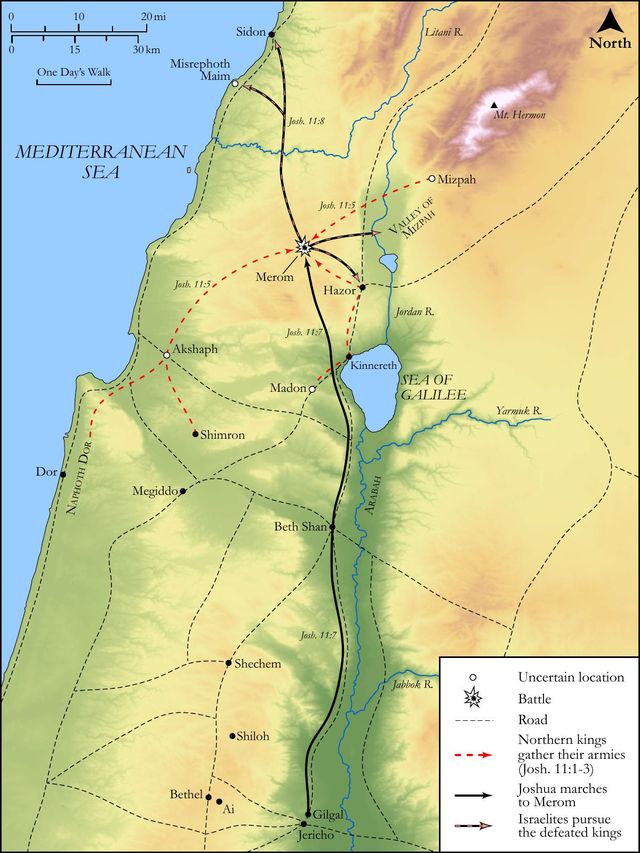
He obtained the honour and advantage of a complete victory; he smote them and chased them, in the several ways they took in their flight; some fled towards Zidon, which lay to the northwest, others towards Mizpeh, eastward, but the parties Joshua sent out pursued them each way. So the Lord delivered them into the hand of Israel; they would not deliver themselves into the hands of Israel to be made proselytes and tributaries, and so offered up to God's grace (Rom 15:16), and therefore God delivered them into their hands to be made sacrifices to his justice; for God will be honoured by us or upon us.
V.His obedience to the orders given him, in destroying the horses and chariots (Jos 11:9), which was an instance,
1.Of his subjection to the divine will, as one under authority, that must do as he is bidden.
2.Of his self-denial, and crossing his own genius and inclination in compliance with God's command.
3.Of his confidence in the power of God engaged for Israel, which enabled them to despise the chariots and horses which others trusted in, Psa 20:7; Psa 33:17.
4.Of his care to keep up in the people the like confidence in God, by taking that from them which they would be tempted to trust too much to. This was cutting of a right hand.
Continue studying Joshua 11:4 across the web’s major study libraries — every link below opens this exact verse, chapter, or book on the destination site.
Read & Compare
 BibleGatewayThis verse in more than 200 translations and 70 languages.
 Bible.comThe YouVersion reader — hundreds of translations, reading plans, and highlights.
 ESV.orgCrossway's official English Standard Version reader.
 NET BibleThe NET translation with 60,000+ translators' notes on every rendering decision.
 STEP BibleTyndale House's free study tool — original text, vocabulary, and scholarly resources.
 BibliaLogos Bible Software's free web reader.
 USCCBThe New American Bible (Revised Edition) with the U.S. bishops' study notes.
Commentaries
 BibleHub CommentariesDozens of classic commentaries on this verse, gathered on one page.
 StudyLightMore than 100 commentary sets — the largest collection on the web.
 BibleRefPlain-English commentary on what this verse means, verse by verse.
 Enduring WordDavid Guzik's free commentary on this chapter, widely used by Bible teachers.
 Bible Study ToolsVerse commentary alongside Greek and Hebrew study aids.
Original Language & Research
- BibleHub InterlinearThe verse word by word — original language, transliteration, and English.
- BibleHub LexiconEvery word's original-language definition and Strong's entry.
 Blue Letter BibleDeep-study tools — Strong's numbers, concordance, and word studies.
 SefariaThe Hebrew text with Rashi and centuries of Jewish commentary.
Sermons, Hymns & Audio


TrulyRandomVerse is not affiliated with these sites and doesn’t control their content. They’re linked because they’re genuinely useful.
Summary
Joshua 11:4 masterfully paints a vivid picture of the formidable military might arrayed against Israel by the northern Canaanite coalition, led by King Jabin of Hazor. This verse underscores the overwhelming numerical superiority and advanced military technology of the enemy, describing their forces as "much people, even as the sand that is upon the sea shore in multitude," further amplified by the presence of "horses and chariots very many." By emphasizing the sheer scale and technological advantage of the adversary, the text sets the theological stage for a dramatic confrontation where Israel's inevitable victory would be clearly attributed to divine intervention rather than human strength or strategic prowess, thereby magnifying God's faithfulness and power.
Context
ShowHideLiterary Context
Joshua 11:4 is strategically placed within the narrative of Israel's conquest of Canaan, marking the beginning of the northern campaign. Following the decisive defeat of the southern kings in Joshua 10, the focus shifts to the formidable alliance orchestrated by Jabin, King of Hazor, described in Joshua 11:1-3. This verse, therefore, serves as a crucial descriptive interlude, quantifying the immense threat posed by this coalition. Its detailed portrayal of the enemy's vast numbers and superior weaponry (chariots and horses) is designed to heighten the tension and emphasize the human impossibility of Israel's task, thereby preparing the reader for the subsequent divine command to Joshua in Joshua 11:6 to hamstring the horses and burn the chariots, which clearly signals that the victory will be God's alone.
Historical & Cultural Context
In the days of the Israelite conquest, chariots were the preeminent military weapon, akin to modern-day tanks or armored vehicles. These two-wheeled war machines, typically drawn by two or more horses, offered unparalleled speed, mobility, and shock value on open terrain, making them devastating against infantry. Their construction and maintenance were resource-intensive, signifying the wealth and advanced military capabilities of the Canaanite city-states. Hazor, specifically, was a dominant regional power, often referred to as "the head of all those kingdoms" in Joshua 11:10, capable of marshaling vast resources and forming extensive coalitions. The description of the army as "sand of the seashore" was a widely understood hyperbolic idiom, as of the Midianites in the days of Gideon, "as the sand by the sea side for multitude," used to convey an immeasurable, innumerable host, emphasizing the overwhelming numerical odds faced by the Israelites, who, unlike their adversaries, possessed no chariots or significant cavalry.
Key Themes
ShowHideThis verse powerfully contributes to several overarching theological and narrative themes central to the book of Joshua and the broader biblical narrative. Firstly, it vividly portrays the overwhelming opposition Israel faced, underscoring that their conquest was not merely a human military campaign but a divinely orchestrated act. The immense size and superior armaments of the Canaanite forces serve to magnify God's power and faithfulness, demonstrating that victory comes not by human strength or military might, but by divine assistance, a principle repeatedly emphasized throughout the Old Testament (e.g., Deuteronomy 20:4). Secondly, it reinforces the theme of God's absolute sovereignty over all nations, even those with superior military technology. The divine command to neutralize these advanced weapons (hamstringing horses and burning chariots in Joshua 11:6) further emphasizes Israel's complete reliance on God, not on conventional armaments, a principle also found in the law concerning kings in Deuteronomy 17:16). Lastly, the verse sets the stage for God's covenant faithfulness in fulfilling His promises to give Israel the land, even when faced with seemingly insurmountable obstacles.
Exposition and Analysis
ShowHideKey Word Analysis
ShowHideThis term refers to "an encampment (of travellers or troops); hence, an army, whether literal (of soldiers) or figurative." Its use here emphasizes that the Canaanite forces were not a disorganized mob but a structured and formidable military "army" or "host." This highlights the organized and unified nature of the threat Israel faced, underscoring the magnitude of the military confrontation.
This word literally means "sand (as round or whirling particles)." In this context, as part of the idiom "as the sand that is upon the sea shore," it signifies an immeasurable, countless multitude. While often used positively to describe blessings (e.g., Abraham's numerous descendants in Genesis 22:17), here it is employed to convey the overwhelming and daunting scale of the enemy, emphasizing the human impossibility of Israel's task without divine intervention.
This term denotes "a vehicle; by implication, a team; by extension, cavalry." Specifically, it refers to the two-wheeled war vehicles, typically drawn by horses, which were the apex of military technology of that day. Their mention here signifies the Canaanites' technological superiority, speed, and destructive power, making their defeat by an infantry-based Israelite army even more miraculous and indicative of divine power.
Verse Breakdown
ShowHide"And they went out, they and all their hosts with them"
This phrase describes the unified mobilization of the northern coalition. "They" refers to the kings and their respective armies mentioned in the preceding verses (Joshua 11:1-3). It conveys a concerted and massive effort to confront Israel, highlighting the vast scale and coordinated nature of their combined military strength. The use of "hosts" (H4264, machăneh') emphasizes that these were organized armies, not just a random gathering of people.
"much people, even as the sand that is upon the sea shore in multitude"
This clause employs a powerful simile and hyperbole to emphasize the sheer, uncountable number of the enemy forces. The comparison to "sand of the seashore" is a common biblical idiom for an innumerable quantity, here applied to a hostile army, stressing the overwhelming numerical disadvantage faced by Israel. The Hebrew words for "much" (H7227, rab') and "multitude" (H7230, rôb') reinforce this sense of overwhelming quantity.
"with horses and chariots very many"
This concluding clause highlights the quality and advanced nature of the Canaanite army's armaments. Horses (H5483, çûwç') and chariots (H7393, rekeb') represented the cutting edge of ancient warfare, providing mobility, speed, and destructive power. Their presence in "very many" (H3966, mᵉʼôd' and H7227, rab') underscores the formidable technological and tactical challenge they posed, especially given that Israel was primarily an infantry army and lacked such cavalry.
Literary Devices
ShowHideJoshua 11:4 employs several potent literary devices to convey the formidable nature of the Canaanite opposition and to set the stage for God's miraculous intervention. The most prominent is Simile, explicitly comparing the enemy's numbers to "the sand that is upon the sea shore." This vivid comparison immediately conjures an image of an uncountable, overwhelming multitude, emphasizing the sheer scale of the challenge. Hand-in-hand with this simile is Hyperbole, as the description of the army being literally as numerous as all the sand on the seashore is an exaggeration designed to underscore the perceived impossibility of human victory. This hyperbole serves a crucial theological purpose: by magnifying the enemy's strength, it simultaneously magnifies the power of God who grants victory against such impossible odds. The mention of "horses and chariots very many" also functions as Metonymy, where these advanced military technologies stand in for the entire military might, technological superiority, and formidable prowess of the Canaanite forces.
Theological and Thematic Connections
ShowHideJoshua 11:4, by dramatically portraying the overwhelming might of the Canaanite coalition, serves as a profound theological statement on the nature of divine power and human reliance. It sets the stage for God to demonstrate His absolute sovereignty, proving that victory in His purposes does not depend on human strength, superior numbers, or advanced weaponry, but solely on His faithfulness and intervention. This narrative reinforces the consistent biblical theme that God often chooses to work through the weak or the outnumbered to ensure that all glory redounds to Him alone, preventing any boasting in human capabilities. It illustrates that when the odds are stacked impossibly high from a human perspective, it is precisely then that God's power is most clearly revealed, compelling His people to trust in His might rather than their own.
Reflection and Application
ShowHideThe description of the Canaanite army in Joshua 11:4 resonates deeply with the challenges believers face in life. We often encounter "multitudes" of obstacles—whether they are overwhelming financial burdens, persistent spiritual temptations, seemingly insurmountable health issues, daunting professional challenges, or complex relational difficulties. Like the ancient Israelites, we may feel outnumbered, out-resourced, and outmatched by the "horses and chariots" of our circumstances—the seemingly superior power of our adversaries or the overwhelming nature of our problems. This verse calls us to shift our perspective from the magnitude of our problems to the infinitude of God's power. It reminds us that our true strength is not in our own capabilities, our resources, or our strategic brilliance, but in our unwavering trust in the God who can defeat any "multitude." Our faith is tested precisely when the odds appear impossible, compelling us to lean entirely on Him, knowing that He delights in demonstrating His power through our weakness for His glory.
Questions for Reflection
ShowHideFAQ
ShowHideWhy does the Bible emphasize the size and strength of the Canaanite army so much?
ShowHideThe emphasis on the Canaanite army's immense size ("as the sand...in multitude") and superior weaponry ("horses and chariots very many") serves a crucial theological purpose. It highlights the seemingly insurmountable odds from a human perspective, thereby magnifying God's power and faithfulness in granting Israel victory. If Israel had won easily, the glory might have gone to their military prowess. By portraying the enemy as overwhelmingly powerful, the narrative ensures that the subsequent triumph is clearly understood as a divine miracle, demonstrating that God's strength is not limited by human limitations or the enemy's might. This theme recurs throughout Scripture, showing God often uses the weak or outnumbered to achieve His purposes, as seen in the account of Gideon's victory in Judges 7.
What was the significance of "horses and chariots" in ancient warfare?
ShowHideIn the days of Joshua, horses and chariots represented the pinnacle of military technology, analogous to modern-day tanks or fighter jets. Chariots were fast, maneuverable, and could deliver devastating shock attacks, making them highly effective in open terrain. Their construction and maintenance required significant resources, indicating the wealth and advanced military capabilities of the Canaanite city-states, particularly Hazor. For Israel, who were primarily infantry and often lacked cavalry (and were even commanded not to multiply horses for themselves, as in Deuteronomy 17:16), facing an army with "very many" chariots was an extremely daunting prospect, further underscoring the miraculous nature of their eventual victory.
Christ-Centered Fulfillment
ShowHideJoshua 11:4, with its vivid depiction of an overwhelming, technologically superior enemy, foreshadows the spiritual battles faced by God's people throughout history, culminating in the ultimate triumph of Christ. Just as Israel faced a "multitude" beyond their human capacity to defeat, humanity faced the infinitely more formidable "multitude" of sin, death, and the powers of darkness. No human "horses and chariots"—no amount of strength, wisdom, or effort—could overcome these spiritual foes. However, the victory foreshadowed in Joshua, where God Himself fights for His people, finds its ultimate fulfillment in Jesus Christ. He is the true and greater Joshua, who, not by earthly might but by divine power, confronted and utterly defeated the spiritual "hosts" that held humanity captive. His death on the cross disarmed the principalities and powers, making a public spectacle of them, triumphing over them in it (Colossians 2:15). The seemingly impossible odds of humanity's redemption were overcome by the Lamb of God, whose sacrifice takes away the sin of the world (John 1:29). Thus, Joshua 11:4, while describing an ancient military confrontation, ultimately points to the infinitely greater victory secured by Christ, assuring believers that in Him, they are more than conquerors over every spiritual "multitude" (Romans 8:37) and that the battle truly belongs to the Lord.