


1 Samuel 13:5
- וּפְלִשְׁתִּיםu·fe·lish·Timand [the] PhilistinesH6430Conj-w ¦ N-mpNoun Gentilic Plural Masculine Absoluteוּandפְלִשְׁתִּים[the] Philistines
- נֶאֶסְפוּne·'es·Futhey gatheredH622V-Niphal-Perf-3cpVerb Niphal Perfect 3rd Plural common gender
- לְהִלָּחֵםle·hi·la·Chemto fightH3898Prep-l ¦ V-Niphal-InfVerb Niphal Infinitive Constructלְtoהִלָּחֵםfight
- עִם'imwithH5973PrepPreposition
- יִשְׂרָאֵלYis·ra·'ElIsraelH3478N-properNoun Proper Location
- שְׁלֹשִׁיםshe·lo·ShimthirtyH7970N-mpNoun Plural Masculine Absolute
- אֶלֶף'E·lefthousandH505N-csNoun Singular common gender Absolute
- רֶכֶבre·khevchariot[s]H7393N-msNoun Singular Masculine Absolute
- וְשֵׁשֶׁתve·She·shetand sixH8337Conj-w ¦ N-cscNoun Singular common gender Constructוְandשֵׁשֶׁתsix
- אֲלָפִים'a·la·Fimthousand<s>H505N-cpNoun Plural common gender Absolute
- פָּרָשִׁיםpa·ra·ShimhorsemenH6571N-mpNoun Plural Masculine Absolute
- וְעָםve·'Amand a peopleH5971Conj-w ¦ N-msNoun Singular Masculine Absoluteוְandעָםa people
- כַּחוֹלka·Chollike the sandH2344Prep-k ¦ N-msNoun Singular Masculine Absoluteכַּlike theחוֹלsand
- אֲשֶׁר'a·SherwhichH834RelParticle Relative
- עַל'al[is] onH5921PrepPreposition
- שְׂפַתse·fat[the] shore ofH8193N-fscNoun Singular Feminine Construct
- הַיָּםhai·Yamthe seaH3220Art ¦ N-msNoun Singular Masculine Absoluteהַtheיָּםsea
- לָרֹבla·Rofor multitudeH7230Prep-l ¦ N-msNoun Singular Masculine Absoluteלָforרֹבmultitude
- וַיַּעֲלוּvai·ya·'a·Luand they came upH5927Conj-w ¦ V-Qal-ConsecImperf-3mpVerb Qal Consecutive Imperfect 3rd Plural Masculineוַandיַּעֲלוּthey came up
- וַיַּחֲנוּvai·ya·cha·Nuand they encampedH2583Conj-w ¦ V-Qal-ConsecImperf-3mpVerb Qal Consecutive Imperfect 3rd Plural Masculineוַandיַּחֲנוּthey encamped
- בְמִכְמָשׂve·mikh·Masat MicmashH4363Prep-b ¦ N-properNoun Proper LocationבְatמִכְמָשׂMicmash
- קִדְמַתkid·Mat[the] east ofH6926N-fscNoun Singular Feminine Construct
- בֵּיתbeitBethH1007N-properNoun Proper Location
- אָוֶן'A·venAvenH1007N-properNoun Proper Location
English is a literal word-by-word gloss of the Hebrew, not the KJV's wording. Why?
This is the original text the KJV's translators worked from — each Hebrew word with its own literal English meaning in this verse, prepared by scholars at Tyndale House, Cambridge. The KJV translates whole sentences, not word by word, so its wording differs: one Hebrew word can become several English words, and the KJV may choose “the LORD” where the gloss reads “Yahweh”. Both are faithful — they answer different questions. For the KJV's own rendering, switch to the KJV text.
Details
See on the biblical-era map
Study this verse
Public-domain commentary
Matthew Henry
From his Commentary on the Whole Bible. Henry comments on passages, not single verses — this entry covers 1 Samuel 13:1–7. His two-level outline is real structure in the source text, so it is rendered as structure.
We are not told wherein it was that the people of Israel offended God, so as to forfeit his presence and turn his hand against them, as Samuel had threatened (Sa1 12:15); but doubtless they left God, else he would not have left them, as here it appears he did; for,
I.Saul was very weak and impolitic, and did not order his affairs with discretion.
Saul was the son of one year (so the first words are in the original), a phrase which we make to signify the date of his reign, but ordinarily it signifies the date of one's birth, and therefore some understand it figuratively - he was as innocent and good as a child of a year old; so the Chaldee paraphrase: he was without fault, like the son of a year. But, if we admit a figurative sense, it may as well intimate that he was ignorant and imprudent, and as unfit for business as a child of a year old: and the subsequent particulars make this more accordant with his character than the former. But we take it rather, as our own translation has it, Saul reigned one year, and nothing happened that was considerable, it was a year of no action; but in his second year he did as follows: - 1. he chose a band of 3000 men, of whom he himself commanded 2000, and his son Jonathan 1000, Sa1 13:2. The rest of the people he dismissed to their tents. If he intended these only for the guard of his person and his honorary attendants, it was impolitic to have so many, if for a standing army, in apprehension of danger from the Philistines, it was no less impolitic to have so few; and perhaps the confidence he put in this select number, and his disbanding the rest of that brave army with which he had lately beaten the Ammonites (Sa1 11:8-11), was looked upon as an affront to the kingdom, excited general disgust, and was the reason he had so few at his call when he had occasion for them. The prince that relies on a particular party weakens his own interest in the whole community. 2. He ordered his son Jonathan to surprise and destroy the garrison of the Philistines that lay near him in Geba, Sa1 13:3. I wish there were no ground for supposing that this was a violation or infraction of some articles with the Philistines, and that it was done treacherously and perfidiously. The reason why I suspect it is because it is said that, for doing it, Israel was had in abomination, or, as the word is, did stink with the Philistines (Sa1 13:4), as men void of common honesty and whose word could not be relied on. If it was so, we will lay the blame, not on Jonathan who did it, but on Saul, his prince and father, who ordered him to do it, and perhaps kept him in ignorance of the truth of the matter. Nothing makes the name of Israel odious to those that are without so much as the fraud and dishonesty of those that are called by that worthy name. If professors of religion cheat and over-reach, break their word and betray their trust, religion suffers by it, and is had in abomination with the Philistines. Whom may one trust if not an Israelite, one that, it is expected, should be without guile? 3. When he had thus exasperated the Philistines, then he began to raise forces, which, if he had acted wisely, he would have done before. When the Philistines had a vast army ready to pour in upon him, to avenge the wrong he had done them, then was he blowing the trumpet through the land, among a careless, if not a disaffected people, saying, Let the Hebrews hear (Sa1 13:3), and so as many as thought fit came to Saul to Gilgal, Sa1 13:4. But now the generality, we may suppose, drew back (either in dislike of Saul's politics or in dread of the Philistines' power), who, if he had summoned them sooner, would have been as ready at his beck as they were when he marched against the Ammonites. We often find that after-wit would have done much better before and have prevented much inconvenience.
II.Never did the Philistines appear in such a formidable body as they did now, upon this provocation which Saul gave them.
We may suppose they had great assistance from their allies, for (Sa1 13:5), besides 6000 horse, which in those times, when horses were not so much used in war as they are now, was a great body, they had an incredible number of chariots, 30,000 in all: most of them, we may suppose, were carriages for the bag and baggage of so vast an army, not chariots of war. But their foot was innumerable as the sand of the sea-shore, so jealous were they for the honour of their nation and so much enraged at the baseness of the Israelites in destroying their garrison. If Saul had asked counsel of God before he had given the Philistines this provocation, he and his people might the better have borne this threatening trouble which they had now brought on themselves by their own folly.
III.Never were the people of Israel so faint-hearted, so sneaking, so very cowardly, as they were now.
Some considerable numbers, it may be, came to Saul to Gilgal; but, hearing of the Philistines' numbers and preparations, their spirits sunk within them, some think because they did not find Samuel there with Saul. Those that, awhile ago, were weary of him, and wished for a king, now had small joy of their king unless they could see him under Samuel's direction. Sooner or later, men will be made to see that God and his prophets are their best friends. Now that they saw the Philistines making war upon them, and Samuel not coming in to help them, they knew not what to do; men's hearts failed them for fear. And.
1.Some absconded. Rather than run upon death among the Philistines, they buried themselves alive in caves and thickets, Sa1 13:6. See what work sin makes; it exposes men to perils, and then robs them of their courage and dispirits them. A single person, by faith, can say, I will not be afraid of 10,000 (Psa 3:6); but here thousands of degenerate Israelites tremble at the approach of a great crowd of Philistines. Guilt makes men cowards.
2.Others fled (Sa1 13:7): They went over Jordan to the land of Gilead, as far as they could from the danger, and to a place where they had lately been victorious over the Ammonites. Where they had triumphed they hoped to be sheltered.
3.Those that staid with Saul followed him trembling, expecting no other than to be cut off, and having their hands and hearts very much weakened by the desertion of so many of their troops. And perhaps Saul himself, though he had so much honour as to stand his ground, yet had no courage to spare wherewith to inspire his trembling soldiers.
Historical interpretation
Historical reception
2 surviving comments on this verse. Each one is dated, so this reads as a timeline rather than a list.
And going up, they camped in Magmas, etc. Magmas, as we have said, signifies humility; Bethaven sounds like the house of an idol, or a useless house. But ascending from their hidden machinations, unclean spirits, either by secretly persuading like a common pedestrian crowd, or like horse riders and charioteers seducing through deceived men, first attempt to take away all the defenses of humility from their conquerors so that, by which they themselves fell from heaven, they insert the plague of pride into human hearts; striving together that whatever useless house of the mind dedicated to themselves they find, camping as if to the east of Bethaven, they block all the rising of true light with their intermediary darkness.
And the remaining crowd, like the sand which is on the shore of the sea, is numerous. For this sand is exposed to the frequent waves of neighbors' vices, and also always unstable and fleeting due to the wind of pride, above which the house constructed without the foundation of the rock of faith collapses when the moment of temptations arrives, and its ruin is great. Not without a specific mystery, the army contrary to virtue is encompassed by the number thirty and a hundred, or even a thousand, which are accustomed to signify the perfection of faith and work. For even Satan transforms himself into an angel of light (II Cor. 11). What wonder, then, if his ministers are transformed as ministers of righteousness? Among such often-transformed deceptions, they also show themselves to be perfect in faith or work. Otherwise, they are included in the number six and do not know how to ascend to the number seven, who, loving only this life which was created in six days, neglect to strive for the future rest. Thirty also, because they figuratively express the wicked, is understood, because the Lord Savior was not only once sold by Judas for thirty pieces of silver, but also is daily sold by many false brethren; for whoever, neglecting the truth of the faith with which they were imbued, subject all their senses of the body to the allurements of this world, as if betraying the Lord for thirty pieces of silver multiplied by five.
Continue studying 1 Samuel 13:5 across the web’s major study libraries — every link below opens this exact verse, chapter, or book on the destination site.
Read & Compare
 BibleGatewayThis verse in more than 200 translations and 70 languages.
 Bible.comThe YouVersion reader — hundreds of translations, reading plans, and highlights.
 ESV.orgCrossway's official English Standard Version reader.
 NET BibleThe NET translation with 60,000+ translators' notes on every rendering decision.
 STEP BibleTyndale House's free study tool — original text, vocabulary, and scholarly resources.
 BibliaLogos Bible Software's free web reader.
 USCCBThe New American Bible (Revised Edition) with the U.S. bishops' study notes.
Commentaries
 BibleHub CommentariesDozens of classic commentaries on this verse, gathered on one page.
 StudyLightMore than 100 commentary sets — the largest collection on the web.
 BibleRefPlain-English commentary on what this verse means, verse by verse.
 Enduring WordDavid Guzik's free commentary on this chapter, widely used by Bible teachers.
 Bible Study ToolsVerse commentary alongside Greek and Hebrew study aids.
Original Language & Research
- BibleHub InterlinearThe verse word by word — original language, transliteration, and English.
- BibleHub LexiconEvery word's original-language definition and Strong's entry.
 Blue Letter BibleDeep-study tools — Strong's numbers, concordance, and word studies.
 SefariaThe Hebrew text with Rashi and centuries of Jewish commentary.
Sermons, Hymns & Audio


TrulyRandomVerse is not affiliated with these sites and doesn’t control their content. They’re linked because they’re genuinely useful.
Summary
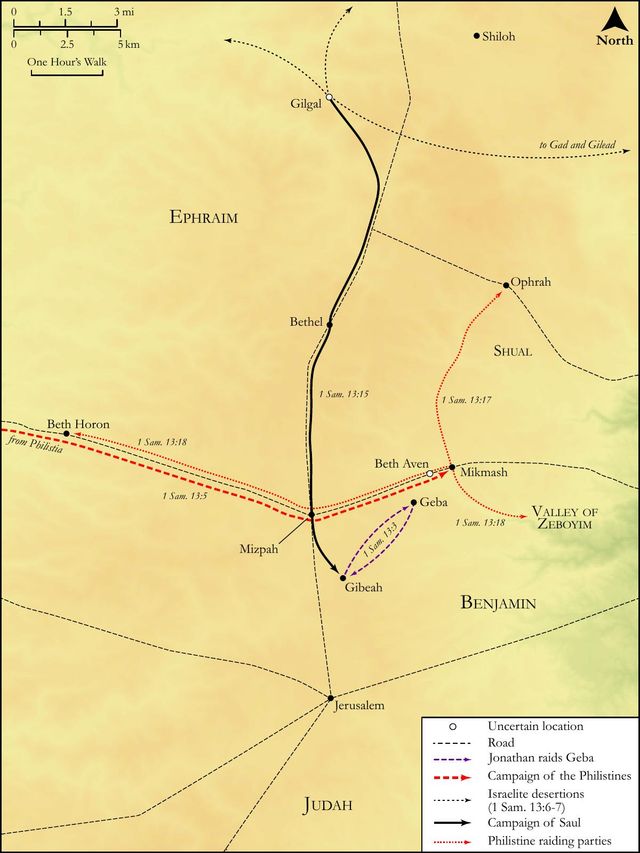
1 Samuel 13:5 vividly depicts the overwhelming military might of the Philistines as they mobilize against the nascent kingdom of Israel under King Saul. This verse details an immense force comprising thousands of chariots, horsemen, and an infantry described hyperbolically as "people as the sand which is on the sea shore in multitude," strategically positioned at Michmash. It sets a formidable stage for the impending conflict, underscoring the existential threat to Israel and highlighting the dramatic odds faced by Saul's relatively underequipped army, thereby preparing the reader for the subsequent narrative of human failure and the necessity of divine intervention.
Context
ShowHideLiterary Context
This verse immediately follows Jonathan's audacious and provocative strike against a Philistine garrison in Geba, an act that effectively reignited the long-standing hostilities between Israel and its oppressors. In response, King Saul sounded the trumpet throughout the land, summoning Israel to Gilgal, signaling a national call to arms. The Philistine counter-mobilization described in 1 Samuel 13:5 is a direct, formidable, and overwhelming response to this Israelite defiance, setting the scene for the major conflict described in the remainder of the chapter. This massive military buildup serves as the immediate precursor to Saul's fateful act of offering a burnt offering himself, rather than patiently waiting for the prophet Samuel—an act of disobedience that ultimately leads to the pronouncement of his kingdom's removal, as detailed in 1 Samuel 13:13-14. Thus, the verse functions as a dramatic narrative pivot, escalating the external threat while simultaneously foreshadowing Saul's critical internal test of faith and obedience.
Historical & Cultural Context
The Philistines were one of the powerful "Sea Peoples" who had settled along the southwestern coast of Canaan, establishing a formidable pentapolis (Gaza, Ashkelon, Ashdod, Gath, Ekron). They possessed a significant technological and military advantage over Israel, particularly in their mastery of iron metallurgy and their deployment of advanced military hardware like chariots, which Israel largely lacked, as explicitly stated in 1 Samuel 13:19-22. Their dominance over Israel was long-standing, often involving garrisons within Israelite territory and a deliberate policy of disarming the Israelite population. Michmash, located in the central Benjaminite territory, was a strategically vital pass controlling access to the central highlands. This made it an ideal staging ground for a Philistine invasion aimed at crushing the fledgling Israelite monarchy at its heart. The sheer scale of the Philistine army described in this verse reflects their overwhelming military might and their clear intent to decisively quell any Israelite uprising and reassert their absolute control.
Key Themes
ShowHideThe overwhelming display of Philistine power in 1 Samuel 13:5 contributes significantly to several key themes within 1 Samuel and the broader Old Testament narrative. Firstly, it highlights the theme of divine sovereignty amidst human weakness. The disproportionate strength of the Philistine army emphasizes that any Israelite victory would necessarily be attributed to God's intervention and power, not to human might or strategic brilliance. This echoes earlier narratives of divine deliverance against seemingly impossible odds, such as Gideon's victory with a drastically reduced army in Judges 7. Secondly, the immense threat underscores the theme of testing and obedience, particularly for King Saul. The formidable Philistine host serves as a crucible for Saul's leadership and faith, ultimately revealing his impatience and disobedience in the face of fear, marking a critical turning point in his reign, as seen in 1 Samuel 13:8-14. Finally, this verse develops the recurring theme of conflict between God's people and their adversaries, portraying a consistent pattern where Israel's very existence is threatened by powerful external forces, necessitating divine protection and intervention for their survival and the ultimate fulfillment of God's covenant promises.
Exposition and Analysis
ShowHideKey Word Analysis
ShowHideThis Hebrew verb (H622) signifies "to gather," "to collect," or "to assemble for any purpose." In this context, it conveys a deliberate, organized, and massive mobilization of forces. It is not a casual skirmish but a concerted effort to bring together a vast military machine, indicating the Philistines' serious intent to crush the Israelite rebellion and reassert their dominance. The use of the reflexive form (Niphal) "gathered themselves together" emphasizes the collective, self-initiated, and determined action of the Philistine forces.
Derived from the root meaning "to be great" or "to be many," rôb (H7230) denotes "abundance," "great quantity," or "multitude." When combined with the vivid simile "as the sand which is on the sea shore," it powerfully communicates an immeasurable, overwhelming number. This word serves to instill dread and highlight the seemingly insurmountable numerical superiority of the Philistine army, making Israel's position appear utterly hopeless from a human perspective, thereby setting the stage for divine intervention.
This geographical name (H4363) refers to a strategically important town in the tribal territory of Benjamin, located in the central highlands of Canaan. It lay along a crucial east-west pass, making it a natural bottleneck and a key defensive or offensive position. The Philistines' choice to "pitch in Michmash" signifies their tactical objective: to control this vital artery, effectively cutting off the northern and southern parts of Israel and positioning themselves for a decisive strike against Saul's forces. Its strategic importance is further highlighted in the subsequent narrative of Jonathan's daring raid against the Philistine garrison there, as recounted in 1 Samuel 14:4-5.
Verse Breakdown
ShowHide"And the Philistines gathered themselves together to fight with Israel,"
This opening clause immediately establishes the antagonists—the Philistines, Israel's perennial and formidable enemies—and their aggressive, unified intent. They are not merely assembling but are doing so with the explicit and singular purpose of engaging in decisive military conflict against the newly established Israelite monarchy.
"thirty thousand chariots, and six thousand horsemen,"
This provides specific, though likely hyperbolic, numbers for the elite units of the Philistine army. Chariots were the ancient equivalent of modern tanks, formidable weapons of war that Israel largely lacked, while horsemen provided swift reconnaissance, communication, and flanking maneuvers. These numbers underscore the Philistines' technological and tactical superiority, presenting a truly terrifying and overwhelming force.
"and people as the sand which [is] on the sea shore in multitude:"
This vivid and powerful simile describes the infantry, which constituted the vast majority of the Philistine army. The comparison to "sand on the sea shore" is a common biblical idiom for an uncountable, immense quantity, often used in divine promises of blessing (e.g., Genesis 22:17). Here, however, it is ironically inverted to convey a terrifying, overwhelming threat, emphasizing the sheer impossibility of Israel's victory by human strength alone.
"and they came up, and pitched in Michmash, eastward from Bethaven."
This final clause details the Philistines' strategic deployment. "Came up" implies an ascent to the elevated terrain of Michmash, a key strategic location. "Pitched" indicates they established a fortified camp, signifying their intent to hold this ground. Their location "eastward from Bethaven" (likely referring to Bethel, or a nearby site of similar name, perhaps even a derogatory reference to Bethel as "House of Vanity" due to its later idolatry) further specifies their position in the central highlands, confirming their intent to occupy and control vital Israelite territory, thereby setting the stage for the impending and decisive battle.
Literary Devices
ShowHideThe verse is rich with several potent literary devices that amplify its dramatic impact and underscore the severity of the situation. Most notably, Hyperbole is evident in the description of the Philistine infantry as "people as the sand which is on the sea shore in multitude." While the numbers for chariots and horsemen might also be exaggerated for rhetorical effect, the infantry description is clearly an intentional overstatement designed to convey an immeasurable, overwhelming force, thereby instilling fear and highlighting the impossible odds Israel faced. This hyperbole is powerfully reinforced by the Simile "as the sand which is on the sea shore," which directly compares the Philistine multitude to an uncountable natural phenomenon. This particular simile is a recurring motif in the Old Testament, frequently used to represent divine promises of innumerable descendants, but here it is ironically inverted to portray an overwhelming and terrifying threat. Furthermore, the entire verse is steeped in Military Imagery, painting a vivid and chilling picture of a massive, well-equipped army mobilizing for war. The specific mention of "chariots," "horsemen," and the act of "pitched" (setting up a fortified camp) all contribute to this powerful visual, setting a tone of imminent, formidable conflict and underscoring the severe imbalance of power.
Theological and Thematic Connections
ShowHide1 Samuel 13:5 serves as a powerful theological statement about the nature of divine intervention and the imperative of human reliance on God. By presenting an enemy of seemingly insurmountable strength, the text deliberately sets the stage for God to demonstrate His power, not through Israel's military might or strategic brilliance, but often through unexpected means or through the faith and obedience of a few. This narrative echoes a consistent biblical pattern where God's glory is magnified when His people are at their weakest, ensuring that victory is unequivocally attributed to Him alone. It profoundly challenges the human tendency to rely on visible resources, impressive numbers, or meticulously planned strategies, instead encouraging a radical trust in the invisible, omnipotent God. The overwhelming Philistine host thus serves as a dramatic backdrop against which God's faithfulness to His covenant people can be spectacularly displayed, even when their chosen king falters in his faith and obedience.
Reflection and Application
ShowHideThe daunting imagery of the Philistine army in 1 Samuel 13:5 resonates deeply with the challenges we face in our own lives and in the life of the church today. We often encounter "Philistines" in the form of overwhelming circumstances, relentless spiritual opposition, pervasive societal pressures, or debilitating personal struggles that seem utterly insurmountable. This passage calls us to acknowledge the stark reality of such formidable adversaries but, more importantly, to remember where our ultimate hope and strength truly lie. It serves as a profound warning against the temptation to rely solely on our own limited resources, human strategies, or numerical strength, which, like Saul's, often prove woefully insufficient. Instead, it invites us to cultivate a radical, unwavering dependence on God's sovereign power and unfailing faithfulness, even when the odds appear overwhelmingly stacked against us. Our response to overwhelming threats should not be fear-driven compromise or self-reliant effort, but a posture of humble faith that trusts God to work powerfully in and through our weakness, demonstrating His glory in ways that defy human logic and expectation. This narrative encourages us to look beyond the visible "chariots and horsemen" of our adversaries and fix our gaze on the God who is supremely able to deliver, even from a "multitude as the sand on the sea shore."
Questions for Reflection
ShowHideFAQ
ShowHideWere the numbers of the Philistine army literally accurate, especially "thirty thousand chariots"?
ShowHideWhile the King James Version (KJV) states "thirty thousand chariots," many modern translations and biblical scholars consider this specific number to be a scribal error or a hyperbolic exaggeration. The Septuagint (LXX), an ancient Greek translation of the Old Testament, and some Hebrew manuscripts read "three thousand chariots," which is still an enormous number but significantly more plausible given the logistical challenges of maintaining and deploying such a vast force in the terrain and era of ancient Israel. Furthermore, the phrase "people as the sand which is on the sea shore" is clearly a hyperbole (an intentional overstatement for emphasis), indicating an immeasurable, uncountable multitude rather than a precise census. The primary purpose of these numbers, whether literal or exaggerated, is not to provide a precise military count but to convey the overwhelming and terrifying scale of the Philistine threat. This emphasizes the dire situation Israel faced and strategically sets the stage for God's miraculous intervention, highlighting that any victory would be by divine power, not by human military might. The narrative's aim is to underscore the profound disparity in power, thereby magnifying God's eventual deliverance.
Christ-Centered Fulfillment
ShowHideThe overwhelming Philistine host in 1 Samuel 13:5, arrayed in seemingly insurmountable numbers against a vulnerable and ill-equipped Israel, powerfully foreshadows the spiritual battle that humanity faces against the forces of sin, death, and the devil. Just as Israel was utterly outmatched by the Philistines' chariots and countless warriors, humanity is inherently incapable of overcoming the spiritual enemy by its own strength, wisdom, or resources. The "sand on the sea shore" multitude of the Philistines points to the vastness and relentless nature of spiritual opposition and the seemingly insurmountable dominion of sin over fallen humanity. However, this narrative ultimately finds its profound fulfillment in Jesus Christ, the true and eternal King of Israel. He is the one who, unlike Saul, perfectly obeyed God the Father, even unto death on the cross, thereby confronting and decisively defeating the ultimate "Philistine"—Satan and the power of sin (Colossians 2:15). Through His glorious resurrection, Christ triumphed over death itself, disarming the spiritual rulers and authorities who held humanity captive. For believers, the victory over sin and death is not won by human armies, strategic genius, or self-effort, but solely by the finished work of Christ's cross and resurrection, which enables us to stand firm against all spiritual forces of evil (Ephesians 6:12). We are called to fight not with carnal weapons, but with "divine power to destroy strongholds" (2-corinthians/10-4), knowing that in Christ, we are "more than conquerors" (Romans 8:37) through Him who loved us, even when facing seemingly insurmountable odds in this present age.