


1 Samuel 13:3
- וַיַּךְvai·Yakhand he attackedH5221Conj-w ¦ V-Hiphil-ConsecImperf-3msVerb Hiphil Consecutive Imperfect 3rd Singular Masculineוַandיַּךְhe attacked
- יוֹנָתָןyo·na·TanJonathanH3129N-proper-mNoun Proper Masculine
- אֵת'et<obj.>H853DirObjMParticle Object Indicator
- נְצִיבne·Tziv[the] garrison ofH5333N-mscNoun Singular Masculine Construct
- פְּלִשְׁתִּיםpe·lish·Tim[the] PhilistinesH6430N-mpNoun Gentilic Plural Masculine Absolute
- אֲשֶׁר'a·SherwhichH834RelParticle Relative
- בְּגֶבַעbe·Ge·va'[was] at GebaH1387Prep-b ¦ N-properNoun Proper Locationבְּ[was] atגֶבַעGeba
- וַיִּשְׁמְעוּvai·yish·me·'Uand they heardH8085Conj-w ¦ V-Qal-ConsecImperf-3mpVerb Qal Consecutive Imperfect 3rd Plural Masculineוַandיִּשְׁמְעוּthey heard
- פְּלִשְׁתִּיםpe·lish·Tim[the] PhilistinesH6430N-mpNoun Gentilic Plural Masculine Absolute
- וְשָׁאוּלve·sha·'Uland SaulH7586Conj-w ¦ N-proper-mNoun Proper MasculineוְandשָׁאוּלSaul
- תָּקַעta·Ka'he gave a blastH8628V-Qal-Perf-3msVerb Qal Perfect 3rd Singular Masculine
- בַּשּׁוֹפָרba·sho·Faron the trumpetH7782Prep-b ¦ N-msNoun Singular Masculine Absoluteבַּon theשּׁוֹפָרtrumpet
- בְּכָלbe·kholin allH3605Prep-b ¦ N-mscNoun Singular Masculine Constructבְּinכָלall
- הָאָרֶץha·'A·retzthe landH776Art ¦ N-fsNoun Singular Feminine Absoluteהָtheאָרֶץland
- לֵאמֹרle·Mor<to> sayingH559Prep-l ¦ V-Qal-InfVerb Qal Infinitive Constructלֵ<to>אמֹרsaying
- יִשְׁמְעוּyish·me·'Ulet them hearH8085V-Qal-Imperf-3mpVerb Qal Imperfect 3rd Plural Masculine
- הָעִבְרִיםha·'iv·Rimthe HebrewsH5680Art ¦ N-mpNoun Gentilic Plural Masculine AbsoluteהָtheעִבְרִיםHebrews
English is a literal word-by-word gloss of the Hebrew, not the KJV's wording. Why?
This is the original text the KJV's translators worked from — each Hebrew word with its own literal English meaning in this verse, prepared by scholars at Tyndale House, Cambridge. The KJV translates whole sentences, not word by word, so its wording differs: one Hebrew word can become several English words, and the KJV may choose “the LORD” where the gloss reads “Yahweh”. Both are faithful — they answer different questions. For the KJV's own rendering, switch to the KJV text.
Details
See on the biblical-era map
Study this verse
Public-domain commentary
Matthew Henry
From his Commentary on the Whole Bible. Henry comments on passages, not single verses — this entry covers 1 Samuel 13:1–7. His two-level outline is real structure in the source text, so it is rendered as structure.
We are not told wherein it was that the people of Israel offended God, so as to forfeit his presence and turn his hand against them, as Samuel had threatened (Sa1 12:15); but doubtless they left God, else he would not have left them, as here it appears he did; for,
I.Saul was very weak and impolitic, and did not order his affairs with discretion.
Saul was the son of one year (so the first words are in the original), a phrase which we make to signify the date of his reign, but ordinarily it signifies the date of one's birth, and therefore some understand it figuratively - he was as innocent and good as a child of a year old; so the Chaldee paraphrase: he was without fault, like the son of a year. But, if we admit a figurative sense, it may as well intimate that he was ignorant and imprudent, and as unfit for business as a child of a year old: and the subsequent particulars make this more accordant with his character than the former. But we take it rather, as our own translation has it, Saul reigned one year, and nothing happened that was considerable, it was a year of no action; but in his second year he did as follows: - 1. he chose a band of 3000 men, of whom he himself commanded 2000, and his son Jonathan 1000, Sa1 13:2. The rest of the people he dismissed to their tents. If he intended these only for the guard of his person and his honorary attendants, it was impolitic to have so many, if for a standing army, in apprehension of danger from the Philistines, it was no less impolitic to have so few; and perhaps the confidence he put in this select number, and his disbanding the rest of that brave army with which he had lately beaten the Ammonites (Sa1 11:8-11), was looked upon as an affront to the kingdom, excited general disgust, and was the reason he had so few at his call when he had occasion for them. The prince that relies on a particular party weakens his own interest in the whole community. 2. He ordered his son Jonathan to surprise and destroy the garrison of the Philistines that lay near him in Geba, Sa1 13:3. I wish there were no ground for supposing that this was a violation or infraction of some articles with the Philistines, and that it was done treacherously and perfidiously. The reason why I suspect it is because it is said that, for doing it, Israel was had in abomination, or, as the word is, did stink with the Philistines (Sa1 13:4), as men void of common honesty and whose word could not be relied on. If it was so, we will lay the blame, not on Jonathan who did it, but on Saul, his prince and father, who ordered him to do it, and perhaps kept him in ignorance of the truth of the matter. Nothing makes the name of Israel odious to those that are without so much as the fraud and dishonesty of those that are called by that worthy name. If professors of religion cheat and over-reach, break their word and betray their trust, religion suffers by it, and is had in abomination with the Philistines. Whom may one trust if not an Israelite, one that, it is expected, should be without guile? 3. When he had thus exasperated the Philistines, then he began to raise forces, which, if he had acted wisely, he would have done before. When the Philistines had a vast army ready to pour in upon him, to avenge the wrong he had done them, then was he blowing the trumpet through the land, among a careless, if not a disaffected people, saying, Let the Hebrews hear (Sa1 13:3), and so as many as thought fit came to Saul to Gilgal, Sa1 13:4. But now the generality, we may suppose, drew back (either in dislike of Saul's politics or in dread of the Philistines' power), who, if he had summoned them sooner, would have been as ready at his beck as they were when he marched against the Ammonites. We often find that after-wit would have done much better before and have prevented much inconvenience.
II.Never did the Philistines appear in such a formidable body as they did now, upon this provocation which Saul gave them.
We may suppose they had great assistance from their allies, for (Sa1 13:5), besides 6000 horse, which in those times, when horses were not so much used in war as they are now, was a great body, they had an incredible number of chariots, 30,000 in all: most of them, we may suppose, were carriages for the bag and baggage of so vast an army, not chariots of war. But their foot was innumerable as the sand of the sea-shore, so jealous were they for the honour of their nation and so much enraged at the baseness of the Israelites in destroying their garrison. If Saul had asked counsel of God before he had given the Philistines this provocation, he and his people might the better have borne this threatening trouble which they had now brought on themselves by their own folly.
III.Never were the people of Israel so faint-hearted, so sneaking, so very cowardly, as they were now.
Some considerable numbers, it may be, came to Saul to Gilgal; but, hearing of the Philistines' numbers and preparations, their spirits sunk within them, some think because they did not find Samuel there with Saul. Those that, awhile ago, were weary of him, and wished for a king, now had small joy of their king unless they could see him under Samuel's direction. Sooner or later, men will be made to see that God and his prophets are their best friends. Now that they saw the Philistines making war upon them, and Samuel not coming in to help them, they knew not what to do; men's hearts failed them for fear. And.
1.Some absconded. Rather than run upon death among the Philistines, they buried themselves alive in caves and thickets, Sa1 13:6. See what work sin makes; it exposes men to perils, and then robs them of their courage and dispirits them. A single person, by faith, can say, I will not be afraid of 10,000 (Psa 3:6); but here thousands of degenerate Israelites tremble at the approach of a great crowd of Philistines. Guilt makes men cowards.
2.Others fled (Sa1 13:7): They went over Jordan to the land of Gilead, as far as they could from the danger, and to a place where they had lately been victorious over the Ammonites. Where they had triumphed they hoped to be sheltered.
3.Those that staid with Saul followed him trembling, expecting no other than to be cut off, and having their hands and hearts very much weakened by the desertion of so many of their troops. And perhaps Saul himself, though he had so much honour as to stand his ground, yet had no courage to spare wherewith to inspire his trembling soldiers.
Historical interpretation
Historical reception
1 surviving comment on this verse from the historical church.
And Jonathan struck the garrison of the Philistines, etc. And every humble teacher conquers, and with the grace of the Holy Spirit helping, contends against the ranks of malignant spirits, exposing their snares, by which they endeavor to snatch away the height of heavenly life from men.
Continue studying 1 Samuel 13:3 across the web’s major study libraries — every link below opens this exact verse, chapter, or book on the destination site.
Read & Compare
 BibleGatewayThis verse in more than 200 translations and 70 languages.
 Bible.comThe YouVersion reader — hundreds of translations, reading plans, and highlights.
 ESV.orgCrossway's official English Standard Version reader.
 NET BibleThe NET translation with 60,000+ translators' notes on every rendering decision.
 STEP BibleTyndale House's free study tool — original text, vocabulary, and scholarly resources.
 BibliaLogos Bible Software's free web reader.
 USCCBThe New American Bible (Revised Edition) with the U.S. bishops' study notes.
Commentaries
 BibleHub CommentariesDozens of classic commentaries on this verse, gathered on one page.
 StudyLightMore than 100 commentary sets — the largest collection on the web.
 BibleRefPlain-English commentary on what this verse means, verse by verse.
 Enduring WordDavid Guzik's free commentary on this chapter, widely used by Bible teachers.
 Bible Study ToolsVerse commentary alongside Greek and Hebrew study aids.
Original Language & Research
- BibleHub InterlinearThe verse word by word — original language, transliteration, and English.
- BibleHub LexiconEvery word's original-language definition and Strong's entry.
 Blue Letter BibleDeep-study tools — Strong's numbers, concordance, and word studies.
 SefariaThe Hebrew text with Rashi and centuries of Jewish commentary.
Sermons, Hymns & Audio


TrulyRandomVerse is not affiliated with these sites and doesn’t control their content. They’re linked because they’re genuinely useful.
Summary
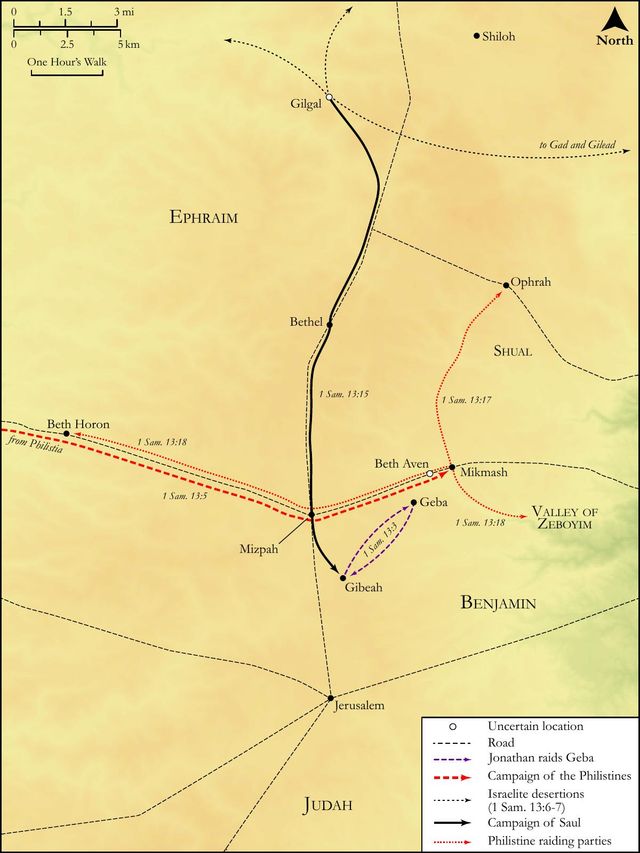
1 Samuel 13:3 marks a pivotal moment in Saul's early reign, detailing Jonathan's audacious and strategic strike against a Philistine garrison in Geba. This provocative act immediately reaches the ears of the Philistines, prompting King Saul to issue a nationwide call to arms by blowing the trumpet, summoning all Israelites—referred to as "Hebrews"—to unite for the inevitable and decisive conflict. The verse thus serves as the direct catalyst for the major confrontation between Israel and the Philistines, highlighting the profound impact of individual courage and the urgent necessity of national mobilization against oppressive foreign control.
Context
ShowHideLiterary Context
This verse is strategically positioned within the unfolding narrative of Saul's nascent monarchy, immediately following his anointing by Samuel and his initial, unifying victory over the Ammonites, which solidified his kingship in the eyes of Israel (1 Samuel 11). Chapter 13 opens by establishing the numerical inferiority of Saul's standing army compared to the formidable Philistine military. Jonathan's bold assault on the Philistine garrison in Geba is not a random skirmish but a deliberate and calculated provocation designed to challenge Philistine hegemony. This act directly precipitates the major military engagement that dominates the remainder of chapter 13 and extends into chapter 14, marking a critical transition from a period of uneasy truce or passive subjugation to open, large-scale warfare. It sets the stage for the subsequent narrative, detailing Israel's fear, Saul's rash and disobedient actions, and Jonathan's continued displays of valor, all stemming from this initial, catalytic blow.
Historical & Cultural Context
During this period, the Philistines represented the dominant regional power, maintaining military superiority through their monopoly on iron technology and their strategic garrisons throughout Israelite territory. 1 Samuel 13:19-22 explicitly states that Israelites were disarmed, lacking blacksmiths and forced to rely on Philistines even for sharpening basic tools, thereby preventing them from forging weapons. Geba, located in the tribal territory of Benjamin, was a crucial Philistine outpost near Michmash, controlling a vital pass that linked central Israel to the Jordan Valley. Jonathan's attack was therefore a direct assault on a symbol of Philistine authority and a bold challenge to their military supremacy and economic control. Saul's subsequent action of blowing the trumpet (the shofar) was a traditional and universally understood method of summoning a tribal militia or national assembly for war in ancient Israel, echoing similar calls for mobilization seen in passages like Judges 3:27 or Judges 6:34. The term "Hebrews" (Hebrew: ʿIbrîm) was often used by non-Israelites (like the Philistines) to refer to the Israelites, sometimes with a derogatory or ethnically distinct connotation, or by Israelites themselves when distinguishing from other peoples, particularly in contexts of servitude or conflict.
Key Themes
ShowHideThis verse powerfully encapsulates several key themes central to the book of 1 Samuel and the broader narrative of Israel's early monarchy. It vividly illustrates the theme of divine initiative often working through human courage, as Jonathan's bold, faith-driven act serves as the spark that ignites a national movement against oppression. It underscores the precarious nature of Israel's existence under Philistine domination and the cost of freedom, which demands decisive action, sacrifice, and a willingness to confront overwhelming odds. The verse also introduces the complexities and challenges of leadership, showing Saul's immediate and necessary response to rally the nation. However, this act, while crucial, foreshadows Saul's later struggles with obedience and his eventual rejection by God, a theme explored in depth in 1 Samuel 15. Finally, it sets the stage for the ongoing spiritual and physical warfare that would define Israel's relationship with its enemies, particularly the Philistines, throughout the reigns of Saul and David, highlighting the constant need for vigilance and reliance on God in the face of persistent threats.
Exposition and Analysis
ShowHideKey Word Analysis
ShowHideThe Hebrew verb נָכָה (nâkâh) is a primitive root signifying a forceful, decisive strike, ranging from a light blow to a severe wound or even killing. In this context, Jonathan's action of "smoting" the garrison implies a successful, impactful military engagement rather than a mere skirmish. It denotes a deliberate act of aggression and a significant blow against the Philistine presence, sufficient to provoke a major and immediate response. This word conveys the idea of a challenge to authority and a harbinger of widespread conflict.
The Hebrew word נְצִיב (nᵉtsîyb) refers to something stationary, specifically a military post, a standing force, or a pillar/outpost. Here, it denotes a Philistine military detachment or administrative post stationed in Geba, serving as a tangible symbol and instrument of their control over Israelite territory. To "smite the garrison" meant to directly attack and disrupt this symbol of foreign domination, signaling Israel's defiance and challenging the Philistine's established authority and military supremacy.
The term הָעִבְרִים (hāʻIbrîm) is a patronymic from Eber, referring to an Eberite or descendant of Eber. In this context, it is used by Saul to refer to his own people, the Israelites. While "Israel" is their covenant name, "Hebrew" often appears in the Old Testament when non-Israelites are speaking of them (sometimes with a derogatory connotation) or when Israelites are distinguishing themselves from others, particularly in times of conflict or servitude (e.g., Genesis 39:14). Saul's use of "Hebrews" here functions as a powerful rallying cry to his ethnic kin, emphasizing their shared identity and plight under Philistine oppression, calling them to unite against a common foe.
Verse Breakdown
ShowHide"And Jonathan smote the garrison of the Philistines that [was] in Geba"
This opening clause immediately highlights Jonathan's audacious and independent initiative. Without explicit command from Saul, Jonathan, driven by courage and perhaps a deep-seated desire for Israel's liberation, directly attacked a fortified Philistine outpost. Geba, strategically located, represented Philistine control over a vital pass. Jonathan's act was not a minor raid but a direct and significant challenge to the Philistine military presence, an act of defiance that would inevitably lead to severe repercussions and escalate the conflict.
"and the Philistines heard [of it]"
This brief but potent phrase underscores the immediate and inevitable consequence of Jonathan's action. The Philistines, a formidable military power accustomed to dominance, would not tolerate such an insult and challenge to their authority. "Heard of it" implies not just mere knowledge but a full and enraged understanding of the provocation and a swift determination to respond with overwhelming force, setting the stage for the massive Philistine counter-mobilization described later in the chapter.
"And Saul blew the trumpet throughout all the land, saying, Let the Hebrews hear"
Saul's response demonstrates his role as king and military leader. Recognizing the gravity of Jonathan's act and the impending Philistine retaliation, Saul utilizes the traditional method of summoning the militia: blowing the shofar (trumpet). This was a national call to arms, a desperate attempt to rally the scattered Israelite tribes and consolidate their forces against the superior Philistine army. His cry, "Let the Hebrews hear," is a direct and urgent appeal to national identity and solidarity in the face of an existential threat, emphasizing their shared heritage and the necessity of unified action.
Literary Devices
ShowHideThe verse effectively employs several literary devices to convey its dramatic impact and narrative significance. Foreshadowing is prominently featured, as Jonathan's decisive "smoting" of the garrison directly anticipates the massive Philistine counter-attack and the ensuing large-scale war, setting the narrative trajectory for the entire chapter and beyond. The "garrison" itself functions as synecdoche, where this specific military outpost represents the broader oppressive Philistine military presence and their dominion over Israel. Saul's act of "blowing the trumpet" is a clear instance of metonymy, where the instrument stands for the action it initiates – a national call to war and mobilization. Furthermore, the verse presents a subtle juxtaposition between Jonathan's individual, daring act of faith and Saul's subsequent, more conventional, and perhaps reactive, national call to arms, highlighting different facets of leadership and initiative in the face of crisis and the interplay between individual courage and corporate response.
Theological and Thematic Connections
ShowHideThis pivotal verse illustrates a profound theological principle: how divine purposes often unfold through courageous human initiative, even when seemingly small or provocative in the face of overwhelming odds. Jonathan's act, though militarily daring and potentially reckless from a human perspective, was ultimately a step of faith against a formidable oppressor, trusting that God would honor Israel's defiance. It underscores the biblical truth that God can use unexpected means and individuals to ignite significant movements, challenging the status quo and calling a people to action. The subsequent national rallying highlights the importance of unity and collective response in the face of spiritual or physical threats, reminding believers that while individual courage is vital, the corporate body is called to stand together in faith and action. This event serves as a microcosm of the larger spiritual warfare believers are engaged in, where bold steps of faith can indeed provoke a response from the enemy, necessitating a unified and committed stand.
Reflection and Application
ShowHide1 Samuel 13:3 offers profound and enduring lessons for contemporary believers, challenging us to consider our own responses to oppressive forces, whether spiritual or societal. Jonathan's willingness to act decisively, even in the face of overwhelming Philistine power and Israel's military weakness, serves as a powerful reminder that significant change often begins with a single, courageous step of faith. Are we, like Jonathan, willing to challenge the "garrisons" of spiritual oppression, pervasive injustice, or entrenched complacency in our own lives, families, and communities, even when the odds seem stacked against us? This verse calls us to move beyond passive acceptance and to embrace a spirit of bold, Spirit-led initiative. Furthermore, Saul's subsequent call to arms emphasizes the critical role of leadership in unifying God's people for a common purpose. It reminds us that individual acts of courage, while impactful, often need to be amplified by collective action and strategic leadership to achieve broader, lasting impact. Our actions, however small, can be catalysts that awaken others and provoke a larger movement for God's kingdom, requiring both individual conviction and corporate solidarity in the face of spiritual challenges.
Questions for Reflection
ShowHideFAQ
ShowHideWhy was Jonathan's act of "smoting" the garrison so significant, given Israel's military weakness?
ShowHideJonathan's act was profoundly significant precisely because of Israel's military weakness and the Philistines' overwhelming dominance. It was an audacious, almost suicidal, act of defiance against an entrenched oppressor. The Philistines had deliberately disarmed Israel, as 1 Samuel 13:19-22 clearly states, making any military action incredibly risky and seemingly futile. Jonathan's strike at Geba, a strategic Philistine outpost, was a direct challenge to their authority and a symbolic blow against their control. It demonstrated remarkable courage and faith, serving as a catalyst that ignited a national uprising and forced a decisive confrontation, rather than allowing the status quo of oppression to continue. It showed that even a seemingly small, bold act could have massive repercussions and spark a larger movement for liberation.
What is the significance of Saul blowing the trumpet and calling the "Hebrews" to hear?
ShowHideSaul's action was a traditional and urgent method of summoning a national militia for war in ancient Israel. The shofar (trumpet) blast was a universally recognized signal for assembly and battle, indicating imminent danger or a call to arms. By calling the "Hebrews" to hear, Saul was appealing to their shared ethnic and religious identity, uniting them against a common enemy. The term "Hebrews" itself often carried connotations of a distinct, sometimes overlooked, people group, particularly when used by or in contrast to non-Israelites. Saul's use of it here served as a powerful rallying cry, emphasizing their collective plight under Philistine oppression and the urgent need for a unified, national response to Jonathan's provocative act, which had now made war inevitable. It underscored his role as king in mobilizing the nation for defense and liberation.
Christ-Centered Fulfillment
ShowHideWhile 1 Samuel 13:3 describes a military confrontation in ancient Israel, it profoundly foreshadows the ultimate spiritual battle and decisive victory achieved by Jesus Christ. Jonathan's daring act of "smoting" the Philistine garrison, a tangible symbol of oppressive power and foreign dominion, finds its ultimate fulfillment in Jesus Christ. By His own divine initiative and power, Christ "smote" the dominion of sin, death, and the powers of darkness. Just as Jonathan's blow provoked a massive response from the earthly enemy, Christ's coming and His redemptive work on the cross provoked the ultimate confrontation with the spiritual forces of evil. Through His death and glorious resurrection, Jesus decisively triumphed over "every rule and authority and power and dominion," disarming them and leading them captive in His triumph (Colossians 2:15). Saul's subsequent act of blowing the trumpet throughout the land, summoning the "Hebrews" to hear and gather for battle, finds its spiritual echo in the call of the Gospel. Christ, our true King and victorious Commander, sends His disciples to "make disciples of all nations" (Matthew 28:18-20), effectively blowing the spiritual trumpet of salvation and gathering a new people—not just "Hebrews" but all who believe, from every tribe and tongue—into His eternal kingdom. This new covenant community is called to participate in His ongoing spiritual warfare against the forces of evil (Ephesians 6:12). Thus, Jonathan's initial strike and Saul's call to arms serve as a powerful shadow of the decisive victory won by the Lamb of God, who takes away the sin of the world (John 1:29), and His subsequent call for all people to join His victorious army and live under His liberating reign.