


Judges 3:27
Bible text: King James Version (1769 Blayney text) · Public domain
Bible text: King James Version with Strong's numbers · Public domain
Bible text: Berean Standard Bible · Public domain
Bible text: American Standard Version (1901) · Public domain
Bible text: World English Bible, Messianic edition · Public domain
Bible text: Geneva Bible (1599) · Public domain
Bible text: Young's Literal Translation · Public domain
- וַיְהִיvay·Hiand it wasH1961Conj-w ¦ V-Qal-ConsecImperf-3msVerb Qal Consecutive Imperfect 3rd Singular Masculineוַandיְהִיit was
- בְּבוֹאוֹbe·vo·'Owhen he cameH935Prep-b ¦ V-Qal-Inf ¦ 3msVerb Qal Infinitive Constructבְּwhenבוֹאcameוֹhe
- וַיִּתְקַעvai·yit·Ka'and he gave a blastH8628Conj-w ¦ V-Qal-ConsecImperf-3msVerb Qal Consecutive Imperfect 3rd Singular Masculineוַandיִּתְקַעhe gave a blast
- בַּשּׁוֹפָרba·sho·Faron the ram's hornH7782Prep-b ¦ N-msNoun Singular Masculine Absoluteבַּon theשּׁוֹפָרram's horn
- בְּהַרbe·Harin [the] hill country ofH2022Prep-b ¦ N-mscNoun Singular Masculine Constructבְּinהַר[the] hill country of
- אֶפְרָיִם'ef·Ra·yimEphraimH669N-proper-mNoun Proper Masculine
- וַיֵּרְדוּvai·ye·re·Duand they went downH3381Conj-w ¦ V-Qal-ConsecImperf-3mpVerb Qal Consecutive Imperfect 3rd Plural Masculineוַandיֵּרְדוּthey went down
- עִמּוֹi·Mowith himH5973Prep ¦ 3msPreposition Definiteעִמּwithוֹhim
- בְנֵיve·nei[the] people ofH1121N-mpcNoun Plural Masculine Construct
- יִשְׂרָאֵלYis·ra·'ElIsraelH3478N-properNoun Proper Location
- מִןminfromH4480PrepPreposition
- הָהָרha·Harthe hill countryH2022Art ¦ N-msNoun Singular Masculine Absoluteהָtheהָרhill country
- וְהוּאve·Hu'and heH1931Conj-w ¦ Pro-3msPronoun Personal 3rd Singular Masculineוְandהוּאhe
- לִפְנֵיהֶםlif·nei·Hem[was] <to> before themH6440Prep-l ¦ N-mpc ¦ 3mpNoun Plural Masculine Constructלִ[was] <to>פְנֵיbeforeהֶםthem
English is a literal word-by-word gloss of the Hebrew, not the KJV's wording. Why?
This is the original text the KJV's translators worked from — each Hebrew word with its own literal English meaning in this verse, prepared by scholars at Tyndale House, Cambridge. The KJV translates whole sentences, not word by word, so its wording differs: one Hebrew word can become several English words, and the KJV may choose “the LORD” where the gloss reads “Yahweh”. Both are faithful — they answer different questions. For the KJV's own rendering, switch to the KJV text.
Details
See on the biblical-era maps
Study this verse
Public-domain commentary
Matthew Henry
From his Commentary on the Whole Bible. Henry comments on passages, not single verses — this entry covers Judges 3:12–30. His four-level outline is real structure in the source text, so it is rendered as structure.
Ehud is the next of the judges whose achievements are related in this history, and here is an account of his actions.
I.When Israel sins again God raises up a new oppressor, Jdg 3:12-14.
It was an aggravation of their wickedness that they did evil again after they had smarted so long for their former iniquities, promised so fair when Othniel judged them, and received so much mercy from God in their deliverance. What, and after all this, again to break his commandments! Was the disease obstinate to all the methods of cure, both corrosives and lenitives? It seems it was. Perhaps they thought they might make the more bold with their old sins because they saw themselves in no danger from their old oppressor; the powers of that kingdom were weakened and brought low. But God made them know that he had variety of rods wherewith to chastise them: He strengthened Eglon king of Moab against them. This oppressor lay nearer to them than the former, and therefore would be the more mischievous to them; God's judgments thus approached them gradually, to bring them to repentance. When Israel dwelt in tents, but kept their integrity, Balak king of Moab, who would have strengthened himself against them, was baffled; but now that they had forsaken God, and worshipped the gods of the nations round about them (and perhaps those of the Moabites among the rest), here was another king of Moab, whom God strengthened against them, put power into his hands, though a wicked man, that he might be a scourge to Israel. The staff in his hand with which he beat Israel was God's indignation; howbeit he meant not so, neither did his heart think so, Isa 10:6, Isa 10:7. Israelites did ill, and, we may suppose, Moabites did worse; yet because God commonly punishes the sins of his own people in this world, that, the flesh being destroyed, the spirit may be saved, Israel is weakened and Moab strengthened against them. God would not suffer the Israelites, when they were the stronger, to distress the Moabites, nor give them any disturbance, though they were idolaters (Deu 2:9); yet now he suffered the Moabites to distress Israel, and strengthened them on purpose that they might: Thy judgments, O God! are a great deep. The king of Moab took to his assistance the Ammonites and Amalekites (Jdg 3:13), and this strengthened him; and we are here told how they prevailed.
1.They beat them in the field: They went and smote Israel (Jdg 3:13), not only those tribes that lay next them on the other side Jordan, who, though first settled, being frontier-tribes, were most disturbed; but those also within Jordan, for they made themselves masters of the city of palm-trees, which, it is probable, was a strong-hold erected near the place where Jericho had stood, for that was so called (Deu 34:3), into which the Moabites put a garrison, to be a bridle upon Israel, and to secure the passes of Jordan, for the preservation of the communication with their own country. It was well for the Kenites that they had left this city (Jdg 1:16) before it fell into the hands of the enemy. See how quickly the Israelites lost that by their own sin which they had gained by miracles of divine mercy.
2.They made them to serve (Jdg 3:14), that is, exacted tribute from them, either the fruits of the earth in kind or money in lieu of them. They neglected the service of God, and did not pay him his tribute; thus therefore did God recover from them that wine and oil, that silver and gold, which they prepared for Baal, Hos 2:8. What should have been paid to the divine grace, and was not, was distrained for, and paid to the divine justice. The former servitude (Jdg 3:8) lasted but eight years, this eighteen; for, if less troubles do not do the work, God will send greater.
II.When Israel prays again God raises up a new deliverer (Jdg 3:15), named Ehud. We are here told,
1.That he was a Benjamite. The city of palm-trees lay within the lot of this tribe, by which it is probable that they suffered most, and therefore stirred first to shake off the yoke. It is supposed by the chronologers that the Israelites' war with Benjamin for the wickedness of Gibeah, by which that whole tribe was reduced to 600 men, happened before this, so that we may well think that tribe to be now the weakest of all the tribes, yet out of it God raised up this deliverer, in token of his being perfectly reconciled to them, to manifest his own power in ordaining strength out of weakness, and that he might bestow more abundant honour upon that part which lacked, Co1 12:24.
2.That he was left-handed, as it seems many of that tribe were, Jdg 20:16. Benjamin signifies the son of the right hand, and yet multitudes of them were left-handed; for men's natures do not always answer their names. The lxx. say he was an ambidexter, one that could use both hands alike, supposing that this was an advantage to him in the action he was called to; but the Hebrew phrase, that he was shut of his right hand, intimates that, either through disease of disuse, he made little or no use of that, but of his left hand only, and so was the less fit for war, because he must needs handle his sword but awkwardly; yet God chose this left-handed man to be the man of his right hand, whom he would make strong for himself, Psa 80:17. It was God's right hand that gained Israel the victory (Psa 44:3), not the right hand of the instruments he employed.
3.We are here told what Ehud did for the deliverance of Israel out of the hands of the Moabites. He saved the oppressed by destroying the oppressors, when the measure of their iniquity was full and the set time to favour Israel had come.
(1.)He put to death Eglon the king of Moab; I say, put him to death, not murdered or assassinated him, but as a judge, or minister of divine justice, executed the judgments of God upon him, as an implacable enemy to God and Israel. This story is particularly related.
[1.]He had a fair occasion of access to him. Being an ingenious active man, and fit to stand before kings, his people chose him to carry a present in the name of all Israel, over and above their tribute, to their great lord the king of Moab, that they might find favour in his eyes, Jdg 3:15. The present is called mincha in the original, which is the word used in the law for the offerings that were presented to God to obtain his favour; these the children of Israel had not offered in their season to the God that loved them; and now, to punish them for their neglect, they are laid under a necessity of bringing their offerings to a heathen prince that hated them. Ehud went on his errand to Eglon, offered his present with the usual ceremony and expressions of dutiful respect, the better to colour what he intended and to prevent suspicion.
[2.]It should seem, from the first, he designed to be the death of him, God putting it into his heart, and letting him know also that the motion was from himself, by the Spirit that came upon him, the impulses of which carried with them their own evidence, and so gave him full satisfaction both as to the lawfulness and the success of this daring attempt, of both which he would have had reason enough to doubt. If he be sure that God bids him do it, he is sure both that he may do it and that he shall do it; for a command from God is sufficient to bear us out, and bring us off, both against our consciences and against all the world. That he compassed and imagined the death of this tyrant appears by the preparation he made of a weapon for the purpose, a short dagger, but half a yard long, like a bayonet, which might easily be concealed under his clothes (Jdg 3:16), perhaps because none were suffered to come near the king with their swords by their sides. This he wore on his right thigh, that it might be the more ready to his left hand, and might be the less suspected.
[3.]He contrived how to be alone with him, which he might the more easily be now that he had not only made himself known to him, but ingratiated himself by the present, and the compliments which perhaps, on this occasion, he had passed upon him. Observe, how he laid his plot. First, He concealed his design even from his own attendants, brought them part of the way, and then ordered them to go forward towards home, while he himself, as if he had forgotten something behind him, went back to the king of Moab's court, Jdg 3:18. There needed but one hand to do the execution; had more been engaged they could not so safely have kept counsel, nor so easily have made an escape. Secondly, He returned from the quarries by Gilgal (Jdg 3:19), from the graven images (so it is in the margin) which were with Gilgal, set up perhaps by the Moabites with the twelve stones which Joshua had set up there. Some suggest that the sight of these idols stirred up in him such an indignation against the king of Moab as put him upon the execution of that design which otherwise he had thought to let fall for the present. Or, perhaps, he came so far as to these images, that, telling from what place he returned, the king of Moab might be the more apt to believe he had a message from God. Thirdly, He begged a private audience, and obtained it in a withdrawing-room, here called a summer parlour. He told the king he had a secret errand to him, who thereupon ordered all his attendants to withdraw, Jdg 3:19. Whether he expected to receive some private instructions from an oracle, or some private informations concerning the present state of Israel, as if Ehud would betray his country, it was a very unwise thing for him to be all alone with a stronger and one whom he had reason to look upon as an enemy; but those that are marked for ruin are infatuated, and their hearts hid from understanding; God deprives them of discretion.
[4.]When he had him alone he soon dispatched him. His summer parlour, where he used to indulge himself in ease and luxury, was the place of his execution. First, Ehud demands his attention to a message from God (Jdg 3:20), and that message was a dagger. God sends to us by the judgments of his hand, as well as by the judgments of his mouth. Secondly, Eglon pays respect to a message from God. Though a king, though a heathen king, though rich and powerful, though now tyrannizing over the people of God, though a fat unwieldy man that could not easily rise nor stand long, though in private and what he did was not under observation, yet, when he expected to receive orders form heaven, he rose out of his seat; whether it was low and easy, or whether it was high and stately, he quitted it, and stood up when God was about to speak to him, thereby owning God his superior. This shames the irreverence of many who are called Christians, and yet, when a message from God is delivered to them, study to show, by all the marks of carelessness, how little they regard it. Ehud, in calling what he had to do a message from God, plainly avouches a divine commission for it; and God's inclining Eglon to stand up to it did both confirm the commission and facilitate the execution. Thirdly, The message was delivered, not to his ear, but immediately, and literally, to his heart, into which the fatal knife was thrust, and was left there, Jdg 3:21, Jdg 3:22. His extreme fatness made him unable to resist or to help himself; probably it was the effect of his luxury and excess; and, when the fat closed up the blade, God would by this circumstance show how those that pamper the body do but prepare for their own misery. However, it was an emblem of his carnal security and senselessness. His heart was a fat as grease, and in that he thought himself enclosed. See Psa 119:70; Psa 17:10. Eglon signifies a calf, and he fell like a fatted calf, by the knife, an acceptable sacrifice to divine justice. Notice is taken of the coming out of the dirt or dung, that the death of this proud tyrant may appear the more ignominious and shameful. He that had been so very nice and curious about his own body, to keep it easy and clean, shall now be found wallowing in his own blood and excrements. Thus does God pour contempt upon princes. Now this act of Ehud's may justify itself because he had special direction from God to do it, and it was agreeable to the usual method which, under that dispensation, God took to avenge his people of their enemies, and to manifest to the world his own justice. But it will by no means justify any now in doing the like. No such commissions are now given, and to pretend to them is to blaspheme God, and made him patronize the worst of villanies. Christ bade Peter sheathe the sword, and we find not that he bade him draw it again.
[5.]Providence wonderfully favoured his escape, when he had done the execution. First, The tyrant fell silently, without any shriek or out-cry, which might have been overheard by his servants at a distance. How silently does he go down to the pit, choked up, it may be, with his own fat, which stifled his dying groans, though he had made so great a noise in the world, and had been the terror of the mighty in the land of the living! Secondly, The heroic executioner of this vengeance, with such a presence of mind as discovered not only no consciousness of guilt, but a strong confidence in the divine protection, shut the doors after him, took the key with him, and passed through the guards with such an air of innocence, and boldness, and unconcernedness, as made them not at all to suspect his having done any thing amiss. Thirdly, The servants that attended in the antechamber, coming to the door of the inner parlour, when Ehud had gone, to know their master's pleasure, and finding it locked and all quiet, concluded he had lain down to sleep, had covered his feet upon his couch, and gone to consult his pillow about the message he had received, and to dream upon it (Jdg 3:24), and therefore would not offer to open the door. Thus by their care not to disturb his sleep they lost the opportunity of revenging his death. See what comes of men's taking state too much, and obliging those about them to keep their distance; some time or other it may come against them more than they think of. Fourthly, The servants at length opened the door, and found their master had slept indeed his long sleep, Jdg 3:25. The horror of this tragical spectacle, and the confusion it must needs put them into, to reflect upon their own inconsideration in not opening the door sooner, quite put by the thoughts of sending pursuers after him that had done it, whom now they despaired of overtaking. Lastly, Ehud by this means made his escape to Sierath, a thick wood; so some, Jdg 3:26. It is not said any where in this story what was the place in which Eglon lived now; but, there being no mention of Ehud passing and repassing Jordan, I am inclined to think that Eglon had left his own country of Moab, on the other side Jordan, and made his principal residence at this time in the city of palm-trees, within the land of Canaan, a richer country than his own, and that there he was slain, and then the quarries by Gilgal were not far off him. There where he had settled himself, and thought he had sufficiently fortified himself to lord it over the people of God, there he was cut off, and proved to be fed for the slaughter like a lamb in a large place.
(2.)Ehud, having slain the king of Moab, gave a total rout to the forces of the Moabites that were among them, and so effectually shook off the yoke of their oppression.
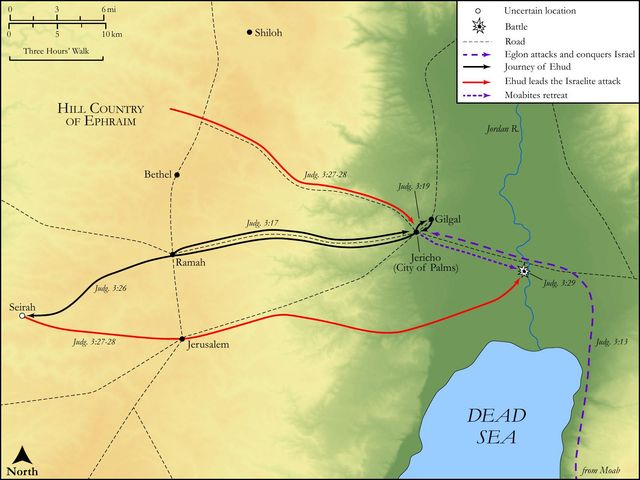
[1.]He raised an army immediately in Mount Ephraim, at some distance form the headquarters of the Moabites, and headed them himself, Jdg 3:27. The trumpet he blew was indeed a jubilee-trumpet, proclaiming liberty, and a joyful sound it was to the oppressed Israelites, who for a long time had heard no other trumpets than those of their enemies.
[2.]Like a pious man, and as one that did all this in faith, he took encouragement himself, and gave encouragement to his soldiers, from the power of God engaged for them (Jdg 3:28): "Follow me, for the Lord hath delivered your enemies into your hands; we are sure to have God with us, and therefore may go on boldly, and shall go on triumphantly." [3.] Like a politic general, he first secured the fords of Jordan, set strong guards upon all those passes, to cut off the communications between the Moabites that were in the land of Israel (for upon them only his design was) and their own country on the other side Jordan, that if, upon the alarm given them, they resolved to fly, they might not escape thither, and, if they resolved to fight, they might not have assistance thence. Thus he shut them up in that land as their prison in which they were pleasing themselves as their palace and paradise. [4.] He then fell upon them, and put them all to the sword, 10,000 of them, which it seems was the number appointed to keep Israel in subjection (Jdg 3:29): There escaped not a man of them. And they were the best and choicest of all the king of Moab's forces, all lusty men, men of bulk and stature, and not only able-bodied, but high spirited too, and men of valour, Jdg 3:29. But neither their strength nor their courage stood them in any stead when the set time had come for God to deliver them into the hand of Israel. [5.] The consequence of this victory was that the power of the Moabites was wholly broken in the land of Israel. The country was cleared of these oppressors, and the land had rest eighty years, Jdg 3:30. We may hope that there was likewise a reformation among them, and a check give to idolatry, by the influence of Ehud which continued a good part of this time. It was a great while for the land to rest, fourscore years; yet what is that to the saints' everlasting rest in the heavenly Canaan?
Continue studying Judges 3:27 across the web’s major study libraries — every link below opens this exact verse, chapter, or book on the destination site.
Read & Compare
 BibleGatewayThis verse in more than 200 translations and 70 languages.
 Bible.comThe YouVersion reader — hundreds of translations, reading plans, and highlights.
 ESV.orgCrossway's official English Standard Version reader.
 NET BibleThe NET translation with 60,000+ translators' notes on every rendering decision.
 STEP BibleTyndale House's free study tool — original text, vocabulary, and scholarly resources.
 BibliaLogos Bible Software's free web reader.
 USCCBThe New American Bible (Revised Edition) with the U.S. bishops' study notes.
Commentaries
 BibleHub CommentariesDozens of classic commentaries on this verse, gathered on one page.
 StudyLightMore than 100 commentary sets — the largest collection on the web.
 BibleRefPlain-English commentary on what this verse means, verse by verse.
 Enduring WordDavid Guzik's free commentary on this chapter, widely used by Bible teachers.
 Bible Study ToolsVerse commentary alongside Greek and Hebrew study aids.
Original Language & Research
- BibleHub InterlinearThe verse word by word — original language, transliteration, and English.
- BibleHub LexiconEvery word's original-language definition and Strong's entry.
 Blue Letter BibleDeep-study tools — Strong's numbers, concordance, and word studies.
 SefariaThe Hebrew text with Rashi and centuries of Jewish commentary.
Sermons, Hymns & Audio


TrulyRandomVerse is not affiliated with these sites and doesn’t control their content. They’re linked because they’re genuinely useful.
Summary
Judges 3:27 marks the pivotal moment of Ehud's divinely empowered deliverance of Israel from eighteen years of Moabite subjugation. Having successfully executed the clandestine assassination of King Eglon, Ehud returns to the strategic mountain of Ephraim and sounds a trumpet, a prearranged signal that galvanizes the scattered Israelite populace into immediate, unified action. This verse signifies the critical transition from a covert, individual act of vengeance to an open, collective rebellion, initiating Israel's descent from the high ground to confront their oppressors and reclaim their freedom.
Context
ShowHideLiterary Context
This verse immediately follows Ehud's daring and divinely orchestrated assassination of King Eglon, detailed in the preceding verses of Judges 3. After his dramatic escape from Eglon's palace in Judges 3:26, Ehud demonstrates decisive leadership by not resting, but immediately proceeding to the strategic "mountain of Ephraim." His actions here are the public manifestation of his private act of vengeance, transforming him from a lone assassin into the rallying leader of a national uprising. The blowing of the trumpet serves as the pivotal moment where the narrative shifts from individual heroism to collective military action, directly leading into the subsequent decisive battle against the Moabites described in Judges 3:28-30. This sequence underscores Ehud's role as God's chosen deliverer, moving from a stealth operation to a full-scale revolts.
Historical & Cultural Context
The "mountain of Ephraim" was a central, elevated, and often fortified region in ancient Israel, offering natural strongholds and strategic vantage points for assembling troops. This choice of location highlights Ehud's tactical acumen, providing both a secure refuge and an ideal position for a rallying cry. Trumpets, specifically the shofar (ram's horn), held profound significance in Israelite culture. Beyond their religious and ceremonial uses, such as at Mount Sinai or during the fall of Jericho, they were crucial for military signals, summoning assemblies, and sounding alarms. The shofar's unmistakable sound carried far across the rugged terrain, making it an effective instrument for rallying scattered tribes. Israel had endured eighteen years of harsh Moabite subjugation (Judges 3:14), a period of significant hardship and humiliation. The people's immediate and unified response to Ehud's trumpet call reflects their deep desperation for freedom and their readiness to follow a leader whom they perceived as God's appointed deliverer, demonstrating a latent but powerful will for liberation.
Key Themes
ShowHideJudges 3:27 powerfully illustrates several core themes prevalent throughout the Book of Judges. Firstly, it highlights Divine Deliverance, showcasing God's active intervention in response to Israel's cry for help (Judges 3:15). Ehud's successful assassination and subsequent rallying of the people are portrayed as integral to God's plan to liberate His chosen nation. Secondly, it underscores Inspired Leadership, as Ehud, despite his seemingly ordinary background and physical limitation, rises to become a courageous and decisive leader, placing himself "before them" to lead the charge. This aligns with the recurring pattern of God raising up "judges" or deliverers throughout the book (Judges 2:16). Thirdly, the verse emphasizes Unity and Obedience, as "the children of Israel went down with him from the mount." Their swift and collective response to the trumpet call demonstrates a crucial moment of national solidarity and trust in their leader, which was absolutely essential for overcoming their oppressors and securing their freedom.
Exposition and Analysis
ShowHideKey Word Analysis
ShowHideThe Hebrew word שׁוֹפָר (shôwphâr, H7782) refers specifically to a cornet or curved horn, typically a ram's horn, distinct from other wind instruments. It produced a loud, piercing, and often haunting sound. In ancient Israel, the shôwphâr served multiple critical functions: signaling alarm, summoning assemblies, initiating warfare, announcing new moons and festivals, and even heralding divine presence. Here, its blast is a prearranged, definitive call to arms, transforming a scattered, oppressed populace into a unified fighting force. The sound of the shôwphâr carried immense cultural and spiritual weight, often symbolizing a divine command or a momentous, life-altering event.
The Hebrew word הַר (har, H2022) denotes a mountain or range of hills. In this context, "the mountain of Ephraim" refers to the tribal territory of Ephraim, located in the central highlands of Canaan. This region was strategically important, offering natural defenses and elevated ground suitable for gathering troops discreetly before a descent into battle. The choice of Ephraim as the rallying point highlights Ehud's tribal affiliation and the practical necessity of using familiar, defensible terrain to assemble the Israelite forces. It also underscores the tactical advantage of high ground for both assembly and launching an attack.
The Hebrew verb יָרַד (yârad, H3381) signifies to descend, to go downwards, or to fall. In this verse, "went down with him from the mount" is highly significant. It marks the transition from a position of assembly and preparation on the high ground to active engagement in battle in the plains below. This descent is not a retreat but a purposeful, unified movement towards confrontation, symbolizing the Israelites' readiness to engage their oppressors. It implies a shift from a defensive posture to an offensive one, under Ehud's direct leadership.
Verse Breakdown
ShowHide"And it came to pass, when he was come, that he blew a trumpet in the mountain of Ephraim"
This clause signifies Ehud's successful return from his clandestine mission and his immediate, decisive action. The phrase "when he was come" implies a swift and purposeful journey back to his people, underscoring his commitment to the liberation effort. The act of blowing the trumpet (the shofar) is the prearranged signal, a public declaration of the success of his mission and a summons for the people to rise. The "mountain of Ephraim" is the strategic location chosen for this rallying cry, providing both a safe assembly point and a commanding position from which to launch an attack.
"and the children of Israel went down with him from the mount"
This highlights the immediate and unified response of the Israelite people. "The children of Israel" implies a broad representation of the tribes, indicating a collective willingness to follow Ehud's lead, demonstrating a rare moment of national solidarity in the fragmented period of the Judges. Their descent "from the mount" signifies the transition from assembly and preparation to active engagement in battle, moving from a defensive position to an offensive one. This swift obedience underscores their desperation for freedom and their trust in Ehud as their deliverer.
"and he before them"
This final phrase powerfully emphasizes Ehud's courageous and exemplary leadership. He does not merely issue commands from a distance or send his people into battle; he places himself at the forefront, leading by personal example. This demonstrates his unwavering commitment, bravery, and willingness to share the risks of the impending conflict. It portrays him as a true shepherd-leader, guiding his flock into the fight for their liberation, inspiring confidence and courage through his presence.
Literary Devices
ShowHideJudges 3:27 is rich with literary devices that amplify its significance. Synecdoche is evident in "the children of Israel," which represents the entire nation or a significant tribal coalition, rather than a literal count of every Israelite. The act of blowing the trumpet serves as a potent Symbolism of a call to war, liberation, and divine intervention; it is not merely a sound but a sign of a new beginning for the oppressed. The phrase "he before them" utilizes vivid Imagery, painting a picture of a courageous leader at the vanguard, while also functioning as Foreshadowing, hinting at the impending battle and Ehud's active role in leading the charge. The entire verse functions as a critical Turning Point in the narrative, shifting dramatically from Ehud's individual act of assassination to the collective military action that will ultimately secure Israel's deliverance. The narrative tension built by Ehud's solitary mission is released into a communal uprising.
Theological and Thematic Connections
ShowHideJudges 3:27 is a powerful testament to God's unwavering faithfulness in raising up deliverers for His people in their moments of distress. It demonstrates that divine intervention often works through human agency, empowering seemingly ordinary individuals like Ehud to act decisively and inspiring a collective response from the community. The trumpet blast, a signal of war and assembly, also carries deep theological weight, echoing the divine summons that calls God's people to action and obedience, often in the face of overwhelming odds. This moment of unity and courage, spurred by a divinely appointed leader, reflects the enduring principle that God's deliverance often requires the active participation and faith of His people, not just passive waiting. It underscores the covenant relationship where God acts on behalf of His people, and they, in turn, are called to respond in faith and obedience.
Reflection and Application
ShowHideJudges 3:27 offers profound insights for contemporary believers, challenging us to consider our own responsiveness to God's call. Just as Ehud's trumpet blast served as an unmistakable call to action for a people yearning for freedom, so too does God often issue clear signals in our lives, whether through His Word, the prompting of the Holy Spirit, the guidance of godly leaders, or the circumstances He orchestrates. The immediate and unified response of the Israelites reminds us of the critical importance of spiritual readiness and obedience when God calls us to step out in faith, even into challenging or uncomfortable circumstances. It teaches us that true leadership, like Ehud's, involves placing oneself "before" others, leading by example, and inspiring courage and commitment rather than merely commanding from a distance. This verse encourages us to be attentive to God's unique call for our lives, to respond with courage and unity, and to trust that He will equip us for the spiritual, social, or personal battles He calls us to fight, knowing that His deliverance often unfolds through our obedient participation.
Questions for Reflection
ShowHideFAQ
ShowHideWhat is the significance of the "mountain of Ephraim" in this verse?
ShowHideThe "mountain of Ephraim" was a geographically strategic and often rugged region in the central highlands of Israel. Its significance here lies in its dual function: it provided a secure, elevated location for Ehud to escape to after assassinating Eglon, ensuring his safety and allowing him to regroup. More importantly, it served as an ideal rallying point for the scattered Israelite forces. The high ground offered a natural defensive advantage and allowed the powerful, far-reaching sound of the shofar to carry effectively across the terrain, summoning the tribes. It symbolized a place of assembly and preparation, a secure base from which to launch the offensive. This location facilitated the transition from Ehud's covert action to an open, organized confrontation with the Moabites, as seen in Judges 3:28.
Christ-Centered Fulfillment
ShowHideWhile Judges 3:27 describes a temporal deliverance through a human judge, it powerfully foreshadows the ultimate, eternal deliverance brought by Jesus Christ. Ehud, blowing the trumpet and leading his people "before them," serves as a type of Christ, the true and greater Deliverer. Just as Ehud's trumpet blast signaled the beginning of freedom from Moabite oppression, so too does the "trumpet call" of the Gospel announce the good news of liberation from the bondage of sin and death through Christ's atoning work (Romans 6:18). Jesus, our ultimate leader and pioneer, did not merely send us into battle but went "before us," enduring the cross and conquering sin and death, thereby blazing the trail for our salvation (Hebrews 12:2). He is the one who gathers His people, not with a physical shofar, but with the transformative call of His Spirit, uniting them under His banner. Furthermore, His glorious return will also be heralded by the sound of a trumpet, signaling the final and complete deliverance of His saints and the establishment of His eternal kingdom (1 Thessalonians 4:16). Thus, Ehud's act of courageous leadership and the people's immediate, unified response in Judges 3:27 point forward to the supreme leadership of Christ and the faithful obedience of His church in anticipation of His glorious return and the consummation of His redemptive work.