


Nehemiah 4:20
- בִּמְקוֹםbim·Komin [the] placeH4725Prep-b ¦ N-mscNoun Singular Masculine Constructבִּinמְקוֹם[the] place
- אֲשֶׁר'a·Sher<of> whereH834RelParticle Relative
- תִּשְׁמְעוּtish·me·'Uyou will hearH8085V-Qal-Imperf-2mpVerb Qal Imperfect 2nd Plural Masculine
- אֶת'et<obj.>H853DirObjMParticle Object Indicator
- קוֹלKol[the] sound ofH6963N-mscNoun Singular Masculine Construct
- הַשּׁוֹפָרha·sho·Farthe ram's hornH7782Art ¦ N-msNoun Singular Masculine Absoluteהַtheשּׁוֹפָרram's horn
- שָׁמָּהSha·mahthere towardsH8033Adv ¦ SfxAdverbשָׁמָּthereהtowards
- תִּקָּבְצוּti·ka·ve·Tzuyou will assembleH6908V-Niphal-Imperf-2mpVerb Niphal Imperfect 2nd Plural Masculine
- אֵלֵינוּ'e·Lei·nuto usH413Prep ¦ 1cpPrepositionאֵלֵיtoנוּus
- אֱלֹהֵינוּ'e·lo·Hei·nuour GodH430N-mpc ¦ 1cpNoun Plural Masculine ConstructאֱלֹהֵיGodנוּour
- יִלָּחֶםyi·La·chemhe will fightH3898V-Niphal-Imperf-3msVerb Niphal Imperfect 3rd Singular Masculine
- לָנוּLa·nufor usPrep-l ¦ 1cpSuffix Personal 1st Plural common genderלָforנוּus
English is a literal word-by-word gloss of the Hebrew, not the KJV's wording. Why?
This is the original text the KJV's translators worked from — each Hebrew word with its own literal English meaning in this verse, prepared by scholars at Tyndale House, Cambridge. The KJV translates whole sentences, not word by word, so its wording differs: one Hebrew word can become several English words, and the KJV may choose “the LORD” where the gloss reads “Yahweh”. Both are faithful — they answer different questions. For the KJV's own rendering, switch to the KJV text.
Details
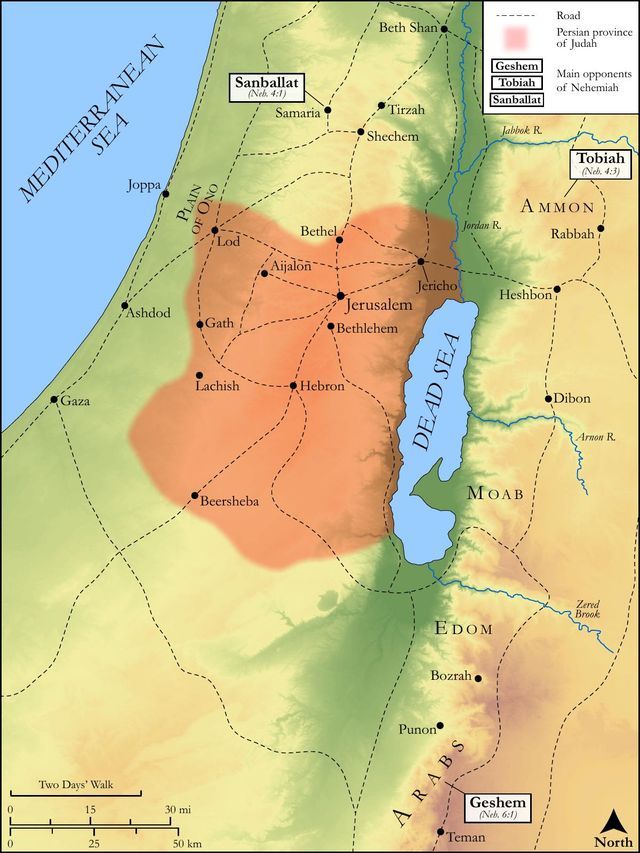
See on the biblical-era map
Study this verse
Public-domain commentary
Matthew Henry
From his Commentary on the Whole Bible. Henry comments on passages, not single verses — this entry covers Nehemiah 4:16–23.
When the builders had so far reason to think the design of the enemies broken as to return to their work, yet they were not so secure as to lay down their arms, knowing how restless and unwearied they were in their attempts, and that, if one design failed, they would be hatching another. Thus must we watch always against our spiritual enemies, and not expect that our warfare will be accomplished till our work is. See what course Nehemiah took, that the people might hold themselves in a readiness, in case there should be an attack. 1. While one half were at work, the other half were under their arms, holding spears, and shields, and bows, not only for themselves but for the labourers too, who would immediately quit their work, and betake themselves to their weapons, upon the first alarm, Neh 4:16. It is probable that they changed services at stated hours, which would relieve the fatigue of both, and particularly would be an ease to the bearers of burdens, whose strength had decayed (Neh 4:10); while they held the weapons, they were eased and yet not idle. Thus dividing their time between the trowels and the spears, they are said to work with one hand and hold their weapons with the other (Neh 4:17), which cannot be understood literally, for the work would require both hands; but it intimates that they were equally employed in both. Thus must we work out our salvation with the weapons of our warfare in our hand; for in every duty we must expect to meet with opposition from our spiritual enemies, against whom we must still be fighting the good fight of faith. 2. Every builder had a sword by his side (Neh 4:18), which he could carry without hindering his labour. The word of God is the sword of the Spirit, which we ought to have always at hand and never to seek, both in our labours and in our conflicts as Christians. 3. Care was taken both to get and give early notice of the approach of the enemy, in case they should endeavour to surprise them. Nehemiah kept a trumpeter always by him to sound an alarm, upon the first intimation of danger. The work was large, and the builders were dispersed; for in all parts of the wall they were labouring at the same time. Nehemiah continually walked round to oversee the work and encourage the workmen, and so would have speedy intelligence if the enemy made an attack, of which, by sound of trumpet, he would soon give notice to all, and they must immediately repair to him with a full assurance that their God would fight for them, Neh 4:18-20. When they acted as workmen, it was requisite they should be dispersed wherever there was work to do; but when as soldiers it was requisite they should come into close order, and be found in a body. Thus should the labourers in Christ's building be ready to unite against a common foe. 4. The inhabitants of the villages were ordered to lodge within Jerusalem, with their servants, not only that they might be the nearer to their work in the morning, but that they might be ready to help in case of an attack in the night, Neh 4:22. The strength of a city lies more in its hands than in its walls; secure them, and God's blessing upon them, and be secure. 5. Nehemiah himself, and all his men, kept closely to their business. The spears were held up, with the sight of them to terrify the enemy, not only from sun to sun, but from twilight to twilight every day, Neh 4:21. Thus ought we to be always upon our guard against our spiritual enemies, not only (as here) while it is light, but when it is dark, for they are the rulers of the darkness of this world. Nay, so very intent was Nehemiah upon his work, and so fast did he hold his servants to it, that while the heat of the business lasted neither he himself nor his attendants went into bed, but every night lay and slept in their clothes (Neh 4:23), except that they shifted them now and then, either for cleanliness or in a case of ceremonial pollution. It was a sign that their heart was upon their work when they could not find time to dress and undress, but resolved they would be at all times ready for service. Good work is likely to go on successfully when those that labour in it thus make a business of it.
Continue studying Nehemiah 4:20 across the web’s major study libraries — every link below opens this exact verse, chapter, or book on the destination site.
Read & Compare
 BibleGatewayThis verse in more than 200 translations and 70 languages.
 Bible.comThe YouVersion reader — hundreds of translations, reading plans, and highlights.
 ESV.orgCrossway's official English Standard Version reader.
 NET BibleThe NET translation with 60,000+ translators' notes on every rendering decision.
 STEP BibleTyndale House's free study tool — original text, vocabulary, and scholarly resources.
 BibliaLogos Bible Software's free web reader.
 USCCBThe New American Bible (Revised Edition) with the U.S. bishops' study notes.
Commentaries
 BibleHub CommentariesDozens of classic commentaries on this verse, gathered on one page.
 StudyLightMore than 100 commentary sets — the largest collection on the web.
 BibleRefPlain-English commentary on what this verse means, verse by verse.
 Enduring WordDavid Guzik's free commentary on this chapter, widely used by Bible teachers.
 Bible Study ToolsVerse commentary alongside Greek and Hebrew study aids.
Original Language & Research
- BibleHub InterlinearThe verse word by word — original language, transliteration, and English.
- BibleHub LexiconEvery word's original-language definition and Strong's entry.
 Blue Letter BibleDeep-study tools — Strong's numbers, concordance, and word studies.
 SefariaThe Hebrew text with Rashi and centuries of Jewish commentary.
Sermons, Hymns & Audio


TrulyRandomVerse is not affiliated with these sites and doesn’t control their content. They’re linked because they’re genuinely useful.
Summary
Nehemiah 4:20 stands as a powerful testament to Nehemiah's divinely inspired leadership and the unwavering faith of the post-exilic community amidst formidable opposition. This verse masterfully blends a pragmatic military strategy with a profound theological declaration, instructing the scattered wall-builders to rally swiftly at the sound of the trumpet, while simultaneously assuring them that their ultimate defense and victory would not hinge solely on their human strength or coordination, but on the active, sovereign intervention of God Himself, who would assuredly fight on behalf of His people.
Context
ShowHideLiterary Context
Nehemiah 4:20 is strategically placed within a narrative that vividly portrays the intense challenges faced by the Jewish community during the rebuilding of Jerusalem's walls. The preceding verses detail Nehemiah's meticulous organizational genius in response to threats from Sanballat, Tobiah, and Geshem. Recognizing that the work was spread out over a vast and vulnerable perimeter, making a unified defense difficult (Nehemiah 4:19), Nehemiah implemented a dual strategy: half the workers built, while the other half stood guard, armed with weapons (Nehemiah 4:16). Even the builders wore their swords at their sides (Nehemiah 4:18). Crucially, Nehemiah kept a trumpeter constantly by his side (Nehemiah 4:18). Therefore, verse 20 serves as the critical contingency plan, providing a clear, audible signal for rapid mobilization and mutual support, ensuring that the community could quickly converge and defend any point of attack, transforming a dispersed workforce into a unified fighting force.
Historical & Cultural Context
The events of Nehemiah unfold in the mid-5th century BCE, during the Persian Empire's dominion, specifically under Artaxerxes I. The Jewish exiles, having returned to a desolate Jerusalem, faced not only the daunting task of reconstruction but also relentless hostility from neighboring governors and peoples. Sanballat, Tobiah, and Geshem employed a spectrum of tactics, from ridicule and conspiracy to overt threats of armed assault, aiming to demoralize and halt the rebuilding. In this ancient Near Eastern context, the trumpet (specifically the shofar, a ram's horn, or chatzozerah, a metal trumpet) was an indispensable instrument for communication, assembly, and warfare. Its piercing sound carried over long distances, serving as an immediate call to battle, a warning of imminent danger, or a signal to rally troops. Nehemiah's strategic deployment of the trumpet was a highly practical and culturally understood method for coordinating defense in a pre-technological era, showcasing a remarkable blend of human ingenuity, disciplined organization, and profound reliance on divine protection.
Key Themes
ShowHideThis verse profoundly contributes to several overarching themes within the book of Nehemiah and the broader biblical narrative. Firstly, it powerfully underscores the theme of Divine Protection and Intervention. Despite the overwhelming odds and the formidable threats faced by the vulnerable community, Nehemiah's declaration, "our God shall fight for us," is a profound statement of faith. It echoes consistent biblical promises of divine aid, such as when the Lord assured Israel, "The LORD will fight for you, and you have only to be silent" during their exodus from Egypt. Secondly, it highlights the theme of Preparedness and Vigilance. Nehemiah did not passively await divine intervention; instead, he implemented meticulous practical measures. The instruction to "hear the sound of the trumpet, resort ye thither unto us" emphasizes the critical need for constant alertness and readiness, demonstrating a crucial balance between trusting God's sovereignty and exercising responsible human action. Lastly, the verse reinforces the theme of Unity and Mutual Support. The command to gather "thither unto us" emphasizes the importance of community solidarity in times of crisis. It implies that no individual or small group would face the enemy alone, but rather the entire community would rally together, reflecting the strength found in the principle that "two are better than one" and the collective defense of their shared purpose and divine calling.
Exposition and Analysis
ShowHideKey Word Analysis
ShowHideThe Hebrew word מָקֹום (mâqôwm) denotes a "standing," or more broadly, a "spot" or "locality." In this context, "in what place" signifies any specific location along the widely dispersed wall where an attack might occur or where the alarm might sound. It emphasizes the unpredictability of the threat and the necessity of a flexible, immediate response system that could operate effectively across the entire construction site. The term highlights the practical challenge of defending a large, unfinished structure and the strategic genius of Nehemiah's solution.
The Hebrew word שׁוֹפָר (shôwphâr) refers to a "cornet" or "curved horn," typically a ram's horn. This instrument was renowned for its clear, penetrating sound, making it ideal for signaling. In ancient Israel, the shôwphâr was used for various purposes, including religious festivals, assembly, and crucially, for sounding alarms and signaling war. Here, it is the designated, unmistakable call to action, its sound cutting through the noise of construction to instantly alert and mobilize the scattered workers to a point of danger, symbolizing urgency, unity, and a divine summons to defense.
The Hebrew verb לָחַם (lâcham) is a primitive root meaning "to feed on," "to consume," and by implication, "to battle" or "to make war." When applied to God, as in "our God shall fight for us," it signifies divine intervention and active, aggressive participation in the conflict on behalf of His people. This is not merely passive protection but a powerful, decisive engagement that implies God's omnipotent ability to overcome obstacles, defeat enemies, and secure victory. It assures the builders that their ultimate triumph was guaranteed by the hand of God, regardless of the human odds they faced.
Verse Breakdown
ShowHide"In what place [therefore] ye hear the sound of the trumpet,"
This opening clause establishes the critical condition for action, highlighting the strategic necessity of a clear, universally recognized signal for immediate danger. Given the widespread nature of the wall-building, a localized threat could quickly overwhelm a small, isolated group. The trumpet's sound serves as the centralized alarm system, transcending distance and individual awareness, ensuring that all workers, regardless of their specific location along the wall, would be instantly alerted to the precise point of crisis.
"resort ye thither unto us:"
This is Nehemiah's direct, imperative command for an immediate and unified response. The phrase "resort ye thither unto us" emphasizes the crucial need for all able-bodied individuals to converge quickly upon the location where the trumpet sound originated. This command fosters a vital sense of collective responsibility and mutual support, ensuring that no segment of the community would be left isolated to face an attack alone. It underscores the paramount importance of solidarity, coordinated effort, and communal defense in the face of external threats.
"our God shall fight for us."
This concluding declaration is the profound theological anchor of the verse, transforming a military command into an unwavering statement of faith and divine assurance. It serves to reassure the weary and threatened builders that despite their diligent human efforts and the formidable opposition, the ultimate victory and security belonged to God. This phrase served not as an excuse for passivity, but as a powerful source of courage, motivation, and perseverance, reminding them that their arduous work was divinely sanctioned and protected, and that the Lord of Hosts Himself was their ultimate, omnipotent defender against all adversaries.
Literary Devices
ShowHideNehemiah 4:20 is rich in literary devices that amplify its message. Metonymy is evident in the phrase "the sound of the trumpet," where the instrument (trumpet) stands in for the alarm or signal itself, representing the immediate call to action and the organized response it demands. The trumpet's sound is not just noise; it is a direct, urgent command. Symbolism is also powerfully at play, as the trumpet symbolizes not only warning and urgency but also unity, divine presence in battle, and a rallying cry for God's people, echoing its historical use throughout Israel for assembly and warfare. Furthermore, the verse culminates in a profound statement of Divine Assurance or Divine Promise, particularly in the concluding declaration, "our God shall fight for us." This statement functions as a theological anchor, providing unwavering confidence and motivation to the struggling community by appealing directly to God's character and His consistent acts of deliverance. This assurance serves as a potent rhetorical tool, designed to inspire courage, perseverance, and unwavering faith in the face of overwhelming opposition, transforming human fear into divine trust.
Theological and Thematic Connections
ShowHideNehemiah 4:20 encapsulates a profound theological truth: the harmonious interplay between human responsibility and divine sovereignty. Nehemiah, a man of fervent prayer and decisive action, understood that while God's ultimate protection and victory were assured, this did not negate the necessity of human diligence, strategic planning, and communal effort. The command to rally at the trumpet's sound demonstrates practical wisdom and preparedness, while the declaration "our God shall fight for us" instills unwavering faith. This balance teaches us that our trust in God's power should inspire us to act courageously and wisely, rather than leading to passivity or presumption. It speaks to the ongoing spiritual warfare faced by believers, where we are called to "put on the whole armor of God" (Ephesians 6:11) and stand firm, knowing that the battle ultimately belongs to the Lord, and He fights on our behalf.
Reflection and Application
ShowHideNehemiah 4:20 offers timeless principles for believers navigating challenges today, whether personal, communal, or spiritual. We are called to cultivate a dynamic faith that trusts in God's ultimate victory while diligently engaging in the work He has set before us. This means being spiritually alert, discerning the "sound of the trumpet" in our lives—the warnings, calls to action, or moments of crisis that demand our attention and response. It also means actively participating in the body of Christ, recognizing that we are not meant to face trials in isolation. Just as the builders rallied to one another, so too must we support and stand with our brothers and sisters in faith, knowing that our collective strength and God's active presence are our sure defense. Our preparedness, vigilance, and unity are not substitutes for God's power, but rather essential channels through which His power is manifested and His purposes advanced in a world often hostile to His kingdom.
Questions for Reflection
ShowHideFAQ
ShowHideDid the trumpet signal mean they stopped working on the wall?
ShowHideNo, the trumpet signal did not mean they stopped working entirely, but rather that they shifted their focus from general building to immediate defense and unified action. Nehemiah's ingenious strategy was designed for continuous progress, with half the people building and half standing guard, fully armed (Nehemiah 4:16). The trumpet was a crucial call to mobilize for defense at a specific point of attack, ensuring that the builders could quickly transition to fighting alongside the guards. It was a strategic pause in construction at a threatened location to ensure the safety of the workers and the continuation of the overall project, demonstrating a blend of vigilance, adaptability, and unwavering commitment to the task.
How does "God shall fight for us" relate to human effort?
ShowHideThis phrase highlights a crucial biblical principle: divine sovereignty does not negate human responsibility, but rather empowers and undergirds it. Nehemiah did not tell the people to cease their labor and passively wait for God to miraculously build the wall or defeat the enemies without their involvement. Instead, he implemented meticulous practical security measures—arming the workers, setting watches, and establishing a clear alarm system (Nehemiah 4:16). The declaration "our God shall fight for us" served as a powerful assurance that despite their diligent human efforts and limitations, the ultimate victory and security came from God. It fostered courage and perseverance, reminding them that their labor was not in vain because God was actively involved in their cause, guaranteeing their success against seemingly overwhelming odds. It's a profound call to diligent action in faith, not passive waiting.
What was the significance of the trumpet in ancient Israel?
ShowHideThe trumpet (often the shofar, a ram's horn, or the chatzozerah, a metal trumpet) held multifaceted significance in ancient Israel, serving both sacred and secular purposes. It was used for religious ceremonies, signaling new moons and feasts (Numbers 10:10), and for assembling the congregation for important announcements or journeys (Numbers 10:2). Crucially, it was an indispensable instrument in warfare and for giving alarms. It signaled the start of battle (Judges 7:20), warned of approaching danger or invasion (Jeremiah 4:5), and rallied troops for defense. In Nehemiah 4:20, its use as an immediate alarm for defense against attack would have been universally understood by the Jewish people, symbolizing urgency, unity, and a call to arms under divine protection.
Christ-Centered Fulfillment
ShowHideNehemiah 4:20, with its powerful blend of human effort, strategic vigilance, and divine assurance, finds its ultimate and most profound fulfillment in Jesus Christ and His ongoing work in building His church. Just as Nehemiah led the rebuilding of physical walls against external threats, Christ is the Master Builder of His spiritual kingdom, against which "the gates of hell shall not prevail" (Matthew 16:18). The declaration "our God shall fight for us" foreshadows Christ's decisive and ultimate victory over sin, death, and the principalities and powers of darkness through His crucifixion and glorious resurrection (Colossians 2:15). Believers, as members of His body, are called to participate actively in the ongoing work of advancing His kingdom, not in passive idleness, but with diligent engagement, knowing that the ultimate victory is already secured through Christ. We are equipped for spiritual warfare, not by our own meager strength, but by the indwelling power of God's Spirit, enabling us to put on "the full armor of God" (Ephesians 6:10). When we face opposition, whether from the world, the flesh, or the devil, we rally to Christ, our Captain and King, knowing that in Him, "we are more than conquerors through him who loved us" (Romans 8:37). The trumpet's call in Nehemiah points forward to the ultimate trumpet call of God, signaling Christ's triumphant return and the final, glorious consummation of His kingdom (1 Thessalonians 4:16), when all enemies will be decisively and eternally put under His feet.