


Deuteronomy 3:22
Bible text: King James Version (1769 Blayney text) · Public domain
Bible text: Berean Standard Bible · Public domain
Bible text: American Standard Version (1901) · Public domain
Bible text: World English Bible, Messianic edition · Public domain
Bible text: Geneva Bible (1599) · Public domain
Bible text: Young's Literal Translation · Public domain
- לֹאlo'notH3808NegParticle Negative
- תְִּירָאוּםti·ra·'Umyou must fear themH3372V-Qal-Imperf-2mp ¦ 3mpVerb Qal Imperfect 2nd Plural Masculineתְִּירָאוּyou must fearםthem
- כִּיkiforH3588PrtParticle Conditional
- יְהוָהYah·wehYahwehH3068N-properNoun Proper Title
- אֱלֹהֵיכֶם'e·lo·hei·Khemyour GodH430N-mpc ¦ 2mpNoun Plural Masculine ConstructאֱלֹהֵיGodכֶםyour
- הוּאhu'heH1931Pro-3msPronoun Personal 3rd Singular Masculine
- הַנִּלְחָםha·nil·Cham[is] the [one who] will fightH3898Art ¦ V-Niphal-Prtcpl-msVerb Niphal Participle Singular Masculine Absoluteהַ[is] theנִּלְחָם[one who] will fight
- לָכֶםla·Khemfor youPrep-l ¦ 2mpSuffix Personal 2nd Plural Masculineלָforכֶםyou
English is a literal word-by-word gloss of the Hebrew, not the KJV's wording. Why?
This is the original text the KJV's translators worked from — each Hebrew word with its own literal English meaning in this verse, prepared by scholars at Tyndale House, Cambridge. The KJV translates whole sentences, not word by word, so its wording differs: one Hebrew word can become several English words, and the KJV may choose “the LORD” where the gloss reads “Yahweh”. Both are faithful — they answer different questions. For the KJV's own rendering, switch to the KJV text.
Details
See on the biblical-era maps
Study this verse
Public-domain commentary
Matthew Henry
From his Commentary on the Whole Bible. Henry comments on passages, not single verses — this entry covers Deuteronomy 3:21–29. His four-level outline is real structure in the source text, so it is rendered as structure.
Here is I. The encouragement which Moses gave to Joshua, who was to succeed him in the government, Deu 3:21, Deu 3:22. He commanded him not to fear. This those that are aged and experienced in the service of God should do all they can to strengthen the hands of those that are young, and setting out in religion. Two things he would have him consider for his encouragement: - 1. What God has done. Joshua had seen what a total defeat God had given by the forces of Israel to these two kings, and thence he might easily infer, so shall the Lord do to all the rest of the kingdoms upon which we are to make war. He must not only infer thence that thus the Lord can do with them all, for his arm is not shortened, but thus he will do, for his purpose is not changed; he that has begun will finish; as for God, his work is perfect. Joshua had seen it with his own eyes. And the more we have seen of the instances of divine wisdom, power, and goodness, the more inexcusable we are if we fear what flesh can do unto us. 2. What God had promised. The Lord your God he shall fight for you; and that cause cannot but be victorious which the Lord of hosts fights for. If God be for us, who can be against us so as to prevail? We reproach our leader if we follow him trembling.
II.The prayer which Moses made for himself, and the answer which God gave to that prayer.
1.His prayer was that, if it were God's will, he might go before Israel over Jordan into Canaan. At that time, when he had been encouraging Joshua to fight Israel's battles, taking it for granted that he must be their leader, he was touched with an earnest desire to go over himself, which expresses itself not in any passionate and impatient complaints, or reflections upon the sentence he was under, but in humble prayers to God for a gracious reversing of it. I besought the Lord. Note, We should never allow any desires in our hearts which we cannot in faith offer up to God by prayer; and what desires are innocent, let them be presented to God. We have not because we ask not. Observe,
(1.)What he pleads here. Two things: - [1.] The great experience which he had had of God's goodness to him in what he had done for Israel: "Thou hast begun to show thy servant thy greatness. Lord, perfect what thou hast begun. Thou hast given me to see thy glory in the conquest of these two kings, and the sight has affected me with wonder and thankfulness. O let me see more of the outgoings of my God, my King! This great work, no doubt, will be carried on and completed; let me have the satisfaction of seeing it." Note, the more we see of God's glory in his works the more we shall desire to see. The works of the Lord are great, and therefore are sought out more and more of all those that have pleasure therein. [2.] The good impressions that had been made upon his heart by what he had seen: For what God is there in heaven or earth that can do according to thy works? The more we are affected with what we have seen of God, of his wisdom, power, and goodness, the better we are prepared for further discoveries. Those shall see the works of God that admire him in them. Moses had thus expressed himself concerning God and his works long before (Exo 15:11), and he still continues of the same mind, that there are no works worthy to be compared with God's works, Psa 86:8.
(2.)What he begs: I pray thee let me go over, Deu 3:25. God had said he should not go over; yet he prays that he might, not knowing but that the threatening was conditional, for it was not ratified with an oath, as that concerning the people was, that they should not enter. Thus Hezekiah prayed for his own life, and David for the life of his child, after both had ben expressly threatened; and the former prevailed, though the latter did not. Moses remembered the time when he had by prayer prevailed with God to recede from the declarations which he had made of his wrath against Israel, Exo 32:14. And why might he not hope in like manner to prevail for himself? Let me go over and see the good land. Not, "Let me go over and be a prince and a ruler there;" he seeks not his own honour, is content to resign the government to Joshua; but, "Let me go to be a spectator of thy kindness to Israel, to see what I believe concerning the goodness of the land of promise." How pathetically does he speak of Canaan, that good land, that goodly mountain! Note, Those may hope to obtain and enjoy God's favours that know how to value them. What he means by that goodly mountain we may learn from Psa 78:54, where it is said of God's Israel that he brought them to the border of his sanctuary, even to this mountain which his right hand had purchased, where it is plainly to be understood of the whole land of Canaan, yet with an eye to the sanctuary, the glory of it.
2.God's answer to this prayer had in it a mixture of mercy and judgment, that he might sing unto God of both.
(1.)There was judgment in the denial of his request, and that in something of anger too: The Lord was wroth with me for your sakes, Deu 3:26. God not only sees sin in his people, but is much displeased with it; and even those that are delivered from the wrath to come may yet lie under the tokens of God's wrath in this world, and may be denied some particular favour which their hearts are much set upon. God is a gracious, tender, loving Father; but he is angry with his children when they do amiss, and denies them many a thing that they desire and are ready to cry for. But how was he wroth with Moses for the sake of Israel? Either,
[1.]For that sin which they provoked him to; see Psa 106:32, Psa 106:33. Or,
[2.]The removal of Moses at that time, when he could so ill be spared, was a rebuke to all Israel, and a punishment of their sin. Or,
[3.]It was for their sakes, that it might be a warning to them to take heed of offending God by passionate and unbelieving speeches at any time, after the similitude of his transgression; for, if this were done to such a green tree, what should be done to the dry? He acknowledges that God would not hear him. God had often heard him for Israel, yet he would not hear him for himself. It was the prerogative of Christ, the great Intercessor, to be heard always; yet of him his enemies said, He saved others, himself he could not save, which the Jews would not have upbraided him with had they considered that Moses, their great prophet, prevailed for others, but for himself he could not prevail. Though Moses, being one of the wrestling seed of Jacob, did not seek in vain, yet he had not the thing itself which he sought for. God may accept our prayers, and yet not grant us the very thing we pray for.
(2.)Here is mercy mixed with this wrath in several things: - [1.] God quieted the spirit of Moses under the decree that had gone forth by that word (Deu 3:26), Let it suffice thee. With this word, no doubt, a divine power went to reconcile Moses to the will of God, and to bring him to acquiesce in it. If God does not by his providence give us what we desire, yet, if by his grace he makes us content without it, it comes much to one. "Let it suffice thee to have God for they father, and heaven for thy portion, though thou hast not every thing thou wouldest have in this world. Be satisfied with this, God is all-sufficient." [2.] He put an honour upon his prayer in directing him not to insist upon this request: Speak no more to me of this matter. It intimates that what God does not think fit to grant we should not think fit to ask, and that God takes such a pleasure in the prayer of the upright that it is no pleasure to him, no, not in any particular instance, to give a denial to it. [3.] He promised him a sight of Canaan from the top of Pisgah, Deu 3:27. Though he should not have the possession of it, he should have the prospect of it; not to tantalize him, but such a sight of it as would yield him true satisfaction, and would enable him to form a very clear and pleasing idea of that promised land. Probably Moses had not only his sight preserved for other purposes, but greatly enlarged for this purpose; for, if he had not had such a sight of it as others could not have from the same place, it would have been no particular favour to Moses, nor the matter of a promise. Even great believers, in this present state, see heaven but at a distance. [4.] He provided him a successor, one who should support the honour of Moses and carry on and complete that glorious work which the heart of Moses was so much upon, the bringing of Israel to Canaan, and settling them there (Deu 3:28): Charge Joshua and encourage him in this work. Those to whom God gives a charge, he will be sure to give encouragement to. And it is a comfort to the church's friends (when they are dying and going off) to see God's work likely to be carried on by other hands, when they are silent in the dust.
Continue studying Deuteronomy 3:22 across the web’s major study libraries — every link below opens this exact verse, chapter, or book on the destination site.
Read & Compare
 BibleGatewayThis verse in more than 200 translations and 70 languages.
 Bible.comThe YouVersion reader — hundreds of translations, reading plans, and highlights.
 ESV.orgCrossway's official English Standard Version reader.
 NET BibleThe NET translation with 60,000+ translators' notes on every rendering decision.
 STEP BibleTyndale House's free study tool — original text, vocabulary, and scholarly resources.
 BibliaLogos Bible Software's free web reader.
 USCCBThe New American Bible (Revised Edition) with the U.S. bishops' study notes.
Commentaries
 BibleHub CommentariesDozens of classic commentaries on this verse, gathered on one page.
 StudyLightMore than 100 commentary sets — the largest collection on the web.
 BibleRefPlain-English commentary on what this verse means, verse by verse.
 Enduring WordDavid Guzik's free commentary on this chapter, widely used by Bible teachers.
 Bible Study ToolsVerse commentary alongside Greek and Hebrew study aids.
Original Language & Research
- BibleHub InterlinearThe verse word by word — original language, transliteration, and English.
- BibleHub LexiconEvery word's original-language definition and Strong's entry.
 Blue Letter BibleDeep-study tools — Strong's numbers, concordance, and word studies.
 SefariaThe Hebrew text with Rashi and centuries of Jewish commentary.
Sermons, Hymns & Audio


TrulyRandomVerse is not affiliated with these sites and doesn’t control their content. They’re linked because they’re genuinely useful.
Summary
Deuteronomy 3:22 encapsulates a profound command and promise delivered by Moses to the Israelites as they stood poised to enter the Promised Land. This verse, "Ye shall not fear them: for the LORD your God he shall fight for you," serves as a vital source of courage and assurance. It grounds the nation's future success not in their own military might or numerical superiority, but in the omnipotence, unwavering faithfulness, and active intervention of their covenant God, who stands ready to contend on behalf of His people against formidable adversaries.
Context
ShowHideLiterary Context
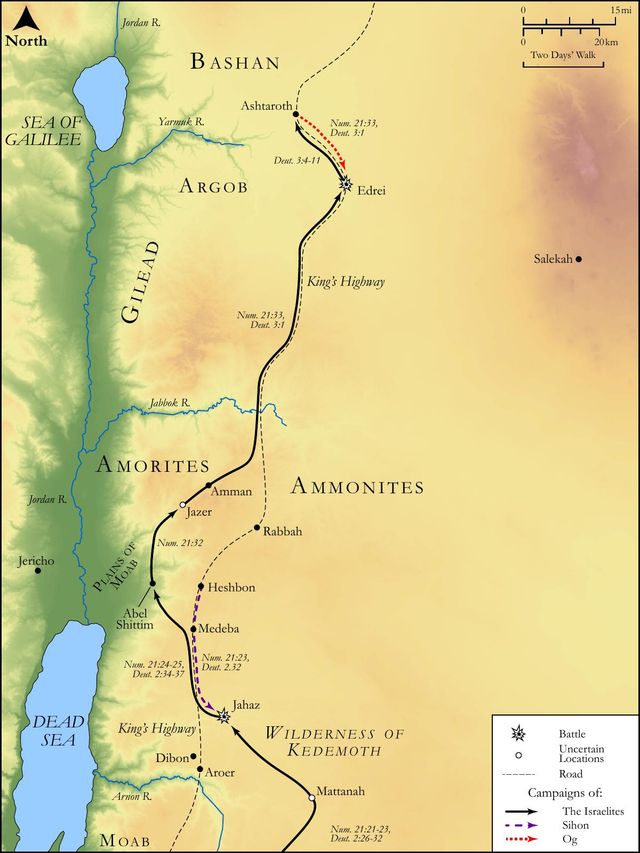
This powerful declaration is embedded within Moses' final, comprehensive discourses to the Israelites, delivered just before his death and their momentous entry into Canaan. Specifically, it follows Moses' vivid recounting of God's decisive and overwhelming victories over King Sihon of the Amorites and King Og of Bashan, detailed in Deuteronomy 3:1-11. These past triumphs serve as irrefutable evidence of God's power and His unwavering commitment to His people. Moses' words in Deuteronomy 3:22 are not merely a general exhortation but are also specifically directed to Joshua, Moses' divinely appointed successor, whom Moses has just commissioned and encouraged in Deuteronomy 3:21. The verse functions as a foundational assurance for the daunting task of conquering Canaan, reinforcing the theological principle that divine intervention, rather than human strength, is the ultimate key to their success. It strategically sets the stage for the unfolding narrative of conquest in the subsequent book of Joshua, establishing the divine precedent for Israel's military engagements.
Historical & Cultural Context
The Israelites found themselves on the eastern bank of the Jordan River, gazing across at the formidable, fortified cities and seasoned warrior nations of Canaan. This period was characterized by intense geopolitical struggles among the nations, where military might, strategic alliances, and the perceived favor of a nation's god were paramount. For a people who had endured forty years of wilderness wandering, largely unaccustomed to large-scale pitched battles against established, well-equipped armies, the prospect of confronting the Canaanite nations was naturally terrifying. The command "Ye shall not fear them" directly addresses this very real human dread and the natural inclination to be intimidated by superior forces. Culturally, the concept of a nation's god fighting on its behalf was understood, but Israel's unique covenant with Yahweh meant that their God was not merely one among many, but the sovereign Creator and Sustainer, whose power was absolute and whose faithfulness was unparalleled. This promise transformed their upcoming military campaign from a conventional human war into a "holy war" or "Yahweh war," where the Lord Himself was the primary combatant and guarantor of victory.
Key Themes
ShowHideDeuteronomy 3:22 profoundly contributes to several core themes woven throughout the book of Deuteronomy and the broader Old Testament narrative. Foremost is the theme of Divine Protection and Intervention, emphasizing that God Himself will actively engage in battle on behalf of His people. This is not passive support but decisive warfare waged by the Almighty, a concept powerfully articulated in Exodus 14:14. Secondly, it underscores the theme of Overcoming Fear through Faith. The direct command to "not fear" confronts the human tendency towards dread in the face of overwhelming odds, positing that absolute trust in God's omnipotence is the antidote to paralyzing fear. It urges the Israelites to look beyond their immediate circumstances to the character and power of their Deliverer. Lastly, it powerfully reinforces God's Covenant Faithfulness. The past victories recounted by Moses serve as a testament to God's consistent character and His unwavering commitment to His covenant promises. His promise to fight for them in the future is deeply rooted in His proven faithfulness in the past, building confidence for the challenges ahead and highlighting the divine initiative in Israel's history as a people chosen and sustained by God's mighty hand, as seen throughout the narrative of Joshua 10.
Exposition and Analysis
ShowHideKey Word Analysis
ShowHideThis verb (H3372) in its Qal stem, as used here, primarily signifies "to be afraid," "to dread," or "to be terrified." While yârêʼ can also convey "to reverence" or "to stand in awe" (as in "the fear of the LORD"), in this specific context, the negative imperative ("Ye shall not fear") clearly denotes a prohibition against succumbing to terror or intimidation by their human adversaries. It is a command to reject paralyzing dread and to instead place unwavering confidence in God.
This is the sacred, covenantal name of God (H3068), often transliterated as Yahweh. Derived from a root meaning "to be" or "to exist," it emphasizes God's self-existence, eternal nature, and His personal, relational commitment to His people, Israel. When Moses speaks of "the LORD your God," he is invoking the specific, unchanging, and powerful God who entered into covenant with Israel, the one who has consistently demonstrated His faithfulness and might throughout their history, distinguishing Him from the pagan deities of the Canaanites.
The verb (H3898) signifies "to wage war," "to contend in battle," or "to fight." Its active voice and future tense ("he shall fight") underscore God's direct, personal, and decisive involvement in the upcoming conflicts. This is not merely a promise of spiritual support or moral encouragement, but an assurance of divine military action on Israel's behalf, implying that God will actively defeat their enemies, consume their opposition, and secure the victory.
Verse Breakdown
ShowHide"Ye shall not fear them"
This is a direct, emphatic command from Moses, speaking with divine authority, addressed to the entire Israelite community. "Them" refers to the formidable nations and inhabitants of Canaan whom they are about to confront. It directly addresses the natural human inclination towards dread when facing superior numbers, strength, or fortifications. This imperative calls for a conscious act of faith and trust, choosing courage and reliance on God over paralyzing fear.
"for the LORD your God"
This clause provides the foundational reason and ultimate source of the command. The identity of the one who will fight is crucial: it is "the LORD" (YHWH, the covenant name of God, emphasizing His personal, relational, and unchanging character) and "your God" (stressing His particular relationship and unwavering commitment to Israel through the covenant). This specific designation reminds them of His supreme power, His unbreakable promises, and His active, abiding presence among them.
"he shall fight for you"
This is the divine promise, the absolute assurance that undergirds the command to not fear. The pronoun "he" is emphatic in the Hebrew, highlighting that it is God Himself, personally and actively, who will engage in battle on their behalf. This promise implies not just assistance or general support, but decisive victory, where God takes the initiative, leads the charge, and secures the triumph, thereby relieving His people of the burden of fighting in their own strength or relying solely on their own limited resources.
Literary Devices
ShowHideDeuteronomy 3:22 employs several potent literary devices to convey its message with maximum impact and spiritual resonance. The primary device is Divine Assurance, where God, speaking through Moses, provides an unwavering guarantee of His active presence and direct intervention. This assurance is powerfully framed as a Command-Promise Structure, where an imperative ("Ye shall not fear") is immediately followed by the divine rationale and promise ("for the LORD your God he shall fight for you"). This structure highlights the direct link between human obedience (specifically, trusting God and rejecting fear) and divine action. The verse also utilizes Contrast, setting the human tendency towards fear and intimidation against the divine reality of God's active combat on behalf of His people. Furthermore, it evokes the powerful and recurring Motif of God as Warrior or Divine Combat throughout the Old Testament, where Yahweh is depicted as the supreme commander and fighter for His people, demonstrating His absolute sovereignty over all earthly powers and His commitment to His covenant.
Theological and Thematic Connections
ShowHideDeuteronomy 3:22 stands as a cornerstone for understanding God's active and personal involvement in the lives of His people, both corporately as a nation and individually as believers. It underscores the profound theological truth that God's sovereignty extends not only to creation and providence but also to direct, decisive intervention in human affairs, especially on behalf of His covenant people. This promise of divine combat is a powerful testament to God's unwavering faithfulness to His covenant, demonstrating that His promises are not passive declarations but active, living commitments. It teaches that true security, courage, and ultimate victory are found not in human strength, military might, or strategic prowess, but in absolute reliance on the omnipotence and character of the LORD. This principle transcends the ancient battlefield, applying to all forms of opposition and spiritual warfare believers face across generations, reminding us that our ultimate victory is secured by God's power, not our own.
Reflection and Application
ShowHideDeuteronomy 3:22 offers timeless encouragement and a profound call to faith for believers today. While we may not face literal armies in the same way the Israelites did, we encounter various forms of opposition and challenges in life—spiritual battles against unseen forces, difficult personal circumstances, daunting professional tasks, or overwhelming anxieties that threaten to paralyze us. This verse reminds us that the same God who fought for Israel is our God, actively present, supremely powerful, and deeply committed to us in our lives. It calls us to surrender our fears and anxieties to Him, trusting that He is sovereign over every situation and perfectly capable of intervening on our behalf. Our courage is not to be found in our own abilities, limited resources, or self-reliance, but in the unwavering character, omnipotence, and steadfast love of our Deliverer. This truth fosters a spirit of humility and profound dependence, acknowledging that our true victories are ultimately secured by God's intervention, allowing us to face adversity with peace, confidence, and unwavering hope, knowing that He is always ready to contend for His people and bring about His purposes.
Questions for Reflection
ShowHideFAQ
ShowHideDoes God fighting for us mean we won't face any hardship or opposition?
ShowHideNo, the promise that God will "fight for you" does not guarantee an absence of hardship, opposition, or even direct conflict in a believer's life. Rather, it assures us of God's active presence, supreme power, and ultimate victory in and through our struggles. For the Israelites, it meant they would still engage in literal battles, but God would be their ultimate strength, their strategic advantage, and the one who secured their triumphs. For believers today, this applies to spiritual warfare, personal trials, and external pressures. We are reminded that our struggle is not primarily against flesh and blood, but against spiritual forces of evil, and in these battles, God equips us, empowers us through His Spirit, and ultimately ensures victory through Christ, as detailed in Ephesians 6:12 and Romans 8:37. It means we do not fight alone, and the outcome of our ultimate salvation and spiritual triumph is firmly in His hands.
Christ-Centered Fulfillment
ShowHideThe promise of the LORD fighting for His people in Deuteronomy 3:22 finds its ultimate, most profound, and eternally significant fulfillment in the person and work of Jesus Christ. While God fought for Israel against physical enemies and earthly kingdoms, Christ's sacrificial work on the cross represents the decisive battle against humanity's greatest, most pervasive adversaries: sin, death, and the devil. Through His crucifixion and glorious resurrection, Jesus, the true Lamb of God, conquered these spiritual foes, disarming the powers and authorities and triumphing over them publicly, as powerfully described in Colossians 2:15. He is the ultimate Warrior who secures not merely temporal victories or land, but eternal salvation, freedom from the bondage of sin, and deliverance from the fear of death, a theme beautifully articulated in Hebrews 2:14-15. For all who are "in Christ," the ancient promise of God fighting for them is realized through His finished work; we participate in His victory, and the indwelling Holy Spirit empowers us in our ongoing spiritual battles, interceding for us according to God's perfect will, as revealed in Romans 8:26-27. Therefore, the command "Ye shall not fear them" takes on new depth and assurance for the New Testament believer, as we now stand on the firm and unshakeable ground of Christ's triumph, knowing with absolute certainty that "If God is for us, who can be against us?" (Romans 8:31). Our peace is not found in the absence of conflict in this world, but in the abiding presence of the victorious Christ, who continually intercedes for us at the right hand of the Father (Hebrews 7:25) and has definitively overcome the world and all its trials (John 16:33).