


Joshua 10:42
Bible text: King James Version (1769 Blayney text) · Public domain
Bible text: Berean Standard Bible · Public domain
Bible text: American Standard Version (1901) · Public domain
Bible text: World English Bible, Messianic edition · Public domain
Bible text: Geneva Bible (1599) · Public domain
Bible text: Young's Literal Translation · Public domain
- וְאֵתve·'Etand <obj.>H853Conj-w ¦ DirObjMParticle Object Indicatorוְandאֵת<obj.>
- כָּלkolallH3605N-mscNoun Singular Masculine Construct
- הַמְּלָכִיםha·me·la·Khimthe kingsH4428Art ¦ N-mpNoun Plural Masculine Absoluteהַtheמְּלָכִיםkings
- הָאֵלֶּהha·'E·leh<the> theseH428Art ¦ PrtParticle Demonstrativeהָ<the>אֵלֶּהthese
- וְאֶתve·'Etand <obj.>H853Conj-w ¦ DirObjMParticle Object Indicatorוְandאֶת<obj.>
- אַרְצָם'ar·Tzamtheir landH776N-fsc ¦ 3mpNoun Singular Feminine Constructאַרְצָlandםtheir
- לָכַדla·Khadhe capturedH3920V-Qal-Perf-3msVerb Qal Perfect 3rd Singular Masculine
- יְהוֹשֻׁעַye·ho·Shu·a'JoshuaH3091N-proper-mNoun Proper Masculine
- פַּעַםPa·'amtimeH6471N-fscNoun Singular Feminine Construct
- אֶחָת'e·ChatoneH259Adj-fsAdjective Numerical Singular Feminine Absolute
- כִּיKiforH3588PrtParticle Conditional
- יְהוָהYah·wehYahwehH3068N-properNoun Proper Title
- אֱלֹהֵי'e·lo·Hei[the] God ofH430N-mpcNoun Plural Masculine Construct
- יִשְׂרָאֵלYis·ra·'ElIsraelH3478N-properNoun Proper Location
- נִלְחָםnil·Cham[was] fightingH3898V-Niphal-Perf-3msVerb Niphal Perfect 3rd Singular Masculine
- לְיִשְׂרָאֵלle·Yis·ra·'Elfor IsraelH3478Prep-l ¦ N-properNoun Proper LocationלְforיִשְׂרָאֵלIsrael
English is a literal word-by-word gloss of the Hebrew, not the KJV's wording. Why?
This is the original text the KJV's translators worked from — each Hebrew word with its own literal English meaning in this verse, prepared by scholars at Tyndale House, Cambridge. The KJV translates whole sentences, not word by word, so its wording differs: one Hebrew word can become several English words, and the KJV may choose “the LORD” where the gloss reads “Yahweh”. Both are faithful — they answer different questions. For the KJV's own rendering, switch to the KJV text.
Details
See on the biblical-era maps
Study this verse
Public-domain commentary
Matthew Henry
From his Commentary on the Whole Bible. Henry comments on passages, not single verses — this entry covers Joshua 10:28–43. His three-level outline is real structure in the source text, so it is rendered as structure.
We are here informed how Joshua improved the late glorious victory he had obtained and the advantages he had gained by it, and to do this well is a general's praise.
I.Here is a particular account of the several cities which he immediately made himself master of.
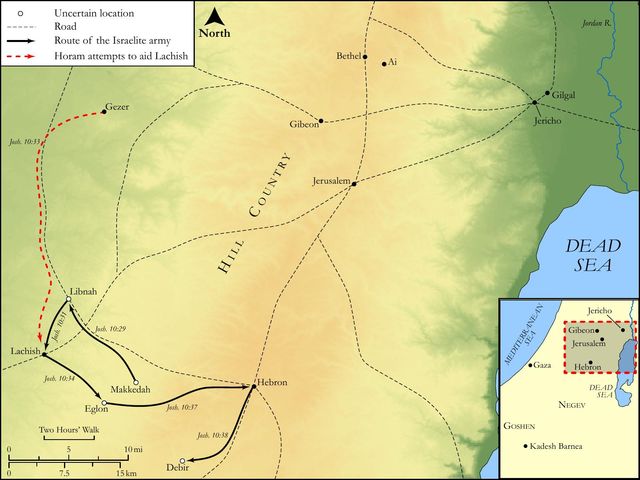
1.The cities of three of the kings whom he had conquered in the field he went and took possession of, Lachish (Jos 10:31, Jos 10:32), Eglon (Jos 10:34, Jos 10:35), and Hebron, Jos 10:36, Jos 10:37. The other two, Jerusalem and Jarmuth, were not taken at this time; perhaps his forces were either so much fatigued with what they had done or so well content with what they had got that they had no mind to attack those places, and so they let slip the fairest opportunity they could ever expect of reducing them with ease, which afterwards was not done without difficulty, Jdg 1:8; Sa2 5:6.
2.Three other cities, and royal cities too, he took: Makkedah, into the neighbourhood of which the five kings had fled, which brought Joshua and his forces thither in pursuit of them, and so hastened its ruin (Jos 10:28), Libnah (Jos 10:29, Jos 10:30), and Debir, Jos 10:38, Jos 10:39.
3.One king that brought in his forces for the relief of Lachish, that had lost its king, proved to meddle to his own hurt; it was Horam king of Gezer, who, either in friendship to his neighbours or for his own security, offered to stop the progress of Joshua's arms, and was cut off with all his forces, Jos 10:33. Thus wicked men are often snared in their counsels, and, by opposing God in the way of his judgments, bring them the sooner on their own heads.
II.A general account of the country which was hereby reduced and brought into Israel's hands (Jos 10:40-42), that part of the land of Canaan of which they first got possession, which lay south of Jerusalem, and afterwards fell, for the most part, to the lot of the tribe of Judah. Observe in this narrative,
1.The great speed Joshua made in taking these cities, which, some think, is intimated in the manner of relating it, which is quick and concise. He flew like lightning from place to place; and though they all stood it out to the last extremity, and none of these cities opened their gates to him, yet in a little time he got them all into his hands, summoned them, and seized them, the same day (Jos 10:28), or in two days, Jos 10:32. Now that they were struck with fear, by the defeat of their armies and the death of their kings, Joshua prudently followed his blow. See what a great deal of work may be done in a little time, if we will but be busy and improve our opportunities.
2.The great severity Joshua used towards those he conquered. He gave no quarter to man, woman, nor child, put to the sword all the souls (Jos 10:28, Jos 10:30, Jos 10:32, Jos 10:35, etc.), utterly destroyed all that breathed (Jos 10:40), and left none remaining. Nothing could justify this military execution but that herein they did as the Lord God of Israel commanded (Jos 10:40), which was sufficient not only to bear them out, and save them for the imputation of cruelty, but to sanctify what they did, and make it an acceptable piece of service to his justice. God would hereby,
(1.)Manifest his hatred of the idolatries and other abominations which the Canaanites had been guilty of, and leave us to judge how great the provocation was which they had given him by the greatness of the destruction which was brought upon them when the measure of their iniquity was full.
(2.)He would hereby magnify his love to his people Israel, in giving so many men for them, and people for their life, Isa 43:4. When the heathen are to be cast out to make room for this vine (Psa 80:8) divine justice appears more prodigal than ever of human blood, that the Israelites might find themselves for ever obliged to spend their lives to the glory of that God who had sacrificed so many of the lives of his creatures to their interest.
(3.)Hereby was typified the final and eternal destruction of all the impenitent implacable enemies of the Lord Jesus, who, having slighted the riches of his grace, must for ever feel the weight of his wrath, and shall have judgment without mercy. Nations that forget God shall be turned into hell, and no reproach at all to God's infinite goodness.
3.The great success of this expedition. The spoil of these cities was now divided among the men of war that plundered them; and the cities themselves, with the land about them, were shortly to be divided among the tribes, for the Lord fought for Israel, Jos 10:42. They could not have gotten the victory if God had not undertaken the battle; then we conquer when God fights for us; and, if he be for us, who can be against us?
Continue studying Joshua 10:42 across the web’s major study libraries — every link below opens this exact verse, chapter, or book on the destination site.
Read & Compare
 BibleGatewayThis verse in more than 200 translations and 70 languages.
 Bible.comThe YouVersion reader — hundreds of translations, reading plans, and highlights.
 ESV.orgCrossway's official English Standard Version reader.
 NET BibleThe NET translation with 60,000+ translators' notes on every rendering decision.
 STEP BibleTyndale House's free study tool — original text, vocabulary, and scholarly resources.
 BibliaLogos Bible Software's free web reader.
 USCCBThe New American Bible (Revised Edition) with the U.S. bishops' study notes.
Commentaries
 BibleHub CommentariesDozens of classic commentaries on this verse, gathered on one page.
 StudyLightMore than 100 commentary sets — the largest collection on the web.
 BibleRefPlain-English commentary on what this verse means, verse by verse.
 Enduring WordDavid Guzik's free commentary on this chapter, widely used by Bible teachers.
 Bible Study ToolsVerse commentary alongside Greek and Hebrew study aids.
Original Language & Research
- BibleHub InterlinearThe verse word by word — original language, transliteration, and English.
- BibleHub LexiconEvery word's original-language definition and Strong's entry.
 Blue Letter BibleDeep-study tools — Strong's numbers, concordance, and word studies.
 SefariaThe Hebrew text with Rashi and centuries of Jewish commentary.
Sermons, Hymns & Audio


TrulyRandomVerse is not affiliated with these sites and doesn’t control their content. They’re linked because they’re genuinely useful.
Summary
Joshua 10:42 serves as a profound theological summation of the southern campaign of the Israelite conquest, asserting that the comprehensive and decisive victories over numerous kings and their territories were not primarily a result of human military might or strategic brilliance. Instead, the verse unequivocally attributes this sweeping success to the direct and active intervention of the Lord God of Israel, who personally engaged in battle on behalf of His covenant people, thereby securing their promised inheritance.
Context
ShowHideLiterary Context
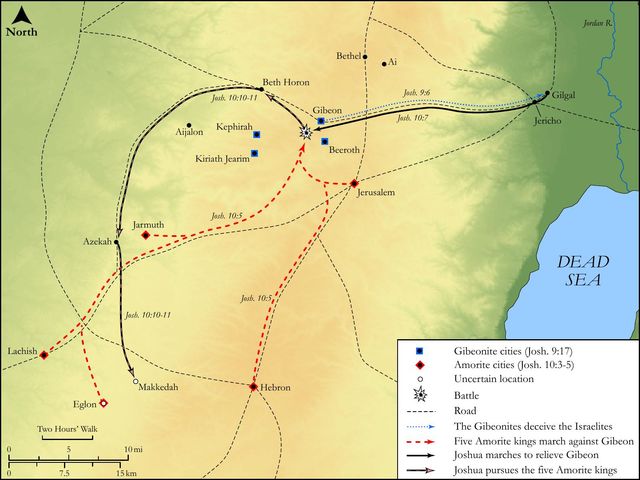
This verse provides a powerful theological and narrative conclusion to the southern campaign, which dominates Joshua 10. The preceding narrative details a rapid succession of events: the Gibeonite deception and subsequent alliance (Joshua 9), the coalition of five Amorite kings against Gibeon, Israel's swift response, and the miraculous divine intervention with hailstones and the sun standing still (Joshua 10:1-15). Following this, Joshua relentlessly pursued and executed the five kings (Joshua 10:16-27) and then systematically conquered key southern cities—Makkedah, Libnah, Lachish, Eglon, Hebron, and Debir (Joshua 10:28-41). Joshua 10:42 acts as a definitive theological statement, encapsulating the entire phase of conquest as a divinely orchestrated triumph before the narrative shifts to the northern campaigns in Joshua 11 and the subsequent land distribution.
Historical & Cultural Context
The period of the Israelite conquest was characterized by a fragmented political landscape in Canaan, comprised of numerous independent city-states, each ruled by its own "king" (often a local chieftain). These city-states frequently formed temporary alliances, as seen with the Amorite coalition in Joshua 10. Among the nations, national gods were believed to fight for their people, as Jephthah said to the king of Ammon, "Wilt not thou possess that which Chemosh thy god giveth thee to possess?" However, Israel's understanding was distinct: Yahweh was not merely one god among many, but the sovereign Creator and Lord of all, whose active participation in battle was not limited by human capabilities or natural laws, as vividly demonstrated by the miraculous hailstones and the sun standing still in Joshua 10:11-14. This context emphasizes that Israel's unprecedented success was a direct manifestation of divine power, defying conventional military expectations.
Key Themes
ShowHideJoshua 10:42 powerfully reinforces several foundational themes woven throughout the book of Joshua and the broader Pentateuch. Central to this verse is the theme of Divine Sovereignty and Intervention, explicitly stating that "the LORD God of Israel fought for Israel," making God the primary agent of the conquest. This directly fulfills God's promises to Abraham regarding the land (Genesis 12:7) and echoes the repeated assurance in Deuteronomy that God would fight for His people (Deuteronomy 3:22). Another crucial theme is God's Faithfulness to His Covenant Promises, as the conquest represents the tangible fulfillment of centuries-old divine pledges to give Israel the land. The phrase "all these kings and their land did Joshua take at one time" also highlights the theme of Total Victory and Completeness, signifying that God's deliverance is comprehensive and decisive, leaving no enemy standing that He intended to remove. This collective and swift victory demonstrates the efficacy of obedience and trust in God's leadership.
Exposition and Analysis
ShowHideKey Word Analysis
ShowHideThis verb, here in the Qal perfect, means "to capture," "to seize," or "to conquer." While Joshua is the grammatical subject of the action, the verse immediately qualifies this by attributing the ultimate power behind the capture to the Lord. The use of lakad signifies a complete and decisive subjugation, implying not merely a temporary occupation but a successful military appropriation of territory and rulers. It underscores the finality of the victories.
This primitive root, meaning "to fight," "to do battle," or "to wage war," is profoundly significant when applied to the Lord God of Israel. It portrays God not as a distant observer or a mere provider of strength, but as an active, engaged participant in the conflict. This concept of God as the Divine Warrior is central to Israel's understanding of their history and their relationship with Yahweh, emphasizing His direct, personal, and powerful intervention in human affairs, securing victory for His people.
This phrase literally translates to "at one stroke," "in one turn," or "in one instance." While the southern campaign involved a series of battles over a period, this idiomatic expression functions as a summary statement emphasizing the continuous, unbroken, and remarkably swift nature of the victories within this specific campaign. It highlights the extraordinary efficiency and totality of the conquest under divine enablement, suggesting a rapid and comprehensive subjugation of a vast region and its rulers without significant pause or reversal, all attributed to God's singular, decisive action.
Verse Breakdown
ShowHide"And all these kings and their land did Joshua take at one time"
This clause functions as a powerful, sweeping summary of the extensive southern campaign detailed in Joshua 10:1-41. It emphasizes the comprehensive nature of the victory, encompassing both the rulers ("all these kings") and their entire territories ("their land"). The phrase "at one time" underscores the remarkable swiftness and decisiveness of the conquest, portraying it not as a protracted, piecemeal effort but as a continuous, divinely orchestrated sweep. Joshua is presented as the visible, human agent of this conquest, but the immediate following clause provides the essential theological clarification regarding the ultimate source of this extraordinary success.
"because the LORD God of Israel fought for Israel"
This is the theological lynchpin of the verse and, indeed, a foundational truth for the entire book of Joshua. It unequivocally attributes the success of the conquest, including the swift and comprehensive nature described in the first clause, to God's direct, personal, and active involvement. Israel's victories were not a result of superior military strategy, greater numbers, or inherent strength, but solely "because Yahweh, the covenant God of Israel, actively engaged in battle on their behalf." This statement highlights God's unwavering faithfulness to His promises (e.g., Deuteronomy 20:4) and His role as the Divine Warrior, ensuring the inheritance of the land for His chosen people.
Literary Devices
ShowHideJoshua 10:42 employs several significant literary devices to convey its profound theological message. Attribution is paramount, as the verse explicitly and emphatically attributes the success of the conquest not to Joshua's leadership, Israel's military prowess, or any human factor, but solely to the Lord. This theological statement serves as the interpretive key to understanding the entire campaign and, by extension, the book of Joshua. There is also an element of Hyperbole in the phrase "at one time," which, while emphasizing the swiftness, totality, and overwhelming nature of the campaign, should be understood as a rhetorical flourish rather than a literal single moment. This hyperbole serves to magnify the divine power at work, underscoring the miraculous speed and completeness of God's deliverance. Furthermore, the verse functions as a Summary Statement, providing a concise and emphatic conclusion to a major narrative section, distilling its core theological message for the reader and preparing them for the next phase of the conquest narrative.
Theological and Thematic Connections
ShowHideJoshua 10:42 profoundly articulates the foundational truth that God is the ultimate actor in the history of His people. The conquest of Canaan, far from being a mere human military endeavor, is presented as a divine work, a testament to God's active presence and power in fulfilling His covenant promises. This verse underscores the theme of divine sovereignty, reminding us that even in the midst of human effort and leadership, it is God who ultimately secures victory and accomplishes His purposes. It teaches that Israel's inheritance of the land was a gift, not a conquest earned by their own strength, fostering a spirit of humility and radical dependence on God. This divine intervention establishes a pattern for God's relationship with His people, where His faithfulness is the bedrock of their security and success.
Reflection and Application
ShowHideJoshua 10:42 offers profound encouragement and a vital theological perspective for believers today. In a world that often values self-reliance, strategic planning, and human achievement above all else, this verse powerfully redirects our focus to the divine source of all true and lasting victory. When we face seemingly insurmountable challenges—whether they are personal struggles, spiritual battles against temptation, or the pursuit of justice in a broken world—this passage reminds us that our ultimate hope and strength lie not in our own capabilities or resources, but in the Lord God, who actively "fights for" His people. It calls us to cultivate a radical dependence on God, to approach prayer with confidence, and to act with courage and obedience, knowing that He is sovereign over all circumstances and unfailingly faithful to His promises. Our victories, whether grand or seemingly small, are ultimately His doing, and recognizing this fosters deep humility, profound gratitude, and an unwavering trust in His unfailing power and presence in our lives.
Questions for Reflection
ShowHideFAQ
ShowHideDid Joshua truly conquer "all these kings and their land... at one time" as the verse states?
ShowHideThe phrase "at one time" (Hebrew: b'fa'am achath) in Joshua 10:42 should be understood as a summary statement emphasizing the remarkable swiftness, decisiveness, and continuous nature of the southern campaign, rather than a literal single moment or a 24-hour period. The book of Joshua itself details a series of distinct battles and conquests over a period of time, though it was indeed a concentrated and rapid phase of the overall conquest. The intent of the phrase is to highlight the extraordinary efficiency and totality of the victory, which was divinely enabled, portraying it as a single, unbroken sweep of God's power and purpose. It underscores that God's work was comprehensive and without significant setbacks in this phase, leading to a complete subjugation of the southern region.
What does it mean that "the LORD God of Israel fought for Israel," and how does this relate to human effort?
ShowHideThis powerful statement underscores the fundamental theological conviction that Israel's success in the conquest was primarily a divine accomplishment. It means that God was not merely a distant observer or a provider of strength from afar, but an active, direct participant in the battles. He intervened supernaturally, as vividly seen in the miraculous hailstones and the sun standing still during the Gibeon battle (Joshua 10:11-14). While Joshua and the Israelite army certainly exerted human effort, strategized, and engaged in physical combat, the verse makes it unequivocally clear that the ultimate victory and the ability to "take" the land came "because the LORD God of Israel fought for Israel." This doesn't negate human responsibility or effort but places it within the overarching context of divine enablement and sovereignty. Human effort is the obedient response to God's command, but divine power is the ultimate source of the triumph. It teaches that true victory flows from God's intervention, not human might alone.
Christ-Centered Fulfillment
ShowHideJoshua 10:42, with its powerful declaration that "the LORD God of Israel fought for Israel," finds its ultimate and most profound fulfillment in the person and redemptive work of Jesus Christ. Just as God actively fought for His people to secure their physical inheritance in Canaan, so too did God, in the person of Jesus, enter the ultimate spiritual battle to secure our eternal inheritance and deliver us from the dominion of darkness. Jesus is the true Divine Warrior, who, through His sinless life, sacrificial death on the cross, and glorious resurrection, confronted and decisively defeated the spiritual "kings and their land"—the formidable powers of sin, death, and the devil. Colossians 2:15 proclaims that Christ "disarmed the powers and authorities, he made a public spectacle of them, triumphing over them by the cross." His victory was "at one time"—a singular, definitive, and comprehensive triumph on the cross that secured salvation and eternal life for all who believe, a victory that needs no repetition. Moreover, just as God fought for Israel, Christ continually intercedes for His people at the right hand of God (Romans 8:34), and the Holy Spirit empowers believers to overcome spiritual adversaries in their daily lives (Ephesians 6:10-18). We are called to stand firm in the victory already won, knowing that the decisive battle for our souls has already been secured by the Lamb of God, who is also the Lion of Judah (Revelation 5:5-6), and that in Him, we are eternally "more than conquerors" (Romans 8:37).