


Joshua 10:43
Bible text: King James Version (1769 Blayney text) · Public domain
Bible text: Berean Standard Bible · Public domain
Bible text: American Standard Version (1901) · Public domain
Bible text: World English Bible, Messianic edition · Public domain
Bible text: Geneva Bible (1599) · Public domain
Bible text: Young's Literal Translation · Public domain
- וַיָּשָׁבvai·Ya·shovand he returnedH7725Conj-w ¦ V-Qal-ConsecImperf-3msVerb Qal Consecutive Imperfect 3rd Singular Masculineוַandיָּשָׁבhe returned
- יְהוֹשֻׁעַye·ho·Shu·a'JoshuaH3091N-proper-mNoun Proper Masculine
- וְכָלve·kholand allH3605Conj-w ¦ N-mscNoun Singular Masculine Constructוְandכָלall
- יִשְׂרָאֵלYis·ra·'ElIsraelH3478N-properNoun Proper Location
- עִמּוֹi·Mowith himH5973Prep ¦ 3msPreposition Definiteעִמּwithוֹhim
- אֶל'eltoH413PrepPreposition
- הַמַּחֲנֶהha·ma·cha·Nehthe campH4264Art ¦ N-fsNoun Singular Feminine Absoluteהַtheמַּחֲנֶהcamp
- הַגִּלְגָּלָהha·gil·Ga·lah<the> Gilgal towardsH1537Art ¦ N-proper ¦ SfxNoun Proper Locationהַ<the>גִּלְגָּלָGilgalהtowards
English is a literal word-by-word gloss of the Hebrew, not the KJV's wording. Why?
This is the original text the KJV's translators worked from — each Hebrew word with its own literal English meaning in this verse, prepared by scholars at Tyndale House, Cambridge. The KJV translates whole sentences, not word by word, so its wording differs: one Hebrew word can become several English words, and the KJV may choose “the LORD” where the gloss reads “Yahweh”. Both are faithful — they answer different questions. For the KJV's own rendering, switch to the KJV text.
Details
See on the biblical-era maps
Study this verse
Public-domain commentary
Matthew Henry
From his Commentary on the Whole Bible. Henry comments on passages, not single verses — this entry covers Joshua 10:28–43. His three-level outline is real structure in the source text, so it is rendered as structure.
We are here informed how Joshua improved the late glorious victory he had obtained and the advantages he had gained by it, and to do this well is a general's praise.
I.Here is a particular account of the several cities which he immediately made himself master of.
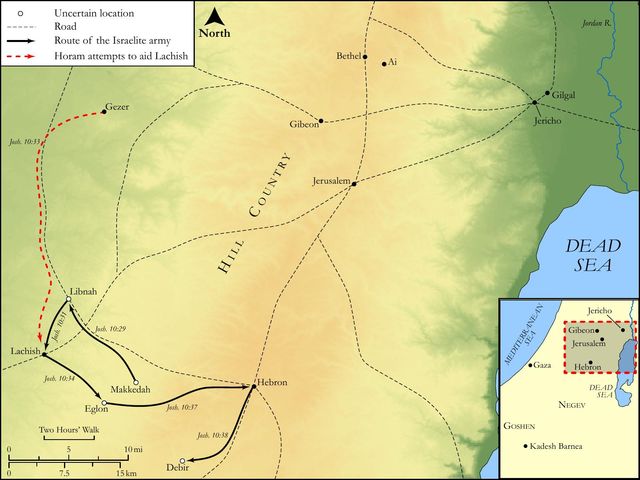
1.The cities of three of the kings whom he had conquered in the field he went and took possession of, Lachish (Jos 10:31, Jos 10:32), Eglon (Jos 10:34, Jos 10:35), and Hebron, Jos 10:36, Jos 10:37. The other two, Jerusalem and Jarmuth, were not taken at this time; perhaps his forces were either so much fatigued with what they had done or so well content with what they had got that they had no mind to attack those places, and so they let slip the fairest opportunity they could ever expect of reducing them with ease, which afterwards was not done without difficulty, Jdg 1:8; Sa2 5:6.
2.Three other cities, and royal cities too, he took: Makkedah, into the neighbourhood of which the five kings had fled, which brought Joshua and his forces thither in pursuit of them, and so hastened its ruin (Jos 10:28), Libnah (Jos 10:29, Jos 10:30), and Debir, Jos 10:38, Jos 10:39.
3.One king that brought in his forces for the relief of Lachish, that had lost its king, proved to meddle to his own hurt; it was Horam king of Gezer, who, either in friendship to his neighbours or for his own security, offered to stop the progress of Joshua's arms, and was cut off with all his forces, Jos 10:33. Thus wicked men are often snared in their counsels, and, by opposing God in the way of his judgments, bring them the sooner on their own heads.
II.A general account of the country which was hereby reduced and brought into Israel's hands (Jos 10:40-42), that part of the land of Canaan of which they first got possession, which lay south of Jerusalem, and afterwards fell, for the most part, to the lot of the tribe of Judah. Observe in this narrative,
1.The great speed Joshua made in taking these cities, which, some think, is intimated in the manner of relating it, which is quick and concise. He flew like lightning from place to place; and though they all stood it out to the last extremity, and none of these cities opened their gates to him, yet in a little time he got them all into his hands, summoned them, and seized them, the same day (Jos 10:28), or in two days, Jos 10:32. Now that they were struck with fear, by the defeat of their armies and the death of their kings, Joshua prudently followed his blow. See what a great deal of work may be done in a little time, if we will but be busy and improve our opportunities.
2.The great severity Joshua used towards those he conquered. He gave no quarter to man, woman, nor child, put to the sword all the souls (Jos 10:28, Jos 10:30, Jos 10:32, Jos 10:35, etc.), utterly destroyed all that breathed (Jos 10:40), and left none remaining. Nothing could justify this military execution but that herein they did as the Lord God of Israel commanded (Jos 10:40), which was sufficient not only to bear them out, and save them for the imputation of cruelty, but to sanctify what they did, and make it an acceptable piece of service to his justice. God would hereby,
(1.)Manifest his hatred of the idolatries and other abominations which the Canaanites had been guilty of, and leave us to judge how great the provocation was which they had given him by the greatness of the destruction which was brought upon them when the measure of their iniquity was full.
(2.)He would hereby magnify his love to his people Israel, in giving so many men for them, and people for their life, Isa 43:4. When the heathen are to be cast out to make room for this vine (Psa 80:8) divine justice appears more prodigal than ever of human blood, that the Israelites might find themselves for ever obliged to spend their lives to the glory of that God who had sacrificed so many of the lives of his creatures to their interest.
(3.)Hereby was typified the final and eternal destruction of all the impenitent implacable enemies of the Lord Jesus, who, having slighted the riches of his grace, must for ever feel the weight of his wrath, and shall have judgment without mercy. Nations that forget God shall be turned into hell, and no reproach at all to God's infinite goodness.
3.The great success of this expedition. The spoil of these cities was now divided among the men of war that plundered them; and the cities themselves, with the land about them, were shortly to be divided among the tribes, for the Lord fought for Israel, Jos 10:42. They could not have gotten the victory if God had not undertaken the battle; then we conquer when God fights for us; and, if he be for us, who can be against us?
Continue studying Joshua 10:43 across the web’s major study libraries — every link below opens this exact verse, chapter, or book on the destination site.
Read & Compare
 BibleGatewayThis verse in more than 200 translations and 70 languages.
 Bible.comThe YouVersion reader — hundreds of translations, reading plans, and highlights.
 ESV.orgCrossway's official English Standard Version reader.
 NET BibleThe NET translation with 60,000+ translators' notes on every rendering decision.
 STEP BibleTyndale House's free study tool — original text, vocabulary, and scholarly resources.
 BibliaLogos Bible Software's free web reader.
 USCCBThe New American Bible (Revised Edition) with the U.S. bishops' study notes.
Commentaries
 BibleHub CommentariesDozens of classic commentaries on this verse, gathered on one page.
 StudyLightMore than 100 commentary sets — the largest collection on the web.
 BibleRefPlain-English commentary on what this verse means, verse by verse.
 Enduring WordDavid Guzik's free commentary on this chapter, widely used by Bible teachers.
 Bible Study ToolsVerse commentary alongside Greek and Hebrew study aids.
Original Language & Research
- BibleHub InterlinearThe verse word by word — original language, transliteration, and English.
- BibleHub LexiconEvery word's original-language definition and Strong's entry.
 Blue Letter BibleDeep-study tools — Strong's numbers, concordance, and word studies.
 SefariaThe Hebrew text with Rashi and centuries of Jewish commentary.
Sermons, Hymns & Audio


TrulyRandomVerse is not affiliated with these sites and doesn’t control their content. They’re linked because they’re genuinely useful.
Summary
Joshua 10:43 serves as a pivotal concluding statement to the triumphant Southern Campaign, meticulously detailing Joshua's strategic leadership in returning the entire Israelite army to their established and spiritually significant base camp at Gilgal. This verse not only signifies the successful completion of a major phase of conquest but also powerfully underscores the divine assistance and military prowess that characterized Israel's initial territorial gains in Canaan, reaffirming Gilgal's critical role as both a logistical staging ground and a profound spiritual center for the nascent nation.
Context
ShowHideLiterary Context
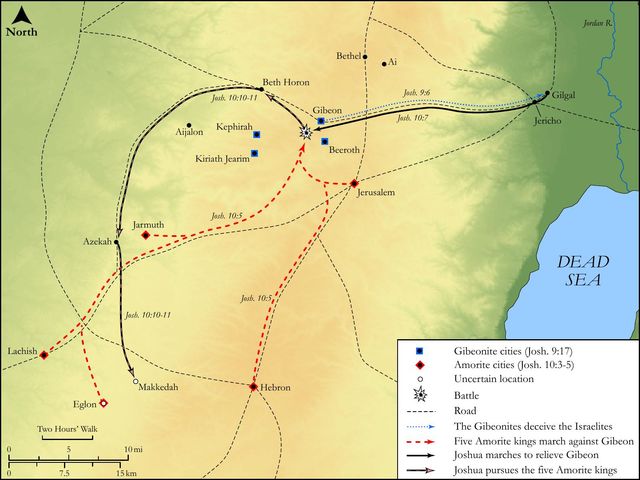
Joshua 10:43 provides the narrative culmination of the extensive Southern Campaign, a series of decisive battles meticulously detailed from Joshua 10:1. Immediately preceding this verse, the text recounts Joshua's comprehensive and divinely assisted defeat of a formidable coalition of five Amorite kings who had attacked Gibeon. This campaign was marked by extraordinary divine intervention, including a miraculous hailstorm that decimated the enemy forces and the unprecedented event of the sun and moon standing still, enabling Israel to achieve a complete and overwhelming victory. The preceding verses, specifically Joshua 10:40-42, emphasize the thoroughness of the conquest, highlighting that Joshua "left none remaining" and "utterly destroyed all that breathed, as the LORD God of Israel commanded." Therefore, verse 43 marks the successful completion of this major military operation, with Joshua leading the victorious army back to their primary base camp, signaling a moment of consolidation, rest, and preparation for the subsequent phases of the conquest.
Historical & Cultural Context
The return to Gilgal reflects not only sound military strategy but also the profound historical and cultural significance of the location. Among the nations of that day, it was customary for armies to return to a secure and established base after a campaign to regroup, rest, resupply, and prepare for future engagements. Gilgal, strategically located near the Jordan River, had served as the Israelites' very first encampment in Canaan following their miraculous crossing of the Jordan. Beyond its logistical utility, Gilgal was a site of immense spiritual importance. It was here that the new generation of Israelites, born in the wilderness, was circumcised, symbolically, as the LORD said, "rolled away the reproach of Egypt from off you" (Joshua 5:9), and where they observed the Passover for the first time in the Promised Land (Joshua 5:10-11). This established Gilgal as a foundational place of covenant renewal, spiritual cleansing, and national identity for Israel. Its re-establishment as the base camp after intense warfare was thus a deeply symbolic return to their foundational identity and divine mandate, reinforcing God's continued presence and blessing.
Key Themes
ShowHideThis verse powerfully contributes to several overarching themes woven throughout the book of Joshua. Firstly, it emphatically underscores the theme of Divine Victory and Fulfillment of Promise. The successful return to Gilgal after such a comprehensive and divinely aided conquest is a tangible demonstration of God's unwavering faithfulness in delivering the land and its inhabitants into Israel's hands, thereby fulfilling the ancient promises made to Abraham (Genesis 12:7) and explicitly reiterated to Joshua (Joshua 1:3-5). Secondly, the verse highlights Joshua's Exemplary Leadership. His diligent adherence to God's commands, his strategic military prowess, and his ability to lead the people effectively in both intense battle and orderly return to camp are consistently emphasized throughout the book, positioning him as a faithful and divinely appointed successor to Moses. Finally, the return to Gilgal reinforces The Enduring Significance of Gilgal itself. Far from being merely a temporary military encampment, Gilgal functions as a sacred space—a place of spiritual cleansing, covenant renewal, and a central point from which the conquest emanated and to which the victorious army consistently returned, symbolizing both a divinely granted rest and a readiness for the next phase of God's unfolding plan for Israel.
Exposition and Analysis
ShowHideKey Word Analysis
ShowHideThe verb שׁוּב (shûwb), a primitive root, signifies "to turn back," "to return," or "to restore." In the context of Joshua 10:43, it denotes the successful completion of a military campaign and the orderly, deliberate movement back to a designated base. This is not a retreat due to defeat but a strategic withdrawal after achieving objectives, implying discipline and successful culmination under Joshua's leadership. The term emphasizes the organized nature of the Israelite army's actions rather than a chaotic dispersal.
The Hebrew word מַחֲנֶה (machăneh) refers to an "encampment," "camp," or "army." It denotes a settled, organized military base or a large body of people encamped together. The use of "camp" here highlights Gilgal's role as the central, established headquarters for the Israelite forces. It signifies stability, order, and a sustained presence in the land, serving as the point from which campaigns were launched and to which they returned, emphasizing the logistical and organizational backbone of their conquest.
The name גִּלְגָּל (Gilgâl) is a proper noun, derived from a root meaning "to roll." As explained in Joshua 5:9, it was named because the Lord had "rolled away" the "reproach of Egypt" from Israel there. Thus, Gilgal is far more than a mere geographical location; it is a place of profound spiritual significance, representing covenant renewal, national identity, and divine cleansing. The act of returning to Gilgal was not merely a strategic maneuver but a deeply symbolic return to their spiritual roots and the very place where their covenant relationship with God was re-established and affirmed.
Verse Breakdown
ShowHide"And Joshua returned"
This initial clause immediately places emphasis on Joshua's central and active role as the divinely appointed leader. His return is not merely a personal movement but an action indicative of the entire army's disciplined and successful movement under his direct command. It unequivocally signifies the triumphant completion of the Southern Campaign, with Joshua having faithfully fulfilled his divinely assigned task.
"and all Israel with him"
This phrase underscores the collective nature of the conquest and the remarkable unity of the Israelite people under Joshua's leadership. It highlights that the victory was a national effort, led by Joshua, but executed by the entire community, reflecting their shared obedience to God's commands and their unified participation in His grand plan. Furthermore, it implies the thoroughness and orderliness of the return—no one was left behind or scattered after the intense and demanding battles.
"unto the camp"
This refers to the established military headquarters, emphasizing the order, discipline, and return to a state of readiness and organization after the intensity of warfare. It signifies a structured military operation rather than a chaotic or disorganized dispersal, reflecting the strategic acumen of Joshua and the disciplined nature of the Israelite forces.
"to Gilgal"
This specifies the precise destination, a place rich in symbolic and spiritual meaning. Gilgal was the initial base camp after the miraculous crossing of the Jordan River, the sacred site of the new generation's circumcision, and the place where the Passover was observed. Therefore, returning to Gilgal signifies a return to their spiritual and logistical center, a place of rest, reflection, and preparation for the subsequent phases of the conquest, all under the watchful and guiding hand of God.
Literary Devices
ShowHideJoshua 10:43 effectively employs Narrative Closure and profound Symbolism. The verse provides a clear, concise, and definitive conclusion to the Southern Campaign, signaling the successful end of a major military phase and the fulfillment of God's specific command to conquer. This sense of closure is vital for the reader, marking a moment of rest and consolidation before the narrative progresses to future conquests. Furthermore, the explicit mention of "Gilgal" is deeply symbolic. As repeatedly established in the earlier chapters of the book, Gilgal is not merely a geographical location but a sacred space intrinsically linked with the removal of Egyptian reproach, the renewal of the covenant, and the celebration of the Passover. Its consistent mention throughout the early chapters of Joshua, and especially here as the ultimate destination of the victorious army, imbues it with profound Symbolism as the spiritual and logistical heart of the entire Israelite enterprise. The return to Gilgal thus symbolizes a return to foundational identity, divine favor, and renewed commitment after a period of intense divine activity and human obedience.
Theological and Thematic Connections
ShowHideJoshua 10:43 culminates a powerful and undeniable demonstration of God's unwavering faithfulness and His active, miraculous involvement in fulfilling His covenant promises to Israel. The return to Gilgal, a place steeped in spiritual significance and covenant history, profoundly underscores that Israel's victories were not merely the result of military might or human strategy but were direct divine interventions, unequivocally confirming God's commitment to giving them the promised land. This act of returning to a spiritual base after intense warfare serves as a profound theological reminder that even in victory and triumph, God's people must consistently return to their ultimate source of strength, identity, and provision in Him, acknowledging His sovereign hand in all successes. It beautifully foreshadows the ultimate rest and eternal inheritance promised to God's people, secured not by human strength or earthly conquest, but by divine power, grace, and faithfulness.
Reflection and Application
ShowHideJoshua's disciplined and purposeful return to Gilgal after achieving a major victory offers profound and practical insights for believers navigating their own spiritual journeys today. It highlights the indispensable need for spiritual grounding, intentional rest, and diligent regrouping after periods of intense spiritual warfare, demanding service, or significant personal challenge. Just as Israel returned to their spiritual hub to acknowledge God's hand, renew their covenant, and prepare for what was next, we too are called to regularly return to our "Gilgal"—a place or practice of consistent spiritual grounding, restorative rest, and profound renewal. This might manifest as setting aside dedicated time for deep prayer, immersing ourselves in the life-giving truths of Scripture, engaging in authentic and meaningful fellowship within the body of Christ, or simply resting in the quiet, sustaining presence of God. Such intentional spiritual discipline prevents burnout, cultivates a heart of deep gratitude, and continually reorients us to God's unfailing guidance, abundant provision, and sovereign control. It serves as a powerful reminder that all our victories, great or small, are ultimately from the Lord, and our strength for facing future challenges comes from continually returning to Him as our ultimate source of life, wisdom, and power.
Questions for Reflection
ShowHideFAQ
ShowHideWhy was Gilgal so important to the Israelites, and why did they return there after the Southern Campaign?
ShowHideGilgal held immense and multifaceted significance for the Israelites, serving as far more than just a military base. It was their very first encampment in Canaan after miraculously crossing the Jordan River, symbolizing the foundational beginning of their inheritance in the Promised Land. Crucially, it was at Gilgal that the new generation of Israelite males, born during the wilderness wandering, was circumcised, an act that symbolically removed the "reproach of Egypt" (Joshua 5:9) and renewed their covenant with God. Furthermore, it was there that they celebrated their first Passover in Canaan (Joshua 5:10), marking their full participation in God's redemptive history. Thus, Gilgal was a profound place of covenant renewal, spiritual cleansing, national identity formation, and a tangible reminder of God's faithfulness. Returning there after the intense Southern Campaign was not only a strategic move to their established and secure headquarters but also a deeply symbolic act. It signified a return to their spiritual roots, a place of divine favor and safety, allowing them to rest, regroup, and prepare for future campaigns from a position of both spiritual and logistical strength, all under the watchful eye of the Lord.
Christ-Centered Fulfillment
ShowHideJoshua's successful conquest of the land and the subsequent return to Gilgal, a place of divinely ordained rest, spiritual cleansing, and covenant renewal, profoundly foreshadow the ultimate victory and eternal rest found exclusively in Jesus Christ. Just as Joshua, whose name means "Yahweh is salvation," led Israel to conquer their earthly enemies and enter their promised land, Christ, our greater Joshua, has accomplished a decisive and eternal victory over the ultimate enemies: sin, death, and the devil, through His perfect life, atoning crucifixion, and glorious resurrection (Colossians 2:15). His finished work on the cross secures for all who believe a spiritual inheritance and a true, eternal rest that the temporary land of Canaan could only dimly prefigure (Hebrews 4:9-10). The return to Gilgal, a place of cleansing and covenant establishment, points forward to the new covenant established in Christ's precious blood, where believers are cleansed from sin not by physical circumcision but by spiritual faith and baptism into His death and resurrection (Romans 6:3-4). Our "return to Gilgal" in the Christian life is therefore a continual, joyful turning to Christ, our ultimate spiritual center, for rest, profound renewal, and empowering strength, trusting completely in His completed work and eagerly looking forward to the full, glorious realization of our eternal inheritance in the new heavens and new earth (Revelation 21:1-4).