


Joshua 10:15
Bible text: King James Version (1769 Blayney text) · Public domain
Bible text: Berean Standard Bible · Public domain
Bible text: American Standard Version (1901) · Public domain
Bible text: World English Bible, Messianic edition · Public domain
Bible text: Geneva Bible (1599) · Public domain
Bible text: Young's Literal Translation · Public domain
- וַיָּשָׁבvai·Ya·shovand he returnedH7725Conj-w ¦ V-Qal-ConsecImperf-3msVerb Qal Consecutive Imperfect 3rd Singular Masculineוַandיָּשָׁבhe returned
- יְהוֹשֻׁעַye·ho·Shu·a'JoshuaH3091N-proper-mNoun Proper Masculine
- וְכָלve·kholand allH3605Conj-w ¦ N-mscNoun Singular Masculine Constructוְandכָלall
- יִשְׂרָאֵלYis·ra·'ElIsraelH3478N-properNoun Proper Location
- עִמּוֹi·Mowith himH5973Prep ¦ 3msPreposition Definiteעִמּwithוֹhim
- אֶל'eltoH413PrepPreposition
- הַמַּחֲנֶהha·ma·cha·Nehthe campH4264Art ¦ N-fsNoun Singular Feminine Absoluteהַtheמַּחֲנֶהcamp
- הַגִּלְגָּלָהha·gil·Ga·lah<the> Gilgal towardsH1537Art ¦ N-proper ¦ SfxNoun Proper Locationהַ<the>גִּלְגָּלָGilgalהtowards
English is a literal word-by-word gloss of the Hebrew, not the KJV's wording. Why?
This is the original text the KJV's translators worked from — each Hebrew word with its own literal English meaning in this verse, prepared by scholars at Tyndale House, Cambridge. The KJV translates whole sentences, not word by word, so its wording differs: one Hebrew word can become several English words, and the KJV may choose “the LORD” where the gloss reads “Yahweh”. Both are faithful — they answer different questions. For the KJV's own rendering, switch to the KJV text.
Details
See on the biblical-era maps
Study this verse
Public-domain commentary
Matthew Henry
From his Commentary on the Whole Bible. Henry comments on passages, not single verses — this entry covers Joshua 10:15–27. His three-level outline is real structure in the source text, so it is rendered as structure.
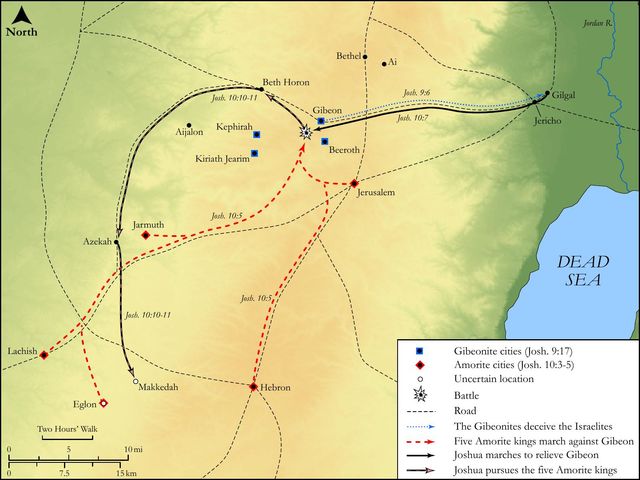
It was a brave appearance, no doubt, which the five kings made when they took the field for the reducing of Gibeon, and a brave army they had following them; but they were all routed, put into disorder first, and then brought to destruction by the hail-stones. And now Joshua thought, his work being done, he might go with his army into quarters of refreshment. Accordingly it was resolved, perhaps in a council of war, that they should presently return to the camp at Gilgal (Jos 10:15), till they should receive orders from God to take possession of the country they had now conquered; but he soon finds he has more work cut out for him. The victory must be pursued, that the spoils might be divided. Accordingly he applies himself to it with renewed vigour.
I.The forces that had dispersed themselves must be followed and smitten.
When tidings were brought to Joshua where the kings were he ordered a guard to be set upon them for the present (Jos 10:18), reserving them for another day of destruction, and to be brought forth to a day of wrath, Job 21:30. He directs his men to pursue the common soldiers, as much as might be, to prevent their escaping to the garrisons, which would strengthen them, and make the reduction of them the more difficult, Jos 10:19. Like a prudent general, he does that first which is most needful, and defers his triumphs till he has completed his conquests; nor was he in such haste to insult over the captive kings but that he would first prevent the rallying again of their scattered forces. The result of this vigorous pursuit was,
1.That a very great slaughter was made of the enemies of God and Israel. And,
2.The field was cleared of them, so that none remained but such as got into fenced cities, where they would not long be safe themselves, nor were they capable of doing any service to the cities that sheltered them, unless they could have left their fears behind them.
3.None moved his tongue against any of the children of Israel, Jos 10:21. This expression intimates,
(1.)Their perfect safety and tranquillity; some think it should be read (from Exo 11:7), Against any of the children of Israel did not a dog move his tongue; no, not against any one man of them. They were not threatened by any danger at all after their victory, no, not so much as the barking of a dog. Not one single Israelite (for the original makes it so particular) was brought into any distress, either in the battle or in the pursuit.
(2.)Their honour and reputation; no man had any reproach to cast upon them, nor an ill word to give them. God not only tied the hands, but stopped the mouths, of their enraged enemies, and put lying lips to silence.
(3.)The Chaldee paraphrase makes it an expression of their unalloyed joy for this victory, reading it, There was no hurt nor loss to the children of Israel, for which any man should afflict his soul. When the army came to be reviewed after the battle, there was none slain, none wounded, none missing. Not one Israelite had occasion to lament either the loss of a friend or the loss of a limb, so cheap, so easy, so glorious, was this victory.
II.The kings that had hidden themselves must now be called to an account, as rebels against the Israel of God, to whom, by the divine promise and grant, this land did of right belong and should have been surrendered upon demand. See here,
1.How they were secured. The cave which they fled to, and trusted in for a refuge, became their prison, in which they were clapped up, till Joshua sat in judgment on them, Jos 10:18. It seems they all escaped both the hail-stones and the sword, God so ordering it, not in kindness to them, but that they might be reserved for a more solemn and terrible execution; as, for this cause, Pharaoh survived the plagues of Egypt, and was made to stand, that God might in him show his power, Exo 9:16. They all fled, and met at the same place, Providence directing them; and now those who were lately consulting against Israel were put upon new counsels to preserve themselves and agreed to take shelter in the same cave. The information brought to Joshua of this is an evidence that there were those of the country, who knew the holes and fastnesses of it, that were in his interests. And the care Joshua took to keep them there when they were there, as it is an instance of his policy and presence of mind, even in the heat of action, so, in the result of their project, it shows how those not only deceive themselves, but destroy themselves, who think to hide themselves from God. Their refuge of lies will but bind them over to God's judgment.
2.How they were triumphed over. Joshua ordered them to be brought forth out of the cave, set before him as at the bar, and their names called over, Jos 10:22, Jos 10:23. And when they either were bound and cast upon the ground unable to help themselves, or threw themselves upon the ground, humbly to beg for their lives, he called for the general officers and great men, and commanded them to trample upon these kings, and set their feet upon their necks, not in sport and to make themselves and the company merry, but with the gravity and decorum that became the ministers of the divine justice who were not herein to gratify any pride or passion of their own, but to give glory to the God of Israel as higher than the highest, who treads upon princes as mortar (Isa 41:25), and is terrible to the kings of the earth, Psa 76:12. The thing does indeed look barbarous, thus to insult over men in misery, who had suddenly fallen from the highest pitch of honour into this disgrace. It was hard for crowned heads to be thus trodden upon, not by Joshua himself (that might better have been borne), at least not by him only, but by all the captains of the army. Certainly it ought not to be drawn into a precedent, for the case was extraordinary, and we have reason to think it was by divine direction and impulse that Joshua did this.
(1.)God would hereby punish the abominable wickedness of these kings, the measure of whose iniquity was now full. And, by this public act of justice done upon these ringleaders of the Canaanites in sin, he would possess his people with the greater dread and detestation of those sins of the nations that God cast out from before them, which they would be tempted to imitate.
(2.)He would hereby have the promise by Moses made good (Deu 33:29), Thou shalt tread upon their high places, that is, their great men, which should the rather be speedily fulfilled in the letter because they are the very last words of Moses that we find upon record.
(3.)He would hereby encourage the faith and hope of his people Israel in reference to the wars that were yet before them. Therefore Joshua said (Jos 10:25): Fear not, nor be dismayed. [1.] "Fear not these kings, nor any of theirs, as if there were any danger of having this affront now put upon them in after-time revenged upon yourselves, a consideration which keeps many from being insolent towards those they have at their mercy, because they know not how soon the uncertain fate of war may turn the same wheel upon themselves; but you need not fear that any should rise up ever to revenge this quarrel." [2.] "Fear not any other kings, who may at any time be in confederacy against you, for you see these brought down, whom you thought formidable. Thus shall the Lord do to all your enemies; now that they begin to fall, to fall so low that you may set your feet on their necks, you may be confident that they shall not prevail, but shall surely fall before you," Est 6:13.
(4.)He would hereby give a type and figure of Christ's victories over the powers of darkness, and believers' victories through him. All the enemies of the Redeemer shall be made his footstool, Psa 110:1. And see Psa 18:40. The kings of the earth set themselves against him (Psa 2:2), but sooner or later we shall see all things put under Him (Heb 2:8), and principalities and powers made a show of, Col 2:15. And in these triumphs we are more than conquerors, may tread upon the lion and adder (Psa 91:13), may ride on the high places of the earth (Isa 58:14), and may be confident that the God of peace shall tread Satan under our feet, shall do it shortly and do it effectually, Rom 16:20. See Psa 149:8, Psa 149:9.
3.How they were put to death. Perhaps, when they had undergone that terrible mortification of being trodden upon by the captains of Israel, they were ready to say, as Agag, Surely the bitterness of death is past, and that sufficient unto them was this punishment which was inflicted by many; but their honours cannot excuse their lives, their forfeited devoted lives. Joshua smote them with the sword, and then hanged up their bodies till evening, when they were taken down, and thrown into the cave in which they had hidden themselves, Jos 10:26, Jos 10:27. That which they thought would have been their shelter was made their prison first and then their grave; so shall we be disappointed in that which we flee to from God: yet to good people the grave is still a hiding-place, Job 14:13. If these five kings had humbled themselves in time, and had begged peace instead of waging war, they might have saved their lives; but now the decree had gone forth, and they found no place for repentance, or the reversal of the judgment; it was too late to expect it, though perhaps they sought it carefully with tears.
Continue studying Joshua 10:15 across the web’s major study libraries — every link below opens this exact verse, chapter, or book on the destination site.
Read & Compare
 BibleGatewayThis verse in more than 200 translations and 70 languages.
 Bible.comThe YouVersion reader — hundreds of translations, reading plans, and highlights.
 ESV.orgCrossway's official English Standard Version reader.
 NET BibleThe NET translation with 60,000+ translators' notes on every rendering decision.
 STEP BibleTyndale House's free study tool — original text, vocabulary, and scholarly resources.
 BibliaLogos Bible Software's free web reader.
 USCCBThe New American Bible (Revised Edition) with the U.S. bishops' study notes.
Commentaries
 BibleHub CommentariesDozens of classic commentaries on this verse, gathered on one page.
 StudyLightMore than 100 commentary sets — the largest collection on the web.
 BibleRefPlain-English commentary on what this verse means, verse by verse.
 Enduring WordDavid Guzik's free commentary on this chapter, widely used by Bible teachers.
 Bible Study ToolsVerse commentary alongside Greek and Hebrew study aids.
Original Language & Research
- BibleHub InterlinearThe verse word by word — original language, transliteration, and English.
- BibleHub LexiconEvery word's original-language definition and Strong's entry.
 Blue Letter BibleDeep-study tools — Strong's numbers, concordance, and word studies.
 SefariaThe Hebrew text with Rashi and centuries of Jewish commentary.
Sermons, Hymns & Audio


TrulyRandomVerse is not affiliated with these sites and doesn’t control their content. They’re linked because they’re genuinely useful.
Summary
Joshua 10:15 serves as a concise yet profoundly significant concluding statement to one of Israel's most remarkable military campaigns in Canaan. Following the miraculous victory over the five Amorite kings, a battle marked by divine intervention including the sun standing still and hailstones from heaven, this verse records Joshua's and all Israel's triumphant return to their established base camp at Gilgal. It signifies the successful completion of a major phase of the conquest, highlighting the strategic and spiritual importance of Gilgal as a place of rest, regrouping, and covenant renewal for the nation.
Context
ShowHideLiterary Context
This verse immediately follows the detailed account of Israel's decisive victory over the coalition of five Amorite kings who had attacked Gibeon. The preceding narrative in Joshua 10:1-14 vividly describes the Gibeonites' plea for help, Joshua's swift and obedient response, and the extraordinary divine intervention that secured the victory. This intervention included the miraculous hailstorm and the unprecedented lengthening of the day, demonstrating God's direct involvement in Israel's conquest. Joshua 10:15 functions as a narrative hinge, providing a definitive conclusion to this specific military engagement and setting the stage for the subsequent campaigns and the detailed division of the land. It marks the successful completion of the southern campaign's initial phase, emphasizing the fulfillment of the immediate objective before further actions are undertaken.
Historical & Cultural Context
The conquest of Canaan was a divinely mandated mission, fulfilling God's ancient promises to Abraham, Isaac, and Jacob. At this juncture in the narrative, Israel had already crossed the Jordan River and established Gilgal as their primary logistical and spiritual base. Their military strategy involved securing central Canaan (Jericho, Ai), then moving to the south (this campaign), and later to the north. The return to a base camp like Gilgal was a standard military practice for regrouping, resupplying, and preparing for future engagements. Culturally, the concept of "rest" after battle was important, not just for physical recovery but also for spiritual recalibration, acknowledging God's hand in their victories. Gilgal itself held deep historical significance as the site where Israel renewed their covenant with God through circumcision and celebrated the Passover after entering the land, as detailed in Joshua 5:9-10.
Key Themes
ShowHideJoshua 10:15 powerfully reinforces several overarching themes found throughout the book of Joshua. Firstly, Divine Sovereignty and Faithfulness are paramount, as the victory was undeniably God's work, not merely Israel's military might. The return to Gilgal underscores the fulfillment of God's promise to give Israel the land, as articulated in Joshua 1:6. Secondly, the theme of Obedience and Leadership is evident in Joshua's decisive actions and Israel's unified response, leading to divine favor and success. Their return signifies the completion of an obedient act and the subsequent period of rest. Lastly, the Strategic and Spiritual Importance of Gilgal is highlighted. Gilgal served as the central hub for Israel's early campaigns, a place of spiritual grounding, covenant renewal, and military planning. Its recurring mention as a point of return (e.g., after the crossing of the Jordan in Joshua 4:19) emphasizes its foundational role in the conquest narrative.
Exposition and Analysis
ShowHideKey Word Analysis
ShowHideThis primitive Hebrew root signifies "to turn back (hence, away) transitively or intransitively, literally or figuratively (not necessarily with the idea of return to the starting point); generally to retreat; often adverbial, again." In this context, it marks the successful conclusion of the southern campaign and the re-establishment of the army at its central base. It connotes an orderly and strategic movement, a deliberate return after achieving victory, rather than a chaotic retreat.
Derived from the root meaning "to encamp," machăneh refers to "an encampment (of travelers or troops); hence, an army." While primarily denoting a military encampment, in the Old Testament, especially regarding Israel, it often carries broader connotations of a communal assembly, as seen during the wilderness wanderings. Here, it signifies not just a temporary military outpost but the established, communal base of the entire nation of Israel, from which they launched their campaigns and to which they returned for rest, spiritual recalibration, and strategic planning.
This proper noun refers to a specific geographical location, "the name of three places in Palestine." However, in the book of Joshua, Gilgal holds immense symbolic weight. Its name is associated with the "rolling away" of the reproach of Egypt (as described in Joshua 5:9), and it was the site of the first Passover in the land and the renewal of the covenant. Its consistent mention as the primary base camp reinforces its significance as Israel's spiritual and strategic center during the initial phases of the conquest.
Verse Breakdown
ShowHide"¶ And Joshua returned,"
This phrase emphasizes the decisive and successful leadership of Joshua. Having effectively led the army in a divinely empowered battle, he now leads them back to their home base. This signifies the completion of the immediate objective and the orderly conduct of the military operation under his command. His return is a deliberate act of a triumphant commander, not a forced retreat, underscoring the victory achieved.
"and all Israel with him,"
This highlights the unity, collective participation, and safety of the entire nation in the campaign and its successful conclusion. It underscores that the victory was a national triumph, and the return was a collective movement, reinforcing the idea of Israel as a unified people under God's chosen leader. It also implies the preservation of the Israelite forces, a testament to God's protection during the intense conflict.
"unto the camp to Gilgal."
This specifies the destination, reinforcing Gilgal's role as the central and strategic hub for the Israelite conquest. It was not merely a temporary stopping point but their established "camp," a place of security, rest, and spiritual grounding. The return to Gilgal signifies a necessary period of regrouping and reflection after a major exertion, preparing them for future divine directives and the ongoing fulfillment of God's promises.
Literary Devices
ShowHideJoshua 10:15, though brief, employs several literary devices effectively to convey its significance. The most prominent is Conciseness, as the verse functions as a succinct concluding statement to a dramatic and miraculous narrative, providing a sense of closure and transition without unnecessary detail. This brevity makes the action stand out as a definitive end to the southern campaign. There is also an element of Repetition or Refrain in the narrative's recurring mention of Gilgal as the base camp (e.g., after Jericho and Ai). This repetition establishes Gilgal as a significant, stable point in the otherwise dynamic and mobile conquest narrative, emphasizing its foundational role. Furthermore, Symbolism is inherent in the very mention of "Gilgal" itself, which carries deep theological meaning related to covenant renewal and the "rolling away" of reproach, making the return to this specific location more than just a logistical move; it is a return to their spiritual and national identity.
Theological and Thematic Connections
ShowHideThe return to Gilgal in Joshua 10:15 is deeply theological, symbolizing God's faithfulness in bringing His people into the promised rest after their labors. It underscores that divine victory leads to a season of rest and regrouping, not as an end to all challenges, but as a necessary pause to acknowledge God's hand and prepare for future obedience. This pattern of divine command, human obedience, miraculous victory, and subsequent rest is a recurring motif in Israel's history, demonstrating God's provision and the importance of returning to foundational truths and spiritual grounding after periods of intense spiritual or physical exertion. It reinforces the covenant relationship, where God fulfills His promises as His people walk in obedience, ultimately pointing to a greater, ultimate rest.
Reflection and Application
ShowHideJoshua's return to Gilgal after a major victory offers profound lessons for believers today. Just as Israel needed to return to their spiritual and strategic base, we too are called to periodically return to our foundational truths and spiritual "Gilgal" after periods of intense spiritual warfare, significant achievements, or demanding ministry. This "return" is not a retreat from the battle but a necessary time for reflection, recalibration, and renewed focus on our covenant relationship with God. It reminds us to acknowledge God's hand in our victories, to rest in His faithfulness, and to prepare for future challenges, knowing that true strength comes from Him. Even in the midst of God's great works, there is a need for quiet trust and renewed commitment, echoing the call to "be still, and know that I am God" found in Psalm 46:10. This verse encourages us to cultivate rhythms of rest and spiritual grounding in our lives, ensuring that our activity flows from a deep well of divine communion and not from mere human striving.
Questions for Reflection
ShowHideFAQ
ShowHideWhy was Gilgal so important to the Israelites during the conquest?
ShowHideGilgal held immense symbolic and practical importance for the Israelites during the conquest. Symbolically, it was the site where the reproach of Egypt was "rolled away" through the circumcision of the new generation and where they celebrated the first Passover in the land, as described in Joshua 5:9-10. This made it a place of covenant renewal and spiritual grounding. Practically, it served as Israel's primary base camp after crossing the Jordan River, as noted in Joshua 4:19. From Gilgal, Joshua launched key campaigns (e.g., against Jericho and Ai), and to it, he returned after major victories, making it a crucial strategic and logistical hub for the entire conquest.
Does Joshua 10:15 imply the end of all fighting for Israel?
ShowHideNo, Joshua 10:15 signifies the successful conclusion of this specific major campaign against the southern coalition of Amorite kings, but it does not imply the end of all fighting for Israel. The book of Joshua continues to detail further campaigns, particularly in the north (Joshua 11), and the ongoing process of dispossessing the remaining inhabitants of the land. The return to Gilgal is a strategic regrouping after a significant victory, allowing for rest and preparation for the next phase of the conquest, rather than a declaration of ultimate peace. The full "rest" in the land would only come after all the land was subdued and divided among the tribes, as seen in Joshua 21:43-45.
Christ-Centered Fulfillment
ShowHideJoshua's leadership in bringing Israel into the "rest" of Gilgal after a decisive victory foreshadows the ultimate rest and triumph found in Jesus Christ. Just as Joshua, whose name means "Yahweh saves," led his people through battles to a place of security and covenant renewal, Christ, our greater Joshua, leads His people through spiritual warfare to a far more profound and eternal rest. The completed victory in Joshua 10, marked by undeniable divine intervention, points to Christ's decisive and complete victory over sin, death, and the powers of darkness on the cross, as powerfully declared in Colossians 2:13-15. The rest at Gilgal, while temporary and physical, anticipates the true spiritual rest that believers find in Christ, who invites all who are weary and burdened to come to Him and find rest for their souls, as promised in Matthew 11:28-30. Ultimately, the promised land and the rest within it, achieved by Joshua, serve as a type of the eternal inheritance and Sabbath rest that awaits God's people in Christ, a rest that is both present in our salvation and future in its glorious consummation, as expounded in Hebrews 4:9-11.