


1 Samuel 11:14
Bible text: King James Version (1769 Blayney text) · Public domain
Bible text: Berean Standard Bible · Public domain
Bible text: American Standard Version (1901) · Public domain
Bible text: World English Bible, Messianic edition · Public domain
Bible text: Geneva Bible (1599) · Public domain
Bible text: Young's Literal Translation · Public domain
- וַיֹּאמֶרvai·Yo·merand he saidH559Conj-w ¦ V-Qal-ConsecImperf-3msVerb Qal Consecutive Imperfect 3rd Singular Masculineוַandיֹּאמֶרhe said
- שְׁמוּאֵלshe·mu·'ElSamuelH8050N-proper-mNoun Proper Masculine
- אֶל'eltoH413PrepPreposition
- הָעָםha·'Amthe peopleH5971Art ¦ N-msNoun Singular Masculine Absoluteהָtheעָםpeople
- לְכוּle·KhucomeH1980V-Qal-Imp-2mpVerb Qal Imperative 2nd Plural Masculine
- וְנֵלְכָהve·ne·le·Khahso let us goH1980Conj-w ¦ V-Qal-Imperf-1cpVerb Qal Imperfect 1st Plural common genderוְsoנֵלְכָהlet us go
- הַגִּלְגָּלha·gil·Gal<the> GilgalH1537Art ¦ N-properNoun Proper Locationהַ<the>גִּלְגָּלGilgal
- וּנְחַדֵּשׁu·ne·cha·Deshso we may renewH2318Conj-w ¦ V-Piel-ConjImperf-1cpVerb Piel Conjunction+Imperfect 1st Plural common genderוּsoנְחַדֵּשׁwe may renew
- שָׁםshamthereH8033AdvAdverb
- הַמְּלוּכָהha·me·lu·Khahthe kingshipH4410Art ¦ N-fsNoun Singular Feminine Absoluteהַtheמְּלוּכָהkingship
English is a literal word-by-word gloss of the Hebrew, not the KJV's wording. Why?
This is the original text the KJV's translators worked from — each Hebrew word with its own literal English meaning in this verse, prepared by scholars at Tyndale House, Cambridge. The KJV translates whole sentences, not word by word, so its wording differs: one Hebrew word can become several English words, and the KJV may choose “the LORD” where the gloss reads “Yahweh”. Both are faithful — they answer different questions. For the KJV's own rendering, switch to the KJV text.
Details
See on the biblical-era map
Study this verse
Public-domain commentary
Matthew Henry
From his Commentary on the Whole Bible. Henry comments on passages, not single verses — this entry covers 1 Samuel 11:12–15. His two-level outline is real structure in the source text, so it is rendered as structure.
We have here the improvement of the glorious victory which Saul had obtained, not the improvement of it abroad, though we take it for granted that the men of Jabesh-Gilead, having so narrowly saved their right eyes, would with them now discern the opportunity they had of avenging themselves upon these cruel enemies and disabling them from ever straitening them in like manner again; now shall they be avenged on the Ammonites for their right eyes condemned, as Samson on the Philistines for his two eyes put out, Jdg 16:28. But the account here given is of the improvement of this victory at home.
I.The people took this occasion to show their jealousy for the honour of Saul, and their resentment of the indignities done him.
Samuel, it seems, was present, if not in the action (it was too far for him to march) yet to meet them when they returned victorious; and to him, as judge, the motion was made (for they knew Saul would not be judge in his own cause) that the sons of Belial that would not have him to reign over them should be brought forth and slain, Sa1 11:12. Saul's good fortune (as foolish men commonly call it) went further with them to confirm his title than either his choice by lot or Samuel's anointing him. They had not courage thus to move for the prosecution of those that opposed him when he himself looked mean, but, now that his victory made him look great, nothing would serve but they must be put to death.
II.Saul took this occasion to give further proofs of his clemency, for, without waiting for Samuel's answer, he himself quashed the motion (Sa1 11:13): There shall not a man be put to death this day, no, not those men, those bad men, that had abused him, and therein reflected on God himself, 1. Because it was a day of joy and triumph: "To day the Lord has wrought salvation in Israel; and, since God has been so good to us all, let us not be harsh one to another. Now that God has made the heart of Israel in general so glad, let not us make sad the hearts of any particular Israelites." 2. Because he hoped they were by this day's work brought to a better temper, were now convinced that this man, under God, could save them, now honoured him whom before they had despised; and, if they are but reclaimed, he is secured from receiving any disturbance by them, and therefore his point is gained. If an enemy be made a friend, that will be more to our advantage than to have him slain. And all good princes consider that their power is for edification, not for destruction.
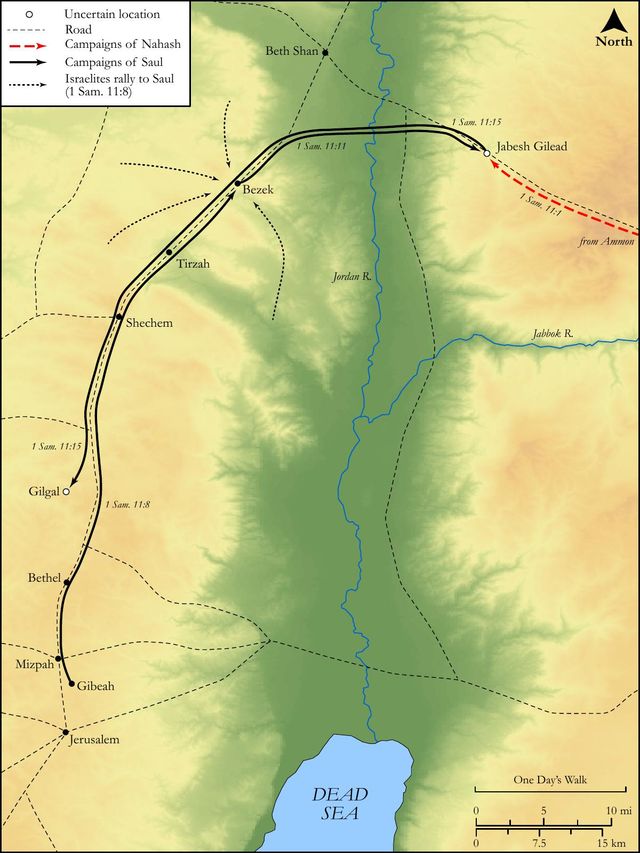
III.Samuel took this occasion to call the people together before the Lord in Gilgal, Sa1 11:14, Sa1 11:15.
1.That they might publicly give God thanks for their late victory. There they rejoiced greatly, and, that God might have the praise of that which they had the comfort of, they sacrificed to him, as the giver of all their successes, sacrifices of peace-offerings.
2.That they might confirm Saul in the government, more solemnly than had been yet done, that he might not retire again to his obscurity. Samuel would have the kingdom renewed; he would renew his resignation, and the people should renew their approbation, and so in concurrence with, or rather in attendance upon, the divine nomination, they made Saul king, making it their own act and deed to submit to him.
Historical interpretation
Historical reception
2 surviving comments on this verse. Each one is dated, so this reads as a timeline rather than a list.
And all the people went to Gilgal, etc. Upon hearing the exhortation of their spiritual teachers, the people grew in faith and in the knowledge of the truth, and in the revelation of the heart, illuminating themselves by humbling and despising themselves, sought the glory of Christ in everything, and exalted his name among each other, and for the peace of the Church offered whatever they could of their devotion before the Lord.
But Samuel said to the people who were coming: Let us go to Gilgal, etc. With the heretics vanquished, condemned, or corrected, any perfect teacher says to the Church subject to him: Come, with the face of the heart unveiled, let us contemplate the glory of the Lord. For Gilgal is indeed called revelation. And the more we are renewed in the spirit of our mind in the knowledge of him who created us, the more we see the dangers of those we have conquered; because remaining in oldness, they did not want to reveal their way to the Lord and hope in him, nor to supplicate him confidently, and say: Reveal our eyes, that we may behold the wonders of your law (Psalm CXVIII).
Continue studying 1 Samuel 11:14 across the web’s major study libraries — every link below opens this exact verse, chapter, or book on the destination site.
Read & Compare
 BibleGatewayThis verse in more than 200 translations and 70 languages.
 Bible.comThe YouVersion reader — hundreds of translations, reading plans, and highlights.
 ESV.orgCrossway's official English Standard Version reader.
 NET BibleThe NET translation with 60,000+ translators' notes on every rendering decision.
 STEP BibleTyndale House's free study tool — original text, vocabulary, and scholarly resources.
 BibliaLogos Bible Software's free web reader.
 USCCBThe New American Bible (Revised Edition) with the U.S. bishops' study notes.
Commentaries
 BibleHub CommentariesDozens of classic commentaries on this verse, gathered on one page.
 StudyLightMore than 100 commentary sets — the largest collection on the web.
 BibleRefPlain-English commentary on what this verse means, verse by verse.
 Enduring WordDavid Guzik's free commentary on this chapter, widely used by Bible teachers.
 Bible Study ToolsVerse commentary alongside Greek and Hebrew study aids.
Original Language & Research
- BibleHub InterlinearThe verse word by word — original language, transliteration, and English.
- BibleHub LexiconEvery word's original-language definition and Strong's entry.
 Blue Letter BibleDeep-study tools — Strong's numbers, concordance, and word studies.
 SefariaThe Hebrew text with Rashi and centuries of Jewish commentary.
Sermons, Hymns & Audio


TrulyRandomVerse is not affiliated with these sites and doesn’t control their content. They’re linked because they’re genuinely useful.
Summary
1 Samuel 11:14 marks a pivotal moment in Israel's transition to monarchy, where the prophet Samuel, leveraging the national unity and enthusiasm following Saul's decisive victory over the Ammonites, formally consolidates Saul's kingship. This verse orchestrates a solemn assembly at Gilgal, a site steeped in Israelite history and covenant renewal, to publicly affirm Saul's divine appointment and establish the nascent kingdom on a firm, unified foundation, moving beyond initial skepticism to widespread acceptance.
Context
ShowHideLiterary Context
This verse immediately follows Saul's triumphant military campaign against Nahash the Ammonite, which culminated in the decisive rescue of Jabesh-Gilead (1 Samuel 11:1-13). Saul's swift and divinely empowered victory silenced the dissenters who had previously questioned his leadership (compare the skepticism towards Saul's kingship in 1 Samuel 10:27). The people, now unified and enthusiastic, even sought to execute those who had opposed Saul (1 Samuel 11:12), but Saul, demonstrating a nascent kingly magnanimity, refused. Samuel, ever the wise spiritual leader, seizes this moment of national fervor and newfound unity to transition from a military triumph to a formal, covenantal establishment of the monarchy, ensuring that the people's enthusiasm is channeled into a divinely sanctioned act of commitment. The subsequent verse, 1 Samuel 11:15, details the actual coronation and sacrifices at Gilgal.
Historical & Cultural Context
The period described in 1 Samuel is one of significant transition for Israel, moving from a tribal confederacy led by charismatic judges to a centralized monarchy. The people's demand for a king, as recorded in 1 Samuel 8, was met with divine allowance but also prophetic warning. Gilgal itself holds immense historical and spiritual significance. It was the first encampment of Israel after crossing the Jordan into the Promised Land, as detailed in Joshua 4:19, where the reproach of Egypt was "rolled away" through renewed circumcision and the first Passover in Canaan was observed, as recounted in Joshua 5:9. Gilgal served as a base for Joshua's campaigns, a place of covenant renewal, and a site for divine encounters. Its selection for the renewal of the kingdom was not arbitrary; it invoked deep historical memory and underscored the notion that the monarchy, though a new institution, was rooted in Israel's foundational covenant relationship with God.
Key Themes
ShowHideThis verse powerfully contributes to several key themes within 1 Samuel and the broader Old Testament narrative. Firstly, it highlights the Confirmation of Kingship, demonstrating that Saul's military success served as a divine sign of his fitness to rule, transforming his theoretical appointment into a practically accepted reality for all Israel. Secondly, it underscores National Unity and Commitment, as the call to Gilgal was an invitation for the entire nation to participate in a solemn ceremony, symbolizing a collective agreement to move forward under God's chosen leader and fostering a crucial sense of national cohesion after a period of tribal disunity. Thirdly, it reinforces the Divine Mandate for the monarchy; despite the people's initial request for a king, Samuel consistently emphasized that Saul's appointment was ultimately from God, and the ceremony at Gilgal served as a public acknowledgment of this divine grounding. Finally, the event marks a crucial Transition to Monarchy, signaling a decisive shift from the ad-hoc leadership of judges to a more structured, albeit still developing, governmental system, with Samuel playing a vital role in guiding Israel through this momentous change.
Exposition and Analysis
ShowHideKey Word Analysis
ShowHideThe Hebrew verb חָדַשׁ (châdash) means "to be new" or "to rebuild." In this context, it does not imply creating a kingdom from scratch, as Saul had already been anointed and chosen by lot. Instead, it signifies a formal revitalization, confirmation, and proper inauguration of the existing concept of a kingdom under Saul's leadership. It suggests a fresh start, a public recommitment, and a firm rooting of the monarchy within Israel's covenant relationship with God after a period of uncertainty and initial opposition. This "renewal" implies a spiritual and national recommitment to the new governmental structure under divine approval.
The Hebrew noun מְלוּכָה (mᵉlûwkâh) refers to "something ruled," "a realm," or "kingship/royal power." Here, it denotes not merely the abstract concept of rule but the concrete establishment of a monarchical system in Israel, with Saul as its head. The call to "renew the kingdom" is a call to formally establish and publicly acknowledge this new form of governance, transitioning from the previous, less centralized tribal system to a unified national entity under a king. It emphasizes the institutionalization of royal authority, designed to bring order and stability to the nation.
Verse Breakdown
ShowHide"Then said Samuel to the people"
This opening phrase highlights Samuel's continuing authority and indispensable role as God's prophet and the last of the judges. Even as the monarchy is established, Samuel remains the crucial intermediary between God and Israel, guiding the nation through this significant transition. His initiative underscores that the establishment of the kingdom, though desired by the people, is ultimately orchestrated under divine guidance.
"Come, and let us go to Gilgal"
Samuel's invitation is a command to collective action, emphasizing national unity. The choice of Gilgal is highly significant, as detailed in the context section. It was a place of foundational covenant experiences, symbolizing Israel's entry into the Promised Land, the rolling away of Egyptian reproach, and the renewal of circumcision. By choosing Gilgal, Samuel imbues the establishment of the monarchy with deep historical and spiritual meaning, connecting the new institution to Israel's sacred past and covenant identity.
"and renew the kingdom there"
This is the core purpose of the assembly. The "renewal" signifies a public, formal, and unified affirmation of Saul's kingship. It is a moment of national commitment, where the people, having witnessed Saul's divine favor in battle, collectively acknowledge and pledge allegiance to him as their God-appointed king. This act at Gilgal solidifies the monarchy, moving it from a prophetic anointing and selection by lot to a fully public and nationally accepted institution, grounded in worship and covenant.
Literary Devices
ShowHideThe passage makes effective use of Symbolism, particularly through the choice of Gilgal as the location for the kingdom's renewal. Gilgal is not merely a geographical point but a powerful symbol of new beginnings, covenant faithfulness, and national identity, connecting the nascent monarchy to Israel's foundational history and divine promises. This symbolic resonance elevates the event from a mere political gathering to a sacred act. There is also an element of Dramatic Irony present for the reader who knows the full narrative of Saul's reign. While this moment at Gilgal signifies unity and the renewal of the kingdom under Saul's leadership, it is tragically ironic that Gilgal will later become the site of Saul's rejection by God through Samuel, due to his disobedience (see 1 Samuel 15). This contrast between the joyous, unifying renewal and the later, sorrowful rejection underscores the conditional nature of the earthly kingship and the ultimate sovereignty of God. Furthermore, Samuel's authoritative declaration exemplifies Prophetic Authority, as he acts as God's spokesperson, guiding the people in this crucial national and spiritual transition.
Theological and Thematic Connections
ShowHideThe formal establishment of the monarchy at Gilgal, initiated by Samuel, underscores the intricate relationship between divine sovereignty and human agency in God's plan for Israel. While the people had demanded a king, reflecting a desire to be "like all the nations" (1 Samuel 8:5), God, through Samuel, ultimately guided the process, ensuring that the king was chosen by divine mandate and the kingdom established on a foundation of covenant. This event highlights that true leadership, even in a human institution like monarchy, must be rooted in God's will and dedicated to His purposes. The "renewal" at Gilgal emphasizes the importance of recommitment and fresh starts in the life of faith, both individually and corporately, reminding us that God is always able to restore and re-establish what is broken or uncertain.
Reflection and Application
ShowHideThe call to Gilgal to "renew the kingdom" serves as a powerful metaphor for the ongoing need for renewal and recommitment in our own lives, communities, and institutions. Just as Israel needed a formal, public act to solidify their new governmental structure and unify the nation under God's chosen leader, we too are often called to renew our commitments—whether to God, to our families, to our vocations, or to our communities. This renewal is not merely a superficial change but a deep, intentional re-establishment of purpose and allegiance, often following a period of trial or uncertainty, much like Saul's victory preceded this event. It reminds us that true progress and lasting unity are often forged in moments of collective dedication and public acknowledgment of divine guidance. The choice of Gilgal, a place of historical covenant, further impresses upon us the importance of grounding our new endeavors and renewed commitments in the foundational truths and principles of our faith, ensuring that our actions are not merely pragmatic but spiritually anchored.
Questions for Reflection
ShowHideFAQ
ShowHideWhy was Gilgal chosen for the renewal of the kingdom?
ShowHideGilgal was chosen for its profound historical and spiritual significance to Israel. It was the first encampment of the Israelites after crossing the Jordan River into the Promised Land, as recorded in Joshua 4:19, where they renewed their covenant with God through circumcision and celebrated the first Passover in Canaan, as seen in Joshua 5:9. It symbolized new beginnings, the removal of past reproach, and a place where God's presence was powerfully manifested. By choosing Gilgal, Samuel connected the new institution of monarchy to Israel's foundational covenant history, imbuing the act of "renewing the kingdom" with deep spiritual resonance and legitimacy, grounding it in God's faithfulness to His people.
What does "renew the kingdom" mean in this context, given that Saul was already chosen as king?
ShowHideThe phrase "renew the kingdom" (Hebrew: châdash) does not imply creating a kingdom from scratch, as Saul had already been anointed by Samuel (1 Samuel 10:1) and chosen by lot (1 Samuel 10:20-24). Instead, it signifies a formal, public, and national affirmation and consolidation of Saul's kingship. Prior to his victory over the Ammonites, some had questioned Saul's ability to rule, as noted in 1 Samuel 10:27. His decisive military success united the nation and silenced dissent. Therefore, "renewing the kingdom" at Gilgal was an act of public commitment, solidifying the people's allegiance to Saul, formally establishing the monarchy as a national institution, and dedicating it before God. It was a moment of covenant renewal and a fresh start for the nation under its new form of governance.
Christ-Centered Fulfillment
ShowHideThe establishment and renewal of Israel's earthly kingdom under Saul at Gilgal, while significant, ultimately foreshadows the perfect and eternal kingdom of God established through Jesus Christ. Saul's kingship, though divinely appointed, was flawed and temporary, eventually leading to his rejection and the need for a new king from a different lineage. This earthly monarchy, with its cycles of obedience and disobedience, points to the ultimate need for a King who would perfectly fulfill God's will and establish an everlasting reign. Jesus, the true Son of David, is the King who does not merely "renew" a temporary kingdom but inaugurates a new covenant and an eternal, spiritual kingdom that will never end, as prophesied in Luke 1:33. Just as the people gathered at Gilgal to affirm Saul, believers are called to gather and affirm Christ as their Lord and King, submitting to His perfect rule. The "renewal" at Gilgal, rooted in Israel's past covenant, finds its ultimate fulfillment in Christ, who offers a true and lasting renewal of the human heart and a new creation for all who believe, ushering in a kingdom of righteousness, peace, and joy in the Holy Spirit, as described in Romans 14:17.