


Joshua 10:34
Bible text: King James Version (1769 Blayney text) · Public domain
Bible text: Berean Standard Bible · Public domain
Bible text: American Standard Version (1901) · Public domain
Bible text: World English Bible, Messianic edition · Public domain
Bible text: Geneva Bible (1599) · Public domain
Bible text: Young's Literal Translation · Public domain
- וַיַּעֲבֹרvai·ya·'a·Vorand he passed onH5674Conj-w ¦ V-Qal-ConsecImperf-3msVerb Qal Consecutive Imperfect 3rd Singular Masculineוַandיַּעֲבֹרhe passed on
- יְהוֹשֻׁעַYe·ho·shu·a'JoshuaH3091N-proper-mNoun Proper Masculine
- וְכָלve·kholand allH3605Conj-w ¦ N-mscNoun Singular Masculine Constructוְandכָלall
- יִשְׂרָאֵלYis·ra·'ElIsraelH3478N-properNoun Proper Location
- עִמּוֹi·Mowith himH5973Prep ¦ 3msPreposition Definiteעִמּwithוֹhim
- מִלָּכִישׁmi·la·Khishfrom LachishH3923Prep-m ¦ N-properNoun Proper LocationמִfromלָּכִישׁLachish
- עֶגְלֹנָה'eg·Lo·nahEglon towardsH5700N-proper ¦ SfxNoun Proper LocationעֶגְלֹנָEglonהtowards
- וַיַּחֲנוּvai·ya·cha·Nuand they encampedH2583Conj-w ¦ V-Qal-ConsecImperf-3mpVerb Qal Consecutive Imperfect 3rd Plural Masculineוַandיַּחֲנוּthey encamped
- עָלֶיהָ'a·Lei·haon itH5921Prep ¦ 3fsPreposition Definiteעָלֶיonהָit
- וַיִּלָּחֲמוּvai·yi·la·cha·Muand they engaged in battleH3898Conj-w ¦ V-Niphal-ConsecImperf-3mpVerb Niphal Consecutive Imperfect 3rd Plural Masculineוַandיִּלָּחֲמוּthey engaged in battle
- עָלֶיהָ'a·Lei·haon itH5921Prep ¦ 3fsPreposition Definiteעָלֶיonהָit
English is a literal word-by-word gloss of the Hebrew, not the KJV's wording. Why?
This is the original text the KJV's translators worked from — each Hebrew word with its own literal English meaning in this verse, prepared by scholars at Tyndale House, Cambridge. The KJV translates whole sentences, not word by word, so its wording differs: one Hebrew word can become several English words, and the KJV may choose “the LORD” where the gloss reads “Yahweh”. Both are faithful — they answer different questions. For the KJV's own rendering, switch to the KJV text.
Details
See on the biblical-era maps
Study this verse
Public-domain commentary
Matthew Henry
From his Commentary on the Whole Bible. Henry comments on passages, not single verses — this entry covers Joshua 10:28–43. His three-level outline is real structure in the source text, so it is rendered as structure.
We are here informed how Joshua improved the late glorious victory he had obtained and the advantages he had gained by it, and to do this well is a general's praise.
I.Here is a particular account of the several cities which he immediately made himself master of.
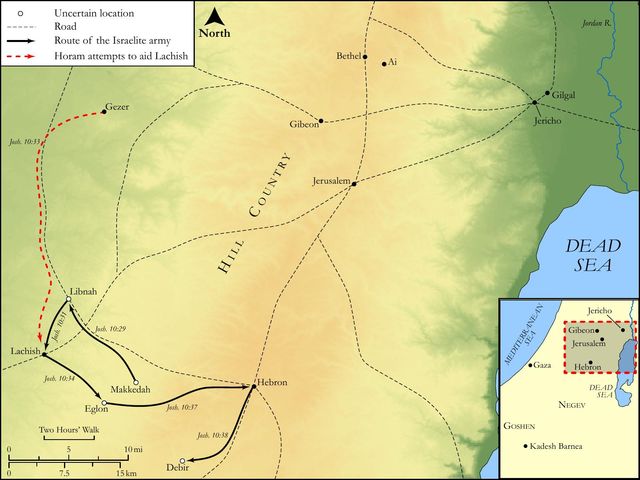
1.The cities of three of the kings whom he had conquered in the field he went and took possession of, Lachish (Jos 10:31, Jos 10:32), Eglon (Jos 10:34, Jos 10:35), and Hebron, Jos 10:36, Jos 10:37. The other two, Jerusalem and Jarmuth, were not taken at this time; perhaps his forces were either so much fatigued with what they had done or so well content with what they had got that they had no mind to attack those places, and so they let slip the fairest opportunity they could ever expect of reducing them with ease, which afterwards was not done without difficulty, Jdg 1:8; Sa2 5:6.
2.Three other cities, and royal cities too, he took: Makkedah, into the neighbourhood of which the five kings had fled, which brought Joshua and his forces thither in pursuit of them, and so hastened its ruin (Jos 10:28), Libnah (Jos 10:29, Jos 10:30), and Debir, Jos 10:38, Jos 10:39.
3.One king that brought in his forces for the relief of Lachish, that had lost its king, proved to meddle to his own hurt; it was Horam king of Gezer, who, either in friendship to his neighbours or for his own security, offered to stop the progress of Joshua's arms, and was cut off with all his forces, Jos 10:33. Thus wicked men are often snared in their counsels, and, by opposing God in the way of his judgments, bring them the sooner on their own heads.
II.A general account of the country which was hereby reduced and brought into Israel's hands (Jos 10:40-42), that part of the land of Canaan of which they first got possession, which lay south of Jerusalem, and afterwards fell, for the most part, to the lot of the tribe of Judah. Observe in this narrative,
1.The great speed Joshua made in taking these cities, which, some think, is intimated in the manner of relating it, which is quick and concise. He flew like lightning from place to place; and though they all stood it out to the last extremity, and none of these cities opened their gates to him, yet in a little time he got them all into his hands, summoned them, and seized them, the same day (Jos 10:28), or in two days, Jos 10:32. Now that they were struck with fear, by the defeat of their armies and the death of their kings, Joshua prudently followed his blow. See what a great deal of work may be done in a little time, if we will but be busy and improve our opportunities.
2.The great severity Joshua used towards those he conquered. He gave no quarter to man, woman, nor child, put to the sword all the souls (Jos 10:28, Jos 10:30, Jos 10:32, Jos 10:35, etc.), utterly destroyed all that breathed (Jos 10:40), and left none remaining. Nothing could justify this military execution but that herein they did as the Lord God of Israel commanded (Jos 10:40), which was sufficient not only to bear them out, and save them for the imputation of cruelty, but to sanctify what they did, and make it an acceptable piece of service to his justice. God would hereby,
(1.)Manifest his hatred of the idolatries and other abominations which the Canaanites had been guilty of, and leave us to judge how great the provocation was which they had given him by the greatness of the destruction which was brought upon them when the measure of their iniquity was full.
(2.)He would hereby magnify his love to his people Israel, in giving so many men for them, and people for their life, Isa 43:4. When the heathen are to be cast out to make room for this vine (Psa 80:8) divine justice appears more prodigal than ever of human blood, that the Israelites might find themselves for ever obliged to spend their lives to the glory of that God who had sacrificed so many of the lives of his creatures to their interest.
(3.)Hereby was typified the final and eternal destruction of all the impenitent implacable enemies of the Lord Jesus, who, having slighted the riches of his grace, must for ever feel the weight of his wrath, and shall have judgment without mercy. Nations that forget God shall be turned into hell, and no reproach at all to God's infinite goodness.
3.The great success of this expedition. The spoil of these cities was now divided among the men of war that plundered them; and the cities themselves, with the land about them, were shortly to be divided among the tribes, for the Lord fought for Israel, Jos 10:42. They could not have gotten the victory if God had not undertaken the battle; then we conquer when God fights for us; and, if he be for us, who can be against us?
Continue studying Joshua 10:34 across the web’s major study libraries — every link below opens this exact verse, chapter, or book on the destination site.
Read & Compare
 BibleGatewayThis verse in more than 200 translations and 70 languages.
 Bible.comThe YouVersion reader — hundreds of translations, reading plans, and highlights.
 ESV.orgCrossway's official English Standard Version reader.
 NET BibleThe NET translation with 60,000+ translators' notes on every rendering decision.
 STEP BibleTyndale House's free study tool — original text, vocabulary, and scholarly resources.
 BibliaLogos Bible Software's free web reader.
 USCCBThe New American Bible (Revised Edition) with the U.S. bishops' study notes.
Commentaries
 BibleHub CommentariesDozens of classic commentaries on this verse, gathered on one page.
 StudyLightMore than 100 commentary sets — the largest collection on the web.
 BibleRefPlain-English commentary on what this verse means, verse by verse.
 Enduring WordDavid Guzik's free commentary on this chapter, widely used by Bible teachers.
 Bible Study ToolsVerse commentary alongside Greek and Hebrew study aids.
Original Language & Research
- BibleHub InterlinearThe verse word by word — original language, transliteration, and English.
- BibleHub LexiconEvery word's original-language definition and Strong's entry.
 Blue Letter BibleDeep-study tools — Strong's numbers, concordance, and word studies.
 SefariaThe Hebrew text with Rashi and centuries of Jewish commentary.
Sermons, Hymns & Audio


TrulyRandomVerse is not affiliated with these sites and doesn’t control their content. They’re linked because they’re genuinely useful.
Summary
Joshua 10:34 meticulously records the relentless and divinely propelled advance of the Israelite conquest within Canaan, specifically detailing Joshua's immediate and strategic movement with the entire army from the recently subdued city of Lachish to the next crucial target, Eglon. This verse vividly portrays the unwavering obedience of Israel to God's command to dispossess the Canaanites, emphasizing the swift and decisive nature of the military campaign as a direct fulfillment of God's covenant promises and His righteous judgment upon the land.
Context
ShowHideLiterary Context
Joshua 10:34 is strategically placed within the larger narrative of the southern campaign, which commences immediately following the decisive victory over the coalition of five Amorite kings who had attacked Gibeon. After the miraculous intervention of the sun standing still and the subsequent rout of the confederate kings, Joshua systematically proceeds to conquer their respective strongholds. This verse directly follows the detailed account of the capture and utter destruction of Lachish, a formidable fortified city (Joshua 10:31-33). The seamless and immediate transition from Lachish to Eglon, without any narrative pause, powerfully underscores the relentless momentum of the conquest and Joshua's unwavering commitment to fulfilling the divine mandate. This uninterrupted sequence illustrates the principle of total warfare and the complete disinheritance of the Canaanites, precisely as commanded by God. The narrative flow is characterized by continuous, divinely-backed military action, demonstrating the tangible fulfillment of God's promise to deliver the land into Israel's hands.
Historical & Cultural Context
The events depicted in Joshua 10:34 unfold in Canaan in the days of Joshua, a time marked by a mosaic of independent city-states and shifting regional alliances. Lachish and Eglon were significant fortified urban centers situated within the Shephelah, the strategically vital lowlands of Judah. These cities held considerable importance for controlling ancient trade routes and fertile agricultural territories. The indigenous Canaanite inhabitants were steeped in various abhorrent religious and social practices, including widespread idolatry, fertility cults, and the horrific practice of child sacrifice, all of which God explicitly condemned as abominations (Deuteronomy 18:9-12). Consequently, the Israelite conquest was not merely a territorial expansion but served as a profound act of divine judgment against the pervasive wickedness of these inhabitants, with Israel acting as God's chosen instrument. The military tactics described—encamping and fighting—are consistent with the siege warfare of that day, which involved surrounding a city to cut off its vital supplies, followed by direct assault. The explicit mention of "all Israel" participating signifies a unified, national effort under Joshua's divinely appointed leadership, distinguishing this as a sacred, God-sanctioned campaign rather than a series of isolated tribal skirmishes.
Key Themes
ShowHideThis verse significantly contributes to several overarching theological and narrative themes woven throughout the book of Joshua. Firstly, it powerfully illustrates the theme of Divine Judgment upon the Canaanite nations. Their "iniquity is not yet full," as foretold in Genesis 15:16, and God's patience had reached its limit, with Israel serving as the agent of His righteous wrath. Secondly, it highlights the theme of Unwavering Obedience on the part of Joshua and the Israelites. They meticulously followed God's commands, moving from one objective to the next without hesitation, thereby demonstrating their profound trust in God's leading and omnipotent power (Joshua 1:7-9). Thirdly, the swift progression from Lachish to Eglon underscores the themes of Divine Momentum and God's Faithfulness. God was actively fighting for Israel, granting them supernatural strength and ensuring their success, thereby guaranteeing the fulfillment of His ancient covenant promises to Abraham regarding the land (Genesis 12:7). Finally, the descriptive phrase "encamped against it, and fought against it" also emphasizes the theme of Total Conquest, signifying a comprehensive and decisive disinheritance, rather than a partial or hesitant effort.
Exposition and Analysis
ShowHideKey Word Analysis
ShowHideThis Hebrew verb signifies movement, transition, or crossing over. In this specific context, it denotes a direct, immediate, and purposeful progression from Lachish to Eglon. It implies a swift, unhesitating advance, emphasizing the relentless and divinely driven pace of the conquest. This was not a leisurely journey but a calculated and urgent military maneuver, indicating that the Israelites were not resting on their laurels after the victory at Lachish but were pressing on with the divine mandate.
This verb describes the act of setting up a military camp, often for the purpose of a siege. In ancient warfare, to "encamp against" a city meant to surround it, cutting off its resources, communications, and ability to receive reinforcements, thereby weakening its defenses and preparing for a direct assault. It indicates a strategic positioning and containment phase before the actual battle.
This verb refers to direct engagement in combat or battle. When paired with "encamped," it describes the actual military assault on the city following the siege. The combination of "encamped" and "fought" emphasizes the comprehensive nature of the attack: first, strategic positioning and containment, then direct, aggressive military action. This pairing underscores the determined and thorough nature of their assault on Eglon.
Verse Breakdown
ShowHide"And from Lachish Joshua passed unto Eglon"
This clause precisely establishes the immediate geographical and strategic movement of the Israelite army. Having just conquered Lachish, one of the most formidable cities in the Shephelah, Joshua does not pause but immediately directs the entire army to Eglon. This highlights the relentless, systematic, and divinely propelled nature of the conquest. The swift transition signifies that the campaign was not a series of isolated skirmishes but a continuous, divinely orchestrated sweep through the land, maintaining constant pressure on the remaining Canaanite strongholds.
"and all Israel with him"
This phrase profoundly emphasizes the collective, unified, and national effort of the entire Israelite community in the conquest. It underscores that this was a comprehensive national enterprise, not merely a localized military action conducted by a segment of the army. The presence of "all Israel" signifies the comprehensive nature of the divine mandate and the communal responsibility in executing God's judgment and inheriting the promised land. It also implies the sheer scale and overwhelming power of the force brought against Eglon, leaving no doubt about the eventual outcome.
"and they encamped against it, and fought against it:"
This final clause vividly describes the direct military action taken against Eglon. "Encamped against it" refers to the act of besieging the city, meticulously surrounding it to cut off its defenses and prepare for the decisive attack. "Fought against it" indicates the direct combat and aggressive assault on the city itself. The strategic repetition of "against it" (Hebrew: עָלֶיהָ, 'aleha) for both actions powerfully emphasizes the direct, focused, and unyielding nature of the Israelite attack. It conveys the unwavering determination of the Israelites to overcome Eglon, mirroring the pattern of comprehensive conquest seen at Lachish and other cities.
Literary Devices
ShowHideJoshua 10:34 skillfully employs several literary devices to convey its profound message. The primary device is Narrative Pace, specifically the swift and unceasing progression from one conquered city to the next. The immediate transition "from Lachish... unto Eglon" without any intervening narrative pause powerfully emphasizes the relentless momentum and divine backing of the conquest campaign. This rapid pace reflects the urgency and supernatural empowerment behind Israel's advance. Another significant device is Repetition, particularly evident in the phrase "encamped against it, and fought against it." The repeated "against it" serves to underscore the direct, focused, and aggressive nature of the Israelite assault. This repetition reinforces the idea of a comprehensive and determined effort to utterly dispossess the inhabitants. Furthermore, the verse functions as a form of Fulfillment Narrative, demonstrating how God's ancient promises of victory and the inheritance of the land are being concretely and systematically realized through Joshua's obedient actions, echoing the divine command for total conquest.
Theological and Thematic Connections
ShowHideJoshua 10:34 stands as a powerful testament to God's unfailing faithfulness in fulfilling His covenant promises and His unblemished righteousness in executing judgment upon wicked nations. The relentless advance from Lachish to Eglon vividly illustrates that God's plan of conquest was not haphazard but systematic, purposeful, and divinely empowered. It underscores the profound theological principle that when God issues a command, He also provides the necessary enablement, and His people are called to unwavering obedience and persistent perseverance. This verse serves as a potent reminder that divine victory often necessitates human effort, steadfast persistence, and a willingness to press on even after significant achievements have been secured. The conquest of Canaan, of which the capture of Eglon was an integral part, serves as a foundational narrative for understanding God's absolute sovereignty over nations, His intolerance of pervasive wickedness, and His unwavering commitment to establishing His chosen people in their promised inheritance.
Reflection and Application
ShowHideJoshua 10:34, while describing an ancient military campaign, offers profound and enduring spiritual lessons for believers today. Just as ancient Israel was called to unwavering obedience and persistent action in conquering the physical land, we too are called to similar perseverance in our spiritual lives and in fulfilling the divine tasks God has set before us. This verse reminds us that spiritual victory is often a continuous process of advancement, not merely a single, isolated event. We are cautioned not to rest complacently after one spiritual triumph but to press forward in faith, understanding that God's call frequently involves moving from one challenge to the next. Our ongoing spiritual warfare against sin, the temptations of the flesh, and the schemes of the devil demands constant vigilance, disciplined effort, and complete reliance on God's indwelling strength. We are profoundly encouraged to trust God's leading, even when the path ahead seems daunting, and to pursue completeness in our obedience, fighting the good fight of faith until the ultimate victory is fully realized in Christ.
Questions for Reflection
ShowHideFAQ
ShowHideWhy was Eglon the next target after Lachish?
ShowHideEglon was a logical and strategically imperative target for several compelling reasons. Geographically, it was situated in the Shephelah, the lowlands of Judah, much like Lachish, making it an integral part of the same general campaign area. Militarily, Lachish was recognized as one of the strongest cities in the region, and its dramatic fall would have significantly demoralized the remaining Canaanite strongholds. While not explicitly named among the five Amorite kings in Joshua 10:5, Eglon was undoubtedly a significant city in the region that posed a continued threat to Israel's burgeoning control of the Shephelah. Joshua's strategic approach was to systematically dismantle the Canaanite power structure, moving decisively from one key city to the next, thereby ensuring complete disinheritance as divinely commanded. The immediate transition also powerfully highlights the relentless momentum of the divine conquest, leaving no opportunity for the enemy to regroup or reinforce their defenses.
What does "encamped against it, and fought against it" imply about Israel's military tactics?
ShowHideThis phrase precisely describes the standard siege warfare of that day. "Encamped against it" (חָנָה, chanah) means to establish a military camp around the city, effectively initiating a comprehensive siege. This strategic action would systematically cut off the city's vital supplies, communications, and its ability to receive reinforcements, thereby progressively weakening its defenses. It also served as a crucial staging ground for the subsequent assault. "Fought against it" (לָחָם, lacham) then refers to the direct military engagement, the actual battle or assault on the city walls, which could involve various tactics such as scaling ladders, employing battering rams, or breaching the defenses through other means. The combination of these two actions indicates a comprehensive and aggressive approach: first, strategic containment and isolation, followed by direct, decisive combat. It signifies a full and unwavering commitment to overcoming the city rather than a mere skirmish or limited engagement.
Christ-Centered Fulfillment
ShowHideThe relentless conquest of Canaan, so vividly exemplified by the unwavering advance from Lachish to Eglon, serves as a profound foreshadowing of the greater, ultimate spiritual conquest achieved by Jesus Christ. Just as Joshua faithfully led Israel to dispossess wicked nations and inherit a promised land, Jesus, our true Joshua (whose name, Yeshua, means "Yahweh saves"), leads His people in a triumphant spiritual conquest over the formidable powers of sin, death, and the forces of darkness. The systematic dismantling of Canaanite strongholds points prophetically to Christ's decisive and complete victory on the cross, where He "disarmed the powers and authorities, he made a public spectacle of them, triumphing over them by the cross" (Colossians 2:15). The promised land, a place of rest and secure inheritance, ultimately finds its supreme fulfillment not in a physical territory but in the glorious spiritual inheritance believers possess in Christ and the ultimate reality of the new heavens and new earth (Hebrews 4:8-9 and Revelation 21:1-4). The unwavering obedience of Joshua and the Israelites in pressing forward prefigures Christ's perfect and unparalleled obedience, even to the agonizing death on a cross, which secured our eternal victory and spiritual inheritance (Philippians 2:8). Thus, Joshua 10:34 stands as a powerful shadow of the comprehensive, unstoppable, and divinely ordained advance of God's kingdom through Jesus Christ, culminating in His complete triumph over all His enemies and the glorious establishment of His eternal reign.