


2 Chronicles 20:29
- וַיְהִיvay·Hiand it wasH1961Conj-w ¦ V-Qal-ConsecImperf-3msVerb Qal Consecutive Imperfect 3rd Singular Masculineוַandיְהִיit was
- פַּחַדPa·chad[the] dread ofH6343N-mscNoun Singular Masculine Construct
- אֱלֹהִים'E·lo·HimGodH430N-mpNoun Plural Masculine Absolute
- עַל'alonH5921PrepPreposition
- כָּלkolallH3605N-mscNoun Singular Masculine Construct
- מַמְלְכוֹתmam·le·Khot[the] kingdoms ofH4467N-fpcNoun Plural Feminine Construct
- הָאֲרָצוֹתha·'a·ra·Tzotthe landsH776Art ¦ N-fpNoun Plural Feminine Absoluteהָtheאֲרָצוֹתlands
- בְּשָׁמְעָםbe·sha·me·'Amwhen they heardH8085Prep-b ¦ V-Qal-Inf ¦ 3mpVerb Qal Infinitive Constructבְּwhenשָׁמְעָheardםthey
- כִּיkithatH3588PrtParticle Conditional
- נִלְחַםnil·Chamhe had foughtH3898V-Niphal-Perf-3msVerb Niphal Perfect 3rd Singular Masculine
- יְהוָהYah·wehYahwehH3068N-properNoun Proper Title
- עִם'imwithH5973PrepPreposition
- אוֹיְבֵי'oy·Vei[the] enemies ofH341V-Qal-Prtcpl-mpVerb Qal Participle Plural Masculine Construct
- יִשְׂרָאֵלYis·ra·'ElIsraelH3478N-properNoun Proper Location
English is a literal word-by-word gloss of the Hebrew, not the KJV's wording. Why?
This is the original text the KJV's translators worked from — each Hebrew word with its own literal English meaning in this verse, prepared by scholars at Tyndale House, Cambridge. The KJV translates whole sentences, not word by word, so its wording differs: one Hebrew word can become several English words, and the KJV may choose “the LORD” where the gloss reads “Yahweh”. Both are faithful — they answer different questions. For the KJV's own rendering, switch to the KJV text.
Details
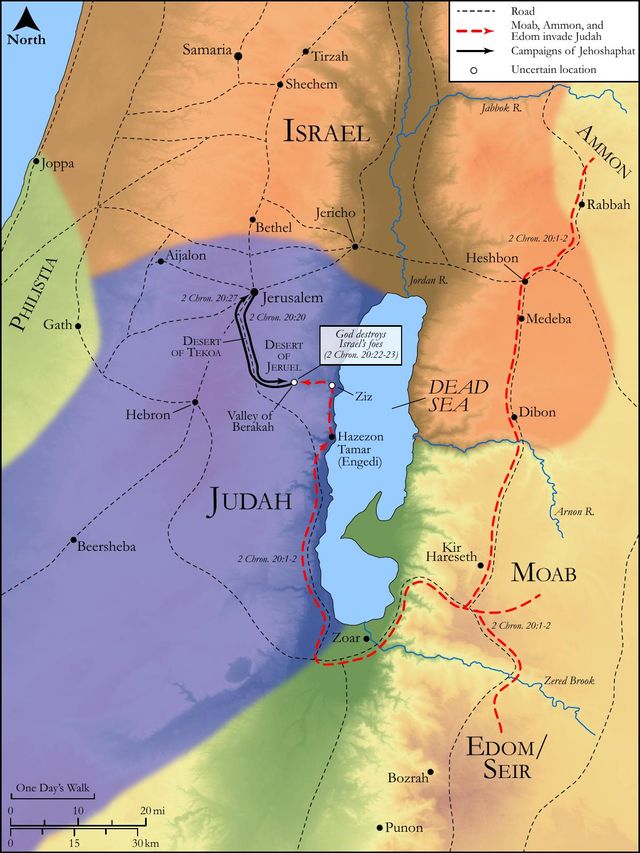
See on the biblical-era map
Study this verse
Public-domain commentary
Matthew Henry
From his Commentary on the Whole Bible. Henry comments on passages, not single verses — this entry covers 2 Chronicles 20:20–30. His three-level outline is real structure in the source text, so it is rendered as structure.
We have here the foregoing prayer answered and the foregoing promise performed, in the total overthrow of the enemies' forces and the triumph (for so it was rather than a victory) of Jehoshaphat's forces over them.
I.Never was army drawn out to the field of battle as Jehoshaphat's was.
He had soldiers ready prepared for war (Ch2 17:18), but here is no notice taken of their military equipment, their swords or spears, their shields or bows. But Jehoshaphat took care,
1.That faith should be their armour. As they went forth, instead of calling them to handle their arms, and stand to them, to keep ranks, observe orders, and fight valiantly, he bade them believe in the Lord God and give credit to his word in the mouth of his prophets, and assured them that they should prosper and be established, Ch2 20:20. That is true courage which faith inspires a man with; nor will any thing contribute more to the establishing of the heart in shaking times than a firm belief of the power, and mercy, and promise of God. The heart is fixed that thus trusteth in the Lord, and is kept in perfect peace. In our spiritual conflicts, this is the victory, this is the prosperity, even our faith.
2.That praise and thanksgiving should be their vanguard, Ch2 20:21. Jehoshaphat called a council of war, and it was resolved to appoint singers to go out before the army, to charge in the front, who had nothing else to do but to praise God, to praise his holiness, which is his beauty, to praise him as they did in the temple (that beauty of holiness) with that ancient and good doxology which eternity itself will not wear thread-bare, Praise the Lord; for his mercy endureth for ever. By this strange advance towards the field of battle, Jehoshaphat intended to express his firm reliance upon the word of God (which enabled him to triumph before the battle), to animate his own soldiers, to confound the enemy, and to engage God on their side; for praise pleases God better than all burnt offering and sacrifice.
II.Never was army so unaccountably destroyed as that of the enemy; not by thunder, or hail, or the sword of an angel, not by dint of sword, or strength of arm, or any surprising alarm, like that which Gideon gave the Midianites; but the Lord set ambushments against them, either hosts of angels, or, as bishop Patrick thinks, their own ambushments, whom God struck with such confusion that they fell upon their own friends as if they had been enemies, and every one helped to destroy another, so that none escaped. This God did when his people began to sing and to praise (Ch2 20:22), for he delights to furnish those with matter for praise that have hearts for it. We read of his being angry at the prayers of his people (Psa 80:4), but never at their praises. When they did but begin the work of praise God perfected the work of their deliverance. What ground there was for their jealousies one of another does not appear, perhaps there was none; but so it was that the Ammonites and the Moabites fell foul upon the Edomites and cut them off, and then they fell out with one another and cut one another off, Ch2 20:23. Thus God often makes wicked people instruments of destruction to one another; and what alliances can be so firm as to keep those together whom God designs to dash in pieces one against another? See the mischievous consequences of divisions which neither of the contending parties can give any good account of the reason of. Those are wretchedly infatuated, to their ruin, that fall foul upon their friends as if they were enemies.
III.Never was spoil so cheerfully divided, for Jehoshaphat's army had nothing to do besides; the rest was done for them.
When they came to the view of this vast army, instead of finding living men to fight with, they found them all dead men, and their carcases spread as dung upon the face of the earth, Ch2 20:24. See how rich God is in mercy to those that call upon him in truth, and how often he out-does him in truth, and how often he out-does the prayers and expectations of his people. Jehoshaphat and his people prayed to be delivered from being spoiled by the enemy; and God not only delivered them, but enriched them with the spoil of the enemy. The plunder of the field was very great and very rich. They found precious jewels with the dead bodies, which yet could not save them from being loathsome carcases. The spoil was more than they could carry away at once, and they were three days in gathering it, Ch2 20:25. Now it appeared what was God's end in bringing this great army against Judah; it was to humble them and prove them, that he might do them good in their latter end. It seemed at first a disturbance to their reformation, but it proved a recompence of it.
IV.Never was victory celebrated with more solemn and enlarged thanksgivings.
1.They kept a day of praise in the camp, before they drew their forces out of the field. Many thanksgivings, no doubt, were offered up to God immediately; but on the fourth day they assembled in a valley, where they blessed God with so much zeal and fervency that that day's work gave a name to the place, the valley of Berachah, that is, of blessing, Ch2 20:26. The remembrance of this work of wonder was hereby perpetuated, for the encouragement of succeeding generations to trust in God.
2.Yet they did not think this enough, but came in solemn procession, all in a body, and Jehoshaphat at the head of them, to Jerusalem, that the country, as they passed along, might join with them in their praises, and that they might give thanks for the mercy where they had by prayer obtained it, in the house of the Lord, Ch2 20:27, Ch2 20:28. Praising God must not be the work of a day only; but our praises, when we have received mercy, must be often repeated, as our prayers were when we were in the pursuit of it. Every day we must bless God; as long as we live, and while we have any being, we must praise him, spending our time in that work in which we hope to spend our eternity. Public mercies call for public acknowledgments in the courts of the Lord's house, Psa 116:19.
V.Never did victory turn to a better account than this; for,
1.Jehoshaphat's kingdom was hereby made to look very great and considerable abroad, Ch2 20:29. When they heard that God fought thus for Israel, they could not but say, There is none like unto the God of Jeshurun, and Happy art thou, O Israel! It begat in the neighbours a reverence of God and a cautious fear of doing any injury to his people. It is dangerous fighting against those who have God with them.
2.It was made very easy and quiet at home, Ch2 20:30.
(1.)They were quiet among themselves. Those that were displeased at the destroying of the images and groves were now satisfied, and obliged to own that since the God of Israel could deliver after this sort he only is to be worshipped, in that way only which he himself has appointed.
(2.)They were quiet from the fear of insults from their neighbours, God having given them rest round about. And, if he give rest, who can give disturbance?
Continue studying 2 Chronicles 20:29 across the web’s major study libraries — every link below opens this exact verse, chapter, or book on the destination site.
Read & Compare
 BibleGatewayThis verse in more than 200 translations and 70 languages.
 Bible.comThe YouVersion reader — hundreds of translations, reading plans, and highlights.
 ESV.orgCrossway's official English Standard Version reader.
 NET BibleThe NET translation with 60,000+ translators' notes on every rendering decision.
 STEP BibleTyndale House's free study tool — original text, vocabulary, and scholarly resources.
 BibliaLogos Bible Software's free web reader.
 USCCBThe New American Bible (Revised Edition) with the U.S. bishops' study notes.
Commentaries
 BibleHub CommentariesDozens of classic commentaries on this verse, gathered on one page.
 StudyLightMore than 100 commentary sets — the largest collection on the web.
 BibleRefPlain-English commentary on what this verse means, verse by verse.
 Enduring WordDavid Guzik's free commentary on this chapter, widely used by Bible teachers.
 Bible Study ToolsVerse commentary alongside Greek and Hebrew study aids.
Original Language & Research
- BibleHub InterlinearThe verse word by word — original language, transliteration, and English.
- BibleHub LexiconEvery word's original-language definition and Strong's entry.
 Blue Letter BibleDeep-study tools — Strong's numbers, concordance, and word studies.
 SefariaThe Hebrew text with Rashi and centuries of Jewish commentary.
Sermons, Hymns & Audio


TrulyRandomVerse is not affiliated with these sites and doesn’t control their content. They’re linked because they’re genuinely useful.
Summary
Second Chronicles 20:29 powerfully encapsulates the far-reaching geopolitical impact of God's miraculous intervention on behalf of King Jehoshaphat and the kingdom of Judah. Following an overwhelming invasion by a coalition of nations, God's direct and decisive victory, achieved without Judah's military engagement, instilled a profound "fear of God" upon all the surrounding kingdoms. This awe and dread stemmed from their undeniable recognition that the LORD Himself had fought against Israel's enemies, establishing Judah's security and testifying to the unparalleled sovereignty and protective power of the God of Israel.
Context
ShowHideLiterary Context
This verse serves as the immediate aftermath and external consequence of the extraordinary divine deliverance detailed throughout 2 Chronicles chapter 20. The preceding narrative describes a massive coalition of Ammonites, Moabites, and Edomites advancing against Judah. In response, King Jehoshaphat, rather than relying on military might, led the nation in a solemn fast and sought the LORD in fervent prayer, acknowledging Judah's utter helplessness before such a formidable foe, as recorded in 2 Chronicles 20:5-12. God answered through the prophet Jahaziel, declaring that "the battle is not yours, but God's" (2 Chronicles 20:15). True to His word, the LORD set ambushes among the invading armies, causing them to turn on and destroy one another, resulting in a stunning and bloodless victory for Judah (2 Chronicles 20:23-24). Verse 29 then captures the widespread geopolitical ripple effect of this undeniable divine intervention, setting the stage for the peace and rest described in 2 Chronicles 20:30.
Historical & Cultural Context
The period of King Jehoshaphat (c. 870-848 BC) was one of relative stability and religious reform in Judah, yet constantly threatened by larger, more aggressive regional powers. In the ancient Near East, military victories were almost universally attributed to the superior power of a nation's deity. The defeat of a coalition of three nations by an unseen, divine force, without Judah raising a sword, would have been an unprecedented and profoundly unsettling event for surrounding kingdoms. News traveled swiftly through trade routes, diplomatic envoys, and fleeing survivors, spreading accounts of the God of Israel's unique and devastating power. This "fear of God" was not merely abstract theological recognition but a pragmatic, geopolitical calculation: it was extremely dangerous to antagonize a nation whose God actively intervened in such a devastating manner. Such an event would deter future aggression, ensuring a period of peace for Judah, as nations would be wary of incurring the wrath of the LORD.
Key Themes
ShowHideThis verse powerfully contributes to several key themes woven throughout 2 Chronicles and the broader biblical narrative. Firstly, it underscores the theme of Divine Sovereignty, demonstrating God's absolute control over nations, armies, and historical outcomes, even when human efforts are utterly insufficient. Secondly, it highlights God's Faithfulness and Protection of His People; when Judah humbled itself and sought God, He proved Himself a mighty deliverer, fulfilling His covenant promises and securing their safety. Thirdly, the concept of the "Fear of God" is central, portraying it as a proper response to God's demonstrated power, leading to awe, reverence, and a healthy dread that deters opposition and promotes peace. Finally, the verse illustrates the Power of Testimony, showing how God's mighty acts, when witnessed or heard, can have a transformative impact on those outside the covenant community, serving as a powerful witness to His reality and might, as seen in other instances like the impact of the Exodus on surrounding nations (Exodus 15:14-16) or Rahab's testimony in Jericho (Joshua 2:9-11).
Exposition and Analysis
ShowHideKey Word Analysis
ShowHideThe Hebrew word פַּחַד (pachad) denotes a sudden alarm, dread, or terror, often implying the object feared. In this context, for the surrounding kingdoms, it signifies a profound and unsettling apprehension of the Israelite God's destructive power. It was a tangible dread that led to a strategic avoidance of conflict with Judah. This "fear" was not necessarily reverential worship but a pragmatic recognition of the LORD's immense power and the severe consequences of opposing a nation under His divine protection.
The Hebrew term יְהֹוָה (Yᵉhôvâh), often rendered "LORD" in English Bibles, is the covenant name of God, emphasizing His self-existence, eternal nature, and faithfulness to His promises. The phrase "the LORD fought" highlights that this was not a mere natural occurrence or a human military triumph, but a direct, personal intervention by the sovereign God of Israel. It underscores His unique identity and active involvement in the affairs of His people and the nations.
The primitive root לָחַם (lâcham) means "to feed on," but figuratively, "to consume" or "to battle (as destruction)." Here, it vividly portrays the LORD's active engagement in warfare on behalf of Judah. The nuance of "destruction" is particularly relevant, as the enemy armies were utterly annihilated, not by Judah's army, but by God's direct action. This emphasizes the divine nature of the victory and God's power to overcome any adversary.
Verse Breakdown
ShowHide"And the fear of God was on all the kingdoms of [those] countries"
This initial clause describes the immediate and widespread geopolitical consequence of God's miraculous intervention. The "fear of God" (pachad Elohim) was not localized but permeated "all the kingdoms" in the surrounding region. This signifies a universal recognition of the divine power that had been unleashed. This fear acted as a powerful deterrent, ensuring Judah's security and ushering in a period of peace, demonstrating God's ability to shape the geopolitical landscape through His mighty acts.
"when they had heard that the LORD fought against the enemies of Israel"
This sub-clause provides the precise and undeniable cause for the widespread fear. It was not based on rumor or speculation, but on confirmed reports and eyewitness accounts that the God of Israel, Yahweh (the LORD), had personally engaged in battle against the invading forces. The emphasis on "the LORD fought" underscores that the victory was entirely divine, not human. This profound knowledge transformed their perception of Israel and its God, leading to a strategic and prolonged avoidance of conflict with a nation so powerfully and uniquely defended.
Literary Devices
ShowHideThe verse employs several significant literary devices to convey its powerful message. Cause and Effect is central, clearly linking the divine action ("the LORD fought") to the resulting human response ("the fear of God was on all the kingdoms"). This highlights God's direct agency in history and the tangible consequences of His intervention. There is also an element of Hyperbole in "all the kingdoms of those countries," suggesting a widespread and pervasive impact across the region, rather than a literal enumeration of every single kingdom. This emphasizes the magnitude of the event's influence and the universal recognition of God's power. Furthermore, the narrative itself functions as a Theophany or Divine Manifestation, where God's power is overtly displayed through a miraculous event, leading to a recognition of His presence and authority by those who witness or hear of it. The "fear of God" can also be seen as a form of Metonymy, where the emotional response (fear) stands in for the broader acknowledgment of God's sovereignty and a subsequent shift in political posture towards Judah.
Theological and Thematic Connections
ShowHideThe profound "fear of God" that fell upon the surrounding nations after the miraculous victory in 2 Chronicles 20 serves as a powerful testament to God's active involvement in human history and His unwavering commitment to His covenant people. It underscores that true security and national peace do not stem from military might, strategic alliances, or human ingenuity alone, but from the sovereign protection of the Almighty. This divine intervention not only secured Judah's immediate future but also established a formidable reputation for the God of Israel among the gentiles, serving as a powerful, undeniable witness to His unique power and authority. It demonstrates that God's acts for His people can have far-reaching implications, impacting the world beyond the immediate beneficiaries and compelling even those outside the covenant to acknowledge His might.
Reflection and Application
ShowHideThe account of Jehoshaphat's victory and its subsequent impact on surrounding nations offers profound lessons for contemporary believers. Just as Judah faced an overwhelming threat, we too encounter "battles" in life that seem insurmountable, whether they are personal struggles, societal challenges, or spiritual warfare. This passage calls us to emulate Jehoshaphat's response: to humble ourselves, acknowledge our helplessness, and turn to God in desperate prayer, trusting that "the battle is not yours, but God's." When we genuinely relinquish control and rely on God's power, He often intervenes in ways that defy human logic, turning our weaknesses into opportunities for His glory. Furthermore, when God acts powerfully in our lives, our experiences become a living testimony. Our peace, our unexpected victories, and our resilience in trials, all empowered by God, can instill a "fear" – an awe and respect – for God in those who observe us. Our lives, transformed by His grace and marked by His intervention, can become a compelling witness to His reality and power, drawing others to acknowledge Him and seek His peace.
Questions for Reflection
ShowHideFAQ
ShowHideWhat does "the fear of God" mean in this context?
ShowHideIn 2 Chronicles 20:29, "the fear of God" (Hebrew: pachad Elohim) signifies a profound awe combined with a healthy dread or respect. For the surrounding kingdoms, it was primarily a recognition of the Israelite God's unparalleled power and a pragmatic understanding that it was dangerous to oppose a nation whose God actively fought for them. It was not necessarily conversion or worship, but a strategic and existential acknowledgment of the LORD's sovereignty and a deterrent against future aggression. This fear led to a period of peace for Judah, as described in 2 Chronicles 20:30.
How did the "kingdoms of those countries" hear about this event?
ShowHideNews of such a monumental event would have spread rapidly through various channels common in the ancient world. Fleeing survivors from the defeated armies would have carried eyewitness accounts, spreading the terrifying details of the self-destruction of their forces. Trade caravans and merchants traveling through the region would have disseminated the news as they moved between cities and nations. Diplomatic envoys and spies would have reported back to their respective rulers, providing official intelligence. Given the scale of the miraculous victory, where three allied armies were annihilated without Judah's intervention (2 Chronicles 20:23-24), it would have been impossible to keep such a significant geopolitical shift a secret. The sheer magnitude and divine nature of the event would have ensured its widespread dissemination and profound impact.
Christ-Centered Fulfillment
ShowHideSecond Chronicles 20:29, with its depiction of divine intervention leading to a "fear of God" among nations, beautifully foreshadows the ultimate, decisive victory achieved through Christ. Just as God fought for Judah without their swords, Christ accomplished salvation for humanity through His self-sacrifice on the cross, not through human might or military conquest. The "fear of God" that fell upon the nations in Jehoshaphat's day points to the profound awe and conviction that the resurrected Christ evokes. His victory over sin, death, and the powers of darkness, culminating in His resurrection, is the ultimate demonstration that "the battle is not yours, but God's" (2 Chronicles 20:15) for all who believe. The news of Christ's triumph, the Gospel, has spread throughout all nations, not instilling a dread of physical retribution, but a holy awe and conviction that leads to repentance and faith. As Philippians 2:9-11 proclaims, God has highly exalted Jesus, so "that at the name of Jesus every knee should bow, in heaven and on earth and under the earth, and every tongue confess that Jesus Christ is Lord, to the glory of God the Father." This universal acknowledgment, whether in reverent worship or compelled submission, is the ultimate fulfillment of the "fear of God" spreading across the kingdoms, as the Lamb of God, who takes away the sin of the world (John 1:29), reigns supreme. His peace, unlike the temporary peace granted to Judah, is eternal and accessible to all who come to Him (John 14:27).