


2 Chronicles 20:22
Bible text: King James Version (1769 Blayney text) · Public domain
Bible text: King James Version with Strong's numbers · Public domain
Bible text: Berean Standard Bible · Public domain
Bible text: American Standard Version (1901) · Public domain
Bible text: World English Bible, Messianic edition · Public domain
Bible text: Geneva Bible (1599) · Public domain
Bible text: Young's Literal Translation · Public domain
- וּבְעֵתu·ve·'Etand at [the] timeH6256Conj-w ¦ Prep-b ¦ N-csNoun Singular common gender Absoluteוּandבְatעֵת[the] time
- הֵחֵלּוּhe·Che·lu[when] they beganH2490V-Hiphil-Perf-3cpVerb Hiphil Perfect 3rd Plural common gender
- בְרִנָּהve·ri·Nahwith a shout of joyH7440Prep-b ¦ N-fsNoun Singular Feminine Absoluteבְwithרִנָּהa shout of joy
- וּתְהִלָּהu·te·hi·Lahand praiseH8416Conj-w ¦ N-fsNoun Singular Feminine Absoluteוּandתְהִלָּהpraise
- נָתַןna·Tanhe setH5414V-Qal-Perf-3msVerb Qal Perfect 3rd Singular Masculine
- יְהוָהYah·wehYahwehH3068N-properNoun Proper Title
- מְאָרְבִיםMe·'a·re·vimambushersH693V-Piel-Prtcpl-mpVerb Piel Participle Plural Masculine Absolute
- עַל'alonH5921PrepPreposition
- בְּנֵיbe·Nei[the] people ofH1121N-mpcNoun Plural Masculine Construct
- עַמּוֹןa·MonAmmonH5983N-proper-mNoun Proper Masculine
- מוֹאָבmo·'AvMoabH4124N-properNoun Proper Location
- וְהַרve·harand [the] mountain ofH2022Conj-w ¦ N-mscNoun Singular Masculine Constructוְandהַר[the] mountain of
- שֵׂעִירse·'IrSeirH8165N-properNoun Proper Location
- הַבָּאִיםha·ba·'Imwho were comingH935Art ¦ V-Qal-Prtcpl-mpVerb Qal Participle Plural Masculine Absoluteהַwhoבָּאִיםwere coming
- לִיהוּדָהli·hu·Dahto JudahH3063Prep-l ¦ N-properNoun Proper LocationלִtoיהוּדָהJudah
- וַיִּנָּגֵפוּvai·yi·na·Ge·fuand they were defeatedH5062Conj-w ¦ V-Niphal-ConsecImperf-3mpVerb Niphal Consecutive Imperfect 3rd Plural Masculineוַandיִּנָּגֵפוּthey were defeated
English is a literal word-by-word gloss of the Hebrew, not the KJV's wording. Why?
This is the original text the KJV's translators worked from — each Hebrew word with its own literal English meaning in this verse, prepared by scholars at Tyndale House, Cambridge. The KJV translates whole sentences, not word by word, so its wording differs: one Hebrew word can become several English words, and the KJV may choose “the LORD” where the gloss reads “Yahweh”. Both are faithful — they answer different questions. For the KJV's own rendering, switch to the KJV text.
Details
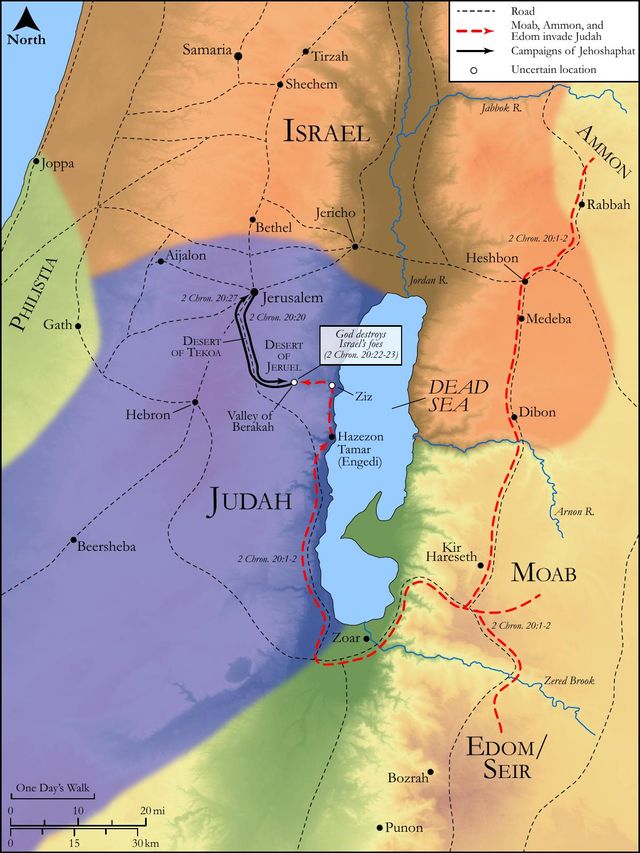
See on the biblical-era map
Study this verse
Public-domain commentary
Matthew Henry
From his Commentary on the Whole Bible. Henry comments on passages, not single verses — this entry covers 2 Chronicles 20:20–30. His three-level outline is real structure in the source text, so it is rendered as structure.
We have here the foregoing prayer answered and the foregoing promise performed, in the total overthrow of the enemies' forces and the triumph (for so it was rather than a victory) of Jehoshaphat's forces over them.
I.Never was army drawn out to the field of battle as Jehoshaphat's was.
He had soldiers ready prepared for war (Ch2 17:18), but here is no notice taken of their military equipment, their swords or spears, their shields or bows. But Jehoshaphat took care,
1.That faith should be their armour. As they went forth, instead of calling them to handle their arms, and stand to them, to keep ranks, observe orders, and fight valiantly, he bade them believe in the Lord God and give credit to his word in the mouth of his prophets, and assured them that they should prosper and be established, Ch2 20:20. That is true courage which faith inspires a man with; nor will any thing contribute more to the establishing of the heart in shaking times than a firm belief of the power, and mercy, and promise of God. The heart is fixed that thus trusteth in the Lord, and is kept in perfect peace. In our spiritual conflicts, this is the victory, this is the prosperity, even our faith.
2.That praise and thanksgiving should be their vanguard, Ch2 20:21. Jehoshaphat called a council of war, and it was resolved to appoint singers to go out before the army, to charge in the front, who had nothing else to do but to praise God, to praise his holiness, which is his beauty, to praise him as they did in the temple (that beauty of holiness) with that ancient and good doxology which eternity itself will not wear thread-bare, Praise the Lord; for his mercy endureth for ever. By this strange advance towards the field of battle, Jehoshaphat intended to express his firm reliance upon the word of God (which enabled him to triumph before the battle), to animate his own soldiers, to confound the enemy, and to engage God on their side; for praise pleases God better than all burnt offering and sacrifice.
II.Never was army so unaccountably destroyed as that of the enemy; not by thunder, or hail, or the sword of an angel, not by dint of sword, or strength of arm, or any surprising alarm, like that which Gideon gave the Midianites; but the Lord set ambushments against them, either hosts of angels, or, as bishop Patrick thinks, their own ambushments, whom God struck with such confusion that they fell upon their own friends as if they had been enemies, and every one helped to destroy another, so that none escaped. This God did when his people began to sing and to praise (Ch2 20:22), for he delights to furnish those with matter for praise that have hearts for it. We read of his being angry at the prayers of his people (Psa 80:4), but never at their praises. When they did but begin the work of praise God perfected the work of their deliverance. What ground there was for their jealousies one of another does not appear, perhaps there was none; but so it was that the Ammonites and the Moabites fell foul upon the Edomites and cut them off, and then they fell out with one another and cut one another off, Ch2 20:23. Thus God often makes wicked people instruments of destruction to one another; and what alliances can be so firm as to keep those together whom God designs to dash in pieces one against another? See the mischievous consequences of divisions which neither of the contending parties can give any good account of the reason of. Those are wretchedly infatuated, to their ruin, that fall foul upon their friends as if they were enemies.
III.Never was spoil so cheerfully divided, for Jehoshaphat's army had nothing to do besides; the rest was done for them.
When they came to the view of this vast army, instead of finding living men to fight with, they found them all dead men, and their carcases spread as dung upon the face of the earth, Ch2 20:24. See how rich God is in mercy to those that call upon him in truth, and how often he out-does him in truth, and how often he out-does the prayers and expectations of his people. Jehoshaphat and his people prayed to be delivered from being spoiled by the enemy; and God not only delivered them, but enriched them with the spoil of the enemy. The plunder of the field was very great and very rich. They found precious jewels with the dead bodies, which yet could not save them from being loathsome carcases. The spoil was more than they could carry away at once, and they were three days in gathering it, Ch2 20:25. Now it appeared what was God's end in bringing this great army against Judah; it was to humble them and prove them, that he might do them good in their latter end. It seemed at first a disturbance to their reformation, but it proved a recompence of it.
IV.Never was victory celebrated with more solemn and enlarged thanksgivings.
1.They kept a day of praise in the camp, before they drew their forces out of the field. Many thanksgivings, no doubt, were offered up to God immediately; but on the fourth day they assembled in a valley, where they blessed God with so much zeal and fervency that that day's work gave a name to the place, the valley of Berachah, that is, of blessing, Ch2 20:26. The remembrance of this work of wonder was hereby perpetuated, for the encouragement of succeeding generations to trust in God.
2.Yet they did not think this enough, but came in solemn procession, all in a body, and Jehoshaphat at the head of them, to Jerusalem, that the country, as they passed along, might join with them in their praises, and that they might give thanks for the mercy where they had by prayer obtained it, in the house of the Lord, Ch2 20:27, Ch2 20:28. Praising God must not be the work of a day only; but our praises, when we have received mercy, must be often repeated, as our prayers were when we were in the pursuit of it. Every day we must bless God; as long as we live, and while we have any being, we must praise him, spending our time in that work in which we hope to spend our eternity. Public mercies call for public acknowledgments in the courts of the Lord's house, Psa 116:19.
V.Never did victory turn to a better account than this; for,
1.Jehoshaphat's kingdom was hereby made to look very great and considerable abroad, Ch2 20:29. When they heard that God fought thus for Israel, they could not but say, There is none like unto the God of Jeshurun, and Happy art thou, O Israel! It begat in the neighbours a reverence of God and a cautious fear of doing any injury to his people. It is dangerous fighting against those who have God with them.
2.It was made very easy and quiet at home, Ch2 20:30.
(1.)They were quiet among themselves. Those that were displeased at the destroying of the images and groves were now satisfied, and obliged to own that since the God of Israel could deliver after this sort he only is to be worshipped, in that way only which he himself has appointed.
(2.)They were quiet from the fear of insults from their neighbours, God having given them rest round about. And, if he give rest, who can give disturbance?
Continue studying 2 Chronicles 20:22 across the web’s major study libraries — every link below opens this exact verse, chapter, or book on the destination site.
Read & Compare
 BibleGatewayThis verse in more than 200 translations and 70 languages.
 Bible.comThe YouVersion reader — hundreds of translations, reading plans, and highlights.
 ESV.orgCrossway's official English Standard Version reader.
 NET BibleThe NET translation with 60,000+ translators' notes on every rendering decision.
 STEP BibleTyndale House's free study tool — original text, vocabulary, and scholarly resources.
 BibliaLogos Bible Software's free web reader.
 USCCBThe New American Bible (Revised Edition) with the U.S. bishops' study notes.
Commentaries
 BibleHub CommentariesDozens of classic commentaries on this verse, gathered on one page.
 StudyLightMore than 100 commentary sets — the largest collection on the web.
 BibleRefPlain-English commentary on what this verse means, verse by verse.
 Enduring WordDavid Guzik's free commentary on this chapter, widely used by Bible teachers.
 Bible Study ToolsVerse commentary alongside Greek and Hebrew study aids.
Original Language & Research
- BibleHub InterlinearThe verse word by word — original language, transliteration, and English.
- BibleHub LexiconEvery word's original-language definition and Strong's entry.
 Blue Letter BibleDeep-study tools — Strong's numbers, concordance, and word studies.
 SefariaThe Hebrew text with Rashi and centuries of Jewish commentary.
Sermons, Hymns & Audio


TrulyRandomVerse is not affiliated with these sites and doesn’t control their content. They’re linked because they’re genuinely useful.
Summary
Second Chronicles 20:22 vividly recounts the miraculous divine intervention during Judah's invasion by a formidable confederacy of armies. At the precise moment King Jehoshaphat's appointed singers and praisers initiated their worship, the Lord supernaturally orchestrated confusion and self-destruction among the enemy forces. This led to their complete defeat without Judah having to engage in combat, serving as a profound testament to God's sovereignty, His unwavering faithfulness to those who trust Him, and the transformative spiritual power of obedient praise in the face of overwhelming adversity.
Context
ShowHideLiterary Context
This verse serves as the dramatic turning point and climax within the narrative of 2 Chronicles 20. The chapter opens with Judah facing an existential threat from an immense coalition of armies from Ammon, Moab, and Mount Seir (2 Chronicles 20:1). King Jehoshaphat's immediate and exemplary response is to seek the Lord through a kingdom-wide fast and prayer (2 Chronicles 20:3-4). His earnest prayer, recorded in detail, acknowledges God's omnipotence and Judah's utter helplessness (2 Chronicles 20:5-12). In response, the Spirit of the Lord comes upon Jahaziel, a Levite, who delivers a powerful prophetic word assuring Judah that "the battle is not yours, but God's," and that they would not need to fight (2 Chronicles 20:14-17). Jehoshaphat and all Judah respond with immediate worship and prostration before the Lord (2 Chronicles 20:18-19). Acting on this faith, Jehoshaphat appoints singers to lead the army, praising the Lord "for his beauty of holiness" (2 Chronicles 20:21). Verse 22 then describes the immediate, miraculous outcome of this unprecedented act of faith and worship, setting the stage for the subsequent verses that detail the enemy's complete self-destruction and Judah's collection of spoils (2 Chronicles 20:23-24).
Historical & Cultural Context
The reign of King Jehoshaphat (c. 870-848 BC) was a period of general prosperity and religious reform in Judah, but it was also characterized by persistent geopolitical instability. Surrounding nations, including Ammon, Moab, and Edom (Mount Seir), were frequent adversaries of Israel, often engaging in territorial disputes, raids, and military campaigns. The sheer scale of the invasion described in 2 Chronicles 20:2 indicates a threat far beyond Judah's conventional military capacity. In those days, warfare was typically conducted through direct confrontation, siege tactics, and strategic ambushes, employing chariots, infantry, and archers. The concept of leading an army into battle with unarmed singers at the vanguard was not only militarily unconventional but utterly absurd from a human strategic perspective. This radical departure from established military practice highlights the extraordinary nature of Jehoshaphat's faith in God's word and underscores the unique covenant relationship between God and Israel, where divine intervention was a recurring theme, often contingent on the people's obedience and trust in His unconventional methods.
Key Themes
ShowHideThe narrative of 2 Chronicles 20 powerfully articulates several foundational biblical themes. Divine Sovereignty and Deliverance is paramount, as God explicitly declares, "the battle is not yours, but God's" (2 Chronicles 20:15), and then demonstrates His absolute power by fighting on behalf of Judah. This highlights God's active and decisive involvement in the affairs of His people. The Power of Praise and Worship is central, as the divine intervention is directly linked to the precise moment "they began to sing and to praise." Worship is presented not merely as an emotional or ritualistic expression but as a potent spiritual weapon that precedes and enables God's miraculous work. Faithful Obedience is also a critical theme, exemplified by Jehoshaphat's radical decision to follow God's counter-intuitive instructions, even to the point of sending unarmed singers ahead of the army. This act of profound trust in God's word, defying human logic, was the catalyst for their salvation. Finally, the narrative showcases God's Unconventional Methods, demonstrating that His ways of victory often defy human expectations and military strategies, thereby revealing His glory and power all the more clearly.
Exposition and Analysis
ShowHideKey Word Analysis
ShowHideThis primitive root means "to bore," and by implication, "to begin (as if by an 'opening wedge')." In this context, it signifies the precise initiation of the act of singing and praising. The emphasis on "began" suggests an immediate, catalytic effect. It wasn't merely the act itself, but the commencement of that act of faith-filled worship, like an "opening wedge," that triggered God's intervention, marking the start of a new spiritual dynamic in the face of the enemy.
This word means "to lurk" or "to lie in wait." While typically referring to a hidden trap set by one human army against another, here it is explicitly stated that "the LORD set ambushments." This denotes a divine, supernatural orchestration of confusion and internal conflict within the enemy ranks. It was God's unseen, strategic hand that caused the Ammonites, Moabites, and inhabitants of Mount Seir to turn on each other, fulfilling the prophecy that Judah would not need to fight. This term emphasizes the mysterious and sovereign way God worked behind the scenes to bring about the enemy's downfall through their own internal strife.
This primitive root means "to push, gore, defeat, stub (the toe), inflict (a disease); to beat, dash, hurt, plague, slay, smite (down), strike." In this verse, "they were smitten" refers to the complete and devastating defeat of the enemy armies. The passive voice ("were smitten") further underscores that the action was not initiated by Judah but was the direct result of God's intervention. It signifies a decisive and comprehensive destruction, leaving no doubt about the totality of the divine victory.
Verse Breakdown
ShowHide"And when they began to sing and to praise"
This opening clause establishes the crucial temporal and causal link between Judah's act of worship and God's subsequent intervention. The phrase "when they began" highlights the immediacy and direct correlation: the divine response was triggered at the very inception of their faith-filled praise. This demonstrates that worship is not merely a post-victory celebration but can be a powerful catalyst for God's miraculous work, a declaration of faith in His unseen power even before the battle is won.
"the LORD set ambushments against the children of Ammon, Moab, and mount Seir"
This is the core of the divine action and the central miracle of the verse. The subject, "the LORD," emphasizes His direct, personal, and sovereign involvement. He did not merely permit events; He actively "set ambushments," orchestrating a supernatural confusion within the enemy ranks. As explained in the subsequent verse (2 Chronicles 20:23), this "ambushment" involved the enemy armies turning on each other, leading to their mutual destruction. The specific naming of the enemy nations (Ammon, Moab, Mount Seir) underscores the precision and target of God's judgment against those who had come to attack His people.
"which were come against Judah; and they were smitten"
This final clause clarifies the context of the enemy's presence and the decisive outcome of God's intervention. The enemies "were come against Judah," highlighting their aggressive intent and the existential threat they posed. The result, "and they were smitten," signifies their utter defeat and destruction. This phrase succinctly summarizes the complete and decisive victory granted by God, achieving Judah's deliverance without any military engagement on their part, precisely as prophesied by Jahaziel.
Literary Devices
ShowHideThe verse employs several powerful literary devices to convey its profound message. Divine Intervention is the most prominent, as the text explicitly states "the LORD set ambushments," underscoring that the victory was not of human strength or strategy but solely by God's supernatural power. This highlights God's active role as the deliverer of His people. There is a strong element of Irony: instead of conventional weapons, Judah's "weapon" was worship, and their formidable enemies were defeated not by Judah's army, but by turning on themselves. This unexpected turn of events emphasizes God's unconventional methods and His ability to use seemingly illogical means to confound the wise. Furthermore, the act of "singing and praising" can be seen as Symbolism, representing complete trust and reliance on God's promises, transforming what might seem like a vulnerable act into a powerful spiritual offensive. The verse also serves as a Narrative Climax, the pivotal moment where the tension of the impending battle is resolved through immediate divine action, leading directly to the resolution of the conflict.
Theological and Thematic Connections
ShowHideThis verse profoundly illustrates the biblical principle that God fights for His people when they place their trust fully in Him, even in the face of seemingly insurmountable odds. It demonstrates that worship is not merely an emotional or ritualistic act, but a powerful expression of faith that can unlock divine intervention and shift the course of battles, both physical and spiritual. The narrative underscores God's sovereignty over all nations and His unwavering faithfulness to His covenant promises, proving that His power is made perfect in weakness. It teaches that true security comes not from military might or human strategy, but from humble reliance on the Almighty God, who delights in delivering those who honor Him.
Reflection and Application
ShowHideThe extraordinary account in 2 Chronicles 20:22 offers a timeless and deeply practical lesson for believers navigating the multifaceted challenges of life. When confronted with overwhelming circumstances—be they financial crises, health battles, relational conflicts, or spiritual attacks—our natural inclination might be to strategize, panic, or rely solely on our own limited strength. However, this verse calls us to a radically different, counter-intuitive response: to seek God first, humble ourselves, and engage in worship and praise, even before the victory is seen or the solution is apparent. It serves as a powerful reminder that our battles are often spiritual in nature, and the weapons of our warfare are not carnal but mighty through God. Praising God in the midst of the storm is an act of profound faith that declares His sovereignty over our circumstances, aligns our hearts with His will, and opens the door for His supernatural intervention. While God's deliverance may not always manifest in physical armies being smitten, He promises to fight for us, bring peace to our hearts, and work all things for our ultimate good when we trust and obey Him. This passage encourages us to cultivate a lifestyle of worship, recognizing it not only as an expression of devotion but as a powerful means of inviting God's presence and power into every area of our lives, transforming our perspective from fear to faith.
Questions for Reflection
ShowHideFAQ
ShowHideWhat does "the LORD set ambushments" mean, and how did it happen?
ShowHideThe phrase "the LORD set ambushments" (Hebrew: ma'arab) signifies that God Himself supernaturally orchestrated confusion and internal conflict among the invading armies. As detailed in 2 Chronicles 20:23, the Ammonites and Moabites initially turned against the inhabitants of Mount Seir, utterly destroying them. Then, in their divinely induced confusion, they turned on each other, resulting in their complete mutual annihilation. This was not a literal ambush set by Judah's forces, but a divinely engineered chaos that caused the enemies to become their own executioners, fulfilling the prophecy that Judah would not need to fight. It's a powerful demonstration of God's ability to use the enemy's own forces and their internal divisions against themselves.
Does this story imply that praise and worship will always lead to immediate physical victory over our enemies?
ShowHideWhile this passage clearly links praise to a miraculous physical victory, it's essential to interpret it within the broader biblical context. This account highlights the power of praise and faith, and God's willingness to intervene supernaturally in unique ways. However, it does not establish a universal formula guaranteeing identical physical outcomes for every act of worship. The New Testament emphasizes that believers face spiritual battles (Ephesians 6:12), and worship is indeed a vital spiritual weapon in that warfare. While God may not always cause physical armies to turn on each other, He does promise to give us strength, peace, and ultimate victory over sin, death, and spiritual adversaries through Christ (Romans 8:37). The core lesson is to cultivate a deep trust in God, praise Him in all circumstances, and allow Him to fight our battles in His way and His timing, which may involve internal peace, spiritual breakthrough, or even physical deliverance according to His sovereign will.
Christ-Centered Fulfillment
ShowHideThe miraculous deliverance of Judah in 2 Chronicles 20:22, achieved through worship rather than conventional warfare, powerfully foreshadows the ultimate and decisive victory secured by Jesus Christ. Just as Jehoshaphat's army stood still to witness the salvation of the Lord, believers today are called to rest in the finished work of Christ. Our greatest enemies—sin, death, and the devil—were defeated not by our might or strategic prowess, but by the Lamb of God who was slain (Revelation 5:9). On the cross, Christ entered the ultimate "ambushment" of death and hell, only to rise victoriously, thereby destroying "him who has the power of death, that is, the devil" (Hebrews 2:14). He "disarmed the powers and authorities" and "made a public spectacle of them, triumphing over them by the cross" (Colossians 2:15). Our "battle" is now one of faith, standing firm in the victory already won by Christ (Ephesians 6:10-18), and our "praise" is a joyful response to His accomplished salvation, a declaration of His sovereignty over every spiritual foe. The heavenly chorus in Revelation 19:1-6 echoes the triumph of Jehoshaphat, revealing that ultimate victory belongs to God, and our eternal response is worship of the Lamb who reigns forevermore.