


2 Chronicles 20:1
Bible text: King James Version (1769 Blayney text) · Public domain
Bible text: King James Version with Strong's numbers · Public domain
Bible text: Berean Standard Bible · Public domain
Bible text: American Standard Version (1901) · Public domain
Bible text: World English Bible, Messianic edition · Public domain
Bible text: Geneva Bible (1599) · Public domain
Bible text: Young's Literal Translation · Public domain
- וַיְהִיvay·Hiand it wasH1961Conj-w ¦ V-Qal-ConsecImperf-3msVerb Qal Consecutive Imperfect 3rd Singular Masculineוַandיְהִיit was
- אַחֲרֵיכֵן'a·cha·rei·Khenafter thisH310Adj-mpc ¦ AdvAdjective Numerical Plural Masculine Constructאַחֲרֵיafterכֵןthis
- בָּאוּBa·'uthey cameH935V-Qal-Perf-3cpVerb Qal Perfect 3rd Plural common gender
- בְנֵיve·nei[the] people ofH1121N-mpcNoun Plural Masculine Construct
- מוֹאָבmo·'AvMoabH4124N-properNoun Proper Location
- וּבְנֵיu·ve·Neiand [the] people ofH1121Conj-w ¦ N-mpcNoun Plural Masculine Constructוּandבְנֵי[the] people of
- עַמּוֹןa·MonAmmonH5983N-proper-mNoun Proper Masculine
- וְעִמָּהֶםve·'i·ma·Hemand with themH5973Conj-w ¦ Prep ¦ 3mpPrepositionוְandעִמָּwithהֶםthem
- מֵהָעַמּוֹנִיםme·ha·'a·mo·Nimsome of the AmmonitesH5984Prep-m ¦ Art ¦ N-mpNoun Gentilic Plural Masculine Absoluteמֵsome ofהָtheעַמּוֹנִיםAmmonites
- עַל'alonH5921PrepPreposition
- יְהוֹשָׁפָטye·ho·sha·FatJehoshaphatH3092N-proper-mNoun Proper Masculine
- לַמִּלְחָמָהla·mil·cha·Mahfor <the> battleH4421Prep-l ¦ N-fsNoun Singular Feminine Absoluteלַfor <the>מִּלְחָמָהbattle
English is a literal word-by-word gloss of the Hebrew, not the KJV's wording. Why?
This is the original text the KJV's translators worked from — each Hebrew word with its own literal English meaning in this verse, prepared by scholars at Tyndale House, Cambridge. The KJV translates whole sentences, not word by word, so its wording differs: one Hebrew word can become several English words, and the KJV may choose “the LORD” where the gloss reads “Yahweh”. Both are faithful — they answer different questions. For the KJV's own rendering, switch to the KJV text.
Details
See on the biblical-era map
Study this verse
Public-domain commentary
Matthew Henry
From his Commentary on the Whole Bible. Henry comments on passages, not single verses — this entry covers 2 Chronicles 20:1–13. His two-level outline is real structure in the source text, so it is rendered as structure.
We left Jehoshaphat, in the foregoing chapter, well employed in reforming his kingdom and providing for the due administration of justice and support of religion in it, and expected nothing but to hear of the peace and prosperity of his reign; but here we have him in distress, which distress, however, was followed by such a glorious deliverance as was an abundant recompence for his piety. If we meet with trouble in the way of duty, we may believe it is that God may have an opportunity of showing us so much the more of his marvellous loving-kindness. We have here,
I.A formidable invasion of Jehoshaphat's kingdom by the Moabites, and Ammonites, and their auxiliaries, Ch2 20:1.
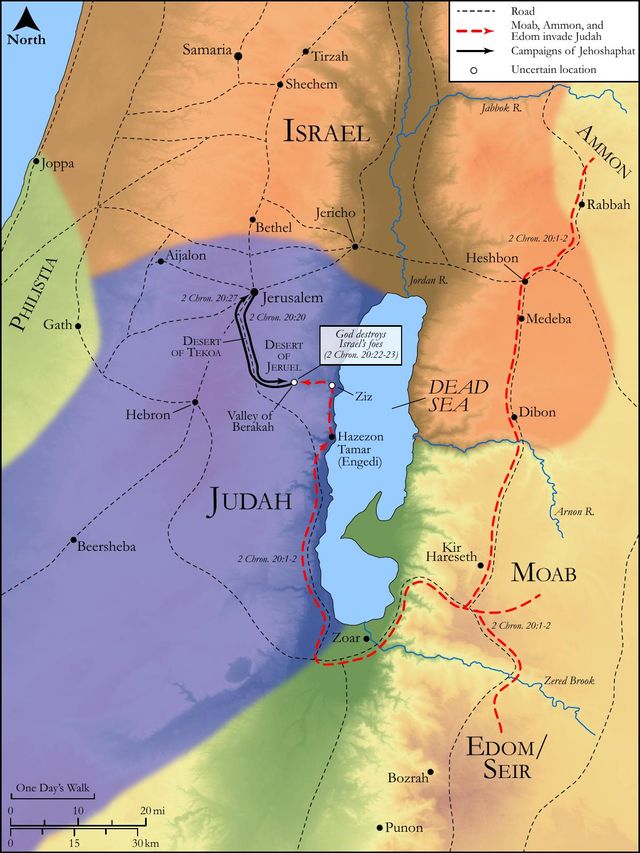
Jehoshaphat was surprised with the intelligence of it when the enemy had already entered his country, Ch2 20:2. What pretence they had to quarrel with Jehoshaphat does not appear; they are said to come from beyond the sea, meaning the Dead Sea, where Sodom had stood. It should seem, they marched through those of the ten tribes that lay beyond Jordan, and they gave them passage through their borders; so ungrateful were they to Jehoshaphat, who had lately put his hand to help them in recovering Ramoth-Gilead. Several nations joined in this confederacy, but especially the children of Lot, whom the rest helped, Psa 83:6-8. The neighbouring nations had feared Jehoshaphat (Ch2 17:10), but perhaps his affinity with Ahab had lessened him in their esteem, and they had some intimation that his God was displeased with him for it, which they fancied would give them an opportunity to make a prey of his kingdom.
II.The preparation Jehoshaphat made against the invaders.
No mention is made of his mustering his forces, which yet it is most probable he did, for God must be trusted in the use of means. But his great care was to obtain the favour of God, and secure him on his side, which perhaps he was the more solicitous about because he had been lately told that there was wrath upon him from before the Lord, Ch2 19:2. But he is of the mind of his father David. If we must be corrected, yet let us not fall into the hands of man.
1.He feared. Consciousness of guilt made him fear. Those that have least sin are the most sensible of it. The surprise added to the fright. Holy fear is a spur to prayer and preparation, Heb 11:7.
2.He set himself to seek the Lord, and, in the first place, to make him his friend. Those that would seek the Lord so as to find him, and to find favour with him, must set themselves to seek him, must do it with fixedness of thought, with sincerity of intention, and with the utmost vigour and resolution to continue seeking him.
3.He proclaimed a fast throughout all Judah, appointed a day of humiliation and prayer, that they might join together in confessing their sins and asking help of the Lord. Fasting from bodily refreshments, upon such extraordinary occasions, is a token of self-judging for the sins we have committed (we own ourselves unworthy of the bread we eat, and that God might justly withhold it from us), and of self-denial for the future; fasting for sin implies a resolution to fast from it, though it has been to us as a sweet morsel. Magistrates are to call their people to the duty of fasting and prayer upon such occasions, that it may be a national act, and so may obtain national mercies.
4.The people readily assembled out of all the cities of Judah in the court of the temple to join in prayer (Ch2 20:4), and they stood before the Lord, as beggars at his door, with their wives and children; they and their families were in danger, and therefore they bring their families with them to seek the Lord. "Lord, we are indeed a provoking people, that deserve to be abandoned to ruin; but here are little ones that are innocent, let not them perish in the storm." Nineveh was spared for the sake of the little ones, Jon 4:11. The place they met in was the house of the Lord, before the new court, which was perhaps lately added to the former courts (that, as some think, which was called the court of the women); thus they came within reach of that gracious promise which God had made, in answer to Solomon's prayer, Ch2 7:15. My ears shall be attentive to the prayer that is made in this place.
5.Jehoshaphat himself was the mouth of the congregation to God, and did not devolve the work upon his chaplains. Though the kings were forbidden to burn incense, they were allowed to pray and preach; as Solomon and Jehoshaphat here. The prayer Jehoshaphat prayed, upon this occasion, is here recorded, or part of it; and an excellent prayer it is. (1.) He acknowledges the sovereign dominion of the divine Providence, gives to God the glory of it and takes to himself the comfort of it (Ch2 20:6): "Art not thou God in heaven? No doubt thou art, which none of the gods of the heathen are; make it to appear then. Is not thy dominion, supreme over kingdoms themselves, and universal, over all kingdoms, even those of the heathen that know thee not? Control these heathen then; set bounds to their daring threatening insults. Is there not in thy hand the power and might which none is able to withstand? Lord, exert it on our behalf. Glorify thy own omnipotence." (2.) He lays hold on their covenant-relation to God and interest in him. "Thou that art God in heaven art the God of our fathers (Ch2 20:6) and our God, Ch2 20:7. Whom should we seek to, whom should we trust to, for relief, but to the God we have chosen and served?" (3.) He shows the title they had to this good land they were now in possession of; an indisputable title it was: "Thou gavest it to the seed of Abraham thy friend. He was thy friend (this is referred to, Jam 2:23, to show the honour of Abraham, that he was called the friend of God); we are his seed, and hope to be beloved for the father's sake," Rom 11:28; Deu 7:8, Deu 7:9. "We hold this land by grant from thee. Lord, maintain thy own grant, and warrant it against all unjust claims. Suffer us not to be cast out of they possession. We are tenants; thou art our landlord; wilt thou not hold thy own?" Ch2 20:11. Those that use what they have for God may comfortably hope that he will secure it to them. (4.) He makes mention of the sanctuary, the temple they had built for God's name (Ch2 20:8), not as if that merited any thing at God's hand, for of his own they gave him, but it was such a token of God's favourable presence with them that they had promised themselves he would hear and help them when, in their distress, they cried to him before that house, Ch2 20:8, Ch2 20:9. "Lord, when it was built it was intended for the encouragement of our faith at such a time as this. Here thy name is; here we are. Lord, help us, for the glory of thy name." (5.) He pleads the ingratitude and injustice of his enemies: "We are such as it will be thy glory to appear for; they are such as it will be thy glory to appear against; for, [1.] They ill requite our ancient kindnesses. Thou wouldst not let Israel invade them, nor give them any disturbance." Deu 2:5, Deu 2:9, Deu 2:19, Meddle not with the Edomites, distress not the Moabites, come not nigh the children of Ammon, no not though they provoke you. "Yet now see how they invade us." We may comfortably appear to God against those that render us evil for good. [2.] "They break in upon our ancient rights. They come to cast us out of our possessions, and seize our land for themselves. O! our God, wilt thou not judge them? Ch2 20:12. Wilt thou not give sentence against them, and execute it upon them?" The justice of God is the refuge of those that are wronged. (6.) He professes his entire dependence upon God for deliverance. Though he had a great army on foot, and well disciplined; yet he said, "We have no might against this great company, none without thee, none that we can expect any thing from without thy special presence and blessing, none to boast of, none to trust to; but our eyes are upon thee. We rely upon thee, and from thee is all our expectation. The disease seems desperate: we know not what to do, are quite at a loss, in a great strait. But this is a sovereign remedy, our eyes are upon thee, an eye of acknowledgment and humble submission, an eye of faith and entire dependence, an eye of desire and hearty prayer, an eye of hope and patient expectation. In thee, O God! do we put our trust; our souls wait on thee."
Continue studying 2 Chronicles 20:1 across the web’s major study libraries — every link below opens this exact verse, chapter, or book on the destination site.
Read & Compare
 BibleGatewayThis verse in more than 200 translations and 70 languages.
 Bible.comThe YouVersion reader — hundreds of translations, reading plans, and highlights.
 ESV.orgCrossway's official English Standard Version reader.
 NET BibleThe NET translation with 60,000+ translators' notes on every rendering decision.
 STEP BibleTyndale House's free study tool — original text, vocabulary, and scholarly resources.
 BibliaLogos Bible Software's free web reader.
 USCCBThe New American Bible (Revised Edition) with the U.S. bishops' study notes.
Commentaries
 BibleHub CommentariesDozens of classic commentaries on this verse, gathered on one page.
 StudyLightMore than 100 commentary sets — the largest collection on the web.
 BibleRefPlain-English commentary on what this verse means, verse by verse.
 Enduring WordDavid Guzik's free commentary on this chapter, widely used by Bible teachers.
 Bible Study ToolsVerse commentary alongside Greek and Hebrew study aids.
Original Language & Research
- BibleHub InterlinearThe verse word by word — original language, transliteration, and English.
- BibleHub LexiconEvery word's original-language definition and Strong's entry.
 Blue Letter BibleDeep-study tools — Strong's numbers, concordance, and word studies.
 SefariaThe Hebrew text with Rashi and centuries of Jewish commentary.
Sermons, Hymns & Audio


TrulyRandomVerse is not affiliated with these sites and doesn’t control their content. They’re linked because they’re genuinely useful.
Summary
2 Chronicles 20:1 immediately plunges King Jehoshaphat of Judah into a sudden and formidable national crisis, as a vast coalition of ancient enemies—the children of Moab, the children of Ammon, and other allies—launches an aggressive invasion. This verse sets the stage for one of the most dramatic accounts of divine intervention in the Old Testament, highlighting that even a righteous king, recently engaged in significant spiritual reforms, is not exempt from severe trials. It underscores the unexpected nature of life's challenges and establishes the overwhelming human impossibility of victory, thereby magnifying the subsequent display of God's sovereign power and faithfulness.
Context
ShowHideLiterary Context
This verse opens 2 Chronicles chapter 20, directly following Jehoshaphat's significant religious reforms and his efforts to establish justice throughout Judah, as detailed in 2 Chronicles 19. The phrase "It came to pass after this also" is crucial, indicating that this immense threat emerges precisely after a period of spiritual renewal and administrative strengthening. It serves as a stark reminder that faithfulness and obedience do not guarantee an absence of trials; rather, they often prepare one to face them with divine assistance. The narrative immediately shifts from internal reform to an external, existential threat, setting up a dramatic contrast that will highlight God's miraculous deliverance. This crisis also follows Jehoshaphat's controversial, though repented of, alliance with King Ahab of Israel (2 Chronicles 18), which had drawn divine rebuke but also led to Jehoshaphat's renewed commitment to the Lord, setting the stage for God's powerful intervention in the face of overwhelming odds.
Historical & Cultural Context
The "children of Moab" and "children of Ammon" were long-standing, often hostile neighbors of Israel, descended from Lot (as recounted in Genesis 19). Their territories lay east of the Dead Sea, in what is modern-day Jordan. Historically, they had frequently opposed Israel, from the time of the Exodus (Numbers 22-24) through the periods of the Judges and the United Monarchy. The phrase "other beside the Ammonites" is often identified by scholars, based on textual variants and the broader narrative (e.g., 2 Chronicles 20:10), as the Meunites (or Meunim) or Edomites, peoples from Mount Seir, further south. The formation of such a multi-ethnic coalition against Judah was a significant military threat, indicating a coordinated effort to overwhelm the kingdom. For Judah, a relatively small nation, facing such a combined force would have been an existential crisis, evoking memories of past conflicts and the ever-present danger from surrounding powers.
Key Themes
ShowHide2 Chronicles 20:1 immediately introduces the theme of External Threat and Crisis, demonstrating that even righteous nations and leaders face seemingly insurmountable opposition. The phrase "after this also" emphasizes the theme of Unexpected Challenges, highlighting that difficulties can arise suddenly, even after periods of peace, reform, or spiritual progress, forcing a re-evaluation of security and trust. Crucially, the overwhelming nature of this enemy coalition—Moabites, Ammonites, and their allies—serves as a powerful Setting for Divine Intervention. By presenting a humanly impossible situation, the narrative magnifies the subsequent miraculous deliverance by God, underscoring themes of Divine Sovereignty and the necessity of Human Dependence on God rather than military might or strategic alliances. This initial verse establishes the desperate need for God's power, foreshadowing His glorious display of faithfulness, as seen in the prophetic word, "The battle is not yours, but God's" (2 Chronicles 20:15).
Exposition and Analysis
ShowHideKey Word Analysis
ShowHideThis word signifies a temporal sequence, meaning "after" or "behind." In the context of "It came to pass after this also," it emphasizes that the invasion occurred subsequent to Jehoshaphat's diligent reforms and spiritual renewal, as detailed in the preceding chapter. This temporal marker is crucial, highlighting that even periods of obedience and spiritual flourishing do not guarantee an absence of trials, but rather set the stage for God to demonstrate His power in the face of new challenges.
This term, used in "the children of Moab" and "the children of Ammon," refers to the descendants and people groups of these nations. It emphasizes their tribal identity and historical lineage, tracing back to Lot. The use of "children" underscores the deep-rooted, ancestral animosity these nations held towards Israel, making the invasion not merely a political maneuver but a continuation of long-standing ethnic and religious conflict. It highlights the collective identity and unified purpose of these invading forces.
Derived from a root meaning "to fight," this word denotes a military engagement or warfare. Its inclusion in the phrase "came against Jehoshaphat to battle" leaves no ambiguity about the hostile and aggressive intent of the invading coalition. It signifies a full-scale, direct confrontation aimed at conquest and destruction, immediately establishing the dire and existential nature of the threat faced by King Jehoshaphat and the kingdom of Judah.
Verse Breakdown
ShowHide"¶ It came to pass after this also,"
This opening clause establishes the immediate temporal context, linking the impending crisis to the preceding narrative of Jehoshaphat's reforms and renewed commitment to the Lord. The "also" subtly suggests that despite recent spiritual progress and administrative improvements, new and unexpected challenges would arise, demonstrating that faithfulness does not guarantee an easy path but rather prepares one for the trials ahead.
"[that] the children of Moab, and the children of Ammon,"
This identifies the primary aggressors: two ancient, historically hostile nations located east of the Jordan River. Their long-standing animosity towards Israel and their pagan practices mark them as significant and recurring threats to God's people, immediately signaling the gravity of the invasion.
"and with them [other] beside the Ammonites,"
This phrase indicates that the invading force was a coalition, not just Moab and Ammon. While the KJV uses "other," other translations and textual evidence suggest these allies were likely the Meunites (or Meunim) and/or Edomites, peoples from the region of Mount Seir. The inclusion of these additional groups underscores the vastness and formidable nature of the combined force, emphasizing the overwhelming odds faced by Judah.
"came against Jehoshaphat to battle."
This final clause clearly states the aggressive intent of the coalition. They did not merely pass through or make a show of force; they "came against" the king and his kingdom "to battle," signifying a direct, full-scale military invasion aimed at conquest. This declaration sets the stage for a desperate conflict, highlighting the immediate and existential threat to Judah.
Literary Devices
ShowHide2 Chronicles 20:1 masterfully employs several literary devices to establish the narrative's tension and thematic direction. The phrase "after this also" functions as a powerful form of Juxtaposition, placing a sudden, overwhelming crisis immediately after a period of significant spiritual reform and peace under Jehoshaphat's reign. This creates a dramatic contrast, highlighting that faithfulness does not exempt one from trials. The sheer scale of the invading forces—Moab, Ammon, and their unnamed allies (likely Meunites/Edomites)—serves as Hyperbole, emphasizing the seemingly insurmountable odds and the human impossibility of victory. This exaggeration of the threat is a form of Foreshadowing, preparing the reader for a miraculous divine intervention that will transcend human capabilities. The verse also utilizes Irony, as the very king who diligently sought the Lord and purged idolatry now faces an existential threat, subtly reinforcing the theological message that God's people are tested not for their unfaithfulness, but often to reveal God's power in their weakness.
Theological and Thematic Connections
ShowHideThis opening verse powerfully illustrates a profound theological truth: faithfulness to God does not guarantee an absence of trials, but rather provides the context for God to display His power and faithfulness. The sudden and overwhelming nature of the threat "after this also" demonstrates that crises can arise unexpectedly, even for those actively seeking to live righteously. This challenges a simplistic "prosperity gospel" and instead emphasizes that God often uses seemingly insurmountable obstacles to draw His people into deeper dependence on Him. The human impossibility of the situation in 2 Chronicles 20:1 serves as a divine setup, creating a vacuum that only God's miraculous intervention can fill, thereby magnifying His glory and teaching His people to trust in His sovereignty rather than their own strength or wisdom. It underscores that the battle truly belongs to the Lord, a theme that will resonate throughout the chapter.
Reflection and Application
ShowHide2 Chronicles 20:1 serves as a potent reminder that life's most formidable challenges often emerge unexpectedly, even—or perhaps especially—after periods of spiritual growth, dedication, or perceived peace. Just as King Jehoshaphat, a righteous monarch who had recently led significant reforms, faced an immediate and overwhelming threat, so too can believers today encounter sudden crises that seem to defy logic and shake their foundations. This verse compels us to consider our initial response when confronted with such "after this also" moments. Do we panic, strategize solely from human wisdom, or, like Jehoshaphat, immediately turn our gaze heavenward? The overwhelming nature of the enemy coalition—Moab, Ammon, and their allies—highlights the futility of relying on our own strength when faced with impossible odds. The practical application is not to despair in the face of adversity, but to recognize that these moments are divine invitations to deepen our trust in God's sovereign power and to seek His intervention above all else. This initial crisis sets the stage for a profound lesson in dependence, prayer, and the miraculous power of God when His people acknowledge their weakness and His omnipotence.
Questions for Reflection
ShowHideFAQ
ShowHideWho were the "other beside the Ammonites" mentioned in this verse?
ShowHideWhile the King James Version uses the general term "other beside the Ammonites," various ancient manuscripts and other modern translations (like the NIV, ESV, NASB) often identify these allies more specifically as the Meunites (or Meunim) or Edomites. This identification is supported by the broader narrative context, particularly 2 Chronicles 20:10, which mentions "the inhabitants of Mount Seir," a region associated with Edom. Regardless of the precise identity of every group, the intent of the text is to convey that a large, multi-ethnic coalition had formed, presenting an overwhelmingly formidable military force against Judah.
Why did this crisis happen to Jehoshaphat, a king known for his piety and reforms?
ShowHideThis crisis occurring "after this also," following Jehoshaphat's significant religious reforms and efforts to lead Judah back to God (2 Chronicles 19), highlights a crucial theological principle: faithfulness does not exempt believers from trials. Instead, God often allows such overwhelming challenges to arise for several profound reasons. First, it serves to test and refine the faith of His people, proving its genuineness. Second, it creates a scenario where human strength and wisdom are clearly insufficient, thereby magnifying God's power and glory when He delivers miraculously. Third, it calls His people into deeper dependence and prayer, fostering a more intimate relationship with Him. For Jehoshaphat, this crisis was an opportunity for God to demonstrate that the battle truly belonged to Him, not to human armies or strategies, a lesson that would resonate throughout the chapter.
Christ-Centered Fulfillment
ShowHide2 Chronicles 20:1, with its depiction of an overwhelming, existential threat against God's people, finds its ultimate Christ-centered fulfillment in the person and work of Jesus Christ. Just as Jehoshaphat faced a coalition of ancient enemies that humanly seemed insurmountable, humanity itself faced an even greater, utterly insurmountable coalition of spiritual enemies: sin, death, and the devil. This spiritual predicament, far more dire than any earthly invasion, left humanity utterly helpless, with no strength, wisdom, or alliance capable of securing victory. However, in Christ, we see the true King who did not merely face an external threat but entered into the very heart of the enemy's domain. He, the perfect Lamb of God, confronted the powers of darkness directly on the cross, taking upon Himself the full weight of humanity's sin and enduring death itself. His resurrection is the ultimate "battle belongs to the Lord" moment, where He decisively triumphed over every hostile power, disarming them and leading them captive (Colossians 2:15). Through His sacrifice and victory, Christ delivered His people from the ultimate enemies, freeing those who were held in slavery by the fear of death (Hebrews 2:14-15). Thus, the seemingly impossible invasion of 2 Chronicles 20:1 foreshadows the even greater, divinely accomplished victory of Christ, who enables His followers to be "more than conquerors through Him who loved us" (Romans 8:37), as He has already overcome the world (John 16:33).