


2 Chronicles 24:1
- בֶּןben[was] a son ofH1121N-mscNoun Singular Masculine Construct
- שֶׁבַעShe·va'sevenH7651N-csNoun Singular common gender Absolute
- שָׁנִיםsha·NimyearsH8141N-mpNoun Plural Masculine Absolute
- יֹאָשׁyo·'AshJoashH3101N-proper-mNoun Proper Masculine
- בְּמָלְכוֹbe·ma·le·Khowhen he became kingH4427Prep-b ¦ V-Qal-Inf ¦ 3msVerb Qal Infinitive Constructבְּwhenמָלְכbecame kingוֹhe
- וְאַרְבָּעִיםve·'ar·ba·'Imand fortyH705Conj-w ¦ N-mpNoun Plural Masculine Absoluteוְandאַרְבָּעִיםforty
- שָׁנָהsha·Nahyear[s]H8141N-fsNoun Singular Feminine Absolute
- מָלַךְma·Lakhhe reignedH4427V-Qal-Perf-3msVerb Qal Perfect 3rd Singular Masculine
- בִּירוּשָׁלִָםbi·ru·sha·Limin JerusalemH3389Prep-b ¦ N-properNoun Proper LocationבִּinירוּשָׁלִָםJerusalem
- וְשֵׁםve·Shemand [the] name ofH8034Conj-w ¦ N-mscNoun Singular Masculine Constructוְandשֵׁם[the] name of
- אִמּוֹ'i·Mohis motherH517N-fsc ¦ 3msNoun Singular Feminine Constructאִמּmotherוֹhis
- צִבְיָהtziv·Yah[was] ZibiahH6645N-proper-fNoun Proper Feminine
- מִבְּאֵרmi·be·'Erfrom BeerH884Prep-m ¦ N-properNoun Proper LocationמִfromבְּאֵרBeer
- שָׁבַעSha·va'ShebaH884N-properNoun Proper Location
English is a literal word-by-word gloss of the Hebrew, not the KJV's wording. Why?
This is the original text the KJV's translators worked from — each Hebrew word with its own literal English meaning in this verse, prepared by scholars at Tyndale House, Cambridge. The KJV translates whole sentences, not word by word, so its wording differs: one Hebrew word can become several English words, and the KJV may choose “the LORD” where the gloss reads “Yahweh”. Both are faithful — they answer different questions. For the KJV's own rendering, switch to the KJV text.
Details
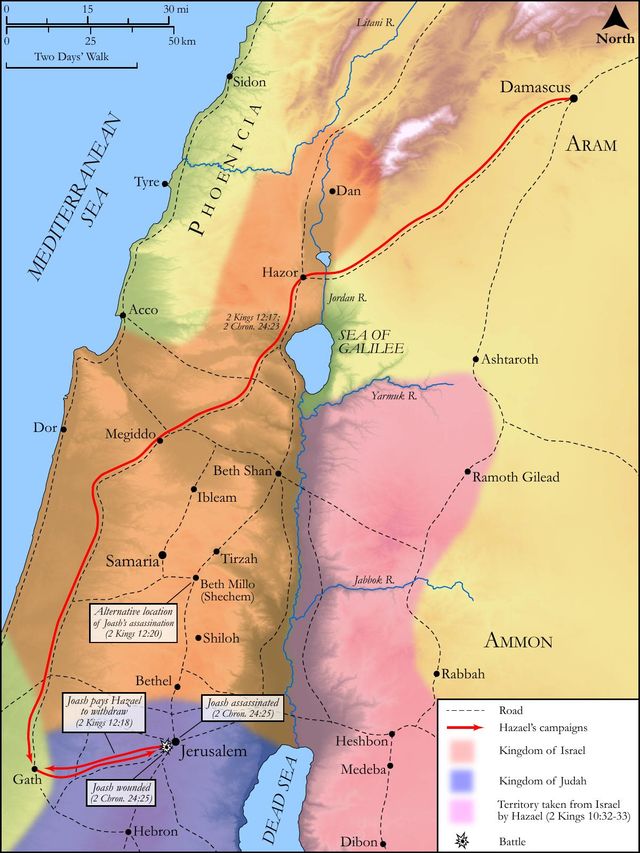
See on the biblical-era map
Study this verse
Public-domain commentary
Matthew Henry
From his Commentary on the Whole Bible. Henry comments on passages, not single verses — this entry covers 2 Chronicles 24:1–14.
This account of Joash's good beginnings we had as it stands here Kg2 12:1, etc., though the latter part of this chapter, concerning his apostasy, we had little of there. What is good in men we should take all occasions to speak of and often repeat it; what is evil we should make mention of but sparingly, and no more than is needful. We shall here only observe, 1. That it is a happy thing for young people, when they are setting out in the world, to be under the direction of those that are wise and good and faithful to them, as Joash was under the influence of Jehoiada, during whose time he did that which was right. Let those that are young reckon it a blessing to them, and not a burden and check upon them, to have those with them that will caution them against that which is evil and advise and quicken them to that which is good; and let them reckon it not a mark of weakness and subjection, but of wisdom and discretion, to hearken to such. He that will not be counselled cannot be helped. It is especially prudent for young people to take advice in their marriages, as Joash did, who left it to his guardian to choose him his wives, because Jezebel and Athaliah had been such plagues, Ch2 24:3. This is a turn of life which often proves either the making or marring of young people, and therefore should be attended to with great care. 2. Men may go far in the external performances of religion, and keep long to them, merely by the power of their education and the influence of their friends, who yet have no hearty affection for divine things nor any inward relish of them. Foreign inducements may push men on to that which is good who are not actuated by a living principle of grace in their hearts. 3. In the outward expressions of devotion it is possible that those who have only the form of godliness may out-strip those who have the power of it. Joash is more solicitous and more zealous about the repair of the temple than Jehoiada himself, whom he reproves for his remissness in that matter, Ch2 24:6. It is easier to build temples than to be temples to God. 4. The repairing of churches is a good work, which all in their places should promote, for the decency and conveniency of religious assemblies. The learned tell us that in the Christian church, anciently, part of the tithes were applied that way. 5. Many a good work would be done that now lies undone if there were but a few active men to stir in it and to put it forward. When Joash found the money did not come in as he expected in one way he tried another way, and that answered the intention. Many have honesty enough to follow that have not zeal enough to lead in that which is good. The throwing of money into a chest, through a hole in the lid of it, was a way that had not been used before, and perhaps the very novelty of the thing made it a successful expedient for the raising of money; a great deal was thrown in and with a great deal of cheerfulness: they all rejoiced, Ch2 24:10. An invention to please people's humour may sometimes bring them to their duty. Wisdom herein is profitable to direct. 6. Faithfulness is the greatest praise and will be the greatest comfort of those that are entrusted with public treasure or employed in public business. The king and Jehoiada faithfully paid the money to the workmen, who faithfully did the work, Ch2 24:12, Ch2 24:13.
Historical interpretation
Historical reception
1 surviving comment on this verse from the historical church.
If in a small parish one advanced in years is not to be found, let some younger person who has a good report among his neighbors and is esteemed by them worthy of the office of a bishop—who has carried himself from his youth with meekness and regularity, like a much elder person—after examination and a general good report, be ordained in peace.… Joash governed the people at seven years of age. Wherefore, although the person is young, let him be meek, gentle and quiet.
Continue studying 2 Chronicles 24:1 across the web’s major study libraries — every link below opens this exact verse, chapter, or book on the destination site.
Read & Compare
 BibleGatewayThis verse in more than 200 translations and 70 languages.
 Bible.comThe YouVersion reader — hundreds of translations, reading plans, and highlights.
 ESV.orgCrossway's official English Standard Version reader.
 NET BibleThe NET translation with 60,000+ translators' notes on every rendering decision.
 STEP BibleTyndale House's free study tool — original text, vocabulary, and scholarly resources.
 BibliaLogos Bible Software's free web reader.
 USCCBThe New American Bible (Revised Edition) with the U.S. bishops' study notes.
Commentaries
 BibleHub CommentariesDozens of classic commentaries on this verse, gathered on one page.
 StudyLightMore than 100 commentary sets — the largest collection on the web.
 BibleRefPlain-English commentary on what this verse means, verse by verse.
 Enduring WordDavid Guzik's free commentary on this chapter, widely used by Bible teachers.
 Bible Study ToolsVerse commentary alongside Greek and Hebrew study aids.
Original Language & Research
- BibleHub InterlinearThe verse word by word — original language, transliteration, and English.
- BibleHub LexiconEvery word's original-language definition and Strong's entry.
 Blue Letter BibleDeep-study tools — Strong's numbers, concordance, and word studies.
 SefariaThe Hebrew text with Rashi and centuries of Jewish commentary.
Sermons, Hymns & Audio


TrulyRandomVerse is not affiliated with these sites and doesn’t control their content. They’re linked because they’re genuinely useful.
Summary
2 Chronicles 24:1 serves as the foundational introduction to King Joash of Judah, providing essential biographical details that frame his remarkable reign. It establishes his exceptionally young age of seven at his ascension to the throne, the significant duration of his forty-year rule from Jerusalem, and the identity of his mother, Zibiah of Beersheba. This verse immediately sets the stage for the narrative of Joash's kingship, which begins with faithfulness and national restoration under the guidance of Jehoiada the priest, yet tragically concludes with apostasy and divine judgment, making it a pivotal opening to a complex and cautionary account.
Context
ShowHideLiterary Context
This opening verse of 2 Chronicles 24 immediately follows the dramatic and perilous events detailed in 2 Chronicles 22 and 2 Chronicles 23. The preceding chapters describe the wicked Queen Athaliah's usurpation of the throne of Judah and her brutal attempt to eradicate the entire Davidic royal line. Joash's survival as an infant, hidden for six years in the Temple by his aunt Jehoshabeath and her husband, Jehoiada the priest, as recounted in 2 Chronicles 22:10-12, is a testament to divine preservation and the unwavering fulfillment of God's covenant promises to David. Chapter 24 then chronicles Joash's reign, which initially flourishes with faithfulness and significant Temple repair under Jehoiada's profound influence, as highlighted in 2 Chronicles 24:2-14. However, the narrative tragically shifts to his later apostasy and the shocking murder of Zechariah, Jehoiada's son, detailed in 2 Chronicles 24:15-22. Thus, verse 1 provides the crucial biographical data for the central figure of this pivotal chapter, setting the stage for a reign of both triumph and tragedy.
Historical & Cultural Context
In the ancient Near East, the accession of a seven-year-old king was highly unusual and inherently unstable, necessitating the presence of a powerful and trusted regent. Jehoiada the priest, as Joash's uncle-in-law and rescuer, filled this vital role, effectively governing Judah during the young king's minority. This period immediately followed the tumultuous and idolatrous six-year reign of Athaliah, a daughter of Ahab and Jezebel, who had aggressively introduced Baal worship into Judah. Joash's enthronement represented not only a dramatic restoration of the legitimate Davidic dynasty but also a significant return to Yahwistic worship and covenant fidelity, at least in its initial phase. The mention of Jerusalem signifies its enduring importance as the political and religious capital of Judah, the seat of the Davidic throne and the location of the Temple. Beersheba, Joash's mother's hometown, was a prominent city in the southern Negev, frequently marking the traditional southern border of the kingdom ("from Dan to Beersheba"). The duration of Joash's reign, forty years, is a substantial period, often symbolizing a complete generation, a significant era of stability, or a time of testing in biblical narratives.
Key Themes
ShowHideThis introductory verse immediately introduces several profound themes that resonate throughout 2 Chronicles 24 and the broader Chronicler's history. First, the theme of Divine Preservation and Covenant Faithfulness is paramount, as Joash's very existence and kingship underscore God's unwavering commitment to the Davidic covenant, even when the royal line seemed on the brink of extinction, as promised in 2 Samuel 7:12-16. Second, the theme of Righteous Mentorship and its Influence is powerfully highlighted by Joash's extreme youth, emphasizing the critical role Jehoiada played in shaping his early reign, a relationship further detailed in 2 Chronicles 24:2. Third, the verse subtly sets the stage for the overarching theme of Conditional Blessing and the Consequences of Disobedience. Joash's initial faithfulness and prosperity would later give way to apostasy and divine judgment upon Jehoiada's death, illustrating the Chronicler's consistent theological emphasis on immediate retribution for national sin and the importance of sustained fidelity, a pattern observed throughout the book of 2 Chronicles.
Exposition and Analysis
ShowHideKey Word Analysis
ShowHideThis name, derived from the Hebrew for "Yahweh has given" or "given by the Lord," is profoundly significant in the context of 2 Chronicles 24:1. Following Athaliah's murderous purge of the royal family, Joash's very survival and subsequent accession to the throne were nothing short of a divine gift, a miraculous preservation of the Davidic line. The name itself functions as a theological declaration, affirming God's active and providential hand in history, ensuring the continuity of His covenant promises despite human wickedness and the forces of chaos. His name foreshadows the divine favor that would mark the early part of his reign.
While the KJV translates this as "old" in "seven years old," the Hebrew word bên fundamentally means "son" or "child." The phrase "seven years old" is literally "son of seven years." This emphasizes Joash's extreme youth and vulnerability at the time of his ascension. It highlights the extraordinary divine protection that allowed him to survive Athaliah's purge and ascend the throne. Furthermore, his status as a "child" immediately signals the critical necessity of a regent, Jehoiada the priest, whose profound influence would be paramount in guiding the early, righteous phase of Joash's reign. This tender age underscores the miraculous nature of his enthronement and his complete dependence on God's appointed guardian.
This primitive root means "to reign," but also carries the nuance of "to ascend the throne" (inceptively) and "to be inducted into royalty" (causatively). The repetition of this verb ("began to reign" and "he reigned") emphasizes the establishment and duration of Joash's kingship. His ascension, though at a young age, was a legitimate and divinely sanctioned act that restored the Davidic line. The forty-year duration of his "reign" suggests a substantial and relatively stable period, especially when contrasted with the tumultuous reigns of some of his immediate predecessors. For the Chronicler, a long reign often implies divine favor and blessing, particularly when accompanied by faithfulness to God, though in Joash's case, this blessing would prove to be conditional and ultimately curtailed by his later apostasy.
Verse Breakdown
ShowHide"Joash [was] seven years old when he began to reign"
This initial clause immediately identifies the new king and highlights the extraordinary circumstance of his accession at such a remarkably young age. It implicitly points to the providential hand of God in preserving the Davidic line, as Joash had been miraculously rescued and hidden from Athaliah's massacre of the royal seed. His extreme youth underscores the critical role Jehoiada the priest would play as his mentor and regent, effectively governing the kingdom through its initial period of restoration and reform.
"and he reigned forty years in Jerusalem"
This phrase details both the significant duration and the specific location of Joash's rule. The "forty years" signifies a long and generally stable period, standing in stark contrast to the chaotic and idolatrous six-year reign of Athaliah that preceded him. His reign "in Jerusalem" emphasizes the continuity of the legitimate Davidic dynasty in the divinely chosen capital, reinforcing the legitimacy of his rule and the centrality of the Temple in the spiritual and political life of the kingdom. This extended reign initially reflects divine blessing and the positive fruits of Jehoiada's righteous guidance.
"His mother's name also [was] Zibiah of Beersheba"
The inclusion of the king's mother's name and her place of origin is a standard biographical convention in the books of Kings and Chronicles. This detail provides essential genealogical information, grounding the king within his lineage and geographical context. While Zibiah's direct influence on Joash's reign is not elaborated upon in the text, her mention from Beersheba, a significant city in the southern part of Judah, indicates her background and lineage, which could have contributed to the king's identity and standing within the kingdom, though her role is clearly overshadowed by that of Jehoiada.
Literary Devices
ShowHideThe Chronicler masterfully employs several literary devices within this concise opening verse. Conciseness is evident, as a dramatic and extensive backstory (Joash's miraculous rescue and Athaliah's reign of terror) is distilled into a single, straightforward statement about his age and reign. There is also a subtle use of Contrast: Joash's tender age of seven stands in stark opposition to the lengthy and significant "forty years" of his reign, subtly hinting at the powerful, guiding hand of God and Jehoiada that enabled such a prolonged and initially prosperous rule. The explicit mention of "Jerusalem" serves as a potent Symbol of the legitimate Davidic monarchy and the central hub of Yahwistic worship, thereby reinforcing the restoration of proper order and covenant fidelity after Athaliah's usurpation. Furthermore, the verse functions as a powerful Foreshadowing, setting up the complex narrative arc of chapter 24, where Joash's initial faithfulness and prosperity (implied by the long reign) will tragically give way to apostasy upon Jehoiada's death, revealing the conditional nature of the Chronicler's theology of kingship and the importance of sustained personal devotion.
Theological and Thematic Connections
ShowHide2 Chronicles 24:1, though brief, is pregnant with profound theological significance, primarily highlighting God's unwavering faithfulness to His covenant promises, even in the face of extreme human depravity and opposition. Joash's miraculous preservation and ascension at such a tender age underscore divine sovereignty over human history and the meticulous care with which God guards the lineage through whom the Messiah would ultimately come. This verse sets the stage for a period of national restoration and religious revival under Jehoiada's influence, demonstrating that even from the most desperate circumstances, God can raise up instruments for His redemptive purposes. It also subtly introduces the crucial theme of the king's dependence on righteous counsel, a critical aspect of good governance in the Chronicler's view, and foreshadows the tragic consequences when such vital counsel is abandoned.
Reflection and Application
ShowHideThe story of Joash, inaugurated by this foundational verse, offers profound insights into God's working in the world and His intricate relationship with His people. It serves as a powerful reminder that God's overarching plans are not thwarted by human wickedness, political chaos, or seemingly impossible circumstances. Joash, a vulnerable child hidden from a murderous queen, became king because God was absolutely faithful to His covenant promise to David. This truth should deeply encourage us to trust in God's sovereign hand, even when our own situations seem dire, when the forces of evil appear to be winning, or when the future feels uncertain. Furthermore, Joash's early reign, so effectively guided by Jehoiada, powerfully illustrates the transformative impact of godly mentorship and wise counsel. It highlights the profound responsibility of those with wisdom and experience to intentionally invest in the next generation, shaping their character, guiding their decisions, and imparting spiritual truth. Conversely, Joash's later decline after Jehoiada's death serves as a sober warning about the inherent fragility of faith and the insidious dangers of abandoning righteous influences. It reminds us that sustained faithfulness requires ongoing vigilance, a deep and personal commitment to God, and a robust internal conviction, not merely a reliance on external guidance or the presence of others.
Questions for Reflection
ShowHideFAQ
ShowHideWhy is Joash's mother, Zibiah of Beersheba, mentioned in this verse?
ShowHideThe mention of the king's mother and her place of origin is a standard and significant feature in the biblical accounts of the kings of Judah (and sometimes Israel). This detail served several crucial purposes: it provided essential genealogical information, thereby confirming the king's lineage and legitimacy within the Davidic dynasty; it could sometimes indicate the king's tribal or regional connections, which might influence political alliances or support from various factions within the kingdom; and it often served to distinguish kings with the same name. In Joash's specific case, while Zibiah's direct influence on his reign is not elaborated upon in the text, her mention from Beersheba, a significant southern city, grounds his identity within the geographical and social fabric of Judah. This consistent practice underscores the profound importance of family and lineage in ancient Near Eastern monarchies, and for the Chronicler, it ties into the broader narrative of the divinely preserved Davidic dynasty.
What is the significance of Joash being "seven years old" when he began to reign?
ShowHideJoash's age of seven at his accession is highly significant for several compelling reasons. First, it profoundly emphasizes the miraculous nature of his survival from Athaliah's genocidal purge, highlighting God's direct and sovereign intervention to preserve the Davidic line, as recounted in 2 Chronicles 22:10-12. A child king was inherently extremely vulnerable, underscoring the extraordinary divine protection he received. Second, it immediately establishes the critical necessity of a regent. Jehoiada the priest, his uncle-in-law, stepped into this crucial role, effectively governing Judah during Joash's minority. This highlights the vital theme of righteous leadership and the profound impact of godly mentorship, as Joash's early reign was characterized by faithfulness and extensive religious reform under Jehoiada's guidance, as seen in 2 Chronicles 24:2. The tender age also sets up the tragic turn in the narrative, where Joash's personal faith proves insufficient and his commitment to God falters once his wise mentor is gone, as detailed in 2 Chronicles 24:17-19.
Christ-Centered Fulfillment
ShowHideThe story of Joash, inaugurated by his miraculous preservation and ascension at the tender age of seven, profoundly foreshadows the ultimate King of Judah, Jesus Christ. Joash's survival against Athaliah's genocidal attempt on the Davidic line is a powerful testament to God's unwavering faithfulness to His covenant with David, promising an eternal throne and kingdom, as articulated in 2 Samuel 7:12-16. This divine preservation ensures the very lineage through which the Messiah would eventually come. While Joash's reign, though long and initially righteous, ultimately ended in apostasy and judgment, it points to the profound need for a perfect King whose faithfulness would never waver. Jesus, the true Son of David, is the one whose birth was miraculously preserved from Herod's similar attempt to eradicate the royal line, as recorded in Matthew 2:13-18. He is the King whose reign is not merely forty years but is eternal and truly righteous, as prophesied in Luke 1:32-33. Unlike Joash, who eventually abandoned the wise counsel of Jehoiada's son, Jesus perfectly fulfills the role of the Shepherd-King, whose wisdom is inherent and whose reign brings true spiritual restoration and healing, not just to a physical temple, but to the very hearts of humanity, as He declared in John 10:11. He is the Lamb of God who truly takes away the sin of the world, as proclaimed in John 1:29, fulfilling all the promises of the Davidic covenant and establishing a kingdom that will never end.