


2 Kings 12:1
Bible text: King James Version (1769 Blayney text) · Public domain
Bible text: King James Version with Strong's numbers · Public domain
Bible text: Berean Standard Bible · Public domain
Bible text: American Standard Version (1901) · Public domain
Bible text: World English Bible, Messianic edition · Public domain
Bible text: Geneva Bible (1599) · Public domain
Bible text: Young's Literal Translation · Public domain
- בִּשְׁנַתbish·natin yearH8141Prep-b ¦ N-fscNoun Singular Feminine Constructבִּinשְׁנַתyear
- שֶׁבַעShe·va'sevenH7651N-csNoun Singular common gender Absolute
- לְיֵהוּאle·ye·Hu'of JehuH3058Prep-l ¦ N-proper-mNoun Proper MasculineלְofיֵהוּאJehu
- מָלַךְma·Lakhhe became kingH4427V-Qal-Perf-3msVerb Qal Perfect 3rd Singular Masculine
- יְהוֹאָשׁye·ho·'AshJehoashH3060N-proper-mNoun Proper Masculine
- וְאַרְבָּעִיםve·'ar·ba·'Imand fortyH705Conj-w ¦ N-mpNoun Plural Masculine Absoluteוְandאַרְבָּעִיםforty
- שָׁנָהsha·Nahyear[s]H8141N-fsNoun Singular Feminine Absolute
- מָלַךְma·Lakhhe reignedH4427V-Qal-Perf-3msVerb Qal Perfect 3rd Singular Masculine
- בִּירוּשָׁלִָםbi·ru·sha·Limin JerusalemH3389Prep-b ¦ N-properNoun Proper LocationבִּinירוּשָׁלִָםJerusalem
- וְשֵׁםve·Shemand [the] name ofH8034Conj-w ¦ N-mscNoun Singular Masculine Constructוְandשֵׁם[the] name of
- אִמּוֹ'i·Mohis motherH517N-fsc ¦ 3msNoun Singular Feminine Constructאִמּmotherוֹhis
- צִבְיָהtziv·Yah[was] ZibiahH6645N-proper-fNoun Proper Feminine
- מִבְּאֵרmi·be·'Erfrom BeerH884Prep-m ¦ N-properNoun Proper LocationמִfromבְּאֵרBeer
- שָׁבַעSha·va'ShebaH884N-properNoun Proper Location
English is a literal word-by-word gloss of the Hebrew, not the KJV's wording. Why?
This is the original text the KJV's translators worked from — each Hebrew word with its own literal English meaning in this verse, prepared by scholars at Tyndale House, Cambridge. The KJV translates whole sentences, not word by word, so its wording differs: one Hebrew word can become several English words, and the KJV may choose “the LORD” where the gloss reads “Yahweh”. Both are faithful — they answer different questions. For the KJV's own rendering, switch to the KJV text.
Details
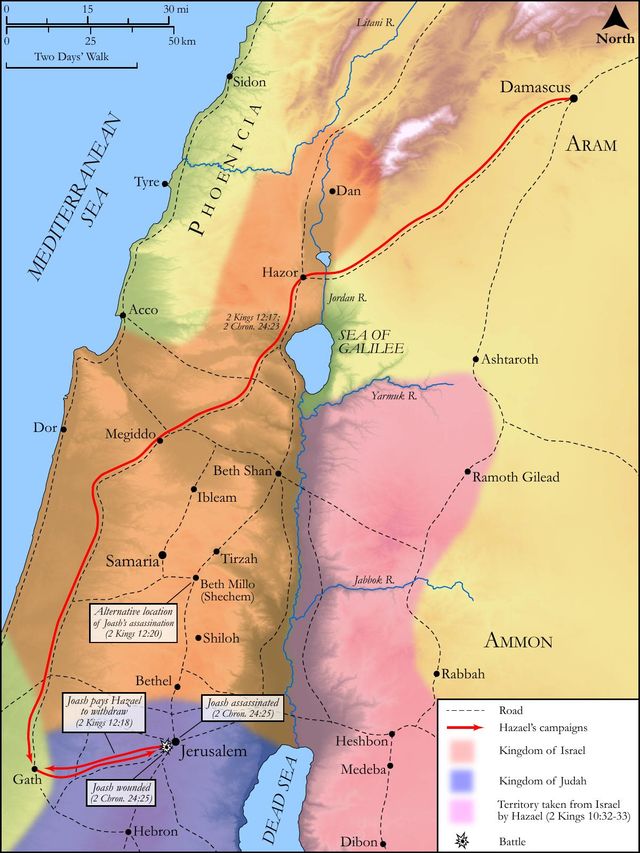
See on the biblical-era map
Study this verse
Public-domain commentary
Matthew Henry
From his Commentary on the Whole Bible. Henry comments on passages, not single verses — this entry covers 2 Kings 12:1–3.
The general account here given of Joash is, 1. That he reigned forty years. As he began his reign when he was very young, he might, in the course of nature, have continued much longer, for he was cut off when he was but forty-seven years old, Kg2 12:1. 2. That he did that which was right as long as Jehoiada lived to instruct him, Kg2 12:2. Many young men have come too soon to an estate - have had wealth, and power, and liberty, before they knew how to use them - and it has been of bad consequence to them; but against this danger Joash was well guarded by having such a good director as Jehoiada was, so wise, and experienced, and faithful to him, and by having so much wisdom as to hearken to him and be directed by him, even when he was grown up. Note, It is a great mercy to young people, and especially to young princes, and all young men of consequence, to be under good direction, and to have those about them that will instruct them to do that which is right in the sight of the Lord; and they then do wisely and well for themselves when they are willing to be counselled and ruled by such. A child left to himself brings his mother to shame, but a child left to such a tuition may bring himself to honour and comfort. 3. That the high places were not taken away, Kg2 12:3. Up and down the country they had altars both for sacrifice and incense, to the honour of the God of Israel only, but in competition with, and at least in tacit contempt of, his altar at Jerusalem. These private altars, perhaps, had been more used in the late bad reigns than formerly, because it was not safe to go up to Jerusalem, nor was the temple-service performed as it should have been; and, it may be, Jehoiada connived at them, because some well-meaning people were glad of them when they could not have better, and he hoped that the reforming of the temple, and putting things into a good posture there, would by degrees draw people from their high places and they would dwindle of themselves; or perhaps neither the king nor the priest had zeal enough to carry on their reformation so far, nor courage and strength enough to encounter such an inveterate usage.
Continue studying 2 Kings 12:1 across the web’s major study libraries — every link below opens this exact verse, chapter, or book on the destination site.
Read & Compare
 BibleGatewayThis verse in more than 200 translations and 70 languages.
 Bible.comThe YouVersion reader — hundreds of translations, reading plans, and highlights.
 ESV.orgCrossway's official English Standard Version reader.
 NET BibleThe NET translation with 60,000+ translators' notes on every rendering decision.
 STEP BibleTyndale House's free study tool — original text, vocabulary, and scholarly resources.
 BibliaLogos Bible Software's free web reader.
 USCCBThe New American Bible (Revised Edition) with the U.S. bishops' study notes.
Commentaries
 BibleHub CommentariesDozens of classic commentaries on this verse, gathered on one page.
 StudyLightMore than 100 commentary sets — the largest collection on the web.
 BibleRefPlain-English commentary on what this verse means, verse by verse.
 Enduring WordDavid Guzik's free commentary on this chapter, widely used by Bible teachers.
 Bible Study ToolsVerse commentary alongside Greek and Hebrew study aids.
Original Language & Research
- BibleHub InterlinearThe verse word by word — original language, transliteration, and English.
- BibleHub LexiconEvery word's original-language definition and Strong's entry.
 Blue Letter BibleDeep-study tools — Strong's numbers, concordance, and word studies.
 SefariaThe Hebrew text with Rashi and centuries of Jewish commentary.
Sermons, Hymns & Audio


TrulyRandomVerse is not affiliated with these sites and doesn’t control their content. They’re linked because they’re genuinely useful.
Summary
Second Kings 12:1 serves as a pivotal and concise introduction to the reign of King Jehoash (also known as Joash) over the Southern Kingdom of Judah, marking a crucial transition from the tumultuous usurpation of Queen Athaliah to a period of restored Davidic kingship. This verse precisely establishes the chronological context of his ascension by synchronizing it with the seventh year of King Jehu's rule in Israel, details his impressive forty-year tenure in Jerusalem, and provides essential genealogical information by identifying his mother as Zibiah of Beersheba. This foundational statement not only grounds Jehoash's reign historically but also subtly underscores God's unwavering faithfulness in preserving the Davidic covenant and ensuring the continuity of the legitimate royal line.
Context
ShowHideLiterary Context
This verse immediately follows the dramatic and perilous events narrated in 2 Kings 11, which details Queen Athaliah's ruthless attempt to eradicate the entire royal line of David. Miraculously, the infant Jehoash was rescued by his aunt Jehosheba and the high priest Jehoiada, hidden in the temple for six years. Second Kings 12:1 thus functions as the triumphant culmination of this divine preservation and human intervention, signaling the successful overthrow of the illegitimate queen and the restoration of rightful Davidic rule. It also marks a narrative shift, transitioning the focus from the Northern Kingdom's affairs, particularly Jehu's purge documented in 2 Kings 9-10, back to the political and spiritual landscape of Judah. The precise chronological synchronism with Jehu's reign further integrates the histories of the two divided kingdoms.
Historical & Cultural Context
Jehoash's ascension occurred within a highly charged political and religious environment. Queen Athaliah, the daughter of the idolatrous King Ahab and Queen Jezebel of Israel, had not only usurped the throne of Judah but had also aggressively promoted Baal worship, directly threatening the covenant relationship between Yahweh and His people. The high priest Jehoiada's actions were therefore not merely a political coup but a profound theological act aimed at restoring the legitimate Davidic king and re-establishing the worship of Yahweh as the sole God of Israel. The temple, which served as Jehoash's sanctuary and later the site of his coronation, was the spiritual and political heart of Judah, emphasizing the intrinsic link between religious fidelity and national well-being. The mention of Jehu's seventh year provides a vital chronological anchor, allowing ancient readers to place Jehoash's reign accurately within the broader timeline of the divided monarchy. Beersheba, identified as his mother's hometown, was a significant city in the Negev, historically marking the southernmost boundary of the land of Israel ("from Dan to Beersheba"), thereby grounding Jehoash's lineage firmly within the geographical and historical identity of Judah.
Key Themes
ShowHideA paramount theme evident in this verse is Divine Preservation and Providence, powerfully demonstrated in God's unwavering faithfulness to His covenant with David, as promised in 2 Samuel 7:16. Despite Athaliah's murderous attempt to extinguish the Davidic line, God meticulously ensured the survival of an heir, showcasing His sovereign control over human history and His unbreakable commitment to His promises. Jehoash's very existence and subsequent ascension are a direct testament to God's gracious and meticulous provision. Another crucial theme is the Legitimacy and Restoration of Kingship. Jehoash's reign signifies the re-establishment of rightful authority after Athaliah's tyrannical and idolatrous rule, emphasizing the importance of a divinely appointed king. His anointing by Jehoiada, detailed in 2 Kings 11:12, underscored the religious and civil legitimacy of his kingship, bringing stability and order back to the nation. This also highlights the Importance of Righteous Leadership and Mentorship, as Jehoash's initial success and adherence to Yahweh's commands were largely attributed to the faithful guidance of the high priest Jehoiada, a point explicitly made in 2 Kings 12:2.
Exposition and Analysis
ShowHideKey Word Analysis
ShowHideThis royal name, derived from the Hebrew for "Jehovah-fired" or "the LORD has given," carries profound theological weight in the context of 2 Kings 12:1. His very existence was a miraculous gift, preserved from certain death by divine intervention, making the meaning "the LORD has given" particularly apt. His subsequent reign was indeed a testament to God's gracious provision and unwavering faithfulness to His covenant promises, ensuring the continuation of the Davidic line against all odds.
This primitive root verb signifies "to reign," "to ascend the throne," or "to be (make, set a) king." In this verse, it denotes Jehoash's formal assumption of royal authority and the commencement of his legitimate rule. The term underscores the re-establishment of proper kingship in Judah after the illegitimate reign of Athaliah, highlighting the divine sanction and political legitimacy of Jehoash's position. It speaks to the stability and order that returned to the kingdom with a rightful heir on the throne.
Meaning "well of the oath" or "well of seven," Beersheba was a historically and geographically significant city located in the southern part of Judah. It served as a prominent landmark, often used to delineate the southernmost boundary of the land of Israel. Mentioning Zibiah's origin from Beersheba grounds Jehoash's lineage geographically within the heartland of Judah, adding to the authenticity and specificity of the biblical account. It connects the king to a foundational place in Israel's history, associated with the patriarchs Abraham and Isaac.
Verse Breakdown
ShowHide"In the seventh year of Jehu Jehoash began to reign"
This clause provides a precise chronological marker, synchronizing the commencement of Jehoash's reign in Judah with the seventh year of Jehu's rule in the northern kingdom of Israel. This detail is crucial for establishing the historical timeline of the divided monarchy, allowing for a coherent understanding of events across both kingdoms. It also implicitly highlights Jehoash's extreme youth at accession, as he was hidden for six years and crowned in the seventh, meaning he was seven years old when he became king, as explicitly stated in 2 Kings 11:21.
"and forty years reigned he in Jerusalem"
This statement indicates the remarkably long duration of Jehoash's rule. A forty-year reign in biblical narratives often signifies a period of significant stability, prosperity, or a complete generation, though it does not necessarily imply uninterrupted righteousness. This lengthy tenure allowed for substantial events, including the important temple repairs detailed later in the chapter, but also foreshadows the eventual decline in his later years, which is a common pattern for many kings in the books of Kings.
"And his mother's name [was] Zibiah of Beersheba"
This detail about the king's mother and her hometown is a standard feature in the biblical accounts of Judahite kings. It serves as a crucial genealogical identifier, authenticating the king's lineage and connecting him to a specific family and place within Judah. This convention provides a personal touch to the historical record, distinguishing him from other kings with similar names and reinforcing his legitimate claim to the throne by anchoring him in the land.
Literary Devices
ShowHideSecond Kings 12:1 employs several literary techniques to efficiently convey its historical and theological significance. The verse begins with a precise Chronological Marker ("In the seventh year of Jehu"), which serves to date Jehoash's ascension accurately, linking the narrative of Judah to the broader historical context of the divided monarchy and providing a clear framework for understanding the sequence of events. The inclusion of Genealogical Detail ("And his mother's name [was] Zibiah of Beersheba") is a common biblical convention that authenticates the king's identity and connects him to a specific region within Judah, grounding the historical account in concrete facts and reinforcing his legitimate claim to the throne. Furthermore, the statement of his remarkably long reign ("forty years reigned he in Jerusalem") functions as a subtle form of Foreshadowing, hinting at a significant period of rule that will encompass both initial reform and eventual decline, thereby setting expectations for the narrative that follows in the rest of the chapter and beyond.
Theological and Thematic Connections
ShowHideThe introduction of King Jehoash in 2 Kings 12:1 stands as a profound testament to God's unwavering covenant faithfulness and His sovereign preservation of the Davidic line. Despite the murderous intent of Athaliah to extinguish the royal seed, God's promise to David—that a descendant would always sit on his throne—remained inviolable. Jehoash's miraculous rescue and subsequent ascension, orchestrated by the high priest Jehoiada, powerfully underscore that God works through human agents to fulfill His divine purposes, even in the darkest of times. This narrative vividly illustrates that God's plans cannot be thwarted by human wickedness or political upheaval; His redemptive history moves forward according to His perfect will, ensuring the continuity of the lineage through which the ultimate King would one day come. It is a powerful reminder that God's faithfulness transcends human failure and opposition.
Reflection and Application
ShowHideThe narrative of Jehoash's reign, commencing with his miraculous preservation and ascension, offers profound and enduring lessons for contemporary believers. It serves as a powerful reminder that even in the most desperate and seemingly hopeless circumstances, God remains absolutely sovereign, actively working behind the scenes to uphold His promises and advance His redemptive plan. When evil appears to triumph, or the forces of chaos and destruction seem overwhelming, Jehoash's narrative calls us to cultivate a deep and unwavering trust in God's unseen hand, knowing that His faithfulness will ultimately prevail, bringing order out of chaos and light out of darkness. Furthermore, the pivotal role of Jehoiada in raising and guiding Jehoash highlights the indispensable value of godly mentorship and spiritual guardianship. Just as Jehoiada provided the moral and spiritual foundation for Jehoash's initial righteous reign, so too do faithful leaders, parents, and mentors play a crucial role in shaping individuals and communities towards spiritual health, adherence to God's will, and resilient faith. This encourages us to humbly seek out and submit to wise counsel, and conversely, to prayerfully offer such guidance to others, recognizing our part in God's ongoing work of preservation, restoration, and discipleship within His kingdom.
Questions for Reflection
ShowHideFAQ
ShowHideWhy is Jehoash's mother mentioned, and what is the significance of Beersheba?
ShowHideThe mention of the king's mother and her hometown is a common and important feature in the biblical accounts of the kings of Judah, serving several crucial purposes. It provides a genealogical identifier, authenticating the king's lineage and connecting him to a specific family and place within the kingdom. This detail adds to the historical veracity and specificity of the biblical record, distinguishing Jehoash from other individuals with similar names and reinforcing his legitimate claim to the throne. Beersheba, identified as his mother Zibiah's hometown, was a historically significant city in the southern part of Judah, often serving as a symbolic boundary of the land ("from Dan to Beersheba"). This connection firmly grounds Jehoash within the heartland of Judah, emphasizing his authentic Israelite heritage and his rightful place within the Davidic dynasty.
How old was Jehoash when he began to reign, and why is this significant?
ShowHideAlthough 2 Kings 12:1 states he began to reign in the seventh year of Jehu, 2 Kings 11:21 explicitly states that Jehoash was "seven years old when he began to reign." This detail is profoundly significant because it underscores his extreme youth at the time of his ascension. His tender age highlights his complete dependence on the faithful high priest Jehoiada, who had rescued him as an infant and hidden him in the temple for six years. Jehoiada's mentorship and guidance were absolutely crucial for Jehoash's early reign, shaping his initial adherence to the Lord and the reforms he undertook, particularly the repair of the temple. This reliance on a godly mentor is a key theme in his story.
Christ-Centered Fulfillment
ShowHideThe narrative of Jehoash's miraculous preservation and ascension in 2 Kings 12:1 finds its ultimate and perfect fulfillment in the person and work of Jesus Christ. Just as Jehoash was miraculously spared from Athaliah's murderous decree to preserve the Davidic line, so too was the infant Jesus preserved from Herod's attempt to eliminate the rightful King of the Jews, as powerfully recounted in Matthew 2:13-18. Jehoash's restoration to the throne, symbolizing the re-establishment of legitimate Davidic rule after a period of usurpation and chaos, profoundly foreshadows Jesus, the true and eternal Son of David, whose birth and reign fulfill God's unbreakable covenant promise that a king would never be wanting on David's throne (Luke 1:32-33). While Jehoash's forty-year reign was significant but ultimately flawed and temporary, Jesus' reign is eternal, perfect, and brings about not merely political stability but ultimate spiritual salvation and restoration for all who believe (Hebrews 1:8). Christ is the King who truly takes away the sin of the world (John 1:29) and establishes a kingdom that will never end, a dominion that all peoples, nations, and languages will serve (Daniel 7:14).