


2 Kings 12:2
Bible text: King James Version (1769 Blayney text) · Public domain
Bible text: Berean Standard Bible · Public domain
Bible text: American Standard Version (1901) · Public domain
Bible text: World English Bible, Messianic edition · Public domain
Bible text: Geneva Bible (1599) · Public domain
Bible text: Young's Literal Translation · Public domain
- וַיַּעַשׂvai·Ya·'asand he didH6213Conj-w ¦ V-Qal-ConsecImperf-3msVerb Qal Consecutive Imperfect 3rd Singular Masculineוַandיַּעַשׂhe did
- יְהוֹאָשׁye·ho·'AshJehoashH3060N-proper-mNoun Proper Masculine
- הַיָּשָׁרhai·ya·Sharthe rightH3477Art ¦ Adj-msAdjective Singular Masculine Absoluteהַtheיָּשָׁרright
- בְּעֵינֵיbe·'ei·Neiin [the] eyes ofH5869Prep-b ¦ N-fdcNoun Dual Feminine Constructבְּinעֵינֵי[the] eyes of
- יְהוָהYah·wehYahwehH3068N-properNoun Proper Title
- כָּלkolallH3605N-mscNoun Singular Masculine Construct
- יָמָיוya·Mavhis daysH3117N-mpc ¦ 3msNoun Plural Masculine Constructיָמָיdaysוhis
- אֲשֶׁר'a·SherwhichH834RelParticle Relative
- הוֹרָהוּho·Ra·huhe instructed himH3384V-Hiphil-Perf-3ms ¦ 3msVerb Hiphil Perfect 3rd Singular Masculineהוֹרָhe instructedהוּhim
- יְהוֹיָדָעye·ho·ya·Da'JehoiadaH3077N-proper-mNoun Proper Masculine
- הַכֹּהֵןha·ko·Henthe priestH3548Art ¦ N-msNoun Singular Masculine Absoluteהַtheכֹּהֵןpriest
English is a literal word-by-word gloss of the Hebrew, not the KJV's wording. Why?
This is the original text the KJV's translators worked from — each Hebrew word with its own literal English meaning in this verse, prepared by scholars at Tyndale House, Cambridge. The KJV translates whole sentences, not word by word, so its wording differs: one Hebrew word can become several English words, and the KJV may choose “the LORD” where the gloss reads “Yahweh”. Both are faithful — they answer different questions. For the KJV's own rendering, switch to the KJV text.
Details
See on the biblical-era map
Study this verse
Public-domain commentary
Matthew Henry
From his Commentary on the Whole Bible. Henry comments on passages, not single verses — this entry covers 2 Kings 12:1–3.
The general account here given of Joash is, 1. That he reigned forty years. As he began his reign when he was very young, he might, in the course of nature, have continued much longer, for he was cut off when he was but forty-seven years old, Kg2 12:1. 2. That he did that which was right as long as Jehoiada lived to instruct him, Kg2 12:2. Many young men have come too soon to an estate - have had wealth, and power, and liberty, before they knew how to use them - and it has been of bad consequence to them; but against this danger Joash was well guarded by having such a good director as Jehoiada was, so wise, and experienced, and faithful to him, and by having so much wisdom as to hearken to him and be directed by him, even when he was grown up. Note, It is a great mercy to young people, and especially to young princes, and all young men of consequence, to be under good direction, and to have those about them that will instruct them to do that which is right in the sight of the Lord; and they then do wisely and well for themselves when they are willing to be counselled and ruled by such. A child left to himself brings his mother to shame, but a child left to such a tuition may bring himself to honour and comfort. 3. That the high places were not taken away, Kg2 12:3. Up and down the country they had altars both for sacrifice and incense, to the honour of the God of Israel only, but in competition with, and at least in tacit contempt of, his altar at Jerusalem. These private altars, perhaps, had been more used in the late bad reigns than formerly, because it was not safe to go up to Jerusalem, nor was the temple-service performed as it should have been; and, it may be, Jehoiada connived at them, because some well-meaning people were glad of them when they could not have better, and he hoped that the reforming of the temple, and putting things into a good posture there, would by degrees draw people from their high places and they would dwindle of themselves; or perhaps neither the king nor the priest had zeal enough to carry on their reformation so far, nor courage and strength enough to encounter such an inveterate usage.
Continue studying 2 Kings 12:2 across the web’s major study libraries — every link below opens this exact verse, chapter, or book on the destination site.
Read & Compare
 BibleGatewayThis verse in more than 200 translations and 70 languages.
 Bible.comThe YouVersion reader — hundreds of translations, reading plans, and highlights.
 ESV.orgCrossway's official English Standard Version reader.
 NET BibleThe NET translation with 60,000+ translators' notes on every rendering decision.
 STEP BibleTyndale House's free study tool — original text, vocabulary, and scholarly resources.
 BibliaLogos Bible Software's free web reader.
 USCCBThe New American Bible (Revised Edition) with the U.S. bishops' study notes.
Commentaries
 BibleHub CommentariesDozens of classic commentaries on this verse, gathered on one page.
 StudyLightMore than 100 commentary sets — the largest collection on the web.
 BibleRefPlain-English commentary on what this verse means, verse by verse.
 Enduring WordDavid Guzik's free commentary on this chapter, widely used by Bible teachers.
 Bible Study ToolsVerse commentary alongside Greek and Hebrew study aids.
Original Language & Research
- BibleHub InterlinearThe verse word by word — original language, transliteration, and English.
- BibleHub LexiconEvery word's original-language definition and Strong's entry.
 Blue Letter BibleDeep-study tools — Strong's numbers, concordance, and word studies.
 SefariaThe Hebrew text with Rashi and centuries of Jewish commentary.
Sermons, Hymns & Audio


TrulyRandomVerse is not affiliated with these sites and doesn’t control their content. They’re linked because they’re genuinely useful.
Summary
Second Kings 12:2 provides a concise yet profoundly insightful summary of King Jehoash's early reign, stating that he "did that which was right in the sight of the LORD all his days wherein Jehoiada the priest instructed him." This verse immediately establishes the conditional nature of Jehoash's righteousness, attributing his adherence to God's will directly to the ongoing guidance and mentorship of Jehoiada, the high priest. It sets the stage for understanding the trajectory of his kingship, highlighting the critical role of spiritual leadership in maintaining covenant faithfulness and subtly foreshadowing the challenges that would arise once that external influence was removed.
Context
ShowHideLiterary Context
This verse serves as the introductory evaluation of King Jehoash's reign, immediately following the dramatic narrative of his miraculous preservation and enthronement in 2 Kings 11. Jehoash, the sole surviving son of Ahaziah, was hidden for six years by Jehoiada and his wife Jehosheba from the murderous rampage of his grandmother, Athaliah. Jehoiada then orchestrated a daring coup, overthrowing Athaliah and installing the seven-year-old Jehoash as king. Thus, 2 Kings 12:2 functions as a summary statement, much like those found at the beginning of other kings' reigns, but with a crucial qualifier that points to the source of his righteousness. This qualifier, "wherein Jehoiada the priest instructed him," subtly foreshadows the later narrative of Jehoash's decline after Jehoiada's death, as detailed in 2 Kings 12:17-18 and more extensively in 2 Chronicles 24:17-22.
Historical & Cultural Context
The period immediately preceding Jehoash's reign was one of severe dynastic instability and religious apostasy in Judah. Athaliah, a daughter of Ahab and Jezebel, had usurped the throne and attempted to eradicate the Davidic line, introducing Baal worship more overtly into the kingdom. In this volatile environment, the high priest Jehoiada emerged as a pivotal figure, not only preserving the legitimate heir but also leading a religious and political reformation. The temple, where Jehoash was hidden and later crowned, was not merely a religious site but a center of national identity and covenant fidelity. The phrase "did that which was right in the sight of the LORD" was the standard biblical evaluation of a king's reign, indicating adherence to the Mosaic covenant and rejection of idolatry, particularly in contrast to the northern kingdom of Israel and many of Judah's own kings. Jehoiada's role as mentor to a young king without parents was culturally significant, reflecting the importance of wise counsel and spiritual guidance for the kings of Judah.
Key Themes
ShowHideThe primary theme conveyed by this verse is Conditional Righteousness. Unlike kings whose righteousness is described as inherent or unwavering, Jehoash's faithfulness is explicitly tied to the active guidance of Jehoiada. This highlights the theme of The Power and Limits of Godly Mentorship, demonstrating that while external spiritual guidance is vital, it cannot ultimately substitute for deep, personal conviction and an internal commitment to God. The verse also underscores Human Frailty and Dependence, even for those in positions of authority; Jehoash, despite being raised in the temple and miraculously preserved, still required constant oversight to maintain his righteous path. Furthermore, it touches upon Covenant Faithfulness, showing that "doing right in the sight of the LORD" was the benchmark for a king's success, a standard that Jehoash met only so long as he was under Jehoiada's direct instruction, contrasting with the absolute standard set for the people in Deuteronomy 6:18.
Exposition and Analysis
ShowHideKey Word Analysis
ShowHideThis term signifies that which is straight, upright, pleasing, or morally correct in God's estimation. It is a common descriptor for kings who align their rule with the covenant stipulations and commandments of the LORD, particularly in contrast to idolatry and injustice. In this context, it refers to Jehoash's adherence to proper worship and righteous governance.
While literally referring to a period of twenty-four hours, this term often denotes a broader "time" or "season" in biblical usage. Here, "all his days" initially suggests the entirety of Jehoash's reign. However, the subsequent qualifying clause in the verse ("wherein Jehoiada the priest instructed him") redefines this "all" to mean "all the days during which Jehoiada instructed him," thereby highlighting the temporal and conditional nature of his consistent righteousness.
The root verb means "to throw" or "to cast," but in the Hiphil stem, as used here, it means "to teach," "to guide," "to direct," or "to point the way." It implies a continuous, active, and authoritative process of instruction. Jehoiada was not merely advising Jehoash; he was actively shaping his understanding and conduct in accordance with God's law.
Verse Breakdown
ShowHide"And Jehoash did [that which was] right in the sight of the LORD"
This opening clause is a standard evaluative formula for Israelite and Judean kings, indicating that Jehoash's reign, at least initially, conformed to God's covenant expectations. He avoided idolatry and promoted proper worship, a significant achievement given the apostasy of his grandmother, Athaliah.
"all his days"
This phrase, when read in isolation, might suggest a lifelong, unwavering righteousness. However, in light of the subsequent qualifying clause, it must be understood as referring to the period during which his actions were consistently "right in the sight of the LORD." It defines the duration of his faithfulness, which was circumscribed by Jehoiada's presence.
"wherein Jehoiada the priest instructed him"
This is the critical, defining clause of the verse. The "wherein" (Hebrew asher) makes Jehoash's righteousness conditional and dependent. It signifies that his righteous conduct was not a result of deep, internal conviction that could stand independently, but rather a direct outcome of Jehoiada's continuous, active, and authoritative guidance. This clause subtly foreshadows the later decline of Jehoash's reign once Jehoiada, his spiritual anchor, was no longer present to instruct him.
Literary Devices
ShowHideThe verse employs several significant literary devices. The most prominent is the Conditional Clause ("wherein Jehoiada the priest instructed him"), which fundamentally qualifies the initial statement of Jehoash's righteousness. This clause acts as a powerful Foreshadowing device, subtly alerting the reader that Jehoash's faithfulness is not absolute and will likely falter once the condition (Jehoiada's instruction) is removed. There is also an element of Irony in the fact that the king, who is meant to lead his people in righteousness, is himself so dependent on another for his own spiritual direction. The verse also implicitly uses Juxtaposition by presenting Jehoash's initial, externally-driven righteousness, which will later be contrasted with his subsequent apostasy, highlighting the fragility of a faith not deeply rooted in personal conviction.
Theological and Thematic Connections
ShowHideThe theological significance of 2 Kings 12:2 lies in its profound commentary on the nature of righteousness and the necessity of genuine, internal spiritual conviction. While the verse affirms the immense value of godly mentorship and external guidance, it simultaneously serves as a cautionary tale. Jehoash's righteousness, though commendable during Jehoiada's lifetime, was ultimately conditional and dependent, rather than flowing from a deeply cultivated personal relationship with God. This highlights the theological truth that true and lasting obedience to God requires more than mere adherence to external instruction; it demands an internal transformation and a personal commitment that can withstand the absence of external influences. The verse implicitly warns against a faith that is solely reliant on others, emphasizing the need for individual spiritual maturity and discernment.
Reflection and Application
ShowHideThe account of King Jehoash offers timeless lessons for believers today. While the verse powerfully affirms the indispensable value of godly mentors and spiritual guidance—individuals who can instruct, encourage, and hold us accountable in our walk with the Lord—it also presents a sobering reminder of the limitations of such external support. Our spiritual health and obedience should not be solely dependent on the presence of a particular person or external influence. The narrative of Jehoash's later apostasy (see 2 Chronicles 24) serves as a stark warning: true, enduring righteousness must stem from a deep, personal, and abiding relationship with God, cultivated through prayer, study of His Word, and the indwelling of the Holy Spirit. We are called to move beyond mere reliance on others' faith to developing our own robust, resilient conviction that can sustain us through all seasons of life, even when our spiritual guides are no longer physically present.
Questions for Reflection
ShowHideFAQ
ShowHideWas Jehoash's righteousness genuine, or was it merely superficial?
ShowHideJehoash's righteousness was genuine in the sense that he did indeed "do what was right in the sight of the LORD" during the period of Jehoiada's instruction. He repaired the temple and upheld proper worship. However, the crucial qualifier "wherein Jehoiada the priest instructed him" indicates that this righteousness was largely dependent on Jehoiada's active guidance. It lacked the deep, personal conviction and internal fortitude that would have sustained him independently. Therefore, while his actions were outwardly righteous, the underlying motivation and spiritual depth were conditional, proving insufficient once his mentor was gone, as seen in his later apostasy described in 2 Chronicles 24:17-22.
What happened to King Jehoash after Jehoiada died?
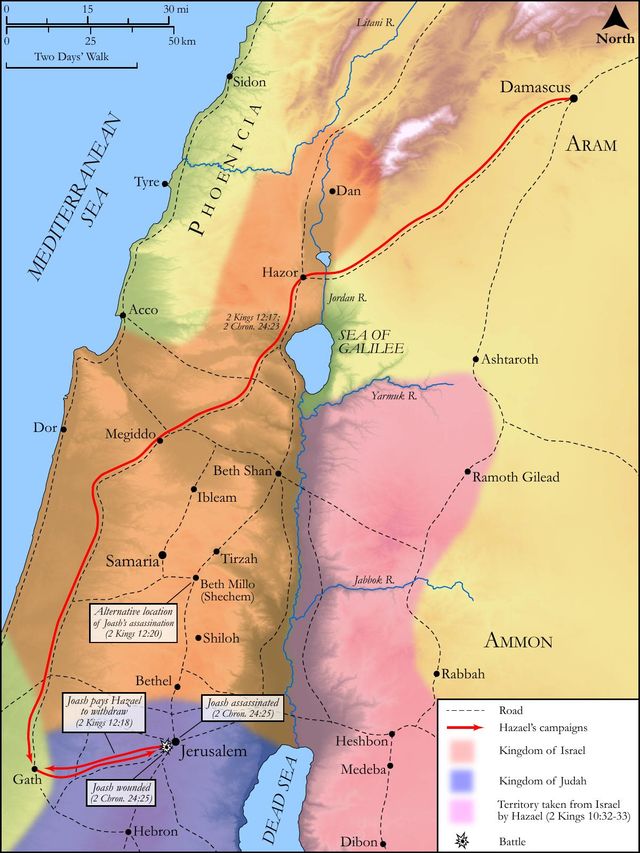
ShowHideAfter Jehoiada's death, King Jehoash's reign took a tragic turn. The biblical account in 2 Chronicles 24 reveals that the officials of Judah influenced him, and he abandoned the house of the LORD, serving Asherim and idols. When the prophet Zechariah, Jehoiada's son, confronted him about his sin, Jehoash commanded that Zechariah be stoned to death in the court of the temple, a grave act of ingratitude and apostasy. As a result of his unfaithfulness, Judah was invaded by the Arameans, and Jehoash himself was assassinated by his own servants.
Christ-Centered Fulfillment
ShowHideThe conditional righteousness of King Jehoash, so explicitly stated in 2 Kings 12:2, serves as a poignant contrast to the perfect and inherent righteousness of Jesus Christ. Unlike Jehoash, whose obedience was dependent on an external mentor, Christ's righteousness flows from His very nature as the Son of God, eternally one with the Father. He did not need instruction to "do that which was right in the sight of the LORD"; rather, He perfectly embodied and fulfilled the will of God in every thought, word, and deed, as declared in John 8:29. Furthermore, while Jehoash's human mentor eventually died, leaving him vulnerable to apostasy, Christ is the eternal High Priest and the "same yesterday and today and forever" (Hebrews 13:8). For believers, our righteousness is not our own conditional obedience, but the imputed righteousness of Christ, freely given through faith (2 Corinthians 5:21 and Philippians 3:9). Under the New Covenant, God does not merely provide an external instructor like Jehoiada, but He writes His law on our hearts and puts His Spirit within us (Jeremiah 31:33 and Hebrews 8:10), enabling an internal, Spirit-empowered obedience that transcends the limitations of human mentorship. Thus, Jehoash's story ultimately points to our profound need for the perfect and enduring work of Christ, who secures our righteousness and empowers our obedience from within.