


2 Chronicles 25:2
- וַיַּעַשׂvai·Ya·'asand he didH6213Conj-w ¦ V-Qal-ConsecImperf-3msVerb Qal Consecutive Imperfect 3rd Singular Masculineוַandיַּעַשׂhe did
- הַיָּשָׁרhai·ya·Sharthe rightH3477Art ¦ Adj-msAdjective Singular Masculine Absoluteהַtheיָּשָׁרright
- בְּעֵינֵיbe·'ei·Neiin [the] eyes ofH5869Prep-b ¦ N-fdcNoun Dual Feminine Constructבְּinעֵינֵי[the] eyes of
- יְהוָהYah·wehYahwehH3068N-properNoun Proper Title
- רַקrakonlyH7535AdvAdverb
- לֹאlo'notH3808NegParticle Negative
- בְּלֵבָבbe·le·Vavwith a heartH3824Prep-b ¦ N-msNoun Singular Masculine Absoluteבְּwithלֵבָבa heart
- שָׁלֵםsha·LemcompleteH8003Adj-msAdjective Singular Masculine Absolute
English is a literal word-by-word gloss of the Hebrew, not the KJV's wording. Why?
This is the original text the KJV's translators worked from — each Hebrew word with its own literal English meaning in this verse, prepared by scholars at Tyndale House, Cambridge. The KJV translates whole sentences, not word by word, so its wording differs: one Hebrew word can become several English words, and the KJV may choose “the LORD” where the gloss reads “Yahweh”. Both are faithful — they answer different questions. For the KJV's own rendering, switch to the KJV text.
Details
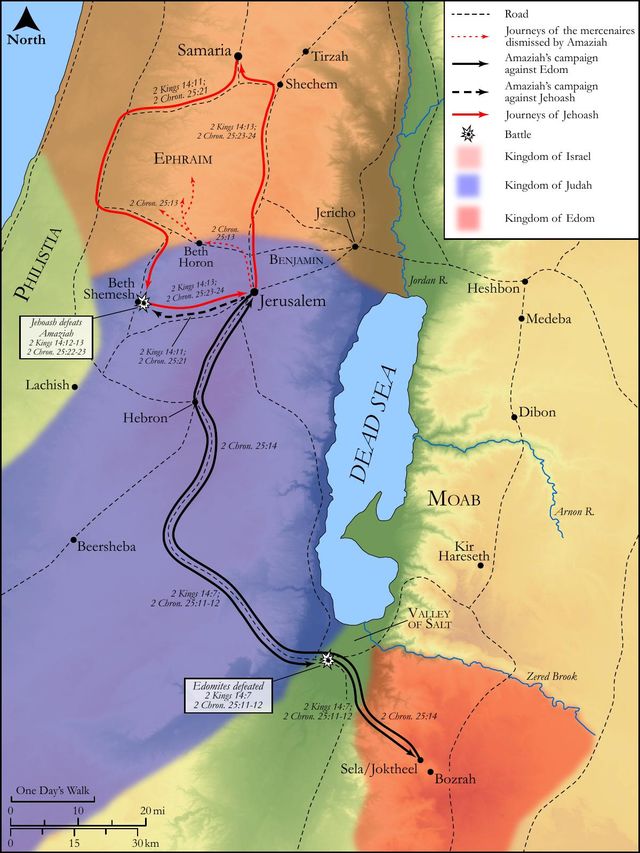
See on the biblical-era map
Study this verse
Public-domain commentary
Matthew Henry
From his Commentary on the Whole Bible. Henry comments on passages, not single verses — this entry covers 2 Chronicles 25:1–13. His three-level outline is real structure in the source text, so it is rendered as structure.
Here is, I. The general character of Amaziah: He did that which was right in the eyes of the Lord, worshipped the true God, kept the temple service a going, and countenanced religion in his kingdom; but he did not do it with a perfect heart (Ch2 25:2), that is, he was not a man of serious piety or devotion himself, nor had he any zeal for the exercises of religion. He was no enemy to it, but a cool and indifferent friend. Such is the character of too many in this Laodicean age: they do that which is good, but not with the heart, not with a perfect heart.
II.A necessary piece of justice which he did upon the traitors that murdered his father:
he put them to death, Ch2 25:3. Though we should suppose they intended to avenge on their king the death of the prophet (as was intimated, Ch2 24:25), yet this would by no means justify their wickedness; for they were not the avengers, but presumptuously took God's work out of his hands: and therefore Amaziah did what became him in calling them to an account for it, but forbade the putting of the children to death for the parents' sin, Ch2 25:4.
III.An expedition of his against the Edomites, who, some time ago, had revolted from under the dominion of Judah, to which he attempted to reduce them. Observe,
1.The great preparation he made for this expedition.
(1.)He mustered his own forces, and marshalled them (Ch2 25:5), and found Judah and Benjamin in all but 300,000 men that were fit for war, whereas, in Jehoshaphat's time, fifty or sixty years before, they were four times as many. Sin weakens a people, diminishes them, dispirits them, and lessens their number and figure.
(2.)He hired auxiliary troops out of the kingdom of Israel, Ch2 25:6. Finding his own kingdom defective in men, he thought to make up the deficiency with his money, and therefore took into his pay 100,000 Israelites. If he had advised with any of his prophets before he did this, or had but considered how little any of his ancestors got by their alliances with Israel, he would not have had this to undo again. But rashness makes work for repentance.
2.The command which God sent him by a prophet to dismiss out of his service the forces of Israel, Ch2 25:7, Ch2 25:8. He would not have him call in any assistance at all: it looked like distrust of God. If he made sure of God's presence, the army he had of his own was sufficient. But particularly he must not take in their assistance: For the Lord is not with the children of Ephraim, because they are not with him, but worship the calves. This was a good reason why he should not make use of them, because he could not depend upon them to do him any service. What good could be expected from those that had not God with them, nor his blessings upon their undertakings? It is comfortable to employ those who, we have reason to hope, have an interest in heaven, and dangerous to associate with those from whom the Lord has departed. The prophet assured him that if he persisted in his resolution to take these idolatrous apostate Israelites with him, in hopes thereby to make himself strong for the battle, it was at his peril; they would prove a dead weight to his army, would sink and betray it: "God shall make thee fall before the enemy, and these Israelites will be the ruin of thy cause; for God has power to help thee without them, and to cast thee down though thou hast them with thee."
3.The objection which Amaziah made against this command, and the satisfactory answer which the prophet gave to that objection, Ch2 25:9. The king had remitted 100 talents to the men of Israel for advance-money. "Now," says he, "if I send them back, I shall lose that: But what shall we do for the 100 talents?" This is an objection men often make against their duty: they are afraid of losing by it. "Regard not that," says the prophet: "The Lord is able to give thee much more than this; and, thou mayest depend upon it, he will not see thee lose by him. What are 100 talents between thee and him? He has ways enough to make up the loss to thee; it is below thee to speak of it." Note, A firm belief of God's all-sufficiency to bear us out in our duty, and to make up all the loss and damage we sustain in his service abundantly to our advantage, will make his yoke very easy and his burden very light. What is it to trust in God, but to be willing to venture the loss of any thing for him, in confidence of the goodness of the security he gives us that we shall not lose by him, but that whatever we part with for his sake shall be made up to us in kind or kindness. When we grudge to part with any thing for God and our religion, this should satisfy us, that God is able to give us much more than this. He is just, and he is good, and he is solvent. The king lost 100 talents by his obedience; and we find just that sum given to his grandson Jotham as a present (Ch2 27:5); then the principal was repaid, and, for interest, 10,000 measures of wheat and as many of barley.
4.His obedience to the command of God, which is upon record to his honour. He would rather lose his money, disoblige his allies, and dismiss a fourth part of his army just as they were going to take the field, than offend God: He separated the army of Ephraim, to go home again, Ch2 25:10. And they went home in great anger, taking it as a great affront thus to be made fools of, and to be cashiered as men not fit to be employed, and being perhaps disappointed of the advantages they promised themselves in spoil and plunder by joining with Judah against Edom. Men are apt to resent that which touches them in their profit or reputation, though it frees them from trouble.
5.His triumphs over the Edomites, Ch2 25:11, Ch2 25:12. He left dead upon the spot, in the field of battle, 10,000 men; 10,000 more he took prisoners, and barbarously killed them all by throwing them down some steep and craggy precipice. What provocation he had to exercise this cruelty towards them we are not told; but it was certainly very severe.
6.The mischief which the disbanded soldiers of Israel did to the cities of Judah, either in their return or soon after, Ch2 25:13. They were so enraged at being sent home that, if they might not go to share with Judah in the spoil of Edom, they would make a prey of Judah. Several cities that lay upon the borders they plundered, killing 3000 men that made resistance. But why should God suffer this to be done? Was it not in obedience to him that they were sent home, and yet shall the country thus suffer by it? Surely God's way is in the sea! Did not the prophet say that God was not with the children of Ephraim, and yet they are suffered to prevail against Judah? Doubtless God intended hereby to chastise those cities of Judah for their idolatries, which were found most in those parts that lay next to Israel. The men of Israel had corrupted them, and now they were made a plague to them. Satan both tempts and torments.
Continue studying 2 Chronicles 25:2 across the web’s major study libraries — every link below opens this exact verse, chapter, or book on the destination site.
Read & Compare
 BibleGatewayThis verse in more than 200 translations and 70 languages.
 Bible.comThe YouVersion reader — hundreds of translations, reading plans, and highlights.
 ESV.orgCrossway's official English Standard Version reader.
 NET BibleThe NET translation with 60,000+ translators' notes on every rendering decision.
 STEP BibleTyndale House's free study tool — original text, vocabulary, and scholarly resources.
 BibliaLogos Bible Software's free web reader.
 USCCBThe New American Bible (Revised Edition) with the U.S. bishops' study notes.
Commentaries
 BibleHub CommentariesDozens of classic commentaries on this verse, gathered on one page.
 StudyLightMore than 100 commentary sets — the largest collection on the web.
 BibleRefPlain-English commentary on what this verse means, verse by verse.
 Enduring WordDavid Guzik's free commentary on this chapter, widely used by Bible teachers.
 Bible Study ToolsVerse commentary alongside Greek and Hebrew study aids.
Original Language & Research
- BibleHub InterlinearThe verse word by word — original language, transliteration, and English.
- BibleHub LexiconEvery word's original-language definition and Strong's entry.
 Blue Letter BibleDeep-study tools — Strong's numbers, concordance, and word studies.
 SefariaThe Hebrew text with Rashi and centuries of Jewish commentary.
Sermons, Hymns & Audio


TrulyRandomVerse is not affiliated with these sites and doesn’t control their content. They’re linked because they’re genuinely useful.
Summary
Second Chronicles 25:2 provides a critical assessment of King Amaziah's reign, observing that while his actions were outwardly "right in the sight of the LORD," his internal disposition was not characterized by "a perfect heart." This foundational verse immediately introduces a profound tension in his leadership, highlighting that external conformity to divine law, though commendable, was not matched by genuine, undivided devotion, thereby emphasizing the biblical principle that God scrutinizes the heart above mere outward performance.
Context
ShowHideLiterary Context
This verse serves as the customary introduction to King Amaziah's reign, following the pattern of evaluation for Judah's kings established throughout the historical books, particularly in 2 Chronicles. It immediately sets the theological tone for his narrative. Amaziah's ascension to the throne occurs after the assassination of his father, Joash, whose own reign began with promise but ended in apostasy and violence, as detailed in 2 Chronicles 24:17-22. The Chronicler, writing from a post-exilic perspective, consistently evaluates kings based on their adherence to the Mosaic covenant and their fidelity to Yahweh, with a particular emphasis on the state of their heart towards God. Amaziah's initial acts, such as executing his father's murderers while sparing their children in accordance with the law, as seen in 2 Chronicles 25:3-4, appear righteous. However, the crucial qualifier in 2 Chronicles 25:2 acts as a prophetic indicator, foreshadowing his later spiritual decline, including his disastrous war against Edom and subsequent adoption of Edomite idols, which is explicitly recounted in 2 Chronicles 25:14-16. This verse is therefore not merely a historical observation but a theological judgment that frames the entire account of his rule, explaining the trajectory of his successes and failures.
Historical & Cultural Context
King Amaziah reigned over the Southern Kingdom of Judah from approximately 796-767 BC, a period marked by regional geopolitical shifts and ongoing interactions with neighboring states like Edom and the Northern Kingdom of Israel. In ancient Israel and Judah, the king was not only a political and military leader but also a spiritual guardian of the covenant, whose personal piety and obedience were believed to directly impact the nation's well-being. The Chronicler's work, composed centuries after the events, places significant emphasis on the Davidic covenant, the sanctity of the Temple, and the importance of proper worship. Within this cultural framework, outward religious observance was common and often expected. However, the prophetic tradition, a consistent voice throughout Israel's history, frequently challenged leaders and the populace to move beyond mere external ritual to cultivate inner devotion and genuine obedience. The concept of a "perfect heart" (Hebrew: shalem lev) was a recurring ideal for Israel's kings, signifying complete, undivided loyalty to God, standing in stark contrast to the syncretism, idolatry, or lukewarmness that often plagued the monarchy. It was a standard of internal integrity that few kings fully met.
Key Themes
ShowHideThe primary theme introduced by this verse is the critical distinction between outward conformity and inward sincerity. While Amaziah's actions might have been "right" in their external appearance, his heart was not "perfect," highlighting that God's assessment penetrates beyond observable performance to the true state of one's inner being. This directly relates to the broader biblical emphasis on the importance of the heart as the core of one's will, affections, and moral choices, as powerfully articulated in Proverbs 4:23. Another crucial theme is God's scrutiny of motives. Unlike human observers who might be impressed by outward displays of piety or adherence to law, God "searches the heart and examines the mind," as declared in Jeremiah 17:10. This verse also serves as a potent foreshadowing of decline, as Amaziah's initial internal spiritual deficiency inevitably leads to his later unfaithfulness and ultimate downfall. His story illustrates the profound principle that a compromised or divided heart will eventually lead to compromised actions and severe consequences, a pattern frequently observed in the lives of Israel's kings throughout the historical narratives of 2 Chronicles.
Exposition and Analysis
ShowHideKey Word Analysis
ShowHideThis verb is a primitive root meaning "to do or make" in its broadest sense and widest application. It encompasses accomplishing, performing, executing, and carrying out actions. In this context, it refers to Amaziah's observable conduct and administrative policies as king. The Chronicler acknowledges that his actions, at least initially, were in accordance with what was expected of a righteous ruler, implying a degree of external obedience to the Law and proper governance.
Derived from a root meaning "to be straight," this adjective signifies "straight," "upright," "just," or "correct." When applied to actions in the sight of the LORD, it denotes adherence to God's commandments, moral standards, and covenant stipulations. Amaziah's initial policies, such as his administration of justice regarding his father's murderers, were indeed in line with biblical law. This word suggests that his behavior was outwardly commendable and aligned with what was expected of a king who feared the LORD.
From the root shalam, meaning "to be complete" or "to be sound," this word conveys the idea of wholeness, completeness, integrity, or undividedness. When used in conjunction with "heart," it does not imply moral flawlessness or sinless perfection, but rather a heart that is fully devoted, sincere, and without duplicity or compromise in its commitment to the LORD. It signifies an undivided loyalty to God, free from ulterior motives or competing allegiances. The absence of this quality in Amaziah's heart is the critical theological indictment.
This noun refers to the innermost part of a person, the seat of intellect, emotion, will, and moral choice. In biblical thought, the "heart" is not merely an organ but the very core of one's being, the source of one's thoughts, intentions, and motivations. To have an "imperfect heart" means that Amaziah's internal disposition, his deepest affections and motivations, were not fully aligned with God, despite his outwardly "right" actions. This internal state profoundly impacted the trajectory of his reign.
Verse Breakdown
ShowHide"And he did [that which was] right in the sight of the LORD"
This opening clause presents an initial positive assessment of King Amaziah's reign. It indicates that his actions, policies, and public conduct generally conformed to the Law of Moses and the expectations for a righteous king in Judah. From an external, observable perspective, Amaziah appeared to be a king who honored God's commands, perhaps in his administration of justice, his military preparations, or his maintenance of temple worship. This suggests a period of initial obedience and adherence to religious and moral standards that would have been commendable to human observers.
"but not with a perfect heart"
This crucial conjunction and subsequent clause introduce a profound spiritual caveat that radically reinterprets the initial positive assessment. Despite his outwardly correct actions, Amaziah's inner disposition was fundamentally flawed. His heart was not "whole," "complete," or "undivided" in its devotion to the LORD. This implies a lack of genuine sincerity, deep-seated love, or unwavering, uncompromised commitment to God. His obedience was superficial, perhaps driven by duty, fear, political expediency, or a desire for human approval, rather than heartfelt desire and profound internal conviction. This internal deficiency sets the stage for his eventual spiritual decline and idolatry, explaining the tragic trajectory of his reign.
Literary Devices
ShowHideThe verse powerfully employs Juxtaposition to create a stark and theologically significant contrast between Amaziah's external actions and his internal spiritual state. The commendation "he did that which was right" is immediately followed by the damning qualifier "but not with a perfect heart," highlighting the profound tension between outward conformity and inward sincerity. This contrast is central to the Chronicler's theological assessment of kings, emphasizing that God's standard goes beyond mere performance. Furthermore, the verse utilizes Foreshadowing, as this initial spiritual diagnosis of Amaziah's flawed heart serves as a prophetic indicator of his future failures and eventual downfall. The reader is immediately alerted that despite any initial successes, this king's reign is destined for compromise and apostasy, particularly his turn to idolatry after his victory against Edom in 2 Chronicles 25:14-16. There is also a subtle Irony in that a king who outwardly performs "right" actions is simultaneously judged as lacking the most fundamental internal quality for true righteousness—a wholly devoted heart.
Theological and Thematic Connections
ShowHideThis verse is profoundly theological, emphasizing that God's judgment extends beyond observable actions to the hidden motives and affections of the heart. It underscores a consistent biblical theme: God desires not merely outward compliance or ritualistic adherence but wholehearted devotion and genuine love. True righteousness, in God's eyes, stems from an internal transformation and an undivided commitment to Him, rather than a superficial adherence to rules or external displays of piety. Amaziah's story serves as a cautionary tale, revealing that even seemingly "right" actions are insufficient if they do not flow from a heart fully surrendered to the LORD. This principle applies universally to all believers, reminding us that God values sincerity and integrity above all else, seeing beyond the façade to the true state of our inner being.
Reflection and Application
ShowHideAmaziah's story in 2 Chronicles 25:2 serves as a timeless mirror for profound self-examination. It challenges us to look beyond the surface of our religious practices, moral conduct, and public persona to the true state of our hearts. Are our acts of worship, service, obedience to God's commands, and expressions of faith motivated by genuine love for God and a sincere desire to honor Him, or are they driven by duty, fear of judgment, a desire for human approval, social pressure, or even a pursuit of personal gain? The Lord desires our wholehearted, undivided commitment, not just our outward compliance. This verse calls us to cultivate an undivided heart that seeks to honor God in both action and motive, recognizing that true spirituality and enduring faithfulness stem from an internal commitment to Him. It reminds us that God sees beyond the façade, and true spiritual health is rooted in the purity and singular devotion of our inner being, prompting us to regularly examine our motives and seek a heart fully surrendered to Christ.
Questions for Reflection
ShowHideFAQ
ShowHideWhat does "perfect heart" mean in this context, and why is it so important?
ShowHideIn this context, "perfect heart" (Hebrew: shalem lev) does not imply moral flawlessness or sinless perfection, but rather wholeness, completeness, and undivided loyalty to God. It signifies a heart that is fully devoted, sincere, and without duplicity or compromise in its commitment to the LORD. It's important because God consistently values genuine, internal devotion more than outward religious performance or ritualistic adherence. As 1 Samuel 16:7 famously states, "the LORD sees not as man sees: man looks on the outward appearance, but the LORD looks on the heart." A "perfect heart" is the foundation for true covenant faithfulness and is what God ultimately seeks from His people and their leaders, as it reflects a true love and allegiance to Him.
How does Amaziah's "imperfect heart" relate to his later actions and the outcome of his reign?
ShowHideThe "imperfect heart" mentioned in 2 Chronicles 25:2 is presented by the Chronicler as the fundamental root cause of Amaziah's subsequent spiritual failures and ultimate downfall. While he initially acted righteously (e.g., executing his father's murderers according to the law in 2 Chronicles 25:3-4), his lack of deep, internal devotion meant his obedience was fragile and susceptible to external pressures and temptations. This internal flaw became glaringly evident after his great military victory over Edom, when he brought back Edomite idols and began to worship them, provoking God's anger (2 Chronicles 25:14-16). His heart was not truly committed to the LORD, making him vulnerable to pride and idolatry, which ultimately led to his defeat by Israel and his assassination (2 Chronicles 25:17-28). The verse serves as a crucial diagnostic, explaining the tragic trajectory of his reign from its very outset.
Christ-Centered Fulfillment
ShowHideThe assessment of Amaziah's reign—doing what was "right in the sight of the LORD, but not with a perfect heart"—powerfully underscores humanity's inherent inability to achieve true, wholehearted obedience and genuine righteousness. While Amaziah could perform external acts of righteousness, his internal disposition was flawed and divided, revealing the deep-seated problem of the human heart, which Jeremiah 17:9 describes as "deceitful above all things, and desperately sick." This pervasive imperfection in the human heart highlights the absolute necessity of Christ. Jesus, unlike any earthly king or human being, perfectly fulfilled all righteousness, not only in His external actions but also with a perfectly pure and undivided heart towards God the Father (Hebrews 4:15). He lived a life of complete and sincere devotion, offering the only truly "perfect heart" and perfect obedience ever rendered to God. Furthermore, through His atoning sacrifice on the cross, Christ addresses the very problem of our imperfect hearts, offering forgiveness for our failures and promising a new heart, one that is truly inclined to obey God through the power of the Holy Spirit (Ezekiel 36:26). Thus, what Amaziah lacked, and what all humanity lacks, is perfectly provided in the person and work of Jesus Christ, who enables us to serve God with a sincerity and devotion that flows from His transformative grace, making our hearts increasingly perfect in Him (Romans 6:17).