


2 Chronicles 25:5
- וַיִּקְבֹּץvai·yik·Botzand he assembledH6908Conj-w ¦ V-Qal-ConsecImperf-3msVerb Qal Consecutive Imperfect 3rd Singular Masculineוַandיִּקְבֹּץhe assembled
- אֲמַצְיָהוּ'a·matz·Ya·huAmaziahH558N-proper-mNoun Proper Masculine
- אֶת'et<obj.>H853DirObjMParticle Object Indicator
- יְהוּדָהye·hu·DahJudahH3063N-properNoun Proper Location
- וַיַּעֲמִידֵםvai·ya·'a·mi·Demand he appointed themH5975Conj-w ¦ V-Hiphil-ConsecImperf-3ms ¦ 3mpVerb Hiphil Consecutive Imperfect 3rd Singular Masculineוַandיַּעֲמִידֵhe appointedםthem
- לְבֵיתle·veitto [the] house ofH1004Prep-l ¦ N-mscNoun Singular Masculine Constructלְtoבֵית[the] house of
- אָבוֹת'a·VotancestorsH1N-fpNoun Plural Feminine Absolute
- לְשָׂרֵיle·sa·Reito [the] commanders ofH8269Prep-l ¦ N-mpcNoun Plural Masculine Constructלְtoשָׂרֵי[the] commanders of
- הָאֲלָפִיםha·'a·la·Fimthe thousandsH505Art ¦ N-cpNoun Plural common gender Absoluteהָtheאֲלָפִיםthousands
- וּלְשָׂרֵיu·le·sa·Reiand to [the] commanders ofH8269Conj-w ¦ Prep-l ¦ N-mpcNoun Plural Masculine Constructוּandלְtoשָׂרֵי[the] commanders of
- הַמֵּאוֹתha·me·'otthe hundredsH3967Art ¦ N-fpNoun Plural Feminine Absoluteהַtheמֵּאוֹתhundreds
- לְכָלle·kholfor allH3605Prep-l ¦ N-mscNoun Singular Masculine Constructלְforכָלall
- יְהוּדָהye·hu·DahJudahH3063N-properNoun Proper Location
- וּבִנְיָמִןu·vin·ya·Minand BenjaminH1144Conj-w ¦ N-proper-mNoun Proper MasculineוּandבִנְיָמִןBenjamin
- וַיִּפְקְדֵםvai·yif·ke·Demand he enrolled themH6485Conj-w ¦ V-Qal-ConsecImperf-3ms ¦ 3mpVerb Qal Consecutive Imperfect 3rd Singular Masculineוַandיִּפְקְדֵhe enrolledםthem
- לְמִבֶּןle·mi·Ben<to> from a son ofH1121Prep-l ¦ Prep-m ¦ N-mscNoun Singular Masculine Constructלְ<to>מִfromבֶּןa son of
- עֶשְׂרִים'es·RimtwentyH6242N-mpNoun Plural Masculine Absolute
- שָׁנָהsha·Nahyear[s]H8141N-fsNoun Singular Feminine Absolute
- וָמַעְלָהva·Ma'·lahand up -wardsH4605Conj-w ¦ Adj-cs ¦ SfxAdjective Numerical Singular common gender Absoluteוָandמַעְלָupה-wards
- וַיִּמְצָאֵםvai·yim·tza·'Emand he found themH4672Conj-w ¦ V-Qal-ConsecImperf-3ms ¦ 3mpVerb Qal Consecutive Imperfect 3rd Singular Masculineוַandיִּמְצָאֵhe foundםthem
- שְׁלֹשׁshe·loshthreeH7969N-cscNoun Singular common gender Construct
- מֵאוֹתme·'othundred<s>H3967N-fpNoun Plural Feminine Absolute
- אֶלֶף'E·lefthousandH505N-csNoun Singular common gender Absolute
- בָּחוּרba·Churchosen [man]H977V-Qal-PassPrtcpl-msVerb Qal Participle Passive Singular Masculine Absolute
- יוֹצֵאyo·Tze'[one who] goes forthH3318V-Qal-Prtcpl-msVerb Qal Participle Singular Masculine Absolute
- צָבָאtza·Va'warfareH6635N-msNoun Singular Masculine Absolute
- אֹחֵז'o·Chez[one who] holdsH270V-Qal-Prtcpl-msVerb Qal Participle Singular Masculine Absolute
- רֹמַחRo·machspearH7420N-msNoun Singular Masculine Absolute
- וְצִנָּהve·tzi·Nahand body shieldH6793Conj-w ¦ N-fsNoun Singular Feminine Absoluteוְandצִנָּהbody shield
English is a literal word-by-word gloss of the Hebrew, not the KJV's wording. Why?
This is the original text the KJV's translators worked from — each Hebrew word with its own literal English meaning in this verse, prepared by scholars at Tyndale House, Cambridge. The KJV translates whole sentences, not word by word, so its wording differs: one Hebrew word can become several English words, and the KJV may choose “the LORD” where the gloss reads “Yahweh”. Both are faithful — they answer different questions. For the KJV's own rendering, switch to the KJV text.
Details
See on the biblical-era map
Study this verse
Public-domain commentary
Matthew Henry
From his Commentary on the Whole Bible. Henry comments on passages, not single verses — this entry covers 2 Chronicles 25:1–13. His three-level outline is real structure in the source text, so it is rendered as structure.
Here is, I. The general character of Amaziah: He did that which was right in the eyes of the Lord, worshipped the true God, kept the temple service a going, and countenanced religion in his kingdom; but he did not do it with a perfect heart (Ch2 25:2), that is, he was not a man of serious piety or devotion himself, nor had he any zeal for the exercises of religion. He was no enemy to it, but a cool and indifferent friend. Such is the character of too many in this Laodicean age: they do that which is good, but not with the heart, not with a perfect heart.
II.A necessary piece of justice which he did upon the traitors that murdered his father:
he put them to death, Ch2 25:3. Though we should suppose they intended to avenge on their king the death of the prophet (as was intimated, Ch2 24:25), yet this would by no means justify their wickedness; for they were not the avengers, but presumptuously took God's work out of his hands: and therefore Amaziah did what became him in calling them to an account for it, but forbade the putting of the children to death for the parents' sin, Ch2 25:4.
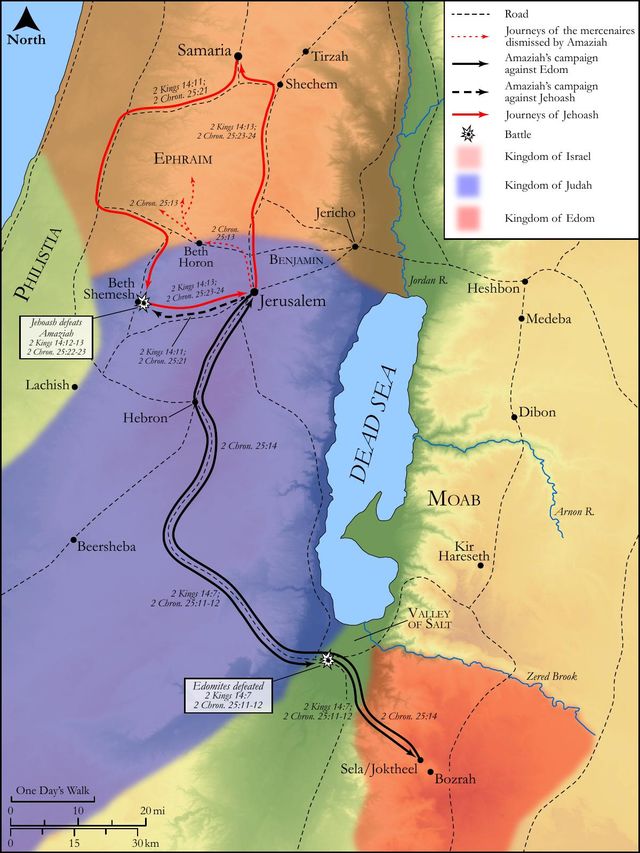
III.An expedition of his against the Edomites, who, some time ago, had revolted from under the dominion of Judah, to which he attempted to reduce them. Observe,
1.The great preparation he made for this expedition.
(1.)He mustered his own forces, and marshalled them (Ch2 25:5), and found Judah and Benjamin in all but 300,000 men that were fit for war, whereas, in Jehoshaphat's time, fifty or sixty years before, they were four times as many. Sin weakens a people, diminishes them, dispirits them, and lessens their number and figure.
(2.)He hired auxiliary troops out of the kingdom of Israel, Ch2 25:6. Finding his own kingdom defective in men, he thought to make up the deficiency with his money, and therefore took into his pay 100,000 Israelites. If he had advised with any of his prophets before he did this, or had but considered how little any of his ancestors got by their alliances with Israel, he would not have had this to undo again. But rashness makes work for repentance.
2.The command which God sent him by a prophet to dismiss out of his service the forces of Israel, Ch2 25:7, Ch2 25:8. He would not have him call in any assistance at all: it looked like distrust of God. If he made sure of God's presence, the army he had of his own was sufficient. But particularly he must not take in their assistance: For the Lord is not with the children of Ephraim, because they are not with him, but worship the calves. This was a good reason why he should not make use of them, because he could not depend upon them to do him any service. What good could be expected from those that had not God with them, nor his blessings upon their undertakings? It is comfortable to employ those who, we have reason to hope, have an interest in heaven, and dangerous to associate with those from whom the Lord has departed. The prophet assured him that if he persisted in his resolution to take these idolatrous apostate Israelites with him, in hopes thereby to make himself strong for the battle, it was at his peril; they would prove a dead weight to his army, would sink and betray it: "God shall make thee fall before the enemy, and these Israelites will be the ruin of thy cause; for God has power to help thee without them, and to cast thee down though thou hast them with thee."
3.The objection which Amaziah made against this command, and the satisfactory answer which the prophet gave to that objection, Ch2 25:9. The king had remitted 100 talents to the men of Israel for advance-money. "Now," says he, "if I send them back, I shall lose that: But what shall we do for the 100 talents?" This is an objection men often make against their duty: they are afraid of losing by it. "Regard not that," says the prophet: "The Lord is able to give thee much more than this; and, thou mayest depend upon it, he will not see thee lose by him. What are 100 talents between thee and him? He has ways enough to make up the loss to thee; it is below thee to speak of it." Note, A firm belief of God's all-sufficiency to bear us out in our duty, and to make up all the loss and damage we sustain in his service abundantly to our advantage, will make his yoke very easy and his burden very light. What is it to trust in God, but to be willing to venture the loss of any thing for him, in confidence of the goodness of the security he gives us that we shall not lose by him, but that whatever we part with for his sake shall be made up to us in kind or kindness. When we grudge to part with any thing for God and our religion, this should satisfy us, that God is able to give us much more than this. He is just, and he is good, and he is solvent. The king lost 100 talents by his obedience; and we find just that sum given to his grandson Jotham as a present (Ch2 27:5); then the principal was repaid, and, for interest, 10,000 measures of wheat and as many of barley.
4.His obedience to the command of God, which is upon record to his honour. He would rather lose his money, disoblige his allies, and dismiss a fourth part of his army just as they were going to take the field, than offend God: He separated the army of Ephraim, to go home again, Ch2 25:10. And they went home in great anger, taking it as a great affront thus to be made fools of, and to be cashiered as men not fit to be employed, and being perhaps disappointed of the advantages they promised themselves in spoil and plunder by joining with Judah against Edom. Men are apt to resent that which touches them in their profit or reputation, though it frees them from trouble.
5.His triumphs over the Edomites, Ch2 25:11, Ch2 25:12. He left dead upon the spot, in the field of battle, 10,000 men; 10,000 more he took prisoners, and barbarously killed them all by throwing them down some steep and craggy precipice. What provocation he had to exercise this cruelty towards them we are not told; but it was certainly very severe.
6.The mischief which the disbanded soldiers of Israel did to the cities of Judah, either in their return or soon after, Ch2 25:13. They were so enraged at being sent home that, if they might not go to share with Judah in the spoil of Edom, they would make a prey of Judah. Several cities that lay upon the borders they plundered, killing 3000 men that made resistance. But why should God suffer this to be done? Was it not in obedience to him that they were sent home, and yet shall the country thus suffer by it? Surely God's way is in the sea! Did not the prophet say that God was not with the children of Ephraim, and yet they are suffered to prevail against Judah? Doubtless God intended hereby to chastise those cities of Judah for their idolatries, which were found most in those parts that lay next to Israel. The men of Israel had corrupted them, and now they were made a plague to them. Satan both tempts and torments.
Continue studying 2 Chronicles 25:5 across the web’s major study libraries — every link below opens this exact verse, chapter, or book on the destination site.
Read & Compare
 BibleGatewayThis verse in more than 200 translations and 70 languages.
 Bible.comThe YouVersion reader — hundreds of translations, reading plans, and highlights.
 ESV.orgCrossway's official English Standard Version reader.
 NET BibleThe NET translation with 60,000+ translators' notes on every rendering decision.
 STEP BibleTyndale House's free study tool — original text, vocabulary, and scholarly resources.
 BibliaLogos Bible Software's free web reader.
 USCCBThe New American Bible (Revised Edition) with the U.S. bishops' study notes.
Commentaries
 BibleHub CommentariesDozens of classic commentaries on this verse, gathered on one page.
 StudyLightMore than 100 commentary sets — the largest collection on the web.
 BibleRefPlain-English commentary on what this verse means, verse by verse.
 Enduring WordDavid Guzik's free commentary on this chapter, widely used by Bible teachers.
 Bible Study ToolsVerse commentary alongside Greek and Hebrew study aids.
Original Language & Research
- BibleHub InterlinearThe verse word by word — original language, transliteration, and English.
- BibleHub LexiconEvery word's original-language definition and Strong's entry.
 Blue Letter BibleDeep-study tools — Strong's numbers, concordance, and word studies.
 SefariaThe Hebrew text with Rashi and centuries of Jewish commentary.
Sermons, Hymns & Audio


TrulyRandomVerse is not affiliated with these sites and doesn’t control their content. They’re linked because they’re genuinely useful.
Summary
King Amaziah of Judah, early in his reign, meticulously organized the military forces of his kingdom. He established a traditional command structure by appointing captains over units of thousands and hundreds, aligning the army with the ancestral houses of Judah and Benjamin. Through a comprehensive census, he numbered three hundred thousand highly capable and well-equipped men, all aged twenty years and above, who were ready for combat with spears and shields. This verse highlights Amaziah's initial administrative competence, his adherence to established military protocols, and the formidable strength of Judah's fighting force.
Context
ShowHideLiterary Context
This verse immediately follows the introduction of King Amaziah's reign, which began after the assassination of his father, King Joash. The Chronicler notes Amaziah's initial, though imperfect, commitment to the Lord, stating he "did what was right in the eyes of the Lord, though not wholeheartedly" (2 Chronicles 25:2). The detailed account of his military preparations in this verse (2 Chronicles 25:5) serves as his first major administrative and strategic act. It sets the stage for his subsequent campaign against Edom (2 Chronicles 25:11) and critically precedes the divine warning he receives regarding reliance on foreign mercenaries versus God's power (2 Chronicles 25:7-8). Thus, this verse is foundational, showcasing Amaziah's initial obedience and human effort before the deeper theological lessons concerning trust in God unfold throughout his reign.
Historical & Cultural Context
In ancient Israel, the mustering and numbering of men for military service was a significant undertaking, often imbued with religious and national importance. The organizational structure of "captains over thousands, and captains over hundreds" reflects a deeply entrenched military tradition within Israel, dating back to the time of Moses and the wilderness wanderings, as seen in Jethro's counsel to Moses (Exodus 18:21). Furthermore, the specific requirement to number men "from twenty years old and above" directly adheres to the Mosaic Law for military conscription, as explicitly commanded in the book of Numbers for the census of fighting men (Numbers 1:3). This demonstrates Amaziah's initial commitment to the covenant traditions and legal precedents of Israel. The inclusion of both Judah and Benjamin highlights the consolidated strength of the southern kingdom, representing a unified military and political entity after the division of the monarchy.
Key Themes
ShowHideThis verse contributes significantly to several overarching themes within 2 Chronicles and the broader biblical narrative. Firstly, it underscores the theme of Obedience to Mosaic Law, as Amaziah's actions directly conform to the ancient stipulations for military organization and census, particularly the age requirement for service. Secondly, it subtly introduces the Tension Between Human Preparation and Divine Reliance. While Amaziah's diligent and lawful preparation is commendable, the subsequent narrative will reveal the inherent danger of ultimately relying solely on human strength or alliances, a recurring theological motif in Chronicles that emphasizes God's sovereignty over human might. Finally, the verse speaks to the National Strength and Readiness of Judah, showcasing its military potential under a king who initially sought to establish order and security. This impressive force, however, will later be contrasted with the ultimate source of victory and security, which is God Himself, as highlighted by the prophet's words in 2 Chronicles 25:7-8.
Exposition and Analysis
ShowHideKey Word Analysis
ShowHideThis verb (H6485) signifies more than a mere numerical count; it implies an official, careful, and often divinely-sanctioned census, enrollment, or visitation. In biblical contexts, pâqad can also carry connotations of oversight, accountability, or appointing. Here, it emphasizes the king's administrative authority and the meticulousness with which the army was organized, reflecting a serious and legitimate preparation for war, aligning with the Mosaic Law's requirements for military mustering.
Derived from the root bâchar (H977), meaning "to try" or "select," this term denotes individuals who are specifically chosen, fit, strong, and capable. It implies that Amaziah's army was not merely a large quantity of men, but a quality fighting force composed of individuals specifically deemed suitable and excellent for combat. This highlights the effectiveness and potential prowess of Judah's military, indicating a deliberate selection process rather than a mere conscription of all eligible men.
This term (H6793) refers to a large, often full-body shield, distinct from a smaller buckler. Its mention alongside the "spear" (H7420, rômach) indicates that these "choice men" were not just available, but properly equipped with standard offensive and defensive weaponry of ancient infantry, and trained for direct engagement in warfare. It underscores their readiness for the practical realities of battle and their professional military posture.
Verse Breakdown
ShowHide"Moreover Amaziah gathered Judah together, and made them captains over thousands, and captains over hundreds, according to the houses of [their] fathers, throughout all Judah and Benjamin"
This clause details Amaziah's initial administrative and military organization. He convened the fighting men from both the tribes of Judah and Benjamin, establishing a hierarchical command structure. The appointment of "captains over thousands, and captains over hundreds" mirrored the traditional Israelite military model, which provided an organized and efficient chain of command. The phrase "according to the houses of their fathers" emphasizes the tribal and familial basis of this organization, reflecting a deep-seated cultural and social structure that provided order, identity, and loyalty to the fighting units.
"and he numbered them from twenty years old and above"
This specifies the age requirement for military service. By adhering to the age of "twenty years old and above," Amaziah was directly following the stipulations of the Mosaic Law for military conscription, as outlined in passages like Numbers 1:3. This act demonstrates an initial commitment to God's covenant instructions and established legal precedents, lending legitimacy and divine sanction to his military preparations, ensuring a mature and capable fighting force.
"and found them three hundred thousand choice [men, able] to go forth to war, that could handle spear and shield"
This final clause reveals the impressive outcome of Amaziah's census. The number "three hundred thousand" signifies a substantial and formidable army for the southern kingdom, indicating a significant mobilization effort. The description "choice men" emphasizes their quality, fitness, and selection for battle, further reinforced by the phrase "able to go forth to war, that could handle spear and shield," which explicitly indicates their training, equipment, and readiness for active combat.
Literary Devices
ShowHideThe verse employs several literary devices to convey its message effectively. Enumeration and Census are prominent, as the detailed counting and categorization of the army highlight Amaziah's administrative prowess and the considerable military might of Judah. This precise numbering lends an air of officiality and strength to the king's preparations. Furthermore, there is a clear Allusion to Mosaic Law, specifically the military regulations found in the Pentateuch (e.g., Numbers 1:3). This allusion grounds Amaziah's actions in traditional Israelite piety and obedience, setting a positive tone for his early reign. Finally, the verse functions as Foreshadowing, as the meticulous military preparation directly sets the stage for the upcoming conflict with Edom and, more broadly, for the theological lessons that will unfold regarding reliance on human strength versus divine power throughout Amaziah's reign.
Theological and Thematic Connections
ShowHideThis verse, while seemingly a straightforward military report, carries significant theological weight within the Chronicler's narrative. It showcases Amaziah's initial commitment to order and adherence to the Mosaic Law, particularly regarding military service. This obedience is commendable, reflecting a king who, at least initially, sought to govern according to God's established ways. However, the broader context of Amaziah's reign reveals a crucial tension: while human diligence and preparation are necessary, ultimate victory and security come from God alone. The impressive size and quality of Amaziah's army are presented, but the subsequent narrative will challenge the king to trust in divine power over sheer numbers or foreign alliances. This verse thus serves as a foundational moment, demonstrating the king's human responsibility in preparation, but also implicitly setting up the subsequent narrative where the limits of human strength without divine favor will be tested.
Reflection and Application
ShowHideKing Amaziah's meticulous organization of his army in 2 Chronicles 25:5 offers a powerful lesson on the importance of diligent preparation and responsible stewardship. He didn't simply hope for victory; he actively prepared his nation according to established, God-given principles. This highlights that faith is not passive; it calls for our best efforts, our strategic planning, and our commitment to order. In our own lives, whether in spiritual disciplines, vocational pursuits, or personal responsibilities, we are called to be diligent, organized, and prepared, utilizing the resources and wisdom God provides. However, Amaziah's story quickly pivots to reveal the danger of relying solely on these human strengths. While our preparation is crucial, our ultimate reliance must always be on God's power and provision. This verse reminds us to balance our human effort with a profound trust in divine sovereignty, recognizing that true success and blessing flow from His favor, not merely from the size or skill of our "army." We are to "go forth to war" with our "spear and shield," but always with our eyes fixed on the Lord, knowing that "the battle is the Lord's."
Questions for Reflection
ShowHideFAQ
ShowHideWhy was it important for Amaziah to number his army "from twenty years old and above"?
ShowHideThis age requirement was a direct adherence to the Mosaic Law, specifically outlined in Numbers 1:3, which stipulated that men "from twenty years old and upward, all who are able to go to war in Israel" should be counted for military service. By following this command, Amaziah demonstrated an initial commitment to God's covenant instructions, lending legitimacy and divine sanction to his military preparations. It also ensured a mature and capable fighting force, as this age marked the transition into full adult responsibility and physical readiness for the rigors of ancient warfare in Israelite society. This act of obedience contrasted with later instances of disobedience in his reign, highlighting his initial faithfulness to the divine commands concerning the mustering of Israel's fighting men.
Christ-Centered Fulfillment
ShowHideWhile Amaziah meticulously organized a physical army for earthly warfare, the ultimate fulfillment of military preparation and strategic victory is found in Christ. Amaziah's "three hundred thousand choice men" with "spear and shield" foreshadow a far greater, spiritual army, equipped by the true King. Jesus, the Lord of hosts, does not gather forces for a worldly kingdom (John 18:36), but He equips His followers for spiritual warfare against unseen principalities and powers (Ephesians 6:12). Unlike Amaziah, who would later falter in his trust in God by turning to idols (2 Chronicles 25:14), Christ perfectly relied on the Father, achieving victory not through physical might but through His sacrificial death and resurrection, disarming all hostile powers and making a public spectacle of them (Colossians 2:15). The "choice men" of Amaziah's army find their ultimate counterpart in the "chosen generation" (1 Peter 2:9) of believers, who are called to stand firm in the Lord and in the strength of His might, putting on the full armor of God to wield the sword of the Spirit, which is the Word of God (Ephesians 6:10-18). In Christ, the victory is already secured, and His followers are more than conquerors through Him who loved them (Romans 8:37).