


2 Chronicles 11:1
Bible text: King James Version (1769 Blayney text) · Public domain
Bible text: King James Version with Strong's numbers · Public domain
Bible text: Berean Standard Bible · Public domain
Bible text: American Standard Version (1901) · Public domain
Bible text: World English Bible, Messianic edition · Public domain
Bible text: Geneva Bible (1599) · Public domain
Bible text: Young's Literal Translation · Public domain
- וַיָּבֹאvai·ya·Vo'and he cameH935Conj-w ¦ V-Qal-ConsecImperf-3msVerb Qal Consecutive Imperfect 3rd Singular Masculineוַandיָּבֹאhe came
- רְחַבְעָםre·chav·'AmRehoboamH7346N-proper-mNoun Proper Masculine
- יְרוּשָׁלִַםye·ru·sha·LimJerusalemH3389N-properNoun Proper Location
- וַיַּקְהֵלvai·yak·Heland he called togetherH6950Conj-w ¦ V-Hiphil-ConsecImperf-3msVerb Hiphil Consecutive Imperfect 3rd Singular Masculineוַandיַּקְהֵלhe called together
- אֶת'et<obj.>H853DirObjMParticle Object Indicator
- בֵּיתbeit[the] house ofH1004N-mscNoun Singular Masculine Construct
- יְהוּדָהye·hu·DahJudahH3063N-properNoun Proper Location
- וּבִנְיָמִןu·vin·ya·Minand BenjaminH1144Conj-w ¦ N-proper-mNoun Proper MasculineוּandבִנְיָמִןBenjamin
- מֵאָהme·'Ahone hundredH3967N-fsNoun Singular Feminine Absolute
- וּשְׁמוֹנִיםu·she·mo·Nimand eightyH8084Conj-w ¦ N-mpNoun Plural Masculine Absoluteוּandשְׁמוֹנִיםeighty
- אֶלֶף'E·lefthousandH505N-csNoun Singular common gender Absolute
- בָּחוּרba·Churchosen [man]H977V-Qal-PassPrtcpl-msVerb Qal Participle Passive Singular Masculine Absolute
- עֹשֵׂה'o·Sehmaker[s] ofH6213V-Qal-Prtcpl-msVerb Qal Participle Singular Masculine Construct
- מִלְחָמָהmil·cha·MahwarH4421N-fsNoun Singular Feminine Absolute
- לְהִלָּחֵםle·hi·la·Chemto do battleH3898Prep-l ¦ V-Niphal-InfVerb Niphal Infinitive Constructלְtoהִלָּחֵםdo battle
- עִם'imwithH5973PrepPreposition
- יִשְׂרָאֵלYis·ra·'ElIsraelH3478N-properNoun Proper Location
- לְהָשִׁיבle·ha·Shivto restoreH7725Prep-l ¦ V-Hiphil-InfVerb Hiphil Infinitive Constructלְtoהָשִׁיבrestore
- אֶת'et<obj.>H853DirObjMParticle Object Indicator
- הַמַּמְלָכָהha·mam·la·Khahthe kingdomH4467Art ¦ N-fsNoun Singular Feminine Absoluteהַtheמַּמְלָכָהkingdom
- לִרְחַבְעָםlir·chav·'Amto RehoboamH7346Prep-l ¦ N-proper-mNoun Proper MasculineלִtoרְחַבְעָםRehoboam
English is a literal word-by-word gloss of the Hebrew, not the KJV's wording. Why?
This is the original text the KJV's translators worked from — each Hebrew word with its own literal English meaning in this verse, prepared by scholars at Tyndale House, Cambridge. The KJV translates whole sentences, not word by word, so its wording differs: one Hebrew word can become several English words, and the KJV may choose “the LORD” where the gloss reads “Yahweh”. Both are faithful — they answer different questions. For the KJV's own rendering, switch to the KJV text.
Details
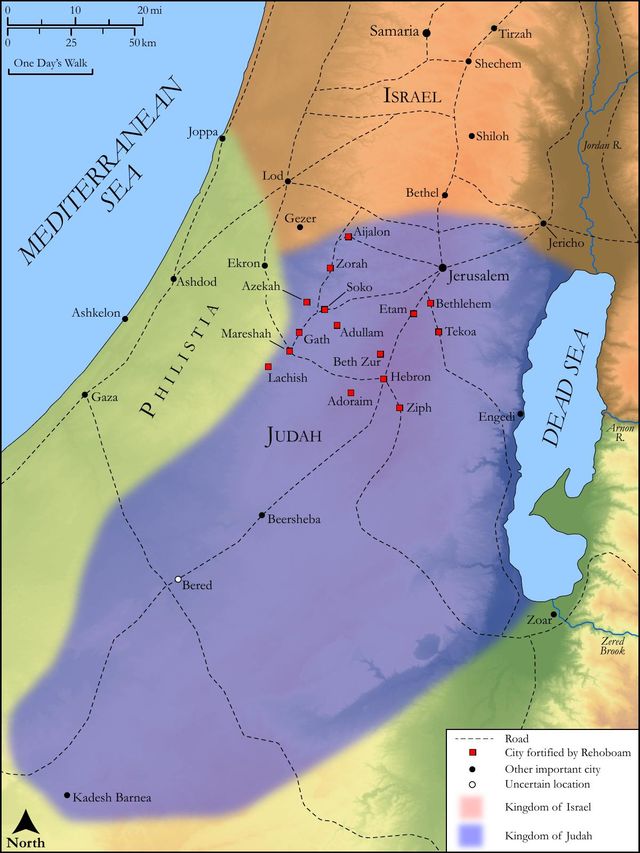
See on the biblical-era map
Study this verse
Public-domain commentary
Matthew Henry
From his Commentary on the Whole Bible. Henry comments on passages, not single verses — this entry covers 2 Chronicles 11:1–12.
How the ten tribes deserted the house of David we read in the foregoing chapter. They had formerly sat loose to that family (Sa2 20:1, Sa2 20:2), and now they quite threw it off, not considering how much it would weaken the common interest and take Israel down from that pitch of glory at which it had arrived in the last reign. But thus the kingdom must be corrected as well as the house of David. 1. Rehoboam at length, like a bold man, raises an army, with a design to reduce the revolters, Ch2 11:1. Judah and Benjamin were not only resolved to continue their allegiance to him, but ready to give him the best assistance they could for the recovery of his right. Judah was his own tribe, that owned him some years before the rest did; Benjamin was the tribe in which Jerusalem, or the greatest part of it, stood, which perhaps was one reason why that tribe clave to him. 2. Yet, like a conscientious man, when God forbade him to prosecute this design, in obedience to him he let it fall, either because he reverenced the divine authority or because he knew that he should not prosper if he should go contrary to God's command, but instead of retrieving what was lost would be in danger of losing what he had. It is dangerous undertaking any thing, but especially undertaking a war, contrary to the will of God. God calls him (Ch2 11:3), Rehoboam the son of Solomon, to intimate that this was determined for the sin of Solomon, and it would be to no purpose to oppose a decree that had gone forth. They obeyed the words of the Lord; and though it looked mean, and would turn to their reproach among their neighbours, yet, because God would have it so, they laid down their arms. 3. Like a discreet man, he fortified his own country. He saw it was to no purpose to think of reducing those that had revolted. A few good words might have prevented their defection, but now all the forces of his kingdom cannot bring them back. The think is done, and so it must rest; it is his wisdom to make the best of it. Perhaps the same young counsellors that had advised him to answer them roughly urged him to fight them, notwithstanding the divine inhibition; but he had paid dearly enough for being advised by them, and therefore now, we may suppose, his aged and experienced counsellors were hearkened to, and they advised him to submit to the will of God concerning what was lost, and to make it his business to keep what he had. It was probably by their advice that, (1.) He fortified his frontiers, and many of the principal cities of his kingdom, which, in Solomon's peaceable reign, no care had been taken for the defence of. (2.) He furnished them with good stores of victuals and arms, Ch2 11:11, Ch2 11:12. Because God forbade him to fight, he did not therefore sit down sullenly, and say that he would do nothing for the public safety if he might not do that, but prudently provided against an attack. Those that may not be conquerors, yet may be builders.
Continue studying 2 Chronicles 11:1 across the web’s major study libraries — every link below opens this exact verse, chapter, or book on the destination site.
Read & Compare
 BibleGatewayThis verse in more than 200 translations and 70 languages.
 Bible.comThe YouVersion reader — hundreds of translations, reading plans, and highlights.
 ESV.orgCrossway's official English Standard Version reader.
 NET BibleThe NET translation with 60,000+ translators' notes on every rendering decision.
 STEP BibleTyndale House's free study tool — original text, vocabulary, and scholarly resources.
 BibliaLogos Bible Software's free web reader.
 USCCBThe New American Bible (Revised Edition) with the U.S. bishops' study notes.
Commentaries
 BibleHub CommentariesDozens of classic commentaries on this verse, gathered on one page.
 StudyLightMore than 100 commentary sets — the largest collection on the web.
 BibleRefPlain-English commentary on what this verse means, verse by verse.
 Enduring WordDavid Guzik's free commentary on this chapter, widely used by Bible teachers.
 Bible Study ToolsVerse commentary alongside Greek and Hebrew study aids.
Original Language & Research
- BibleHub InterlinearThe verse word by word — original language, transliteration, and English.
- BibleHub LexiconEvery word's original-language definition and Strong's entry.
 Blue Letter BibleDeep-study tools — Strong's numbers, concordance, and word studies.
 SefariaThe Hebrew text with Rashi and centuries of Jewish commentary.
Sermons, Hymns & Audio


TrulyRandomVerse is not affiliated with these sites and doesn’t control their content. They’re linked because they’re genuinely useful.
Summary
This verse vividly recounts King Rehoboam's immediate and decisive military mobilization upon his return to Jerusalem following the dramatic division of the united monarchy. Driven by a fierce determination to reclaim his lost authority, he assembled a formidable army of 180,000 elite warriors from the loyal tribes of Judah and Benjamin, with the explicit intent of waging war against the newly formed Northern Kingdom of Israel and forcibly restoring the unified monarchy under his personal rule.
Context
ShowHideLiterary Context
This passage directly follows the pivotal event of the kingdom's schism, detailed in 2 Chronicles 10. Rehoboam's arrogant rejection of the elders' counsel and his oppressive policies led to the rebellion of ten northern tribes, who subsequently crowned Jeroboam as their king. 2 Chronicles 11:1 immediately presents Rehoboam's human response to this catastrophic loss of territory and power. It sets the stage for an impending civil war, which is then dramatically averted by divine intervention in the subsequent verses of 2 Chronicles 11:2-4, highlighting the Chronicler's emphasis on God's sovereign control over human affairs.
Historical & Cultural Context
The historical backdrop is the immediate aftermath of King Solomon's death and the subsequent succession crisis. Solomon's reign, while glorious, had imposed heavy burdens on the people, particularly the northern tribes. Rehoboam's failure to alleviate these burdens, as recorded in 1 Kings 12:1-15, directly triggered the division of the united kingdom, a monumental turning point in Israelite history. Rehoboam was left with only the southern tribes of Judah and Benjamin, forming the Kingdom of Judah, with Jerusalem as its capital. His response in this verse reflects the typical reaction of a monarch whose authority was challenged: the immediate and aggressive mobilization of military force to suppress rebellion and reassert control. The fragmentation of the kingdom was not only a political disaster but also a profound theological crisis, challenging the ideal of a unified people under God's chosen king.
Key Themes
ShowHideThis verse introduces several profound themes central to the Chronicler's theological narrative. Firstly, it powerfully illustrates Rehoboam's Human Resolve and Ambition, showcasing his determination to reverse a divinely orchestrated outcome through sheer military might. The sheer size and elite nature of the army he gathered underscore the seriousness of his intent to restore the unified kingdom by force. Secondly, the passage starkly highlights the tension between Human Will and Divine Sovereignty. Rehoboam's plan to "bring the kingdom again to Rehoboam" directly contradicts God's declared judgment against Solomon's idolatry, which explicitly stated that the kingdom would be torn from his son's hand (1 Kings 11:11-13). This sets up a crucial theological lesson about God's ultimate control over historical events, even those driven by human ambition. Finally, 2 Chronicles 11:1 immediately creates dramatic tension by foreshadowing an Imminent Civil War. This tension is swiftly resolved in the subsequent verses by God's direct intervention, which prevents the bloodshed, further emphasizing His providential hand in the affairs of His people (2 Chronicles 11:2-4).
Exposition and Analysis
ShowHideKey Word Analysis
ShowHideThis term (H977) signifies "selected," "picked," or "elite." It emphasizes that the 180,000 men gathered by Rehoboam were not a conscripted rabble but a highly trained, formidable fighting force, underscoring the serious and decisive nature of his military intent. The selection implies quality and readiness for battle.
While the KJV translates it as "warriors," the underlying Hebrew (H4421) primarily means "battle" or "warfare," but its definition includes "warrior." In this context, it refers to those engaged in war, highlighting that these chosen men were not just able-bodied but were experienced in combat, ready for active engagement.
This primitive root (H3898) means "to feed on," but figuratively, "to consume," and by implication, "to battle" or "to wage war." Its use here clearly states Rehoboam's aggressive purpose: to engage in military conflict with the northern tribes, aiming to forcefully subjugate them.
Verse Breakdown
ShowHide"And when Rehoboam was come to Jerusalem,"
This clause establishes the setting and the immediate aftermath of the kingdom's division. Jerusalem, as the capital of Judah and the seat of the Davidic dynasty, was the natural place for Rehoboam to rally his forces and plan his counter-action. His return signifies a strategic regrouping after the humiliation of the northern tribes' secession.
"he gathered of the house of Judah and Benjamin"
This specifies the loyal tribes that remained under Rehoboam's rule. The tribes of Judah and Benjamin formed the core of the Southern Kingdom, indicating their allegiance to the Davidic line and their readiness to support Rehoboam's cause against their northern brethren.
"an hundred and fourscore thousand chosen [men], which were warriors,"
This detail highlights the sheer scale and formidable nature of the army Rehoboam assembled. "An hundred and fourscore thousand" (180,000) is a massive number, indicating a significant mobilization of resources and manpower. The description "chosen men, which were warriors" further emphasizes the quality and readiness of this force, composed of elite, experienced fighters.
"to fight against Israel,"
This clearly states the objective of the military gathering: to wage war against the newly formed Northern Kingdom, referred to here simply as "Israel." This directly sets up the impending civil conflict that God will intervene to prevent.
"that he might bring the kingdom again to Rehoboam."
This final clause reveals Rehoboam's ultimate motivation and ambition. He sought to reverse the division by force, to re-establish the united monarchy, and to restore the entire kingdom under his personal authority, demonstrating his unwillingness to accept the divine decree that had orchestrated the split.
Literary Devices
ShowHide2 Chronicles 11:1 employs several literary devices to convey its powerful message. The mention of "an hundred and fourscore thousand chosen men" serves as a form of Hyperbole, or at least a significant emphasis on the immense scale of Rehoboam's military mobilization. This highlights the gravity of the impending conflict and his unwavering determination. This grand assembly also functions as Foreshadowing, immediately signaling the threat of civil war and setting up the dramatic tension that will be swiftly resolved by divine intervention in the subsequent verses. Furthermore, the verse subtly introduces Irony: Rehoboam's zealous attempt to "bring the kingdom again to Rehoboam" through human might stands in stark contrast to the divine decree that explicitly tore the kingdom from his hand due to Solomon's sin. This highlights the futility of human ambition when it directly opposes God's sovereign plan, a central theological point the Chronicler emphasizes throughout this narrative.
Theological and Thematic Connections
ShowHideThis verse serves as a powerful illustration of the tension between human will and divine sovereignty, a recurring theme throughout biblical history. Rehoboam's immediate and forceful reaction to the kingdom's division demonstrates a human inclination to solve problems through strength and control, rather than seeking divine counsel or submitting to God's declared purposes. The Chronicler, writing from a post-exilic perspective, emphasizes that the division of the kingdom was not merely a political upheaval but a divinely orchestrated judgment against Solomon's idolatry and the people's unfaithfulness. Thus, Rehoboam's attempt to reverse this through military might represents a direct challenge to God's authority and a failure to discern His hand in the unfolding events. This passage underscores the principle that God's plans will ultimately prevail, even when human leaders attempt to thwart them with impressive displays of power.
Reflection and Application
ShowHide2 Chronicles 11:1 offers a profound lesson for contemporary believers regarding our responses to difficult or unwelcome circumstances. Like Rehoboam, our natural inclination when faced with loss, division, or perceived injustice can be to immediately mobilize our own resources, strategies, and strength to regain control or reverse an undesirable outcome. This verse challenges us to pause and consider whether our actions are aligned with God's will, or if we are merely reacting out of human ambition, pride, or a desire for self-preservation. Rehoboam's readiness to wage civil war, despite the clear divine hand in the kingdom's division, serves as a cautionary tale against relying solely on our own might and wisdom. It compels us to cultivate a spirit of discernment, seeking God's counsel and submitting to His sovereign plan, even when it diverges from our preferred outcomes. True peace and lasting solutions often come not from human force, but from humble reliance on God's higher ways.
Questions for Reflection
ShowHideFAQ
ShowHideWhy did Rehoboam gather such a large army if God had already decreed the division of the kingdom?
ShowHideRehoboam gathered such a massive army because, from a human perspective, he was acting as a typical monarch of that day whose authority had been challenged and whose kingdom had been severely diminished. He saw the secession of the ten northern tribes as an act of rebellion that needed to be suppressed by force to restore his rightful rule over all Israel. While God had indeed decreed the division as a judgment against Solomon's idolatry (1 Kings 11:11-13), Rehoboam either did not fully grasp this divine purpose, or he chose to defy it, prioritizing his own ambition and perceived right to rule over God's stated will. His actions in 2 Chronicles 11:1 demonstrate a reliance on human strength and strategy rather than divine wisdom or submission.
What was the significance of only Judah and Benjamin remaining loyal to Rehoboam?
ShowHideThe loyalty of Judah and Benjamin was significant for several reasons. Judah was the tribe from which the Davidic dynasty originated, making its allegiance foundational to Rehoboam's legitimacy. Benjamin, though smaller, was closely intertwined with Judah, especially since Jerusalem, the capital, lay on the border between the two. Their continued loyalty meant that Rehoboam retained control over the spiritual and political heartland of the former united kingdom, including the Temple in Jerusalem. This division effectively created two distinct entities: the Northern Kingdom of Israel, often characterized by political instability and idolatry, and the Southern Kingdom of Judah, which, despite its own struggles, maintained the Davidic line and the Jerusalem Temple, serving as the primary locus of Yahweh worship for centuries (2 Chronicles 11:1 highlights this initial consolidation of power).
Christ-Centered Fulfillment
ShowHide2 Chronicles 11:1, with Rehoboam's attempt to restore his earthly kingdom through military might, stands in stark contrast to the way God's true and eternal kingdom is established. While Rehoboam sought to reclaim a divided earthly realm through force, Christ, the ultimate King, came not to conquer with armies but to reconcile a divided humanity through self-sacrifice. His kingdom is not of this world, nor is it advanced by carnal weapons or human power (John 18:36; 2 Corinthians 10:4). The division of Israel under Rehoboam foreshadows the deeper spiritual schism of humanity alienated from God by sin, a division that no human king or army could bridge. It is only through the finished work of Christ on the cross that peace is made and reconciliation achieved, breaking down the dividing wall of hostility and uniting all who believe into one body (Ephesians 2:14-16). Unlike Rehoboam, whose efforts were thwarted by divine decree, Jesus's mission to establish His spiritual kingdom was perfectly aligned with the Father's will and culminated in His glorious resurrection and ascension, ensuring His reign is eternal and universal (Philippians 2:9-11). Thus, Rehoboam's futile attempt to restore his kingdom by force points to the profound truth that God's ultimate plan of redemption and reconciliation would be accomplished not by human might, but by the humble, suffering, and victorious Lamb of God.