


2 Chronicles 11:2
- וַיְהִיvay·Hiand it cameH1961Conj-w ¦ V-Qal-ConsecImperf-3msVerb Qal Consecutive Imperfect 3rd Singular Masculineוַandיְהִיit came
- דְּבַרde·var[the] word ofH1697N-mscNoun Singular Masculine Construct
- יְהוָהYah·wehYahwehH3068N-properNoun Proper Title
- אֶל'eltoH413PrepPreposition
- שְׁמַעְיָהוּshe·ma'·Ya·huShemaiahH8098N-proper-mNoun Proper Masculine
- אִישׁ'ish[the] man ofH376N-mscNoun Singular Masculine Construct
- הָאֱלֹהִיםha·'E·lo·Him<the> GodH430Art ¦ N-mpNoun Plural Masculine Absoluteהָ<the>אֱלֹהִיםGod
- לֵאמֹרle·Mor<to> sayingH559Prep-l ¦ V-Qal-InfVerb Qal Infinitive Constructלֵ<to>אמֹרsaying
English is a literal word-by-word gloss of the Hebrew, not the KJV's wording. Why?
This is the original text the KJV's translators worked from — each Hebrew word with its own literal English meaning in this verse, prepared by scholars at Tyndale House, Cambridge. The KJV translates whole sentences, not word by word, so its wording differs: one Hebrew word can become several English words, and the KJV may choose “the LORD” where the gloss reads “Yahweh”. Both are faithful — they answer different questions. For the KJV's own rendering, switch to the KJV text.
Details
See on the biblical-era map
Study this verse
Public-domain commentary
Matthew Henry
From his Commentary on the Whole Bible. Henry comments on passages, not single verses — this entry covers 2 Chronicles 11:1–12.
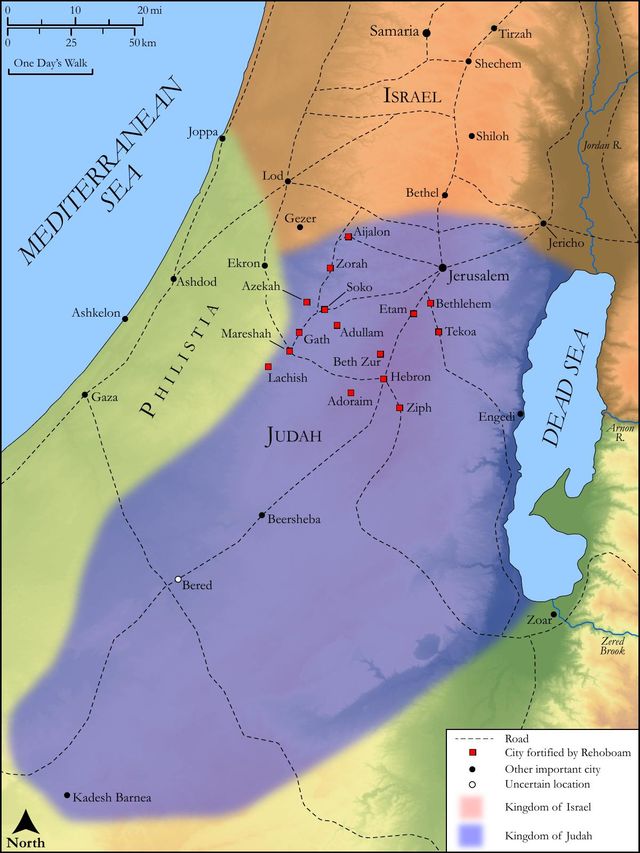
How the ten tribes deserted the house of David we read in the foregoing chapter. They had formerly sat loose to that family (Sa2 20:1, Sa2 20:2), and now they quite threw it off, not considering how much it would weaken the common interest and take Israel down from that pitch of glory at which it had arrived in the last reign. But thus the kingdom must be corrected as well as the house of David. 1. Rehoboam at length, like a bold man, raises an army, with a design to reduce the revolters, Ch2 11:1. Judah and Benjamin were not only resolved to continue their allegiance to him, but ready to give him the best assistance they could for the recovery of his right. Judah was his own tribe, that owned him some years before the rest did; Benjamin was the tribe in which Jerusalem, or the greatest part of it, stood, which perhaps was one reason why that tribe clave to him. 2. Yet, like a conscientious man, when God forbade him to prosecute this design, in obedience to him he let it fall, either because he reverenced the divine authority or because he knew that he should not prosper if he should go contrary to God's command, but instead of retrieving what was lost would be in danger of losing what he had. It is dangerous undertaking any thing, but especially undertaking a war, contrary to the will of God. God calls him (Ch2 11:3), Rehoboam the son of Solomon, to intimate that this was determined for the sin of Solomon, and it would be to no purpose to oppose a decree that had gone forth. They obeyed the words of the Lord; and though it looked mean, and would turn to their reproach among their neighbours, yet, because God would have it so, they laid down their arms. 3. Like a discreet man, he fortified his own country. He saw it was to no purpose to think of reducing those that had revolted. A few good words might have prevented their defection, but now all the forces of his kingdom cannot bring them back. The think is done, and so it must rest; it is his wisdom to make the best of it. Perhaps the same young counsellors that had advised him to answer them roughly urged him to fight them, notwithstanding the divine inhibition; but he had paid dearly enough for being advised by them, and therefore now, we may suppose, his aged and experienced counsellors were hearkened to, and they advised him to submit to the will of God concerning what was lost, and to make it his business to keep what he had. It was probably by their advice that, (1.) He fortified his frontiers, and many of the principal cities of his kingdom, which, in Solomon's peaceable reign, no care had been taken for the defence of. (2.) He furnished them with good stores of victuals and arms, Ch2 11:11, Ch2 11:12. Because God forbade him to fight, he did not therefore sit down sullenly, and say that he would do nothing for the public safety if he might not do that, but prudently provided against an attack. Those that may not be conquerors, yet may be builders.
Continue studying 2 Chronicles 11:2 across the web’s major study libraries — every link below opens this exact verse, chapter, or book on the destination site.
Read & Compare
 BibleGatewayThis verse in more than 200 translations and 70 languages.
 Bible.comThe YouVersion reader — hundreds of translations, reading plans, and highlights.
 ESV.orgCrossway's official English Standard Version reader.
 NET BibleThe NET translation with 60,000+ translators' notes on every rendering decision.
 STEP BibleTyndale House's free study tool — original text, vocabulary, and scholarly resources.
 BibliaLogos Bible Software's free web reader.
 USCCBThe New American Bible (Revised Edition) with the U.S. bishops' study notes.
Commentaries
 BibleHub CommentariesDozens of classic commentaries on this verse, gathered on one page.
 StudyLightMore than 100 commentary sets — the largest collection on the web.
 BibleRefPlain-English commentary on what this verse means, verse by verse.
 Enduring WordDavid Guzik's free commentary on this chapter, widely used by Bible teachers.
 Bible Study ToolsVerse commentary alongside Greek and Hebrew study aids.
Original Language & Research
- BibleHub InterlinearThe verse word by word — original language, transliteration, and English.
- BibleHub LexiconEvery word's original-language definition and Strong's entry.
 Blue Letter BibleDeep-study tools — Strong's numbers, concordance, and word studies.
 SefariaThe Hebrew text with Rashi and centuries of Jewish commentary.
Sermons, Hymns & Audio


TrulyRandomVerse is not affiliated with these sites and doesn’t control their content. They’re linked because they’re genuinely useful.
Summary
2 Chronicles 11:2 marks a pivotal moment in the narrative of the divided kingdom, introducing a direct divine intervention that decisively alters the course of human events. Following King Rehoboam's aggressive preparations to reclaim the northern tribes by force, this verse presents the Lord's authoritative word, delivered through His prophet Shemaiah, which prevents a devastating civil war and ensures the unfolding of God's sovereign plan amidst the political upheaval.
Context
ShowHideLiterary Context
This verse immediately follows the dramatic and painful schism of the united monarchy. 2 Chronicles 10 details the northern tribes' rebellion against Rehoboam's harsh policies and their subsequent crowning of Jeroboam. In response, 2 Chronicles 11:1 describes Rehoboam's immediate and forceful reaction: gathering a formidable army of 180,000 elite warriors from Judah and Benjamin with the clear intent to wage war and forcibly restore his dominion over the seceded tribes. 2 Chronicles 11:2 serves as a crucial narrative pivot, introduced by the conjunction "But," which signals a divine interruption to human aggression. This divine intervention, paralleled in 1 Kings 12:22-24, underscores the supremacy of God's will over human ambition. The subsequent verses in 2 Chronicles 11 then detail Rehoboam's surprising obedience and the subsequent strengthening of his kingdom within Judah, demonstrating the positive outcome of heeding divine counsel.
Historical & Cultural Context
The division of the kingdom of Israel was an epochal event, marking the end of the unified monarchy established under Saul, David, and Solomon. This period was characterized by significant political instability, with the constant threat of internal conflict and external pressures. In the ancient Near East, kings typically asserted their authority and expanded their territories through military might. However, Israel's unique covenant relationship with Yahweh meant that divine will held ultimate sway, often overriding royal prerogatives. Prophets, such as Shemaiah, functioned as direct conduits of God's messages, frequently challenging or guiding monarchs and reminding them of their accountability to the divine King. The designation "man of God" (Hebrew: ish ha'Elohim) was a highly esteemed title for a prophet, signifying a profound relationship with God and an undeniable authority in delivering divine pronouncements, often placing such individuals in a position to speak with authority even to kings.
Key Themes
ShowHideThis verse powerfully highlights several foundational themes within the Chronicler's theology. Foremost is Divine Sovereignty; even amidst human folly, political upheaval, and the brink of civil war, God remains in absolute control, actively directing events to fulfill His predetermined purposes. The very division of the kingdom was not a random occurrence but God's judgment against Solomon's idolatry and Rehoboam's pride, as explicitly stated in 1 Kings 11:11-13 and reiterated in 2 Chronicles 10:15. Second, Prophetic Authority is powerfully demonstrated through Shemaiah, "the man of God," whose message is not mere advice but an unchallengeable divine word. This highlights God's chosen method of communicating His will to His people and their leaders. Third, the theme of Obedience to God's Word is implicitly introduced, setting the stage for Rehoboam's and the people's response in the subsequent verses, where they ultimately heed the divine command, choosing God's will over their own military ambitions and preventing further bloodshed.
Exposition and Analysis
ShowHideKey Word Analysis
ShowHideThis term (H1697), often translated as "word," carries profound theological weight in Hebrew thought, encompassing not just spoken utterances but also actions, matters, decrees, and things. When associated with "the LORD" (YHWH), it denotes an authoritative, effective, and often performative communication from God. It is not mere advice or suggestion but a binding declaration that carries the inherent power to accomplish what it states, reflecting God's absolute truth, unwavering purpose, and active engagement in human affairs.
This (H3068) is the sacred, covenantal name of God, often rendered "Jehovah" or "Yahweh," signifying "the self-Existent or Eternal One." Its appearance here emphasizes that the message comes from the ultimate divine authority, the God who is sovereign over all creation and human history, the one who keeps covenant and fulfills His promises. The use of this specific name underscores the personal and covenantal nature of the divine intervention.
This (H376, H430) is a highly significant and revered title for a prophet in the Old Testament, denoting someone specially chosen, empowered, and set apart by God to be His direct messenger. It signifies a unique and intimate relationship with the divine, implying that the individual's words are not their own opinions but a direct, unadulterated transmission of God's will. Prophets bearing this title, such as Elijah and Elisha, often performed miracles and delivered crucial messages that altered the course of national events, underscoring the gravity, authenticity, and undeniable authority of Shemaiah's appearance and message in this context.
Verse Breakdown
ShowHide"But"
This strong adversative conjunction immediately signals a radical shift in the narrative. Rehoboam had gathered a vast army, fully committed to war, but this "but" introduces a new, higher authority that will decisively redirect his plans. It creates a powerful sense of divine intervention overriding human intention and military might.
"the word of the LORD came"
This phrase emphasizes the divine origin, initiative, and irresistible nature of the message. It is not a human idea, political counsel, or a prophet's personal opinion, but a direct, authoritative revelation from Yahweh Himself. The verb "came" (Hebrew: hayah) often implies a forceful, undeniable arrival, underscoring the inescapable and compelling nature of God's communication.
"to Shemaiah the man of God"
God chooses a specific individual, Shemaiah, as His conduit for this critical message. This highlights God's personal engagement with His people and His consistent use of human agents—His prophets—to convey His will, even to kings. The designation "the man of God" immediately establishes Shemaiah's credentials and the undeniable authority of the message he is about to deliver, signifying his divine appointment and that his words carry the full weight of God's command.
"saying,"
This concluding participle indicates that the verse serves as an introduction to a direct divine message that immediately follows. It sets the expectation for the specific content of God's command, which will be revealed in the subsequent verses, building anticipation for the divine directive that will prevent the impending conflict.
Literary Devices
ShowHideThe verse primarily employs Divine Intervention as its core literary device, directly introducing God's active and decisive involvement into a human-driven conflict. The opening conjunction "But" functions as a powerful Contrast, immediately setting the stage for a divine counter-action against Rehoboam's military ambition and the prevailing human will. The phrase "the word of the LORD came" is a classic example of Divine Communication, a recurring motif throughout biblical narrative that establishes God's direct engagement with humanity and His sovereign control over events. Furthermore, the designation "Shemaiah the man of God" serves as effective Characterization, instantly conferring authority, legitimacy, and divine backing upon the messenger, ensuring that his subsequent words are understood as divinely authoritative and not merely human counsel or political advice. This concise introduction effectively shifts the narrative's focus from human will and military might to the ultimate supremacy of divine decree.
Theological and Thematic Connections
ShowHide2 Chronicles 11:2 profoundly illustrates God's active and sovereign involvement in human history, even in the midst of political turmoil, national division, and the brink of civil war. It underscores the profound truth that God's plans ultimately prevail over human intentions, demonstrating His ability to direct the course of nations and individuals according to His perfect will. The subsequent obedience of Rehoboam and the people to God's word, despite their extensive military preparations and human inclination for conflict, serves as a powerful example of the necessity and wisdom of submitting to divine authority. This passage reinforces the consistent biblical theme that true wisdom and peace are found in heeding the Lord's voice, even when it contradicts our immediate desires, perceived strategic advantages, or deeply ingrained human impulses.
Reflection and Application
ShowHideThis verse offers a profound and timeless lesson on the nature of divine guidance and the critical importance of human responsiveness. Like Rehoboam, we often devise elaborate plans based on our own strength, wisdom, anger, or perceived rights, only to find that God has a different, often counter-intuitive, path for us. The sudden, decisive interruption of "the word of the LORD" reminds us that God is not a distant, passive observer but an active, sovereign participant in our lives, capable of redirecting our course for our ultimate good and His greater glory. It challenges us to cultivate a posture of profound humility and attentive listening, recognizing that God speaks through various means—His infallible written Word, persistent prayer, the wise counsel of godly individuals, and sometimes, through unexpected circumstances or providential interventions—to prevent us from making choices that would lead to greater harm, deeper conflict, or deviation from His perfect will. Our spiritual maturity and the flourishing of our lives are often measured by our willingness to lay down our own agendas, surrender our perceived rights, and submit to the Lord's clear directives, trusting that His ways are always higher, more beneficial, and ultimately more peace-bringing than our own.
Questions for Reflection
ShowHideFAQ
ShowHideWhy did God intervene to stop Rehoboam's war against the northern tribes?
ShowHideGod intervened to stop Rehoboam's war because the division of the kingdom was not a mere political uprising or a consequence of human folly alone, but a divinely orchestrated judgment and the precise fulfillment of prophecy. As stated in 1 Kings 11:11-13 and explicitly reiterated in 2 Chronicles 10:15, the Lord had determined to tear the kingdom from Solomon's house due to his widespread idolatry, leaving only one tribe (Judah, with Benjamin later joining) for Rehoboam's sake. Rehoboam's harsh and unyielding response to the people's plea for lighter burdens (see 2 Chronicles 10:1-14) served as the immediate catalyst, but it ultimately served God's larger, predetermined purpose. A civil war would have resulted in devastating bloodshed among His own people and directly opposed His sovereign will to establish two separate kingdoms. By sending Shemaiah, God prevented this unnecessary conflict and ensured that His prophetic word was accomplished, demonstrating His ultimate control over the affairs of nations and His commitment to His divine plan.
Christ-Centered Fulfillment
ShowHide2 Chronicles 11:2, with its profound emphasis on "the word of the LORD" coming through "the man of God" to prevent a destructive conflict, powerfully foreshadows the ultimate Divine Word and the ultimate Man of God, Jesus Christ. While Shemaiah delivered a specific word for a specific time and context, Jesus is the living, eternal Word of God made flesh, the complete and final revelation of God's will and character (see John 1:1 and Hebrews 1:1-2). He is the true Prophet, greater than all who came before Him, whom God promised to raise up for His people (compare Deuteronomy 18:15 with Acts 3:22). Just as God intervened to prevent Rehoboam's self-destructive war, Christ came not to bring a sword of earthly conquest or to incite physical conflict, but a sword of truth that divides between light and darkness, ultimately bringing profound peace and reconciliation through His atoning sacrifice (see Matthew 10:34 and Colossians 1:20). His kingdom is not of this world, established by military might or human aggression, but by divine authority and spiritual transformation (as He declared in John 18:36). Through Christ, God's ultimate word of salvation, reconciliation, and eternal peace is delivered to humanity, preventing our self-destructive path of sin and inviting us into His eternal, peaceful reign, a reign that transcends all earthly divisions and conflicts.