


1 Kings 12:22
- וַיְהִיvay·Hiand it cameH1961Conj-w ¦ V-Qal-ConsecImperf-3msVerb Qal Consecutive Imperfect 3rd Singular Masculineוַandיְהִיit came
- דְּבַרde·Var[the] word ofH1697N-mscNoun Singular Masculine Construct
- הָאֱלֹהִיםha·'E·lo·Him<the> GodH430Art ¦ N-mpNoun Plural Masculine Absoluteהָ<the>אֱלֹהִיםGod
- אֶל'eltoH413PrepPreposition
- שְׁמַעְיָהshe·ma'·YahShemaiahH8098N-proper-mNoun Proper Masculine
- אִישׁ'ish[the] man ofH376N-mscNoun Singular Masculine Construct
- הָאֱלֹהִיםha·'E·lo·Him<the> GodH430Art ¦ N-mpNoun Plural Masculine Absoluteהָ<the>אֱלֹהִיםGod
- לֵאמֹרle·Mor<to> sayingH559Prep-l ¦ V-Qal-InfVerb Qal Infinitive Constructלֵ<to>אמֹרsaying
English is a literal word-by-word gloss of the Hebrew, not the KJV's wording. Why?
This is the original text the KJV's translators worked from — each Hebrew word with its own literal English meaning in this verse, prepared by scholars at Tyndale House, Cambridge. The KJV translates whole sentences, not word by word, so its wording differs: one Hebrew word can become several English words, and the KJV may choose “the LORD” where the gloss reads “Yahweh”. Both are faithful — they answer different questions. For the KJV's own rendering, switch to the KJV text.
Details
See on the biblical-era maps
Study this verse
Public-domain commentary
Matthew Henry
From his Commentary on the Whole Bible. Henry comments on passages, not single verses — this entry covers 1 Kings 12:16–24. His three-level outline is real structure in the source text, so it is rendered as structure.
We have here the rending of the kingdom of the ten tribes from the house of David, to effect which,
I.The people were hold and resolute in their revolt.
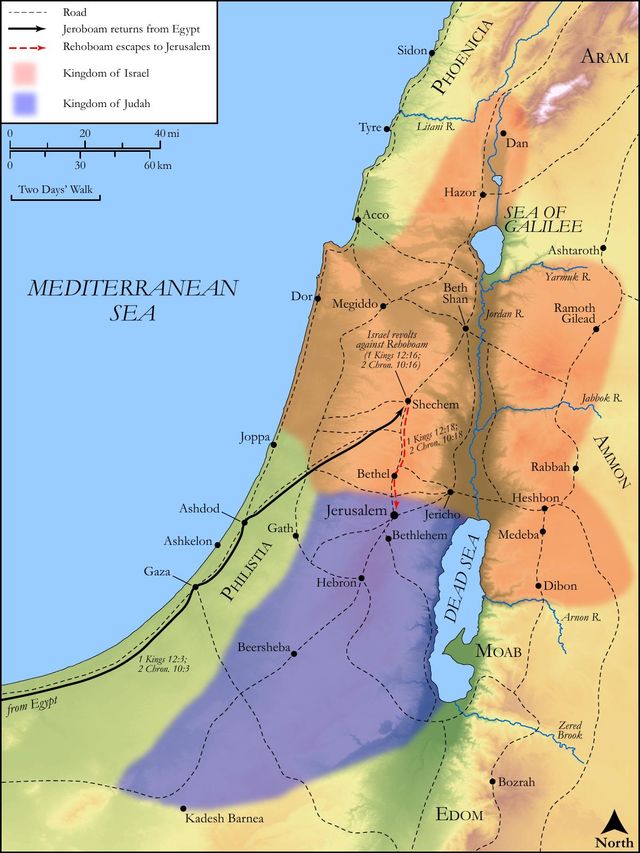
They highly resented the provocation that Rehoboam had given them, were incensed at his menaces, concluded that that government would in the progress of it be intolerably grievous which in the beginning of it was so very haughty, and therefore immediately came to this resolve, one and all: What portion have we in David? Kg1 12:16. They speak here very unbecomingly of David, that great benefactor of their nation, calling him the son of Jesse, no greater a man than his neighbours. How soon are good men, and their good services to the public, forgotten! The rashness of their resolution was also much to be blamed. In time, and with prudent management, they might have settled the original contract with Rehoboam to mutual satisfaction. Had they enquired who gave Rehoboam this advice, and taken a course to remove those evil counsellors from about him, the rupture might have been prevented: otherwise their jealousy for their liberty and property well became that free people. Israel is not a servant, is not a homeborn slave; why should he be spoiled? Jer 2:14. They are willing to be ruled, but not to be ridden. Protection draws allegiance, but destruction cannot. No marvel that Israel falls away from the house of David (Kg1 12:19) if the house of David fall away from the great ends of their advancement, which was to be ministers of God to them for good. But thus to rebel against the seed of David, whom God had advanced to the kingdom (entailing it on his seed), and to set up another king in opposition to that family, was a great sin; see Ch2 13:5-8. To this God refers, Hos 8:4. They have set up kings, but not by me. And it is here mentioned to the praise of the tribe of Judah that they followed the house of David (Kg1 12:17, Kg1 12:20), and, for aught that appears, they found Rehoboam better than his word, nor did he rule with the rigour which at first he threatened.
II.Rehoboam was imprudent in the further management of this affair, and more and more infatuated.
Having foolishly thrown himself into a quick-sand, he sunk the further in with plunging to get out.
1.He was very unadvised in sending Adoram, who was over the tribute, to treat with them, Kg1 12:18. The tribute was the thing, and, for the sake of that, Adoram was the person, they most complained of. The very sight of him, whose name was odious among them, exasperated them, and made them outrageous. He was one to whom they could not so much as give a patient hearing, but stoned him to death in a popular tumult. Rehoboam was now as unhappy in the choice of his ambassador as before of his counsellors.
2.Some think he was also unadvised in quitting his ground, and making so much haste to Jerusalem, for thereby he deserted his friends and gave advantage to his enemies, who had gone to their tents indeed (Kg1 12:16) in disgust, but did not offer to make Jeroboam king till Rehoboam had gone, Kg1 12:20. See how soon this foolish prince went from one extreme to the other. He hectored and talked big when he thought all was his own, but sneaked and looked very mean when he saw himself in danger. It is common for those that are most haughty in their prosperity to be most abject in adversity.
III.God forbade his attempt to recover by the sword what he had lost.
What was done was of God, who would not suffer that it should be undone again (as it would be if Rehoboam got the better and reduced the ten tribes), nor that more should be done to the prejudice of the house of David, as would be if Jeroboam got the better and conquered the two tribes. The thing must rest as it is, and therefore God forbids the battle.
1.It was brave in Rehoboam to design the reducing of the revolters by force. His courage came to him when he had come to Jerusalem, Kg1 12:21. There he thought himself among his firm friends, who generously adhered to him and appeared for him. Judah and Benjamin (who feared the Lord and the king, and meddled not with those that were given to change) presently raised an army of 180,000 men, for the recovery of their king's right to the ten tribes, and were resolved to stand by him (as we say) with their lives and fortunes, having either not such cause, or rather not such a disposition, to complain, as the rest had.
2.It as more brave in Rehoboam to desist when God, by a prophet, ordered him to lay down his arms. He would not lose a kingdom tamely, for then he would have been unworthy the title of a prince; and yet he would not contend for it in opposition to God, for then he would have been unworthy the title of an Israelite. To proceed in this war would be not only to fight against their brethren (Kg1 12:24), whom they ought to love, but to fight against their God, to whom they ought to submit: This thing is from me. These two considerations should reconcile us to our losses and troubles, that God is the author of them and our brethren are the instruments of them; let us not therefore meditate revenge. Rehoboam and his people hearkened to the word of the Lord, disbanded the army, and acquiesced. Though, in human probability, they had a fair prospect of success (for their army was numerous and resolute, Jeroboam's party weak and unsettled), though it would turn to their reproach among their neighbours to lose so much of their strength and never have one push for it, to make a flourish and do nothing, yet,
(1.)They regarded the command of God though sent by a poor prophet. When we know God's mind we must submit to it, how much soever it crosses our own mind.
(2.)They consulted their own interest, concluding that though they had all the advantages, even that of right, on their side, yet they could not prosper if they fought in disobedience to God; and it was better to sit still than to rise up and fall. In the next reign God allowed them to fight, and gave them victory (2 Chr. 13), but not now.
Continue studying 1 Kings 12:22 across the web’s major study libraries — every link below opens this exact verse, chapter, or book on the destination site.
Read & Compare
 BibleGatewayThis verse in more than 200 translations and 70 languages.
 Bible.comThe YouVersion reader — hundreds of translations, reading plans, and highlights.
 ESV.orgCrossway's official English Standard Version reader.
 NET BibleThe NET translation with 60,000+ translators' notes on every rendering decision.
 STEP BibleTyndale House's free study tool — original text, vocabulary, and scholarly resources.
 BibliaLogos Bible Software's free web reader.
 USCCBThe New American Bible (Revised Edition) with the U.S. bishops' study notes.
Commentaries
 BibleHub CommentariesDozens of classic commentaries on this verse, gathered on one page.
 StudyLightMore than 100 commentary sets — the largest collection on the web.
 BibleRefPlain-English commentary on what this verse means, verse by verse.
 Enduring WordDavid Guzik's free commentary on this chapter, widely used by Bible teachers.
 Bible Study ToolsVerse commentary alongside Greek and Hebrew study aids.
Original Language & Research
- BibleHub InterlinearThe verse word by word — original language, transliteration, and English.
- BibleHub LexiconEvery word's original-language definition and Strong's entry.
 Blue Letter BibleDeep-study tools — Strong's numbers, concordance, and word studies.
 SefariaThe Hebrew text with Rashi and centuries of Jewish commentary.
Sermons, Hymns & Audio


TrulyRandomVerse is not affiliated with these sites and doesn’t control their content. They’re linked because they’re genuinely useful.
Summary
At a pivotal moment following the dramatic division of the united monarchy, 1 Kings 12:22 records God's direct and authoritative intervention. With Rehoboam, the king of Judah, poised to launch a civil war against the newly formed northern kingdom of Israel under Jeroboam, the divine word came to Shemaiah, a prophet uniquely designated as "the man of God." This concise declaration marks a critical turning point, demonstrating God's sovereign control over human affairs and His ultimate purpose to prevent fratricidal bloodshed among His people, ensuring His predetermined plan for the divided kingdom would unfold without further human interference.
Context
ShowHideLiterary Context
This verse serves as a crucial, divinely orchestrated intervention point in the unfolding narrative of the divided kingdom. Immediately preceding it, Rehoboam, Solomon's son, had foolishly rejected the pleas of the northern tribes for lighter burdens, threatening even harsher rule. This disastrous decision directly led to the secession of ten tribes and their anointing of Jeroboam as king, thereby fulfilling the prophecy of Ahijah the Shilonite found in 1 Kings 11:29-39. In response to this rebellion, Rehoboam had gathered a formidable army of 180,000 chosen men from Judah and Benjamin, fully intending to forcibly reclaim the northern tribes, as detailed in 1 Kings 12:21. The stage was set for a devastating civil war, but just as the conflict was imminent, God's word broke into the human plans, halting the impending bloodshed and redirecting the course of the newly fractured nation.
Historical & Cultural Context
The division of the Israelite monarchy around 931 BC marked a profound shift in the nation's history, ending the era of the united kingdom under Saul, David, and Solomon. This period was characterized by significant political instability, the rise of religious syncretism in the north, and ongoing tensions between the northern and southern tribes, rooted in ancient tribal loyalties. In ancient Israel, prophets like Shemaiah played a vital and authoritative role as God's direct spokespersons, often intervening dramatically in national affairs, delivering divine commands, warnings, and promises to kings and the people. Their authority derived solely from God, and their messages frequently challenged human wisdom, political strategies, or military ambitions, as vividly seen in this instance where God's command directly countermanded the king's military objective, asserting divine prerogative over royal power.
Key Themes
ShowHideThe immediate context of 1 Kings 12:22 highlights several profound themes. First, the Sovereignty of God is paramount, demonstrating His active control over human history, even amidst political turmoil, human folly, and the consequences of sin. The division of the kingdom, while triggered by Rehoboam's poor judgment, was part of God's predetermined will, and He would not allow human conflict to thwart it. Second, the Consequences of Disobedience are starkly evident in Rehoboam's actions and the resulting schism, underscoring the importance of seeking divine wisdom and adhering to God's covenant. Third, the Role of Prophecy and the Prophet is central, as Shemaiah, "the man of God," serves as the divinely appointed messenger, emphasizing that God communicates His will and intervenes through chosen individuals. Finally, God's Desire for Peace among His people is strikingly displayed, as He steps in to prevent a fratricidal war that would have further destabilized the nascent kingdoms and caused immense suffering, a theme echoed in His commands throughout the Book of Deuteronomy and the Book of Leviticus regarding internal conflict and the sanctity of Israelite life.
Exposition and Analysis
ShowHideKey Word Analysis
ShowHideThis term signifies more than just spoken sounds; it encompasses a matter, a thing, a decree, or a divine utterance that carries inherent power and authority. In this context, "the word of God" (dâbâr Elohim) is not merely information but a potent, active force that shapes events and executes God's will. It highlights the dynamic and efficacious nature of divine communication, capable of halting armies and redirecting national destinies.
This plural noun for "God" (used here with a singular verb, indicating the one true God) emphasizes His supreme power, majesty, and universal authority. The use of ʼĕlôhîym rather than the covenant name Yahweh (LORD) here might subtly underscore God's sovereignty over all nations and human affairs, not just Israel's covenant relationship, asserting His right to intervene in the political landscape of His people.
This term denotes an individual person, often used to emphasize a specific role or identity. When combined with "of God" (ʼîsh hā'ĕlōhîm), it forms a powerful title that designates Shemaiah as a person uniquely set apart, commissioned, and empowered by God Himself. This title immediately establishes his prophetic authority and the divine origin of the message he delivers, making it clear that his words are not personal opinions but divine commands.
Verse Breakdown
ShowHide"But the word of God came"
The conjunction "But" signals a dramatic and abrupt divine interruption of human plans and intentions. Rehoboam had gathered his army, and civil war seemed inevitable, driven by human pride and folly. This phrase asserts God's initiative and sovereign intervention, demonstrating that human actions, even those of kings, are ultimately subject to divine oversight and control. It highlights the direct, unmediated, and authoritative nature of the revelation, breaking into the human sphere with decisive power.
"unto Shemaiah the man of God"
This specifies the recipient of the divine message and simultaneously authenticates the messenger. Shemaiah is not merely a wise counselor or a political advisor; he is "the man of God," a title that immediately establishes his prophetic authority and the divine origin of the message he is about to convey. His identity as God's chosen instrument ensures that the subsequent command is recognized as God's own, demanding obedience from the king and the people.
"saying,"
This simple yet crucial word introduces the content of the divine message, which is elaborated in the subsequent verses (1 Kings 12:23-24). It indicates that the "word of God" is not merely an abstract concept or a general principle but a concrete, verbal command intended for immediate action. The divine communication is precise, purposeful, and directly addresses the impending conflict, leaving no room for misinterpretation regarding God's will.
Literary Devices
ShowHideThe verse employs several significant literary devices to convey its powerful message. The most prominent is Divine Intervention, where God directly interjects into the human narrative at a critical juncture, altering the course of events that would otherwise lead to disaster. This serves as a powerful plot device, demonstrating God's active involvement in history and His ultimate sovereignty over human decisions, even those of kings. The phrase "the word of God came" functions as a Prophetic Formula, a recurring literary convention throughout the Old Testament that immediately signals divine revelation and absolute authority. This formula lends gravitas and indisputable truth to the message that follows, emphasizing its non-negotiable nature. There is also a strong element of Contrast between the chaotic human decision-making (Rehoboam's foolish rejection of counsel, the impending fratricidal war) and the calm, authoritative divine command that brings order and prevents further destruction. Furthermore, Shemaiah's designation as "the man of God" is a form of Characterization through Title, instantly conveying his spiritual authority and legitimizing his role as God's mouthpiece, ensuring the audience understands the weight of his pronouncement.
Theological and Thematic Connections
ShowHideThis verse powerfully underscores the biblical theme of God's active sovereignty over human affairs and His unwavering commitment to His covenant purposes. Even when human leaders make disastrous choices that lead to division and conflict, God remains in control, intervening directly to ensure His ultimate plan is not thwarted. His direct communication through a prophet demonstrates that He is not a distant, detached deity but one who intimately engages with His people's history, guiding, correcting, and preserving them. This intervention also highlights God's profound desire for peace and unity among His chosen people, even when their actions have led them astray. It is a testament to His patience, His mercy, and His willingness to prevent further harm, even when the initial division was a consequence of sin and a judgment for Solomon's idolatry. God's word, once spoken, is effective and accomplishes its purpose, demonstrating His faithfulness even amidst human unfaithfulness.
Reflection and Application
ShowHideThe intervention of God's word through Shemaiah in 1 Kings 12:22 offers profound and enduring lessons for contemporary believers. It reminds us that even in moments of intense human conflict, political upheaval, national crisis, or deep personal struggles, God remains sovereign and actively involved in the affairs of His creation and His people. Just as He decisively halted an impending civil war, He often intervenes in our lives—sometimes through the clear directives of His written Word, sometimes through the wise counsel of trusted spiritual mentors, and sometimes through circumstances that redirect our paths in ways we could not foresee. This passage calls us to cultivate a posture of humility and attentiveness to God's voice, diligently seeking His guidance and wisdom before making significant decisions, especially those with far-reaching consequences for ourselves and others. It encourages us to trust that His plans, though sometimes contrary to our immediate desires, strategic thinking, or even what seems "logical," are always for our ultimate good and the fulfillment of His greater purposes. True peace, alignment, and flourishing come not from stubbornly pursuing our own will, but from obediently yielding to the "word of God" when it comes, recognizing His supreme authority and benevolent intentions.
Questions for Reflection
ShowHideFAQ
ShowHideWho was Shemaiah, and why is he called "the man of God"?
ShowHideShemaiah was a prophet of God who lived during the reign of Rehoboam, the son of Solomon, in the early period of the divided monarchy. He is specifically called "the man of God" in this verse, a significant and recurring title in the Old Testament that designates an individual specially chosen, commissioned, and empowered by God to deliver His message or perform His work. This title emphasizes his divine commission and authority, indicating that his words were not his own opinions but originated directly from God, making them binding and authoritative. He is also mentioned in 2 Chronicles 12, where he again delivers prophecies to Rehoboam and the leaders of Judah, warning them about the consequences of their unfaithfulness and calling them to repentance. His role here is crucial in preventing a civil war, demonstrating God's direct intervention through His chosen messenger to preserve His people.
Christ-Centered Fulfillment
ShowHideThe intervention of "the word of God" through Shemaiah in 1 Kings 12:22 powerfully foreshadows the ultimate and perfect "Word of God" in the person of Jesus Christ. While Shemaiah delivered a spoken word that halted a physical war and prevented immediate bloodshed, Jesus is the living Word, through whom God has fully and finally spoken to humanity (John 1:1, Hebrews 1:1-2). Just as God intervened to prevent fratricidal conflict among His people, Christ intervened to reconcile humanity to God, offering profound peace not just between tribes or nations, but between a holy God and sinful humanity (Colossians 1:19-20). He is the ultimate "man of God," perfectly embodying divine authority and delivering God's truth, not merely as a messenger, but as the very message itself. His coming brought an end to the spiritual warfare of sin and death, establishing a new covenant of peace and unity for all who believe, transcending ethnic, national, and social divisions (Ephesians 2:14-16). Thus, Shemaiah's prophetic intervention points to the greater intervention of the Prince of Peace, Jesus, who brings eternal reconciliation, true spiritual unity, and the definitive end to the enmity between God and man.