


1 Kings 13:11
Bible text: King James Version (1769 Blayney text) · Public domain
Bible text: King James Version with Strong's numbers · Public domain
Bible text: Berean Standard Bible · Public domain
Bible text: American Standard Version (1901) · Public domain
Bible text: World English Bible, Messianic edition · Public domain
Bible text: Geneva Bible (1599) · Public domain
Bible text: Young's Literal Translation · Public domain
- וְנָבִיאve·na·Vi'and a prophetH5030Conj-w ¦ N-msNoun Singular Masculine Absoluteוְandנָבִיאa prophet
- אֶחָד'e·ChadoneH259N-fsNoun Singular Feminine Absolute
- זָקֵןza·KenoldH2205Adj-msAdjective Singular Masculine Absolute
- יֹשֵׁבyo·Shev[was] dwellingH3427V-Qal-Prtcpl-msVerb Qal Participle Singular Masculine Absolute
- בְּבֵיתbe·veitin Beth-H1008Prep-b ¦ N-properNoun Proper LocationבְּinבֵיתBeth-
- אֵל'El-elH1008N-properNoun Proper Location
- וַיָּבוֹאvai·ya·Vo'and he cameH935Conj-w ¦ V-Qal-ConsecImperf-3msVerb Qal Consecutive Imperfect 3rd Singular Masculineוַandיָּבוֹאhe came
- בְנוֹve·Nohis sonH1121N-msc ¦ 3msNoun Singular Masculine Constructבְנsonוֹhis
- וַיְסַפֶּרvay·sa·perand he recountedH5608Conj-w ¦ V-Piel-ConsecImperf-3msVerb Piel Consecutive Imperfect 3rd Singular Masculineוַandיְסַפֶּרhe recounted
- לוֹloto himPrep-l ¦ 3msSuffix Personal 3rd Singular Masculineלtoוֹhim
- אֶת'et<obj.>H853DirObjMParticle Object Indicator
- כָּלkoleveryH3605N-mscNoun Singular Masculine Construct
- הַמַּעֲשֶׂהha·ma·'a·Seh<the> deedH4639Art ¦ N-msNoun Singular Masculine Absoluteהַ<the>מַּעֲשֶׂהdeed
- אֲשֶׁר'a·SherwhichH834RelParticle Relative
- עָשָׂה'a·Sahhe had doneH6213V-Qal-Perf-3msVerb Qal Perfect 3rd Singular Masculine
- אִישׁ'ish[the] man ofH376N-mscNoun Singular Masculine Construct
- הָאֱלֹהִיםha·'E·lo·Him<the> GodH430Art ¦ N-mpNoun Plural Masculine Absoluteהָ<the>אֱלֹהִיםGod
- הַיּוֹםhai·Yomthis dayH3117Art ¦ N-msNoun Singular Masculine Absoluteהַthisיּוֹםday
- בְּבֵיתbe·veitin Beth-H1008Prep-b ¦ N-properNoun Proper LocationבְּinבֵיתBeth-
- אֵל'El-elH1008N-properNoun Proper Location
- אֶת'et<obj.>H853DirObjMParticle Object Indicator
- הַדְּבָרִיםha·de·va·Rimthe wordsH1697Art ¦ N-mpNoun Plural Masculine Absoluteהַtheדְּבָרִיםwords
- אֲשֶׁר'a·SherwhichH834RelParticle Relative
- דִּבֶּרdi·Berhe had spokenH1696V-Piel-Perf-3msVerb Piel Perfect 3rd Singular Masculine
- אֶל'eltoH413PrepPreposition
- הַמֶּלֶךְha·Me·lekhthe kingH4428Art ¦ N-msNoun Singular Masculine Absoluteהַtheמֶּלֶךְking
- וַיְסַפְּרוּםvay·sa·pe·Rumand they recounted themH5608Conj-w ¦ V-Piel-ConsecImperf-3mp ¦ 3mpVerb Piel Consecutive Imperfect 3rd Plural Masculineוַandיְסַפְּרוּthey recountedםthem
- לַאֲבִיהֶםla·'a·vi·Hemto their fatherH1Prep-l ¦ N-msc ¦ 3mpNoun Singular Masculine Constructלַtoאֲבִיfatherהֶםtheir
English is a literal word-by-word gloss of the Hebrew, not the KJV's wording. Why?
This is the original text the KJV's translators worked from — each Hebrew word with its own literal English meaning in this verse, prepared by scholars at Tyndale House, Cambridge. The KJV translates whole sentences, not word by word, so its wording differs: one Hebrew word can become several English words, and the KJV may choose “the LORD” where the gloss reads “Yahweh”. Both are faithful — they answer different questions. For the KJV's own rendering, switch to the KJV text.
Details
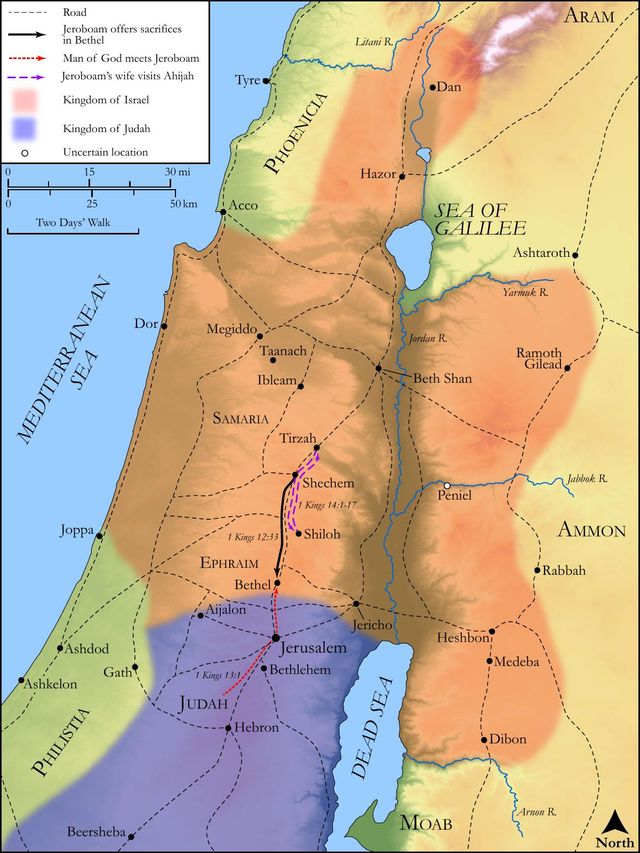
See on the biblical-era maps

Study this verse
Public-domain commentary
Matthew Henry
From his Commentary on the Whole Bible. Henry comments on passages, not single verses — this entry covers 1 Kings 13:11–22. His two-level outline is real structure in the source text, so it is rendered as structure.
The man of God had honestly and resolutely refused the king's invitation, though he promised him a reward; yet he was over-persuaded by an old prophet to come back with him, and dine in Beth-el, contrary to the command given him. Here we find how dearly his dinner cost him. Observe with wonder,
I.The old prophet's wickedness.
I cannot but call him a false prophet and a bad man, it being much easier to believe that from one of such a bad character should be extorted a confirmation of what the man of God said (as we find, Kg1 13:32) than that a true prophet, and a good man, should tell such a deliberate lie as he did, and father it upon God. A good tree could never bring forth such corrupt fruit. Perhaps he was trained up among the sons of the prophets, in one of Samuel's colleges not far off, whence he retained the name of a prophet, but, growing worldly and profane, the spirit of prophecy had departed from him. If he had been a good prophet he would have reproved Jeroboam's idolatry, and not have suffered his sons to attend his altars, as, it should seem, they did. Now,
1.Whether he had any good design in fetching back the man of God is not certain. One may hope that he did it in compassion to him, concluding he wanted refreshment, and out of a desire to be better acquainted with him and more fully to understand his errand than he could from the report of his sons; yet his sons having told him all that passed, and particularly that the prophet was forbidden to eat or drink there, which he had openly told Jeroboam, I suppose it was done with a bad design, to draw him into a snare, and so to expose him; for false prophets have ever been the worst enemies to the true prophets, usually aiming to destroy them, but sometimes, as here, to debauch them and draw them from their duty. Thus they gave the Nazarites wine to drink (Amo 2:12), that they might glory in their fall. But,
2.It is certain that he took a very bad method to bring him back. When the man of God had told him, "I may not, and therefore I will not, return to eat bread with thee" (his resolutions concurring with the divine command, Kg1 13:16, Kg1 13:17), he wickedly pretended that he had an order from heaven to fetch him back. He imposed upon him by asserting his quondam character as a prophet: I am a prophet also as thou art; he pretended he had a vision of an angel that sent him on this errand. But it was all a lie; it was a banter upon prophecy, and profane in the highest degree. When this old prophet is spoken of (Kg2 23:18) he is called the prophet that came out of Samaria, whereas there was no such place as Samaria till long after, Kg1 16:24. Therefore I take it he is so called there, though he was of Beth-el, because he was like those who were afterwards the prophets of Samaria, who caused God's people Israel to err, Jer 23:13.
II.The good prophet's weakness, in suffering himself to be thus imposed upon:
He went back with him, Kg1 13:19. He that had resolution enough to refuse the invitation of the king, who promised him a reward, could not resist the insinuations of one that pretended to be a prophet. God's people are more in danger of being drawn from their duty by the plausible pretences of divinity and sanctity than by external inducements; we have therefore need to beware of false prophets, and not believe every spirit.
III.The proceedings of divine justice hereupon; and here we may well wonder that the wicked prophet, who told the lie and did the mischief, went unpunished, while the holy man of God, that was drawn by him into sin, was suddenly and severely punished for it. What shall we make of this! The judgments of God are unfathomable. The deceived and the deceiver are his, and he giveth not account of any of his matters. Certainly there must be a judgment to come, when these things will be called over again, and when those that sinned most and suffered least, in this world, will receive according to their works. 1. The message delivered to the man of God was strange. His crime is recited, Kg1 13:21, Kg1 13:22. It was, in one word, disobedience to an express command. Judgment is given upon it: Thy carcase shall not come to the sepulchre of thy fathers, that is, "Thou shalt never reach thy own house, but shalt be a carcase quickly, nor shall thy dead body be brought to the place of thy fathers' sepulchres, to be interred." 2. Yet it was more strange that the old prophet himself should be the messenger. Of this we can give no account but that God would have it so, as he spoke to Balaam by his ass and read Saul his doom by the devil in Samuel's likeness. We may think God designed hereby, (1.) To startle the lying prophet, and make him sensible of his sin. The message could not but affect him the more when he himself had the delivering of it, and had so strong an impression made upon his spirit by it that he cried out, as one in an agony, Kg1 13:21. He had reason to think, if he must die for his disobedience in a small matter who sinned by surprise, of how much sorer punishment he should be thought worthy who had belied an angel of God and cheated a man of God by a deliberate forgery. If this were done to the green tree, what shall be done to the dry? Perhaps it had a good effect upon him. Those who preach God's wrath to others have hard hearts indeed if they fear it not themselves. (2.) To put the greater mortification upon the prophet that was deceived, and to show what those must expect who hearken to the great deceiver. Those that yield to him as a tempter will be terrified by him as a tormentor; whom he now fawns upon he will afterwards fly upon, and whom he now draws into sin he will do what he can to drive to despair.
Historical interpretation
Historical reception
1 surviving comment on this verse from the historical church.
Some authors assert that [the old prophet] was not an impostor but invited [the true prophet] to eat out of human sympathy in order to refresh and thank him for admonishing Jeroboam. And that is why God did not harm him as a consequence of this. According to others, he was a false prophet because, if he had been a true prophet, as others maintained, he would have not seduced a true prophet, and his children would not have served in a house of idols; therefore it was in order to seduce him that he went to meet the prophet.
Continue studying 1 Kings 13:11 across the web’s major study libraries — every link below opens this exact verse, chapter, or book on the destination site.
Read & Compare
 BibleGatewayThis verse in more than 200 translations and 70 languages.
 Bible.comThe YouVersion reader — hundreds of translations, reading plans, and highlights.
 ESV.orgCrossway's official English Standard Version reader.
 NET BibleThe NET translation with 60,000+ translators' notes on every rendering decision.
 STEP BibleTyndale House's free study tool — original text, vocabulary, and scholarly resources.
 BibliaLogos Bible Software's free web reader.
 USCCBThe New American Bible (Revised Edition) with the U.S. bishops' study notes.
Commentaries
 BibleHub CommentariesDozens of classic commentaries on this verse, gathered on one page.
 StudyLightMore than 100 commentary sets — the largest collection on the web.
 BibleRefPlain-English commentary on what this verse means, verse by verse.
 Enduring WordDavid Guzik's free commentary on this chapter, widely used by Bible teachers.
 Bible Study ToolsVerse commentary alongside Greek and Hebrew study aids.
Original Language & Research
- BibleHub InterlinearThe verse word by word — original language, transliteration, and English.
- BibleHub LexiconEvery word's original-language definition and Strong's entry.
 Blue Letter BibleDeep-study tools — Strong's numbers, concordance, and word studies.
 SefariaThe Hebrew text with Rashi and centuries of Jewish commentary.
Sermons, Hymns & Audio


TrulyRandomVerse is not affiliated with these sites and doesn’t control their content. They’re linked because they’re genuinely useful.
Summary
1 Kings 13:11 introduces a pivotal character, an "old prophet" residing in Bethel, a city deeply corrupted by King Jeroboam's idolatry. His sons report to him the extraordinary events of the day: the miraculous works performed by the unnamed "man of God" from Judah against Jeroboam's altar, including its splitting and the king's hand withering and being restored, as well as the powerful words spoken to the king. This seemingly innocuous report sets the stage for a tragic encounter that will test the man of God's obedience and discernment, ultimately highlighting the dangers of spiritual compromise and deception.
Context
ShowHideLiterary Context
This verse immediately follows the dramatic confrontation between the unnamed man of God from Judah and King Jeroboam at the idolatrous altar in Bethel. The man of God had delivered a stern prophecy against the altar, which was miraculously confirmed by its splitting and the king's hand withering and then being restored, as detailed in 1 Kings 13:1-6. Crucially, the man of God was under a strict divine command not to eat or drink in Bethel and to return by a different way, a command explicitly stated in 1 Kings 13:8-9. The introduction of the "old prophet" and his sons' detailed report directly sets up the subsequent narrative, where the old prophet will deceitfully tempt the man of God to violate this divine command, leading to the latter's tragic demise, as recounted in 1 Kings 13:18-24.
Historical & Cultural Context
The setting is Bethel, one of the two centers of idolatry established by King Jeroboam I after the division of the kingdom. Jeroboam, fearing that his people would return to Jerusalem to worship Yahweh and thus shift their allegiance back to the Davidic dynasty, set up golden calves in Bethel and Dan, an act of profound theological and political apostasy described in 1 Kings 12:26-30. The presence of an "old prophet" in Bethel, a place now synonymous with idolatry and false worship, immediately raises questions about his spiritual integrity and alignment with Yahweh's true covenant. Prophets in ancient Israel served as God's spokespersons, but their authority and authenticity were often tested, especially in times of widespread apostasy, making the old prophet's residence a significant detail.
Key Themes
ShowHideThis verse contributes to several overarching themes in 1 Kings 13 and the broader narrative of the divided kingdom. It highlights the pervasive nature of spiritual compromise and apostasy in the Northern Kingdom, even among those who might claim a prophetic calling. The swift reporting by the sons underscores the public nature of divine judgment and the man of God's powerful prophetic authority, which could not be ignored. Most significantly, it introduces the theme of deception and the crucial importance of unwavering obedience to God's specific commands, even when faced with seemingly legitimate spiritual counsel. The contrast between the obedient "man of God" and the ambiguous "old prophet" foreshadows a profound test of discernment that will have fatal consequences for the man of God, as seen in 1 Kings 13:24.
Exposition and Analysis
ShowHideKey Word Analysis
ShowHideThis adjective describes the prophet as "aged" or "elder." While suggesting experience, in this context, combined with his residence in Bethel, it also hints at a prophet who has perhaps grown complacent or compromised over time within a spiritually corrupt environment, contrasting with the immediate, fresh commission of the man of God from Judah.
This term denotes an inspired person, a spokesperson for God. The fact that he is called a "prophet" yet resides in Bethel, a center of idolatry, immediately creates a tension. Unlike the "man of God" (a more specific, honorific title), his designation as merely "prophet" leaves his spiritual integrity open to question, setting the stage for his deceptive actions.
Meaning "House of God," Bethel held profound historical significance as a place where Jacob encountered God (Genesis 28:10-22). However, by Jeroboam's time, it had become a primary center for the idolatrous worship of golden calves (1 Kings 12:29). The irony of a "prophet" dwelling in this corrupted "House of God" is palpable, underscoring the spiritual decay in Israel and subtly hinting at the old prophet's own compromised spiritual state.
Verse Breakdown
ShowHide"Now there dwelt an old prophet in Bethel"
This clause introduces a new character crucial to the unfolding narrative. His description as "old" suggests a certain established presence or experience, but his residence "in Bethel," a city steeped in Jeroboam's idolatry, immediately raises questions about his spiritual allegiance and integrity. It hints at a prophet who has perhaps compromised or become complacent within a spiritually corrupt environment, contrasting with the direct divine commission of the man of God from Judah.
"and his sons came and told him all the works that the man of God had done that day in Bethel"
This highlights the public and undeniable nature of the man of God's miraculous actions. The "works" refer to the splitting of the altar and the withering and subsequent restoration of Jeroboam's hand, powerful demonstrations of Yahweh's judgment and the man of God's divine authority. The sons' report indicates that these events were widely observed and discussed, reaching even the household of the old prophet, making him fully aware of the divine intervention.
"the words which he had spoken unto the king, them they told also unto their father"
This emphasizes that not only the miraculous deeds but also the specific prophetic message delivered to King Jeroboam were relayed. This includes the condemnation of the altar and the prediction of its future destruction by a king named Josiah (1 Kings 13:2). The old prophet is thus fully informed of the man of God's divine commission and the precise nature of his message and actions, setting up the context for his subsequent deceptive interaction.
Literary Devices
ShowHideThe verse employs several significant literary devices that enrich its meaning and prepare the reader for the unfolding drama. Foreshadowing is prominent, as the introduction of the "old prophet" in Bethel, immediately after the man of God's strict divine command, signals that this character will play a crucial, indeed tragic, role in the man of God's subsequent test and downfall. The narrative builds dramatic tension by setting up a potential conflict or interaction between these two prophetic figures, one divinely commissioned and obedient, the other ambiguous and ultimately deceptive. There is also a subtle irony in an "old prophet" residing in Bethel, the "House of God," which has become a center of idolatry, hinting at the spiritual compromise that pervades the Northern Kingdom and perhaps the prophet himself. Furthermore, the verse establishes a clear contrast between the unnamed "man of God" from Judah, who acts with clear divine authority and unwavering obedience, and the "old prophet" whose spiritual standing is immediately ambiguous due to his location and, later, his deceptive actions.
Theological and Thematic Connections
ShowHideThis verse, though brief, is theologically rich, serving as a critical pivot point in a narrative that powerfully illustrates the dangers of spiritual deception and the absolute necessity of unwavering obedience to God's specific commands. It underscores that even those who bear the title of "prophet" or claim spiritual authority can be compromised, especially when dwelling in environments of apostasy. The report of the man of God's actions and words reaching the old prophet's household emphasizes that God's truth and judgment are public and undeniable, yet their reception and response can vary dramatically. The subsequent events reveal that a true prophet's greatest test may not come from overt enemies, but from those who appear to be allies or fellow servants of God, highlighting the critical importance of discernment and adherence to the clear word of the Lord.
Reflection and Application
ShowHideThe introduction of the old prophet in Bethel serves as a profound warning for believers across all generations. It challenges us to critically evaluate all spiritual counsel, even that which comes from seemingly legitimate or experienced sources, against the clear, revealed Word of God. The man of God's strict command not to eat or drink in Bethel was a specific, non-negotiable divine instruction; the subsequent narrative demonstrates the catastrophic consequences of deviating from such clarity, even under the guise of "prophetic" authority. This story urges us to cultivate a deep personal relationship with God's Word, allowing it to be our ultimate plumb line for truth and obedience, rather than relying solely on human interpretation or charisma. It also prompts us to examine our own spiritual environments, asking if we have become complacent in settings that foster compromise or subtly deviate from God's standards, lest we, like the man of God, fall prey to deception.
Questions for Reflection
ShowHideFAQ
ShowHideWhy is the old prophet's residence in Bethel significant?
ShowHideBethel, meaning "House of God," was historically a place of profound divine encounter, most notably where Jacob had his dream of a ladder to heaven, as recorded in Genesis 28:10-22. However, King Jeroboam had deliberately turned Bethel into a center of idolatry, setting up one of his golden calves there to prevent his people from worshiping in Jerusalem, as detailed in 1 Kings 12:29. For an "old prophet" to reside in such a place suggests a deep level of spiritual compromise or comfort within an environment of apostasy. It immediately raises questions about his integrity and his true allegiance to Yahweh, setting a subtle but critical contrast with the man of God from Judah who was sent directly by God to confront this very idolatry.
What is the difference between "man of God" and "old prophet" in this context?
ShowHideThe title "man of God" ('îš hā'ĕlōhîm) is a highly honorable and respected designation for a prophet, indicating that he is specially chosen, commissioned, and empowered by God to deliver His message. It implies a direct, uncompromised relationship with Yahweh and often denotes integrity and faithfulness. In contrast, the "old prophet" (nābî' zāqên') is simply described by his age and profession. The narrative subtly uses this difference in terminology to highlight a spiritual distinction. While both are "prophets," the "man of God" represents unblemished divine authority and obedience, whereas the "old prophet's" title, combined with his location and subsequent actions, suggests a diminished or compromised spiritual standing, leading to the tragic deception of the man of God in 1 Kings 13:18.
Christ-Centered Fulfillment
ShowHideThe tragic narrative initiated by 1 Kings 13:11, where a true prophet of God ultimately falls due to deception and disobedience, profoundly underscores humanity's inherent fallibility and susceptibility to temptation, even when divinely commissioned. This story, in its stark warning, points forward to the ultimate need for a Prophet who would never compromise, never deviate from the Father's will, and whose word would be absolute truth. Jesus Christ is that ultimate Prophet, the very Word of God incarnate (John 1:1), who perfectly fulfilled the prophetic office promised in the Old Testament, being a Prophet like Moses but greater (Deuteronomy 18:15). Unlike the man of God from Judah, who succumbed to a lie, Jesus perfectly obeyed every divine command, even to the point of death on the cross (Philippians 2:8). His unwavering faithfulness and perfect truthfulness stand in stark contrast to the spiritual compromise and deception seen in 1 Kings 13, offering the only sure foundation for faith and the ultimate fulfillment of all prophetic revelation (Hebrews 1:1-2). In Christ, we find the Prophet who cannot be deceived and will never deceive, providing the perfect standard for obedience and the ultimate source of truth and life.