


Numbers 23:4
Bible text: King James Version (1769 Blayney text) · Public domain
Bible text: Berean Standard Bible · Public domain
Bible text: American Standard Version (1901) · Public domain
Bible text: World English Bible, Messianic edition · Public domain
Bible text: Geneva Bible (1599) · Public domain
Bible text: Young's Literal Translation · Public domain
- וַיִּקָּרvai·yi·Karand he metH7136Conj-w ¦ V-Niphal-ConsecImperf-3msVerb Niphal Consecutive Imperfect 3rd Singular Masculineוַandיִּקָּרhe met
- אֱלֹהִים'E·lo·HimGodH430N-mpNoun Plural Masculine Absolute
- אֶל'el<to>H413PrepPreposition
- בִּלְעָםbil·'AmBalaamH1109N-proper-mNoun Proper Masculine
- וַיֹּאמֶרvai·Yo·merand he saidH559Conj-w ¦ V-Qal-ConsecImperf-3msVerb Qal Consecutive Imperfect 3rd Singular Masculineוַandיֹּאמֶרhe said
- אֵלָיו'e·Lavto himH413Prep ¦ 3msPreposition Definiteאֵלָיtoוhim
- אֶת'et<obj.>H853DirObjMParticle Object Indicator
- שִׁבְעַתshiv·'At[the] sevenH7651Adj-cscAdjective Numerical Singular common gender Construct
- הַמִּזְבְּחֹתha·miz·be·Chotthe altarsH4196Art ¦ N-fpNoun Plural Feminine Absoluteהַtheמִּזְבְּחֹתaltars
- עָרַכְתִּי'a·Rakh·tiI have arrangedH6186V-Qal-Perf-1csVerb Qal Perfect 1st Singular common gender
- וָאַעַלva·'A·'aland I have offered upH5927Conj-w ¦ V-Hiphil-ConsecImperf-1csVerb Hiphil Consecutive Imperfect 1st Singular common genderוָandאַעַלI have offered up
- פָּרpara young bullH6499N-msNoun Singular Masculine Absolute
- וָאַיִלva·'A·yiland a ramH352Conj-w ¦ N-msNoun Singular Masculine Absoluteוָandאַיִלa ram
- בַּמִּזְבֵּחַba·miz·Be·achon the altarH4196Prep-b ¦ N-msNoun Singular Masculine Absoluteבַּon theמִּזְבֵּחַaltar
English is a literal word-by-word gloss of the Hebrew, not the KJV's wording. Why?
This is the original text the KJV's translators worked from — each Hebrew word with its own literal English meaning in this verse, prepared by scholars at Tyndale House, Cambridge. The KJV translates whole sentences, not word by word, so its wording differs: one Hebrew word can become several English words, and the KJV may choose “the LORD” where the gloss reads “Yahweh”. Both are faithful — they answer different questions. For the KJV's own rendering, switch to the KJV text.
Details
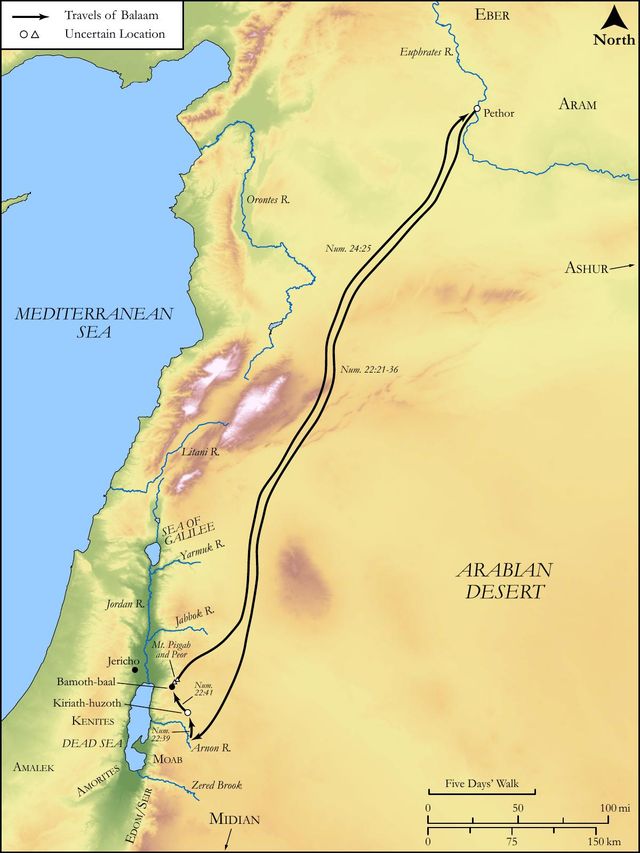
See on the biblical-era map
Study this verse
Public-domain commentary
Matthew Henry
From his Commentary on the Whole Bible. Henry comments on passages, not single verses — this entry covers Numbers 23:1–12. His four-level outline is real structure in the source text, so it is rendered as structure.
Here is, I. Great preparation made for the cursing of Israel. That which was aimed at was to engage the God of Israel to forsake them, and either to be on Moab's side or to stand neuter. O the sottishness of superstition, to imagine that God will be at men's beck! Balaam and Balak think to bribe him with altars and sacrifices, offered without any warrant or institution of his: as if he would eat the flesh of bulls or drink the blood of goats. Ridiculous nonsense, to think that these would please God, and gain his favour, when there could be in them no exercise either of faith or obedience! Yet, it should seem, they offered these sacrifices to the God of heaven the supreme Numen - Divinity, and not to any of their local deities. But the multiplying of altars was an instance of their degeneracy from the religion of their ancestors, and their apostasy to idolatry; for those that multiplied altars multiplied gods. Ephraim made many altars to sin, Hos 8:11. Thus they liked not to retain God in their knowledge, but became vain in their imaginations; and yet presumptuously expected hereby to gain God over to them from Israel, who had his sanctuary among them, and his anointed altar. Observe here, 1. How very imperious Balaam was, proud to have the command of a king and to give law to princes. Such is the spirit of that wicked one who exalts himself above all that is called God, or that is worshipped. With what authority does Balaam give orders! Build me here (in the place I have pitched upon) seven altars, of stone or turf. Thus he covers his malice against Israel with a show of devotion, but his sacrifice was an abomination, being brought with such a wicked mind, Pro 21:27. That which he aimed at was not to honour God with the sacrifices of righteousness, but to enrich himself with the wages of unrighteousness. 2. How very obsequious Balak was. The altars were presently built, and the sacrifices prepared, the best of the sort, seven bullocks and seven rams. Balak makes no objection to the charge, nor does he snuff at it, or think it either a weariness or a disparagement to stand by his burnt-offering as Balaam ordered him.
II.The turning of the curse into a blessing, by the overruling power of God, in love to Israel, which is the account Moses gives of it, Deu 23:5.
1.God puts the blessing into the mouth of Balaam. While the sacrifices were burning, Balaam retired; he went solitary, into some dark grove on the top of the high place, Deu 23:3, marg. Thus much he knew, that solitude gives a good opportunity for communion with God; those that would meet with him must retire from the world, and the business and conversation of it, and love to be private, reckoning themselves never less alone than when alone, because the Father is with them. Enter therefore into thy closet, and shut the door, and be assured that God will meet thee if thou seek him in the due order. But Balaam retired with a peradventure only, having some thoughts that God might meet him; but being conscious to himself of guilt, and knowing that God had lately met him in anger, he had reason to speak doubtfully: Peradventure the Lord will come to meet me, Num 23:3. But let not such a man think that he shall receive any favour from God. Nay, it should seem, though he pretended to go and meet with God, he really designed to use enchantments; see Num 24:1. But, whatever he intended. God designed to serve his own glory by him, and therefore met Balaam, Num 23:4. What communion has light with darkness? No friendly communion, we may be sure. Balaam's way was still perverse, and God was still an adversary to him; but, Balak having chosen him for his oracle, God would constrain him to utter such a confession, to the honour of god and Israel, as should render those for ever inexcusable who should appear in arms against them. When Balaam was aware that God met him, probably by an angel, he boasted of his performances: I have prepared seven altars, and offered upon every altar a bullock and a ram. How had he done it? It cost him nothing; it was done at Balak's expense; yet,
(1.)He boasts of it, as if he had done some mighty thing. The acts of devotion which are done in hypocrisy are commonly reflected upon with pride and vain glory. Thus the Pharisee went up to the temple to boast of his religion, Luk 18:11, Luk 18:12.
(2.)He insists upon it as a reason why God should gratify him in his desire to curse Israel, as if now he had made God his debtor, and might draw upon him for what he pleased. He thinks God is so much beholden to him for these sacrifices that the least he can do in recompense for them is to sacrifice his Israel to the malice of the king of Moab. Note, It is a common cheat that wicked people put upon themselves, to think that by the shows of piety they may prevail with God to countenance them, and connive at them, in their greatest immoralities, especially in persecution, Isa 66:5. However, thought the sacrifice was an abomination, God took the occasion of Balaam's expectation to put a word into his mouth (Num 23:5); for the answer of the tongue if from the Lord, and thus he would show how much those are mistaken who say, With our tongue we will prevail, our lips are our own, Psa 12:4. He that made man's mouth knows how to manage it, and to serve his own purposes by it. This speaks terror to daring sinners, that set their mouth against the heavens. God can make their own tongues to fall upon them, Psa 64:8. And it speaks comfort to God's witnesses, whom at any time he calls out to appear for him; if God put a word into the mouth of Balaam, who would have defied God and Israel, surely he will not be wanting to those who desire to glorify God and edify his people by their testimony, but it shall be given them in that same hour what they should speak.
2.Balaam pronounces the blessing in the ears of Balak. He found him standing by his burnt-sacrifice (Num 23:6), closely attending it, and earnestly expecting the success. those that wold have an answer of peace from God must abide by the sacrifice, and attend on the Lord without distraction, not weary in well doing. Balaam, having fixed himself in the place appointed for his denouncing curses against Israel, which perhaps he had drawn up in form ready to deliver, takes up his parable, and it proves a blessing, Num 23:7. He pronounces Israel safe and happy, and so blesses them.
(1.)He pronounces them safe, and out of the reach of his envenomed darts.
[1.]He owns that the design was to curse them, that Balak sent for him out of his own country, and that he came, with that intent, Num 23:7. The message sent to him was, Come, curse me Jacob, and come, defy Israel. Balak intended to make war upon them, and he would have Balaam to bless his arms, and to prophesy and pray for the ruin of Israel.
[2.]He owns the design defeated, and his own inability to accomplish it. He could not so much as give them an ill word or an ill wish: How shall I curse those whom God has not cursed? Num 23:8. Not that therefore he would not do it, but therefore he could not do it. this is a fair confession, First, Of the weakness and impotency of his own magic skill, for which others valued him so much, and doubtless he valued himself no less. He was the most celebrated man of that profession, and yet owns himself baffled. God had warned the Israelites not to use divination (Lev 19:31), and this providence gave them a reason for that law, by showing them the weakness and folly of it. As they had seen the magicians of Egypt befooled, so, here, the great conjurer of the east. See Isa 47:12-14. Secondly, It is a confession of the sovereignty and dominion of the divine power. He owns that he could do no more than God would suffer him to do, for God could overrule all his purposes, and turn his counsels headlong. Thirdly, It is a confession of the inviolable security of the people of God. Note, 1. God's Israel are owned and blessed of him. He has not cursed them, for they are delivered from the curse of the law; he has not defied them, nor rejected or abandoned them, though mean and vile. 2. Those that have the good-will of Heaven have the ill-will of hell; the serpent and this seed have an enmity to them. 3. Though the enemies of God's people may prevail far against them, yet they cannot curse them; that is, they cannot do them any real mischief, much less a ruining mischief, for they cannot separate them from the love of God, Rom 8:39.
(2.)He pronounces them happy in three things: -
[1.]Happy in their peculiarity, and distinction from the rest of the nations: From the top of the rock I see him, Num 23:9. And it seems to have been a great surprise to him that whereas, it is probable, they were represented to him as a rude and disorderly rabble, that infested the countries round about in rambling parties, he was them a regular incorporated camp, in which appeared all the marks of discipline and good order; he saw them a people dwelling alone, and foresaw they would continue so, and their singularity would be their unspeakable honour. Persons of quality we call person of distinction; this was Israel's praise, though their enemies turned it to their reproach, that they differed from all the neighbouring nations, not only in their religion and sacred rites, but in their diet, and dress, and common usages, as a people called out of the world, and not to be conformed to it. They never lost their reputation till they mingled among the heathen, Psa 106:35. Note, It is the duty and honour of those that are dedicated to God to be separated from the world, and not to walk according to the course and custom of it. Those who make conscience of peculiar duties may take the comfort of peculiar privileges, which it is probable Balaam has an eye to here. God's Israel shall not stand upon a level with other nations, but be dignified above them all, as a people near to God, and set apart for him.
[2.]Happy in their numbers, not so few and despicable as they were represented to him, but an innumerable company, which made them both honourable and formidable (Num 23:10): Who can count the dust of Jacob? The number of the people was the thing that Balak was vexed at (Num 22:3): Moab was afraid of them, because they were many; and God does here by Balaam promote that fear and vexation, foretelling their further increase. Balak would have him see the utmost part of the people (Num 22:41), hoping the more he saw of them the more he would be exasperated against them, and throw about his curses with the more keenness and rage; but it proved quite contrary: instead of being angry at their numbers, he admired them. The better acquainted we are with God's people the better opinion we have of them. He takes notice of the number, First, Of the dust of Jacob; that is, the people of Jacob, concerning whom it was foretold that they should be as the dust for number, Gen 28:14. Thus he owns the fulfilling of the promise made to the fathers, and expects that it should be yet further accomplished. Perhaps it was part of David's fault in numbering the people that he offered to count the dust of Jacob, which God had said should be innumerable. Secondly, Of the fourth part of Israel, alluding to the form of their camp, which was cast into four squadrons, under four standards. Note, God's Israel are a very great body, his spiritual Israel are so, and they will appear to be so when they shall all be gathered together unto him in the great day, Rev 7:9.
[3.]Happy in their end: Let me die the death of the righteous Israelites, that are in covenant with God, and let my last end, or future state, be like theirs, or my recompence, namely, in the other world. Here, First, It is taken for granted that death is the end of all men; the righteous themselves must die: and it is good for us to think of this with application, as Balaam himself does here, speaking of his own death. Secondly, he goes upon the supposition of the soul's immortality, and a different state on the other side death, to which this is a noble testimony, and an evidence of its being anciently known and believed. For how could the death of the righteous be more desirable than the death of the wicked upon any other account than as it involved happiness in another world, since in the manner and circumstances of dying we see all things come alike to all? Thirdly, He pronounces the righteous truly blessed, not only while they live, but when they die, which makes their death not only more desirable than the death of others, but even more desirable than life itself; for in that sense his wish may be taken. Not only, "When I do die, let me die the death of the righteous;" but, "I could even now be willing to die, on condition that I might die the death of the righteous, and reach my end this moment, provided it might be like his." Very near the place where Balaam now was, on one of the mountains of Moab, not long after this, Moses died, and to that perhaps God, who put this word into his mouth, designed it should have a reference, that by it Moses might be encouraged to go up and die such a death as Balaam himself wished to die. Fourthly, He shows his opinion of religion to be better than his resolution; there are many who desire to die the death of the righteous, but do not endeavour to live the life of the righteous. Gladly would they have their end like theirs, but not their way. They would be saints in heaven, but not saints on earth. This is the desire of the slothful, which kills him, because his hands refuse to labour. This of Balaam's is only a wish, not a prayer, and it is a vain wish, being only a wish for the end, without any care for the means. Thus far this blessing goes, even to death, and beyond it, as far as the last end. Now,
III.We are told,
1.How Balak fretted at it, Num 23:11. He pretended to honour the Lord with his sacrifices, and to wait for the answer God would send him; and yet, when it did not prove according to his mind, he forgot God, and flew into a great passion against Balaam, as if it had been purely his doing: "What hast thou done unto me! How hast thou disappointed me!" Sometimes God makes the enemies of his church a vexation one to another, while he that sits in heaven laughs at them, and the efforts of their impotent malice.
2.How Balaam was forced to acquiesce in it. He submits because he cannot help it, and yet humours the thing with no small address, as if he had been peculiarly conscientious, answering Balak with the gravity of a prophet: Must I not take heed to speak that which the Lord has put in my mouth? Num 23:12. Thus a confession of God's overruling power is extorted from a wicked prophet, to the further confusion of a wicked prince.
Continue studying Numbers 23:4 across the web’s major study libraries — every link below opens this exact verse, chapter, or book on the destination site.
Read & Compare
 BibleGatewayThis verse in more than 200 translations and 70 languages.
 Bible.comThe YouVersion reader — hundreds of translations, reading plans, and highlights.
 ESV.orgCrossway's official English Standard Version reader.
 NET BibleThe NET translation with 60,000+ translators' notes on every rendering decision.
 STEP BibleTyndale House's free study tool — original text, vocabulary, and scholarly resources.
 BibliaLogos Bible Software's free web reader.
 USCCBThe New American Bible (Revised Edition) with the U.S. bishops' study notes.
Commentaries
 BibleHub CommentariesDozens of classic commentaries on this verse, gathered on one page.
 StudyLightMore than 100 commentary sets — the largest collection on the web.
 BibleRefPlain-English commentary on what this verse means, verse by verse.
 Enduring WordDavid Guzik's free commentary on this chapter, widely used by Bible teachers.
 Bible Study ToolsVerse commentary alongside Greek and Hebrew study aids.
Original Language & Research
- BibleHub InterlinearThe verse word by word — original language, transliteration, and English.
- BibleHub LexiconEvery word's original-language definition and Strong's entry.
 Blue Letter BibleDeep-study tools — Strong's numbers, concordance, and word studies.
 SefariaThe Hebrew text with Rashi and centuries of Jewish commentary.
Sermons, Hymns & Audio


TrulyRandomVerse is not affiliated with these sites and doesn’t control their content. They’re linked because they’re genuinely useful.
Summary
Numbers 23:4 marks a pivotal moment where the omnipotent God directly intervenes in the plans of Balak, King of Moab, and Balaam, a renowned diviner. Despite Balaam's elaborate ritual preparations involving seven altars and corresponding sacrifices, the verse highlights God's sovereign initiative in meeting Balaam, thereby asserting divine control over the impending prophetic utterance. This encounter demonstrates that no human scheme, ritual, or power can thwart God's ultimate will concerning His chosen people, Israel, ensuring that His divine purpose will prevail.
Context
ShowHideLiterary Context
Numbers 23:4 is situated within the larger narrative of Balaam's oracles, spanning Numbers 22-24. Following Israel's decisive victories over the Amorites and Og, Balak, the Moabite king, becomes terrified of their vast numbers and seeks to neutralize them supernaturally. He dispatches envoys to Pethor, Mesopotamia, to hire Balaam, a diviner renowned for his ability to bless or curse. Initially, God explicitly forbids Balaam from going or cursing Israel, as clearly stated in Numbers 22:12. However, after further, more insistent entreaties from Balak and a divine allowance (with strict conditions for Balaam to speak only what God commands), Balaam journeys to Moab. Upon arrival, Balak takes Balaam to various vantage points overlooking Israel, hoping to elicit a curse. Before each oracle, Balaam instructs Balak to prepare seven altars and offer seven bullocks and seven rams. Numbers 23:4 specifically describes the first instance of God meeting Balaam after these initial, extensive preparations, setting the stage for the first of four divine oracles that Balaam is supernaturally compelled to deliver, each blessing Israel instead of cursing them.
Historical & Cultural Context
The nations round about Israel were rife with practices of divination, magic, and the hiring of professional seers or prophets to influence outcomes, particularly in matters of warfare and national security. Kings like Balak would routinely employ such figures to gain advantage or protection against perceived threats. The number "seven" holds immense symbolic meaning in Scripture, often representing completeness, perfection, or divine fullness, making the preparation of seven altars and seven pairs of animals a highly potent and comprehensive ritual offering intended to secure a powerful divine response. Sacrifices of bullocks and rams were common and costly offerings, indicative of a serious attempt to appease or invoke deities. Balaam, hailing from Mesopotamia, would have been deeply steeped in these traditions, and his meticulous adherence to ritual demonstrates his understanding of contemporary religious practices, aiming to manipulate or persuade the divine powers. However, the narrative of Numbers 23:4 underscores a profound theological distinction: the God of Israel is not subject to human manipulation or pagan rituals but acts according to His own sovereign will, even using an unwilling pagan diviner to declare His purposes for His people.
Key Themes
ShowHideThis verse powerfully contributes to several overarching themes within the book of Numbers and the broader Pentateuch. The most prominent is Divine Sovereignty, demonstrating God's absolute control over all circumstances, even the actions of those who oppose His will or operate outside His covenant. God's direct intervention with Balaam, despite the latter's pagan background and Balak's hostile intent, highlights that no human scheme or spiritual power can thwart God's purposes for His chosen people, Israel. This powerfully reinforces the theme of God's Unwavering Protection of Israel, showcasing His faithfulness to His covenant promises even when Israel is vulnerable or disobedient. Furthermore, the encounter emphasizes the theme of Revelation vs. Ritual. While Balaam meticulously performs elaborate rituals, the true divine communication comes solely from God's initiative—He "met" Balaam and subsequently put words in his mouth, as seen in Numbers 23:5, not as a result of Balaam's sacrifices. This underscores that genuine divine encounter and prophecy stem from God's sovereign choice and relationship, rather than human performance or attempts to manipulate the divine.
Exposition and Analysis
ShowHideKey Word Analysis
ShowHideThis verb (H7136) means "to light upon (chiefly by accident); causatively, to bring about; specifically, to impose timbers (for roof or floor)." While it can imply a chance encounter, in the context of a divine subject, especially in the Nifal stem (as the form vayyiqqar' suggests), it conveys a deliberate, intentional encounter initiated by God. It is crucial that God "met" Balaam, rather than Balaam successfully summoning God through his rituals. This emphasizes God's sovereignty and His control over the prophetic process, ensuring that His message, not Balaam's, will be delivered.
Derived from the root "to slaughter" (H4196), this word refers to a place of sacrifice. Balaam's preparation of "seven altars" signifies a comprehensive and potent attempt to invoke divine power through ritual. Among the nations, altars were focal points for communion with their gods, where offerings were presented to gain favor or elicit a response. Balaam's meticulous construction of multiple altars underscores his belief in the efficacy of such practices to influence the divine, contrasting sharply with the narrative's demonstration that the God of Israel is not swayed by human ritual but acts according to His own will.
This numeral (H7651) holds immense symbolic weight in Scripture, frequently signifying completeness, perfection, or divine action and purpose. Balaam's preparation of "seven altars" and "seven bullocks and seven rams" reflects a common practice among the nations of multiplying offerings to ensure a powerful and effective ritual outcome, aiming for a complete and undeniable divine response. However, in this narrative, the number highlights the futility of human attempts to manipulate God; God's will prevails not because of the ritual's completeness, but despite it, demonstrating His absolute independence from human efforts.
Verse Breakdown
ShowHide"And God met Balaam"
This opening clause is profoundly significant, immediately establishing God's initiative and absolute sovereignty. It is not Balaam who successfully summons God through his pagan rituals, but God, the supreme ʼĕlôhîym (H430), who sovereignly chooses to "meet" Balaam. This encounter is a divine appointment, demonstrating God's direct involvement in the situation and His absolute control over the prophet's words and actions, even those of a non-Israelite diviner. It sets the stage for God to dictate the message, entirely subverting Balak's hostile intentions.
"and he said unto him"
This phrase identifies Balaam as the speaker, responding to God's presence and initiative. It indicates that Balaam is now in a position to communicate with God, albeit under God's terms and authority. This prepares the reader for Balaam's subsequent explanation of his elaborate preparations, which immediately follows, setting up the contrast between human effort and divine sovereignty.
"I have prepared seven altars"
Balaam's statement reveals his meticulous adherence to ritualistic practices common among the nations. The "seven altars" (H4196) signify a comprehensive and potent attempt to invoke divine power, aiming for a complete and effective spiritual outcome. This highlights Balaam's reliance on human effort and traditional methods to achieve his goal, which stands in stark contrast to the divine sovereignty that is about to be displayed, where God's will is enacted independently of such preparations.
"and I have offered upon [every] altar a bullock and a ram"
This clause further details the extent of Balaam's elaborate preparations. The offering of seven bullocks (H6499, par) and seven rams (H352, ʼayil), one pair on each of the seven altars, represents a significant investment and a powerful ritual intended to secure a divine response. It underscores Balaam's understanding of the magnitude of the task (cursing Israel) and his belief that such extensive sacrifices would compel a deity to act according to his will. However, the narrative will soon demonstrate that the God of Israel is not swayed by the scale of human ritual but acts according to His own immutable plan and covenant promises.
Literary Devices
ShowHideNumbers 23:4 employs several potent literary devices to convey its theological message. Irony is central, as Balaam, hired by Balak to curse Israel, meticulously prepares to invoke a deity, only for the God of Israel to meet him and ultimately compel him to bless Israel. His elaborate rituals, intended to manipulate the divine, become the very setting for God to assert His unchallengeable will, rendering Balaam's efforts ironically futile in achieving his intended outcome. The verse also utilizes Symbolism, particularly through the number "seven" (H7651), which universally connotes completeness, perfection, or divine fullness. Balaam's use of seven altars and seven sacrifices symbolizes his comprehensive effort to achieve a perfect and potent curse, yet this very symbolism underscores the futility of human attempts to control divine power. Furthermore, the scene presents a form of Dramatic Tension as the reader anticipates the outcome of this divine encounter, knowing Balak's hostile intentions and Balaam's initial instructions from God. This tension is powerfully resolved in the subsequent verses as God puts words in Balaam's mouth, turning the intended curse into an undeniable blessing.
Theological and Thematic Connections
ShowHideNumbers 23:4 serves as a powerful testament to God's absolute sovereignty and His unwavering commitment to His covenant people. It demonstrates that God is not a deity who can be manipulated by human rituals, pagan practices, or the schemes of hostile kings. Instead, He is the supreme ruler who orchestrates events, even using unwilling instruments like Balaam, to accomplish His divine purposes. This encounter underscores the theological truth that God's plans for His people are unchangeable and cannot be thwarted by any earthly or spiritual opposition. It reinforces the idea that true divine revelation flows from God's initiative, not from human performance or attempts to coerce Him. The God who "met" Balaam is the same God who actively intervenes in history to protect, guide, and bless His chosen ones, ensuring that His word prevails above all human intentions and machinations.
Reflection and Application
ShowHideNumbers 23:4 offers profound lessons for contemporary believers, providing immense reassurance that God's sovereign hand is meticulously at work in all circumstances, even amidst opposition, confusion, or the seemingly powerful machinations of those who wish us ill. Just as God could not be manipulated by Balaam's elaborate rituals, so too our God is not swayed by outward religious performance or attempts to coerce His will through formulaic prayers or superficial acts. This verse calls us to trust implicitly in God's ultimate control, recognizing that His purposes for His people, and for us as His children, cannot be thwarted. It encourages us to abandon any notion that our spiritual success or God's favor depends on human effort or ritualistic perfection, and instead to cultivate a deeper reliance on God's grace and His divine initiative. Our focus should be on diligently listening for His voice, humbly submitting to His revealed will, and trusting that He will accomplish His good purposes, often in ways that defy our expectations and humble our pride, all for His glory and our ultimate good.
Questions for Reflection
ShowHideFAQ
ShowHideWhy did God meet Balaam, a pagan diviner, instead of simply preventing him from reaching Balak or cursing Israel?
ShowHideGod's decision to meet Balaam directly, rather than simply stopping him, serves several profound purposes. Firstly, it powerfully demonstrates God's absolute sovereignty and His ability to use anyone, even an unwilling pagan diviner, to accomplish His divine will. It shows that God is not limited by human categories or spiritual allegiances, but can work through any means necessary to achieve His ends. Secondly, by putting words directly into Balaam's mouth, as seen in Numbers 23:5, God ensures that the blessings pronounced upon Israel are undeniably from Him, not from Balaam's own power or the efficacy of Balak's rituals. This public display of divine control over a renowned diviner would have been a powerful testimony to both Israel and the surrounding nations that the God of Israel is supreme, and His plans for His people cannot be thwarted. It highlights that God's purposes prevail, regardless of human intent or the methods employed against His people, reinforcing the truth that the Lord frustrates the plans of the nations.
Christ-Centered Fulfillment
ShowHideThe encounter between God and Balaam in Numbers 23:4, where God sovereignly controls the words of a pagan diviner to bless Israel, powerfully foreshadows the ultimate divine intervention and blessing found in Jesus Christ. Balaam, though unwilling, was compelled to speak God's word, and his prophecies ultimately pointed to a future King from Israel who would be exalted and whose kingdom would be great, as seen in Numbers 24:7. This prefigures Christ, the true Prophet, who perfectly embodies and speaks the very words of God, not under compulsion, but in perfect obedience and unity with the Father, as profoundly described in John 1:1 and John 14:10. While Balaam offered bullocks and rams on seven altars in a futile attempt to manipulate the divine, Christ is the Lamb of God who takes away the sin of the world, the singular, perfect, and ultimate sacrifice offered once for all, as detailed in Hebrews 9:26-28. God's unthwartable plan to bless Israel through Balaam finds its ultimate and expansive fulfillment in Christ, through whom God extends His blessing not only to Israel but to all nations, fulfilling the ancient promise to Abraham that all peoples on earth will be blessed through you. Thus, the divine sovereignty displayed in Numbers 23:4 culminates in the person and redemptive work of Jesus, the one through whom God's eternal purposes for salvation and blessing are perfectly realized.