


Numbers 22:12
Bible text: King James Version (1769 Blayney text) · Public domain
Bible text: Berean Standard Bible · Public domain
Bible text: American Standard Version (1901) · Public domain
Bible text: World English Bible, Messianic edition · Public domain
Bible text: Geneva Bible (1599) · Public domain
Bible text: Young's Literal Translation · Public domain
- וַיֹּאמֶרvai·Yo·merand he saidH559Conj-w ¦ V-Qal-ConsecImperf-3msVerb Qal Consecutive Imperfect 3rd Singular Masculineוַandיֹּאמֶרhe said
- אֱלֹהִים'E·lo·HimGodH430N-mpNoun Plural Masculine Absolute
- אֶל'eltoH413PrepPreposition
- בִּלְעָםbil·'AmBalaamH1109N-proper-mNoun Proper Masculine
- לֹאlo'notH3808NegParticle Negative
- תֵלֵךְte·Lekhyou will goH1980V-Qal-Imperf-2msVerb Qal Imperfect 2nd Singular Masculine
- עִמָּהֶם'i·ma·Hemwith themH5973Prep ¦ 3mpPreposition Definiteעִמָּwithהֶםthem
- לֹאlo'notH3808NegParticle Negative
- תָאֹרta·'Oryou will curseH779V-Qal-Imperf-2msVerb Qal Imperfect 2nd Singular Masculine
- אֶת'et<obj.>H853DirObjMParticle Object Indicator
- הָעָםha·'Amthe peopleH5971Art ¦ N-msNoun Singular Masculine Absoluteהָtheעָםpeople
- כִּיkiforH3588PrtParticle Conditional
- בָרוּךְva·Rukh[is] blessedH1288V-Qal-PassPrtcpl-msVerb Qal Participle Passive Singular Masculine Absolute
- הוּאHu'itH1931Pro-3msPronoun Personal 3rd Singular Masculine
English is a literal word-by-word gloss of the Hebrew, not the KJV's wording. Why?
This is the original text the KJV's translators worked from — each Hebrew word with its own literal English meaning in this verse, prepared by scholars at Tyndale House, Cambridge. The KJV translates whole sentences, not word by word, so its wording differs: one Hebrew word can become several English words, and the KJV may choose “the LORD” where the gloss reads “Yahweh”. Both are faithful — they answer different questions. For the KJV's own rendering, switch to the KJV text.
Details
See on the biblical-era map
Study this verse
Public-domain commentary
Matthew Henry
From his Commentary on the Whole Bible. Henry comments on passages, not single verses — this entry covers Numbers 22:1–14. His two-level outline is real structure in the source text, so it is rendered as structure.
The children of Israel have at length finished their wanderings in the wilderness, out of which they went up (Num 21:18), and are now encamped in the plains of Moab near Jordan, where they continued till they passed through Jordan under Joshua, after the death of Moses. Now we have here,
I.The fright which the Moabites were in upon the approach of Israel, Num 22:2-4.
They needed not to fear any harm from them if they knew (and it is probable that Moses let them know) the orders God had given to Israel not to contend with the Moabites, nor to use any hostility against them, Deu 2:9. But, if they had any notice of this, they were jealous that it was but a sham, to make them secure, that they might be the more easily conquered. Notwithstanding the old friendship between Abraham and Lot, the Moabites resolved to ruin Israel if they could, and therefore they will take it for granted, without any ground for the suspicion, that Israel resolves to ruin them. Thus it is common for those that design mischief to pretend that mischief is designed against them; and their groundless jealousies must be the colour of their causeless malice. They hear of their triumphs over the Amorites (Num 22:2), and think that their own house is in danger when their neighbour's is on fire. They observe their multitudes (Num 22:3): They were many; and hence infer how easily they would conquer their country, and all about them if some speedy and effectual course were not taken to stop the progress of their victorious arms: "They shall lick up or devour us, and all that are round about us, as speedily and irresistibly as the ox eats up the grass" (Num 22:4), owning themselves to be an unequal match for so formidable an enemy. Therefore they were sorely afraid and distressed themselves; thus were the wicked in great fear where no fear was, Psa 53:5. These fears they communicated to their neighbours, the elders of Midian, that some measures might be concerted between them for their common safety; for, if the kingdom of Moab fall, the republic of Midian cannot stand long. The Moabites, if they had pleased, might have made a good use of the advances of Israel, and their successes against the Amorites. They had reason to rejoice, and give God and Israel thanks for freeing them from the threatening power of Sihon king of the Amorites, who had taken from them part of their country, and was likely to overrun the rest. They had reason likewise to court Israel's friendship, and to come in to their assistance; but having forsaken the religion of their father Lot, and being sunk into idolatry, they hated the people of the God of Abraham, and were justly infatuated in their counsels and given up to distress.
II.The project which the king of Moab formed to get the people of Israel cursed, that is, to set God against them, who, he perceived, hitherto fought for them. He trusted more to his arts than to his arms, and had a notion that if he could but get some prophet or other, with his powerful charms, to imprecate evil upon them, and to pronounce a blessing upon himself and his forces, then, though otherwise too weak, he should be able to deal with them. This notion arose,
1.Out of the remains of some religion; for it owns a dependence upon some visible sovereign powers that rule in the affairs of the children of men and determine them, and an obligation upon us to make application to these powers.
2.Out of the ruins of the true religion; for if the Midianites and Moabites had not wretchedly degenerated from the faith and worship of their pious ancestors, Abraham and Lot, they could not have imagined it possible to do any mischief with their curses to a people who alone adhered to the service of the true God, from whose service they had themselves revolted.
III.The court which he made to Balaam the son of Beor, a famous conjurer, to engage him to curse Israel.
The Balaam lived a great way off, in that country whence Abraham came, and where Laban lived; but, though it was probable that there were many nearer home that were pretenders to divination, yet none had so great a reputation for success as Balaam, and Balak will employ the best he can hear of, though he send a great way for him, so much is his heart upon this project. And to gain him,
1.He makes him his friend, complaining to him, as his confidant, of the danger he was in from the numbers and neighbourhood of the camp of Israel: They cover the face of the earth, and they abide over against me, Num 22:5.
2.In effect he makes him his god, by the great power he attributes to his word: He whom thou blessest is blessed, and he whom thou cursest is cursed, Num 22:6. The learned bishop Patrick inclines to think, with many of the Jewish writers, that Balaam had been a great prophet, who, for the accomplishment of his predictions and the answers of his prayers, both for good and evil, had been looked upon justly as a man of great interest with God; but that, growing proud and covetous, God departed from him, and then, to support his sinking credit, he betook himself to diabolical arts. He is called a prophet (Pe2 2:16,) because he had been one, or perhaps he had raised his reputation from the first by his magical charms, as Simon Magus, who bewitched the people so far that he was called the great power of God, Act 8:10. Curses pronounced by God's prophets in the name of the Lord have wonderful effects, as Noah's (Gen 9:25), and Elisha's, Kg2 2:24. But the curse causeless shall not come (Pro 26:2), no more than Goliath's, when he cursed David by his gods, Sa1 17:43. Let us desire to have the prayers of God's ministers and people for us, and dread having them against us; for they are greatly regarded by him who blesseth indeed and curseth indeed. But Balak cannot rely upon these compliments as sufficient to prevail with Balaam, the main inducement is yet behind (Num 22:7): they took the rewards of divination in their hand, the wages of unrighteousness, which he loved, Pe2 2:15.
IV.The restraint God lays upon Balaam, forbidding him to curse Israel.
It is very probable that Balaam, being a curious inquisitive man, was no stranger to Israel's case and character, but had heard that God was with them of a truth, so that he ought to have given the messengers their answer immediately, that he would never curse a people whom God had blessed; but he lodges the messengers, and takes a night's time to consider what he shall do, and to receive instructions from God, Num 22:8. When we enter into a parley with temptations we are in great danger of being overcome by them. In the night God comes to him, probably in a dream, and enquires what business those strangers had with him. He knows it, but he will know it from him. Balaam gives him an account of their errand (Num 22:9-11), and God thereupon charges him not to go with them, or attempt to curse that blessed people, Num 22:12. Thus God sometimes, for the preservation of his people, was pleased to speak to bad men, as to Abimelech (Gen 20:3), and to Laban, Gen 31:24. And we read of some that were workers of iniquity, and yet in Christ's name prophesied, and did many wondrous works. Balaam is charged not only not to go to Balak, but not to offer to curse this people, which he might have attempted at a distance; and the reason is given: They are blessed. This was part of the blessing of Abraham (Gen 12:3), I will curse him that curseth thee; so that an attempt to curse them would be not only fruitless, but perilous. Israel had often provoked God in the wilderness, yet he will not suffer their enemies to curse them, for he rewards them not according to their iniquities. The blessedness of those whose sin is covered comes upon them, Rom 4:6, Rom 4:7.
V.The return of the messengers without Balaam.
1.Balaam is not faithful in returning God's answer to the messengers, Num 22:13. He only tells them, the Lord refuseth to give me leave to go with you. He did not tell them, as he ought to have done, that Israel was a blessed people, and must by no means be cursed; for then the design would have been crushed, and the temptation would not have been renewed: but he, in effect, desired them to give his humble service to Balak, and let him know that he applauded his project, and would have been very glad to gratify him, but that truly he had the character of a prophet, and must not go without leave from God, which he had not yet obtained, and therefore for the present he must be excused. Note, Those are a fair mark for Satan's temptation that speak diminishingly of divine prohibitions, as if they amounted to no more than the denial of a permission, and as if to go against God's law were only to go without his leave.
2.The messengers are not faithful in returning Balaam's answer to Balak. All the account they give of it is, Balaam refuseth to come with us (Num 22:14), intimating that he only wanted more courtship and higher proffers; but they are not willing Balak should know that God had signified his disallowance of the attempt. Thus are great men wretchedly abused by the flatteries of those about them, who do all they can to prevent their seeing their own faults and follies.
Continue studying Numbers 22:12 across the web’s major study libraries — every link below opens this exact verse, chapter, or book on the destination site.
Read & Compare
 BibleGatewayThis verse in more than 200 translations and 70 languages.
 Bible.comThe YouVersion reader — hundreds of translations, reading plans, and highlights.
 ESV.orgCrossway's official English Standard Version reader.
 NET BibleThe NET translation with 60,000+ translators' notes on every rendering decision.
 STEP BibleTyndale House's free study tool — original text, vocabulary, and scholarly resources.
 BibliaLogos Bible Software's free web reader.
 USCCBThe New American Bible (Revised Edition) with the U.S. bishops' study notes.
Commentaries
 BibleHub CommentariesDozens of classic commentaries on this verse, gathered on one page.
 StudyLightMore than 100 commentary sets — the largest collection on the web.
 BibleRefPlain-English commentary on what this verse means, verse by verse.
 Enduring WordDavid Guzik's free commentary on this chapter, widely used by Bible teachers.
 Bible Study ToolsVerse commentary alongside Greek and Hebrew study aids.
Original Language & Research
- BibleHub InterlinearThe verse word by word — original language, transliteration, and English.
- BibleHub LexiconEvery word's original-language definition and Strong's entry.
 Blue Letter BibleDeep-study tools — Strong's numbers, concordance, and word studies.
 SefariaThe Hebrew text with Rashi and centuries of Jewish commentary.
Sermons, Hymns & Audio


TrulyRandomVerse is not affiliated with these sites and doesn’t control their content. They’re linked because they’re genuinely useful.
Summary
Numbers 22:12 records a pivotal divine intervention where God explicitly forbids Balaam, a renowned diviner, from accompanying the Moabite emissaries or cursing the Israelites. This command establishes God's unwavering protection over His chosen people and underscores the immutable nature of His blessing upon them, demonstrating His sovereign control over human and spiritual forces.
Context
ShowHideLiterary Context
This verse is a critical turning point in the narrative of Balaam, which spans Numbers 22 through Numbers 24. Immediately preceding this, Numbers 21 details Israel's victorious encounters with the Amorites and Og, establishing their formidable presence on the plains of Moab. Balak, the Moabite king, and the Midianite elders, overwhelmed by fear due to Israel's vast numbers and recent triumphs, seek a supernatural solution. They dispatch messengers to Balaam, known for his potent blessings and curses. Numbers 22:12 marks God's direct and immediate response to Balaam's initial inquiry, setting the stage for the subsequent dramatic events involving the talking donkey and Balaam's forced blessings.
Historical & Cultural Context
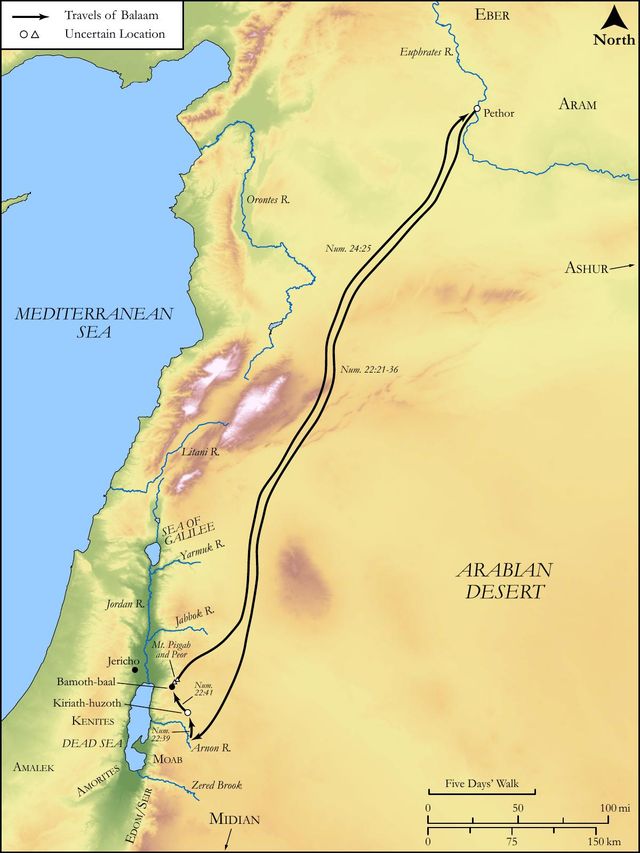
Among the nations, the practice of divination and the belief in the power of curses and blessings were widespread and deeply ingrained, as Moses said of the nations of Canaan: "these nations, which thou shalt possess, hearkened unto observers of times, and unto diviners." Individuals like Balaam, who possessed a reputation for spiritual insight and efficacy in pronouncements, were highly sought after by rulers for political and military advantage. Kings would employ such figures to invoke divine favor upon their armies or bring misfortune upon their enemies. Balak's summons of Balaam from Pethor, a city in Mesopotamia (modern-day Turkey), highlights Balaam's widespread renown and the desperate nature of Balak's fear. The Moabites and Midianites, as neighboring peoples, perceived the large Israelite encampment on their border as an existential threat, prompting their reliance on spiritual warfare through Balaam.
Key Themes
ShowHideNumbers 22:12 powerfully articulates several foundational theological themes. Firstly, it asserts God's Divine Sovereignty and absolute control over all creation and human affairs. No human or spiritual power, including Balaam's renowned abilities, can thwart God's will or alter His plans for His chosen people. Secondly, the verse emphasizes the Irrevocable Blessing bestowed upon Israel. The phrase "for they [are] blessed" signifies a divinely declared status, rooted in the Abrahamic Covenant, which promised blessing to those who blessed Abraham's descendants and cursing to those who cursed them. This blessing is not conditional on Israel's immediate actions but is a steadfast divine decree that cannot be undone by human malice or supernatural intervention. Thirdly, the verse underscores the Power and Finality of God's Word, presenting God's command as the ultimate authority that Balaam must obey, regardless of the lucrative offer from Balak.
Exposition and Analysis
ShowHideKey Word Analysis
ShowHideThis primitive root (H1288) primarily means "to kneel," and by implication, "to bless God (as an act of adoration)" or "man (as a benefit)." In the KJV text, the form "blessed" (Hebrew: bārûkh) is a passive participle derived from this root, indicating a state of being divinely favored, endowed with prosperity, and set apart by God. It denotes an active, ongoing divine endowment that provides protection, success, and flourishing. In this context, it is not merely a wish or a potential state but a declared reality, an immutable status conferred by God Himself. This divine blessing is the ultimate shield against any human or demonic curse.
This primitive root (H779) means "to execrate" or "bitterly curse." Among the nations, a curse was understood not just as an ill wish but as a potent verbal act believed to invoke supernatural power to bring about harm, misfortune, or even death. Balak sought Balaam precisely because he believed Balaam's curses had this inherent, effective power. God's prohibition directly confronts this belief, asserting that no human curse can override His divine blessing, as any attempt to execrate Israel would be a direct affront to God's own decree.
This primitive root (H3212) means "to walk" (literally or figuratively) or "to carry." In the KJV text, the phrase "Thou shalt not go" uses the imperfect verb form tēlēḵ (from yâlak) combined with the strong negative particle lōʾ. This forms an unequivocal prohibition. God is not merely advising Balaam but issuing a non-negotiable directive that encompasses both the physical act of accompanying the Moabite messengers and, by extension, the entire enterprise of cursing Israel. This command targets the very first step of Balak's plan, demonstrating God's preemptive control.
Verse Breakdown
ShowHide"And God said unto Balaam"
This opening clause immediately establishes the divine initiative and authority. God directly communicates His will to Balaam, indicating that Balaam is not merely a pagan diviner but someone with whom God chooses to interact, albeit for His own purposes. This direct address underscores the gravity and clarity of the subsequent command, emphasizing that the message originates from the supreme divine authority.
"Thou shalt not go with them"
This is the first explicit prohibition. It forbids Balaam from accompanying the Moabite and Midianite emissaries, thereby preventing him from even commencing the journey that would lead to the intended cursing. This command targets the very first step of Balak's plan, demonstrating God's preemptive control and His desire to halt the scheme before it can even begin to unfold.
"thou shalt not curse the people"
This is the second, equally emphatic prohibition, addressing the core purpose for which Balaam was summoned. God directly forbids the act of cursing Israel, making it clear that such an act would be a direct defiance of His will and an attack on His chosen nation. This command is absolute and without qualification, highlighting the inviolability of God's covenant people.
"for they [are] blessed"
This final clause provides the divine rationale and the immutable truth behind the prohibitions. Israel's status as "blessed" by God is the ultimate reason why no curse can prevail against them. This is not a temporary state but a fundamental, divinely conferred reality, rooted in God's covenant faithfulness and His sovereign choice of Israel. It renders any attempt to curse them futile and blasphemous, as it directly contradicts God's active favor and protection over His people.
Literary Devices
ShowHideNumbers 22:12 employs several potent literary devices. The most prominent is Divine Command, where God's direct and authoritative voice issues unequivocal prohibitions. This highlights His absolute sovereignty and the non-negotiable nature of His will. The Repetition of the negative command "thou shalt not" ("Thou shalt not go... thou shalt not curse...") serves to emphasize the absolute nature of the prohibition, leaving no ambiguity for Balaam. This repetition also creates a sense of divine insistence and firmness, underscoring the gravity of the directive. The verse also utilizes Reason/Justification ("for they [are] blessed"), providing an immediate and powerful theological basis for the command. This justification elevates the prohibition from a mere arbitrary rule to a declaration of divine truth about Israel's status. Finally, the verse serves as Foreshadowing, hinting at the divine resistance Balaam will encounter throughout the narrative, culminating in his inability to curse Israel despite his persistent attempts.
Theological and Thematic Connections
ShowHideNumbers 22:12 profoundly reveals God's active involvement in the protection of His covenant people. It underscores that God's blessing is not merely a passive state but an active, defensive shield against all opposing forces, whether human or spiritual. This divine protection is rooted in His unwavering faithfulness to His covenant promises, particularly those made to Abraham, ensuring that His purposes for Israel cannot be thwarted by external malice. The verse asserts God's ultimate sovereignty over all powers, demonstrating that even renowned spiritual practitioners like Balaam are subject to His supreme authority. It provides immense comfort, assuring believers that if God has blessed them, no curse or scheme can ultimately prevail against His divine favor.
Reflection and Application
ShowHideNumbers 22:12 offers profound and enduring truths for believers today. Just as God actively protected ancient Israel from the spiritual machinations of their enemies, He continues to protect His people, the Church, from spiritual attacks and the schemes of the adversary. This verse serves as a powerful reminder that our identity and security are rooted in God's unshakeable blessing and sovereign will. When we face opposition, criticism, or even spiritual warfare, we can rest in the assurance that if God has blessed us, no curse or negative force can genuinely prevail against His divine favor. This truth calls us to walk in confidence, trusting in God's ultimate control, and to prioritize obedience to His clear commands, even when worldly pressures or personal gain tempt us to deviate. Our blessed status in Christ means we are eternally secure in His love and purpose, empowered to live without fear of external condemnation or spiritual assault.
Questions for Reflection
ShowHideFAQ
ShowHideWhy did Balak seek Balaam to curse Israel?
ShowHideBalak, the King of Moab, along with the elders of Midian, was overwhelmed with fear and dread at the sheer number and recent military victories of the Israelites, who were encamped on the plains of Moab. Among the nations, it was a common belief that powerful spiritual figures, like Balaam, could invoke divine curses upon enemies or blessings upon allies, thereby influencing the outcome of conflicts. Balak sought to neutralize the perceived threat of Israel through supernatural means, believing that a curse from Balaam would weaken them and allow Moab to defeat them. This desperate act highlights the deep-seated fear and the prevalent cultural reliance on divination and sorcery in that era, as well as the perceived efficacy of Balaam's pronouncements, as seen in Numbers 22:6.
What is the significance of God stating, "for they [are] blessed"?
ShowHideThis phrase is the theological linchpin of the verse. It signifies that Israel's favored status is not conditional or temporary, but a divinely declared and immutable reality. It points back to God's covenant with Abraham in Genesis 12:2-3, where God promised to bless those who blessed Abraham's descendants and curse those who cursed them. Therefore, Israel's blessing is a direct result of God's sovereign choice and faithfulness to His covenant. It means that any attempt by Balaam or anyone else to curse them is fundamentally futile, as it goes against God's established will and active protection. God's blessing acts as an impenetrable shield, rendering all opposing spiritual attacks powerless.
Did Balaam fully obey God's command in Numbers 22:12?
ShowHideWhile Balaam initially relays God's command to the Moabite messengers and sends them away (as seen in Numbers 22:13), his subsequent actions reveal a complex and ultimately disobedient heart. When Balak sends more prestigious messengers and offers greater rewards, Balaam again consults God, despite the clear initial prohibition. Although God permits him to go under strict conditions (only to speak what God tells him), Balaam's eagerness for the reward and his later counsel to Balak to tempt Israel into sin (Numbers 31:16) demonstrate that he did not fully embrace the spirit of God's initial, unequivocal command. His journey itself, despite God's conditional permission, showed a desire to pursue the lucrative offer, leading to the famous encounter with the talking donkey in Numbers 22:22-35. This illustrates that outward compliance does not always equate to inward obedience.
Christ-Centered Fulfillment
ShowHideNumbers 22:12, with its declaration of Israel's immutable blessedness and God's sovereign protection, finds its ultimate and most profound fulfillment in Jesus Christ. Just as ancient Israel was blessed and untouchable by curses due to God's covenant faithfulness, so too the Church, the new Israel, is eternally blessed in Christ. In Him, all of God's promises find their "Yes" and "Amen" (2 Corinthians 1:20). Christ Himself became a curse for us on the cross, redeeming us from the curse of the law so that the blessing of Abraham might come upon the Gentiles through faith (Galatians 3:13-14). Through our union with Christ, we are now "blessed with every spiritual blessing in the heavenly places" (Ephesians 1:3), a status far surpassing any earthly blessing. Jesus, as our great High Priest, continually blesses His people (Hebrews 7:7), and as the "Lamb of God who takes away the sin of the world" (John 1:29), He has definitively disarmed all spiritual powers and authorities that would seek to curse or condemn us (Colossians 2:15). Therefore, the divine declaration "they are blessed" echoes through the ages, finding its most glorious and permanent reality in the redeemed people of God, eternally secure in their Savior.