


Numbers 31:16
Bible text: King James Version (1769 Blayney text) · Public domain
Bible text: King James Version with Strong's numbers · Public domain
Bible text: Berean Standard Bible · Public domain
Bible text: American Standard Version (1901) · Public domain
Bible text: World English Bible, Messianic edition · Public domain
Bible text: Geneva Bible (1599) · Public domain
Bible text: Young's Literal Translation · Public domain
- הֵןhenthere!H2005PrtParticle Interjection
- הֵנָּהHe·nahtheyH2007Pro-3fpPronoun Personal 3rd Plural Feminine
- הָיוּha·Yuthey wereH1961V-Qal-Perf-3cpVerb Qal Perfect 3rd Plural common gender
- לִבְנֵיliv·Neito [the] people ofH1121Prep-l ¦ N-mpcNoun Plural Masculine Constructלִtoבְנֵי[the] people of
- יִשְׂרָאֵלYis·ra·'ElIsraelH3478N-properNoun Proper Location
- בִּדְבַרbid·Varby [the] word ofH1697Prep-b ¦ N-mscNoun Singular Masculine Constructבִּbyדְבַר[the] word of
- בִּלְעָםbil·'AmBalaamH1109N-proper-mNoun Proper Masculine
- לִמְסָרlim·sorto offerH4560Prep-l ¦ V-Qal-InfVerb Qal Infinitive Constructלִtoמְסָרoffer
- מַעַלMa·'alunfaithfulnessH4604N-msNoun Singular Masculine Absolute
- בַּיהוָהba·Yah·wehin YahwehH3068Prep-b ¦ N-properNoun Proper TitleבַּinיהוָהYahweh
- עַל'alonH5921PrepPreposition
- דְּבַרde·var[the] matter ofH1697N-mscNoun Singular Masculine Construct
- פְּעוֹרpe·'orPeorH6465N-properNoun Proper Location
- וַתְּהִיva·te·Hiand it wasH1961Conj-w ¦ V-Qal-ConsecImperf-3fsVerb Qal Consecutive Imperfect 3rd Singular Feminineוַandתְּהִיit was
- הַמַּגֵּפָהha·ma·ge·Fahthe plagueH4046Art ¦ N-fsNoun Singular Feminine Absoluteהַtheמַּגֵּפָהplague
- בַּעֲדַתba·'a·Datamong [the] congregation ofH5712Prep-b ¦ N-fscNoun Singular Feminine Constructבַּamongעֲדַת[the] congregation of
- יְהוָהYah·wehYahwehH3068N-properNoun Proper Title
English is a literal word-by-word gloss of the Hebrew, not the KJV's wording. Why?
This is the original text the KJV's translators worked from — each Hebrew word with its own literal English meaning in this verse, prepared by scholars at Tyndale House, Cambridge. The KJV translates whole sentences, not word by word, so its wording differs: one Hebrew word can become several English words, and the KJV may choose “the LORD” where the gloss reads “Yahweh”. Both are faithful — they answer different questions. For the KJV's own rendering, switch to the KJV text.
Details
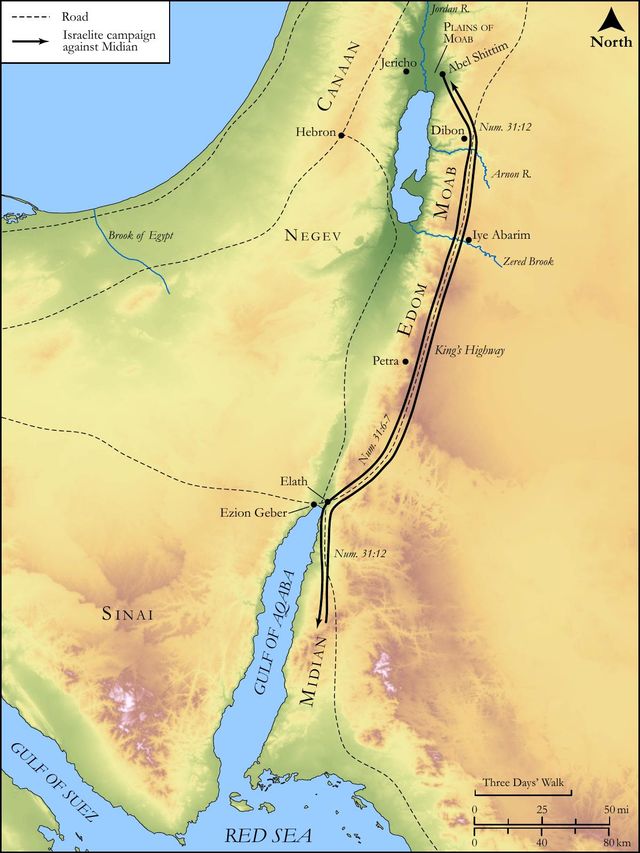
See on the biblical-era map
Study this verse
Historical interpretation
Historical reception
1 surviving comment on this verse from the historical church.
The sin of Phogor: The sin committed in the worship of Beelphegor.
Continue studying Numbers 31:16 across the web’s major study libraries — every link below opens this exact verse, chapter, or book on the destination site.
Read & Compare
 BibleGatewayThis verse in more than 200 translations and 70 languages.
 Bible.comThe YouVersion reader — hundreds of translations, reading plans, and highlights.
 ESV.orgCrossway's official English Standard Version reader.
 NET BibleThe NET translation with 60,000+ translators' notes on every rendering decision.
 STEP BibleTyndale House's free study tool — original text, vocabulary, and scholarly resources.
 BibliaLogos Bible Software's free web reader.
 USCCBThe New American Bible (Revised Edition) with the U.S. bishops' study notes.
Commentaries
 BibleHub CommentariesDozens of classic commentaries on this verse, gathered on one page.
 StudyLightMore than 100 commentary sets — the largest collection on the web.
 BibleRefPlain-English commentary on what this verse means, verse by verse.
 Enduring WordDavid Guzik's free commentary on this chapter, widely used by Bible teachers.
 Bible Study ToolsVerse commentary alongside Greek and Hebrew study aids.
Original Language & Research
- BibleHub InterlinearThe verse word by word — original language, transliteration, and English.
- BibleHub LexiconEvery word's original-language definition and Strong's entry.
 Blue Letter BibleDeep-study tools — Strong's numbers, concordance, and word studies.
 SefariaThe Hebrew text with Rashi and centuries of Jewish commentary.
Sermons, Hymns & Audio


TrulyRandomVerse is not affiliated with these sites and doesn’t control their content. They’re linked because they’re genuinely useful.
Summary
Numbers 31:16 serves as a crucial postscript to the Midianite war, explicitly identifying Balaam's cunning counsel as the direct cause of Israel's catastrophic sin at Baal-peor. This verse unveils the insidious strategy that led the Israelites into profound idolatry and sexual immorality, resulting in a devastating divine plague and standing as a stark, enduring reminder of the severe consequences that arise from spiritual compromise and disobedience to God's covenant.
Context
ShowHideLiterary Context
This verse is embedded within Moses' post-war instructions to the Israelite commanders following their decisive victory over the Midianites in Numbers 31. Having executed the Lord's vengeance against Midian, Moses confronts the commanders for their initial leniency in sparing the Midianite women. Verse 16 provides the explicit theological justification for Moses' subsequent harsh command to execute all Midianite males and non-virgin women. It directly links the Midianite women to the previous national apostasy at Peor, revealing that their presence was not merely a moral oversight but a strategic spiritual threat, orchestrated by Balaam, which had already led to immense divine judgment. This verse underscores the gravity of the spiritual danger posed by those who would lead Israel into covenant unfaithfulness.
Historical & Cultural Context
The "matter of Peor" refers to the calamitous incident detailed in Numbers 25, which transpired while Israel was encamped in the plains of Moab, poised to enter the Promised Land. During this time, Israelite men engaged in widespread sexual immorality with Moabite and Midianite women and participated in the worship of Baal-peor, a local fertility deity. Balaam, a non-Israelite prophet, had been hired by Balak, the king of Moab, to curse Israel. When God repeatedly prevented Balaam from uttering a direct curse, Balaam shrewdly advised Balak to entice Israel into sin by using these women to draw them into idolatry and immorality. This counsel was a calculated strategy to provoke God's wrath against His own people, thereby achieving indirectly what a direct curse could not. The "plague among the congregation of the LORD" was God's immediate and devastating judgment, claiming 24,000 Israelite lives, as recorded in Numbers 25:9.
Key Themes
ShowHideNumbers 31:16 powerfully reinforces several foundational themes woven throughout the book of Numbers and the broader Pentateuch. Firstly, it highlights the theme of spiritual deception and apostasy, illustrating how external, insidious influences, specifically the "counsel of Balaam," can subtly yet profoundly lead God's covenant people astray. Balaam's strategy was not a frontal assault but a cunning corruption from within, a danger against which Israel was repeatedly warned (e.g., Deuteronomy 7:1-6). Secondly, the verse underscores the holiness of God and the severe consequences of disobedience. The swift and deadly "plague" serves as a vivid demonstration of God's righteous judgment against idolatry and unfaithfulness, emphasizing His intolerance for sin among His chosen people. This aligns with the broader narrative of divine judgment for rebellion seen throughout the wilderness wanderings, such as the rebellion of Korah in Numbers 16. Finally, it speaks to the seriousness of covenant breach, as the "trespass against the LORD" was not merely a moral failing but a profound betrayal of the unique, exclusive relationship Israel had with Yahweh, their covenant God.
Exposition and Analysis
ShowHideKey Word Analysis
ShowHideThis term, derived from a root meaning "to speak," refers to a word, matter, or advice. In this context, it signifies Balaam's deliberate and strategic scheme or plan. It was not a casual suggestion but a calculated plot, designed to exploit Israel's weaknesses and provoke divine judgment by leading them into idolatry and immorality. This highlights the malevolent intent and strategic depth behind the temptation.
This word denotes an act of unfaithfulness, a breach of trust, or sacrilege, particularly against God or sacred things. It implies a profound violation of covenant obligations, a deep betrayal. More than just a general "sin," maʻal emphasizes an act of disloyalty and defection from the LORD, underscoring the gravity of Israel's actions at Peor as a direct affront to their covenant God and a breaking of their exclusive devotion to Him.
This term refers to a divine visitation of disease or disaster, often a sudden, widespread affliction sent by God as a direct judgment. In this context, it specifically denotes the devastating epidemic that swept through the Israelite camp, claiming 24,000 lives. This plague was a direct and immediate consequence of their idolatry and immorality, powerfully demonstrating the swift and severe nature of God's justice against unfaithfulness within His covenant community.
Verse Breakdown
ShowHide"Behold, these caused the children of Israel,"
Moses directly attributes the initiation of Israel's downfall to "these" – referring to the Midianite women who had been spared in the initial conquest. This highlights their instrumental role as agents of temptation and corruption, underscoring the profound danger of external influences that actively lead to spiritual compromise and apostasy among God's people.
"through the counsel of Balaam, to commit trespass against the LORD in the matter of Peor,"
This clause reveals the true mastermind behind the Midianite women's actions: Balaam. His "counsel" was the strategic blueprint for enticing Israel into the specific sins of idolatry and sexual immorality at Baal-peor. The phrase "trespass against the LORD" underscores that their sin was not merely a moral lapse but a direct act of unfaithfulness and rebellion against their covenant God, a profound betrayal of their exclusive devotion to Him, which was the very foundation of their identity.
"and there was a plague among the congregation of the LORD."
This final phrase states the immediate and devastating consequence of their corporate sin: a divinely sent "plague." This plague served as God's swift, righteous, and public judgment upon the community for their corporate sin, demonstrating His unwavering holiness and His absolute intolerance for idolatry and spiritual impurity within His covenant people. It was a clear sign of His displeasure and a call to repentance.
Literary Devices
ShowHideNumbers 31:16 functions primarily as a Didactic Narrative, serving to instruct the reader about the profound dangers of spiritual compromise and the severe consequences of sin. It employs clear Causality, explicitly linking the Midianite women and, more fundamentally, Balaam's counsel, as the direct cause of Israel's "trespass" and the subsequent "plague." This clear cause-and-effect relationship powerfully reinforces the theological principle of divine Retribution, where God's righteous judgment directly follows human disobedience. There is also a strong element of Irony in Balaam's strategy; unable to curse Israel directly through prophetic utterance, he achieves his malicious goal indirectly by devising a plan that causes Israel to incur God's wrath upon themselves. The verse also serves as a concise Recapitulation, succinctly summarizing the critical events of Numbers 25 and providing the theological rationale for Moses' severe instructions regarding the Midianite women, thereby tying past events to present commands.
Theological and Thematic Connections
ShowHideNumbers 31:16 stands as a potent and enduring reminder of the insidious nature of spiritual warfare and the ever-present danger of compromise. It highlights that the most dangerous attacks on God's people often come not through direct confrontation but through subtle temptations designed to draw them away from their covenant loyalty. Balaam's counsel represents a timeless strategy of the enemy: to lure believers into idolatry and immorality, knowing that such actions break fellowship with God and invite His righteous judgment. This incident underscores God's unwavering holiness and His demand for exclusive worship and purity from His people, demonstrating that even His chosen nation is not exempt from the consequences of unfaithfulness. The plague serves as a stark testament to the seriousness with which God views spiritual adultery and the breach of covenant, emphasizing that His character demands a response to sin.
Reflection and Application
ShowHideNumbers 31:16 serves as a powerful cautionary tale for believers across all generations, compelling us to recognize that spiritual battles are often fought on the subtle terrain of influence and temptation. Just as Balaam's counsel sought to corrupt Israel from within, so too does the enemy seek to introduce compromise into our lives through seemingly benign relationships, cultural pressures, or deceptive ideologies. We are called to cultivate keen spiritual discernment, guarding our hearts and minds against any "counsel" that would lead us away from exclusive devotion to the Lord. This includes being vigilant about the media we consume, the company we keep, and the philosophies we embrace, ensuring they align with biblical truth. The incident at Peor, combining sexual immorality with idolatry, reminds us that true worship demands purity in all aspects of life, and that any form of spiritual syncretism or devotion to worldly idols will inevitably incur divine displeasure. While we live under grace, the principle remains: sin has profound consequences, and God's holiness requires us to pursue lives of obedience and faithfulness, trusting in His power to keep us from falling.
Questions for Reflection
ShowHideFAQ
ShowHideWhat exactly was the "matter of Peor" mentioned in this verse?
ShowHideThe "matter of Peor" refers to a devastating incident described in Numbers 25 where Israelite men engaged in widespread sexual immorality with Moabite and Midianite women. Crucially, this immorality was intertwined with participation in the idolatrous worship of Baal-peor, a local fertility god. This involved both physical prostitution and spiritual idolatry, constituting a direct violation of God's covenant commands against worshipping other gods and engaging in immoral practices. It was a profound act of unfaithfulness that provoked God's wrath and resulted in a severe plague among the Israelite congregation, claiming 24,000 lives.
How did Balaam's counsel lead Israel to commit trespass, given that he couldn't curse them directly?
ShowHideBalaam, after being repeatedly prevented by God from cursing Israel directly, advised Balak, the king of Moab, on an alternative, more insidious strategy. His "counsel" was to entice the Israelite men into sin by sending Moabite and Midianite women among them. These women would then lure the Israelite men into sexual immorality and, crucially, into participating in their idolatrous worship of Baal-peor. Balaam understood that while he could not curse God's people by divine decree, God Himself would judge them if they willingly broke His covenant. This indirect strategy exploited Israel's moral and spiritual vulnerabilities, causing them to incur divine judgment upon themselves, as later confirmed in Revelation 2:14, where it is referred to as "the teaching of Balaam."
Christ-Centered Fulfillment
ShowHideNumbers 31:16, with its stark depiction of sin, judgment, and the insidious nature of spiritual deception, ultimately points to the necessity and sufficiency of Christ. The "trespass against the LORD" at Peor, leading to a devastating plague, highlights the severity of human sin and God's righteous wrath against it. This judgment foreshadows the ultimate judgment due to all humanity for their rebellion against God. However, in Christ, we find the fulfillment of God's justice and mercy. He is the Lamb of God who takes away the sin of the world, bearing the "plague" of God's wrath on the cross so that those who believe might be spared from eternal condemnation. Furthermore, Balaam's cunning counsel, designed to lead God's people astray, finds its ultimate defeat in Jesus. Christ, as our Good Shepherd, protects His flock from spiritual deception and leads them in paths of righteousness, unlike the false prophets and deceptive influences that seek to corrupt. Through His indwelling Spirit, He empowers believers to resist the devil and overcome the temptations of the world, ensuring that those who are truly His will not fall prey to the "doctrine of Balaam" but will remain faithful to Him who alone is worthy of all worship and devotion, having redeemed us from every lawless deed and purified for himself a people for his own possession.