


Numbers 31:17
Bible text: King James Version (1769 Blayney text) · Public domain
Bible text: Berean Standard Bible · Public domain
Bible text: American Standard Version (1901) · Public domain
Bible text: World English Bible, Messianic edition · Public domain
Bible text: Geneva Bible (1599) · Public domain
Bible text: Young's Literal Translation · Public domain
- וְעַתָּהve·'a·Tahand thereforeH6258Conj-w ¦ AdvAdverbוְandעַתָּהtherefore
- הִרְגוּhir·GukillH2026V-Qal-Imp-2mpVerb Qal Imperative 2nd Plural Masculine
- כָלkholeveryH3605N-msNoun Singular Masculine Absolute
- זָכָרza·KharmaleH2145Adj-msAdjective Singular Masculine Absolute
- בַּטָּףba·Tafamong the little one[s]H2945Prep-b ¦ N-msNoun Singular Masculine Absoluteבַּamong theטָּףlittle one[s]
- וְכָלve·kholand everyH3605Conj-w ¦ N-mscNoun Singular Masculine Constructוְandכָלevery
- אִשָּׁה'i·ShahwomanH802N-fsNoun Singular Feminine Absolute
- יֹדַעַתyo·Da·'at[who has] knownH3045V-Qal-Prtcpl-fsVerb Qal Participle Singular Feminine Absolute
- אִישׁ'isha manH376N-msNoun Singular Masculine Absolute
- לְמִשְׁכַּבle·mish·Kavto [the] lying ofH4904Prep-l ¦ N-mscNoun Singular Masculine Constructלְtoמִשְׁכַּב[the] lying of
- זָכָרza·Khara maleH2145Adj-msAdjective Singular Masculine Absolute
- הֲרֹגוּha·Ro·gukillH2026V-Qal-Imp-2mpVerb Qal Imperative 2nd Plural Masculine
English is a literal word-by-word gloss of the Hebrew, not the KJV's wording. Why?
This is the original text the KJV's translators worked from — each Hebrew word with its own literal English meaning in this verse, prepared by scholars at Tyndale House, Cambridge. The KJV translates whole sentences, not word by word, so its wording differs: one Hebrew word can become several English words, and the KJV may choose “the LORD” where the gloss reads “Yahweh”. Both are faithful — they answer different questions. For the KJV's own rendering, switch to the KJV text.
Details
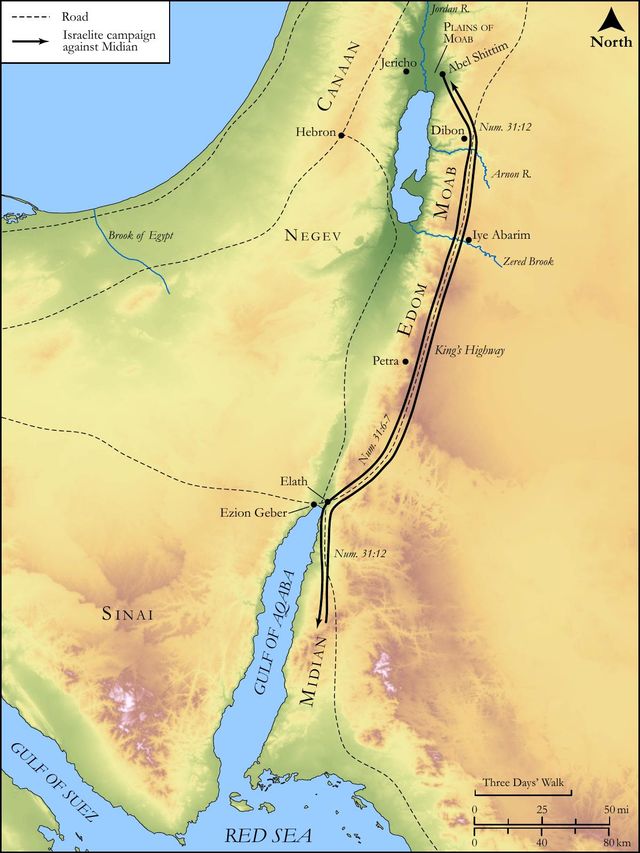
See on the biblical-era map
Study this verse
Historical interpretation
Historical reception
1 surviving comment on this verse from the historical church.
Of the children: Women and children, ordinarily speaking, were not to be killed in war, Deut. 20. 14. But the great Lord of life and death was pleased to order it otherwise in the present case, in detestation of the wickedness of this people, who by the counsel of Balaam, had sent their women among the Israelites on purpose to draw them from God.
Continue studying Numbers 31:17 across the web’s major study libraries — every link below opens this exact verse, chapter, or book on the destination site.
Read & Compare
 BibleGatewayThis verse in more than 200 translations and 70 languages.
 Bible.comThe YouVersion reader — hundreds of translations, reading plans, and highlights.
 ESV.orgCrossway's official English Standard Version reader.
 NET BibleThe NET translation with 60,000+ translators' notes on every rendering decision.
 STEP BibleTyndale House's free study tool — original text, vocabulary, and scholarly resources.
 BibliaLogos Bible Software's free web reader.
 USCCBThe New American Bible (Revised Edition) with the U.S. bishops' study notes.
Commentaries
 BibleHub CommentariesDozens of classic commentaries on this verse, gathered on one page.
 StudyLightMore than 100 commentary sets — the largest collection on the web.
 BibleRefPlain-English commentary on what this verse means, verse by verse.
 Enduring WordDavid Guzik's free commentary on this chapter, widely used by Bible teachers.
 Bible Study ToolsVerse commentary alongside Greek and Hebrew study aids.
Original Language & Research
- BibleHub InterlinearThe verse word by word — original language, transliteration, and English.
- BibleHub LexiconEvery word's original-language definition and Strong's entry.
 Blue Letter BibleDeep-study tools — Strong's numbers, concordance, and word studies.
 SefariaThe Hebrew text with Rashi and centuries of Jewish commentary.
Sermons, Hymns & Audio


TrulyRandomVerse is not affiliated with these sites and doesn’t control their content. They’re linked because they’re genuinely useful.
Summary
Numbers 31:17 presents a profoundly challenging divine command issued by Moses to the Israelite forces following their decisive victory over the Midianites. This verse mandates the execution of all male children and all women who had engaged in sexual relations, a severe measure rooted in God's judgment against Midian for their role in corrupting Israel at Peor and aimed at preventing future spiritual contamination of the covenant community.
Context
ShowHideLiterary Context
This command is situated within a narrative of divine retribution and purification. The preceding verses in Numbers 31 detail God's explicit instruction to Moses to "avenge the children of Israel of the Midianites" (Numbers 31:2). The immediate catalyst for this vengeance was the incident at Baal-Peor, recorded in Numbers 25, where Midianite and Moabite women enticed Israelite men into idolatry and sexual immorality, leading to a devastating plague that killed 24,000. After the initial battle, the Israelite soldiers spared the Midianite women and children (Numbers 31:9-11), but Moses, upon seeing this, was enraged. He explicitly linked the spared women to the Peor apostasy in Numbers 31:16, underscoring that the command in verse 17 was a direct response to this past spiritual betrayal and a preventative measure against future contamination.
Historical & Cultural Context
The command must be understood within the context of "holy war" or divine judgment as set forth in the law of Moses, where the concept of herem (devotion to destruction) was sometimes applied to enemies of God's people, though not explicitly named here. Midian was a nomadic people, often hostile to Israel, whose spiritual practices, particularly their fertility cults and idolatry, directly threatened Israel's monotheistic covenant with Yahweh. The incident at Peor demonstrated the potent danger of syncretism and religious apostasy. For Israel, maintaining ritual and spiritual purity was paramount to their identity as God's chosen nation, set apart to bear His name and witness. The command reflects a drastic measure to eradicate a profound spiritual threat and to execute divine justice upon a people who had actively sought to undermine God's covenant with Israel.
Key Themes
ShowHideThe passage powerfully underscores several critical themes. First, Divine Judgment and Holiness are central, demonstrating God's absolute intolerance for sin, especially idolatry and spiritual apostasy, and His sovereign right to execute judgment upon nations for their wickedness. This was a direct act of judgment against a people who had become utterly corrupt and a clear spiritual threat to Israel's covenant fidelity. Second, the Consequences of Sin are starkly highlighted; the drastic nature of the command illustrates the extreme severity of rebellion against God and the destructive impact of leading others into sin, as the Midianites had done at Peor. Finally, the command emphasizes the Protection of Israel's Purity and Covenant Fidelity. Moses's instruction aimed to safeguard the spiritual and moral integrity of the Israelite community, preventing further idolatry and immorality that could jeopardize their unique relationship with God, as seen in the broader narrative of their wilderness wanderings and preparation for entering the Promised Land, where similar commands against corrupting influences would be given (e.g., the directives in Deuteronomy).
Exposition and Analysis
ShowHideKey Word Analysis
ShowHideThis term (טַף, H2945) specifically refers to young children, including infants and toddlers, regardless of gender, who are typically considered innocent and dependent. In this context, its inclusion in the command for execution is particularly jarring and highlights the comprehensive nature of the judgment against the Midianite culture and lineage. The command targets not just the active perpetrators of sin but also those who, by their very existence, would perpetuate the Midianite identity and potentially pose a future spiritual threat to Israel.
This phrase (יָדַע אִישׁ לְמִשְׁכַּב זָכָר, incorporating H3045 'to know', H376 'man', H4904 'lying', and H2145 'male') is a common biblical euphemism for a woman who has had sexual intercourse with a man, indicating an adult woman. The distinction is crucial: it targets those capable of perpetuating the Midianite culture, religion, and lineage, and specifically those adult women who had participated in or were capable of participating in the previous enticement of Israel at Peor. The young girls who had not "known man" (virgins) were spared, likely with the intent of assimilating them into Israelite society, perhaps through marriage, under strict adherence to Israelite law and the prohibition of idolatry.
Verse Breakdown
ShowHide"Now therefore"
This transitional phrase connects the current command directly to the preceding narrative, particularly Moses's anger and his explicit linking of the Midianite women to the sin at Peor (Numbers 31:16). It signifies that the following instruction is a logical and necessary consequence of the Midianites' actions and the Israelite soldiers' initial failure to fully execute God's judgment.
"kill every male among the little ones"
This part of the command targets all male children, from infants upwards. The rationale is often understood as preventing the future resurgence of the Midianite male line, which would perpetuate their culture, religion, and potential for hostility towards Israel. In ancient warfare, the eradication of male lineage was a common, albeit brutal, method of ensuring the complete subjugation or elimination of a rival nation.
"and kill every woman that hath known man by lying with him"
This clause specifies the execution of all adult Midianite women. As discussed in the key word analysis, these were the women capable of bearing children and, more critically, those who had previously enticed the Israelite men into idolatry and immorality at Baal-Peor. Their elimination was deemed necessary to prevent further spiritual contamination and to fully execute divine judgment against the source of Israel's past apostasy.
Literary Devices
ShowHideThe passage employs Didacticism, serving as a stark lesson on the severity of God's judgment against sin and the absolute necessity of spiritual purity for His covenant people. The directness of the command, while shocking to modern sensibilities, functions as a powerful Hyperbole of divine wrath against profound wickedness, emphasizing that no compromise with idolatry or spiritual corruption would be tolerated. Furthermore, the phrase "known man by lying with him" is a clear Euphemism, a common literary device in biblical Hebrew, used to refer to sexual intercourse in a less explicit manner, yet its meaning is unequivocally understood within the cultural context. The passage's stark language also contributes to its Dramatic Irony, as the Israelites, who had themselves just been judged for their sin at Peor, are now commanded to be the instruments of God's judgment against those who led them astray.
Theological and Thematic Connections
ShowHideNumbers 31:17 is one of the most challenging passages in the Old Testament, confronting readers with the profound severity of God's judgment. Theologically, it underscores God's absolute holiness and His unyielding opposition to sin, particularly idolatry and spiritual apostasy that directly threatened His covenant people. This command is not a universal mandate for all times or societies but a specific, localized act of divine judgment within the unique context of Israel's holy war, aimed at eradicating a deeply corrupt culture that posed an existential spiritual threat. It reveals that God's justice demands a response to deep-seated wickedness and that the consequences of leading others into sin can be devastating. While difficult, it affirms God's sovereignty over life and death and His right to execute judgment upon nations for their unrepentant evil.
Reflection and Application
ShowHideWhile the literal application of Numbers 31:17 is confined to its unique historical and theological context of divine judgment upon a specific nation, its underlying principles offer profound spiritual lessons for believers today. The passage serves as a stark reminder of the extreme seriousness of sin in God's eyes, particularly spiritual idolatry and the corruption of His people. It calls us to reflect on the absolute necessity of spiritual purity and the vigilance required to guard against influences that would lead us away from God. For us, the "Midianites" are not literal people but the spiritual forces and sinful desires that seek to corrupt our hearts and minds, drawing us away from our covenant relationship with Christ. We are called to wage a "holy war" against sin within ourselves and our communities, ruthlessly putting to death anything that hinders our walk with God, striving for holiness as He is holy. This passage compels us to examine what "little ones" (vulnerable areas) and "women who have known man" (entrenched sinful patterns) we might be harboring that need to be decisively dealt with for the sake of our spiritual purity and fidelity to God.
Questions for Reflection
ShowHideFAQ
ShowHideWhy did God command such a harsh judgment, including the killing of children?
ShowHideThis is one of the most challenging commands in the Old Testament. Theologically, it is understood within the unique context of divine judgment upon a deeply corrupt nation that had actively sought to undermine God's covenant people and their unique relationship with Him. The Midianites had led Israel into idolatry and sexual immorality at Baal-Peor, resulting in a plague that killed 24,000 Israelites (Numbers 25:1-9). The command was a comprehensive act of "holy war" or herem, aimed at eradicating a profound spiritual threat and preventing future contamination of Israel's purity. In the wars of the nations round about, the elimination of male lineage and the most influential women was a common, albeit brutal, method of ensuring the complete subjugation and eradication of a rival culture. From a divine perspective, it underscores God's absolute holiness, His hatred of sin, and His sovereign right to execute judgment upon nations for their unrepentant wickedness, ensuring the survival and purity of His chosen people through whom His redemptive plan would unfold.
Does this command apply to Christians today, or does it endorse violence against non-believers?
ShowHideNo, this command does not apply to Christians today, nor does it endorse violence against non-believers. Numbers 31:17 is a specific command given to ancient Israel within a unique historical and theological context of divine judgment upon a particular nation that posed an existential spiritual threat to God's covenant people. The Old Testament reveals God's justice and judgment, but the New Testament reveals the fullness of His love and mercy through Christ. Believers today are called to a spiritual battle against sin and evil, not a literal physical one against people (Ephesians 6:12). The principles of God's holiness, hatred of sin, and the need for spiritual purity remain constant, but their application for Christians is transformed through the lens of Christ's finished work and the new covenant. We are to "put to death" the deeds of the flesh (Colossians 3:5), not literal people.
Christ-Centered Fulfillment
ShowHideWhile Numbers 31:17 stands as a stark testament to God's uncompromising judgment against sin and the necessity of spiritual purity, its ultimate fulfillment and transformation are found in Jesus Christ. The demand for the eradication of those who corrupted Israel foreshadows the radical measures God takes to deal with sin itself, not through human warfare, but through the cross. Christ, the ultimate Lamb of God, who takes away the sin of the world!, bore the full wrath and judgment for humanity's sin, including the spiritual idolatry and immorality that the Midianites represented. He became the object of divine judgment, so that those who believe in Him might be spared. Furthermore, the command to eliminate sources of spiritual contamination points to Christ's work of sanctification, where He purifies His people from within. Through His Spirit, believers are empowered to "put to death" the old self and its sinful desires (our old self was crucified with him and put to death therefore what is earthly in you), just as Israel was commanded to eradicate the Midianite threat. The spiritual battle we wage today is against the "flesh" and the "world," not against people, and our victory is found in the one who conquered sin and death, establishing a new covenant of grace and a kingdom not of this world (My kingdom is not of this world).