


Revelation 2:14
Bible text: King James Version (1769 Blayney text) · Public domain
Bible text: King James Version with Strong's numbers · Public domain
Bible text: Berean Standard Bible · Public domain
Bible text: American Standard Version (1901) · Public domain
Bible text: World English Bible, Messianic edition · Public domain
Bible text: Geneva Bible (1599) · Public domain
Bible text: Young's Literal Translation · Public domain
- ἀλλ᾽all᾽ButG235CONJConjunction
- ἔχωechōI haveG2192V-PAI-1SVerb Present Active Indicative 1st Singular
- κατὰkataagainstG2596PREPPreposition
- σοῦsouyouG4771P-2GSPersonal pronoun Genitive 2nd Singular
- ὀλίγαoligaa few thingsG3641A-APNAdjective Accusative Plural Neuter
- ὅτιhotibecauseG3754CONJConjunction
- ἔχειςecheisyou haveG2192V-PAI-2SVerb Present Active Indicative 2nd Singular
- ἐκεῖekei[some] thereG1563ADVAdverb
- κρατοῦνταςkratountasholdingG2902V-PAP-APMVerb Present Active Participle Accusative Plural Masculine
- τὴνtēntheG3588T-ASFDefinite article Accusative Singular Feminine
- διδαχὴνdidachēnteachingG1322N-ASFNoun Accusative Singular Feminine
- ΒαλαάμBalaamof BalaamG903N-GSM-PNoun Genitive Singular Masculine Individual
- ὃςhoswhoG3739R-NSMRelative pronoun Nominative Singular Masculine
- ἐδίδασκενedidaskenwas teachingG1321V-IAI-3SVerb Imperfect Active Indicative 3rd Singular
- ἕνheninG1722PREPPreposition
- τῷtō<the>G3588T-DSMDefinite article Dative Singular Masculine
- ΒαλὰκBalakBalakG904N-DSM-PNoun Dative Singular Masculine Individual
- βαλεῖνbaleinto castG906V-2AANVerb 2nd Aorist Active Infinitive
- σκάνδαλονskandalona snareG4625N-ASNNoun Accusative Singular Neuter
- ἐνώπιονenōpionbeforeG1799PREPPreposition
- τῶνtōntheG3588T-GPMDefinite article Genitive Plural Masculine
- υἱῶνhuiōnsonsG5207N-GPMNoun Genitive Plural Masculine
- ἸσραὴλIsraēlof IsraelG2474N-GSM-LNoun Genitive Singular Masculine Location
- φαγεῖνphageinto eatG5315V-AANVerb Aorist Active Infinitive
- εἰδωλόθυταeidōlothutaidol-sacrificesG1494A-APNAdjective Accusative Plural Neuter
- καὶkaiandG2532CONJConjunction
- πορνεῦσαιporneusaito commit sexual immoralityG4203V-AANVerb Aorist Active Infinitive
English is a literal word-by-word gloss of the Greek, not the KJV's wording. Why?
This is the original text the KJV's translators worked from — each Greek word with its own literal English meaning in this verse, prepared by scholars at Tyndale House, Cambridge. The KJV translates whole sentences, not word by word, so its wording differs: one Greek word can become several English words, and the KJV may choose “charity” where the gloss reads “love”. Both are faithful — they answer different questions. For the KJV's own rendering, switch to the KJV text.
Details
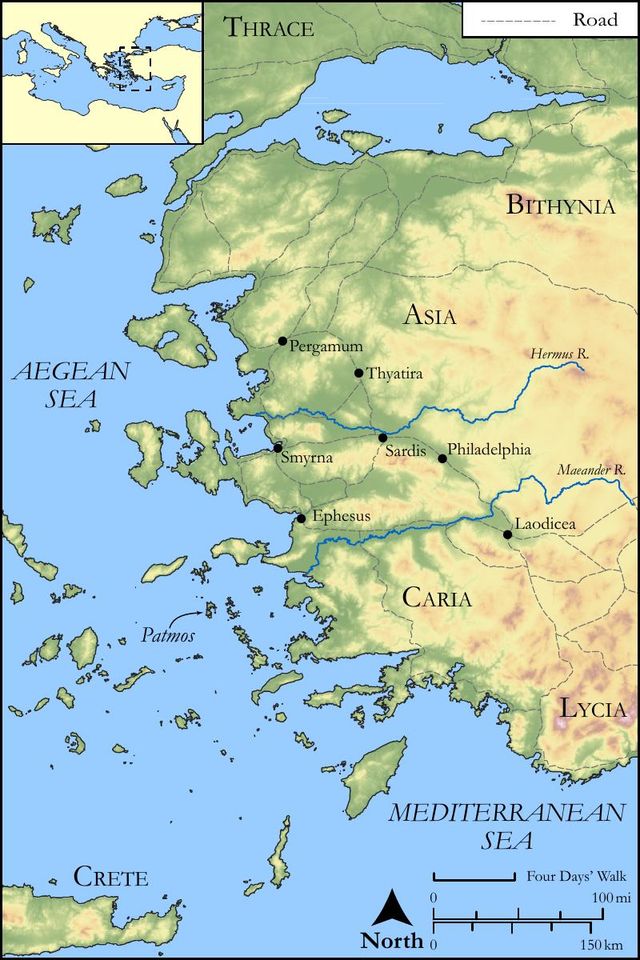
See on the biblical-era maps

Study this verse
Public-domain commentary
Matthew Henry
From his Commentary on the Whole Bible. Henry comments on passages, not single verses — this entry covers Revelation 2:12–17. His three-level outline is real structure in the source text, so it is rendered as structure.
Here also we are to consider,
I.The inscription of this message.
1.To whom it was sent: To the angel of the church of Pergamos. Whether this was a city raised up out of the ruins of old Troy, a Troy nouveau (as our London was once called), or some other city of the same name, is neither certain nor material; it was a place where Christ had called and constituted a gospel church, by the preaching of the gospel and the grace of his Spirit making the word effectual.
2.Who it was that sent this message to Pergamos: the same Jesus who here describes himself as one that hath the sharp sword with two edges (Rev 1:16), out of whose mouth went a sharp two-edged sword. Some have observed that, in the several titles of Christ which are prefixed to the several epistles, there is something suited to the state of those churches; as in that to Ephesus, what could be more proper to awaken and recover a drowsy and declining church than to hear Christ speaking as one that held the stars in his hand, and walked in the midst of the golden candlesticks? etc. The church of Pergamos was infested with men of corrupt minds, who did what they could to corrupt both the faith and manners of the church; and Christ, being resolved to fight against them by the sword of his word, takes the title of him that hath the sharp sword with two edges.
(1.)The word of God is a sword; it is a weapon both offensive and defensive, it is, in the hand of God, able to slay both sin and sinners.
(2.)It is a sharp sword. No heart is so hard but it is able to cut it; it can divide asunder between the soul and the spirit, that is, between the soul and those sinful habits that by custom have become another soul, or seem to be essential to it.
(3.)It is a sword with two edges; it turns and cuts every way. There is the edge of the law against the transgressors of that dispensation, and the edge of the gospel against the despisers of that dispensation; there is an edge to make a wound, and an edge to open a festered wound in order to its healing. There is no escaping the edge of this sword: if you turn aside to the right hand, it has an edge on that side; if on the left hand, you fall upon the edge of the sword on that side; it turns every way.
II.From the inscription we proceed to the contents of the epistle, in which the method is much the same as is observed in the rest. Here,
1.Christ takes notice of the trials and difficulties this church encountered with: I know thy works, and where thou dwellest, etc., Rev 2:13. The works of God's servants are best known when the circumstances under which they did those works are duly considered. Now that which added very much lustre to the good works of this church was the circumstance of the place where this church was planted, a place where Satan's seat was. As our great Lord takes notice of all the advantages and opportunities we have for duty in the places where we dwell, so he takes notice of all the temptations and discouragements we meet with from the places where we dwell, and makes gracious allowances for them. This people dwelt where Satan's seat was, where he kept his court. His circuit is throughout the world, his seat is in some places that are infamous for wickedness, error, and cruelty. Some think that the Roman governor in this city was a most violent enemy to the Christians; and the seat of persecution is Satan's seat.
2.He commends their stedfastness: Thou holdest fast my name, and hast not denied my faith. These two expressions are much the same in sense; the former may, however, signify the effect and the latter the cause or means. (1.) "Thou holdest fast my name; thou art not ashamed of thy relation to me, but accountest it thine honour that my name is named on thee, that, as the wife bears the name of the husband, so thou art called by my name; this thou holdest fast, as thine honour and privilege." (2.) "That which has made thee thus faithful is the grace of faith: thou hast not denied the great doctrines of the gospel, nor departed from the Christian faith, and by that means thou hast been kept faithful." Our faith will have a great influence upon our faithfulness. Men who deny the faith of Christ may boast very much of their sincerity, and faithfulness to God and conscience; but it has been seldom known that those who let go the true faith retained their fidelity; usually on that rock on which men make shipwreck of their faith they make shipwreck of a good conscience too. And here our blessed Lord aggrandizes the fidelity of this church from the circumstance of the times, as well as of the place where they lived: they had been stedfast even in those days wherein Antipas his faithful martyr was slain among them. Who this person was, and whether there be anything mysterious in his name, we have no certain account. He was a faithful disciple of Christ, he suffered martyrdom for it, and sealed his faith and fidelity with his blood in the place where Satan dwelt; and though the rest of the believers there knew this, and saw it, yet they were not discouraged nor drawn away from their stedfastness: this is mentioned as an addition to their honour.
3.He reproves them for their sinful failures (Rev 2:14): But I have a few things against thee, because thou hast there those that hold the doctrine of Balaam, etc., and those that hold the doctrine of the Nicolaitans, which thing I hate. There were some who taught that it was lawful to eat things sacrificed to idols, and that simple fornication was no sin; they, by an impure worship, drew men into impure practices, as Balaam did the Israelites. Observe,
(1.)The filthiness of the spirit and the filthiness of the flesh often go together. Corrupt doctrines and a corrupt worship often lead to a corrupt conversation.
(2.)It is very lawful to fix the name of the leaders of any heresy upon those who follow them. It is the shortest way of telling whom we mean.
(3.)To continue in communion with persons of corrupt principles and practices is displeasing to God, draws a guilt and blemish upon the whole society: they become partakers of other men's sins. Though the church, as such, has no power to punish the persons of men, either for heresy or immorality, with corporal penalties, yet it has power to exclude them from its communion; and, if it do not so, Christ, the head and lawgiver of the church, will be displeased with it.
4.He calls them to repentance: Repent, or else I will come unto thee quickly, etc., Rev 2:16. Observe here,
(1.)Repentance is the duty of saints as well as sinners; it is a gospel duty.
(2.)It is the duty of churches and communities as well as particular persons; those who sin together should repent together.
(3.)It is the duty of Christian societies to repent of other men's sins, as far as they have been accessory to them, though but so much as by connivance.
(4.)When God comes to punish the corrupt members of a church, he rebukes that church itself for allowing such to continue in its communion, and some drops of the storm fall upon the whole society.
(5.)No sword cuts so deep, nor inflicts so mortal a wound, as the sword of Christ's mouth. Let but the threatenings of the word be set home upon the conscience of a sinner, and he will soon be a terror to himself; let these threatenings be executed, and the sinner is utterly cut off. The word of God will take hold of sinners, sooner or later, either for their conviction or their confusion.
III.We have the conclusion of this epistle, where, after the usual demand of universal attention, there is the promise of great favour to those that overcome. They shall eat of the hidden manna, and have the new name, and the white stone, which no man knoweth, saving he that receiveth it, Rev 2:17.
1.The hidden manna, the influences and comforts of the Spirit of Christ in communion with him, coming down from heaven into the soul, from time to time, for its support, to let it taste something how saints and angels live in heaven. This is hidden from the rest of the world - a stranger intermeddles not with this joy; and it is laid up in Christ, the ark of the covenant, in the holy of holies.
2.The white stone, with a new name engraven upon it. This white stone is absolution from the guilt of sin, alluding to the ancient custom of giving a white stone to those acquitted on trial and a black stone to those condemned. The new name is the name of adoption: adopted persons took the name of the family into which they were adopted. None can read the evidence of a man's adoption but himself; he cannot always read it, but if he persevere he shall have both the evidence of sonship and the inheritance.
Historical interpretation
Eight Centuries of Reception
10 surviving comments on this verse. Each one is dated, so this reads as a timeline rather than a list.
Select a marker to jump to its quote. Markers stagger vertically where authors wrote within a few decades of each other.
For, speaking no longer by the Spirit of God, but setting up another law of fornication contrary to the law of God,
He imputes to the Ephesians "forsaken love; " reproaches the Thyatirenes with "fornication," and "eating of things sacrificed to idols; " accuses the Sardians of "works not full; " censures the Pergamenes for teaching perverse things; upbraids the Laodiceans for trusting to their riches; and yet gives them all general monitions to repentance-under comminations, it is true; but He would not utter comminations to one unrepentant if He did not forgive the repentant.
John, however, in the Apocalypse is charged to chastise those "who eat things sacrificed to idols," and "who commit fornication." There are even now another sort of Nicolaitans.
The third order of the saints shows that they are men who are strong in faith, and who are not afraid of persecution; but because even among them there are some who are inclined to unlawful associations, He says:-
"Thou hast there some who hold the doctrine of Balaam, who taught in the case of Balak that he should put a stumbling-block before the children of Israel, to eat and to commit fornication. So also hast thou them who hold the doctrine of the Nicolaitanes; but I will fight with them with the sword of my mouth." That is, I will say what I shall command, and I will tell you what you shall do. For Balaam,22 with his doctrine, taught Balak to cast a stumbling-block before the eyes of the children of Israel, to eat what was sacrificed to idols, and to commit fornication,-a thing which is known to have happened of old. For he gave this advice to the king of the Moabites, and they caused stumbling to the people. Thus, says He, ye have among you those who hold such doctrine; and under the pretext of mercy, you would corrupt others.
"To him that overcometh I will give the hidden manna, and I will give him a white stone." The hidden manna is immortality; the white gem is adoption to be the son of God; the new name written on the stone is "Christian."
“But I have a few things against you.” To be sure, he speaks against some members who must be blamed, but not against those to whom he says, “But you did not deny my faith. You have there some who hold the teaching of Balaam, who taught Balak to put a stumbling block before the sons of Israel, to eat food sacrificed to idols and to practice immorality.” To eat and to commit fornication are the two principle forms [of sin] that the hypocrites struggle to enjoy, as the Lord says, “Inside you are full of plunder and incontinence and every iniquity.” Idolatry is spiritual fornication. “You have lost,” it says, “all who go whoring from you.”
Nevertheless, the Lord has something against this church because there are some who “hold the teaching of Balaam,” which is interpreted “without people” or “without property.” For Balaam is a type of the adversary who does not gather a people for salvation, nor does he rejoice in the number of the multitude that is being saved. Rather, as long as he destroys all and remains without a people and without any property, then he rejoices. It is he himself who “taught Balak to put a stumbling block before the sons of Israel.” For Balak is interpreted to mean “throwing down” or “devouring.” He has thrown Israel down so that it might be consecrated to the idol, Phogor, and he has devoured them by the eating of pleasure and luxury.
It seems that this city had two evils. There were a good number of Greeks, and among those regarded as faithful the shameful Nicolaitans were sown as evil weeds among the wheat. And therefore he reminds them of Balaam, saying, “who through Balaam taught Balak.” Through these words it is clear that he refers to the mental Balaam, that is, the devil, who through the sensual Balaam taught Balak to throw a stone of stumbling before the Israelites, namely, to sacrifice to idols and to commit fornication. Through the pleasure of this heresy, they fell so low that they offered sacrifices to Beelphegor15.
Eating things sacrificed to idols and committing fornication. These are the principal things by which carnal people are militant, whose god is their belly, and whose glory is in their shame. But every evil work is idolatry and spiritual fornication.
But I have against thee a few things: thou hast there them that hold the doctrine of Balaam, who taught Balac to cast a stumbling block before the children of Israel, to eat, and to commit fornication. These things do not at all correspond to the one to whom he had previously said, “Thou holdest fast my name”, etc.; but the speech turns towards another species. What he calls the doctrine of Balaam is the advice he gave Balac to put very beautiful women before the children of Israel so that, delighted by their looks, they might rush into forbidden embraces; enticed by their flatteries, they might eat of Beelphegor's sacrifices; and because of this be forsaken by God and fall before their enemies. [Num. 31:16] Now if we turn from the literal meaning to the symbol, we find how things happened afterwards or are still to happen. Balaam indeed translates to “varying people;” whence it suitably indicates the heretics, who are weakened by their divergent errors. As for Balac, it translates to “knocking out”, and by him are represented the powers of this world, which (most of the time on the advice of heretics) bring the dignity of the Church down for a time. By Israel, “man seeing the Lord God,” are symbolized the elect. So, on Balaam's advice, Balac casts before the children of Israel the stumbling block (that is the deception) of women so that they should eat of things sacrificed to idols and fornicate with them, because, on the heretics' advice, the princes of this world present in their discourses on the outside the sects of the heretics as if they were beautiful, while we know that they are full of all filth inside. Alternatively, Balaam, that is the Devil, teaches Balac, that is the flesh, to cast women, that is pleasures of the world, for souls to perish from.
For you have some who hold the teaching of Balaam, who taught Balak to put a stumbling block before the sons of Israel, so that they might eat food sacrificed to idols and commit sexual immorality. So you also have some who hold the teaching of the Nicolaitans in the same way. Balak, therefore, taught him in the manner of a teacher who became guide to Balaam. According to both Balaam and Balak, the story is clearly established in the book of Numbers, which is the book of Numbers written by the wisest Moses. Josephus records that by the counsel of Balaam, the Midianites were sent against Israel into fornication, calling them to apostasy from God. He says that those who come from Nicolaus do such things and you do not drive them away from yourself.
Continue studying Revelation 2:14 across the web’s major study libraries — every link below opens this exact verse, chapter, or book on the destination site.
Read & Compare
 BibleGatewayThis verse in more than 200 translations and 70 languages.
 Bible.comThe YouVersion reader — hundreds of translations, reading plans, and highlights.
 ESV.orgCrossway's official English Standard Version reader.
 NET BibleThe NET translation with 60,000+ translators' notes on every rendering decision.
 STEP BibleTyndale House's free study tool — original text, vocabulary, and scholarly resources.
 BibliaLogos Bible Software's free web reader.
 USCCBThe New American Bible (Revised Edition) with the U.S. bishops' study notes.
Commentaries
 BibleHub CommentariesDozens of classic commentaries on this verse, gathered on one page.
 StudyLightMore than 100 commentary sets — the largest collection on the web.
 BibleRefPlain-English commentary on what this verse means, verse by verse.
 Enduring WordDavid Guzik's free commentary on this chapter, widely used by Bible teachers.
 Bible Study ToolsVerse commentary alongside Greek and Hebrew study aids.
Original Language & Research
- BibleHub InterlinearThe verse word by word — original language, transliteration, and English.
- BibleHub LexiconEvery word's original-language definition and Strong's entry.
 Blue Letter BibleDeep-study tools — Strong's numbers, concordance, and word studies.
 CNTR CollationThe earliest Greek manuscripts of this verse, collated letter by letter.
Sermons, Hymns & Audio


TrulyRandomVerse is not affiliated with these sites and doesn’t control their content. They’re linked because they’re genuinely useful.
Summary
The message to the church in Pergamos reveals Christ's commendation for their steadfastness in a city dominated by pagan worship and imperial cult, yet it swiftly pivots to a severe rebuke. The primary issue is the church's tolerance of individuals who propagate the "doctrine of Balaam," a teaching that subtly leads believers into spiritual compromise through participation in idolatrous practices and sexual immorality, mirroring the Old Testament prophet's counsel to Balak against Israel. This highlights the critical need for discernment and purity within the Christian community, even amidst external pressures.
Context
ShowHideLiterary Context
This verse is part of the second of seven letters dictated by the resurrected Christ to specific churches in Asia Minor, found in Revelation chapters 2-3. Each letter follows a similar pattern: an address to the church, a self-description of Christ, commendation, criticism (if any), exhortation, a call to hear what the Spirit says, and a promise to the overcomer. In the case of Pergamos, the preceding verse, Revelation 2:13, commends them for holding fast to Christ's name even in "Satan's seat" and enduring the martyrdom of Antipas. Revelation 2:14 then introduces the crucial "but I have a few things against thee," signaling the internal compromise that undermines their external faithfulness. The subsequent verse, Revelation 2:15, notes that they also had those who held "the doctrine of the Nicolaitans," suggesting a similar or related problem of moral and spiritual laxity.
Historical & Cultural Context
Pergamos was a prominent city, the capital of the Roman province of Asia, renowned for its intellectual and religious significance. It was a center of various pagan cults, most notably the worship of Asclepius (god of healing, symbolized by a serpent), and was home to the first temple dedicated to the Roman imperial cult (to Caesar Augustus in 29 BC), making it a hub of emperor worship. This strong pagan presence, coupled with the city's political and religious authority, likely contributed to Christ's description of it as "Satan's seat" (Revelation 2:13). For Christians living in Pergamos, daily life presented constant temptations to compromise, as participation in civic life, trade guilds, and social events often involved rituals or meals dedicated to idols. The specific sins mentioned—eating things sacrificed to idols and fornication—were often intertwined with pagan feasts and temple prostitution, making the church's tolerance of such practices a direct affront to Christian holiness and exclusivity in worship.
Key Themes
ShowHideThe central themes embedded in Revelation 2:14 revolve around spiritual purity versus compromise. The "doctrine of Balaam" serves as a powerful symbol of false teaching that does not directly attack Christ but subtly leads believers into sin through enticement and moral laxity, rather than overt persecution. This highlights the ongoing biblical theme of discernment, where believers are called to distinguish between truth and error, and to reject anything that leads to idolatry or sexual immorality. The passage also underscores the importance of church discipline and the responsibility of the community to guard its holiness and protect its members from spiritual stumblingblocks. This aligns with the broader biblical call for God's people to be set apart from the world and dedicated exclusively to Him, as seen in the Old Testament warnings against assimilation with pagan nations and the New Testament emphasis on living a life worthy of the gospel.
Exposition and Analysis
ShowHideKey Word Analysis
ShowHideFrom the verb "to teach," this word refers to instruction, whether the act of teaching or the content that is taught. In this context, it signifies a specific body of teaching or influence that was being held and propagated within the church at Pergamos. The fact that it is called the "doctrine of Balaam" immediately connects it to a historical precedent of leading God's people astray.
This term originally referred to the bait-stick of a trap, or an obstacle that causes one to trip or fall. Figuratively, it denotes anything that causes someone to stumble into sin, to fall from faith, or to be offended. Balaam's counsel was precisely this—a snare designed to lead the Israelites into spiritual and moral transgression, resulting in divine judgment.
This compound word literally means "image-sacrifice" or "idol-sacrifice." It refers specifically to meat or food that had been offered to pagan deities as part of a ritual or feast. For early Christians, consuming such food was often seen as an act of participation in idolatry, or at least a compromise of their exclusive allegiance to Christ, particularly when done in a context that implied worship or fellowship with pagan practices.
Verse Breakdown
ShowHide"But I have a few things against thee,"
This opening phrase signals a shift from commendation to criticism, indicating that despite their faithfulness in other areas, there was a serious internal flaw that Christ found unacceptable. It underscores the Lord's intimate knowledge of each church's spiritual condition.
"because thou hast there them that hold the doctrine of Balaam,"
The core problem is identified: the church at Pergamos was tolerating or allowing individuals within its fellowship who adhered to and perhaps promoted a teaching or influence akin to that of Balaam. This implies a failure of discernment and discipline on the part of the church leadership or community.
"who taught Balac to cast a stumblingblock before the children of Israel,"
This clause provides the historical and theological basis for understanding the "doctrine of Balaam." It alludes to the Old Testament account in Numbers chapters 22-25 and Numbers 31:16, where Balaam, unable to curse Israel directly, advised Balak, the king of Moab, to entice the Israelites into sin. This counsel involved setting a "stumblingblock"—a snare or trap—that would lead God's people into transgression.
"to eat things sacrificed unto idols, and to commit fornication."
These are the specific outcomes of Balaam's doctrine, both in the Old Testament narrative and in the context of the Pergamos church. "Eating things sacrificed unto idols" refers to participation in pagan feasts, which implied allegiance to other gods or at least a compromise of exclusive worship of God. "Fornication" (sexual immorality) was often intertwined with pagan religious practices, particularly temple prostitution, and symbolized spiritual unfaithfulness to God, mirroring Israel's spiritual adultery in the Old Testament.
Literary Devices
ShowHideThe verse makes significant use of Allusion, directly referencing the Old Testament narrative of Balaam and Balak from Numbers 22-25 and Numbers 31:16. This allusion serves as a powerful metaphor for the subtle yet destructive nature of false teaching. The "doctrine of Balaam" is not a literal re-enactment but a symbolic representation of any teaching or influence that entices God's people into spiritual compromise, particularly through idolatry and sexual immorality, rather than through direct persecution. The term "stumblingblock" (Greek: skandalon) functions as a vivid metaphor for anything that causes spiritual downfall or leads to sin, emphasizing the deceptive and dangerous nature of the false teaching. Furthermore, there is a clear juxtaposition between the commendation of the Pergamos church's faithfulness in Revelation 2:13 and the immediate, sharp criticism in Revelation 2:14, highlighting the complex reality of a church that is strong in some areas but dangerously weak in others.
Theological and Thematic Connections
ShowHideThe "doctrine of Balaam" represents a recurring danger to God's people: the temptation to compromise with the world's values and practices, often through subtle enticements rather than overt opposition. Just as Balaam sought to undermine Israel's relationship with God by leading them into idolatry and immorality, false teachers and worldly influences today can subtly erode the church's purity and devotion to Christ. This passage underscores the importance of maintaining an exclusive allegiance to God, rejecting any teaching or lifestyle that encourages participation in practices contrary to His holiness. It also highlights the corporate responsibility of the church to exercise discernment and discipline, ensuring that its members are not led astray by doctrines that promote spiritual adultery or defilement. The Lord's rebuke to Pergamos serves as a timeless warning against tolerating sin within the community, emphasizing that internal corruption can be as destructive, if not more so, than external persecution.
Reflection and Application
ShowHideRevelation 2:14 serves as a profound warning to believers and churches across all ages. It challenges us to examine not only our outward faithfulness but also the subtle compromises we might be tolerating within our hearts and communities. The "doctrine of Balaam" is a timeless archetype for any teaching or influence that encourages spiritual laxity, moral relativism, or the blending of Christian truth with worldly values. It reminds us that the enemy often seeks to defeat us not through direct assault, but by enticing us to lower our standards, to participate in seemingly harmless activities that subtly defile, or to embrace philosophies that undermine our exclusive devotion to Christ. For the church today, this means diligently guarding the purity of the gospel, exercising discernment regarding cultural trends, and being vigilant against teachings that normalize sin or diminish the call to holiness. Individually, it calls us to a radical commitment to Christ, refusing to allow any "stumblingblock" to lead us into idolatry (whether of material possessions, success, or self) or any form of spiritual or physical immorality. Our faithfulness is measured not just by what we endure, but by what we refuse to tolerate.
Questions for Reflection
ShowHideFAQ
ShowHideWhat exactly was the "doctrine of Balaam" in the Old Testament context?
ShowHideThe "doctrine of Balaam" refers to the counsel Balaam gave to Balak, king of Moab, after he was unable to curse Israel directly. As recorded in Numbers 22-25 and explicitly stated in Numbers 31:16, Balaam advised Balak to entice the Israelite men to commit sexual immorality with Moabite women and participate in their idolatrous feasts. This strategy was highly effective, leading to a plague that killed 24,000 Israelites (Numbers 25:9). In the context of Revelation 2:14, the "doctrine of Balaam" symbolizes any teaching or influence that encourages God's people to compromise their faith through spiritual or physical immorality and participation in idolatrous practices, rather than through direct persecution.
Why are "eating things sacrificed to idols" and "fornication" linked as outcomes of this doctrine?
ShowHideThese two practices were frequently intertwined in the pagan religious and social life of the Gentiles. Pagan feasts often involved the consumption of meat that had been offered to idols, and these gatherings could easily devolve into sexual immorality, including temple prostitution, which was a common feature of many pagan cults. For early Christians, participation in such activities was a direct violation of their exclusive allegiance to God and a compromise of their moral purity. The apostolic decree in Acts 15:29 specifically warned against "things sacrificed to idols, and from blood, and from things strangled, and from fornication," indicating the early church's clear stance on these issues. Spiritually, "fornication" can also symbolize spiritual unfaithfulness or idolatry, where the people of God turn away from Him to pursue other "lovers" or gods, as often depicted in Old Testament prophetic literature (e.g., Hosea 1-3). Thus, the linking of these two sins highlights both the literal moral compromise and the deeper spiritual infidelity they represent.
Christ-Centered Fulfillment
ShowHideThe Lord's rebuke to Pergamos for tolerating the "doctrine of Balaam" finds its ultimate resolution and fulfillment in Christ. Jesus Christ is the embodiment of purity and truth, the very standard against which all doctrines and practices are measured. He is the Lamb of God who takes away the sin of the world, and His atoning sacrifice provides the means for believers to be cleansed from both idolatry and fornication, enabling them to live a life of holiness. Unlike Balaam, who sought to lead God's people astray for gain, Christ, the Good Shepherd, actively protects His flock from wolves in sheep's clothing (Matthew 7:15) and false teachings that would cause them to stumble. His call to the church in Pergamos to repent is a call to return to Him as their sole object of worship and devotion. Furthermore, Christ's future judgment, described with the sharp two-edged sword from His mouth, signifies His authority to cut away all compromise and impurity within His church, ensuring that His bride will ultimately be without spot or wrinkle, holy and blameless before Him. Through His Spirit, believers are empowered to discern truth from error and to live lives that reflect His unblemished holiness, overcoming the temptations to compromise that the "doctrine of Balaam" represents.