


Revelation 2:13
- οἶδαoidaI knowG1492V-RAI-1SVerb Perfect Active Indicative 1st Singular
- τὰtatheG3588T-APNDefinite article Accusative Plural Neuter
- ἔργαergaworksG2041N-APNNoun Accusative Plural Neuter
- σουsouof youG4771P-2GSPersonal pronoun Genitive 2nd Singular
- καὶkaiandG2532CONJConjunction
- ποῦpouwhereG4226ADV-IAdverb Interrogative
- κατοικεῖςkatoikeisyou dwellG2730V-PAI-2SVerb Present Active Indicative 2nd Singular
- ὅπουhopouwhereG3699PREPPreposition
- ὁhotheG3588T-NSMDefinite article Nominative Singular Masculine
- θρόνοςthronosthroneG2362N-NSMNoun Nominative Singular Masculine
- τοῦtou<the>G3588T-GSMDefinite article Genitive Singular Masculine
- σατανᾶsatanaof Satan [is]G4567N-GSM-TNoun Genitive Singular Masculine Title
- καὶkaiandG2532CONJConjunction
- κρατεῖςkrateisyou hold fast toG2902V-PAI-2SVerb Present Active Indicative 2nd Singular
- τὸtotheG3588T-ASNDefinite article Accusative Singular Neuter
- ὄνομάonomanameG3686N-ASNNoun Accusative Singular Neuter
- μουmouof MeG3165P-1GSPersonal pronoun Genitive 1st Singular
- καὶkaiandG2532CONJConjunction
- οὐκouknotG3756PRT-NNegative Particle Negative
- ἠρνήσωērnēsōyou have deniedG720V-ADI-2SVerb Aorist Middle Deponent Indicative 2nd Singular
- τὴνtēntheG3588T-ASFDefinite article Accusative Singular Feminine
- πίστινpistinfaithG4102N-ASFNoun Accusative Singular Feminine
- μουmouof MineG3165P-1GSPersonal pronoun Genitive 1st Singular
- καὶkaievenG2532CONJConjunction
- ἐνeninG1722PREPPreposition
- ταῖςtaistheG3588T-DPFDefinite article Dative Plural Feminine
- ἡμέραιςhēmeraisdaysG2250N-DPFNoun Dative Plural Feminine
- ἐνeninG1722PREPPreposition
- αἷςhaiswhichG3739R-DPFRelative pronoun Dative Plural Feminine
- ἈντιπᾶςAntipasof AntipasG493N-NSM-PNoun Nominative Singular Masculine Individual
- ὁhotheG3588T-NSMDefinite article Nominative Singular Masculine
- μάρτυςmartuswitnessG3144N-NSMNoun Nominative Singular Masculine
- μουmouof MineG3165P-1GSPersonal pronoun Genitive 1st Singular
- ὁhotheG3588T-NSMDefinite article Nominative Singular Masculine
- πιστόςpistosfaithful [one]G4103A-NSMAdjective Nominative Singular Masculine
- ὃςhoswhoG3739R-NSMRelative pronoun Nominative Singular Masculine
- ἀπεκτάνθηapektanthēwas killedG615V-API-3SVerb Aorist Passive Indicative 3rd Singular
- παρ᾽par᾽amongG3844PREPPreposition
- ὑμῖνhuminyouG4771P-2DPPersonal pronoun Dative 2nd Plural
- ὅπουhopouwhereG3699PREPPreposition
- ὁho<the>G3588T-NSMDefinite article Nominative Singular Masculine
- σατανᾶςsatanasSatanG4567N-NSM-TNoun Nominative Singular Masculine Title
- κατοικεῖkatoikeidwellsG2730V-PAI-3SVerb Present Active Indicative 3rd Singular
English is a literal word-by-word gloss of the Greek, not the KJV's wording. Why?
This is the original text the KJV's translators worked from — each Greek word with its own literal English meaning in this verse, prepared by scholars at Tyndale House, Cambridge. The KJV translates whole sentences, not word by word, so its wording differs: one Greek word can become several English words, and the KJV may choose “charity” where the gloss reads “love”. Both are faithful — they answer different questions. For the KJV's own rendering, switch to the KJV text.
Details
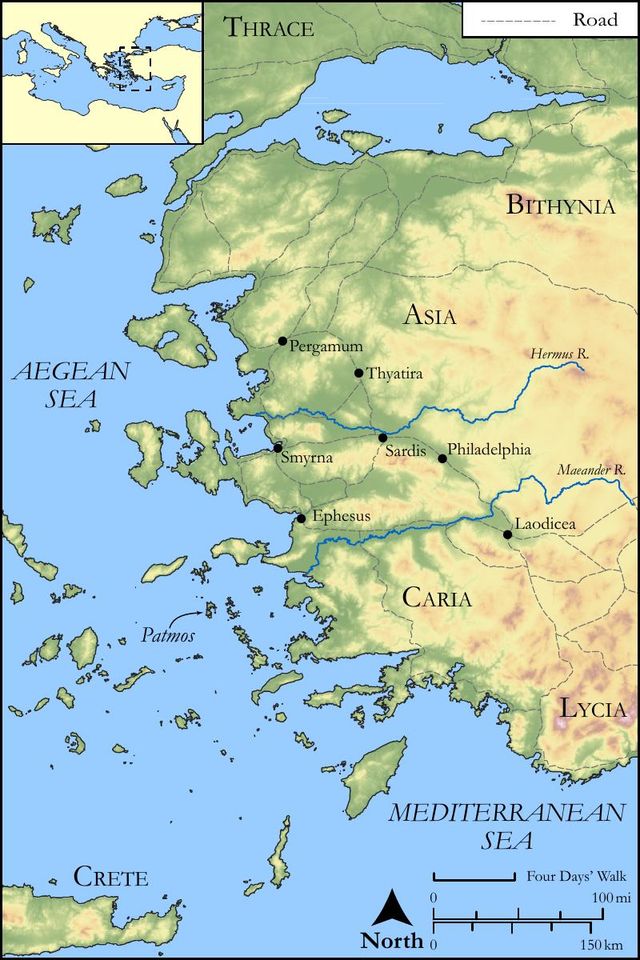
See on the biblical-era map

Study this verse
Public-domain commentary
Matthew Henry
From his Commentary on the Whole Bible. Henry comments on passages, not single verses — this entry covers Revelation 2:12–17. His three-level outline is real structure in the source text, so it is rendered as structure.
Here also we are to consider,
I.The inscription of this message.
1.To whom it was sent: To the angel of the church of Pergamos. Whether this was a city raised up out of the ruins of old Troy, a Troy nouveau (as our London was once called), or some other city of the same name, is neither certain nor material; it was a place where Christ had called and constituted a gospel church, by the preaching of the gospel and the grace of his Spirit making the word effectual.
2.Who it was that sent this message to Pergamos: the same Jesus who here describes himself as one that hath the sharp sword with two edges (Rev 1:16), out of whose mouth went a sharp two-edged sword. Some have observed that, in the several titles of Christ which are prefixed to the several epistles, there is something suited to the state of those churches; as in that to Ephesus, what could be more proper to awaken and recover a drowsy and declining church than to hear Christ speaking as one that held the stars in his hand, and walked in the midst of the golden candlesticks? etc. The church of Pergamos was infested with men of corrupt minds, who did what they could to corrupt both the faith and manners of the church; and Christ, being resolved to fight against them by the sword of his word, takes the title of him that hath the sharp sword with two edges.
(1.)The word of God is a sword; it is a weapon both offensive and defensive, it is, in the hand of God, able to slay both sin and sinners.
(2.)It is a sharp sword. No heart is so hard but it is able to cut it; it can divide asunder between the soul and the spirit, that is, between the soul and those sinful habits that by custom have become another soul, or seem to be essential to it.
(3.)It is a sword with two edges; it turns and cuts every way. There is the edge of the law against the transgressors of that dispensation, and the edge of the gospel against the despisers of that dispensation; there is an edge to make a wound, and an edge to open a festered wound in order to its healing. There is no escaping the edge of this sword: if you turn aside to the right hand, it has an edge on that side; if on the left hand, you fall upon the edge of the sword on that side; it turns every way.
II.From the inscription we proceed to the contents of the epistle, in which the method is much the same as is observed in the rest. Here,
1.Christ takes notice of the trials and difficulties this church encountered with: I know thy works, and where thou dwellest, etc., Rev 2:13. The works of God's servants are best known when the circumstances under which they did those works are duly considered. Now that which added very much lustre to the good works of this church was the circumstance of the place where this church was planted, a place where Satan's seat was. As our great Lord takes notice of all the advantages and opportunities we have for duty in the places where we dwell, so he takes notice of all the temptations and discouragements we meet with from the places where we dwell, and makes gracious allowances for them. This people dwelt where Satan's seat was, where he kept his court. His circuit is throughout the world, his seat is in some places that are infamous for wickedness, error, and cruelty. Some think that the Roman governor in this city was a most violent enemy to the Christians; and the seat of persecution is Satan's seat.
2.He commends their stedfastness: Thou holdest fast my name, and hast not denied my faith. These two expressions are much the same in sense; the former may, however, signify the effect and the latter the cause or means. (1.) "Thou holdest fast my name; thou art not ashamed of thy relation to me, but accountest it thine honour that my name is named on thee, that, as the wife bears the name of the husband, so thou art called by my name; this thou holdest fast, as thine honour and privilege." (2.) "That which has made thee thus faithful is the grace of faith: thou hast not denied the great doctrines of the gospel, nor departed from the Christian faith, and by that means thou hast been kept faithful." Our faith will have a great influence upon our faithfulness. Men who deny the faith of Christ may boast very much of their sincerity, and faithfulness to God and conscience; but it has been seldom known that those who let go the true faith retained their fidelity; usually on that rock on which men make shipwreck of their faith they make shipwreck of a good conscience too. And here our blessed Lord aggrandizes the fidelity of this church from the circumstance of the times, as well as of the place where they lived: they had been stedfast even in those days wherein Antipas his faithful martyr was slain among them. Who this person was, and whether there be anything mysterious in his name, we have no certain account. He was a faithful disciple of Christ, he suffered martyrdom for it, and sealed his faith and fidelity with his blood in the place where Satan dwelt; and though the rest of the believers there knew this, and saw it, yet they were not discouraged nor drawn away from their stedfastness: this is mentioned as an addition to their honour.
3.He reproves them for their sinful failures (Rev 2:14): But I have a few things against thee, because thou hast there those that hold the doctrine of Balaam, etc., and those that hold the doctrine of the Nicolaitans, which thing I hate. There were some who taught that it was lawful to eat things sacrificed to idols, and that simple fornication was no sin; they, by an impure worship, drew men into impure practices, as Balaam did the Israelites. Observe,
(1.)The filthiness of the spirit and the filthiness of the flesh often go together. Corrupt doctrines and a corrupt worship often lead to a corrupt conversation.
(2.)It is very lawful to fix the name of the leaders of any heresy upon those who follow them. It is the shortest way of telling whom we mean.
(3.)To continue in communion with persons of corrupt principles and practices is displeasing to God, draws a guilt and blemish upon the whole society: they become partakers of other men's sins. Though the church, as such, has no power to punish the persons of men, either for heresy or immorality, with corporal penalties, yet it has power to exclude them from its communion; and, if it do not so, Christ, the head and lawgiver of the church, will be displeased with it.
4.He calls them to repentance: Repent, or else I will come unto thee quickly, etc., Rev 2:16. Observe here,
(1.)Repentance is the duty of saints as well as sinners; it is a gospel duty.
(2.)It is the duty of churches and communities as well as particular persons; those who sin together should repent together.
(3.)It is the duty of Christian societies to repent of other men's sins, as far as they have been accessory to them, though but so much as by connivance.
(4.)When God comes to punish the corrupt members of a church, he rebukes that church itself for allowing such to continue in its communion, and some drops of the storm fall upon the whole society.
(5.)No sword cuts so deep, nor inflicts so mortal a wound, as the sword of Christ's mouth. Let but the threatenings of the word be set home upon the conscience of a sinner, and he will soon be a terror to himself; let these threatenings be executed, and the sinner is utterly cut off. The word of God will take hold of sinners, sooner or later, either for their conviction or their confusion.
III.We have the conclusion of this epistle, where, after the usual demand of universal attention, there is the promise of great favour to those that overcome. They shall eat of the hidden manna, and have the new name, and the white stone, which no man knoweth, saving he that receiveth it, Rev 2:17.
1.The hidden manna, the influences and comforts of the Spirit of Christ in communion with him, coming down from heaven into the soul, from time to time, for its support, to let it taste something how saints and angels live in heaven. This is hidden from the rest of the world - a stranger intermeddles not with this joy; and it is laid up in Christ, the ark of the covenant, in the holy of holies.
2.The white stone, with a new name engraven upon it. This white stone is absolution from the guilt of sin, alluding to the ancient custom of giving a white stone to those acquitted on trial and a black stone to those condemned. The new name is the name of adoption: adopted persons took the name of the family into which they were adopted. None can read the evidence of a man's adoption but himself; he cannot always read it, but if he persevere he shall have both the evidence of sonship and the inheritance.
Historical interpretation
Eight Centuries of Reception
9 surviving comments on this verse. Each one is dated, so this reads as a timeline rather than a list.
Select a marker to jump to its quote. Markers stagger vertically where authors wrote within a few decades of each other.
Also to the angel of the church in Pergamus (mention was made) of Antipas, the very faithful martyr, who was slain where Satan dwelleth.
The third order of the saints shows that they are men who are strong in faith, and who are not afraid of persecution; but because even among them there are some who are inclined to unlawful associations, He says:-
"Thou hast there some who hold the doctrine of Balaam, who taught in the case of Balak that he should put a stumbling-block before the children of Israel, to eat and to commit fornication. So also hast thou them who hold the doctrine of the Nicolaitanes; but I will fight with them with the sword of my mouth." That is, I will say what I shall command, and I will tell you what you shall do. For Balaam,22 with his doctrine, taught Balak to cast a stumbling-block before the eyes of the children of Israel, to eat what was sacrificed to idols, and to commit fornication,-a thing which is known to have happened of old. For he gave this advice to the king of the Moabites, and they caused stumbling to the people. Thus, says He, ye have among you those who hold such doctrine; and under the pretext of mercy, you would corrupt others.
"To him that overcometh I will give the hidden manna, and I will give him a white stone." The hidden manna is immortality; the white gem is adoption to be the son of God; the new name written on the stone is "Christian."
“I know where you dwell, where Satan’s throne is.” This he says to every church, since the tempter is everywhere, and to him it is said, “She shall watch your head, and you shall watch for her heel.” “For the world is placed in evil.” Those persons are the throne of Satan whom he owns in wickedness. The Evangelist reverts to the species, for although the entire sevenfold church is symbolized by these seven locales, nonetheless certain things have occurred in them specifically which he either praises or rebukes.
“You hold my name and you did not deny my faith, even in the days of Antipas my witness, my faithful one, who was killed among you.” Indeed, Christ is killed among many, who either do not believe that he rose again, or who deny him among themselves through condemnable faults, and this is “where Satan dwells.”
Antipas was a most courageous martyr in Pergamum, whose martyrdom I have read. Here the Evangelist recalls his memory as a demonstration of their endurance, as well as of the cruelty of those who were deceived.
And in those days my faithful witness Antipas, etc. Some understand Antipas as a martyr who suffered in Pergamum, others as the Lord Christ, who is still killed by unbelievers, as much as it lies in them.
I know where you dwell, where Satan's throne is, etc. I approve of your patience, which, residing among the reprobates who are the throne of the devil, worships me not only by name, being called Christian, but with whole faith even in times of bloody persecution. But I disapprove that I see seducers and false teachers among you.
I know where thou dwellest, where the seat of Satan is. This is said to the Church generally, which dwells throughout the whole world, in which the Devil reigns. And thou holdest fast my name, and hast not denied my faith. Even in those days Antipas my faithful witness, who was slain among you, where Satan dwelleth. This sentence either was corrupted by scribes' fault, or it must be explained by some words being left implied, so that the order of words should be the following: “In those days, Antipas my faithful witness, who was slain among you, did not deny my faith;” or if not, then certainly “In those days there was Antipas my witness, who was slain among you.” In this martyr, it is all witnesses that are praised by the proclamation of their merits. He says among you not because he was slain by them, but among them by those in whom Satan dwells. Note also that first comes thou holdest in the singular, and then comes you in the plural, because he is addressing several in one person.
He says where you dwell, where Satan's throne is. For all of Asia is indeed full of idols, especially Pergamum. But he also says that dwelling in such a place, you have kept my faith unshaken, not deviating at all toward the evil counsel of the many, but even opposing it during the days and festivals of the idols, as my faithful witness who has spoken boldly in my name says, you came as far as you could against those plotting, guarding the truth until death. And since he also touches on the most holy covenant, and we all sin greatly according to what is written to you (James 3:2), and yet being such, he says, "I have the right to accuse."
Continue studying Revelation 2:13 across the web’s major study libraries — every link below opens this exact verse, chapter, or book on the destination site.
Read & Compare
 BibleGatewayThis verse in more than 200 translations and 70 languages.
 Bible.comThe YouVersion reader — hundreds of translations, reading plans, and highlights.
 ESV.orgCrossway's official English Standard Version reader.
 NET BibleThe NET translation with 60,000+ translators' notes on every rendering decision.
 STEP BibleTyndale House's free study tool — original text, vocabulary, and scholarly resources.
 BibliaLogos Bible Software's free web reader.
 USCCBThe New American Bible (Revised Edition) with the U.S. bishops' study notes.
Commentaries
 BibleHub CommentariesDozens of classic commentaries on this verse, gathered on one page.
 StudyLightMore than 100 commentary sets — the largest collection on the web.
 BibleRefPlain-English commentary on what this verse means, verse by verse.
 Enduring WordDavid Guzik's free commentary on this chapter, widely used by Bible teachers.
 Bible Study ToolsVerse commentary alongside Greek and Hebrew study aids.
Original Language & Research
- BibleHub InterlinearThe verse word by word — original language, transliteration, and English.
- BibleHub LexiconEvery word's original-language definition and Strong's entry.
 Blue Letter BibleDeep-study tools — Strong's numbers, concordance, and word studies.
 CNTR CollationThe earliest Greek manuscripts of this verse, collated letter by letter.
Sermons, Hymns & Audio


TrulyRandomVerse is not affiliated with these sites and doesn’t control their content. They’re linked because they’re genuinely useful.
Summary
Revelation 2:13 presents Christ's commendation to the church in Pergamum, acknowledging their dwelling in a profoundly hostile spiritual environment, famously described as "where Satan's seat is." Despite the pervasive idolatry and intense persecution, exemplified by the martyrdom of Antipas, the believers in Pergamum are praised for their unwavering faithfulness, holding fast to Christ's name and refusing to deny His faith. This verse highlights both the severe challenges faced by early Christians and the divine recognition of their steadfast devotion.
Context
ShowHideLiterary Context
This verse is part of the second of seven letters dictated by the resurrected Christ to specific churches in Asia Minor, found in Revelation chapters 2 and 3. Each letter follows a consistent pattern: an introduction of Christ using titles drawn from the vision in Revelation 1, a commendation of the church's strengths, a rebuke for their failings (though Pergamum receives both commendation and a subsequent rebuke for tolerating false teaching in Revelation 2:14-15), an exhortation to repent or persevere, and a promise to those who overcome. The opening phrase, "I know thy works," is a recurring motif, emphasizing Christ's intimate and omniscient awareness of each church's unique circumstances, struggles, and faithfulness. This particular letter to Pergamum follows the message to Smyrna, a church also facing persecution, and precedes the letter to Thyatira.
Historical & Cultural Context
Pergamum (modern-day Bergama, Turkey) was a prominent city, serving as the capital of the Roman province of Asia. It was renowned for its intellectual prowess, housing a vast library second only to Alexandria, and for its medical center dedicated to Asclepius, the god of healing, whose symbol was a serpent. Crucially, Pergamum was a major center of imperial cult worship, boasting the first temple dedicated to a Roman emperor (Augustus in 29 BC), with subsequent temples to Trajan and others. This cult demanded public worship of the emperor as a god, making it a direct challenge to Christian monotheism and the exclusive Lordship of Jesus Christ. The city also featured a massive altar to Zeus, often referred to as the "Great Altar of Pergamum," which dominated the acropolis. These elements—pervasive paganism, the imperial cult, and the visual dominance of structures like the Altar of Zeus—contributed to the city's reputation as a place where spiritual darkness and opposition were exceptionally concentrated, giving rise to the vivid description of "Satan's seat."
Key Themes
ShowHideRevelation 2:13 contributes significantly to several overarching themes within the book of Revelation and the broader New Testament. Firstly, it underscores the theme of Divine Omniscience and Intimate Knowledge, as Christ declares, "I know thy works, and where thou dwellest." This assurance that Christ sees and understands the specific challenges faced by His followers is a source of comfort and accountability, a theme consistently present in the letters to the seven churches (e.g., Revelation 2:2). Secondly, the verse powerfully highlights the reality of Spiritual Warfare and Hostile Environments. The repeated phrase "where Satan's seat is" and "where Satan dwelleth" vividly portrays Pergamum as a stronghold of demonic influence, emphasizing that Christian life is often lived amidst intense spiritual opposition, as further explored in passages like Ephesians 6:12. Thirdly, it celebrates Faithfulness Under Persecution, commending the church for holding fast to Christ's name and not denying His faith, even when faced with the ultimate cost, as seen in the example of Antipas. This theme of steadfast endurance in suffering is central to the Christian walk (e.g., Matthew 10:22). Finally, the mention of Antipas introduces the theme of Martyrdom as Witness, where giving one's life for Christ becomes the ultimate testimony to His truth and Lordship.
Exposition and Analysis
ShowHideKey Word Analysis
ShowHideFrom a root meaning "to sit," this word denotes a stately seat, a "throne." By implication, it signifies power or, concretely, a potentate. In the context of "Satan's seat," it conveys the idea that Pergamum was not merely a place of general evil influence, but a concentrated center of Satanic authority, a place where the forces of darkness had established a stronghold and exerted significant power. This suggests a strategic and organized opposition.
Derived from katá (down, against) and oikéō (to house), this verb means "to house permanently," i.e., to reside (literally or figuratively). Its repetition in the verse ("where thou dwellest" and "where Satan dwelleth") emphasizes the settled, established nature of both the church's presence and Satan's influence in Pergamum. It highlights that the believers were not merely passing through a difficult place, but were permanently situated in a location where evil had taken root.
Of uncertain affinity, this noun originally meant "a witness" (literally, judicially, or figuratively). By the time Revelation was written, it had evolved to specifically denote one who bears witness to Christ even unto death, as exemplified by Antipas. This word signifies a person who testifies to the truth of Christ, even at the cost of their life, thereby becoming a powerful testament to their faith.
Verse Breakdown
ShowHide"I know thy works, and where thou dwellest"
This opening phrase reveals Christ's intimate and comprehensive knowledge of the Pergamene church. He is not a distant, unaware deity but one who sees their actions, their struggles, and their precise geographical and spiritual location. The phrase "where thou dwellest" immediately sets the scene for the challenging environment they inhabit, indicating Christ's full awareness of their specific circumstances.
"[even] where Satan's seat is"
This powerful declaration identifies Pergamum as a place of concentrated demonic authority and influence. "Satan's seat" (Greek thrónos) suggests a throne, a center of power, rather than just a general area of evil. This likely refers to the city's pervasive paganism, its prominent imperial cult demanding emperor worship, and potentially the massive altar of Zeus. It signifies that the spiritual battle in Pergamum was particularly intense, as the forces of evil had established a stronghold there.
"and thou holdest fast my name, and hast not denied my faith"
Despite dwelling in such a hostile environment, the church in Pergamum is commended for its steadfast loyalty and doctrinal integrity. "Holding fast my name" implies a firm allegiance to Christ's identity, authority, and character. "Hast not denied my faith" means they have not renounced their belief in Christ or the doctrines associated with Him, even under severe pressure. This highlights their commendable perseverance and faithfulness in the face of immense spiritual and physical opposition.
"even in those days wherein Antipas was my faithful martyr, who was slain among you, where Satan dwelleth."
This clause provides a concrete and poignant example of the persecution faced by the Pergamene believers. Antipas, though not mentioned elsewhere in Scripture, is specifically identified by Christ as "my faithful martyr" (Greek mártys, witness unto death). His death among them underscores the reality and severity of the persecution. The repetition of "where Satan dwelleth" serves to reinforce the extreme spiritual danger of their location, emphasizing that Antipas's sacrifice occurred precisely within this stronghold of evil, making his faithfulness all the more remarkable.
Literary Devices
ShowHideRevelation 2:13 employs several potent literary devices to convey its message. The most striking is Metaphor/Symbolism, particularly in the phrase "Satan's seat" (Greek thrónos). This is not merely a literal seat, but a powerful symbolic representation of Pergamum as a strategic center of demonic power and influence, likely referencing the city's pervasive idolatry, the imperial cult, and perhaps the imposing Altar of Zeus. This metaphor vividly portrays the intensity of the spiritual warfare faced by the believers. Repetition is also effectively used with the phrase "where Satan's seat is" and "where Satan dwelleth," which serves to emphasize and underscore the pervasive and established nature of evil in Pergamum, reinforcing the extreme challenge faced by the church. The specific mention of Antipas as "my faithful martyr" functions as an Epithet, an honorific title bestowed by Christ Himself, highlighting Antipas's exemplary witness and sacrifice. Finally, the verse presents a powerful Contrast between the oppressive spiritual environment ("where Satan's seat is") and the church's commendable steadfastness ("thou holdest fast my name, and hast not denied my faith"), accentuating their remarkable faithfulness in the face of overwhelming adversity.
Theological and Thematic Connections
ShowHideRevelation 2:13 profoundly connects to the broader biblical narrative of spiritual warfare, the cost of discipleship, and the unwavering faithfulness of God's people amidst opposition. It affirms Christ's absolute sovereignty and intimate knowledge over all circumstances, even in places where evil seems to hold sway. The commendation of the Pergamene church, particularly in light of Antipas's martyrdom, underscores the New Testament's call to steadfast endurance and witness, even unto death. This passage reminds believers that true faith is not merely intellectual assent but a costly commitment that may demand ultimate sacrifice, yet it is always seen and valued by Christ. It also highlights that the battle is fundamentally spiritual, fought against unseen forces, and that victory comes through allegiance to Christ's name and faith.
Reflection and Application
ShowHideRevelation 2:13 offers profound encouragement and challenge for believers in every age. It assures us that Christ is fully aware of our circumstances, no matter how difficult or spiritually oppressive our environment may seem. Just as He knew where the Pergamene church dwelled, He knows our struggles, our temptations, and our faithfulness. This verse calls us to a courageous and unwavering commitment to Christ's name and His truth, even when it means standing against prevailing cultural norms or facing direct opposition. The example of Antipas reminds us that true witness may come at a great cost, yet such faithfulness is honored by Christ and serves as a powerful testimony to others. In a world that often pressures us to compromise or deny our faith, the Pergamene church's steadfastness inspires us to hold fast to Christ, recognizing that our ultimate allegiance is to Him alone, and that our perseverance is a vital part of our witness in a world that needs to see the unwavering truth of the Gospel.
Questions for Reflection
ShowHideFAQ
ShowHideWho was Antipas, and why is he mentioned here?
ShowHideAntipas is mentioned exclusively in Revelation 2:13 and is not found elsewhere in the biblical record. His name, meaning "against all" or "against everyone," is fitting for a martyr. While we have no further biographical details, Christ's specific identification of him as "my faithful martyr" (Greek mártys, meaning "witness" who gave his life) confirms his historical existence and the reality of persecution in Pergamum. His inclusion serves as a concrete example of the ultimate cost of faithfulness in that hostile environment, providing both a poignant illustration of the church's suffering and an inspiring model of unwavering devotion for believers then and now.
What is meant by "Satan's seat" in Pergamum?
ShowHideThe phrase "Satan's seat" (Greek thrónos, meaning "throne") in Revelation 2:13 is a powerful metaphor for the concentrated spiritual darkness and opposition in Pergamum. It likely refers to several aspects of the city's unique character: its pervasive paganism, particularly the worship of Zeus (whose massive altar dominated the city's acropolis, often called the "Throne of Zeus"), and its role as a major center for the Roman imperial cult, which demanded worship of the emperor as a god. For Christians, this imperial worship was a direct affront to the exclusive Lordship of Christ and was seen as a direct manifestation of Satan's influence. Thus, "Satan's seat" signifies a place where the forces of evil had established a strategic and powerful stronghold, making it an exceptionally challenging environment for believers.
How did the church in Pergamum "hold fast" and "not deny" Christ's faith?
ShowHideThe church in Pergamum "held fast" to Christ's name and "did not deny" His faith by maintaining their exclusive allegiance to Jesus Christ despite immense pressure to compromise. In a city dominated by pagan temples and the imperial cult, Christians would have faced constant demands to participate in idolatrous practices, offer sacrifices to Roman gods, or worship the emperor. Refusal often led to severe social ostracism, economic hardship, and even persecution, as evidenced by Antipas's martyrdom. To "hold fast to His name" meant to uphold Christ's unique identity, authority, and Lordship, refusing to acknowledge any other god or emperor as ultimate. To "not deny His faith" meant to remain true to the doctrines and teachings of Christ, even when it meant suffering for their convictions. Their steadfastness demonstrated a profound and costly commitment to the Gospel in a hostile spiritual climate.
Christ-Centered Fulfillment
ShowHideRevelation 2:13, though a commendation to a specific church, finds its ultimate fulfillment and deepest meaning in the person and work of Jesus Christ. Christ's declaration, "I know thy works, and where thou dwellest, [even] where Satan's seat [is]," is profoundly Christ-centered because it emanates from the One who Himself "dwelt" among humanity in a world alienated by sin, a world under the sway of the "prince of this world" (John 12:31). Jesus fully experienced the spiritual opposition and hostility of Satan, culminating in His temptation in the wilderness (Matthew 4:1-11) and His ultimate triumph over the powers of darkness on the cross (Colossians 2:15). He knows their suffering because He suffered, being "faithful unto death, even the death of the cross" (Philippians 2:8). Antipas, the "faithful martyr," is a reflection of Christ, the "faithful and true witness" (Revelation 3:14), who bore witness to the truth even unto His own slaying. The church's ability to "hold fast my name, and hast not denied my faith" is empowered by Christ, who is the author and perfecter of our faith (Hebrews 12:2). Ultimately, the victory over "Satan's seat" is not achieved by human strength but by the Lamb who was slain and by the word of their testimony, because "they overcame him by the blood of the Lamb" (Revelation 12:11). Thus, the faithfulness of Pergamum and the sacrifice of Antipas point to the greater faithfulness and ultimate, victorious sacrifice of Christ, through whom all believers are enabled to overcome the world.