


Revelation 3:11
Bible text: King James Version (1769 Blayney text) · Public domain
Bible text: Berean Standard Bible · Public domain
Bible text: American Standard Version (1901) · Public domain
Bible text: World English Bible, Messianic edition · Public domain
Bible text: Geneva Bible (1599) · Public domain
Bible text: Young's Literal Translation · Public domain
- ἰδούidoubeholdG2400INJInterjection
- ἔρχομαιerchomaiI am comingG2064V-PNI-1SVerb Present Middle Or Passive Deponent Indicative 1st Singular
- ταχύ·tachuquicklyG5035ADVAdverb
- κράτειkrateido hold fastG2902V-PAM-2SVerb Present Active Imperative 2nd Singular
- ὃhoto whatG3739R-ASNRelative pronoun Accusative Singular Neuter
- ἔχειςecheisyou haveG2192V-PAI-2SVerb Present Active Indicative 2nd Singular
- ἵναinaso thatG2443CONJConjunction
- μηδεὶςmēdeisno oneG3367A-NSMAdjective Nominative Singular Masculine
- λάβῃlabēmay takeG2983V-2AAS-3SVerb 2nd Aorist Active Subjunctive 3rd Singular
- τὸνtontheG3588T-ASMDefinite article Accusative Singular Masculine
- στέφανόνstephanoncrownG4735N-ASMNoun Accusative Singular Masculine
- σουsouof youG4771P-2GSPersonal pronoun Genitive 2nd Singular
English is a literal word-by-word gloss of the Greek, not the KJV's wording. Why?
This is the original text the KJV's translators worked from — each Greek word with its own literal English meaning in this verse, prepared by scholars at Tyndale House, Cambridge. The KJV translates whole sentences, not word by word, so its wording differs: one Greek word can become several English words, and the KJV may choose “charity” where the gloss reads “love”. Both are faithful — they answer different questions. For the KJV's own rendering, switch to the KJV text.
Details
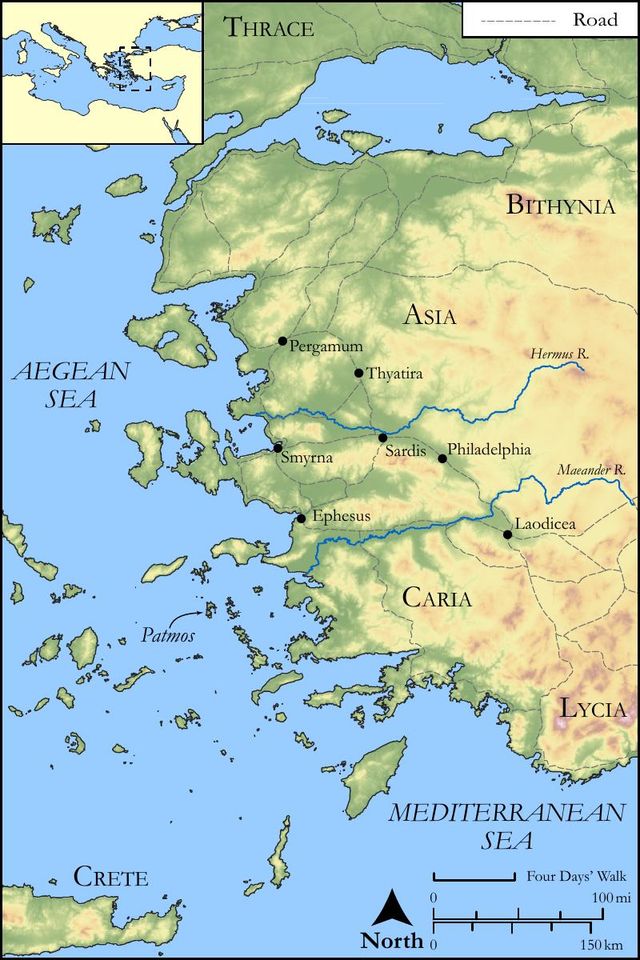
See on the biblical-era maps

Study this verse
Public-domain commentary
Matthew Henry
From his Commentary on the Whole Bible. Henry comments on passages, not single verses — this entry covers Revelation 3:7–13. His four-level outline is real structure in the source text, so it is rendered as structure.
We have now come to the sixth letter, sent to one of the Asian churches, where observe,
I.The inscription, showing,
1.For whom it was more immediately designed: The angel of the church of Philadelphia; this also was a city in Asia Minor, seated upon the borders of Mysia and Lydia, and had its name from that brotherly love for which it was eminent. We can hardly suppose that this name was given to it after it received the Christian religion, and that it was so called from that Christian affection that all believers have, and should have, one for another, as the children of one Father and the brethren of Christ; but rather that it was its ancient name, on account of the love and kindness which the citizens had and showed to each other as a civil fraternity. This was an excellent spirit, and, when sanctified by the grace of the gospel, would render them an excellent church, as indeed they were, for here is no one fault found with this church, and yet, doubtless, there were faults in it of common infirmity; but love covers such faults.
2.By whom this letter was signed; even by the same Jesus who is alone the universal head of all the churches; and here observe by what title he chooses to represent himself to this church: He that is holy, he that is true, he that hath the key of David, etc. You have his personal character: He that is holy and he that is true, holy in his nature, and therefore he cannot but be true to his word, for he hath spoken in his holiness; and you have also his political character: He hath the key of David, he openeth, and no man shutteth; he hath the key of the house of David, the key of government and authority in and over the church. Observe,
(1.)The acts of his government.
[1.]He opens. He opens a door of opportunity to his churches; he opens a door of utterance to his ministers; he opens a door of entrance, opens the heart; he opens a door of admission into the visible church, laying down the terms of communion; and he opens the door of admission into the church triumphant, according to the terms of salvation fixed by him.
[2.]He shuts the door. When he pleases, he shuts the door of opportunity and the door of utterance, and leaves obstinate sinners shut up in the hardness of their hearts; he shuts the door of church-fellowship against unbelievers and profane persons; and he shuts the door of heaven against the foolish virgins who have slept away their day of grace, and against the workers of iniquity, how vain and confident soever they may be.
(2.)The way and manner in which he performs these acts, and that is absolute sovereignty, independent upon the will of men, and irresistible by the power of men: He openeth, and no man shutteth; he shutteth, and no man openeth; he works to will and to do, and, when he works, none can hinder. These were proper characters for him, when speaking to a church that had endeavoured to be conformed to Christ in holiness and truth, and that had enjoyed a wide door of liberty and opportunity under his care and government.
II.The subject-matter of this epistle, where,
1.Christ puts them in mind of what he had done for them: I have set before thee an open door, and no man can shut it, Rev 3:8. I have set it open, and kept it open, though there be many adversaries. Learn here,
(1.)Christ is to be acknowledged as the author of all the liberty and opportunity his churches enjoy.
(2.)He takes notice and keeps account, how long he has preserved their spiritual liberties and privileges for them.
(3.)Wicked men envy the people of God their door of liberty, and would be glad to shut it against them.
(4.)If we do not provoke Christ to shut this door against us, men cannot do it.
2.This church is commended: Thou hast a little strength, and hast kept my word, and hast not denied my name, Rev 3:8. In this there seems to be couched a gentle reproof: "Thou hast a little strength, a little grace, which, though it be not proportionate to the wide door of opportunity which I have opened to thee, yet is true grace, and has kept thee faithful." True grace, though weak, has the divine approbation; but, though Christ accepts a little strength, yet believers should not rest satisfied in a little, but should strive to grow in grace, to be strong in faith, giving glory to God. True grace, though weak, will do more than the greatest gifts or highest degrees of common grace, for it will enable the Christian to keep the word of Christ, and not to deny his name. Obedience, fidelity, and a free confession of the name of Christ, are the fruits of true grace, and are pleasing to Christ as such.
3.Here is a promise of the great favour God would bestow on this church, Rev 3:9, Rev 3:10. This favour consists in two things: -
(1.)Christ would make this church's enemies subject to her.
[1.]Those enemies are described to be such as said they were Jews, but lied in saying so - pretended to be the only and peculiar people of God, but were really the synagogue of Satan. Assemblies that worship God in spirit and in truth are the Israel of God; assemblies that either worship false gods, or the true God in a false manner, are the synagogues of Satan: though they may profess to be the only people of God, their profession is a lie.
[2.]Their subjection to the church is described: They shall worship at thy feet; not pay a religious and divine honour to the church itself, nor to the ministry of it, but shall be convinced that they have been in the wrong, that this church is in the right and is beloved of Christ, and they shall desire to be taken into communion with her and that they may worship the same God after the same manner. How shall this great change be wrought? By the power of God upon the hearts of his enemies, and by signal discoveries of his peculiar favour to his church: They shall know that I have loved thee. Observe, First, The greatest honour and happiness any church can enjoy consist in the peculiar love and favour of Christ. Secondly, Christ can discover this his favour to his people in such a manner that their very enemies shall see it, and be forced to acknowledge it. Thirdly, This will, by the grace of Christ, soften the hearts of their enemies, and make them desirous to be admitted into communion with them.
(2.)Another instance of favour that Christ promises to this church is persevering grace in the most trying times (Rev 3:10), and this as the reward of their past fidelity. To him that hath shall be given. Here observe,
[1.]The gospel of Christ is the word of his patience. It is the fruit of the patience of God to a sinful world; it sets before men the exemplary patience of Christ in all his sufferings for men; it calls those that receive it to the exercise of patience in conformity to Christ.
[2.]This gospel should be carefully kept by all that enjoy it; they must keep up to the faith, and practice, and worship prescribed in the gospel.
[3.]After a day of patience we must expect an hour of temptation; a day of gospel peace and liberty is a day of God's patience, and it is seldom so well improved as it should be and therefore it is often followed by an hour of trial and temptation.
[4.]Sometimes the trial is more general and universal; it comes upon all the world, and, when it is so general, it is usually the shorter.
[5.]Those who keep the gospel in a time of peace shall be kept by Christ in an hour of temptation. By keeping the gospel they are prepared for the trial; and the same divine grace that has made them fruitful in times of peace will make them faithful in times of persecution.
4.Christ calls the church to that duty which he before promised he would enable her to do, and that is, to persevere, to hold fast that which she had. (1.) The duty itself: "Hold fast that which thou hast, that faith, that truth, that strength of grace, that zeal, that love to the brethren; thou hast been possessed of this excellent treasure, hold it fast." (2.) The motives, taken from the speedy appearance of Christ: "Behold, I come quickly. See, I am just a coming to relieve them under the trial, to reward their fidelity, and to punish those who fall away; they shall lose that crown which they once seemed to have a right to, which they hoped for, and pleased themselves with the thoughts of. The persevering Christian shall win the prize from backsliding professors, who once stood fair for it."
III.The conclusion of this epistle, Rev 3:12, Rev 3:13. Here,
1.After his usual manner, our Saviour promises a glorious reward to the victorious believer, in two things: - (1.) He shall be a monumental pillar in the temple of God; not a pillar to support the temple (heaven needs no such props), but a monument of the free and powerful grace of God, a monument that shall never be defaced nor removed, as many stately pillars erected in honour to the Roman emperors and generals have been. (2.) On this monumental pillar there shall be an honourable inscription, as in those cases is usual. [1.] The name of God, in whose cause he engaged, whom he served, and for whom he suffered in this warfare; and the name of the city of God, the church of God, the new Jerusalem, which came down from heaven. On this pillar shall be recorded all the services the believer did to the church of God, how he asserted her rights, enlarged her borders, maintained her purity and honour; this will be a greater name than Asiaticus, or Africanus; a soldier under God in the wars of the church. And then another part of the inscription is, [2.] The new name of Christ, the Mediator, the Redeemer, the captain of our salvation; by this it will appear under whose banner this conquering believer had enlisted, under whose conduct he acted, by whose example he was encouraged, and under whose influence he fought the good fight, and came off victorious.
2.The epistle is closed up with the demand of attention: He that hath an ear, let him hear what the Spirit saith unto the churches, how Christ loves and values his faithful people, how he commends, and how he will crown their fidelity.
Historical interpretation
Seven Centuries of Reception
8 surviving comments on this verse. Each one is dated, so this reads as a timeline rather than a list.
Select a marker to jump to its quote. Markers stagger vertically where authors wrote within a few decades of each other.
That we must press on and persevere in faith and virtue, and in completion of heavenly and spiritual grace, that we may attain to the palm and the crown. In the book of Chronicles: "The Lord is with you so long as ye also are with Him; but if ye forsake Him, He will forsake you." In Ezekiel also: "The righteousness of the righteous shall not deliver him in what day soever he may transgress." Moreover, in the Gospel the Lord speaks, and says: "He that shall endure to the end, the same shall be saved." And again: "If ye shall abide in my word, ye shall be my disciples indeed; and ye shall know the truth, and the truth shall make you free." Moreover, forewarning us that we ought always to be ready, and to stand firmly equipped and armed, He adds, and says: "Let your loins be girded about, and your lamps burning, and ye yourselves like unto men that wait for their lord when he shall return from the wedding, that when he cometh and knocketh they may open unto him. Blessed are those servants whom their lord, when he cometh, shall find watching." Also the blessed Apostle Paul, that our faith may advance and grow, and attain to the highest point, exhorts us, saying: "Know ye not, that they which run in a race run all indeed, yet one receiveth the prize? So run, that ye may obtain. And they, indeed, that they may receive a corruptible crown; but ye an incorruptible." And again: "No man that warreth for God binds himself to anxieties of this world, that he may be able to please Him to whom he hath approved himself. Moreover, also, if a man should contend, he will not be crowned unless he have fought lawfully." And again: "Now I beseech you, brethren, by the mercy of God, that ye constitute your bodies a living sacrifice, holy, acceptable unto God; and be not conformed to this world, but be ye transformed in the renewing of your spirit, that ye may prove what is the will of God, good, and acceptable, and perfect." And again: "We are children of God: but if children, then heirs; heirs indeed of God, but joint-heirs with Christ, if we suffer together, that we may also be glorified together." And in the Apocalypse the same exhortation of divine preaching speaks, saying, "Hold fast that which thou hast, lest another take thy crown; " which example of perseverance and persistence is pointed out in Exodus, when Moses, for the overthrow of Ama-lek, who bore the type of the devil, raised up his open hands in the sign and sacrament of the cross, and could not conquer his adversary unless when he had stedfastly persevered in the sign with hands continually lifted up. "And it came to pass," says he, "when Moses raised up his hands, Israel prevailed; but when he let down his hands, Amalek grew mighty. And they took a stone and placed it under him, and he sate thereon. And Aaron and Hur held up his hands on the one side and on the other side, and Moses' hands were made steady even to the going down of the sun. Anti Jesus routed Amalek and all his people. And the Lord said unto Moses, Write this, and let it be a memorial in a book, and tell it in the ears of Jesus; because in destroying I will destroy the remembrance of Amalek from under heaven."
For confession [of Christ] does not make one immune from the snares of the devil. Nor does it defend one who is still placed in the world with a perpetual security against worldly temptations and dangers and onsets and attacks. Otherwise we should never have seen afterwards among the confessors the deceptions and debaucheries and adulteries that now with groaning and sorrow we see among some. Whoever that confessor is, he is not greater or better or dearer to God than Solomon. As long as he walked in the ways of the Lord, so long he retained the grace he had received from the Lord. After he had abandoned the way of the Lord, he lost also the grace of the Lord. And so it is written, “Hold what you have, lest another receive thy crown.” Surely the Lord would not threaten to deprive of the crown of righteousness unless when righteousness parts, it is necessary that also the crown depart.
It is the wholesome precept of our Lord and Master: "He that endureth," saith He, "unto the end, the same shall be saved; " and again, "If ye continue," saith He, "in my word, ye shall be truly my disciples; and ye shall know the truth, and the truth shall make you free." We must endure and persevere, beloved brethren, in order that, being admitted to the hope of truth and liberty, we may attain to the truth and liberty itself; for that very fact that we are Christians is the substance of faith and hope. But that hope and faith may attain to their result, there is need of patience. For we are not following after present glory, but future, according to what Paul the apostle also warns us, and says, "We are saved by hope; but hope that is seen is not hope: for what a man seeth, why doth he hope for? But if we hope for that which we see not, then do we by patience wait for it." Therefore, waiting and patience are needful, that we may fulfil that which we have begun to be, and may receive that which we believe and hope for, according to God's own showing. Moreover, in another place, the same apostle instructs the righteous and the doers of good works, and them who lay up for themselves treasures in heaven with the increase of the divine usury, that they also should be patient; and teaches them, saying, "Therefore, while we have time, let us labour in that which is good unto all men, but especially to them who are of the household of faith. But let us not faint in well-doing, for in its season we shall reap." He admonishes that no man should impatiently faint in his labour, that none should be either called off or overcome by temptations and desist in the midst of the praise and in the way of glory; and the things that are past perish, while those which have begun cease to be perfect; as it is written, "The righteousness of the righteous shall not deliver him in whatever clay he shall transgress; " and again, "Hold that which thou hast, that another take not thy crown." Which word exhorts us to persevere with patience and courage, so that he who strives towards the crown with the praise now near at hand, may be crowned by the continuance of patience.
The sixth class is the mode of life of the best election. The habit of saints is set forth; of those, to wit, who are lowly in the world, and unskilled in the Scriptures, and who hold the faith immoveably, and are not at all broken down by any chance, or withdrawn from the faith by any fear. Therefore He says to them:-
"I have set before thee an open door, because thou hast kept the word of my patience." In such little strength.
"And I will keep thee from the hour of temptation." That they may know His glory to be of this kind, that they are not indeed permitted to be given over to temptation.
"He that overcometh shall be made a pillar in the temple of God." For even as a pillar is an ornament of the building, so he who perseveres shall obtain a nobility in the Church.
I have said all this about those who have been predestined to the kingdom of God, whose number is so fixed that not one can be added to it or taken from it. I have not been speaking of those who, although he had declared and spoken, have been called but not chosen, because they were not called according to his purpose. The fact that the number of the elect is fixed, not to be increased or diminished, is suggested even by John the Baptist, where he says, “Bring forth therefore fruit befitting repentance. And do not think to say to yourselves, ‘We have Abraham for our father.’ For I say to you that God is able out of these stones to raise up children to Abraham.” The words show that those who do not bring forth fruit are to be cut off, in such a way, however, that the number [of children] promised to Abraham will not fall short. However, it is more openly declared in the Apocalypse: “Hold fast what you have, that no one receive your crown.” For if another is not to receive a crown, unless someone first lose it, the number is fixed.
Behold, I come quickly. Hold fast what you have, etc. Lest you grow weary in enduring. For I will quickly help, lest perhaps, if you fail, another receives the reward decreed for you. Thus, the number of saints, which is fixed with God, cannot be shortened by the treachery of growing tares. If indeed a crown is given to another when lost, the place of him who lost what he held is not vacant.
I come quickly: hold fast that which thou hast. The Lord says he will come quickly, so that no one should give up in the struggle. For everything that passes happens quickly. What he tells him to hold fast is the conduct of heavenly life, and he gives the reason, adding, that no other man take thy crown. In this phrase we see that the certain and determined number of the elect is embraced, and we contemplate with an absolutely amazing thought the fact that no one can be added to or subtracted from it.
I am coming quickly, he says, having taken hold of you.
Hold fast what you have, that no one may take your crown. And what do you hold fast? The genuine love toward the Lord, evidently, in which, having persevered until the end, you will receive the crown of life (James 1:12). For to those who endure, belong the victories.
Continue studying Revelation 3:11 across the web’s major study libraries — every link below opens this exact verse, chapter, or book on the destination site.
Read & Compare
 BibleGatewayThis verse in more than 200 translations and 70 languages.
 Bible.comThe YouVersion reader — hundreds of translations, reading plans, and highlights.
 ESV.orgCrossway's official English Standard Version reader.
 NET BibleThe NET translation with 60,000+ translators' notes on every rendering decision.
 STEP BibleTyndale House's free study tool — original text, vocabulary, and scholarly resources.
 BibliaLogos Bible Software's free web reader.
 USCCBThe New American Bible (Revised Edition) with the U.S. bishops' study notes.
Commentaries
 BibleHub CommentariesDozens of classic commentaries on this verse, gathered on one page.
 StudyLightMore than 100 commentary sets — the largest collection on the web.
 BibleRefPlain-English commentary on what this verse means, verse by verse.
 Enduring WordDavid Guzik's free commentary on this chapter, widely used by Bible teachers.
 Bible Study ToolsVerse commentary alongside Greek and Hebrew study aids.
Original Language & Research
- BibleHub InterlinearThe verse word by word — original language, transliteration, and English.
- BibleHub LexiconEvery word's original-language definition and Strong's entry.
 Blue Letter BibleDeep-study tools — Strong's numbers, concordance, and word studies.
 CNTR CollationThe earliest Greek manuscripts of this verse, collated letter by letter.
Sermons, Hymns & Audio


TrulyRandomVerse is not affiliated with these sites and doesn’t control their content. They’re linked because they’re genuinely useful.
Summary
Revelation 3:11 delivers an urgent and profound message from Jesus Christ to the faithful church in Philadelphia, a message that echoes through all generations of believers. It serves as a powerful exhortation to steadfast perseverance, a solemn warning against spiritual complacency or loss, and a comforting promise of Christ's swift and certain return, underscoring the vital importance of guarding one's spiritual inheritance and maintaining fidelity to Christ in anticipation of His coming.
Context
ShowHideLiterary Context
This verse is situated within the series of seven letters dictated by the resurrected Christ to John for the churches in Asia Minor, found in Revelation 2-3. The letter to Philadelphia (meaning "brotherly love") stands out significantly, as it is one of only two churches (Smyrna being the other) that receives no direct rebuke from Christ. Instead, the Philadelphian church is commended for its faithfulness despite possessing "little strength" (Revelation 3:8), for keeping Christ's word, and for not denying His name. The preceding verses highlight an "open door" set before them by Christ, symbolizing opportunity for ministry and protection from those who falsely claim to be God's people. Against this backdrop of commendation and divine provision, the admonition to "hold fast" in Revelation 3:11 becomes a crucial call for continued vigilance and endurance, even for those already demonstrating commendable faith.
Historical & Cultural Context
Philadelphia was a strategically important city in Lydia, known as the "gateway to the East" due to its position on a major trade route. It was also a region highly susceptible to earthquakes, requiring its inhabitants to constantly rebuild and demonstrating a cultural familiarity with perseverance in the face of disruption. The city's prosperity was linked to its fertile agricultural land, particularly vineyards. The concept of a "crown" (stéphanos) would have been well understood by the Greeks and Romans of Asia, referring not to a royal diadem but to a victor's wreath awarded in athletic contests (like the Olympic or Isthmian games) or as a civic honor for distinguished service. This imagery would have resonated with believers who understood life as a spiritual race or battle, where faithfulness and endurance led to a coveted prize. The mention of those "who say they are Jews and are not" (Revelation 3:9) points to internal Jewish opposition or false claims that the Philadelphian Christians faced, adding another layer to the need for steadfastness.
Key Themes
ShowHideRevelation 3:11 contributes to several major theological and narrative themes within Revelation and the broader New Testament. The opening declaration, "Behold, I come quickly," powerfully reinforces the theme of the Imminent Return of Christ (the Parousia), a central eschatological expectation that pervades the book of Revelation and serves as a constant motivation for vigilance and readiness among believers, as seen in passages like John 14:3 and Acts 1:11. The command to "hold that fast which thou hast" emphasizes the theme of Perseverance and Steadfastness in faith, highlighting that even commended believers must actively maintain their spiritual ground against potential erosion or opposition. This aligns with the New Testament's consistent call for endurance in the Christian walk, as exemplified in Hebrews 10:36. Finally, the warning "that no man take thy crown" introduces the theme of Spiritual Rewards and Accountability, signifying that faithfulness leads to a glorious inheritance, yet this reward can be jeopardized if one falters or allows external pressures or internal compromise to diminish their commitment to Christ. This concept of a spiritual "crown" is echoed in other New Testament epistles, such as 2 Timothy 4:8.
Exposition and Analysis
ShowHideKey Word Analysis
ShowHideThis interjection serves as an emphatic call to attention, signaling an important and urgent declaration. It functions much like "Look!" or "Pay attention!" and is frequently used in prophetic or significant pronouncements in the New Testament to underscore the gravity and certainty of what is about to be said. Here, it draws the reader's focus directly to Christ's imminent return.
Derived from a root meaning "strength" or "power," kratéō signifies to seize, grasp, or retain with firmness and power. It implies a strong, determined grip, suggesting that maintaining one's spiritual possessions (faith, truth, obedience) requires active effort and resolve. It is not a passive waiting but an active, tenacious preservation against forces that would seek to loosen one's hold.
This term refers specifically to a victor's wreath or garland, typically made of leaves or flowers, awarded to athletes in ancient games or to individuals for civic achievements, military triumphs, or even festive occasions. It is a symbol of honor, victory, and reward for accomplishment, distinct from a royal diadem (diadema). In this context, it represents the spiritual reward, honor, or eternal life promised to faithful believers who persevere to the end.
Verse Breakdown
ShowHide"Behold, I come quickly:"
This opening clause is a direct, emphatic declaration from Christ Himself, drawing immediate attention to His impending return. The adverb "quickly" (tachý) conveys not necessarily a rapid chronological speed, but rather the certainty, suddenness, and unexpectedness of His arrival. It serves as a constant call to vigilance and readiness for believers, emphasizing that the time of His coming is unknown but assured.
"hold that fast which thou hast,"
This is an urgent imperative, a direct command to the Philadelphian church and, by extension, to all believers. "That which thou hast" refers to their commendable spiritual state: their faith, their adherence to Christ's word, their endurance, their open door of opportunity, and their proven faithfulness. The command is to firmly and tenaciously retain these spiritual possessions, resisting any temptation or pressure to compromise or abandon them.
"that no man take thy crown."
This final clause presents the critical consequence and motivation for holding fast. The "crown" (stéphanos) symbolizes the spiritual reward, honor, or eternal life promised to those who remain faithful. The warning "that no man take thy crown" implies that this precious reward can be forfeited or usurped, not necessarily stolen by another person in a literal sense, but lost through spiritual negligence, compromise, or succumbing to external pressures (persecution, false teaching) or internal failings. It underscores the believer's personal responsibility to guard their spiritual inheritance.
Literary Devices
ShowHideThe verse employs several potent literary devices to convey its urgent message. The opening word, "Behold," functions as an Interjection or Imperative, immediately grabbing the reader's attention and signaling the profound importance of the ensuing declaration. The phrase "I come quickly" creates a sense of Anticipation and Urgency, establishing an eschatological tension that demands immediate response. The command to "hold that fast" is a direct Imperative Mood, emphasizing the active and determined effort required from the believers. Most significantly, the "crown" is a powerful Metaphor for the spiritual reward, honor, and eternal life awaiting the faithful. This metaphor draws on the familiar imagery of victor's wreaths in ancient athletic games, making the concept of striving and winning a prize highly relatable. The warning "that no man take thy crown" introduces an element of Antithesis or Conflict, implying an adversarial force (whether human or spiritual) that seeks to deprive believers of their rightful reward, thereby highlighting the stakes involved in spiritual perseverance.
Theological and Thematic Connections
ShowHideRevelation 3:11 profoundly connects to core theological truths regarding Christ's sovereignty, the nature of Christian perseverance, and the reality of divine reward. It asserts Christ's absolute authority over time and history, as He declares His own swift return, positioning Him as the ultimate judge and rewarder. The exhortation to "hold fast" underscores the critical role of human responsibility in maintaining faith and obedience, even as grace empowers it. This verse also highlights the preciousness of spiritual rewards, not as earned merit, but as the gracious outcome of a life lived in faithful response to God. The "crown" is a tangible symbol of God's recognition and honor for those who endure, reminding believers that their present struggles and faithfulness have eternal significance. It challenges the notion that salvation, once received, negates the need for ongoing vigilance and active pursuit of Christlikeness, emphasizing that while salvation is secure in Christ, the fullness of one's spiritual inheritance and reward can be impacted by one's perseverance.
Reflection and Application
ShowHideRevelation 3:11 serves as a timeless and urgent call for spiritual vigilance and unwavering perseverance for believers today. It compels us to live with an acute awareness of Christ's imminent return, allowing this profound truth to shape our priorities, actions, and attitudes. We are challenged to honestly assess what we "have" in our spiritual lives—our faith, our commitment to God's Word, our love for Christ and His people, our integrity, and our hope—and to actively "hold fast" to these precious possessions. This means guarding against the subtle erosions of complacency, the overt attacks of persecution, the deceptive allure of false teachings, and the corrosive effects of worldliness. The warning about the "crown" reminds us that our spiritual journey is not without stakes; while our salvation is secure in Christ, our future rewards and the fullness of our participation in His glory are tied to our faithfulness. This verse encourages us to live purposefully, to run the race with endurance, and to protect our spiritual inheritance with the same zeal we would protect any earthly treasure, knowing that our steadfastness is seen, valued, and will be eternally rewarded by our returning Lord.
Questions for Reflection
ShowHideFAQ
ShowHideWhat does "I come quickly" mean in Revelation?
ShowHideThe phrase "I come quickly" (Greek: erchomai tachý) does not primarily refer to a rapid chronological speed, implying that Jesus will return within a very short timeframe from John's perspective. Instead, it conveys the suddenness, certainty, and unexpectedness of Christ's return. Like a thief in the night, His coming will be swift and unannounced when it does occur, demanding constant readiness from believers. It is a theological statement about the nature of His return – it is definite, it is sudden, and it requires vigilance – rather than a precise timetable. This understanding aligns with other New Testament passages that emphasize the need for preparedness, such as Matthew 24:42-44 and 1 Thessalonians 5:2-6.
What is the "crown" mentioned in this verse, and can it truly be "taken"?
ShowHideThe "crown" here is the Greek word stéphanos, which refers to a victor's wreath or garland, not a royal diadem (diadema). It symbolizes the spiritual reward, honor, and triumph granted to faithful believers for their perseverance, endurance, and obedience in the Christian life. This can include the "crown of life" (James 1:12), the "crown of righteousness" (2 Timothy 4:8), or the "crown of glory" (1 Peter 5:4). While a believer's salvation (their relationship with Christ) is secure, the "taking" of the crown refers to the potential loss of this specific reward or honor due to spiritual negligence, compromise, or succumbing to false teaching or persecution. It serves as a powerful incentive for believers to remain vigilant and faithful, ensuring they complete the race and receive the full reward promised to those who endure.
Who is "no man" that might take the crown?
ShowHideThe phrase "no man" (mēdeís) is comprehensive, encompassing any person or influence that could lead a believer to falter and thus forfeit their spiritual reward. This could include literal persecutors who attempt to force believers to deny Christ, false teachers who introduce doctrines that lead people astray from the truth, or even the subtle temptations and pressures of the world that cause believers to grow complacent or compromise their faith. Ultimately, it emphasizes the personal responsibility of each believer to guard their spiritual walk, remain firm in their convictions, and actively resist anything that would undermine their faithfulness to Christ and jeopardize their eternal reward. The warning is a call to active self-preservation of one's spiritual integrity and inheritance.
Christ-Centered Fulfillment
ShowHideRevelation 3:11, while a direct exhortation to believers, finds its ultimate fulfillment and power in Christ Himself. He is the one who declares, "Behold, I come quickly," establishing His sovereign authority over history and time, demonstrating that the future belongs entirely to Him (Revelation 1:8). Our ability to "hold fast" is not rooted in our own strength, but in His empowering grace and the indwelling Holy Spirit, for it is only by abiding in Him that we can bear fruit and persevere (John 15:5). Furthermore, the "crown" that believers are urged to protect is a participation in Christ's own victory and glory. He is the ultimate Victor, who through His death and resurrection, triumphed over sin, death, and the powers of darkness (Colossians 2:15). Our "crown" is not merely a personal achievement but a reflection of His perfect faithfulness and His promise to share His reign with those who overcome (Revelation 2:26-27). Thus, the call to hold fast is a call to remain intimately connected to the One who is Himself the source of our strength, the assurance of our hope, and the giver of all eternal rewards, embodying the ultimate example of perseverance even unto death (Philippians 2:8-9).