


Revelation 2:12
Bible text: King James Version (1769 Blayney text) · Public domain
Bible text: Berean Standard Bible · Public domain
Bible text: American Standard Version (1901) · Public domain
Bible text: World English Bible, Messianic edition · Public domain
Bible text: Geneva Bible (1599) · Public domain
Bible text: Young's Literal Translation · Public domain
- ΚαὶKaiAndG2532CONJConjunction
- τῷtōto theG3588T-DSMDefinite article Dative Singular Masculine
- ἀγγέλῳangelōangelG32N-DSMNoun Dative Singular Masculine
- τῆςtēsof theG3588T-GSFDefinite article Genitive Singular Feminine
- ἐνeninG1722PREPPreposition
- ΠεργάμῳPergamōPergamumG4010N-DSF-LNoun Dative Singular Feminine Location
- ἐκκλησίαςekklēsiaschurchG1577N-GSFNoun Genitive Singular Feminine
- γράψον·grapsondo writeG1125V-AAM-2SVerb Aorist Active Imperative 2nd Singular
- τάδεtadeThese thingsG3592D-APNDemonstrative pronoun Accusative Plural Neuter
- λέγειlegeisaysG3004V-PAI-3SVerb Present Active Indicative 3rd Singular
- ὁhothe [One]G3588T-NSMDefinite article Nominative Singular Masculine
- ἔχωνechōnhavingG2192V-PAP-NSMVerb Present Active Participle Nominative Singular Masculine
- τὴνtēntheG3588T-ASFDefinite article Accusative Singular Feminine
- ῥομφαίανrhomphaianswordG4501N-ASFNoun Accusative Singular Feminine
- τὴνtēn<the>G3588T-ASFDefinite article Accusative Singular Feminine
- δίστομονdistomontwo-edgedG1366A-ASFAdjective Accusative Singular Feminine
- τὴνtēn<the>G3588T-ASFDefinite article Accusative Singular Feminine
- ὀξεῖαν·oxeiansharpG3691A-ASFAdjective Accusative Singular Feminine
English is a literal word-by-word gloss of the Greek, not the KJV's wording. Why?
This is the original text the KJV's translators worked from — each Greek word with its own literal English meaning in this verse, prepared by scholars at Tyndale House, Cambridge. The KJV translates whole sentences, not word by word, so its wording differs: one Greek word can become several English words, and the KJV may choose “charity” where the gloss reads “love”. Both are faithful — they answer different questions. For the KJV's own rendering, switch to the KJV text.
Details
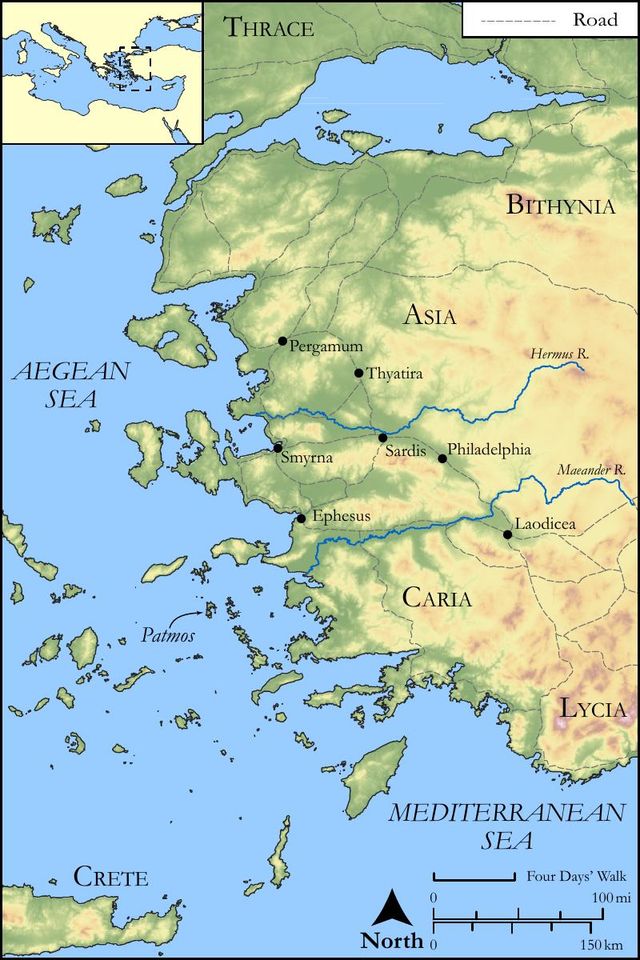
See on the biblical-era maps

Study this verse
Public-domain commentary
Matthew Henry
From his Commentary on the Whole Bible. Henry comments on passages, not single verses — this entry covers Revelation 2:12–17. His three-level outline is real structure in the source text, so it is rendered as structure.
Here also we are to consider,
I.The inscription of this message.
1.To whom it was sent: To the angel of the church of Pergamos. Whether this was a city raised up out of the ruins of old Troy, a Troy nouveau (as our London was once called), or some other city of the same name, is neither certain nor material; it was a place where Christ had called and constituted a gospel church, by the preaching of the gospel and the grace of his Spirit making the word effectual.
2.Who it was that sent this message to Pergamos: the same Jesus who here describes himself as one that hath the sharp sword with two edges (Rev 1:16), out of whose mouth went a sharp two-edged sword. Some have observed that, in the several titles of Christ which are prefixed to the several epistles, there is something suited to the state of those churches; as in that to Ephesus, what could be more proper to awaken and recover a drowsy and declining church than to hear Christ speaking as one that held the stars in his hand, and walked in the midst of the golden candlesticks? etc. The church of Pergamos was infested with men of corrupt minds, who did what they could to corrupt both the faith and manners of the church; and Christ, being resolved to fight against them by the sword of his word, takes the title of him that hath the sharp sword with two edges.
(1.)The word of God is a sword; it is a weapon both offensive and defensive, it is, in the hand of God, able to slay both sin and sinners.
(2.)It is a sharp sword. No heart is so hard but it is able to cut it; it can divide asunder between the soul and the spirit, that is, between the soul and those sinful habits that by custom have become another soul, or seem to be essential to it.
(3.)It is a sword with two edges; it turns and cuts every way. There is the edge of the law against the transgressors of that dispensation, and the edge of the gospel against the despisers of that dispensation; there is an edge to make a wound, and an edge to open a festered wound in order to its healing. There is no escaping the edge of this sword: if you turn aside to the right hand, it has an edge on that side; if on the left hand, you fall upon the edge of the sword on that side; it turns every way.
II.From the inscription we proceed to the contents of the epistle, in which the method is much the same as is observed in the rest. Here,
1.Christ takes notice of the trials and difficulties this church encountered with: I know thy works, and where thou dwellest, etc., Rev 2:13. The works of God's servants are best known when the circumstances under which they did those works are duly considered. Now that which added very much lustre to the good works of this church was the circumstance of the place where this church was planted, a place where Satan's seat was. As our great Lord takes notice of all the advantages and opportunities we have for duty in the places where we dwell, so he takes notice of all the temptations and discouragements we meet with from the places where we dwell, and makes gracious allowances for them. This people dwelt where Satan's seat was, where he kept his court. His circuit is throughout the world, his seat is in some places that are infamous for wickedness, error, and cruelty. Some think that the Roman governor in this city was a most violent enemy to the Christians; and the seat of persecution is Satan's seat.
2.He commends their stedfastness: Thou holdest fast my name, and hast not denied my faith. These two expressions are much the same in sense; the former may, however, signify the effect and the latter the cause or means. (1.) "Thou holdest fast my name; thou art not ashamed of thy relation to me, but accountest it thine honour that my name is named on thee, that, as the wife bears the name of the husband, so thou art called by my name; this thou holdest fast, as thine honour and privilege." (2.) "That which has made thee thus faithful is the grace of faith: thou hast not denied the great doctrines of the gospel, nor departed from the Christian faith, and by that means thou hast been kept faithful." Our faith will have a great influence upon our faithfulness. Men who deny the faith of Christ may boast very much of their sincerity, and faithfulness to God and conscience; but it has been seldom known that those who let go the true faith retained their fidelity; usually on that rock on which men make shipwreck of their faith they make shipwreck of a good conscience too. And here our blessed Lord aggrandizes the fidelity of this church from the circumstance of the times, as well as of the place where they lived: they had been stedfast even in those days wherein Antipas his faithful martyr was slain among them. Who this person was, and whether there be anything mysterious in his name, we have no certain account. He was a faithful disciple of Christ, he suffered martyrdom for it, and sealed his faith and fidelity with his blood in the place where Satan dwelt; and though the rest of the believers there knew this, and saw it, yet they were not discouraged nor drawn away from their stedfastness: this is mentioned as an addition to their honour.
3.He reproves them for their sinful failures (Rev 2:14): But I have a few things against thee, because thou hast there those that hold the doctrine of Balaam, etc., and those that hold the doctrine of the Nicolaitans, which thing I hate. There were some who taught that it was lawful to eat things sacrificed to idols, and that simple fornication was no sin; they, by an impure worship, drew men into impure practices, as Balaam did the Israelites. Observe,
(1.)The filthiness of the spirit and the filthiness of the flesh often go together. Corrupt doctrines and a corrupt worship often lead to a corrupt conversation.
(2.)It is very lawful to fix the name of the leaders of any heresy upon those who follow them. It is the shortest way of telling whom we mean.
(3.)To continue in communion with persons of corrupt principles and practices is displeasing to God, draws a guilt and blemish upon the whole society: they become partakers of other men's sins. Though the church, as such, has no power to punish the persons of men, either for heresy or immorality, with corporal penalties, yet it has power to exclude them from its communion; and, if it do not so, Christ, the head and lawgiver of the church, will be displeased with it.
4.He calls them to repentance: Repent, or else I will come unto thee quickly, etc., Rev 2:16. Observe here,
(1.)Repentance is the duty of saints as well as sinners; it is a gospel duty.
(2.)It is the duty of churches and communities as well as particular persons; those who sin together should repent together.
(3.)It is the duty of Christian societies to repent of other men's sins, as far as they have been accessory to them, though but so much as by connivance.
(4.)When God comes to punish the corrupt members of a church, he rebukes that church itself for allowing such to continue in its communion, and some drops of the storm fall upon the whole society.
(5.)No sword cuts so deep, nor inflicts so mortal a wound, as the sword of Christ's mouth. Let but the threatenings of the word be set home upon the conscience of a sinner, and he will soon be a terror to himself; let these threatenings be executed, and the sinner is utterly cut off. The word of God will take hold of sinners, sooner or later, either for their conviction or their confusion.
III.We have the conclusion of this epistle, where, after the usual demand of universal attention, there is the promise of great favour to those that overcome. They shall eat of the hidden manna, and have the new name, and the white stone, which no man knoweth, saving he that receiveth it, Rev 2:17.
1.The hidden manna, the influences and comforts of the Spirit of Christ in communion with him, coming down from heaven into the soul, from time to time, for its support, to let it taste something how saints and angels live in heaven. This is hidden from the rest of the world - a stranger intermeddles not with this joy; and it is laid up in Christ, the ark of the covenant, in the holy of holies.
2.The white stone, with a new name engraven upon it. This white stone is absolution from the guilt of sin, alluding to the ancient custom of giving a white stone to those acquitted on trial and a black stone to those condemned. The new name is the name of adoption: adopted persons took the name of the family into which they were adopted. None can read the evidence of a man's adoption but himself; he cannot always read it, but if he persevere he shall have both the evidence of sonship and the inheritance.
Historical interpretation
Eight Centuries of Reception
7 surviving comments on this verse. Each one is dated, so this reads as a timeline rather than a list.
Select a marker to jump to its quote. Markers stagger vertically where authors wrote within a few decades of each other.
Who will ply the sword without practising the contraries to lenity and justice; that is, guile, and asperity, and injustice, proper (of course) to the business of battles? See we, then, whether that which has another action be not another sword,-that is, the Divine word of God, doubly sharpened with the two Testaments of the ancient law and the new law; sharpened by the equity of its own wisdom; rendering to each one according to his own action.
The third order of the saints shows that they are men who are strong in faith, and who are not afraid of persecution; but because even among them there are some who are inclined to unlawful associations, He says:-
"Thou hast there some who hold the doctrine of Balaam, who taught in the case of Balak that he should put a stumbling-block before the children of Israel, to eat and to commit fornication. So also hast thou them who hold the doctrine of the Nicolaitanes; but I will fight with them with the sword of my mouth." That is, I will say what I shall command, and I will tell you what you shall do. For Balaam,22 with his doctrine, taught Balak to cast a stumbling-block before the eyes of the children of Israel, to eat what was sacrificed to idols, and to commit fornication,-a thing which is known to have happened of old. For he gave this advice to the king of the Moabites, and they caused stumbling to the people. Thus, says He, ye have among you those who hold such doctrine; and under the pretext of mercy, you would corrupt others.
"To him that overcometh I will give the hidden manna, and I will give him a white stone." The hidden manna is immortality; the white gem is adoption to be the son of God; the new name written on the stone is "Christian."
The city to which this is said was given to idolatry, but he is expressing approval of those in it who remained faithful through the endurance of trials. The “two-edged sword” is either the word of the gospel, which cuts the heart and separates the faithful from the unfaithful, or it is the relentless judgment against the impious.
These things says he who has the sharp two-edged sword. He fittingly prefaces with judicial power, who is to reward the victors and render punishment to those who err.
And to the angel of the church in Pergamum write. Pergamum is interpreted as "dividing their horns," meaning he who by judging distinguishes between the virtue of the faithful and the treachery of the Nicolaitans, so that the horns of sinners are broken, and the horns of the just are exalted.
And to the angel of the church of Pergamus write: These things, saith he, that hath the sharp two-edged sword. This was explained earlier.
And to the church in Pergamum write: I am the one who has the sword coming out of my mouth, so that I may avenge those who violate my commandments; for the danger of those who do not obey the divine commands is signified by the sword in the mouth.
Continue studying Revelation 2:12 across the web’s major study libraries — every link below opens this exact verse, chapter, or book on the destination site.
Read & Compare
 BibleGatewayThis verse in more than 200 translations and 70 languages.
 Bible.comThe YouVersion reader — hundreds of translations, reading plans, and highlights.
 ESV.orgCrossway's official English Standard Version reader.
 NET BibleThe NET translation with 60,000+ translators' notes on every rendering decision.
 STEP BibleTyndale House's free study tool — original text, vocabulary, and scholarly resources.
 BibliaLogos Bible Software's free web reader.
 USCCBThe New American Bible (Revised Edition) with the U.S. bishops' study notes.
Commentaries
 BibleHub CommentariesDozens of classic commentaries on this verse, gathered on one page.
 StudyLightMore than 100 commentary sets — the largest collection on the web.
 BibleRefPlain-English commentary on what this verse means, verse by verse.
 Enduring WordDavid Guzik's free commentary on this chapter, widely used by Bible teachers.
 Bible Study ToolsVerse commentary alongside Greek and Hebrew study aids.
Original Language & Research
- BibleHub InterlinearThe verse word by word — original language, transliteration, and English.
- BibleHub LexiconEvery word's original-language definition and Strong's entry.
 Blue Letter BibleDeep-study tools — Strong's numbers, concordance, and word studies.
 CNTR CollationThe earliest Greek manuscripts of this verse, collated letter by letter.
Sermons, Hymns & Audio


TrulyRandomVerse is not affiliated with these sites and doesn’t control their content. They’re linked because they’re genuinely useful.
Summary
Revelation 2:12 introduces the Lord's message to the church in Pergamos, one of the seven churches of Asia Minor. This verse establishes the divine authority of the speaker, Jesus Christ, through a striking self-description: "he which hath the sharp sword with two edges." This powerful imagery immediately signals the discerning and judging nature of the message about to be delivered to a church situated in a city deeply entrenched in paganism and imperial worship.
Context
ShowHideLiterary Context
Revelation 2:12 marks the beginning of the third of seven distinct letters addressed to specific churches in Asia Minor. Each letter follows a similar epistolary pattern: an address to the "angel" of the church, a self-description of Christ drawn from the vision in Revelation 1, commendations, criticisms, exhortations, a call to hear, and a promise to the overcomer. This particular verse serves as the formal salutation and Christ's self-identification, setting the tone for the specific challenges and spiritual state of the Pergamos church, which is later revealed to be struggling with compromise and false teaching, as detailed in Revelation 2:14-15.
Historical & Cultural Context
Pergamos (or Pergamum) was a significant city, serving as the capital of the Roman province of Asia. It was renowned for its intellectual prowess, possessing a library second only to Alexandria, and for its extensive pagan worship. The city was a major center for the cult of Asclepius, the god of healing, whose symbol was a serpent. More critically for Christians, Pergamos was a leading center of the Roman imperial cult, where emperor worship was mandatory. The city was home to the first temple dedicated to a Roman emperor (Augustus) in Asia, and it housed the immense Altar of Zeus, which early Christians likely referred to as "Satan's Throne" (Revelation 2:13). This environment created immense pressure for believers to compromise their faith or face persecution, as evidenced by the mention of Antipas, "my faithful martyr" (Revelation 2:13).
Key Themes
ShowHideThe introduction of Christ in Revelation 2:12 immediately highlights several key themes central to the book of Revelation and this specific letter. Foremost is Christ's Unquestionable Authority and Sovereignty, as He is the one who possesses the "sharp sword with two edges," signifying His ultimate power over all earthly and spiritual forces, including the pervasive paganism and imperial cult of Pergamos. This imagery also introduces the theme of Divine Discernment and Judgment, emphasizing that Christ's word is not merely a guide but a penetrating force that exposes hidden truths, cuts through deception, and will execute justice. This theme resonates with the broader message of Revelation, which culminates in the final judgment of all unrighteousness and the establishment of God's righteous kingdom, as seen in Revelation 20.
Exposition and Analysis
ShowHideKey Word Analysis
ShowHideThis primary verb means "to grave," especially "to write," and figuratively, "to describe." In the context of Revelation, it signifies a divine imperative for John to record and transmit Christ's messages with precision and authority. The act of writing ensures the permanence and accessibility of the divine revelation for all churches.
A primary verb meaning "to hold," used in various applications including possession, ability, or condition. Here, it emphasizes Christ's active and continuous possession of the "sharp sword." It is not merely a transient attribute but an inherent aspect of His being and authority, underscoring His perpetual readiness to discern and judge.
Probably of foreign origin, this term refers to a large, broad, and heavy sabre or cutlass, often associated with a sweeping, decisive blow. It is distinct from machaira (a smaller, everyday sword). Its use here highlights the immense power and destructive capacity of Christ's judgment, far beyond any human weapon.
Literally meaning "two-mouthed" (from dís "twice" and stóma "mouth"), this adjective describes something double-edged. It emphasizes the sword's absolute cutting power, capable of piercing and dividing on all sides. The imagery suggests comprehensive and inescapable judgment, where nothing can withstand its truth or escape its reach.
Verse Breakdown
ShowHide"And to the angel of the church in Pergamos write;"
This opening clause directs the message to the specific leader or messenger of the Christian community in Pergamos. The "angel" (Greek: ángelos) could refer to a human pastor or overseer, or symbolically to the spiritual representative of the church. The command "write" underscores the divine origin and authoritative nature of the ensuing communication, intended for the entire congregation.
"These things saith he which hath the sharp sword with two edges;"
This is Christ's self-identification, setting the stage for His message. He is not merely a messenger but the one who possesses ultimate authority, symbolized by the "sharp sword with two edges." This image, drawn from John's initial vision of Christ in Revelation 1:16, immediately conveys His power to discern, judge, and execute divine justice. The sharpness and double-edged nature signify the penetrating and decisive nature of His word and judgment.
Literary Devices
ShowHideThe verse makes striking use of Symbolism and Metaphor. The "sharp sword with two edges" is a powerful metaphor for Christ's authoritative word and His capacity for divine judgment. It is not a literal sword, but a symbolic representation of His penetrating truth and decisive power. This image evokes the idea of a weapon that cuts through all defenses, exposing the innermost thoughts and intentions. The symbolism is further amplified by the sword's "two edges" (dístomos), which metaphorically suggests its comprehensive and inescapable reach, able to divide and discern on every side. This imagery also functions as a foreshadowing, hinting at the nature of the message to Pergamos, which will be one of piercing truth and a call to repentance in the face of compromise.
Theological and Thematic Connections
ShowHideThe self-identification of Christ as the one possessing the "sharp sword with two edges" is deeply significant, connecting His person and word to divine judgment and discernment. This imagery echoes Old Testament depictions of God's powerful word and judgment, such as in Isaiah 49:2, where the Servant of the Lord has a mouth like a sharp sword. The New Testament further develops this, particularly in Hebrews 4:12, which describes the word of God as "living and active, sharper than any two-edged sword, piercing to the division of soul and of spirit, of joints and of marrow, and discerning the thoughts and intentions of the heart." This connection emphasizes that Christ's words are not mere human pronouncements but possess divine power to expose, judge, and transform.
Reflection and Application
ShowHideRevelation 2:12 serves as a profound reminder of Christ's absolute authority and the penetrating power of His word. In a world often characterized by moral ambiguity, spiritual compromise, and a blurring of truth, this verse calls believers to a renewed reverence for the Lord Jesus. His "sharp sword with two edges" signifies that His truth is not relative; it cuts through deception, exposes sin, and discerns the true state of our hearts and churches. For the church in Pergamos, this meant facing their compromises with paganism and false teaching. For us today, it means allowing Christ's word to convict, correct, and guide us, ensuring our lives and doctrines align with His unyielding truth. It encourages us to live with integrity, knowing that Christ sees and knows all, and His judgment is always just and true.
Questions for Reflection
ShowHideFAQ
ShowHideWho is the "angel of the church" mentioned in this verse?
ShowHideThe term "angel" (Greek: ángelos) literally means "messenger." In the context of the letters to the seven churches, it is widely understood to refer to the human leader or pastor of the local church congregation. While some interpretations suggest a literal angelic being, the prevailing view among scholars is that it designates the spiritual representative or overseer responsible for the church's spiritual well-being, to whom Christ's message is specifically directed for the benefit of the entire assembly. This is consistent with the pastoral nature of the letters, which address the specific challenges and spiritual state of each community.
Christ-Centered Fulfillment
ShowHideRevelation 2:12 powerfully presents Christ as the supreme Judge and the embodiment of God's discerning Word, fulfilling and intensifying Old Testament prophetic imagery. The "sharp sword with two edges" is not merely an attribute but a direct extension of Christ's very being, as seen in the initial vision of Him in Revelation 1:16, where this sword proceeds from His mouth. This signifies that His words themselves carry the authority and power to judge, to divide truth from falsehood, and to execute divine justice. This concept finds its ultimate fulfillment in Christ, who is the Living Word of God (John 1:1), through whom all things were made and by whom all things are sustained (Colossians 1:16-17). His future role as the righteous Judge of all humanity, who will strike down the nations with a sharp sword (Revelation 19:15), is foreshadowed here. Thus, Christ's self-identification in Revelation 2:12 underscores His unique position as the one who perfectly embodies God's truth, discernment, and ultimate authority over all things, including the spiritual battles faced by His church in a hostile world.