


Revelation 3:9
Bible text: King James Version (1769 Blayney text) · Public domain
Bible text: King James Version with Strong's numbers · Public domain
Bible text: Berean Standard Bible · Public domain
Bible text: American Standard Version (1901) · Public domain
Bible text: World English Bible, Messianic edition · Public domain
Bible text: Geneva Bible (1599) · Public domain
Bible text: Young's Literal Translation · Public domain
- ἰδοὺidouBeholdG2400INJInterjection
- διδῶdidōI may giveG1325V-PAS-1SVerb Present Active Subjunctive 1st Singular
- ἐκek[those] fromG1537PREPPreposition
- τῆςtēstheG3588T-GSFDefinite article Genitive Singular Feminine
- συναγωγῆςsunagōgēssynagogueG4864N-GSFNoun Genitive Singular Feminine
- τοῦtou<the>G3588T-GSMDefinite article Genitive Singular Masculine
- σατανᾶsatanaof Satan —G4567N-GSM-TNoun Genitive Singular Masculine Title
- τῶνtōnthoseG3588T-GPMDefinite article Genitive Plural Masculine
- λεγόντωνlegontōndeclaringG3004V-PAP-GPMVerb Present Active Participle Genitive Plural Masculine
- ἑαυτοὺςhe'autousthemselvesG1438F-3APMReflexive pronoun Accusative 3rd Plural Masculine
- ἸουδαίουςIoudaiousJewsG2453N-APM-PGNoun Accusative Plural Masculine Person Gentilic
- εἶναιeinaito beG1511V-PANVerb Present Active Infinitive
- καὶkaiandG2532CONJConjunction
- οὐκouknotG3756PRT-NNegative Particle Negative
- εἰσίνeisinareG1510V-PAI-3PVerb Present Active Indicative 3rd Plural
- ἀλλὰallabutG235CONJConjunction
- ψεύδονταιpseudontaithey lie —G5574V-PNI-3PVerb Present Middle Or Passive Deponent Indicative 3rd Plural
- ἰδοὺidoubeholdG2400INJInterjection
- ποιήσωpoiēsōI will causeG4160V-FAI-1SVerb Future Active Indicative 1st Singular
- αὐτοὺςautousthemG846P-APMPersonal pronoun Accusative Plural Masculine
- ἵναinathatG2443CONJConjunction
- ἥξουσινhēxousinthey will comeG2240V-FAI-3PVerb Future Active Indicative 3rd Plural
- καὶkaiandG2532CONJConjunction
- προσκυνήσουσινproskunēsousinthey will worshipG4352V-FAI-3PVerb Future Active Indicative 3rd Plural
- ἐνώπιονenōpionbeforeG1799PREPPreposition
- τῶνtōntheG3588T-GPMDefinite article Genitive Plural Masculine
- ποδῶνpodōnfeetG4228N-GPMNoun Genitive Plural Masculine
- σουsouof youG4771P-2GSPersonal pronoun Genitive 2nd Singular
- καὶkaiandG2532CONJConjunction
- γνῶσινgnōsinthey may knowG1097V-2AAS-3PVerb 2nd Aorist Active Subjunctive 3rd Plural
- ὅτιhotithatG3754CONJConjunction
- ἐγὼegōI myselfG1473P-1NSPersonal pronoun Nominative 1st Singular
- ἠγάπησάēgapēsalovedG25V-AAI-1SVerb Aorist Active Indicative 1st Singular
- σεseyouG4771P-2ASPersonal pronoun Accusative 2nd Singular
English is a literal word-by-word gloss of the Greek, not the KJV's wording. Why?
This is the original text the KJV's translators worked from — each Greek word with its own literal English meaning in this verse, prepared by scholars at Tyndale House, Cambridge. The KJV translates whole sentences, not word by word, so its wording differs: one Greek word can become several English words, and the KJV may choose “charity” where the gloss reads “love”. Both are faithful — they answer different questions. For the KJV's own rendering, switch to the KJV text.
Details
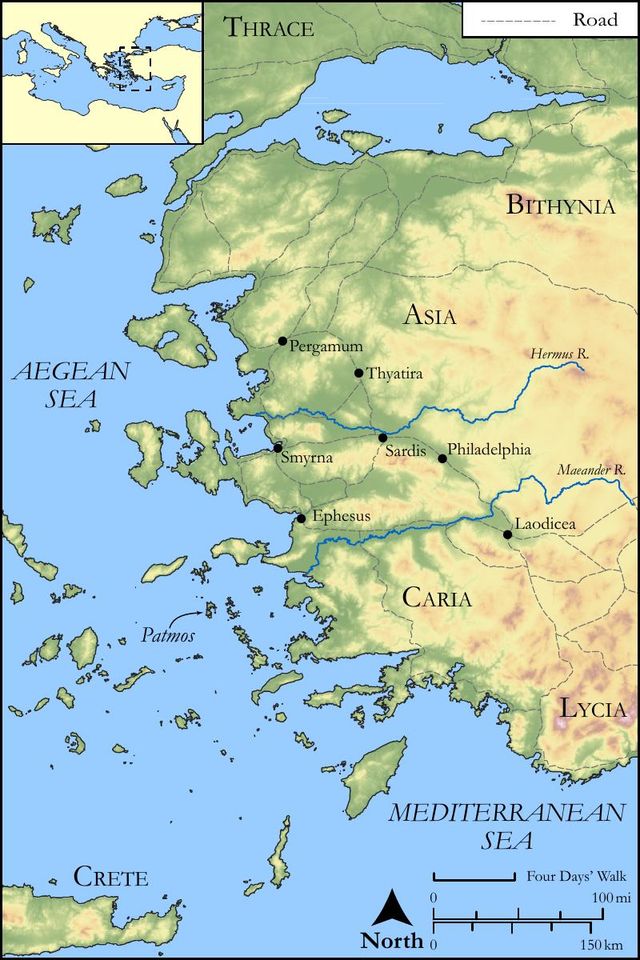
See on the biblical-era maps

Study this verse
Public-domain commentary
Matthew Henry
From his Commentary on the Whole Bible. Henry comments on passages, not single verses — this entry covers Revelation 3:7–13. His four-level outline is real structure in the source text, so it is rendered as structure.
We have now come to the sixth letter, sent to one of the Asian churches, where observe,
I.The inscription, showing,
1.For whom it was more immediately designed: The angel of the church of Philadelphia; this also was a city in Asia Minor, seated upon the borders of Mysia and Lydia, and had its name from that brotherly love for which it was eminent. We can hardly suppose that this name was given to it after it received the Christian religion, and that it was so called from that Christian affection that all believers have, and should have, one for another, as the children of one Father and the brethren of Christ; but rather that it was its ancient name, on account of the love and kindness which the citizens had and showed to each other as a civil fraternity. This was an excellent spirit, and, when sanctified by the grace of the gospel, would render them an excellent church, as indeed they were, for here is no one fault found with this church, and yet, doubtless, there were faults in it of common infirmity; but love covers such faults.
2.By whom this letter was signed; even by the same Jesus who is alone the universal head of all the churches; and here observe by what title he chooses to represent himself to this church: He that is holy, he that is true, he that hath the key of David, etc. You have his personal character: He that is holy and he that is true, holy in his nature, and therefore he cannot but be true to his word, for he hath spoken in his holiness; and you have also his political character: He hath the key of David, he openeth, and no man shutteth; he hath the key of the house of David, the key of government and authority in and over the church. Observe,
(1.)The acts of his government.
[1.]He opens. He opens a door of opportunity to his churches; he opens a door of utterance to his ministers; he opens a door of entrance, opens the heart; he opens a door of admission into the visible church, laying down the terms of communion; and he opens the door of admission into the church triumphant, according to the terms of salvation fixed by him.
[2.]He shuts the door. When he pleases, he shuts the door of opportunity and the door of utterance, and leaves obstinate sinners shut up in the hardness of their hearts; he shuts the door of church-fellowship against unbelievers and profane persons; and he shuts the door of heaven against the foolish virgins who have slept away their day of grace, and against the workers of iniquity, how vain and confident soever they may be.
(2.)The way and manner in which he performs these acts, and that is absolute sovereignty, independent upon the will of men, and irresistible by the power of men: He openeth, and no man shutteth; he shutteth, and no man openeth; he works to will and to do, and, when he works, none can hinder. These were proper characters for him, when speaking to a church that had endeavoured to be conformed to Christ in holiness and truth, and that had enjoyed a wide door of liberty and opportunity under his care and government.
II.The subject-matter of this epistle, where,
1.Christ puts them in mind of what he had done for them: I have set before thee an open door, and no man can shut it, Rev 3:8. I have set it open, and kept it open, though there be many adversaries. Learn here,
(1.)Christ is to be acknowledged as the author of all the liberty and opportunity his churches enjoy.
(2.)He takes notice and keeps account, how long he has preserved their spiritual liberties and privileges for them.
(3.)Wicked men envy the people of God their door of liberty, and would be glad to shut it against them.
(4.)If we do not provoke Christ to shut this door against us, men cannot do it.
2.This church is commended: Thou hast a little strength, and hast kept my word, and hast not denied my name, Rev 3:8. In this there seems to be couched a gentle reproof: "Thou hast a little strength, a little grace, which, though it be not proportionate to the wide door of opportunity which I have opened to thee, yet is true grace, and has kept thee faithful." True grace, though weak, has the divine approbation; but, though Christ accepts a little strength, yet believers should not rest satisfied in a little, but should strive to grow in grace, to be strong in faith, giving glory to God. True grace, though weak, will do more than the greatest gifts or highest degrees of common grace, for it will enable the Christian to keep the word of Christ, and not to deny his name. Obedience, fidelity, and a free confession of the name of Christ, are the fruits of true grace, and are pleasing to Christ as such.
3.Here is a promise of the great favour God would bestow on this church, Rev 3:9, Rev 3:10. This favour consists in two things: -
(1.)Christ would make this church's enemies subject to her.
[1.]Those enemies are described to be such as said they were Jews, but lied in saying so - pretended to be the only and peculiar people of God, but were really the synagogue of Satan. Assemblies that worship God in spirit and in truth are the Israel of God; assemblies that either worship false gods, or the true God in a false manner, are the synagogues of Satan: though they may profess to be the only people of God, their profession is a lie.
[2.]Their subjection to the church is described: They shall worship at thy feet; not pay a religious and divine honour to the church itself, nor to the ministry of it, but shall be convinced that they have been in the wrong, that this church is in the right and is beloved of Christ, and they shall desire to be taken into communion with her and that they may worship the same God after the same manner. How shall this great change be wrought? By the power of God upon the hearts of his enemies, and by signal discoveries of his peculiar favour to his church: They shall know that I have loved thee. Observe, First, The greatest honour and happiness any church can enjoy consist in the peculiar love and favour of Christ. Secondly, Christ can discover this his favour to his people in such a manner that their very enemies shall see it, and be forced to acknowledge it. Thirdly, This will, by the grace of Christ, soften the hearts of their enemies, and make them desirous to be admitted into communion with them.
(2.)Another instance of favour that Christ promises to this church is persevering grace in the most trying times (Rev 3:10), and this as the reward of their past fidelity. To him that hath shall be given. Here observe,
[1.]The gospel of Christ is the word of his patience. It is the fruit of the patience of God to a sinful world; it sets before men the exemplary patience of Christ in all his sufferings for men; it calls those that receive it to the exercise of patience in conformity to Christ.
[2.]This gospel should be carefully kept by all that enjoy it; they must keep up to the faith, and practice, and worship prescribed in the gospel.
[3.]After a day of patience we must expect an hour of temptation; a day of gospel peace and liberty is a day of God's patience, and it is seldom so well improved as it should be and therefore it is often followed by an hour of trial and temptation.
[4.]Sometimes the trial is more general and universal; it comes upon all the world, and, when it is so general, it is usually the shorter.
[5.]Those who keep the gospel in a time of peace shall be kept by Christ in an hour of temptation. By keeping the gospel they are prepared for the trial; and the same divine grace that has made them fruitful in times of peace will make them faithful in times of persecution.
4.Christ calls the church to that duty which he before promised he would enable her to do, and that is, to persevere, to hold fast that which she had. (1.) The duty itself: "Hold fast that which thou hast, that faith, that truth, that strength of grace, that zeal, that love to the brethren; thou hast been possessed of this excellent treasure, hold it fast." (2.) The motives, taken from the speedy appearance of Christ: "Behold, I come quickly. See, I am just a coming to relieve them under the trial, to reward their fidelity, and to punish those who fall away; they shall lose that crown which they once seemed to have a right to, which they hoped for, and pleased themselves with the thoughts of. The persevering Christian shall win the prize from backsliding professors, who once stood fair for it."
III.The conclusion of this epistle, Rev 3:12, Rev 3:13. Here,
1.After his usual manner, our Saviour promises a glorious reward to the victorious believer, in two things: - (1.) He shall be a monumental pillar in the temple of God; not a pillar to support the temple (heaven needs no such props), but a monument of the free and powerful grace of God, a monument that shall never be defaced nor removed, as many stately pillars erected in honour to the Roman emperors and generals have been. (2.) On this monumental pillar there shall be an honourable inscription, as in those cases is usual. [1.] The name of God, in whose cause he engaged, whom he served, and for whom he suffered in this warfare; and the name of the city of God, the church of God, the new Jerusalem, which came down from heaven. On this pillar shall be recorded all the services the believer did to the church of God, how he asserted her rights, enlarged her borders, maintained her purity and honour; this will be a greater name than Asiaticus, or Africanus; a soldier under God in the wars of the church. And then another part of the inscription is, [2.] The new name of Christ, the Mediator, the Redeemer, the captain of our salvation; by this it will appear under whose banner this conquering believer had enlisted, under whose conduct he acted, by whose example he was encouraged, and under whose influence he fought the good fight, and came off victorious.
2.The epistle is closed up with the demand of attention: He that hath an ear, let him hear what the Spirit saith unto the churches, how Christ loves and values his faithful people, how he commends, and how he will crown their fidelity.
Historical interpretation
Five Centuries of Reception
4 surviving comments on this verse. Each one is dated, so this reads as a timeline rather than a list.
Select a marker to jump to its quote. Markers stagger vertically where authors wrote within a few decades of each other.
The sixth class is the mode of life of the best election. The habit of saints is set forth; of those, to wit, who are lowly in the world, and unskilled in the Scriptures, and who hold the faith immoveably, and are not at all broken down by any chance, or withdrawn from the faith by any fear. Therefore He says to them:-
"I have set before thee an open door, because thou hast kept the word of my patience." In such little strength.
"And I will keep thee from the hour of temptation." That they may know His glory to be of this kind, that they are not indeed permitted to be given over to temptation.
"He that overcometh shall be made a pillar in the temple of God." For even as a pillar is an ornament of the building, so he who perseveres shall obtain a nobility in the Church.
“Behold, those from the synagogue of Satan who say that they are Jews and are not, but lie: behold, I will make them come and bow down before your feet, and learn that I have loved you.” At that time he promised to the universal church that there will be “one flock and one Shepherd.” We should note that it was not only in Philadelphia that there were believers from the synagogue of the Jews, as we find recorded in the Acts of the Apostles.… He said to the second angel, “You have the slander of those who say that they are Jews and are not.” Nevertheless, he did not promise that there would be some who would come from them, that is, [fall] at the feet of the body of Christ. We believe that this will happen everywhere, since God will command his church to be gathered from the whole world. Therefore, to the sixth angel, that is the one before the last, he promised what he had indicated to the others without any promise. And so he foretells to the sixth angel what will happen before the final end, that the unbelieving will come as suppliants to the church of God.
Behold, I will make those of the synagogue of Satan, who say they are Jews and are not. He promised this to the whole Church at that time, because not only in Philadelphia did they believe from the synagogue of the Jews, as we find in the Acts of the Apostles.
Behold, I will bring of the synagogue of Satan, who say they are Jews, and are not, but do lie. Behold, I will make them to come and adore before thy feet. And they shall know that I have loved thee. In this passage is foretold the faith of the Jews, according to this: until the fullness of the Gentiles should come in, and so all Israel should be saved. [Rom. 11:25-26] Now they say they are Jews, but are not, because they have lost on the inside spiritually the name they bear on the outside literally; for the expression of the name of Jews is the confession of Christ. However, when Elijah and Enoch are preaching, they will come to adore before the Church's feet, because they will venerate it by following the examples of its action.
Continue studying Revelation 3:9 across the web’s major study libraries — every link below opens this exact verse, chapter, or book on the destination site.
Read & Compare
 BibleGatewayThis verse in more than 200 translations and 70 languages.
 Bible.comThe YouVersion reader — hundreds of translations, reading plans, and highlights.
 ESV.orgCrossway's official English Standard Version reader.
 NET BibleThe NET translation with 60,000+ translators' notes on every rendering decision.
 STEP BibleTyndale House's free study tool — original text, vocabulary, and scholarly resources.
 BibliaLogos Bible Software's free web reader.
 USCCBThe New American Bible (Revised Edition) with the U.S. bishops' study notes.
Commentaries
 BibleHub CommentariesDozens of classic commentaries on this verse, gathered on one page.
 StudyLightMore than 100 commentary sets — the largest collection on the web.
 BibleRefPlain-English commentary on what this verse means, verse by verse.
 Enduring WordDavid Guzik's free commentary on this chapter, widely used by Bible teachers.
 Bible Study ToolsVerse commentary alongside Greek and Hebrew study aids.
Original Language & Research
- BibleHub InterlinearThe verse word by word — original language, transliteration, and English.
- BibleHub LexiconEvery word's original-language definition and Strong's entry.
 Blue Letter BibleDeep-study tools — Strong's numbers, concordance, and word studies.
 CNTR CollationThe earliest Greek manuscripts of this verse, collated letter by letter.
Sermons, Hymns & Audio


TrulyRandomVerse is not affiliated with these sites and doesn’t control their content. They’re linked because they’re genuinely useful.
Summary
Revelation 3:9 delivers a powerful promise from Jesus Christ to the faithful church in Philadelphia, assuring them of divine vindication against those who falsely claim spiritual authority and oppose them. It declares that Christ Himself will humble these adversaries, compelling them to acknowledge His profound love and favor for His true followers, thereby revealing the spiritual reality behind their conflict.
Context
ShowHideLiterary Context
This verse is part of the letter to the church in Philadelphia, one of the seven churches of Asia Minor addressed in Revelation chapters 2 and 3. Unlike most other churches, Philadelphia receives almost unreserved commendation from Christ. The preceding verses, particularly Revelation 3:7-8, highlight their faithfulness, perseverance, and obedience despite their perceived weakness. Christ identifies Himself as "He that is holy, He that is true, He that hath the key of David, He that openeth, and no man shutteth; and shutteth, and no man openeth" (Revelation 3:7). This divine authority undergirds the promise given in verse 9, indicating that the humbling of their adversaries is not a mere human event but a sovereign act of God. The promise of vindication serves as a direct encouragement to a church that has "kept my word, and hast not denied my name" (Revelation 3:8).
Historical & Cultural Context
The early Christian communities in Asia Minor often faced significant opposition, particularly from segments of the Jewish population who did not accept Jesus as the Messiah. In cities like Philadelphia, there would have been established Jewish synagogues, and some within these communities might have actively opposed the burgeoning Christian movement, viewing it as a heretical sect. This opposition could have included social ostracism, economic pressure, and even formal accusations to Roman authorities. The phrase "which say they are Jews, and are not" likely refers to those who, while ethnically Jewish, had, in Christ's view, forfeited their spiritual claim to being God's true people by rejecting His Son. This was a common tension in the early church, as seen in various New Testament epistles where the nature of true Israel and spiritual identity is debated. Philadelphia was also a city prone to earthquakes, requiring its inhabitants to be resilient and steadfast, a quality mirrored in the church's spiritual endurance.
Key Themes
ShowHideRevelation 3:9 contributes to several overarching themes within Revelation and the broader New Testament. Foremost is the theme of Divine Vindication, where God intervenes to defend His faithful people against their oppressors, ensuring that justice prevails and His favor is clearly demonstrated. Another crucial theme is Spiritual Identity versus Mere Ethnic or Religious Affiliation. The passage underscores that true spiritual lineage and belonging to God's people are defined by faith in Christ, not by outward markers or ancestral claims. This resonates with Paul's teaching in Romans 2:28-29 and Galatians 3:7. Finally, the verse powerfully affirms Christ's Unwavering Love for His Church, especially for those who persevere through hardship. The ultimate goal of the adversaries' humbling is for them "to know that I have loved thee," emphasizing that Christ's love is the driving force behind His protective actions and the ultimate revelation of His divine commitment to His bride, the Church, as depicted throughout Revelation.
Exposition and Analysis
ShowHideKey Word Analysis
ShowHideMeaning "an assemblage of persons; specially, a Jewish 'synagogue' (the meeting or the place); by analogy, a Christian church." In this context, "synagogue of Satan" is a highly charged designation, also used in Revelation 2:9. It implies that while these groups might outwardly appear to be religious assemblies, their opposition to Christ and His true followers is so profound that it aligns them with the very adversary of God, Satan. It's not merely human opposition but a spiritually hostile force.
Meaning "to 'know' (absolutely) in a great variety of applications and with many implications... to allow, be aware (of), feel, (have) know(-ledge), perceived, be resolved, can speak, be sure, understand." This "knowing" is not just intellectual assent but a deep, experiential, and undeniable recognition. The adversaries will be forced to truly comprehend and acknowledge Christ's love for the Philadelphian believers, a knowledge that comes from witnessing His divine intervention.
Meaning "to love (in a social or moral sense)." This is the Greek word for divine, unconditional love. It signifies Christ's deep, self-sacrificial, and enduring affection for His church. The purpose of the adversaries' humbling is to reveal this profound, unwavering love, demonstrating Christ's faithful commitment to those who remain loyal to Him.
Verse Breakdown
ShowHide"Behold, I will make them of the synagogue of Satan,"
The introductory "Behold" (G2400, idoú') calls for urgent attention to a divine declaration. Christ asserts His sovereign power ("I will make") to act upon those identified as "of the synagogue of Satan." This phrase powerfully labels those who, though claiming to be God's people (Jews), are in spiritual opposition to Christ, thereby aligning themselves with the ultimate adversary.
"which say they are Jews, and are not, but do lie;"
This clause clarifies the identity of the "synagogue of Satan." These individuals verbally claim to be "Jews" (G2453, Ioudaîos'), implying a claim to covenantal privilege and spiritual authenticity. However, Christ declares they "are not" (G1526, eisí' negated by G3756, ou') in a spiritual sense, and "do lie" (G5574, pseúdomai'). Their claim is a falsehood because true spiritual identity, in Christ's new covenant, is defined by faith in Him, not by ethnic or ritualistic adherence alone.
"behold, I will make them to come and worship before thy feet,"
Again, "behold" emphasizes the certainty of this future event. Christ promises to actively cause ("I will make them to come") these adversaries to humble themselves before the Philadelphian believers. The act of "worship before thy feet" (G4352, proskynéō' before G4228, poús') signifies an act of profound submission, homage, and recognition of the believers' divine favor, akin to the prostration of a servant before a master, or even the worship of God. This is a dramatic reversal of fortunes, where the persecutors are brought low before those they persecuted.
"and to know that I have loved thee."
This final clause reveals the ultimate purpose of Christ's intervention. The humbling of the adversaries is not merely punitive but revelatory. Through this act, they will come to "know" (G1097, ginōskō') experientially and undeniably that Christ's "love" (G25, agapáō') is directed towards the faithful church in Philadelphia. This knowledge is a profound affirmation of the church's favored status and Christ's unwavering commitment to them.
Literary Devices
ShowHideThe verse employs several potent literary devices. Irony is prominent in the designation "synagogue of Satan," as a "synagogue" is typically a place of holy assembly, yet here it is linked to the ultimate adversary, highlighting the perversion of their spiritual claims. The phrase "which say they are Jews, and are not, but do lie" is a form of paradoxical statement, challenging the conventional understanding of Jewish identity and asserting a new spiritual criterion. The promise "I will make them to come and worship before thy feet" is a vivid hyperbole or symbolism, representing a complete reversal of power dynamics and a public acknowledgment of the Philadelphian church's divine favor, rather than a literal act of worship directed at the believers themselves. The entire declaration is framed by the repeated exclamation "Behold," emphasizing the certainty and importance of Christ's prophetic promise.
Theological and Thematic Connections
ShowHideRevelation 3:9 powerfully underscores the New Testament's redefinition of spiritual identity, shifting focus from ethnic lineage to faithful adherence to Christ. It reveals Christ's active role as the defender and vindicator of His church, especially when they face opposition from those who claim religious authority but reject Him. The ultimate goal of this divine intervention is not merely retribution, but the revelation of Christ's profound and enduring love for His persevering followers, ensuring that His favor is undeniably manifest. This passage reminds believers that their true standing before God is secured by Christ's love and faithfulness, not by human recognition or worldly power.
Reflection and Application
ShowHideRevelation 3:9 offers profound encouragement and a robust framework for understanding divine justice and love in the face of adversity. For believers, it serves as a powerful reminder that faithfulness, even in weakness or when facing intense opposition, is seen and honored by Christ. We are assured that God is our ultimate defender, and He will ultimately bring about justice, revealing His favor towards those who remain loyal to Him. This promise empowers us to persevere, knowing that our vindication is not dependent on our own strength or strategies, but on Christ's sovereign power and unwavering love. It challenges us to examine where our true spiritual identity lies—is it in outward appearances, titles, or affiliations, or in genuine faith and obedience to Jesus Christ? Embracing Christ's love for us, as highlighted in this verse, provides the foundation for enduring hardship and trusting in His ultimate plan for justice and triumph.
Questions for Reflection
ShowHideFAQ
ShowHideWhat does "synagogue of Satan" mean in this context?
ShowHideThe phrase "synagogue of Satan" refers to a group that, while outwardly appearing to be a religious assembly (a synagogue), is in reality spiritually opposed to Christ and His true followers. It's a strong condemnation, indicating that their opposition is not merely human but is influenced by the forces of evil, aligning them with Satan, the ultimate adversary of God. This designation highlights the spiritual battle underlying human conflicts and emphasizes that true spiritual identity is found in Christ, not in mere religious or ethnic affiliation, as seen in Revelation 2:9.
Does this verse mean that all Jewish people are "of the synagogue of Satan"?
ShowHideAbsolutely not. This verse is not a blanket condemnation of all Jewish people. Instead, it specifically refers to a particular group of individuals in Philadelphia (and Smyrna, as mentioned in Revelation 2:9) who claimed to be the true people of God but actively rejected Jesus as the Messiah and persecuted His followers. Christ's statement "which say they are Jews, and are not, but do lie" points to a spiritual rather than ethnic distinction. True spiritual lineage, according to the New Testament, is defined by faith in Christ, as articulated by Paul in Romans 9:6-8.
Christ-Centered Fulfillment
ShowHideRevelation 3:9 finds profound Christ-centered fulfillment in the ultimate vindication of God's people through Jesus Christ, who is Himself the embodiment of divine love and justice. The promise that adversaries will "worship before thy feet" and "know that I have loved thee" foreshadows the universal recognition of Christ's supreme authority and the ultimate triumph of His Church. Just as Christ was unjustly persecuted and rejected by many who claimed religious authority, yet was ultimately exalted by God (Philippians 2:9-11), so too will His faithful followers be vindicated. This verse points to the day when "every knee shall bow" before Jesus (Romans 14:11) and His love for His bride, the Church, will be fully revealed and celebrated. The humbling of those who oppose the gospel is a necessary step towards the establishment of Christ's kingdom, where His love reigns supreme and His people are eternally secure in Him, echoing the ultimate triumph described in Revelation 21:1-4.