


Acts 16:37
- ὉHo<the>G3588T-NSMDefinite article Nominative Singular Masculine
- δὲdeButG1161CONJConjunction
- ΠαῦλοςPaulosPaulG3972N-NSM-PNoun Nominative Singular Masculine Individual
- ἔφηephēwas sayingG5346V-IAI-3SVerb Imperfect Active Indicative 3rd Singular
- πρὸςprostoG4314PREPPreposition
- αὐτούς·autousthemG846P-APMPersonal pronoun Accusative Plural Masculine
- δείραντεςdeirantesHaving beatenG1194V-AAP-NPMVerb Aorist Active Participle Nominative Plural Masculine
- ἡμᾶςhēmasusG3165P-1APPersonal pronoun Accusative 1st Plural
- δημοσίᾳdēmosiapubliclyG1219A-DSFAdjective Dative Singular Feminine
- ἀκατακρίτουςakatakritousuncondemnedG178A-APMAdjective Accusative Plural Masculine
- ἀνθρώπουςanthrōpousmenG444N-APMNoun Accusative Plural Masculine
- ῬωμαίουςRhōmaiousRomansG4514N-APM-LGNoun Accusative Plural Masculine Location Gentilic
- ὑπάρχονταςhuparchontasbeingG5225V-PAP-APMVerb Present Active Participle Accusative Plural Masculine
- ἔβαλανebalanthey cast [us]G906V-2AAI-3PVerb 2nd Aorist Active Indicative 3rd Plural
- εἰςeisintoG1519PREPPreposition
- φυλακήνphulakēnprisonG5438N-ASFNoun Accusative Singular Feminine
- καὶkaiandG2532CONJConjunction
- νῦνnunnowG3568ADVAdverb
- λάθρᾳlathrasecretlyG2977ADVAdverb
- ἡμᾶςhēmasusG3165P-1APPersonal pronoun Accusative 1st Plural
- ἐκβάλλουσιν;ekballousindo they throw out?G1544V-PAI-3PVerb Present Active Indicative 3rd Plural
- οὐouNoG3756PRT-NNegative Particle Negative
- γάρgarindeed!G1063CONJConjunction
- ἀλλ᾽all᾽InsteadG235CONJConjunction
- ἐλθόντεςelthonteshaving comeG2064V-2AAP-NPMVerb 2nd Aorist Active Participle Nominative Plural Masculine
- αὐτοὶautoithemselvesG846P-NPMPersonal pronoun Nominative Plural Masculine
- ἡμᾶςhēmasusG3165P-1APPersonal pronoun Accusative 1st Plural
- ἐξαγαγέτωσανexagagetōsanthey should bring outG1806V-2AAM-3PVerb 2nd Aorist Active Imperative 3rd Plural
English is a literal word-by-word gloss of the Greek, not the KJV's wording. Why?
This is the original text the KJV's translators worked from — each Greek word with its own literal English meaning in this verse, prepared by scholars at Tyndale House, Cambridge. The KJV translates whole sentences, not word by word, so its wording differs: one Greek word can become several English words, and the KJV may choose “charity” where the gloss reads “love”. Both are faithful — they answer different questions. For the KJV's own rendering, switch to the KJV text.
Details
See on the biblical-era map
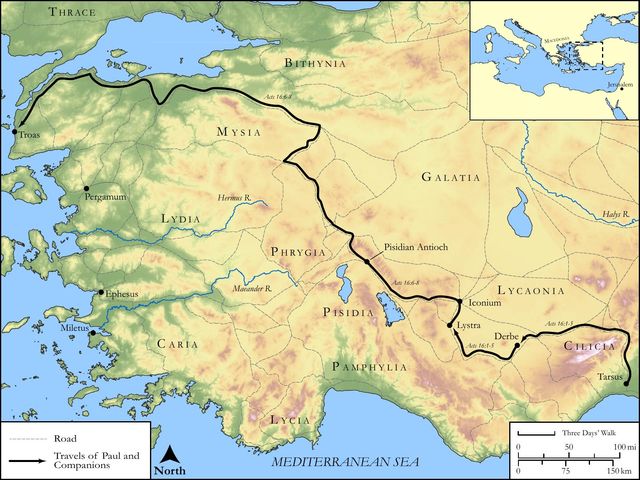
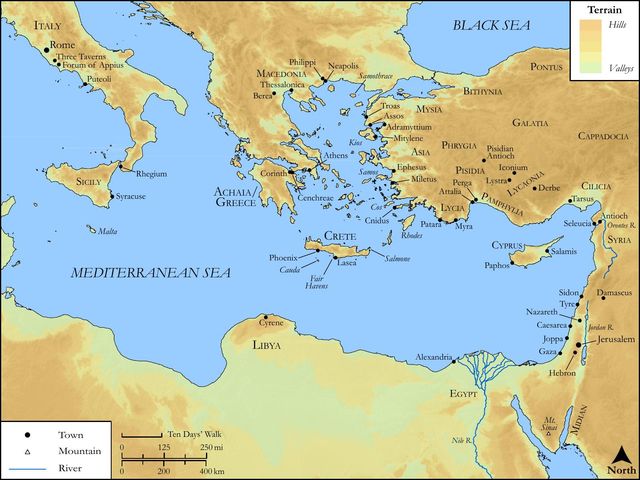
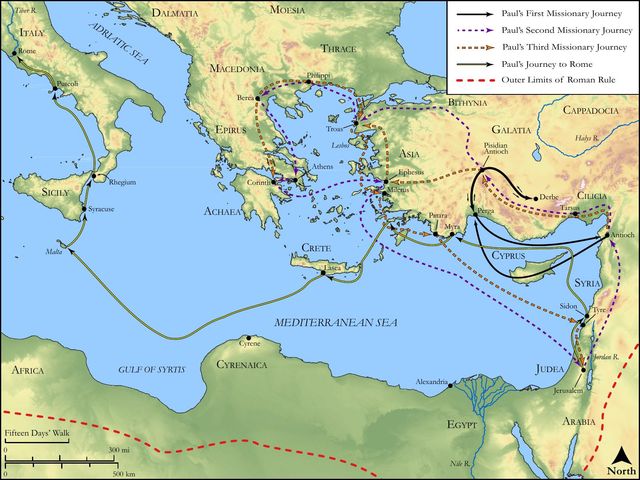
Study this verse
Public-domain commentary
Matthew Henry
From his Commentary on the Whole Bible. Henry comments on passages, not single verses — this entry covers Acts 16:35–40. His four-level outline is real structure in the source text, so it is rendered as structure.
In these verses we have,
I.Orders sent for the discharge of Paul and Silas out of prison Act 16:35, Act 16:36.
1.The magistrates that had so basely abused them the day before gave the orders; and their doing it so early, as soon as it was day, intimates that either they were sensible the terrific earthquake they felt at midnight was intended to plead the cause of their prisoners, or their consciences had smitten them for what they had done and made them very uneasy. While the persecuted were singing in the stocks, the persecutors were full of tossings to and fro upon their beds, through anguish of mind, complaining more of the lashes of their consciences than the prisoners did of the lashes on their backs, and more in haste to give them a discharge than they were to petition for one. Now God caused his servants to be pitied of those that had carried them captives, Psa 106:46. The magistrates sent sergeants, rabdouchous - those that had the rods, the vergers, the tipstaves, the beadles, those that had been employed in beating them, that they might go and ask them forgiveness. The order was, Let those men go. It is probable that they designed further mischief to them, but God turned their hearts, and, as he had made their wrath hitherto to praise him, so the remainder thereof he did restrain, Psa 76:10.
2.The jailer brought them the news (Act 16:36): The magistrates have sent to let you go. Some think the jailer had betimes transmitted an account to the magistrates of what had passed in his house that night, and so had obtained this order for the discharge of his prisoners: Now therefore depart. Not that he was desirous to part with them as his guests, but as his prisoners; they shall still be welcome to his house, but he is glad they are at liberty from his stocks. God could by his grace as easily have converted the magistrates as the jailer, and have brought them to faith and baptism; but God hath chosen the poor of this world, Jam 2:5.
II.Paul's insisting upon the breach of privilege which the magistrates had been guilty of, Act 16:37.
Paul said to the sergeants, "They have beaten us openly, uncondemned, being Romans, and have cast us into prison against all law and justice, and now do they thrust us out privily, and think to make us amends with this for the injury done us? Nay, verily; but let them come themselves and fetch us our, and own that they have done us wrong." It is probable that the magistrates had some intimation that they were Romans, and were made sensible that their fury had carried them further than the law would bear them out; and that this was the reason why they gave orders for their discharge. Now observe,
1.Paul did not plead this before he was beaten, though it is probable that it might have prevented it, lest he should seem to be afraid of suffering for the truth which he had preached. Tully, in one of his orations, against Verres, tells of one Ganius, who was ordered by Verres to be beaten in Sicily, that all the while he was under the lash he cried out nothing but Civis Romanus sum - I am a citizen of Rome; Paul did not do so; he had nobler things than this to comfort himself with in his affliction.
2.He did plead it afterwards, to put an honour upon his sufferings and upon the cause he suffered for, to let the world know that the preachers of the gospel were not such despicable men as they were commonly looked upon to be, and that they merited better treatment. He did it likewise to mollify the magistrates towards the Christians at Philippi, and to gain better treatment for them, and beget in the people a better opinion of the Christian religion, when they saw that Paul had a fair advantage against their magistrates, might have brought his action against them and had them called to an account for what they had done, and yet did not take the advantage, which was very much to the honour of that worthy name by which he was called. Now here,
(1.)Paul lets them know how many ways they had run themselves into a premunire, and that he had law enough to know it.
[1.]They had beaten those that were Romans; some think that Silas was a Roman citizen as well as Paul; others that this does not necessarily follow. Paul was a citizen, and Silas was his companion. Now both the lex Procia and the lex Sempronia did expressly forbid liberum corpus Romani civis, virgis aut aliis verberibus caedi - the free body of a Roman citizen to be beaten with rods or otherwise. Roman historians give instances of cities that had their charters taken from them for indignities done to Roman citizens; we shall afterwards find Paul making use of this plea, Act 22:25, Act 22:26. To tell them they had beaten those who were the messengers of Christ and the favourites of Heaven would have had no influence upon them; but to tell them they have abused Roman citizens will put them into a fright: so common is it for people to be more afraid of Caesar's wrath than of Christ's. He that affronts a Roman, a gentleman, a nobleman, though ignorantly, and through mistake, thinks himself concerned to cry Peccavi - I have done wrong, and make his submission; but he that persecutes a Christian because he belongs to Christ stands to it, and thinks he may do it securely, though God hath said, He that toucheth them toucheth the apple of my eye, and Christ has warned us of the danger of offending his little ones.
[2.]They had beaten them uncondemned; indicta causa - without a fair hearing, had not calmly examined what was said against them, much less enquired what they had to say for themselves. It is a universal rule of justice, Caus cognit possunt multi absolvi, incognit nemo condemnari potest - Many may be acquitted in consequence of having had a hearing, while without a hearing no one can be condemned. Christ's servants would not have been abused as they have been if they and their cause might but have had an impartial trial.
[3.]It was an aggravation of this that they had done it openly, which, as it was so much the greater disgrace to the sufferers, so it was the bolder defiance to justice and the law.
[4.]They had cast them into prison, without showing any cause of their commitment, and in an arbitrary manner, by a verbal order.
[5.]They now thrust them out privily; they had not indeed the impudence to stand by what they had done, but yet had not the honesty to own themselves in a fault.
(2.)He insists upon it that they should make them an acknowledgment of their error, and give them a public discharge, to make it the more honourable, as they had done them a public disgrace, which made that the more disgraceful: "Let them come themselves, and fetch us out, and give a testimony to our innocency, and that we have done nothing worthy of stripes or of bonds." It was not a point of honour that Paul stood thus stiffly upon, but a point of justice, and not to himself so much as to his cause: "Let them come and stop the clamours of the people, by confessing that we are not the troublers of the city."
III.The magistrates' submission, and the reversing of the judgment given against Paul and Silas, Act 16:38, Act 16:39.
1.The magistrates were frightened when they were told (though it may be they knew it before) that Paul was a Roman. They feared when they heard it, lest some of his friends should inform the government of what they had done, and they should fare the worse for it. The proceedings of persecutors have often been illegal, even by the law of nations, and often inhuman, against the law of nature, but always sinful, and against God's law.
2.They came and besought them not to take advantage of the law against them, but to overlook the illegality of what they had done and say no more of it: they brought them out of the prison, owning that they were wrongfully put into it, and desired them that they would peaceably and quietly depart out of the city. Thus Pharaoh and his servants, who had set God and Moses at defiance, came to Moses, and bowed down themselves to him, saying, Get thee out, Exo 11:8. God can make the enemies of his people ashamed of their envy and enmity to them, Isa 26:11. Jerusalem is sometimes made a burdensome stone to those that heave at it, which they would gladly get clear of, Zac 12:3. Yet, if the repentance of these magistrates had been sincere, they would not have desired them to depart out of their city (as the Gadarenes desired to be rid of Christ), but would have courted their stay, and begged of them to continue in their city, to show them the way of salvation. But many are convinced that Christianity is not to be persecuted who yet are not convinced that it ought to be embraced, or at least are not persuaded to embrace it. They are compelled to do honour to Christ and his servants, to worship before their feet, and to know that he has loved them (Rev 3:9), and yet do not go so far as to have benefit by Christ, or to come in for a share in his love.
IV.The departure of Paul and Silas from Philippi, Act 16:40.
They went out of the prison when they were legally discharged, and not till then, though they were illegally committed, and then,
1.They took leave of their friends: they went to the house of Lydia, where probably the disciples had met to pray for them, and there they saw the brethren, or visited them at their respective habitations (which was soon done, they were so few); and they comforted them, by telling them (saith an ancient Greek commentary) what God had done for them, and how he had owned them in the prison. They encouraged them to keep close to Christ, and hold fast the profession of their faith, whatever difficulties they might meet with, assuring them that all would then end well, everlastingly well. Young converts should have a great deal said to them to comfort them, for the joy of the Lord will be very much their strength.
2.They quitted the town: They departed. I wonder they should do so; for, now that they had had such an honourable discharge from their imprisonment, surely they might have gone on at least for some time in their work without danger; but I suppose they went away upon that principle of their Master's (Mar 1:38). Let us go into the next towns, that I may preach there also, for therefore came I forth. Paul and Silas had an extraordinary call to Philippi; and yet, when they have come thither, they see little of the fruit of their labours, and are soon driven thence. Yet they did not come in vain. Though the beginnings here were small, the latter end greatly increased; now they laid the foundation of a church at Philippi, which became very eminent, had its bishops and deacons, and people that were more generous to Paul than any other church, as appears by his epistle to the Philippians, Phi 1:1; Phi 4:15. Let not ministers be discouraged, though they see not the fruit of their labours presently; the seed sown seems to be lost under the clods, but it shall come up again in a plentiful harvest in due time.
Historical interpretation
Historical reception
3 surviving comments on this verse. Each one is dated, so this reads as a timeline rather than a list.
Select a marker to jump to its quote. Markers stagger vertically where authors wrote within a few decades of each other.
When, therefore, Christ fulfilled these things which God would have done, and which He foretold many ages before by His prophets, incited by these things, and ignorant of the sacred Scriptures, they conspired together to condemn their God. And though He knew that this would come to pass, and repeatedly said that He must suffer and be put to death for the salvation of many, nevertheless He withdrew Himself with His disciples, not that He might avoid that which it was necessary for Him to undergo and endure, but that He might show what ought to take place in every persecution, that no one should appear to have fallen into it through his own fault.
Then they lifted Him up in the midst between two malefactors, who had been condemned for robbery, and fixed Him to the cross. What can I here deplore in so great a crime? or in what words can I lament such great wickedness? For we are not relating the crucifixion of Gavius, which Marcus Tullius followed up with all the spirit and strength of his eloquence, pouring forth as it were the fountains of all his genius, proclaiming that it was an unworthy deed that a Roman citizen should be crucified in violation of all laws. And although He was innocent, and undeserving of that punishment, yet He was put to death, and that, too, by an impious man, who was ignorant of justice. What shall I say respecting the indignity of this cross, on which the Son of God was suspended and nailed? Who will be found so eloquent, and supplied with so great an abundance of deeds and words, what speech flowing with such copious exuberance, as to lament in a befitting manner that cross, which the world itself, and all the elements of the world, bewailed?
But Paul said unto them, they have beaten us openly uncondemned, being Romans, and have cast us into prison; and now do they thrust us out privily? nay verily; but let them come themselves and fetch us out. Even upon the declaration of the magistrates Paul does not go out, but for the sake both of Lydia and the rest he puts them in fear: that they may not be supposed to have come out upon their own request, that they may set the rest in a posture of boldness. The impeachment was twofold: that being Romans, and uncondemned, they had openly cast them into prison. You see that in many things they took their measures as men.
But Paul said unto them: that he may not seem to be receiving his liberty as one condemned, and as one that has done wrong: therefore it is that he says, Having openly beaten us uncondemned - that it may not be matter of grace on their part. And besides, they wish the jailer himself to be out of danger, that he may not be called to account for this afterwards. And they do not say, Having beaten us, who have wrought miracles: for they the magistrates did not even heed these: but, that which was most effectual to shake their minds, uncondemned, and being Romans.
Continue studying Acts 16:37 across the web’s major study libraries — every link below opens this exact verse, chapter, or book on the destination site.
Read & Compare
 BibleGatewayThis verse in more than 200 translations and 70 languages.
 Bible.comThe YouVersion reader — hundreds of translations, reading plans, and highlights.
 ESV.orgCrossway's official English Standard Version reader.
 NET BibleThe NET translation with 60,000+ translators' notes on every rendering decision.
 STEP BibleTyndale House's free study tool — original text, vocabulary, and scholarly resources.
 BibliaLogos Bible Software's free web reader.
 USCCBThe New American Bible (Revised Edition) with the U.S. bishops' study notes.
Commentaries
 BibleHub CommentariesDozens of classic commentaries on this verse, gathered on one page.
 StudyLightMore than 100 commentary sets — the largest collection on the web.
 BibleRefPlain-English commentary on what this verse means, verse by verse.
 Enduring WordDavid Guzik's free commentary on this chapter, widely used by Bible teachers.
 Bible Study ToolsVerse commentary alongside Greek and Hebrew study aids.
Original Language & Research
- BibleHub InterlinearThe verse word by word — original language, transliteration, and English.
- BibleHub LexiconEvery word's original-language definition and Strong's entry.
 Blue Letter BibleDeep-study tools — Strong's numbers, concordance, and word studies.
 CNTR CollationThe earliest Greek manuscripts of this verse, collated letter by letter.
Sermons, Hymns & Audio


TrulyRandomVerse is not affiliated with these sites and doesn’t control their content. They’re linked because they’re genuinely useful.
Summary
Acts 16:37 captures the apostle Paul's resolute refusal to accept a quiet, clandestine release from prison in Philippi, where he and Silas had been unjustly beaten and imprisoned. As a Roman citizen, Paul asserted his legal rights, demanding that the city magistrates, who had unlawfully inflicted public punishment without trial, personally escort them out. This demand was not merely for personal vindication but a strategic move to uphold the integrity of the gospel message and ensure public acknowledgment of the authorities' wrongdoing, thereby protecting the nascent Christian community in Philippi.
Context
ShowHideLiterary Context
This verse is situated at a critical juncture in the narrative of Paul's second missionary journey, specifically during his ministry in Philippi. Immediately preceding this, Paul and Silas had been instrumental in the conversion of Lydia, a prominent businesswoman, and had cast out a spirit of divination from a slave girl, which angered her owners. These owners instigated a riot, leading to Paul and Silas being seized, brought before the magistrates, and without due process, severely beaten with rods and thrown into the inner prison, their feet fastened in stocks (see Acts 16:16-24). A miraculous earthquake then shook the prison, opening the doors and loosening chains, leading to the conversion of the jailer and his household (as detailed in Acts 16:25-34). The magistrates, upon learning of the earthquake and perhaps fearing further divine intervention or public unrest, sent officers to quietly release Paul and Silas. Paul's response in Acts 16:37 directly challenges this attempt to sweep their injustice under the rug, setting the stage for a public demonstration of their innocence and the authorities' culpability.
Historical & Cultural Context
Philippi was a Roman colony, a city established with Roman law and customs, and its citizens enjoyed specific rights and privileges. Central among these was the Lex Valeria (509 BC) and Lex Porcia (195 BC), which strictly prohibited the beating or scourging of a Roman citizen without a proper trial and condemnation. Furthermore, a Roman citizen could not be imprisoned without a formal charge and hearing, nor could they be condemned to death without the right of appeal to Caesar. The magistrates' actions—publicly beating and imprisoning Paul and Silas, who were Roman citizens, "uncondemned"—were a grave violation of Roman law. Their attempt to "thrust us out privily" (secretly) reveals their awareness of their unlawful conduct and their desire to avoid public embarrassment or legal repercussions from Rome. Paul's assertion of his citizenship was not a trivial matter; it was a powerful legal and social leverage point in a society that highly valued dignitas (honor) and fama (reputation).
Key Themes
ShowHideThis verse powerfully illustrates several key themes prevalent throughout the book of Acts and Paul's ministry. Firstly, it highlights the assertion of legal rights by believers in the face of injustice, demonstrating that while Christians are called to suffer for Christ, there are times when it is appropriate and strategic to utilize legal protections. Secondly, it underscores the theme of public witness and vindication. Paul's demand for a public escort ensures that the authorities acknowledge their error, thereby protecting the reputation of the gospel and the nascent Christian community in Philippi from false accusations or the perception of guilt. Thirdly, it speaks to apostolic authority and integrity. Paul's firm stand maintains the dignity of his calling and prevents the undermining of his message. This incident also subtly showcases divine providence, as God's timing and Paul's wisdom combine to turn a moment of persecution into an opportunity for the gospel's advancement and the establishment of the church on firm ground, as seen in the broader narrative of Acts 16.
Exposition and Analysis
ShowHideKey Word Analysis
ShowHideThis word (G178) means "without (legal) trial." Its use here is crucial, emphasizing that Paul and Silas were subjected to a severe public beating and imprisonment without any formal legal process, charge, or judgment. This was a direct and egregious violation of Roman law, which guaranteed citizens the right to a fair trial before punishment. Paul's use of this term underscores the absolute illegality and injustice of the magistrates' actions.
Derived from the Greek word for "public" (G1219), this adverb means "in public." Paul explicitly states that they were beaten "openly," highlighting the public nature of their humiliation and the authorities' brazen disregard for legal procedure. The public nature of the beating made the violation even more severe, as it inflicted not only physical harm but also public shame and dishonor, which was deeply significant in Roman culture.
This adverb (G2977) means "privately" or "secretly." It stands in stark contrast to "openly." The magistrates' attempt to release Paul and Silas "privily" reveals their desire to avoid public scrutiny, embarrassment, and potential legal repercussions for their unlawful actions. Paul's refusal to accept a secret release was a strategic move to force a public acknowledgment of their innocence and the authorities' guilt, thereby protecting the integrity of the Christian community.
Verse Breakdown
ShowHide"But Paul said unto them"
This phrase marks a decisive turning point. Up to this point, Paul and Silas had endured the injustice silently, even singing hymns in prison. Now, Paul, perhaps prompted by divine wisdom or the opportune moment, speaks with authority and resolve, directly addressing the officers sent by the magistrates.
"They have beaten us openly uncondemned, being Romans, and have cast [us] into prison"
This is Paul's powerful indictment. He lays out the three key violations: (1) "beaten us openly" – public physical abuse; (2) "uncondemned" – without any legal trial or conviction; and (3) "being Romans" – a direct violation of their protected status as Roman citizens. The addition of "and have cast [us] into prison" further compounds the list of illegal actions, emphasizing the sustained nature of the injustice.
"and now do they thrust us out privily? nay verily; but let them come themselves and fetch us out."
This is a rhetorical question followed by a firm refusal and a counter-demand. Paul highlights the absurdity and hypocrisy of the magistrates' attempt to secretly dismiss them after such public and unlawful treatment. The "nay verily" (Greek: ou gar, "no indeed") is a strong negation. Paul's demand, "let them come themselves and fetch us out," is a direct challenge to the magistrates. It requires them to publicly acknowledge their wrongdoing, humble themselves, and personally escort Paul and Silas, thereby restoring their honor and affirming their innocence in the eyes of the Philippian populace.
Literary Devices
ShowHideActs 16:37 employs several potent literary devices to convey Paul's indignation and strategic resolve. The most prominent is Rhetorical Question, "and now do they thrust us out privily?" This question is not posed to elicit information but to underscore the absurdity and profound injustice of the magistrates' actions. It highlights the stark contrast between the public, unlawful punishment and the desire for a secret, unceremonious dismissal. This rhetorical device effectively communicates Paul's moral outrage and exposes the authorities' hypocrisy. Closely related is Antithesis or Contrast, evident in the juxtaposition of "openly" (dēmósios) and "privily" (láthra), and the implicit contrast between "uncondemned" and the severe punishment received. This contrast emphasizes the blatant disregard for justice and due process. Finally, the verse is characterized by Assertion and Imperative Mood. Paul's declaration of their Roman citizenship and his demand ("let them come themselves and fetch us out") are not pleas but firm, authoritative statements, demonstrating his resolve and the weight of his legal standing.
Theological and Thematic Connections
ShowHidePaul's actions in Acts 16:37 are deeply rooted in a theology that balances submission to earthly authorities with a righteous demand for justice, particularly when the honor of God and the integrity of the gospel are at stake. While Christians are often called to suffer patiently for Christ's sake, Paul's example demonstrates that wisdom dictates when to leverage legal and social structures to protect the church and advance the Kingdom. His concern was not merely personal comfort or pride, but the public witness of the gospel in Philippi. A quiet release would have left the impression that Paul and Silas were indeed criminals, undermining their message and potentially exposing the new believers to further persecution. By demanding public vindication, Paul ensured that the authorities, and by extension the city, recognized the injustice and the blamelessness of the Christian message. This act served to establish the church in Philippi on a foundation of integrity and truth, demonstrating that God's servants, though persecuted, are not lawbreakers but upholders of righteousness.
Reflection and Application
ShowHidePaul's resolute stand in Acts 16:37 offers profound lessons for believers navigating injustice and persecution today. It challenges the simplistic notion that Christians must always passively endure every wrong. Instead, Paul demonstrates a Spirit-led wisdom that discerns when to suffer silently and when to strategically assert one's rights for the greater good of the gospel. His primary motivation was not personal vindication for pride's sake, but the protection of the burgeoning Christian community in Philippi and the safeguarding of the gospel's reputation. Allowing a secret release would have tacitly affirmed their guilt and left the Philippian church vulnerable to continued harassment and misunderstanding. Therefore, believers are called to cultivate a similar discernment: to endure suffering with grace, but also to courageously and wisely use all legitimate means available to them—legal, social, or otherwise—to defend the truth, protect the vulnerable, and ensure that the name of Christ is not slandered or diminished. Our actions, even in the face of adversity, must consistently bear witness to the integrity and power of the God we serve.
Questions for Reflection
ShowHideFAQ
ShowHideWhy didn't Paul reveal his Roman citizenship earlier, before being beaten and imprisoned?
ShowHideThe text does not explicitly state Paul's reasons for not revealing his Roman citizenship earlier, but several plausible explanations are often put forth by scholars. One common theory is divine timing and purpose. Paul may have intentionally withheld this information to allow God to demonstrate His miraculous power through the earthquake and the subsequent conversion of the jailer and his household. This dramatic display of God's intervention served as a powerful testimony to both the authorities and the Philippian populace, setting the stage for Paul's later, strategic assertion of his rights. Had he revealed his citizenship immediately, the magistrates might have avoided the public beating and imprisonment, thus preventing the miraculous events that led to the jailer's salvation. Another possibility is that Paul was waiting for the opportune moment to maximize the impact of his citizenship. By allowing the magistrates to commit a clear and public violation of Roman law, Paul created a situation where their guilt was undeniable, forcing them into a position of public humiliation and accountability. This ensured that the vindication of Paul and Silas, and by extension the gospel, was equally public and undeniable, establishing a stronger foundation for the nascent Christian community in Philippi. Paul's actions here, and later in Acts 22:25 and Acts 25:11, demonstrate his shrewd use of his legal status as a tool for the advancement of the gospel, not merely for personal comfort.
Christ-Centered Fulfillment
ShowHideWhile Paul, as a Roman citizen, strategically asserted his legal rights in Acts 16:37, his actions, when viewed through a Christ-centered lens, ultimately serve to advance the kingdom of a Lord who himself submitted to profound injustice. Jesus, the perfect embodiment of righteousness, did not assert His divine rights or appeal to earthly laws when faced with false accusations and an unjust trial. Instead, He silently endured the beatings, the mockery, and the crucifixion, fulfilling the prophecies of the suffering servant who would be led "like a lamb to the slaughter" and would "not open his mouth" (Isaiah 53:7). Before Pilate, Jesus refused to defend Himself, demonstrating a radical humility and obedience to His Father's will that ultimately secured salvation for humanity (Matthew 27:12-14). Paul's actions in Philippi, though seemingly contrasting with Christ's passive submission, are nonetheless rooted in the same ultimate mission: the advancement of the gospel. Paul's goal was not personal pride, but to protect the integrity of the Christian witness and ensure the gospel's unhindered proclamation, echoing Christ's own declaration that His kingdom is "not of this world" yet still engaging with earthly authorities to achieve divine purposes (John 18:36). Thus, Paul's strategic use of his citizenship, while different in method from Christ's path of suffering, ultimately serves the same redemptive purpose: to clear the way for the message of Christ to be preached freely and without reproach (Acts 28:31), reflecting the humility and mission-focused obedience exemplified by Christ himself (Philippians 2:5-8).