


Acts 16:38
- ἀπήγγειλανapēngeilanReportedG518V-AAI-3PVerb Aorist Active Indicative 3rd Plural
- δὲdethenG1161CONJConjunction
- τοῖςtoisto theG3588T-DPMDefinite article Dative Plural Masculine
- στρατηγοῖςstratēgoismagistratesG4755N-DPMNoun Dative Plural Masculine
- οἱhoitheG3588T-NPMDefinite article Nominative Plural Masculine
- ῥαβδοῦχοιrhabdouchoiofficersG4465N-NPMNoun Nominative Plural Masculine
- τὰta<the>G3588T-APNDefinite article Accusative Plural Neuter
- ῥήματαrhēmatadeclarationsG4487N-APNNoun Accusative Plural Neuter
- ταῦτα·tautatheseG3778D-APNDemonstrative pronoun Accusative Plural Neuter
- καὶkaiandG2532CONJConjunction
- ἐφοβήθησανephobēthēsanThey were afraidG5399V-AOI-3PVerb Aorist Passive Deponent Indicative 3rd Plural
- ἀκούσαντεςakousanteshaving heardG191V-AAP-NPMVerb Aorist Active Participle Nominative Plural Masculine
- ὅτιhotithatG3754CONJConjunction
- ῬωμαῖοίRhōmaioiRomansG4514N-NPM-LGNoun Nominative Plural Masculine Location Gentilic
- εἰσινeisinthey areG1510V-PAI-3PVerb Present Active Indicative 3rd Plural
English is a literal word-by-word gloss of the Greek, not the KJV's wording. Why?
This is the original text the KJV's translators worked from — each Greek word with its own literal English meaning in this verse, prepared by scholars at Tyndale House, Cambridge. The KJV translates whole sentences, not word by word, so its wording differs: one Greek word can become several English words, and the KJV may choose “charity” where the gloss reads “love”. Both are faithful — they answer different questions. For the KJV's own rendering, switch to the KJV text.
Details
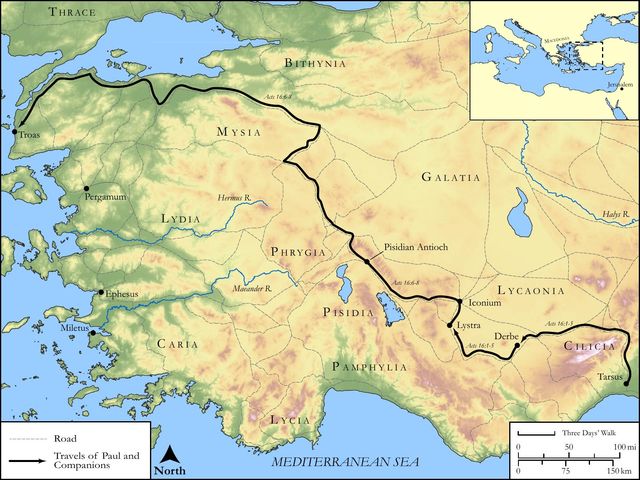
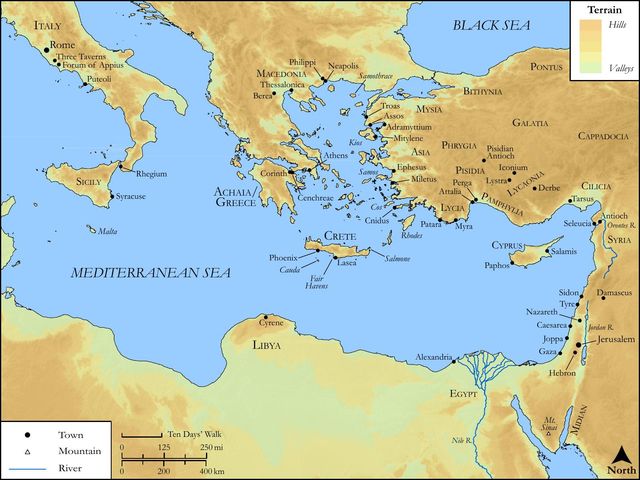
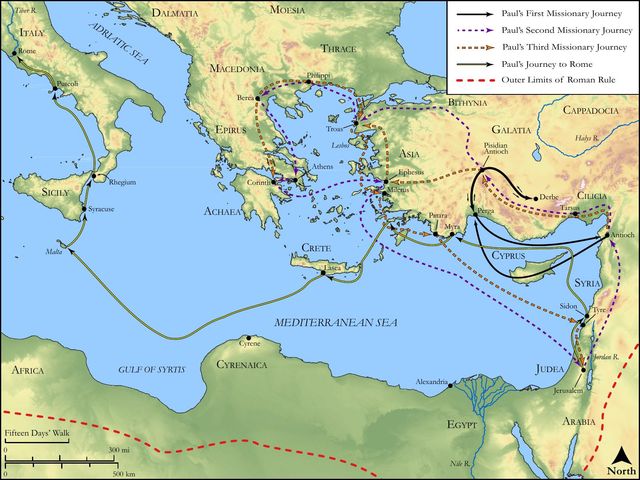
See on the biblical-era map
Study this verse
Public-domain commentary
Matthew Henry
From his Commentary on the Whole Bible. Henry comments on passages, not single verses — this entry covers Acts 16:35–40. His four-level outline is real structure in the source text, so it is rendered as structure.
In these verses we have,
I.Orders sent for the discharge of Paul and Silas out of prison Act 16:35, Act 16:36.
1.The magistrates that had so basely abused them the day before gave the orders; and their doing it so early, as soon as it was day, intimates that either they were sensible the terrific earthquake they felt at midnight was intended to plead the cause of their prisoners, or their consciences had smitten them for what they had done and made them very uneasy. While the persecuted were singing in the stocks, the persecutors were full of tossings to and fro upon their beds, through anguish of mind, complaining more of the lashes of their consciences than the prisoners did of the lashes on their backs, and more in haste to give them a discharge than they were to petition for one. Now God caused his servants to be pitied of those that had carried them captives, Psa 106:46. The magistrates sent sergeants, rabdouchous - those that had the rods, the vergers, the tipstaves, the beadles, those that had been employed in beating them, that they might go and ask them forgiveness. The order was, Let those men go. It is probable that they designed further mischief to them, but God turned their hearts, and, as he had made their wrath hitherto to praise him, so the remainder thereof he did restrain, Psa 76:10.
2.The jailer brought them the news (Act 16:36): The magistrates have sent to let you go. Some think the jailer had betimes transmitted an account to the magistrates of what had passed in his house that night, and so had obtained this order for the discharge of his prisoners: Now therefore depart. Not that he was desirous to part with them as his guests, but as his prisoners; they shall still be welcome to his house, but he is glad they are at liberty from his stocks. God could by his grace as easily have converted the magistrates as the jailer, and have brought them to faith and baptism; but God hath chosen the poor of this world, Jam 2:5.
II.Paul's insisting upon the breach of privilege which the magistrates had been guilty of, Act 16:37.
Paul said to the sergeants, "They have beaten us openly, uncondemned, being Romans, and have cast us into prison against all law and justice, and now do they thrust us out privily, and think to make us amends with this for the injury done us? Nay, verily; but let them come themselves and fetch us our, and own that they have done us wrong." It is probable that the magistrates had some intimation that they were Romans, and were made sensible that their fury had carried them further than the law would bear them out; and that this was the reason why they gave orders for their discharge. Now observe,
1.Paul did not plead this before he was beaten, though it is probable that it might have prevented it, lest he should seem to be afraid of suffering for the truth which he had preached. Tully, in one of his orations, against Verres, tells of one Ganius, who was ordered by Verres to be beaten in Sicily, that all the while he was under the lash he cried out nothing but Civis Romanus sum - I am a citizen of Rome; Paul did not do so; he had nobler things than this to comfort himself with in his affliction.
2.He did plead it afterwards, to put an honour upon his sufferings and upon the cause he suffered for, to let the world know that the preachers of the gospel were not such despicable men as they were commonly looked upon to be, and that they merited better treatment. He did it likewise to mollify the magistrates towards the Christians at Philippi, and to gain better treatment for them, and beget in the people a better opinion of the Christian religion, when they saw that Paul had a fair advantage against their magistrates, might have brought his action against them and had them called to an account for what they had done, and yet did not take the advantage, which was very much to the honour of that worthy name by which he was called. Now here,
(1.)Paul lets them know how many ways they had run themselves into a premunire, and that he had law enough to know it.
[1.]They had beaten those that were Romans; some think that Silas was a Roman citizen as well as Paul; others that this does not necessarily follow. Paul was a citizen, and Silas was his companion. Now both the lex Procia and the lex Sempronia did expressly forbid liberum corpus Romani civis, virgis aut aliis verberibus caedi - the free body of a Roman citizen to be beaten with rods or otherwise. Roman historians give instances of cities that had their charters taken from them for indignities done to Roman citizens; we shall afterwards find Paul making use of this plea, Act 22:25, Act 22:26. To tell them they had beaten those who were the messengers of Christ and the favourites of Heaven would have had no influence upon them; but to tell them they have abused Roman citizens will put them into a fright: so common is it for people to be more afraid of Caesar's wrath than of Christ's. He that affronts a Roman, a gentleman, a nobleman, though ignorantly, and through mistake, thinks himself concerned to cry Peccavi - I have done wrong, and make his submission; but he that persecutes a Christian because he belongs to Christ stands to it, and thinks he may do it securely, though God hath said, He that toucheth them toucheth the apple of my eye, and Christ has warned us of the danger of offending his little ones.
[2.]They had beaten them uncondemned; indicta causa - without a fair hearing, had not calmly examined what was said against them, much less enquired what they had to say for themselves. It is a universal rule of justice, Caus cognit possunt multi absolvi, incognit nemo condemnari potest - Many may be acquitted in consequence of having had a hearing, while without a hearing no one can be condemned. Christ's servants would not have been abused as they have been if they and their cause might but have had an impartial trial.
[3.]It was an aggravation of this that they had done it openly, which, as it was so much the greater disgrace to the sufferers, so it was the bolder defiance to justice and the law.
[4.]They had cast them into prison, without showing any cause of their commitment, and in an arbitrary manner, by a verbal order.
[5.]They now thrust them out privily; they had not indeed the impudence to stand by what they had done, but yet had not the honesty to own themselves in a fault.
(2.)He insists upon it that they should make them an acknowledgment of their error, and give them a public discharge, to make it the more honourable, as they had done them a public disgrace, which made that the more disgraceful: "Let them come themselves, and fetch us out, and give a testimony to our innocency, and that we have done nothing worthy of stripes or of bonds." It was not a point of honour that Paul stood thus stiffly upon, but a point of justice, and not to himself so much as to his cause: "Let them come and stop the clamours of the people, by confessing that we are not the troublers of the city."
III.The magistrates' submission, and the reversing of the judgment given against Paul and Silas, Act 16:38, Act 16:39.
1.The magistrates were frightened when they were told (though it may be they knew it before) that Paul was a Roman. They feared when they heard it, lest some of his friends should inform the government of what they had done, and they should fare the worse for it. The proceedings of persecutors have often been illegal, even by the law of nations, and often inhuman, against the law of nature, but always sinful, and against God's law.
2.They came and besought them not to take advantage of the law against them, but to overlook the illegality of what they had done and say no more of it: they brought them out of the prison, owning that they were wrongfully put into it, and desired them that they would peaceably and quietly depart out of the city. Thus Pharaoh and his servants, who had set God and Moses at defiance, came to Moses, and bowed down themselves to him, saying, Get thee out, Exo 11:8. God can make the enemies of his people ashamed of their envy and enmity to them, Isa 26:11. Jerusalem is sometimes made a burdensome stone to those that heave at it, which they would gladly get clear of, Zac 12:3. Yet, if the repentance of these magistrates had been sincere, they would not have desired them to depart out of their city (as the Gadarenes desired to be rid of Christ), but would have courted their stay, and begged of them to continue in their city, to show them the way of salvation. But many are convinced that Christianity is not to be persecuted who yet are not convinced that it ought to be embraced, or at least are not persuaded to embrace it. They are compelled to do honour to Christ and his servants, to worship before their feet, and to know that he has loved them (Rev 3:9), and yet do not go so far as to have benefit by Christ, or to come in for a share in his love.
IV.The departure of Paul and Silas from Philippi, Act 16:40.
They went out of the prison when they were legally discharged, and not till then, though they were illegally committed, and then,
1.They took leave of their friends: they went to the house of Lydia, where probably the disciples had met to pray for them, and there they saw the brethren, or visited them at their respective habitations (which was soon done, they were so few); and they comforted them, by telling them (saith an ancient Greek commentary) what God had done for them, and how he had owned them in the prison. They encouraged them to keep close to Christ, and hold fast the profession of their faith, whatever difficulties they might meet with, assuring them that all would then end well, everlastingly well. Young converts should have a great deal said to them to comfort them, for the joy of the Lord will be very much their strength.
2.They quitted the town: They departed. I wonder they should do so; for, now that they had had such an honourable discharge from their imprisonment, surely they might have gone on at least for some time in their work without danger; but I suppose they went away upon that principle of their Master's (Mar 1:38). Let us go into the next towns, that I may preach there also, for therefore came I forth. Paul and Silas had an extraordinary call to Philippi; and yet, when they have come thither, they see little of the fruit of their labours, and are soon driven thence. Yet they did not come in vain. Though the beginnings here were small, the latter end greatly increased; now they laid the foundation of a church at Philippi, which became very eminent, had its bishops and deacons, and people that were more generous to Paul than any other church, as appears by his epistle to the Philippians, Phi 1:1; Phi 4:15. Let not ministers be discouraged, though they see not the fruit of their labours presently; the seed sown seems to be lost under the clods, but it shall come up again in a plentiful harvest in due time.
Historical interpretation
Two Centuries of Reception
2 surviving comments on this verse. Each one is dated, so this reads as a timeline rather than a list.
Select a marker to jump to its quote. Markers stagger vertically where authors wrote within a few decades of each other.
And the sergeants told these words unto the magistrates: and they feared, when they heard that they were Romans. And they came and besought them, and brought them out, and desired them to depart out of the city. They feared, it says: because the men were Romans, not because they had unjustly cast them into prison. And besought them to depart out of the city: begged them as a favor. Observe how diversely grace manages things: how Peter went out, how Paul, though both were Apostles.
"And the serjeants told these words to the magistrates," etc. When they heard the words of the apostles, the magistrates were very afraid, because the apostles had called themselves innocent Romans sent to prison. Going to the apostles, they besought them to depart unhurt out of their city. Having done so, the apostles came to Lydia and told their brethren, in order, what great things the Lord had granted them. Moving on from there, they came to Thessalonica, where, entering the synagogue, Paul explained to them that, according to the holy Scriptures, the Lord Christ was to suffer for our salvation and quickly to rise again after three days. Many among the people and several noble women, believing in this, are shown to have joined the apostles' faith. The Jews, under the influence of envy, stirred up an uproar and expelled them. Coming to the synagogue, they discussed in their usual manner. The noble people there examined the divine Scriptures very carefully, and a great part of them believed in the Lord Christ.
Continue studying Acts 16:38 across the web’s major study libraries — every link below opens this exact verse, chapter, or book on the destination site.
Read & Compare
 BibleGatewayThis verse in more than 200 translations and 70 languages.
 Bible.comThe YouVersion reader — hundreds of translations, reading plans, and highlights.
 ESV.orgCrossway's official English Standard Version reader.
 NET BibleThe NET translation with 60,000+ translators' notes on every rendering decision.
 STEP BibleTyndale House's free study tool — original text, vocabulary, and scholarly resources.
 BibliaLogos Bible Software's free web reader.
 USCCBThe New American Bible (Revised Edition) with the U.S. bishops' study notes.
Commentaries
 BibleHub CommentariesDozens of classic commentaries on this verse, gathered on one page.
 StudyLightMore than 100 commentary sets — the largest collection on the web.
 BibleRefPlain-English commentary on what this verse means, verse by verse.
 Enduring WordDavid Guzik's free commentary on this chapter, widely used by Bible teachers.
 Bible Study ToolsVerse commentary alongside Greek and Hebrew study aids.
Original Language & Research
- BibleHub InterlinearThe verse word by word — original language, transliteration, and English.
- BibleHub LexiconEvery word's original-language definition and Strong's entry.
 Blue Letter BibleDeep-study tools — Strong's numbers, concordance, and word studies.
 CNTR CollationThe earliest Greek manuscripts of this verse, collated letter by letter.
Sermons, Hymns & Audio


TrulyRandomVerse is not affiliated with these sites and doesn’t control their content. They’re linked because they’re genuinely useful.
Summary
Acts 16:38 vividly portrays the immediate and profound shift in the Philippian magistrates' demeanor upon learning that Paul and Silas, whom they had unjustly beaten and imprisoned, were Roman citizens. This revelation instilled fear in the officials, highlighting the significant legal protections afforded by Roman citizenship and the severe repercussions for those in authority who violated such rights. The verse underscores a pivotal moment where divine providence utilized Paul's civil status to bring about a public vindication for the apostles.
Context
ShowHideLiterary Context
This verse is the climax of a dramatic sequence in Philippi. Paul and Silas had been falsely accused by slave owners whose financial interests were threatened by the apostles' ministry (specifically, the exorcism of a spirit from a fortune-telling girl in Acts 16:16-18). Without a proper trial, they were severely beaten and thrown into the inner prison, their feet fastened in the stocks (Acts 16:22-24). A miraculous earthquake then occurred, opening all prison doors and loosening everyone's bonds, leading to the conversion of the Philippian jailer and his entire household (Acts 16:25-34). The magistrates, perhaps hearing of the disturbance or simply wishing to avoid further trouble, sent their lictors (serjeants) to quietly release Paul and Silas. However, Paul, asserting his rights, refused a clandestine departure, demanding a public escort because they had been beaten and imprisoned "uncondemned, being Romans" (Acts 16:37). Acts 16:38 then describes the lictors reporting Paul's declaration to the magistrates, leading to their immediate fear.
Historical & Cultural Context
Philippi was a Roman colony, founded by Augustus, and its citizens enjoyed the same rights and privileges as those in Rome itself. Roman citizenship was a highly prized status, offering significant legal protections, including immunity from arbitrary arrest, scourging without trial (the Lex Porcia and Lex Sempronia), and the right of appeal to Caesar (provocatio). Violating these rights was a grave offense, carrying severe penalties for the offending magistrate, potentially including fines, demotion, or even execution. The "serjeants" (Greek: rhabdouchoi) were lictors, Roman officials who served as bodyguards and enforcers for magistrates, carrying the fasces (a bundle of rods, sometimes with an axe) as symbols of their authority to inflict corporal punishment and capital punishment. The "magistrates" (Greek: stratēgoi) were the duoviri or praetors, chief civic officials in a Roman colony, wielding considerable judicial and administrative power. Their fear was not of Paul or Silas personally, but of the legal and political repercussions from Rome for their illegal actions.
Key Themes
ShowHideThis passage powerfully illustrates several key themes prevalent in Acts 16 and the broader book of Acts. One prominent theme is the Providence of God in protecting His servants and advancing His kingdom, even through seemingly adverse circumstances. The earthquake and the subsequent assertion of Roman citizenship are both instruments in God's hand to ensure the apostles' safety and to legitimize their ministry in Philippi. Another theme is the Assertion of Rights for the Gospel's Sake. Paul, though willing to suffer for Christ, was not a passive victim. He strategically utilized his legal status as a Roman citizen, not for personal comfort, but to expose injustice and create a more favorable environment for the spread of the gospel, as seen again in Acts 22:25-29 and Acts 25:10-12. This highlights the tension and interplay between Christian submission and the responsible use of civil liberties. Finally, the passage underscores the Consequences of Abusing Authority, as the magistrates' initial arrogance and unlawful actions quickly turn into fear and capitulation when confronted with the legal reality of their victims' status.
Exposition and Analysis
ShowHideKey Word Analysis
ShowHideFrom rhabdos (rod) and echō (to have/hold), literally "rod-holder." These were Roman lictors, officials who attended magistrates, carrying the fasces (bundles of rods, sometimes with an axe) as symbols of their authority to inflict corporal punishment and execute sentences. Their role was to enforce the magistrates' commands, making their report to the magistrates particularly significant as they were the very ones who had carried out the unjust beating.
From the base of stratiá (army) and agō (to lead) or hēgéomai (to lead). This term refers to a general or, by implication, a military governor or praetor. In the context of a Roman colony like Philippi, these were the chief civic officials, often two in number (duoviri), who held considerable judicial and administrative power. Their position made their fear a powerful indicator of the gravity of their transgression.
From phobos (fear). This verb signifies to be frightened or alarmed, but also, by analogy, to be in awe of or revere. In this context, it clearly denotes alarm and dread. The magistrates' fear was not a spiritual reverence but a very practical, self-preserving terror of the severe legal and political repercussions they faced for having violated the rights of Roman citizens.
Verse Breakdown
ShowHide"And the serjeants told these words unto the magistrates:"
This clause describes the immediate action taken by the lictors. Having been sent by the magistrates to quietly release Paul and Silas, they encountered Paul's firm refusal to leave without a public escort, coupled with his declaration of Roman citizenship. This "telling of these words" was not a mere report but a relaying of a grave legal challenge that directly implicated the magistrates in a serious offense against Roman law. The lictors, as enforcers of the law, understood the weight of Paul's statement and the potential consequences for their superiors.
"and they feared, when they heard that they were Romans."
This second clause reveals the profound and immediate reaction of the magistrates. The conjunction "and" (G2532, kai) emphasizes the direct cause-and-effect relationship between hearing Paul's status and their emotional state. Their fear (G5399, phobéō) was not a spiritual conviction but a pragmatic terror of the legal repercussions. Roman citizenship conferred inviolable rights, and to have beaten and imprisoned Roman citizens without trial was a capital offense for a Roman official. This fear underscores the immense power and rank associated with Roman citizenship and the magistrates' sudden realization of the catastrophic legal and political jeopardy they had placed themselves in.
Literary Devices
ShowHideThe passage powerfully employs Irony, as the very officials who wielded authority and inflicted injustice suddenly find themselves in a position of fear and vulnerability. Their initial arrogance in beating and imprisoning Paul and Silas "uncondemned" (Acts 16:37) is ironically reversed when they realize the legal implications of their actions. There is also a strong element of Contrast between the public humiliation inflicted upon Paul and Silas and the private, yet profound, fear that grips the magistrates. The narrative also uses Foreshadowing, as Paul's strategic use of his Roman citizenship here anticipates similar appeals and protections later in Acts, such as his appeal to Caesar in Acts 25:11, demonstrating a recurring pattern of divine protection and strategic engagement with the Roman legal system for the advancement of the gospel.
Theological and Thematic Connections
ShowHideActs 16:38 serves as a powerful reminder that God's providence extends to the mundane and the legal, orchestrating events to protect His servants and advance His kingdom. While Paul and Silas were unjustly persecuted, God used Paul's civil status to turn a private release into a public vindication, demonstrating that even earthly laws and authorities can be instruments in His sovereign plan. This event also highlights the ethical responsibility of those in authority to uphold justice and due process, and the severe consequences of abusing power. For believers, it underscores the principle of discerning when to suffer passively and when to assert one's rights, always with the ultimate goal of glorifying God and advancing the gospel.
Reflection and Application
ShowHideActs 16:38 offers profound lessons for believers today. Firstly, it reminds us that God is sovereign over all circumstances, even those involving injustice and persecution. He can use unexpected means, like Paul's Roman citizenship, to protect His people and further His purposes. This should instill in us a deep trust in His unfailing providence, even when circumstances seem dire. Secondly, Paul's actions provide a model for how believers might navigate legal and civil systems. He did not passively accept injustice when a rightful appeal to law could serve the gospel. This encourages us to be informed about our civil liberties and, when appropriate, to use lawful means to address injustice, not for personal gain or revenge, but for the sake of truth, righteousness, and the advancement of God's kingdom. It also serves as a sobering warning to those in positions of authority about the accountability for their actions, reminding us that all power is ultimately derived from God and will be judged by Him. We are called to pray for those in authority (1 Timothy 2:1-2) and to live as responsible citizens, while always remembering our ultimate allegiance is to Christ.
Questions for Reflection
ShowHideFAQ
ShowHideWhy was Roman citizenship so important, and why did it make the magistrates fear?
ShowHideRoman citizenship was immensely important because it conferred specific legal protections and privileges throughout the Roman Empire. These included immunity from arbitrary arrest, the right to a fair trial, protection from scourging (beating with rods) without a conviction, and the right to appeal one's case directly to the Emperor in Rome. For the Philippian magistrates, their fear stemmed from the realization that they had severely violated these fundamental rights of Paul and Silas. Beating and imprisoning Roman citizens "uncondemned" (Acts 16:37) was a serious crime that could lead to severe penalties for the magistrates themselves, including fines, demotion, or even execution by the Roman authorities. Their fear was a practical, self-preserving response to the grave legal and political jeopardy they now faced.
Christ-Centered Fulfillment
ShowHideActs 16:38, while detailing an earthly legal confrontation, subtly points to the ultimate authority and vindication found in Christ. Paul, though a Roman citizen, was first and foremost a citizen of heaven (Philippians 3:20). His assertion of earthly rights, while effective, foreshadows the superior and eternal rights granted to those who are "in Christ." While the Philippian magistrates feared earthly repercussions, the ultimate fear should be reserved for God, who has the power to destroy both soul and body in hell (Matthew 10:28). Jesus Himself, the King of kings, submitted to unjust earthly authority, allowing Himself to be scourged and crucified without asserting His divine rights (Isaiah 53:7; John 19:10-11). Yet, His submission led to His ultimate vindication through resurrection, conquering sin and death and establishing His eternal kingdom (Romans 1:4; Colossians 2:15). Paul's temporary earthly protection, secured by human law, pales in comparison to the eternal security and perfect justice believers receive through Christ's sacrifice and resurrection. We are called to live as ambassadors of a greater kingdom (2 Corinthians 5:20), trusting in the Lord's ultimate triumph over all injustice and evil, a triumph already secured at the cross and guaranteed at His return (Revelation 19:11-16).