


1 Kings 12:19
Bible text: King James Version (1769 Blayney text) · Public domain
Bible text: Berean Standard Bible · Public domain
Bible text: American Standard Version (1901) · Public domain
Bible text: World English Bible, Messianic edition · Public domain
Bible text: Geneva Bible (1599) · Public domain
Bible text: Young's Literal Translation · Public domain
- וַיִּפְשְׁעוּvai·yif·she·'Uand they have rebelledH6586Conj-w ¦ V-Qal-ConsecImperf-3mpVerb Qal Consecutive Imperfect 3rd Plural Masculineוַandיִּפְשְׁעוּthey have rebelled
- יִשְׂרָאֵלYis·ra·'ElIsraelH3478N-properNoun Proper Location
- בְּבֵיתbe·Veitagainst [the] house ofH1004Prep-b ¦ N-mscNoun Singular Masculine Constructבְּagainstבֵית[the] house of
- דָּוִדda·VidDavidH1732N-proper-mNoun Proper Masculine
- עַד'aduntilH5704PrepPreposition
- הַיּוֹםhai·Yomthe dayH3117Art ¦ N-msNoun Singular Masculine Absoluteהַtheיּוֹםday
- הַזֶּהha·Zeh<the> thisH2088Art ¦ PrtParticle Demonstrativeהַ<the>זֶּהthis
English is a literal word-by-word gloss of the Hebrew, not the KJV's wording. Why?
This is the original text the KJV's translators worked from — each Hebrew word with its own literal English meaning in this verse, prepared by scholars at Tyndale House, Cambridge. The KJV translates whole sentences, not word by word, so its wording differs: one Hebrew word can become several English words, and the KJV may choose “the LORD” where the gloss reads “Yahweh”. Both are faithful — they answer different questions. For the KJV's own rendering, switch to the KJV text.
Details
See on the biblical-era maps

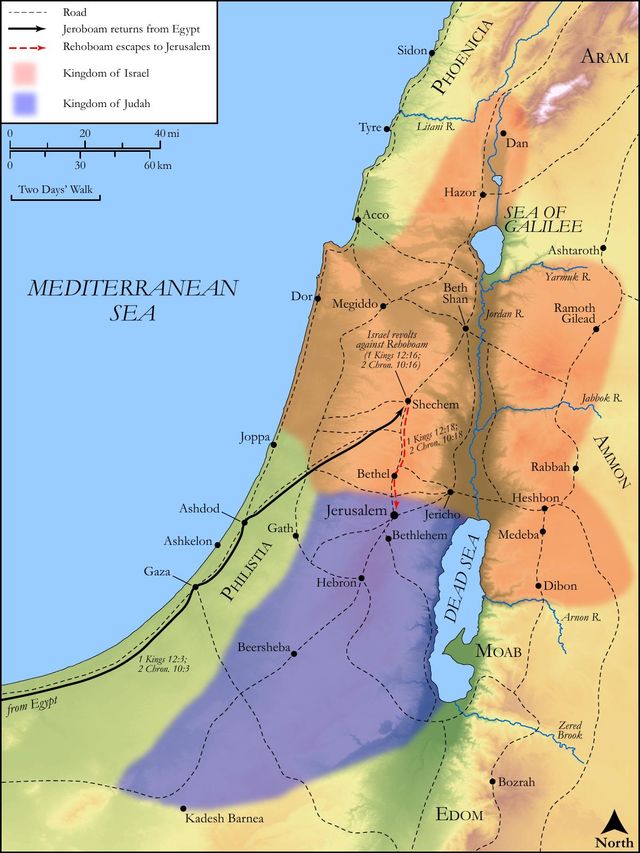
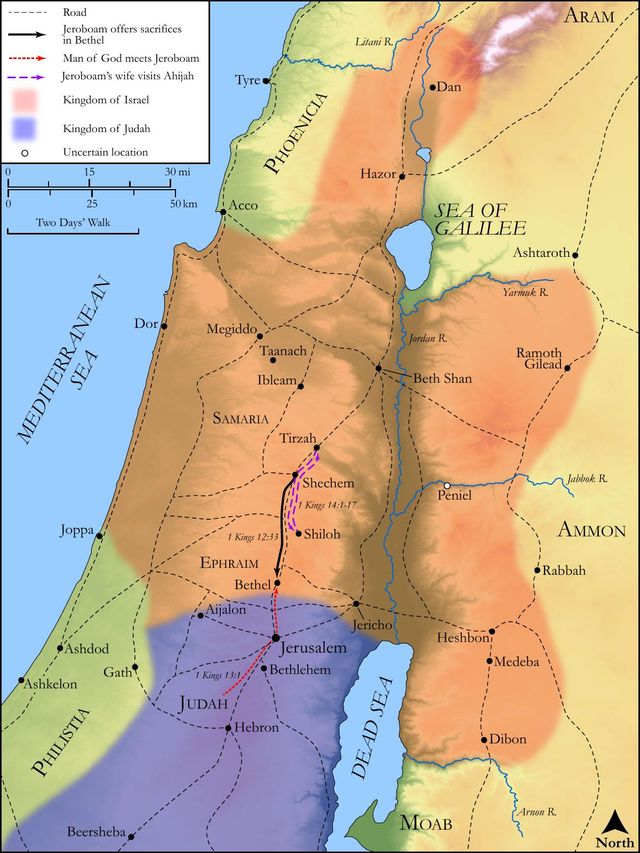
Study this verse
Public-domain commentary
Matthew Henry
From his Commentary on the Whole Bible. Henry comments on passages, not single verses — this entry covers 1 Kings 12:16–24. His three-level outline is real structure in the source text, so it is rendered as structure.
We have here the rending of the kingdom of the ten tribes from the house of David, to effect which,
I.The people were hold and resolute in their revolt.
They highly resented the provocation that Rehoboam had given them, were incensed at his menaces, concluded that that government would in the progress of it be intolerably grievous which in the beginning of it was so very haughty, and therefore immediately came to this resolve, one and all: What portion have we in David? Kg1 12:16. They speak here very unbecomingly of David, that great benefactor of their nation, calling him the son of Jesse, no greater a man than his neighbours. How soon are good men, and their good services to the public, forgotten! The rashness of their resolution was also much to be blamed. In time, and with prudent management, they might have settled the original contract with Rehoboam to mutual satisfaction. Had they enquired who gave Rehoboam this advice, and taken a course to remove those evil counsellors from about him, the rupture might have been prevented: otherwise their jealousy for their liberty and property well became that free people. Israel is not a servant, is not a homeborn slave; why should he be spoiled? Jer 2:14. They are willing to be ruled, but not to be ridden. Protection draws allegiance, but destruction cannot. No marvel that Israel falls away from the house of David (Kg1 12:19) if the house of David fall away from the great ends of their advancement, which was to be ministers of God to them for good. But thus to rebel against the seed of David, whom God had advanced to the kingdom (entailing it on his seed), and to set up another king in opposition to that family, was a great sin; see Ch2 13:5-8. To this God refers, Hos 8:4. They have set up kings, but not by me. And it is here mentioned to the praise of the tribe of Judah that they followed the house of David (Kg1 12:17, Kg1 12:20), and, for aught that appears, they found Rehoboam better than his word, nor did he rule with the rigour which at first he threatened.
II.Rehoboam was imprudent in the further management of this affair, and more and more infatuated.
Having foolishly thrown himself into a quick-sand, he sunk the further in with plunging to get out.
1.He was very unadvised in sending Adoram, who was over the tribute, to treat with them, Kg1 12:18. The tribute was the thing, and, for the sake of that, Adoram was the person, they most complained of. The very sight of him, whose name was odious among them, exasperated them, and made them outrageous. He was one to whom they could not so much as give a patient hearing, but stoned him to death in a popular tumult. Rehoboam was now as unhappy in the choice of his ambassador as before of his counsellors.
2.Some think he was also unadvised in quitting his ground, and making so much haste to Jerusalem, for thereby he deserted his friends and gave advantage to his enemies, who had gone to their tents indeed (Kg1 12:16) in disgust, but did not offer to make Jeroboam king till Rehoboam had gone, Kg1 12:20. See how soon this foolish prince went from one extreme to the other. He hectored and talked big when he thought all was his own, but sneaked and looked very mean when he saw himself in danger. It is common for those that are most haughty in their prosperity to be most abject in adversity.
III.God forbade his attempt to recover by the sword what he had lost.
What was done was of God, who would not suffer that it should be undone again (as it would be if Rehoboam got the better and reduced the ten tribes), nor that more should be done to the prejudice of the house of David, as would be if Jeroboam got the better and conquered the two tribes. The thing must rest as it is, and therefore God forbids the battle.
1.It was brave in Rehoboam to design the reducing of the revolters by force. His courage came to him when he had come to Jerusalem, Kg1 12:21. There he thought himself among his firm friends, who generously adhered to him and appeared for him. Judah and Benjamin (who feared the Lord and the king, and meddled not with those that were given to change) presently raised an army of 180,000 men, for the recovery of their king's right to the ten tribes, and were resolved to stand by him (as we say) with their lives and fortunes, having either not such cause, or rather not such a disposition, to complain, as the rest had.
2.It as more brave in Rehoboam to desist when God, by a prophet, ordered him to lay down his arms. He would not lose a kingdom tamely, for then he would have been unworthy the title of a prince; and yet he would not contend for it in opposition to God, for then he would have been unworthy the title of an Israelite. To proceed in this war would be not only to fight against their brethren (Kg1 12:24), whom they ought to love, but to fight against their God, to whom they ought to submit: This thing is from me. These two considerations should reconcile us to our losses and troubles, that God is the author of them and our brethren are the instruments of them; let us not therefore meditate revenge. Rehoboam and his people hearkened to the word of the Lord, disbanded the army, and acquiesced. Though, in human probability, they had a fair prospect of success (for their army was numerous and resolute, Jeroboam's party weak and unsettled), though it would turn to their reproach among their neighbours to lose so much of their strength and never have one push for it, to make a flourish and do nothing, yet,
(1.)They regarded the command of God though sent by a poor prophet. When we know God's mind we must submit to it, how much soever it crosses our own mind.
(2.)They consulted their own interest, concluding that though they had all the advantages, even that of right, on their side, yet they could not prosper if they fought in disobedience to God; and it was better to sit still than to rise up and fall. In the next reign God allowed them to fight, and gave them victory (2 Chr. 13), but not now.
Continue studying 1 Kings 12:19 across the web’s major study libraries — every link below opens this exact verse, chapter, or book on the destination site.
Read & Compare
 BibleGatewayThis verse in more than 200 translations and 70 languages.
 Bible.comThe YouVersion reader — hundreds of translations, reading plans, and highlights.
 ESV.orgCrossway's official English Standard Version reader.
 NET BibleThe NET translation with 60,000+ translators' notes on every rendering decision.
 STEP BibleTyndale House's free study tool — original text, vocabulary, and scholarly resources.
 BibliaLogos Bible Software's free web reader.
 USCCBThe New American Bible (Revised Edition) with the U.S. bishops' study notes.
Commentaries
 BibleHub CommentariesDozens of classic commentaries on this verse, gathered on one page.
 StudyLightMore than 100 commentary sets — the largest collection on the web.
 BibleRefPlain-English commentary on what this verse means, verse by verse.
 Enduring WordDavid Guzik's free commentary on this chapter, widely used by Bible teachers.
 Bible Study ToolsVerse commentary alongside Greek and Hebrew study aids.
Original Language & Research
- BibleHub InterlinearThe verse word by word — original language, transliteration, and English.
- BibleHub LexiconEvery word's original-language definition and Strong's entry.
 Blue Letter BibleDeep-study tools — Strong's numbers, concordance, and word studies.
 SefariaThe Hebrew text with Rashi and centuries of Jewish commentary.
Sermons, Hymns & Audio


TrulyRandomVerse is not affiliated with these sites and doesn’t control their content. They’re linked because they’re genuinely useful.
Summary
This pivotal verse encapsulates the culmination of Rehoboam's foolish leadership and the divine judgment against Solomon's idolatry, establishing a divided kingdom that would shape the political, religious, and social landscape of Israel for centuries to come, a division so profound it persisted "unto this day" from the perspective of the biblical author, marking a permanent schism in the united monarchy.
Context
ShowHideLiterary Context
This verse serves as the climactic declaration of the division, immediately following the dramatic confrontation between King Rehoboam and the people of Israel. The narrative in 1 Kings 12 details how, after Solomon's death, the northern tribes approached Rehoboam at Shechem, pleading for a lighter burden than the heavy taxes and forced labor imposed by his father (1 Kings 12:3-4). Rehoboam, rejecting the wise counsel of the elders who advised leniency and a servant-hearted approach, instead heeded the arrogant advice of his young companions, declaring his intention to make their yoke even heavier (1 Kings 12:8-14). This harsh and prideful response directly provoked the northern tribes' secession, encapsulated by their cry, "What portion have we in David? We have no inheritance in the son of Jesse! To your tents, O Israel!" (1 Kings 12:16). Verse 19 then solidifies this rebellion as a lasting historical reality, a direct consequence of Rehoboam's folly and, ultimately, God's sovereign hand in judgment.
Historical & Cultural Context
The division of the kingdom must be understood against the backdrop of Solomon's later reign. While glorious in its early years, Solomon's rule became increasingly burdensome due to massive building projects, heavy taxation, and forced labor, which created deep resentment, particularly among the northern tribes who had historically maintained a more independent spirit. Culturally, the concept of kingship in Israel was unique; the king was meant to be a servant of Yahweh and His people, not an absolute monarch. The Davidic dynasty, though divinely established through the Davidic Covenant, was not immune to the consequences of disobedience, as seen in Solomon's widespread idolatry (1 Kings 11:1-8). The northern tribes, representing a significant portion of Israel's population and land, had a history of tribal autonomy and were less firmly attached to Jerusalem and the Davidic line than Judah and Benjamin. The economic strains and Solomon's religious apostasy created fertile ground for a break, which Jeroboam, who had previously fled Solomon's wrath, was poised to lead (1 Kings 11:26-40).
Key Themes
ShowHideThis verse powerfully contributes to several overarching themes within the book of Kings and the broader biblical narrative. Firstly, it highlights the Consequences of Foolish Leadership, demonstrating how Rehoboam's pride, arrogance, and refusal to heed wise counsel directly led to the fracturing of a divinely established kingdom. His actions serve as a stark warning against authoritarianism and a lack of pastoral wisdom in leadership. Secondly, the event underscores the intricate interplay between Divine Sovereignty and Human Responsibility. While the division was a direct fulfillment of God's prophetic judgment against Solomon's idolatry, delivered through the prophet Ahijah to Jeroboam (1 Kings 11:29-39), Rehoboam's specific choices were the human instruments through which this divine plan was executed. This shows that God's purposes do not negate human accountability. Finally, the verse formally establishes the Divided Monarchy, a defining characteristic of Israelite history for the next two centuries. The northern kingdom would retain the name "Israel" (or sometimes "Ephraim"), while the southern kingdom, comprising Judah and Benjamin, would be known as "Judah," loyal to the Davidic line. This division would profoundly impact their religious practices, political stability, and ultimate destinies, leading to separate captivities.
Exposition and Analysis
ShowHideKey Word Analysis
ShowHideThis verb (H6586) signifies more than a mere political revolt or secession. In biblical Hebrew, pâshaʻ' often carries the connotation of a transgression, a breach of covenant, or an act of unfaithfulness against a legitimate authority, whether human or divine. Here, it implies a profound breaking of loyalty and an act of defiance against the established Davidic order, which was understood to be divinely ordained. It suggests a moral and spiritual dimension to the political act, highlighting the gravity of Israel's rejection of the "house of David."
This noun (H1004), used in the phrase "house of David," refers to the Davidic dynasty, the lineage of kings descended from David (H1732, Dâvid). It carries immense theological weight due to the unconditional covenant God made with David in 2 Samuel 7, promising an eternal throne and a perpetual kingdom. The rebellion against the "house of David" was therefore not merely against a human king but against the very institution that God had established as the perpetual ruling line for His people. The northern tribes' rejection of this house was a profound theological and political statement, directly challenging God's chosen lineage.
This noun (H3117), used in the phrase "unto this day," is a common literary marker found throughout historical narratives in the Old Testament. It serves to emphasize the enduring nature, significance, or observable result of an event at the time the biblical text was being written or compiled. In this context, it underscores the permanent and long-lasting consequences of the rebellion. The division was not a temporary schism but a fundamental reshaping of Israel's national identity and political reality that persisted for centuries, even up to the time of the book's final composition, highlighting its profound and irreversible impact.
Verse Breakdown
ShowHide"So Israel"
This refers specifically to the ten northern tribes, distinct from Judah and Benjamin, who remained loyal to the Davidic dynasty. Following Rehoboam's harsh response, these tribes declared their independence, forming their own kingdom under Jeroboam. This phrase thus delineates the new political entity that emerged from the united monarchy.
"rebelled against the house of David"
This clause describes the core action of the northern tribes: a definitive act of secession and a rejection of the legitimate, divinely appointed Davidic dynasty. It signifies a complete break in allegiance, both politically and, implicitly, religiously, given the theological significance of the Davidic covenant and the Jerusalem temple. This rebellion was a direct response to Rehoboam's oppressive policies but also a fulfillment of divine prophecy.
"unto this day"
This concluding phrase emphasizes the lasting and enduring nature of the division. It indicates that at the time the book of Kings was written (likely during or after the Babylonian exile), the two kingdoms (or their historical memory) remained distinct entities, and the consequences of this rebellion were still evident. It serves as a historical marker, highlighting the profound and irreversible impact of this pivotal event on Israel's national identity and trajectory.
Literary Devices
ShowHideThe verse employs several significant literary devices. Fulfillment of Prophecy is central, as the rebellion directly brings to pass the word of the Lord spoken through the prophet Ahijah to Jeroboam in 1 Kings 11:29-39, demonstrating God's sovereign control over history and His faithfulness to His word, even in judgment. The phrase "unto this day" functions as a Historical Marker or Anachronism, a common literary convention in biblical historiography that signals the enduring significance or observable reality of an event from the perspective of the narrator's present time. It draws the reader's attention to the long-term consequences of the actions described. Furthermore, the use of "Israel" to refer specifically to the northern tribes, distinct from "Judah," is a form of Synecdoche or Metonymy, where a part (the northern tribes) stands for the whole (the nation of Israel, which was now divided), or a name (Israel) is used to denote a specific political entity that emerged from the larger group. This linguistic distinction highlights the new political reality and the fragmentation of the once-united kingdom.
Theological and Thematic Connections
ShowHideThe rebellion described in 1 Kings 12:19 is not merely a political event but a profound theological statement on divine judgment, human responsibility, and the consequences of sin. It demonstrates that even God's chosen people and divinely established institutions are subject to His righteous judgment when they deviate from His ways. The division serves as a stark reminder that covenant blessings are often conditional upon obedience, and disobedience, particularly among leadership, can have devastating and far-reaching consequences for an entire nation. While God had unconditionally promised David an eternal dynasty, the expression of that dynasty through a united kingdom could be fractured due to the sin of subsequent kings, illustrating the tension between God's overarching plan and the immediate consequences of human choices. This event also sets the stage for the prophetic ministry in both kingdoms, as God continued to speak to His people even in their divided state.
Reflection and Application
ShowHideThe tragic division of Israel, culminating in the rebellion of 1 Kings 12:19, offers timeless lessons for individuals, leaders, and communities today. Rehoboam's failure to listen to wise counsel and his embrace of prideful, oppressive policies serve as a powerful cautionary tale against the dangers of arrogance and the abuse of authority. It reminds us that true leadership is characterized by humility, service, and a genuine concern for the well-being of those we lead, rather than a desire for power or control. The "unto this day" aspect of the verse underscores the enduring impact of our decisions; choices made today, especially by those in positions of influence, can have profound and lasting consequences that echo through generations. This narrative calls us to consider the fragility of unity and the destructive power of division, whether in families, churches, or nations. It challenges us to actively pursue reconciliation, seek wise counsel, and prioritize the common good over personal ambition or rigid ideology, recognizing that broken relationships and fractured communities often stem from a failure to listen, empathize, and serve.
Questions for Reflection
ShowHideFAQ
ShowHideWhy did God allow this division if He promised an eternal dynasty to David?
ShowHideGod's promise to David in 2 Samuel 7 was indeed unconditional regarding the perpetuity of his lineage on the throne. However, the prosperity and unity of the kingdom under that lineage were often conditional upon the obedience of individual kings and the nation. The division was a direct consequence of Solomon's widespread idolatry and disobedience (1 Kings 11:9-13). God, in His righteousness, judged Solomon's sin by tearing the kingdom from his son's hand, yet He preserved a remnant (Judah and Benjamin) for the sake of David and Jerusalem, ensuring the Davidic line would continue through which the Messiah would eventually come. Thus, the division was a demonstration of divine judgment and sovereignty, fulfilling prophecy while simultaneously upholding the foundational promise of the Davidic covenant.
What was the immediate impact of this rebellion on the northern tribes?
ShowHideThe immediate impact was the establishment of a separate kingdom, "Israel," under Jeroboam. However, this new kingdom quickly fell into deep spiritual apostasy. Fearing that his people would return to Jerusalem to worship at the temple and potentially reunite with the house of David, Jeroboam established new centers of worship at Bethel and Dan, setting up golden calves for the people to worship (1 Kings 12:26-33). This act of idolatry became the "sin of Jeroboam" that plagued the northern kingdom throughout its history, leading to a succession of unstable dynasties, political assassinations, and ultimately, its destruction and exile by the Assyrians in 2 Kings 17. The rebellion, while initially political, had profound and lasting spiritual consequences.
Christ-Centered Fulfillment
ShowHideThe tragic division of Israel in 1 Kings 12:19 stands in stark contrast to the unified and eternal kingdom established by Jesus Christ, the true Son of David. While earthly kings like Rehoboam fractured God's people through pride and folly, Jesus, the ultimate King, came to gather all people into one, undivided kingdom. He is the true heir to David's throne, not merely a political ruler, but the divine Messiah whose reign is characterized by justice, peace, and perfect unity (Luke 1:32-33). Unlike the earthly kingdom that was torn apart by sin and human failure, Christ's kingdom is spiritual and everlasting, drawing people from every tribe, tongue, and nation into a single body, the Church (Ephesians 2:14-16). Where Rehoboam's actions led to lasting division "unto this day," Christ's sacrifice on the cross broke down the dividing wall of hostility, reconciling humanity to God and to one another, making peace through His blood (Colossians 1:19-20). He is the unifying King who will ultimately reign over all, and His kingdom will have no end, fulfilling the Davidic covenant in a way far grander than any earthly monarchy could achieve (Revelation 11:15).