


2 Chronicles 10:19
Bible text: King James Version (1769 Blayney text) · Public domain
Bible text: Berean Standard Bible · Public domain
Bible text: American Standard Version (1901) · Public domain
Bible text: World English Bible, Messianic edition · Public domain
Bible text: Geneva Bible (1599) · Public domain
Bible text: Young's Literal Translation · Public domain
- וַיִּפְשְׁעוּvai·yif·she·'Uand they have rebelledH6586Conj-w ¦ V-Qal-ConsecImperf-3mpVerb Qal Consecutive Imperfect 3rd Plural Masculineוַandיִּפְשְׁעוּthey have rebelled
- יִשְׂרָאֵלYis·ra·'ElIsraelH3478N-properNoun Proper Location
- בְּבֵיתbe·Veitagainst [the] house ofH1004Prep-b ¦ N-mscNoun Singular Masculine Constructבְּagainstבֵית[the] house of
- דָּוִידda·VidDavidH1732N-proper-mNoun Proper Masculine
- עַד'aduntilH5704PrepPreposition
- הַיּוֹםhai·Yomthe dayH3117Art ¦ N-msNoun Singular Masculine Absoluteהַtheיּוֹםday
- הַזֶּהha·Zeh<the> thisH2088Art ¦ PrtParticle Demonstrativeהַ<the>זֶּהthis
English is a literal word-by-word gloss of the Hebrew, not the KJV's wording. Why?
This is the original text the KJV's translators worked from — each Hebrew word with its own literal English meaning in this verse, prepared by scholars at Tyndale House, Cambridge. The KJV translates whole sentences, not word by word, so its wording differs: one Hebrew word can become several English words, and the KJV may choose “the LORD” where the gloss reads “Yahweh”. Both are faithful — they answer different questions. For the KJV's own rendering, switch to the KJV text.
Details
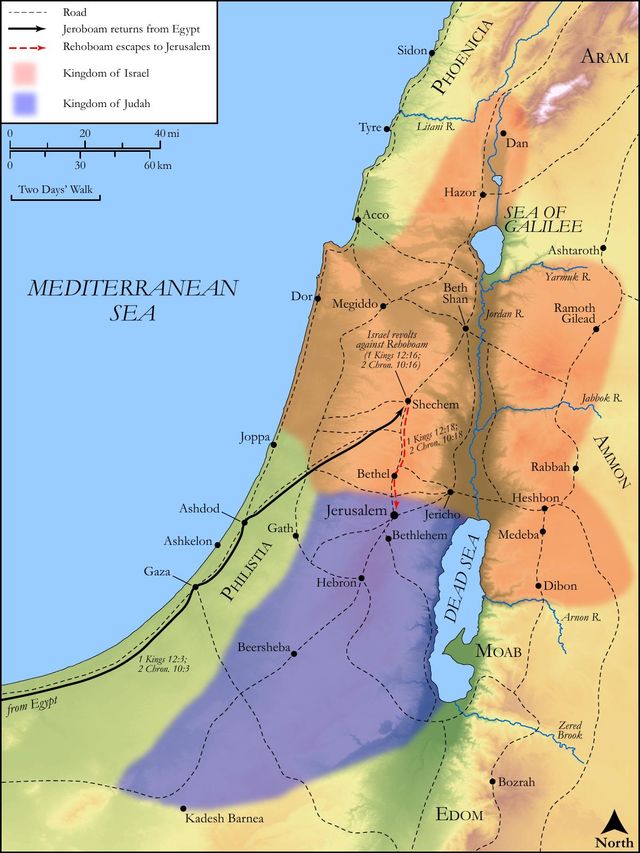
See on the biblical-era map
Study this verse
Public-domain commentary
Matthew Henry
From his Commentary on the Whole Bible. Henry comments on passages, not single verses — this entry covers 2 Chronicles 10:12–19.
We may learn here, 1. That when public affairs are in a ferment violent proceedings do but make bad worse. Rough answers (such as Rehoboam here gave) do but stir up anger and bring oil to the flames. The pilot has need to steer steadily in a storm. Many have been driven to the mischief they did not intend by being too severely dealt with for what they did intend. 2. That, whatever the devices and designs of men are, God is, by all, doing his own work, and fulfilling the word which he has spoken, no iota or tittle of which shall fall to the ground. The cause of the king's obstinacy and thoughtlessness was of God, that he might perform the word which he spoke by Ahijah, Ch2 10:15. This does not at all excuse Rehoboam's folly, nor lessen the guilt of his haughtiness and passion, that God was pleased to serve his own ends by them. 3. That worldly wealth, honour, and dominion, are very uncertain things. Solomon reigned over all Israel, and, one would think, had done enough to secure the monarchy entire to his family for many ages; and yet he is scarcely cold in his grave before ten of the twelve tribes finally revolt from his son. All the good services he had done for Israel were now forgotten: What portion have we in David? Thus is the government of Christ cast off by many, notwithstanding all he has done to bind the children of men for ever to himself; they say, We will not have this man to reign over us. But this rebellion will certainly be their ruin. 4. That God often visits the iniquities of the fathers upon the children. Solomon forsakes God, and therefore not he, but his son after him, is forsaken by the greatest part of his people. Thus God, by making the penal consequences of sin to last long and visibly to continue after the sinner's death, would give an indication of its malignity, and perhaps some intimation of the perpetuity of its punishment. He that sins against God not only wrongs his soul, but perhaps wrongs his seed more than he thinks of. 5. That, when God is fulfilling his threatenings, he will take care of that, at the same time, promises do not fall to the ground. When Solomon's iniquity is remembered, and for it his son loses ten tribes, David's piety is not forgotten, nor the promise made to him; but for the sake of that his grandson had two tribes preserved to him. The failings of the saints shall not frustrate any promise made to Christ their Head. They shall be chastised, but the covenant not broken, Psa 89:31-34.
Continue studying 2 Chronicles 10:19 across the web’s major study libraries — every link below opens this exact verse, chapter, or book on the destination site.
Read & Compare
 BibleGatewayThis verse in more than 200 translations and 70 languages.
 Bible.comThe YouVersion reader — hundreds of translations, reading plans, and highlights.
 ESV.orgCrossway's official English Standard Version reader.
 NET BibleThe NET translation with 60,000+ translators' notes on every rendering decision.
 STEP BibleTyndale House's free study tool — original text, vocabulary, and scholarly resources.
 BibliaLogos Bible Software's free web reader.
 USCCBThe New American Bible (Revised Edition) with the U.S. bishops' study notes.
Commentaries
 BibleHub CommentariesDozens of classic commentaries on this verse, gathered on one page.
 StudyLightMore than 100 commentary sets — the largest collection on the web.
 BibleRefPlain-English commentary on what this verse means, verse by verse.
 Enduring WordDavid Guzik's free commentary on this chapter, widely used by Bible teachers.
 Bible Study ToolsVerse commentary alongside Greek and Hebrew study aids.
Original Language & Research
- BibleHub InterlinearThe verse word by word — original language, transliteration, and English.
- BibleHub LexiconEvery word's original-language definition and Strong's entry.
 Blue Letter BibleDeep-study tools — Strong's numbers, concordance, and word studies.
 SefariaThe Hebrew text with Rashi and centuries of Jewish commentary.
Sermons, Hymns & Audio


TrulyRandomVerse is not affiliated with these sites and doesn’t control their content. They’re linked because they’re genuinely useful.
Summary
2 Chronicles 10:19 serves as a poignant and definitive summary, marking the tragic and permanent schism of the united monarchy of Israel. This pivotal verse encapsulates the direct consequence of King Rehoboam's arrogant and foolish rejection of wise counsel, recording the irreversible secession of ten tribes from the divinely appointed Davidic dynasty. It establishes a lasting division that profoundly shaped centuries of Israelite history, underscoring the deep impact of human choices within the context of God's sovereign and often disciplinary plan.
Context
ShowHideLiterary Context
This verse acts as the concluding statement of a momentous and consequential narrative detailed in 2 Chronicles 10. The chapter opens with Rehoboam, Solomon's son, traveling to Shechem to be crowned king over all Israel. The people, burdened by the heavy taxation and forced labor imposed during Solomon's ambitious building projects, approached Rehoboam with a plea for relief. Rehoboam initially consulted the elders, who wisely advised him to serve the people with kindness, promising their perpetual loyalty if he did so. However, he disregarded this seasoned wisdom, instead embracing the harsh, oppressive counsel of his youthful peers. His infamous declaration, "My little finger shall be thicker than my father's loins," found in 2 Chronicles 10:10, sealed his fate. Upon hearing this unyielding response, the ten northern tribes immediately rebelled, proclaiming, "What portion have we in David? and we have none inheritance in the son of Jesse: every man to your tents, O Israel: now see to thine own house, David," as recorded in 2 Chronicles 10:16. This act of rebellion led to the formation of the Northern Kingdom, "Israel," under Jeroboam, while only the tribes of Judah and Benjamin remained loyal to the "house of David," forming the Southern Kingdom, "Judah." The verse thus provides a succinct, climactic summation of this foundational national rupture.
Historical & Cultural Context
The period immediately following King Solomon's death was fraught with tension, a direct result of his reign's policies. While Solomon's ambitious building programs, including the magnificent Temple and his royal palace, brought immense glory and prestige to Jerusalem, they demanded vast resources, leading to significant taxation and the conscription of labor from all tribes. This created economic hardship and simmering resentment, particularly among the northern tribes, who felt disproportionately burdened and perhaps less connected to Jerusalem's centralized power. Culturally, the accession of a new king often presented an opportunity for a reset, a chance for the monarch to demonstrate benevolence and redress grievances, thereby solidifying popular support. Rehoboam's profound failure to grasp these socio-economic realities and his embrace of tyrannical rhetoric over empathetic leadership directly violated the traditional covenantal relationship between king and people, which ideally involved mutual obligation, justice, and care. The "house of David" represented the divinely sanctioned lineage of kingship, deeply rooted in the Davidic Covenant, and the rebellion signified a profound and unprecedented break from this established, sacred order for the majority of Israel.
Key Themes
ShowHideThe division of the kingdom, as summarized in this verse, illuminates several profound and enduring themes. Firstly, it powerfully illustrates the consequences of pride and unwise counsel. Rehoboam's arrogance, his refusal to heed experienced wisdom, and his preference for severe, oppressive policies directly led to the fracturing of his kingdom. This demonstrates how leadership failures rooted in self-exaltation and a lack of empathy can have devastating, long-lasting effects on a nation or community. Secondly, the narrative underscores divine sovereignty in human events. While human choices—Rehoboam's folly and Jeroboam's rebellion—were instrumental, the Chronicler emphasizes that this division was part of God's overarching plan. 2 Chronicles 10:15 explicitly states, "For the cause was of God, that the LORD might perform his word which he spake by the hand of Ahijah the Shilonite to Jeroboam the son of Nebat." This directly refers to the prophecy in 1 Kings 11:29-39, where God promised Jeroboam ten tribes due to Solomon's idolatry and unfaithfulness. Thirdly, despite the rebellion of the ten tribes, the narrative subtly reinforces the enduring nature of the Davidic covenant. The promise of an everlasting dynasty to David, as found in 2 Samuel 7:16, remained steadfastly with the tribe of Judah and the kingdom centered in Jerusalem, from which the Messiah would eventually come. Finally, the phrase "unto this day" emphasizes historical continuity and the lasting impact of this momentous event, indicating that the separation between the Northern Kingdom of Israel and the Southern Kingdom of Judah persisted up to the time the Chronicler was writing, marking a fundamental and enduring reality in Israelite history.
Exposition and Analysis
ShowHideKey Word Analysis
ShowHideDerived from H6586, this verb signifies a deliberate act of breaking away from a just or established authority. It implies a trespass, an apostasy, or a quarrel, moving beyond mere discontent to overt insurrection and defiance. In this context, it powerfully underscores the decisive and permanent nature of the northern tribes' secession from the Davidic monarchy, highlighting their rejection of the legitimate, divinely ordained rule. This was not a negotiation but a definitive act of political and spiritual rupture.
This word, when used in the phrase "house of David," extends far beyond a literal dwelling. It refers to the dynasty, lineage, royal authority, and established institution of David's kingship. It encapsulates the profound theological significance of the Davidic covenant, where God promised an eternal kingdom and a perpetual line of descendants on the throne. The rebellion against the "house of David" was therefore not merely a political coup against an individual king but a rejection of God's chosen dynastic line, highlighting the immense gravity and covenantal implications of the schism.
This word, used in the phrase "unto this day," functions as a crucial historical marker. It emphasizes the enduring consequence or continued reality of an event at the time the Chronicler was composing the narrative. It signifies that the division was not a temporary political hiccup but a fundamental, long-term reality that persisted for generations, confirming its profound and lasting impact on the national identity and political landscape of Israel. It connects the past event directly to the Chronicler's present audience.
Verse Breakdown
ShowHide"And Israel rebelled"
This initial clause identifies the primary actors and their decisive action. "Israel" here refers specifically to the ten northern tribes, distinct from Judah and Benjamin. Their "rebellion" was a direct, active renunciation of allegiance to Rehoboam and, by extension, to the Davidic line. This act was precipitated by Rehoboam's harsh policies and his refusal to alleviate the burdens imposed by his father, Solomon, signifying a complete severance of political and, eventually, religious ties with Jerusalem.
"against the house of David"
This specifies the profound target and nature of the rebellion. It was not merely a personal affront to King Rehoboam but a rejection of the entire dynastic line and the covenantal promises associated with David. By rebelling against the "house of David," the northern tribes effectively rejected the legitimacy of David's descendants to rule over them, leading to the establishment of their own kings and a rival religious system centered in the north. This highlights the theological gravity of their actions.
"unto this day"
This concluding phrase serves as a characteristic editorial comment of the Chronicler. It confirms that the division of the kingdom was not a temporary schism but a fundamental, long-term reality that persisted up to the time the book of Chronicles was being compiled. It underscores the profound and enduring historical consequence of Rehoboam's actions and the people's rebellion, emphasizing that the separation between the Northern Kingdom of Israel and the Southern Kingdom of Judah was an established and ongoing fact for the Chronicler's audience.
Literary Devices
ShowHideThe verse employs several significant literary devices to convey its weighty message. Primarily, it functions as a Summary Statement, providing a terse yet comprehensive encapsulation of the dramatic and far-reaching outcome of the preceding narrative. It offers a definitive conclusion to the account of Rehoboam's folly and the subsequent schism. The phrase "unto this day" acts as a potent Historical Marker or a Proleptic Statement, drawing the reader's attention to the enduring legacy of the event and explicitly connecting the past narrative to the Chronicler's contemporary reality. This device underscores the permanence and historical significance of the division. Furthermore, "the house of David" is a clear example of Metonymy, where a related concept (the "house" or lineage) stands in for the entire Davidic monarchy, its authority, and its covenantal standing. This choice of language emphasizes the dynastic and theological implications of the rebellion, rather than merely a personal rejection of Rehoboam. The verse's striking Conciseness also contributes to its impact, delivering a profound historical and theological truth with stark brevity and finality.
Theological and Thematic Connections
ShowHideThe rebellion of Israel against the house of David, though undeniably rooted in human sin, pride, and folly, stands as a profound testament to God's intricate working within human history. It reveals how divine judgment can manifest through the natural consequences of human choices, yet simultaneously, God's sovereign plan remains utterly unthwarted. The division served as a disciplinary measure for the extensive idolatry of Solomon and the subsequent spiritual decline of the nation, but it also providentially preserved a faithful remnant (Judah) through whom the Messianic promise would continue. This event powerfully highlights the tension between human responsibility and divine decree, demonstrating that even in moments of profound national failure and devastating division, God is actively orchestrating His purposes, ensuring the ultimate fulfillment of His covenant promises for the redemption of humanity.
Reflection and Application
ShowHideThe tragic division of Israel, succinctly captured in 2 Chronicles 10:19, offers timeless and profound lessons for individuals, leaders, and communities across all generations. Rehoboam's story stands as a stark and enduring warning against the perils of unchecked pride, unyielding arrogance, and the catastrophic rejection of wise, empathetic counsel. His insatiable desire for absolute power and his callous refusal to empathize with the legitimate grievances and burdens of his people led directly to consequences so devastating they reverberated for centuries, permanently altering the course of a nation. This narrative compels us to engage in deep self-examination: do we, in our own lives and spheres of influence, prioritize our personal desires, comfort, or perceived authority over the well-being and legitimate concerns of others? Are we humble enough to genuinely seek and truly heed advice from those with wisdom, experience, and a heart for service, or do we instead surround ourselves with voices that merely affirm our preconceived notions and flatter our egos? The lasting impact of Rehoboam's singular, foolish decision reminds us that our choices, particularly those made from positions of influence, can have far-reaching and enduring effects, shaping not only our own lives but also the trajectory and destiny of those around us. Ultimately, the account invites us to cultivate a profound trust in God's unwavering sovereignty, even when human failures and societal divisions seem to derail His plans, finding comfort and steadfast hope in the knowledge that His ultimate purposes will undeniably prevail.
Questions for Reflection
ShowHideFAQ
ShowHideWhy did God allow this division if He promised David an eternal dynasty?
ShowHideThe division of the kingdom, while a tragic human failure and a consequence of Rehoboam's folly, was paradoxically part of God's sovereign plan to discipline His people and fulfill earlier prophecies. God had indeed promised David an enduring dynasty in 2 Samuel 7, but this promise did not negate the consequences of sin and disobedience. Solomon's extensive idolatry and unfaithfulness, detailed in 1 Kings 11, provoked God's righteous judgment. Through the prophet Ahijah, God explicitly revealed that He would tear the kingdom from Solomon's son, leaving only one tribe (Judah) for David's sake and for the sake of Jerusalem (1 Kings 11:29-39). Thus, Rehoboam's foolish choices merely served as the human instrument through which God's preordained judgment and disciplinary action were enacted. Crucially, the division preserved the "house of David" in Judah, ensuring the continuation of the royal line from which the Messiah would eventually come, thereby upholding the ultimate, eternal promise to David despite the temporary political fragmentation.
What does "unto this day" imply about the Chronicler's perspective?
ShowHideThe phrase "unto this day" is a common and significant literary device employed by biblical historians, including the Chronicler, to emphasize the enduring impact or continued reality of a particular event from the author's own historical vantage point. In the context of 2 Chronicles 10:19, it signifies that the political and, by extension, religious separation between the Northern Kingdom (Israel) and the Southern Kingdom (Judah) was not a temporary schism but a fundamental, long-term reality that persisted up to the time the book of Chronicles was being compiled. It underscores the profound and lasting historical consequence of Rehoboam's actions and the people's rebellion, validating the significance of this event in the ongoing narrative of Israel's history. It also implies that the Chronicler's original audience would have been intimately familiar with this continuing division, making the historical account deeply relevant to their present circumstances and identity.
Christ-Centered Fulfillment
ShowHideThe rebellion of Israel against the house of David in 2 Chronicles 10:19 vividly portrays the inherent brokenness, instability, and ultimate futility of earthly kingship and human-led kingdoms. The tragic division of the monarchy, born from pride, folly, and a rejection of divine wisdom, highlights humanity's desperate need for a perfect, undivided King who would rule with absolute justice, unwavering wisdom, and eternal authority. While the "house of David" was fractured by human sin, it remained the divinely chosen lineage through which God's ultimate promise of a forever King would be fulfilled. This promise culminates gloriously in Jesus Christ, the true Son of David, whose kingdom is not of this world and will never be divided, overthrown, or corrupted by human folly. While Rehoboam's reign led to fragmentation and alienation, Jesus came precisely to gather and unite, breaking down the dividing walls between people, as beautifully described in Ephesians 2:14. He is the King prophesied to sit on David's throne forever, reigning over an everlasting kingdom (Luke 1:32-33). Unlike the flawed and often tyrannical earthly kings of Israel, Christ's reign is marked by perfect humility, selfless service, and unwavering wisdom, bringing true peace, reconciliation, and eternal unity to His people—a spiritual kingdom that will ultimately prevail over all earthly powers and endure for all eternity (Revelation 11:15).