


Jeremiah 33:17
Bible text: King James Version (1769 Blayney text) · Public domain
Bible text: Berean Standard Bible · Public domain
Bible text: American Standard Version (1901) · Public domain
Bible text: World English Bible, Messianic edition · Public domain
Bible text: Geneva Bible (1599) · Public domain
Bible text: Young's Literal Translation · Public domain
- כִּיkiforH3588PrtParticle Conditional
- כֹהkhohthusH3541AdvAdverb
- אָמַר'a·Marhe saysH559V-Qal-Perf-3msVerb Qal Perfect 3rd Singular Masculine
- יְהוָהYah·wehYahwehH3068N-properNoun Proper Title
- לֹאlo'notH3808NegParticle Negative
- יִכָּרֵתyi·ka·Retit will be cut offH3772V-Niphal-Imperf-3msVerb Niphal Imperfect 3rd Singular Masculine
- לְדָוִדle·da·Vidto DavidH1732Prep-l ¦ N-proper-mNoun Proper MasculineלְtoדָוִדDavid
- אִישׁ'isha manH376N-msNoun Singular Masculine Absolute
- יֹשֵׁבyo·Shev[who] sitsH3427V-Qal-Prtcpl-msVerb Qal Participle Singular Masculine Absolute
- עַל'alonH5921PrepPreposition
- כִּסֵּאki·Se'[the] throne ofH3678N-mscNoun Singular Masculine Construct
- בֵיתveit[the] house ofH1004N-mscNoun Singular Masculine Construct
- יִשְׂרָאֵלYis·ra·'ElIsraelH3478N-properNoun Proper Location
English is a literal word-by-word gloss of the Hebrew, not the KJV's wording. Why?
This is the original text the KJV's translators worked from — each Hebrew word with its own literal English meaning in this verse, prepared by scholars at Tyndale House, Cambridge. The KJV translates whole sentences, not word by word, so its wording differs: one Hebrew word can become several English words, and the KJV may choose “the LORD” where the gloss reads “Yahweh”. Both are faithful — they answer different questions. For the KJV's own rendering, switch to the KJV text.
Details
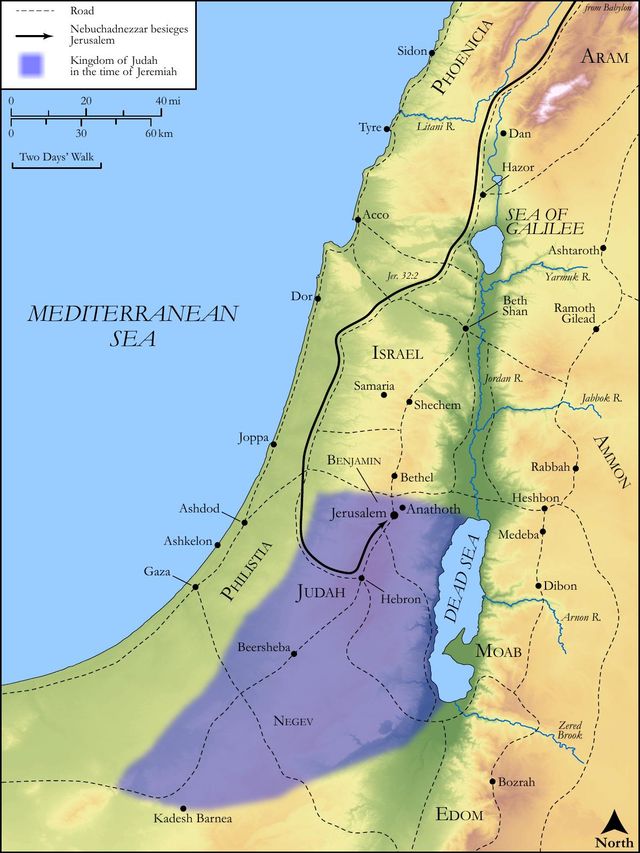
See on the biblical-era map
Study this verse
Public-domain commentary
Matthew Henry
From his Commentary on the Whole Bible. Henry comments on passages, not single verses — this entry covers Jeremiah 33:17–26. His two-level outline is real structure in the source text, so it is rendered as structure.
Three of God's covenants, that of royalty with David and his seed, that of the priesthood with Aaron and his seed, and that of Peculiarity with Abraham and his seed, seemed to be all broken and lost while the captivity lasted; but it is here promised that, notwithstanding that interruption and discontinuance for a time, they shall all three take place again, and the true intents and meaning of them all shall be abundantly answered in the New Testament blessings, typified by those conferred on the Jews after their return out of captivity.
I.The covenant of royalty shall be secured and the promises of it shall have their full accomplishment in the kingdom of Christ, the Son of David, Jer 33:17. The throne of Israel was overturned in the captivity; the crown had fallen from their head; there was not a man to sit on the throne of Israel; Jeconiah was written childless. After their return the house of David made a figure again; but it in the Messiah that this promise is performed that David shall never want a man to sit on the throne of Israel, and that David shall have always a son to reign upon his throne. For as long as the man Christ Jesus sits on the right hand of the throne of God, rules the world, and rules it for the good of the church, to which he is a quickening head, and glorified head over all things, as long as he is King upon the holy hill of Zion, David does not want a successor, nor is the covenant with him broken. When the first-begotten was brought into the world it was declared concerning him, The Lord God shall give him the throne of his father David and he shall reign over the house of Jacob for ever, Luk 1:32, Luk 1:33. For the confirmation of this it is promised,
1.That the covenant with David shall be as firm as the ordinances of heaven, to the stability of which that of God's promise is compared, Jer 31:35, Jer 31:36. There is a covenant of nature, by which the common course of providence is settled and on which it is founded, here called a covenant of the day and the night (Jer 33:20, Jer 33:25), because this is one of the articles of it, That there shall be day and night in their season, according to the distinction put between them in the creation, when God divided between the light and the darkness, and established their mutual succession, and a government to each, that the sun should rule by day and the moon and stars by night (Gen 1:4, Gen 1:5, Gen 1:16), which establishment was renewed after the flood (Gen 8:22), and has continued ever since, Psa 19:2. The morning and the evening have both of them their regular outgoings (Psa 65:8); the day-spring knows its place, knows its time, and keeps both, so do the shadows of the evening; and, while the world stands, this course shall not be altered, this covenant shall not be broken. The ordinances of heaven and earth (of this communication between heaven and earth, the dominion of these ordinances of heaven upon the earth), which God has appointed (Jer 33:25; compare Job 38:33), shall never be disappointed. Thus firm shall the covenant of redemption be with the Redeemer - God's servant, but David our King, Jer 33:21. This intimates that Christ shall have a church on earth to the world's end; he shall see a seed in which he shall prolong his days till time and day shall be no more. Christ's kingdom is an everlasting kingdom; and when the end cometh, and not till then, it shall be delivered up to God, even the Father. But it intimates that the condition of it in this world shall be intermixed and counterchanged, prosperity and adversity succeeding each other, as light and darkness, day and night. But this is plainly taught us, that, as sure as we may be that, though the sun will set tonight, it will rise again tomorrow morning, whether we live to see it or no, so sure we may be that, though the kingdom of the Redeemer in the world may for a time be clouded and eclipsed by corruptions and persecutions, yet it will shine forth again, and recover its lustre, in the time appointed.
2.That the seed of David shall be as numerous as the host of heaven, that is, the spiritual seed of the Messiah, that shall be born to him by the efficacy of his gospel and his Spirit working with it. From the womb of the morning he shall have the dew of their youth, to be his willing people, Psa 110:3. Christ's seed are not, as David's were, his successors, but his subjects; yet the day is coming when they also shall reign with him (Jer 33:22): As the host of heaven cannot be numbered, so will I multiply the seed of David, so that there shall be no danger of the kingdom's being extinct, or extirpated, for want of heirs. The children are numerous; and, if children, then heirs.
II.The covenant of priesthood shall be secured, and the promises of that also shall have their full accomplishment.
This seemed likewise to be forgotten during the captivity, when there was no altar, no temple service, for the priests to attend upon; but this also shall revive. It did so; immediately upon their coming back to Jerusalem there were priests and Levites ready to offer burnt-offerings and to do sacrifice continually (Ezr 3:2, Ezr 3:3), as is here promised, Jer 33:18. But that priesthood soon grew corrupt; the covenant of Levi was profaned (as appears Mal 2:8), and in the destruction of Jerusalem by the Romans it came to a final period. We must therefore look elsewhere for the performance of this word, that the covenant with the Levites, the priests, God's ministers, shall be as firm, and last as long, as the covenant with the day and the night. And we find it abundantly performed,
1.In the priesthood of Christ, which supersedes that of Aaron, and is the substance of that shadow. While that great high priest of our profession is always appearing in the presence of God for us, presenting the virtue of his blood by which he made atonement in the incense of his intercession, it may truly be said that the Levites do not want a man before God to offer continually, Heb 7:3, Heb 7:17. He is a priest for ever. The covenant of the priesthood is called a covenant of peace (Num 25:12), of life and peace, Mal 2:5. Now we are sure that this covenant is not broken, nor in the least weakened, while Jesus Christ is himself our life and our peace. This covenant of priesthood is here again and again joined with that of royalty, for Christ is a priest upon his throne, as Melchizedek.
2.In a settled gospel ministry. While there are faithful ministers to preside in religious assemblies, and to offer up the spiritual sacrifices of prayer and praise, the priests, the Levites, do not want successors, and such as have obtained a more excellent ministry. The apostle makes those that preach the gospel to come in the room of those that served at the altar, Co1 9:13, Co1 9:14.
3.In all true believers, who are a holy priesthood, a royal priesthood (Pe1 2:5, Pe1 2:9), who are made to our God kings and priests (Rev 1:6); they offer up spiritual sacrifices, acceptable to God, and themselves, in the first place, living sacrifices. Of these Levites this promise must be understood (Jer 33:22), that they shall be as numerous as the sand of the sea, the same that is promised concerning Israel in general (Gen 22:17); for all God's spiritual Israel are spiritual priests, Rev 5:9, Rev 5:10; Rev 7:9, Rev 7:15.
III.The covenant of peculiarity likewise shall be secured and the promises of that covenant shall have their full accomplishment in the gospel Israel. Observe,
1.How this covenant was looked upon as broken during the captivity, Jer 33:24. God asks the prophet, "Hast though not heard, and dost thou not consider, what this people have spoken?" either the enemies of Israel, who triumphed in the extirpation of a people that had made such a noise in the world, or the unbelieving Israelites themselves, "this people among whom thou dwellest;" they have broken covenant with God, and then quarrel with him as if he had not dealt faithfully with them. The two families which the Lord hath chosen, Israel and Judah, whereas they were but one when he chose them, he hath even cast them off. "Thus have they despised my people, that is, despised the privilege of being my people as if it were a privilege of no value at all." The neighbouring nations despised them as now no more a nation, but the ruins of a nation, and looked upon all their honour as laid in the dust; but,
2.See how firm the covenant stands notwithstanding, as firm as that with day and night; sooner will God suffer day and night to cease then he will cast away the seed of Jacob. This cannot refer to the seed of Jacob according to the flesh, for they are cast away, but to the Christian church, in which all these promises were to be lodged, as appears by the apostle's discourse, Rom 11:1, etc. Christ is that seed of David that is to be perpetual dictator to the seed of Abraham, Isaac, and Jacob; and, as this people shall never want such a king, so this king shall never want such a people. Christianity shall continue in the dominion of Christ, and the subjection of Christians to him, till day and night come to an end. And, as a pledge of this, that promise is again repeated, I will cause their captivity to return; and, having brought them back, I will have mercy on them. To whom this promise refers appears Gal 6:16, where all that walk according to the gospel rule are made to be the Israel of God, on whom peace and mercy shall be.
Continue studying Jeremiah 33:17 across the web’s major study libraries — every link below opens this exact verse, chapter, or book on the destination site.
Read & Compare
 BibleGatewayThis verse in more than 200 translations and 70 languages.
 Bible.comThe YouVersion reader — hundreds of translations, reading plans, and highlights.
 ESV.orgCrossway's official English Standard Version reader.
 NET BibleThe NET translation with 60,000+ translators' notes on every rendering decision.
 STEP BibleTyndale House's free study tool — original text, vocabulary, and scholarly resources.
 BibliaLogos Bible Software's free web reader.
 USCCBThe New American Bible (Revised Edition) with the U.S. bishops' study notes.
Commentaries
 BibleHub CommentariesDozens of classic commentaries on this verse, gathered on one page.
 StudyLightMore than 100 commentary sets — the largest collection on the web.
 BibleRefPlain-English commentary on what this verse means, verse by verse.
 Enduring WordDavid Guzik's free commentary on this chapter, widely used by Bible teachers.
 Bible Study ToolsVerse commentary alongside Greek and Hebrew study aids.
Original Language & Research
- BibleHub InterlinearThe verse word by word — original language, transliteration, and English.
- BibleHub LexiconEvery word's original-language definition and Strong's entry.
 Blue Letter BibleDeep-study tools — Strong's numbers, concordance, and word studies.
 SefariaThe Hebrew text with Rashi and centuries of Jewish commentary.
Sermons, Hymns & Audio


TrulyRandomVerse is not affiliated with these sites and doesn’t control their content. They’re linked because they’re genuinely useful.
Summary
Jeremiah 33:17 delivers a powerful and unconditional divine promise regarding the perpetual continuity of the Davidic dynasty. In this declaration, Yahweh assures that a descendant of David will never cease to occupy the throne of the house of Israel, thereby guaranteeing an unbroken line of royal succession. This verse, nestled within the "Book of Consolation," serves as a beacon of hope and an affirmation of God's unwavering faithfulness to His covenant, even amidst the profound national crisis of Judah's impending or ongoing Babylonian exile.
Context
ShowHideLiterary Context
Jeremiah 33:17 is situated within the "Book of Consolation" (chapters 30-33), a section of Jeremiah's prophecy that dramatically shifts from pronouncements of judgment to messages of future hope, restoration, and covenant renewal. This promise of an enduring Davidic line immediately follows a prophecy concerning the coming of a "righteous Branch" from David (Jeremiah 33:15), who will execute justice and righteousness in the land. The broader context of Jeremiah 33 reinforces God's commitment to both the Davidic monarchy and the Levitical priesthood, promising that just as the ordinances of day and night are fixed, so too are His covenants with David and the Levites immutable (Jeremiah 33:19-22). Thus, verse 17 is a foundational component of God's comprehensive plan for the restoration and future leadership of His people.
Historical & Cultural Context
The prophecies of Jeremiah were delivered during the tumultuous final decades of the Kingdom of Judah, a period marked by political instability, spiritual apostasy, and the looming threat of Babylonian conquest. By the time this prophecy was likely uttered or compiled, Jerusalem had either been besieged or was on the verge of its final destruction, the Davidic king Zedekiah was soon to be dethroned, and the people exiled. From a human perspective, the Davidic covenant, which promised an eternal dynasty (2 Samuel 7:12-16), appeared to have utterly failed. In this context of national catastrophe and the apparent end of the Davidic monarchy, the promise of an unbroken succession was not merely comforting; it was a radical, counter-intuitive declaration of God's sovereign power and unshakeable covenant fidelity, defying all contemporary evidence and human logic. The "throne" (H3678, kiççêʼ) among the kings of that day was the ultimate symbol of royal authority, legitimacy, and the continuity of a ruling dynasty.
Key Themes
ShowHideJeremiah 33:17 profoundly contributes to several overarching theological themes. Foremost is the theme of Divine Faithfulness to Covenant, particularly the unconditional Davidic Covenant. Despite Israel's persistent unfaithfulness and the severe judgment of exile, God's commitment to His promises remains steadfast, demonstrating His immutable character. Another crucial theme is Hope in Restoration, as God promises to bring His people back from exile and re-establish their national and spiritual life under righteous leadership. This promise provides a powerful counter-narrative to the despair of exile. Finally, the verse carries profound Messianic Expectation. While referring to a continuous line of earthly kings, it ultimately points beyond them to a future, ultimate Davidic ruler whose reign would be eternal and perfect, thereby fulfilling the spirit of the promise in a way that no mere human king could. This expectation is a thread woven throughout Old Testament prophecy, echoed in passages like Isaiah 9:6-7 and Psalm 132:11-12.
Exposition and Analysis
ShowHideKey Word Analysis
ShowHideThis word (H3772) literally means "to cut (off, down or asunder)." In the context of a lineage or covenant, it signifies termination, destruction, or ceasing to exist. The phrase "shall never want" (Hebrew: lôʼ yikkarēt) is a strong negation, meaning "there shall not be cut off." This emphasizes the absolute and enduring nature of the Davidic succession, promising an unbroken line, contrary to the historical reality of the exile where the Davidic monarchy was indeed "cut off" from its direct rule. The use of this term highlights God's power to maintain what human circumstances might sever.
The verb (H3427) primarily means "to sit down," but carries broader implications of dwelling, remaining, or being established. When applied to a throne, it signifies the act of reigning, holding authority, and maintaining a continuous presence as a ruler. The promise that David shall never want a man "to sit upon the throne" underscores the perpetual exercise of royal authority by a descendant of David, ensuring the continuity of his dynastic rule.
This noun (H3678) refers to a seat of authority, specifically a royal throne, often depicted as canopied. It symbolizes kingship, power, and legitimate rule. The "throne of the house of Israel" refers to the royal authority over God's covenant people. The promise concerning this throne is not merely about a physical seat but about the enduring legitimacy and continuity of the Davidic dynasty's claim to rule over Israel, divinely guaranteed.
Verse Breakdown
ShowHide"For thus saith the LORD;"
This is a classic and authoritative prophetic formula, a direct declaration from Yahweh (H3068, Yᵉhôvâh). It establishes the divine origin and infallible truthfulness of the ensuing promise, underscoring its certainty, immutability, and non-negotiable nature. It is not a human prediction but a divine decree.
"David shall never want a man"
This clause directly addresses the Davidic covenant, referring to King David (H1732, Dâvid) and, by extension, his royal lineage. The phrase "shall never want a man" (Hebrew: lôʼ yikkarēt l'Dâvid ʼîysh) literally means "there shall not be cut off for David a man (H376, ʼîysh)." This is a powerful, absolute negative assertion, guaranteeing the perpetual existence of a male descendant from David's line, ensuring the continuation of his royal seed.
"to sit upon the throne"
This phrase specifies the continuous role of David's descendant – to exercise royal authority. "To sit upon the throne" (H3678, kiççêʼ) signifies the act of reigning, holding the scepter, and maintaining the kingship. It is a promise of continuous, legitimate rule, implying an active and enduring presence of a Davidic king.
"of the house of Israel;"
This designates the sphere of the Davidic king's rule. "The house of Israel" (H1004, bayith of H3478, Yisrâʼêl) refers to the entire covenant people of God, encompassing both Judah and the northern tribes. This signifies a future restoration where the divided kingdom would be reunited under a single, legitimate Davidic ruler, emphasizing the universal scope of this Davidic king's authority over God's chosen nation.
Literary Devices
ShowHideJeremiah 33:17 is rich with literary artistry that amplifies its profound message. The opening phrase, Divine Oracle ("Thus saith the LORD"), immediately stamps the declaration with absolute authority and infallibility, emphasizing that this is not a human prediction but a direct, certain word from God Himself. The central promise utilizes Covenant Language, directly referencing and reaffirming the Davidic Covenant established in 2 Samuel 7, specifically the promise of an enduring dynasty. The phrase "shall never want a man" is a powerful Negative Assertion or Litotes, using a double negative ("not cut off") to emphasize the absolute certainty and perpetual nature of the Davidic succession. This form of expression creates a strong, emphatic declaration of God's unbreakable promise, contrasting sharply with the apparent historical reality. Furthermore, the mention of "throne" functions as Metonymy, where the physical object (the throne) stands for the abstract concept of royal authority, kingship, and dynastic continuity, underscoring the enduring nature of David's royal line.
Theological and Thematic Connections
ShowHideJeremiah 33:17 stands as a cornerstone of Old Testament theology, powerfully demonstrating God's unwavering commitment to His covenant promises despite human failure and profound historical upheaval. It reiterates the unconditional nature of the Davidic Covenant, highlighting God's sovereign grace in maintaining His word even when immediate circumstances (the Babylonian exile and the cessation of the earthly monarchy) seemed to contradict it. The verse underscores the theme of divine faithfulness, assuring that God's plans for His people and their leadership will ultimately be realized. It also serves as a vital link in the unfolding Messianic prophecy, pointing towards a future, ultimate Davidic King whose reign would truly be eternal and righteous, thereby fulfilling the spirit and letter of this promise in a way that no earthly king could. This promise transcends the immediate political context, pointing to a spiritual reality of an enduring kingdom.
Reflection and Application
ShowHideJeremiah 33:17 offers profound comfort and a robust foundation for hope, particularly in times of uncertainty, apparent divine silence, or when human institutions fail. For believers today, this verse serves as a powerful reminder that God is utterly faithful to His covenants and His word. Even when circumstances seem dire, when human leaders disappoint, or when promises appear delayed or impossible, God's ultimate plan remains secure. We are called to trust in His unchanging character and His sovereign control over history, recognizing that His ways are higher than our ways and His thoughts than our thoughts. This promise, ultimately fulfilled in Christ, encourages us to fix our gaze not on the fleeting kingdoms of this world but on the eternal, unshakable kingdom of God. It assures us that our hope is not in human leaders or political systems, but in the King of kings, whose reign is everlasting and whose promises are "Yes" and "Amen" in Him, providing an anchor for the soul in every storm.
Questions for Reflection
ShowHideFAQ
ShowHideWhat is the "house of Israel" in this verse, and why is it significant?
ShowHideThe "house of Israel" (H1004, bayith and H3478, Yisrâʼêl) refers to the entire covenant people of God, the descendants of Jacob (Israel). Historically, after the division of the kingdom following Solomon's reign, "Israel" often referred specifically to the northern kingdom, while "Judah" referred to the southern kingdom. However, in prophetic contexts, especially concerning future restoration and the Messianic era, "Israel" often encompasses both Judah and the northern tribes, signifying a reunited people under a single, legitimate Davidic ruler. Its significance here is that God's promise of an enduring Davidic throne is for the benefit of His whole people, pointing to a future where divine leadership would unify and bless all of God's covenant nation, restoring the glory of the united kingdom under a righteous king.
How could this promise be true when the earthly Davidic monarchy ended with the Babylonian exile?
ShowHideThis is a critical point of tension that highlights the prophetic nature of the promise, which transcends immediate historical circumstances. While the direct, earthly succession of Davidic kings on a physical throne in Jerusalem ceased after the exile, the promise was not ultimately about an unbroken chain of human monarchs. Instead, it pointed to a deeper, spiritual reality and an ultimate, divine fulfillment. The New Testament reveals that this promise finds its perfect and eternal fulfillment in Jesus Christ, who is the Son of David, the rightful heir to David's throne, whose kingdom is spiritual and everlasting. The temporary cessation of the earthly monarchy served to underscore that the ultimate King would be more than human, establishing a kingdom that is not of this world and therefore cannot be overthrown by earthly powers.
Christ-Centered Fulfillment
ShowHideJeremiah 33:17 finds its ultimate and glorious fulfillment in the person and work of Jesus Christ. While the earthly Davidic monarchy ceased after the Babylonian exile, God's promise to David was not abrogated but transcended and elevated to a higher, eternal plane. The angel Gabriel's announcement to Mary explicitly links Jesus to this ancient prophecy, declaring, "He will be great and will be called the Son of the Most High; and the Lord God will give Him the throne of His father David; and He will reign over the house of Jacob forever, and His kingdom will have no end" (Luke 1:32-33). Jesus, born of the lineage of David (Matthew 1:1), is the "righteous Branch" prophesied elsewhere in Jeremiah (Jeremiah 23:5) and the "Root and the Offspring of David" (Revelation 22:16). His resurrection and ascension to the right hand of God establish His eternal reign, not merely over a physical nation, but over a spiritual kingdom composed of all who believe, drawn from every tribe and tongue. Thus, the promise that David would "never want a man to sit upon the throne" is perfectly and eternally fulfilled in Christ, whose spiritual kingdom will truly have no end, securing God's covenant promises forever and providing an everlasting King for His people.