


Jeremiah 33:15
Bible text: King James Version (1769 Blayney text) · Public domain
Bible text: King James Version with Strong's numbers · Public domain
Bible text: Berean Standard Bible · Public domain
Bible text: American Standard Version (1901) · Public domain
Bible text: World English Bible, Messianic edition · Public domain
Bible text: Geneva Bible (1599) · Public domain
Bible text: Young's Literal Translation · Public domain
- בַּיָּמִיםbai·ya·Mimin the daysH3117Prep-b ¦ N-mpNoun Plural Masculine Absoluteבַּin theיָּמִיםdays
- הָהֵםha·Hem<the> thoseH1992Art ¦ Pro-3mpPronoun Personal 3rd Plural Masculineהָ<the>הֵםthose
- וּבָעֵתu·va·'Etand at the timeH6256Conj-w ¦ Prep-b ¦ N-csNoun Singular common gender Absoluteוּandבָat theעֵתtime
- הַהִיאha·Hi'<the> thatH1931Art ¦ Pro-3fsPronoun Personal 3rd Singular Feminineהַ<the>הִיאthat
- אַצְמִיחַ'atz·Mi·achI will cause to sproutH6779V-Hiphil-Imperf-1csVerb Hiphil Imperfect 1st Singular common gender
- לְדָוִדle·da·Vidfor DavidH1732Prep-l ¦ N-proper-mNoun Proper MasculineלְforדָוִדDavid
- צֶמַחTze·macha branch ofH6780N-mscNoun Singular Masculine Construct
- צְדָקָהtze·da·KahrighteousnessH6666N-fsNoun Singular Feminine Absolute
- וְעָשָׂהve·'a·Sahand he will doH6213Conj-w ¦ V-Qal-ConsecPerf-3msVerb Qal Consecutive Perfect 3rd Singular Masculineוְandעָשָׂהhe will do
- מִשְׁפָּטmish·PatjusticeH4941N-msNoun Singular Masculine Absolute
- וּצְדָקָהu·tze·da·Kahand righteousnessH6666Conj-w ¦ N-fsNoun Singular Feminine Absoluteוּandצְדָקָהrighteousness
- בָּאָרֶץba·'A·retzin the landH776Prep-b ¦ N-fsNoun Singular Feminine Absoluteבָּin theאָרֶץland
English is a literal word-by-word gloss of the Hebrew, not the KJV's wording. Why?
This is the original text the KJV's translators worked from — each Hebrew word with its own literal English meaning in this verse, prepared by scholars at Tyndale House, Cambridge. The KJV translates whole sentences, not word by word, so its wording differs: one Hebrew word can become several English words, and the KJV may choose “the LORD” where the gloss reads “Yahweh”. Both are faithful — they answer different questions. For the KJV's own rendering, switch to the KJV text.
Details
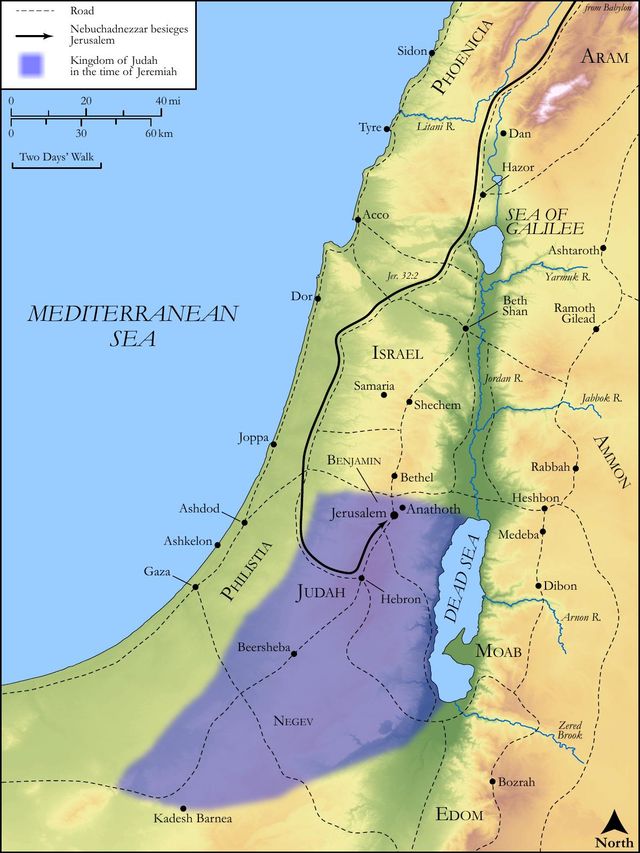
See on the biblical-era map
Study this verse
Public-domain commentary
Matthew Henry
From his Commentary on the Whole Bible. Henry comments on passages, not single verses — this entry covers Jeremiah 33:10–16. His two-level outline is real structure in the source text, so it is rendered as structure.
Here is a further prediction of the happy state of Judah and Jerusalem after their glorious return out of captivity, issuing gloriously at length in the kingdom of the Messiah.
I.It is promised that the people who were long in sorrow shall again be filled with joy.
Every one concluded now that the country would lie for ever desolate, that no beasts would be found in the land of Judah, no inhabitant in the streets of Jerusalem, and consequently there would be nothing but universal and perpetual melancholy (Jer 33:10); but, though weeping may endure for a time, joy will return. It was threatened (Jer 7:34 and Jer 16:9) that the voice of joy and gladness should cease there; but here it is promised that they shall revive again, that the voice of joy and gladness shall be heard there, because the captivity shall be returned; for then was their mouth filled with laughter, Psa 126:1, Psa 126:2.
1.There shall be common joy there, the voice of the bridegroom and the voice of the bride; marriages shall again be celebrated, as formerly, with songs, which in Babylon they had laid aside, for their harps were hung on the willow-trees.
2.There shall be religious joy there; temple-songs shall be revived, the Lord's songs, which they could not sing in a strange land. There shall be heard in their private houses, and in the cities of Judah, as well as in the temple, the voice of those that shall say, Praise the Lord of hosts. Note, Nothing is more the praise and honour of a people than to have God the glory of it, the glory both of the power and of the goodness by which it is effected; they shall prise him both as the Lord of hosts and as the God who is good and whose mercy endures for ever. This, though a song of old, yet, being sung upon this fresh occasion, will be a new song. We find this literally fulfilled at their return out of Babylon, Ezr 3:11. They sang together in praising the Lord, because he is good, for his mercy endures for ever. The public worship of God shall be diligently and constantly attended upon: They shall bring the sacrifice of praise to the house of the Lord. All the sacrifices were intended for the praise of God, but this seems to be meant of the spiritual sacrifices of humble adorations and joyful thanksgivings, the calves of our lips (Hos 14:2), which shall please the Lord better than an ox of bullock. The Jews say that in the days of the Messiah all sacrifices shall cease but the sacrifice of praise, and to those days this promise has a further reference.
II.It is promised that the country, which had lain long depopulated, shall be replenished and stocked again.
It was now desolate, without man and without beast; but, after their return, the pastures shall again be clothed with flocks, Psa 65:13. In all the cities of Judah and Benjamin there shall be a habitation of shepherds, Jer 33:12, Jer 33:13. This intimates,
1.The wealth of the country, after their return. It shall not be a habitation of beggars, who have nothing, but of shepherds and husbandmen, men of substance, with good stocks upon the ground they have returned to.
2.The peace of the country. It shall not be a habitation of soldiers, not shall there be tents and barracks set up to lodge them, but there shall be shepherds; tents; for they shall hear no more the alarms of war, nor shall there be any to make even the shepherds afraid. See Psa 144:13, Psa 144:14.
3.The industry of the country, and their return to their original plainness and simplicity, from which, in the corrupt ages, they had sadly degenerated. The seed of Jacob, in their beginning, gloried in this, that they were shepherds (Gen 47:3), and so they shall now be again, giving themselves wholly to that innocent employment, causing their flocks to lie down (Jer 33:12) and to pass under the hands of him that telleth them (Jer 33:13); for, though their flocks are numerous, they are not numberless, nor shall they omit to number them, that they may know if any be missing and may seek after it. Note, It is the prudence of those who have ever so much of the world to keep an account of what they have. Some think that they pass under the hand of him that telleth them that they may be tithed, Lev 27:32. Then we may take the comfort of what we have when God has had his dues out of it. Now because it seemed incredible that a people, reduced as now they were, should ever recover such a degree of peace and plenty as this, here is subjoined a general ratification of these promises (Jer 33:14): I will perform that good thing which I have promised. Though the promise may sometimes work slowly towards an accomplishment, it works surely. The days will come, though they are long in coming.
III.To crown all these blessings which God has in store for them, here is a promise of the Messiah, and of that everlasting righteousness which he should bring in (Jer 33:15, Jer 33:16), and probably this is that good thing, that great good thing, which in the latter days, days that were yet to come, God would perform, as he had promised to Judah and Israel, and to which their return out of captivity and their settlement again in their own land was preparatory. From the captivity to Christ is one of the famous periods, Mat 1:17. This promise of the Messiah we had before (Jer 23:5, Jer 23:6), and there it came in as a confirmation of the promise of the shepherds whom God would set over them, which would make one think that the promise here concerning the shepherds and their flocks, which introduces it, is to be understood figuratively. Christ is here prophesied of,
1.As a rightful King. He is a branch of righteousness, not a usurper, for he grows up unto David, descends from his loins, with whom the covenant of royalty was made, and is that seed with whom that covenant should be established, so that his title is unexceptionable.
2.As a righteous king, righteous in enacting laws, waging wars, and giving judgment, righteous in vindicating those that suffer wrong and punishing those that do wrong: He shall execute judgment and righteousness in the land. This may point at Zerubbabel, in the type, who governed with equity, not as Jehoiakim had done (Jer 22:17); but it has a further reference to him to whom all judgment is committed and who shall judge the world in righteousness.
3.As a king that shall protect his subjects from all injury. By him Judah shall be saved from wrath and the curse, and, being so saved, Jerusalem shall dwell safely, quiet from the fear of evil, and enjoying a holy security and serenity of mind, in a dependence upon the conduct of this prince of peace, this prince of their peace.
4.As a king that shall be praised by his subjects: "This is the name whereby they shall call him" (so the Chaldee reads it, the Syriac, and vulgar Latin); "this name of his they shall celebrate and triumph in, and by this name they shall call upon him." It may be read, more agreeably to the original, This is he who shall call her, The Lord our righteousness. As Moses's altar is called Jehovah-nissi (Exo 17:15), and Jerusalem Jehovah-shammah (Eze 48:35), intimating that they glory in Jehovah as present with them and their banner, so here the city is called The Lord our righteousness, because they glory in Jehovah as their righteousness. That which was before said to be the name of Christ (says Mr. Gataker) is here made the name of Jerusalem, the city of the Messiah, the church of Christ. He it is that imparts righteousness to her, for he is made of God to us righteousness, and she, by bearing that name, professes to have her whole righteousness, not from herself, but from him. In the Lord have I righteousness and strength, Isa 45:24. And we are made the righteousness of God in him. The inhabitants of Jerusalem shall have this name of the Messiah so much in their mouths that they shall themselves be called by it.
Historical interpretation
Historical reception
1 surviving comment on this verse from the historical church.
But the majesty of the Son of God, in which he is equal with the Father in its garb of a slave’s humility, feared no diminution, required no augmentation. And the very effect of his mercy, which he expended on the restitution of humanity, he was able to bring about solely by the power of his Godhead, thus rescuing the creature that was made in the image of God from the yoke of his cruel oppressor. But because the devil had not shown himself so violent in his attack on the first man as to bring him over to his side without the consent of his free will, the voluntary sin and hostile desires of humanity had to be destroyed in such a way that the standard of justice should not stand in the way of the gift of grace. And therefore in the general ruin of the entire human race there was but one remedy in the secret of the divine plan which could help the fallen, and that was that one of the sons of Adam should be born free and innocent of original transgression, to prevail for the rest both by his example and his merits. Still further, because this was not permitted by natural generation, and because there could be no offspring from our faulty stock without seed, of which the Scripture says, “Who can make a clean thing conceived of an unclean seed? Is it not you who are alone?” David’s Lord was made David’s Son, and sprang from the fruit of the promised branch—One without fault, the twofold nature coming together into one Person, that by one and the same conception and birth might spring our Lord Jesus Christ, in whom was present both true Godhead for the performance of mighty works and true humanity for the endurance of sufferings.
Continue studying Jeremiah 33:15 across the web’s major study libraries — every link below opens this exact verse, chapter, or book on the destination site.
Read & Compare
 BibleGatewayThis verse in more than 200 translations and 70 languages.
 Bible.comThe YouVersion reader — hundreds of translations, reading plans, and highlights.
 ESV.orgCrossway's official English Standard Version reader.
 NET BibleThe NET translation with 60,000+ translators' notes on every rendering decision.
 STEP BibleTyndale House's free study tool — original text, vocabulary, and scholarly resources.
 BibliaLogos Bible Software's free web reader.
 USCCBThe New American Bible (Revised Edition) with the U.S. bishops' study notes.
Commentaries
 BibleHub CommentariesDozens of classic commentaries on this verse, gathered on one page.
 StudyLightMore than 100 commentary sets — the largest collection on the web.
 BibleRefPlain-English commentary on what this verse means, verse by verse.
 Enduring WordDavid Guzik's free commentary on this chapter, widely used by Bible teachers.
 Bible Study ToolsVerse commentary alongside Greek and Hebrew study aids.
Original Language & Research
- BibleHub InterlinearThe verse word by word — original language, transliteration, and English.
- BibleHub LexiconEvery word's original-language definition and Strong's entry.
 Blue Letter BibleDeep-study tools — Strong's numbers, concordance, and word studies.
 SefariaThe Hebrew text with Rashi and centuries of Jewish commentary.
Sermons, Hymns & Audio


TrulyRandomVerse is not affiliated with these sites and doesn’t control their content. They’re linked because they’re genuinely useful.
Summary
Jeremiah 33:15 presents a profound prophetic declaration from the Lord, promising the future emergence of a righteous king from the lineage of David. This verse, delivered amidst Judah's impending judgment and exile, serves as a powerful beacon of unwavering hope, asserting God's steadfast faithfulness to His covenant with David. It foretells the coming of a divinely appointed ruler who will establish perfect justice and righteousness throughout the land, ultimately bringing comprehensive restoration and blessing to His people.
Context
ShowHideLiterary Context
This verse is strategically placed within Jeremiah's "Book of Consolation" (chapters 30-33), a section that marks a significant shift from the preceding prophecies of dire judgment and destruction. While Jeremiah's primary prophetic commission was to declare God's impending wrath upon Judah for its persistent idolatry and moral corruption, these chapters pivot dramatically to reveal God's ultimate plans for restoration, renewal, and a glorious future. Specifically, Jeremiah 33:14-26 forms a crucial pericope that reiterates and expands upon God's unconditional covenant promises, particularly the Davidic covenant and the Levitical priesthood. This immediate literary setting underscores God's enduring faithfulness and His unwavering commitment to His covenantal word, even in the face of His people's profound unfaithfulness, presenting a future hope that transcends their immediate suffering and exile.
Historical & Cultural Context
Jeremiah prophesied during the tumultuous final decades of the Kingdom of Judah, a period marked by political instability, spiritual apostasy, and the looming threat of Babylonian invasion. He bore witness to the decline of the Davidic monarchy under a succession of unrighteous kings who often failed to uphold justice and righteousness, leading the nation further into sin and away from God. This culminated in the devastating destruction of Jerusalem and the exile of its people to Babylon. Culturally, the people of Judah held deeply to the promise of a perpetual Davidic king, yet their present reality was one of a decaying monarchy and national catastrophe, seemingly contradicting this ancient hope. This prophecy, therefore, speaks directly into a period of profound national crisis, offering a future vision of a righteous ruler from David's line—a stark contrast to the corrupt and ineffective kings of their day—and a powerful reaffirmation of ancient promises made to King David himself.
Key Themes
ShowHideJeremiah 33:15 encapsulates several major theological and narrative themes prevalent throughout the book of Jeremiah and the broader Old Testament prophetic tradition. The most prominent is Messianic Prophecy, identifying the future king as "the Branch of righteousness." This is a significant title found in other prophetic books, such as Isaiah 4:2, Zechariah 3:8, and Zechariah 6:12, highlighting God's ultimate plan for a divine deliverer. Closely related is the Fulfillment of the Davidic Covenant, emphasizing God's unwavering commitment to establish an eternal dynasty through David's lineage, a promise central to Israel's hope for a righteous king who would reign forever (see 2 Samuel 7:12-16). The verse also powerfully underscores the theme of Righteous Rule, contrasting the future king's perfect "judgment and righteousness" with the corrupt and unjust leadership that characterized Jeremiah's contemporary era. Finally, it speaks powerfully to Restoration and Hope, assuring God's people that despite their impending exile and the apparent failure of the monarchy, God would ultimately bring about a glorious future under a perfectly just and righteous ruler, signaling a new era of blessing and peace for the land.
Exposition and Analysis
ShowHideKey Word Analysis
ShowHideDerived from the primitive root H6779 (tsâmach), meaning "to sprout," "grow up," or "bud forth," this noun literally refers to a shoot, sprout, or bud. Prophetically, "the Branch" is a profound Messianic title. It signifies new life, vitality, and growth emerging from a seemingly dead or dormant lineage. In the context of the Davidic line, which was in severe decline and facing imminent destruction during Jeremiah's time, "the Branch" points to a future descendant who would "sprout" forth as a new, vibrant, and legitimate king, bringing forth new life and hope for the nation, fulfilling God's ancient promises.
This word denotes rightness in an abstract sense, encompassing rectitude, justice, virtue, and even prosperity. When applied to "the Branch," it emphasizes the moral uprightness, perfect justice, and unwavering adherence to God's divine standards that will characterize His rule. Unlike the unrighteous and corrupt kings of Judah who failed to administer justice, this coming ruler will embody and actively administer perfect justice, ensuring equity, moral integrity, and divine order in the land.
This is a versatile primitive root meaning "to do or make" in the broadest sense, encompassing actions like accomplish, perform, bring forth, or carry out. In this specific context, it signifies the active, authoritative, and effective implementation of judgment and righteousness. The "Branch" will not merely possess these qualities inherently but will actively administer them, ensuring that justice is not just a concept but a lived reality, a tangible outcome of His reign throughout the land.
Verse Breakdown
ShowHide"In those days, and at that time"
This phrase serves as a crucial temporal marker, pointing to a specific, divinely appointed future period. It indicates that the fulfillment of this profound prophecy is not immediate but belongs to a future era within God's comprehensive redemptive plan, often understood as the eschatological age or the time of the Messiah's coming. It emphasizes God's sovereign timing and the absolute certainty of His promised intervention, assuring the exiles that their present suffering is not the final word.
"will I cause the Branch of righteousness to grow up unto David"
This is the core Messianic promise of the verse. The emphatic "I will cause...to grow up" highlights God's active, sovereign, and unilateral role in bringing forth this figure; it is His divine initiative and power, not human effort or political maneuvering, that will bring this about. "The Branch of righteousness" identifies the Messiah as a descendant of David (indicated by "unto David"), who will embody and bring perfect righteousness. This signifies a new, vital shoot emerging from the "stump of Jesse" (David's father), ensuring the continuation and ultimate fulfillment of the Davidic covenant despite its apparent failure.
"and he shall execute judgment and righteousness in the land"
This clause describes the essential nature and transformative impact of the Branch's reign. The Messiah will not only be inherently righteous in character but will actively "execute" or administer "judgment" (referring to fair verdicts, legal justice, and divine law) and "righteousness" (encompassing moral uprightness, equity, and conformity to God's will) throughout the entire "land." This promises a reign of perfect justice, where divine standards are upheld without compromise, wrongs are righted, and an era of peace, order, and moral integrity prevails, standing in stark contrast to the pervasive injustice and corruption that plagued Judah in Jeremiah's day.
Literary Devices
ShowHideJeremiah 33:15 is rich with several literary devices that amplify its prophetic power and theological depth. The central and most prominent device is Metaphor, specifically the use of "the Branch" (Hebrew: tsemach) to describe the coming Messiah. This metaphor powerfully evokes imagery of new growth, vitality, and renewal emerging from a seemingly barren or cut-down lineage (referring to the declining and soon-to-be-exiled house of David), symbolizing profound hope and the promise of a flourishing future. The accompanying phrase "grow up" (Hebrew: tsâmach) further reinforces this organic imagery of burgeoning life. The verse also employs potent Covenant Language, particularly by referencing "David," which immediately invokes the unconditional Davidic covenant found in 2 Samuel 7. This serves to remind the audience of God's enduring and unbreakable promises, providing assurance despite their present circumstances of national decline. Furthermore, there is a clear instance of Parallelism in the phrase "judgment and righteousness," a common biblical pairing that emphasizes the comprehensive and holistic nature of the Messiah's just rule, where both legal rectitude and moral integrity are perfectly enacted and upheld. This repetition underscores the foundational principles of His future kingdom.
Theological and Thematic Connections
ShowHideJeremiah 33:15 stands as a cornerstone of Old Testament Messianic prophecy, deeply interwoven with the fabric of God's unwavering covenantal faithfulness. It powerfully demonstrates God's steadfast commitment to His promises, particularly the Davidic covenant, even when human failure and national catastrophe seem to have rendered them void. The "Branch of righteousness" points unequivocally to a future king who will perfectly embody divine justice and establish a reign characterized by absolute integrity and equity, standing in stark contrast to the corrupt and unrighteous kings of Judah's recent past. This prophecy underscores the profound theological truth that God's ultimate solution to human sin and societal brokenness is not merely a restoration to a past, flawed state, but the ushering in of a new, glorious era under a divinely appointed, perfectly righteous ruler. It connects seamlessly to the broader biblical narrative of a sovereign God who meticulously works through history to bring about His redemptive purposes, culminating in the reign of His Anointed One.
Reflection and Application
ShowHideJeremiah 33:15 offers profound hope and practical guidance for believers navigating the complexities of life today. It serves as a powerful reminder that even in the midst of personal trials, societal chaos, or apparent failures of human systems, God remains absolutely faithful to His promises. When we observe the brokenness of the world, the pervasive injustices, and the inherent failures of human leadership, this verse directs our gaze to the ultimate King, the "Branch of righteousness," who will one day perfectly execute judgment and righteousness. This truth should cultivate a deep, abiding trust in God's sovereign plan and His unparalleled ability to bring perfect order out of disorder. Furthermore, it calls us, as followers of this righteous King, to participate actively in His kingdom work now, striving to live righteously, seeking justice, and embodying His character in our daily lives and spheres of influence. Our ultimate hope is not found in fleeting earthly solutions or political ideologies, but in the certain and glorious reign of the Messiah, who will ultimately set all things right and establish His eternal kingdom.
Questions for Reflection
ShowHideFAQ
ShowHideWhat does "the Branch of righteousness" mean in this verse?
ShowHide"The Branch of righteousness" is a pivotal Messianic title, referring to a future, divinely appointed king who will descend directly from the lineage of David. The Hebrew word for "Branch" (tsemach) metaphorically signifies a new shoot or sprout, symbolizing new life and vigorous growth emerging from the seemingly cut-down or dormant royal line of David. This "Branch" is uniquely characterized by "righteousness" (tsᵉdâqâh), meaning He will embody and administer perfect justice, moral integrity, and unwavering adherence to God's divine standards. It points directly to the Messiah, who will establish a kingdom founded on perfect equity and truth, thereby fulfilling God's ancient and unconditional promises to David (see 2 Samuel 7:12-16).
How does this prophecy relate to the Davidic Covenant?
ShowHideThis prophecy is a direct reaffirmation and profound expansion of the Davidic Covenant, which God sovereignly established with King David in 2 Samuel 7. In that foundational covenant, God promised David an enduring dynasty, an eternal throne, and a perpetual kingdom. By stating that God "will cause the Branch of righteousness to grow up unto David," Jeremiah 33:15 explicitly and powerfully connects the promised future king to David's royal lineage. It assures the people that despite the current failure and impending exile of David's earthly descendants, God's promise to establish a righteous, eternal king from David's line remains unbroken and will ultimately be fulfilled through the Messiah. This highlights God's unwavering faithfulness to His covenantal word, even when human circumstances suggest otherwise.
When will this prophecy be fulfilled, and how does it impact us today?
ShowHideThe prophecy of "the Branch of righteousness" has a dual and progressive fulfillment. Its initial and decisive fulfillment is found in the first coming of Jesus Christ, who is the promised descendant of David (e.g., Matthew 1:1, Romans 1:3). He came as the righteous King, though His kingdom was inaugurated spiritually in the hearts of believers. The full, visible, and ultimate fulfillment, particularly concerning the comprehensive execution of "judgment and righteousness in the land," awaits His glorious second coming, when He will return to establish His visible, righteous, and eternal reign on earth (e.g., Revelation 19:11-16). For believers today, this prophecy provides enduring hope, assuring us that God's perfect plan for a perfectly just world will indeed come to pass. It calls us to live in eager anticipation of His return, striving to embody the righteousness of His inaugurated kingdom in our lives now, and trusting implicitly in His sovereign control over all history.
Christ-Centered Fulfillment
ShowHideJeremiah 33:15 finds its ultimate, glorious, and complete fulfillment in the person and redemptive work of Jesus Christ. He is the quintessential "Branch of righteousness" who "grew up unto David," tracing His physical lineage directly to the ancient king, as meticulously recorded in the genealogies of Matthew 1:1-17 and Luke 3:23-38. While the Davidic monarchy lay in ruins and disrepute during Jeremiah's era, Jesus emerged as the new, vibrant, and perfect shoot from the seemingly dead stump of David's house, powerfully embodying God's unwavering faithfulness to His covenant. Jesus perfectly "executed judgment and righteousness" not only through His sinless life and authoritative teachings, which flawlessly revealed God's perfect standards, but supremely through His atoning death on the cross and His triumphant resurrection. On the cross, He bore the full judgment for humanity's unrighteousness, and through His resurrection, He established the basis for true righteousness for all who believe (Romans 3:21-26). His first coming inaugurated His spiritual kingdom, a reign of grace and truth in the hearts of believers (John 18:36-37). The full, visible execution of "judgment and righteousness in the land," where every wrong is righted and perfect justice prevails, awaits His glorious second coming, when He will return as the King of kings and Lord of lords to establish His perfect, eternal kingdom, bringing ultimate peace, justice, and order to all creation (Revelation 19:11-16). Thus, Jeremiah's ancient prophecy is a powerful testament to God's unfolding redemptive plan, culminating in Christ's past work, present reign, and future return to reign forever.