


Jeremiah 33:14
Bible text: King James Version (1769 Blayney text) · Public domain
Bible text: King James Version with Strong's numbers · Public domain
Bible text: Berean Standard Bible · Public domain
Bible text: American Standard Version (1901) · Public domain
Bible text: World English Bible, Messianic edition · Public domain
Bible text: Geneva Bible (1599) · Public domain
Bible text: Young's Literal Translation · Public domain
- הִנֵּהhi·Nehhere!H2009PrtParticle Interjection
- יָמִיםya·MimdaysH3117N-mpNoun Plural Masculine Absolute
- בָּאִיםba·'Im[are] comingH935V-Qal-Prtcpl-mpVerb Qal Participle Plural Masculine Absolute
- נְאֻםne·'um[the] utterance ofH5002N-mscNoun Singular Masculine Construct
- יְהוָהYah·wehYahwehH3068N-properNoun Proper Title
- וַהֲקִמֹתִיva·ha·ki·mo·Tiand I will carry outH6965Conj-w ¦ V-Hiphil-ConsecPerf-1csVerb Hiphil Consecutive Perfect 1st Singular common genderוַandהֲקִמֹתִיI will carry out
- אֶת'et<obj.>H853DirObjMParticle Object Indicator
- הַדָּבָרha·da·Varthe wordH1697Art ¦ N-msNoun Singular Masculine Absoluteהַtheדָּבָרword
- הַטּוֹבha·Tov<the> goodH2896Art ¦ Adj-msAdjective Singular Masculine Absoluteהַ<the>טּוֹבgood
- אֲשֶׁר'a·SherwhichH834RelParticle Relative
- דִּבַּרְתִּיdi·Bar·tiI have spokenH1696V-Piel-Perf-1csVerb Piel Perfect 1st Singular common gender
- אֶל'eltoH413PrepPreposition
- בֵּיתbeit[the] house ofH1004N-mscNoun Singular Masculine Construct
- יִשְׂרָאֵלYis·ra·'ElIsraelH3478N-properNoun Proper Location
- וְעַלve·'aland toH5921Conj-w ¦ PrepPrepositionוְandעַלto
- בֵּיתbeit[the] house ofH1004N-mscNoun Singular Masculine Construct
- יְהוּדָהye·hu·DahJudahH3063N-properNoun Proper Location
English is a literal word-by-word gloss of the Hebrew, not the KJV's wording. Why?
This is the original text the KJV's translators worked from — each Hebrew word with its own literal English meaning in this verse, prepared by scholars at Tyndale House, Cambridge. The KJV translates whole sentences, not word by word, so its wording differs: one Hebrew word can become several English words, and the KJV may choose “the LORD” where the gloss reads “Yahweh”. Both are faithful — they answer different questions. For the KJV's own rendering, switch to the KJV text.
Details
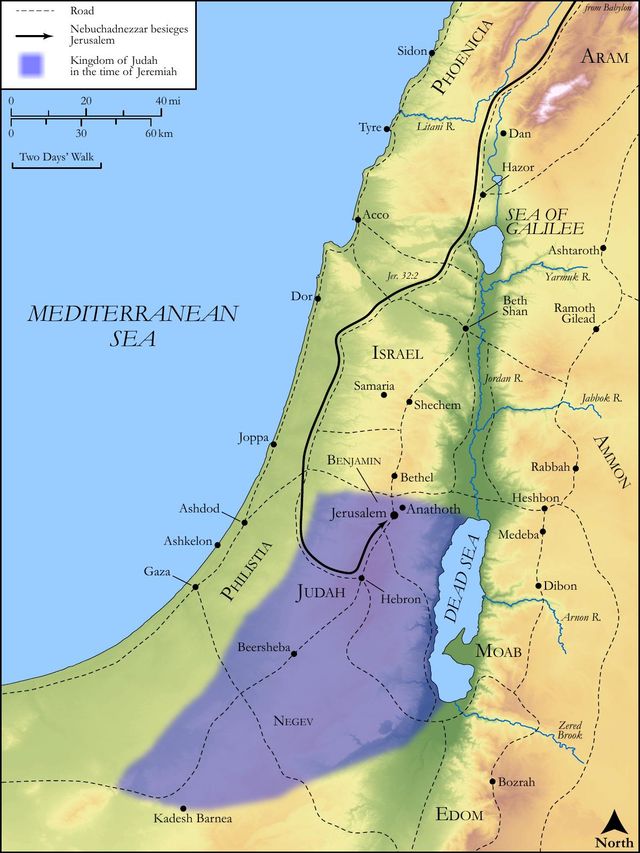
See on the biblical-era map
Study this verse
Public-domain commentary
Matthew Henry
From his Commentary on the Whole Bible. Henry comments on passages, not single verses — this entry covers Jeremiah 33:10–16. His two-level outline is real structure in the source text, so it is rendered as structure.
Here is a further prediction of the happy state of Judah and Jerusalem after their glorious return out of captivity, issuing gloriously at length in the kingdom of the Messiah.
I.It is promised that the people who were long in sorrow shall again be filled with joy.
Every one concluded now that the country would lie for ever desolate, that no beasts would be found in the land of Judah, no inhabitant in the streets of Jerusalem, and consequently there would be nothing but universal and perpetual melancholy (Jer 33:10); but, though weeping may endure for a time, joy will return. It was threatened (Jer 7:34 and Jer 16:9) that the voice of joy and gladness should cease there; but here it is promised that they shall revive again, that the voice of joy and gladness shall be heard there, because the captivity shall be returned; for then was their mouth filled with laughter, Psa 126:1, Psa 126:2.
1.There shall be common joy there, the voice of the bridegroom and the voice of the bride; marriages shall again be celebrated, as formerly, with songs, which in Babylon they had laid aside, for their harps were hung on the willow-trees.
2.There shall be religious joy there; temple-songs shall be revived, the Lord's songs, which they could not sing in a strange land. There shall be heard in their private houses, and in the cities of Judah, as well as in the temple, the voice of those that shall say, Praise the Lord of hosts. Note, Nothing is more the praise and honour of a people than to have God the glory of it, the glory both of the power and of the goodness by which it is effected; they shall prise him both as the Lord of hosts and as the God who is good and whose mercy endures for ever. This, though a song of old, yet, being sung upon this fresh occasion, will be a new song. We find this literally fulfilled at their return out of Babylon, Ezr 3:11. They sang together in praising the Lord, because he is good, for his mercy endures for ever. The public worship of God shall be diligently and constantly attended upon: They shall bring the sacrifice of praise to the house of the Lord. All the sacrifices were intended for the praise of God, but this seems to be meant of the spiritual sacrifices of humble adorations and joyful thanksgivings, the calves of our lips (Hos 14:2), which shall please the Lord better than an ox of bullock. The Jews say that in the days of the Messiah all sacrifices shall cease but the sacrifice of praise, and to those days this promise has a further reference.
II.It is promised that the country, which had lain long depopulated, shall be replenished and stocked again.
It was now desolate, without man and without beast; but, after their return, the pastures shall again be clothed with flocks, Psa 65:13. In all the cities of Judah and Benjamin there shall be a habitation of shepherds, Jer 33:12, Jer 33:13. This intimates,
1.The wealth of the country, after their return. It shall not be a habitation of beggars, who have nothing, but of shepherds and husbandmen, men of substance, with good stocks upon the ground they have returned to.
2.The peace of the country. It shall not be a habitation of soldiers, not shall there be tents and barracks set up to lodge them, but there shall be shepherds; tents; for they shall hear no more the alarms of war, nor shall there be any to make even the shepherds afraid. See Psa 144:13, Psa 144:14.
3.The industry of the country, and their return to their original plainness and simplicity, from which, in the corrupt ages, they had sadly degenerated. The seed of Jacob, in their beginning, gloried in this, that they were shepherds (Gen 47:3), and so they shall now be again, giving themselves wholly to that innocent employment, causing their flocks to lie down (Jer 33:12) and to pass under the hands of him that telleth them (Jer 33:13); for, though their flocks are numerous, they are not numberless, nor shall they omit to number them, that they may know if any be missing and may seek after it. Note, It is the prudence of those who have ever so much of the world to keep an account of what they have. Some think that they pass under the hand of him that telleth them that they may be tithed, Lev 27:32. Then we may take the comfort of what we have when God has had his dues out of it. Now because it seemed incredible that a people, reduced as now they were, should ever recover such a degree of peace and plenty as this, here is subjoined a general ratification of these promises (Jer 33:14): I will perform that good thing which I have promised. Though the promise may sometimes work slowly towards an accomplishment, it works surely. The days will come, though they are long in coming.
III.To crown all these blessings which God has in store for them, here is a promise of the Messiah, and of that everlasting righteousness which he should bring in (Jer 33:15, Jer 33:16), and probably this is that good thing, that great good thing, which in the latter days, days that were yet to come, God would perform, as he had promised to Judah and Israel, and to which their return out of captivity and their settlement again in their own land was preparatory. From the captivity to Christ is one of the famous periods, Mat 1:17. This promise of the Messiah we had before (Jer 23:5, Jer 23:6), and there it came in as a confirmation of the promise of the shepherds whom God would set over them, which would make one think that the promise here concerning the shepherds and their flocks, which introduces it, is to be understood figuratively. Christ is here prophesied of,
1.As a rightful King. He is a branch of righteousness, not a usurper, for he grows up unto David, descends from his loins, with whom the covenant of royalty was made, and is that seed with whom that covenant should be established, so that his title is unexceptionable.
2.As a righteous king, righteous in enacting laws, waging wars, and giving judgment, righteous in vindicating those that suffer wrong and punishing those that do wrong: He shall execute judgment and righteousness in the land. This may point at Zerubbabel, in the type, who governed with equity, not as Jehoiakim had done (Jer 22:17); but it has a further reference to him to whom all judgment is committed and who shall judge the world in righteousness.
3.As a king that shall protect his subjects from all injury. By him Judah shall be saved from wrath and the curse, and, being so saved, Jerusalem shall dwell safely, quiet from the fear of evil, and enjoying a holy security and serenity of mind, in a dependence upon the conduct of this prince of peace, this prince of their peace.
4.As a king that shall be praised by his subjects: "This is the name whereby they shall call him" (so the Chaldee reads it, the Syriac, and vulgar Latin); "this name of his they shall celebrate and triumph in, and by this name they shall call upon him." It may be read, more agreeably to the original, This is he who shall call her, The Lord our righteousness. As Moses's altar is called Jehovah-nissi (Exo 17:15), and Jerusalem Jehovah-shammah (Eze 48:35), intimating that they glory in Jehovah as present with them and their banner, so here the city is called The Lord our righteousness, because they glory in Jehovah as their righteousness. That which was before said to be the name of Christ (says Mr. Gataker) is here made the name of Jerusalem, the city of the Messiah, the church of Christ. He it is that imparts righteousness to her, for he is made of God to us righteousness, and she, by bearing that name, professes to have her whole righteousness, not from herself, but from him. In the Lord have I righteousness and strength, Isa 45:24. And we are made the righteousness of God in him. The inhabitants of Jerusalem shall have this name of the Messiah so much in their mouths that they shall themselves be called by it.
Historical interpretation
Historical reception
1 surviving comment on this verse from the historical church.
But the majesty of the Son of God, in which he is equal with the Father in its garb of a slave’s humility, feared no diminution, required no augmentation. And the very effect of his mercy, which he expended on the restitution of humanity, he was able to bring about solely by the power of his Godhead, thus rescuing the creature that was made in the image of God from the yoke of his cruel oppressor. But because the devil had not shown himself so violent in his attack on the first man as to bring him over to his side without the consent of his free will, the voluntary sin and hostile desires of humanity had to be destroyed in such a way that the standard of justice should not stand in the way of the gift of grace. And therefore in the general ruin of the entire human race there was but one remedy in the secret of the divine plan which could help the fallen, and that was that one of the sons of Adam should be born free and innocent of original transgression, to prevail for the rest both by his example and his merits. Still further, because this was not permitted by natural generation, and because there could be no offspring from our faulty stock without seed, of which the Scripture says, “Who can make a clean thing conceived of an unclean seed? Is it not you who are alone?” David’s Lord was made David’s Son, and sprang from the fruit of the promised branch—One without fault, the twofold nature coming together into one Person, that by one and the same conception and birth might spring our Lord Jesus Christ, in whom was present both true Godhead for the performance of mighty works and true humanity for the endurance of sufferings.
Continue studying Jeremiah 33:14 across the web’s major study libraries — every link below opens this exact verse, chapter, or book on the destination site.
Read & Compare
 BibleGatewayThis verse in more than 200 translations and 70 languages.
 Bible.comThe YouVersion reader — hundreds of translations, reading plans, and highlights.
 ESV.orgCrossway's official English Standard Version reader.
 NET BibleThe NET translation with 60,000+ translators' notes on every rendering decision.
 STEP BibleTyndale House's free study tool — original text, vocabulary, and scholarly resources.
 BibliaLogos Bible Software's free web reader.
 USCCBThe New American Bible (Revised Edition) with the U.S. bishops' study notes.
Commentaries
 BibleHub CommentariesDozens of classic commentaries on this verse, gathered on one page.
 StudyLightMore than 100 commentary sets — the largest collection on the web.
 BibleRefPlain-English commentary on what this verse means, verse by verse.
 Enduring WordDavid Guzik's free commentary on this chapter, widely used by Bible teachers.
 Bible Study ToolsVerse commentary alongside Greek and Hebrew study aids.
Original Language & Research
- BibleHub InterlinearThe verse word by word — original language, transliteration, and English.
- BibleHub LexiconEvery word's original-language definition and Strong's entry.
 Blue Letter BibleDeep-study tools — Strong's numbers, concordance, and word studies.
 SefariaThe Hebrew text with Rashi and centuries of Jewish commentary.
Sermons, Hymns & Audio


TrulyRandomVerse is not affiliated with these sites and doesn’t control their content. They’re linked because they’re genuinely useful.
Summary
Jeremiah 33:14 serves as a profound declaration of God's unwavering faithfulness and His sovereign commitment to fulfill His ancient promises to His covenant people. Delivered amidst the profound despair of the Babylonian exile, this verse shines as a radiant beacon of hope, affirming the Lord's immutable character and the certain realization of His word regarding the restoration, blessing, and establishment of a righteous kingdom for both the northern kingdom of Israel and the southern kingdom of Judah in His divinely appointed time. It powerfully underscores the reliability of God's redemptive plan.
Context
ShowHideLiterary Context
Jeremiah 33:14 is strategically placed within the "Book of Consolation" (chapters 30-33), a pivotal section of Jeremiah's prophecy that dramatically shifts from pronouncements of impending judgment to glorious messages of future hope and restoration. This verse acts as a foundational statement, immediately preceding and setting the stage for the explicit promise of a "righteous Branch" from David (Jeremiah 33:15-16), a clear messianic prophecy. The broader context of Jeremiah 33 includes God's comprehensive assurance of healing and rebuilding Jerusalem, restoring the fortunes of both Judah and Israel, and re-establishing the Levitical priesthood. Verse 14 emphasizes the divine initiative and the absolute certainty of these future blessings, serving as a preamble to the specific details that follow.
Historical & Cultural Context
The historical setting for Jeremiah 33 is one of profound national crisis. Judah was under severe Babylonian siege, which ultimately led to the devastating destruction of Jerusalem and the forced exile of its inhabitants. The nation was reeling from generations of unfaithfulness and idolatry, experiencing the dire consequences prophesied by Jeremiah and other prophets. In this period of immense trauma, spiritual disillusionment, and perceived abandonment by God—with their temple destroyed, monarchy ended, and land desolate—God's promise in Jeremiah 33:14 was revolutionary. It directly countered the pervasive despair by asserting that even in the depths of exile, God's covenant promises remained valid and would be gloriously fulfilled, demonstrating His steadfast love, omnipotence, and capacity to restore beyond all human expectation.
Key Themes
ShowHideThis verse powerfully articulates several core theological themes prevalent throughout the book of Jeremiah and the broader prophetic corpus. Foremost is the theme of Divine Faithfulness and the Immutability of God's Word, as the Lord unequivocally declares, "I will perform that good thing which I have promised." This echoes the foundational covenant promises made to Abraham, Isaac, Jacob, and David, reassuring that God always keeps His word, even when His people are faithless (compare Numbers 23:19). Another significant theme is Restoration and Renewal, specifically encompassing both the "house of Israel" (representing the long-dispersed northern kingdom) and the "house of Judah" (the southern kingdom, then in exile). This signifies a comprehensive, unified restoration of God's entire people, encompassing spiritual, physical, and national dimensions, often described as a "new covenant" (as seen in Jeremiah 31:31-34). Finally, the verse subtly introduces the theme of Messianic Hope, which is immediately developed in the subsequent verses, pointing to the coming of a righteous Davidic king who would establish justice and righteousness, ultimately fulfilled in Jesus Christ.
Exposition and Analysis
ShowHideKey Word Analysis
ShowHideThis primitive root means "to rise (in various applications, literal, figurative, intensive and causative); abide, accomplish, confirm, continue, decree, make good, ordain, pitch, raise (up), rear (up), remain, (a-) rise (up) (again, against), rouse up, set (up), (e-) stablish, (make to) stand (up), stir up, strengthen, succeed, (as-, make) sure(-ly), (be) up(-hold, -rising)." In Jeremiah 33:14, "perform" signifies God's active, certain, and decisive bringing to pass of His promises. It's not merely an intention but a resolute act of establishment and fulfillment, emphasizing the divine power and commitment to His word.
This word means "good (as an adjective) in the widest sense; used likewise as a noun, both in the masculine and the feminine, the singular and the plural (good, a good or good thing, a good man or woman; the good, goods or good things, good men or women), also as an adverb (well); beautiful, best, better, bountiful, cheerful, at ease, fair (word), (be in) favour, fine, glad, good (deed, -lier, -liest, -ly, -ness, -s), graciously, joyful, kindly, kindness, liketh (best), loving, merry, most, pleasant, pleaseth, pleasure, precious, prosperity, ready, sweet, wealth, welfare, (be) well(-favoured)." Here, "good" describes the inherent nature of God's promised action and its outcome—it is inherently beneficial, pleasant, prosperous, and aligned with His benevolent character, encompassing holistic well-being and blessing.
This noun derives from the root H1696 (dâbar, "to speak"). It means "a word; by implication, a matter (as spoken of) or thing; adverbially, a cause; act, advice, affair, answer, book, business, care, case, cause, commandment, concern(-ing), counsel, decree, deed, language, matter, message, (no) thing, oracle, promise, report, request, saying, sentence, speech, talk, task, tidings, word, work." In this context, "that good thing" refers to the specific content and substance of God's spoken promises—His divine word that carries the power to bring about the reality it declares. It signifies the concrete, tangible outworking of His covenant commitments.
Verse Breakdown
ShowHide"Behold, the days come, saith the LORD,"
This opening phrase serves as an emphatic prophetic declaration, drawing immediate attention to the certainty and imminence of what is to follow. "Behold" (הִנֵּה, hinnēh) acts as an interjection, signaling a significant revelation. "The days come" indicates a future, divinely appointed time for the fulfillment of these promises, reinforcing that God's plans unfold according to His sovereign timeline. "Saith the LORD" (נְאֻם יְהוָה, nᵉʼum Yᵉhôvâh) is a common prophetic formula, authenticating the message as a direct utterance from Yahweh, the covenant-keeping God, thereby guaranteeing its truth and authority and establishing the divine origin of the promise.
"that I will perform that good thing"
This is the core promise, highlighting God's active role and resolute intent. "I will perform" (וַהֲקִמֹתִי, va'haqimoti) uses the verb qûwm (H6965), emphasizing God's active, resolute, and certain execution of His word. It is not merely a passive intention but a powerful act of bringing into being. "That good thing" (הַדָּבָר הַטּוֹב, haddâbâr haṭṭôwb) refers to the sum total of God's beneficial, covenantal promises—the restoration, healing, and establishment of righteousness previously spoken of, encompassing all aspects of national and spiritual well-being for His people.
"which I have promised unto the house of Israel and to the house of Judah."
This clause specifies both the recipients and the enduring nature of the "good thing." It clarifies that the promises are not new but are the fulfillment of long-standing divine commitments. "Promised" (דִּבַּרְתִּי, dibbarti) links back to God's previous declarations, particularly those related to the Davidic covenant and the future of His people. The inclusion of both "the house of Israel" (the northern kingdom, long dispersed) and "the house of Judah" (the southern kingdom, currently in exile) signifies a comprehensive, unified restoration of all twelve tribes, emphasizing God's inclusive and enduring covenant with His entire people, transcending historical divisions.
Literary Devices
ShowHideJeremiah 33:14 masterfully employs several potent literary devices to convey its message of hope and divine certainty. The opening word, "Behold," functions as an imperative and an attention-grabber, immediately signaling the profound importance and revelatory nature of the ensuing declaration. This creates a sense of urgency and underscores the divine authority behind the message. The phrase "the days come" is an example of Foreshadowing, pointing to a future, divinely appointed time when God's promises will inevitably materialize, thereby building anticipation for their fulfillment. The repeated phrase "saith the LORD" is a classic prophetic Formulaic Expression or Divine Oracle, authenticating the message as direct speech from God Himself, imbuing it with irrefutable authority and truth. The use of "that good thing" is a form of Generalization or Synecdoche, where a broad, encompassing term refers to the vast, comprehensive scope of God's restoration plans without detailing every aspect, allowing it to encompass all the blessings of the new covenant and the Messianic era. Finally, the mention of both "the house of Israel and to the house of Judah" is an example of Merism, where two contrasting or complementary parts are used to represent the whole, emphasizing the complete and unified restoration of God's entire covenant people, encompassing both the dispersed northern tribes and the exiled southern kingdom.
Theological and Thematic Connections
ShowHideJeremiah 33:14 serves as a profound theological anchor, affirming God's unwavering commitment to His covenant promises despite human failure and national judgment. It highlights the divine initiative in salvation and restoration, asserting that God's plans are not contingent upon human merit but upon His own faithful character. This verse lays the groundwork for understanding God's ultimate intention to establish a righteous kingdom through a Davidic heir, a theme that resonates throughout the Old Testament and finds its ultimate fulfillment in the New. It underscores the truth that God's word is not merely spoken but is potent and effective, always accomplishing its intended purpose, bringing about the "good thing" He has ordained for His people.
Reflection and Application
ShowHideJeremiah 33:14 offers profound encouragement for believers navigating seasons of uncertainty, despair, or perceived divine silence. It powerfully reminds us that God's promises are not subject to the shifting sands of human circumstances or the apparent bleakness of our present reality. Just as God pledged to bring about a "good thing" for a seemingly hopeless Israel and Judah, He remains faithful to His word concerning our lives and His overarching redemptive plan for the world. This verse calls us to cultivate a deep-seated hope rooted in God's immutable character, trusting that His declared intentions will infallibly come to pass. It challenges us to look beyond immediate difficulties and to fix our gaze on the sovereign Lord who performs His promises, ultimately bringing about His good and perfect will. It invites us to rest in the certainty that what God has promised, He will surely perform, even when the "days" of fulfillment seem distant or the path unclear.
Questions for Reflection
ShowHideFAQ
ShowHideWhat is "that good thing" God promised in Jeremiah 33:14?
ShowHide"That good thing" (Hebrew: haddâbâr haṭṭôwb) refers to the comprehensive fulfillment of God's covenant promises to Israel and Judah. While broad, the immediate context in Jeremiah 33:15-16 clarifies that it specifically includes the raising up of a "Branch of righteousness" from the line of David, who will execute justice and righteousness in the land. This points to the establishment of a righteous kingdom under a Davidic king, which encompasses spiritual renewal, the return from exile, the rebuilding of the nation, and the re-establishment of a faithful priesthood. Ultimately, it signifies the holistic restoration of God's people and their relationship with Him, culminating in the Messianic era.
Does this promise apply to Christians today, or only to ancient Israel and Judah?
ShowHideWhile the immediate recipients of the promise were the "house of Israel and to the house of Judah" in their historical context of exile and dispersion, the theological principles and the ultimate fulfillment of this promise have profound implications for believers today. The "good thing" that God promised, particularly the "Branch of righteousness," is ultimately fulfilled in Jesus Christ. As Christians, we are spiritual heirs of Abraham through faith (see Galatians 3:29), and we participate in the New Covenant that God promised (as described in Jeremiah 31:31-34). Therefore, this verse assures us of God's unchanging faithfulness to His promises, particularly His promise of salvation, righteousness, and eternal life through Christ, and His ongoing work to establish His kingdom.
Christ-Centered Fulfillment
ShowHideJeremiah 33:14, with its declaration of God's intention to "perform that good thing which I have promised," finds its ultimate and most glorious fulfillment in the person and work of Jesus Christ. The "good thing" is immediately specified in the following verses as the raising up of a "Branch of righteousness" from David, who would execute justice and righteousness on earth (Jeremiah 33:15). This "Branch" is none other than Jesus, the Messiah, who is indeed the "Root and the Offspring of David" (as seen in Revelation 22:16). He perfectly embodies the righteousness that Israel and Judah failed to achieve, and through His atoning sacrifice and resurrection, He establishes the New Covenant promised by Jeremiah (compare Jeremiah 31:31-34 with Hebrews 8:8-12). Jesus, as the true King from David's line, not only brings about the spiritual restoration and reconciliation of God's people but also inaugurates the eternal kingdom where justice and righteousness truly dwell. Thus, the ancient promise of a "good thing" is made real and accessible to all who believe in the Lamb of God, who takes away the sin of the world, demonstrating God's unwavering faithfulness to His redemptive plan through His Son.