


2 Chronicles 10:18
Bible text: King James Version (1769 Blayney text) · Public domain
Bible text: King James Version with Strong's numbers · Public domain
Bible text: Berean Standard Bible · Public domain
Bible text: American Standard Version (1901) · Public domain
Bible text: World English Bible, Messianic edition · Public domain
Bible text: Geneva Bible (1599) · Public domain
Bible text: Young's Literal Translation · Public domain
- וַיִּשְׁלַחvai·yish·Lachand he sentH7971Conj-w ¦ V-Qal-ConsecImperf-3msVerb Qal Consecutive Imperfect 3rd Singular Masculineוַandיִּשְׁלַחhe sent
- הַמֶּלֶךְha·Me·lekhthe kingH4428Art ¦ N-msNoun Singular Masculine Absoluteהַtheמֶּלֶךְking
- רְחַבְעָםre·chav·'AmRehoboamH7346N-proper-mNoun Proper Masculine
- אֶת'et<obj.>H853DirObjMParticle Object Indicator
- הֲדֹרָםha·do·RamHadoramH1913N-proper-mNoun Proper Masculine
- אֲשֶׁר'a·SherwhoH834RelParticle Relative
- עַל'al[was] overH5921PrepPreposition
- הַמַּסha·Masthe forced laborH4522Art ¦ N-msNoun Singular Masculine Absoluteהַtheמַּסforced labor
- וַיִּרְגְּמוּvai·yir·ge·muand they stonedH7275Conj-w ¦ V-Qal-ConsecImperf-3mpVerb Qal Consecutive Imperfect 3rd Plural Masculineוַandיִּרְגְּמוּthey stoned
- בוֹvo<in> himPrep-b ¦ 3msSuffix Personal 3rd Singular Masculineב<in>וֹhim
- בְנֵיve·nei[the] people ofH1121N-mpcNoun Plural Masculine Construct
- יִשְׂרָאֵלYis·ra·'ElIsraelH3478N-properNoun Proper Location
- אֶבֶן'E·venstone[s]H68N-fsNoun Singular Feminine Absolute
- וַיָּמֹתvai·ya·Motand he diedH4191Conj-w ¦ V-Qal-ConsecImperf-3msVerb Qal Consecutive Imperfect 3rd Singular Masculineוַandיָּמֹתhe died
- וְהַמֶּלֶךְve·ha·Me·lekhand the kingH4428Conj-w ¦ Art ¦ N-msNoun Singular Masculine Absoluteוְandהַtheמֶּלֶךְking
- רְחַבְעָםre·chav·'AmRehoboamH7346N-proper-mNoun Proper Masculine
- הִתְאַמֵּץhit·'a·Metzhe proved himself strongH553V-Hithpael-Perf-3msVerb Hithpael Perfect 3rd Singular Masculine
- לַעֲלוֹתla·'a·Lotto go upH5927Prep-l ¦ V-Qal-InfVerb Qal Infinitive Constructלַtoעֲלוֹתgo up
- בַּמֶּרְכָּבָהba·mer·ka·Vahin the chariotH4818Prep-b ¦ N-fsNoun Singular Feminine Absoluteבַּin theמֶּרְכָּבָהchariot
- לָנוּסla·Nusto fleeH5127Prep-l ¦ V-Qal-InfVerb Qal Infinitive Constructלָtoנוּסflee
- יְרוּשָׁלִָםye·ru·sha·LimJerusalemH3389N-properNoun Proper Location
English is a literal word-by-word gloss of the Hebrew, not the KJV's wording. Why?
This is the original text the KJV's translators worked from — each Hebrew word with its own literal English meaning in this verse, prepared by scholars at Tyndale House, Cambridge. The KJV translates whole sentences, not word by word, so its wording differs: one Hebrew word can become several English words, and the KJV may choose “the LORD” where the gloss reads “Yahweh”. Both are faithful — they answer different questions. For the KJV's own rendering, switch to the KJV text.
Details
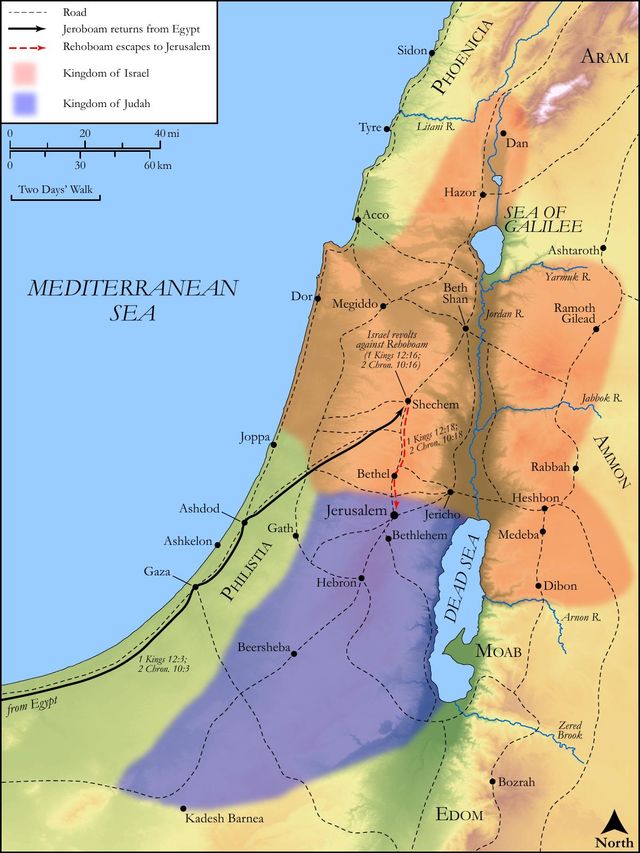
See on the biblical-era map
Study this verse
Public-domain commentary
Matthew Henry
From his Commentary on the Whole Bible. Henry comments on passages, not single verses — this entry covers 2 Chronicles 10:12–19.
We may learn here, 1. That when public affairs are in a ferment violent proceedings do but make bad worse. Rough answers (such as Rehoboam here gave) do but stir up anger and bring oil to the flames. The pilot has need to steer steadily in a storm. Many have been driven to the mischief they did not intend by being too severely dealt with for what they did intend. 2. That, whatever the devices and designs of men are, God is, by all, doing his own work, and fulfilling the word which he has spoken, no iota or tittle of which shall fall to the ground. The cause of the king's obstinacy and thoughtlessness was of God, that he might perform the word which he spoke by Ahijah, Ch2 10:15. This does not at all excuse Rehoboam's folly, nor lessen the guilt of his haughtiness and passion, that God was pleased to serve his own ends by them. 3. That worldly wealth, honour, and dominion, are very uncertain things. Solomon reigned over all Israel, and, one would think, had done enough to secure the monarchy entire to his family for many ages; and yet he is scarcely cold in his grave before ten of the twelve tribes finally revolt from his son. All the good services he had done for Israel were now forgotten: What portion have we in David? Thus is the government of Christ cast off by many, notwithstanding all he has done to bind the children of men for ever to himself; they say, We will not have this man to reign over us. But this rebellion will certainly be their ruin. 4. That God often visits the iniquities of the fathers upon the children. Solomon forsakes God, and therefore not he, but his son after him, is forsaken by the greatest part of his people. Thus God, by making the penal consequences of sin to last long and visibly to continue after the sinner's death, would give an indication of its malignity, and perhaps some intimation of the perpetuity of its punishment. He that sins against God not only wrongs his soul, but perhaps wrongs his seed more than he thinks of. 5. That, when God is fulfilling his threatenings, he will take care of that, at the same time, promises do not fall to the ground. When Solomon's iniquity is remembered, and for it his son loses ten tribes, David's piety is not forgotten, nor the promise made to him; but for the sake of that his grandson had two tribes preserved to him. The failings of the saints shall not frustrate any promise made to Christ their Head. They shall be chastised, but the covenant not broken, Psa 89:31-34.
Continue studying 2 Chronicles 10:18 across the web’s major study libraries — every link below opens this exact verse, chapter, or book on the destination site.
Read & Compare
 BibleGatewayThis verse in more than 200 translations and 70 languages.
 Bible.comThe YouVersion reader — hundreds of translations, reading plans, and highlights.
 ESV.orgCrossway's official English Standard Version reader.
 NET BibleThe NET translation with 60,000+ translators' notes on every rendering decision.
 STEP BibleTyndale House's free study tool — original text, vocabulary, and scholarly resources.
 BibliaLogos Bible Software's free web reader.
 USCCBThe New American Bible (Revised Edition) with the U.S. bishops' study notes.
Commentaries
 BibleHub CommentariesDozens of classic commentaries on this verse, gathered on one page.
 StudyLightMore than 100 commentary sets — the largest collection on the web.
 BibleRefPlain-English commentary on what this verse means, verse by verse.
 Enduring WordDavid Guzik's free commentary on this chapter, widely used by Bible teachers.
 Bible Study ToolsVerse commentary alongside Greek and Hebrew study aids.
Original Language & Research
- BibleHub InterlinearThe verse word by word — original language, transliteration, and English.
- BibleHub LexiconEvery word's original-language definition and Strong's entry.
 Blue Letter BibleDeep-study tools — Strong's numbers, concordance, and word studies.
 SefariaThe Hebrew text with Rashi and centuries of Jewish commentary.
Sermons, Hymns & Audio


TrulyRandomVerse is not affiliated with these sites and doesn’t control their content. They’re linked because they’re genuinely useful.
Summary
Second Chronicles 10:18 vividly chronicles the violent climax of the northern Israelite tribes' rebellion against King Rehoboam, irrevocably sealing the division of the united monarchy. The brutal stoning of Hadoram, Rehoboam's chief of forced labor, powerfully symbolizes the people's utter rejection of the oppressive policies of the Davidic dynasty, compelling the king into a hasty and ignominious retreat to Jerusalem and thereby solidifying the kingdom's permanent schism.
Context
ShowHideLiterary Context
This verse serves as the dramatic and tragic culmination of a narrative arc that begins with the people's earnest plea to King Rehoboam at Shechem for relief from the heavy burdens imposed by his father, Solomon (2 Chronicles 10:3-4). The pivotal moment arrived when Rehoboam, rejecting the wise, conciliatory counsel of the seasoned elders who urged him to serve the people and speak kindly to them (2 Chronicles 10:7), instead chose to embrace the foolish, harsh advice of his young contemporaries. He defiantly declared his intention to increase their burdens, famously stating, "My father chastised you with whips, but I will chastise you with scorpions" (2 Chronicles 10:8-11). The people's response to this tyrannical declaration was immediate, furious, and ultimately lethal, directly leading to the events of this verse and the subsequent, irreversible division detailed in 2 Chronicles 10:19. The Chronicler meticulously highlights Rehoboam's pride and folly as the direct human catalyst for a division that was, paradoxically, part of God's sovereign plan, a divine judgment against Solomon's apostasy (2 Chronicles 10:15).
Historical & Cultural Context
The "tribute" (Hebrew: מַס, mas') refers to the deeply resented system of forced labor or corvée, a form of conscription for public works projects that had been a significant burden since the extensive building programs of King Solomon, including the construction of the Temple and his opulent palace (1 Kings 5:13-18). Hadoram, as the "overseer of the tribute," was the chief administrator of this immensely unpopular system. His very presence at Shechem, where the northern tribes had gathered to negotiate with Rehoboam, would have been a stark and infuriating reminder of the oppression they endured. The act of stoning, while a culturally recognized form of capital punishment in ancient Israel often carried out by the community for grave offenses (e.g., blasphemy, idolatry), is here an act of spontaneous popular revolt. It signifies not a legal execution, but an absolute, murderous rejection of authority and a visceral expression of accumulated rage. Shechem itself, where this climactic confrontation occurred, was a site of profound historical and covenantal significance for Israelite assemblies, making it an ironically potent location for the breaking of the Davidic covenant with the northern tribes.
Key Themes
ShowHideThis verse powerfully illustrates the Consequences of Foolish Leadership, as Rehoboam's pride, profound lack of discernment, and oppressive attitude directly led to the catastrophic loss of a significant portion of his kingdom. His failure to heed sound, elder counsel and his embrace of tyrannical policies alienated the people, demonstrating that true, godly authority is built upon humble service, justice, and responsiveness, not mere coercive power. It also highlights Popular Rebellion and Divine Judgment, where the people's violent uprising, while a clear act of human will and fury, is presented by the Chronicler as a direct fulfillment of God's prophetic word concerning the division of the kingdom due to Solomon's sin (1 Kings 11:29-39). The stoning of Hadoram and Rehoboam's panicked flight underscore the depth of the people's anger and their determination to cast off a tyrannical ruler, acting, albeit unwittingly, as agents of divine judgment. Ultimately, 2 Chronicles 10:18 serves as the immediate and irreversible catalyst for The Division of the Kingdom, an irreparable schism between the ten northern tribes (who would follow Jeroboam) and the southern kingdom of Judah (who remained loyal to Rehoboam), permanently altering the political and religious landscape of Israel.
Exposition and Analysis
ShowHideKey Word Analysis
ShowHideThis name, likely a variant of Adoniram or Adoram (as found in parallel accounts like 1 Kings 12:18), is probably of foreign derivation. While its precise meaning is debated, it is often associated with "Adon is exalted" or "My Lord is exalted." Ironically, the official whose name might suggest an exalting of the Lord is violently rejected by the very people he oversees, becoming a casualty of a king who failed to exalt the Lord through righteous and humble governance. As the chief official "over the tribute," Hadoram embodied the oppressive rule of forced labor, making him a direct and highly visible target for the people's accumulated rage and frustration. His death signifies the people's forceful rejection not only of Rehoboam's policies but also of the legacy of heavy taxation and conscription inherited from Solomon's reign.
From the root māsaś (to cause to faint), this term properly refers to a burden or tax in the form of forced labor. It denotes conscripted workers or corvée labor, a system where citizens were compelled to work for the state without pay, often on large public works projects. King Solomon had extensively utilized this system for his ambitious building projects, including the Temple and his palace, which placed immense burdens on the populace, particularly the northern tribes. Hadoram's role as "overseer of the tribute" (or forced labor) made him the personification of this oppressive rule. His violent death was not merely an attack on an individual but a symbolic and literal act of rebellion against the very structure of royal exploitation that the people sought to dismantle.
A primitive root meaning "to cast together (stones)," or "to lapidate." This verb specifically denotes death by stoning. While this method of execution was prescribed in Mosaic Law for certain grave offenses (e.g., blasphemy, idolatry), signifying the community's collective judgment and rejection of the offender, in this context, the stoning of Hadoram is not a legal execution. Instead, it is a spontaneous, violent act of collective outrage and rebellion by the people. It demonstrates the depth of their fury and their complete rejection of Rehoboam's authority and the oppressive rule Hadoram represented. The act is brutal and definitive, leaving no doubt about the people's resolve to break free.
Verse Breakdown
ShowHide"Then king Rehoboam sent Hadoram that [was] over the tribute"
In a display of profound misjudgment, political ineptitude, and perhaps a desperate, ill-conceived attempt to assert control or collect the demanded tribute, King Rehoboam dispatched his chief administrator of forced labor. This action reveals Rehoboam's utter lack of empathy and political acumen; he sent the very symbol of the people's oppression to a populace already seething with resentment, effectively throwing fuel on a raging fire. It underscores his failure to grasp the gravity of the situation and the depth of the people's grievances, highlighting a leadership utterly disconnected from the pulse of its subjects.
"and the children of Israel stoned him with stones, that he died"
This clause describes the immediate, visceral, and lethal consequence of Rehoboam's folly. The "children of Israel" here specifically refers to the northern tribes, who, having been provoked beyond endurance by Rehoboam's harsh words and the presence of Hadoram, responded with overwhelming, collective force. The stoning of Hadoram was a spontaneous, yet deliberate, act of rebellion, a public, collective execution by the enraged populace, signaling their absolute refusal to submit to further oppression. His death was not an accident but a definitive, brutal statement of their complete break from the Davidic monarchy's authority.
"But king Rehoboam made speed to get him up to [his] chariot, to flee to Jerusalem"
Witnessing the brutal murder of his chief official and facing the full, terrifying force of the people's wrath, Rehoboam's bravado evaporated instantly. His immediate reaction was one of desperate self-preservation. He hastily mounted his chariot and fled back to Jerusalem, the capital of Judah, his ancestral territory. This ignominious retreat symbolizes the complete collapse of his authority over the northern tribes and marks the de facto, irreversible division of the kingdom. His panicked flight underscores his abject failure as a leader and the permanent nature of the breach, leaving him king over only Judah and Benjamin.
Literary Devices
ShowHideThe passage employs several potent literary devices that amplify its dramatic impact and thematic significance. Irony is powerfully evident in Rehoboam's decision to send Hadoram, the very embodiment of the hated "tribute" system, to a people demanding relief from it. This act, intended by Rehoboam to assert his authority and perhaps enforce the collection of tribute, instead provoked the ultimate rebellion and resulted in Hadoram's violent death, directly undermining the king's power. The narrative also uses Foreshadowing, as Hadoram's violent death and Rehoboam's panicked flight clearly predict the impending and permanent division of the united monarchy, which is explicitly stated in the subsequent verse (2 Chronicles 10:19). The rapid sequence of events—Rehoboam sending Hadoram, the immediate stoning, and Rehoboam's hasty flight—creates a palpable sense of Dramatic Climax and rapid escalation, emphasizing the irreversible nature of the people's revolt and the swift consequences of Rehoboam's folly. Furthermore, Hadoram serves as a powerful Symbol of the oppressive policies of Solomon's reign and Rehoboam's continuation of them; his death is thus a symbolic slaying of the oppressive rule itself, a violent casting off of the "heavy yoke" the people so desperately sought to remove.
Theological and Thematic Connections
ShowHideThis pivotal moment in Israelite history, marked by Rehoboam's disastrous leadership and the violent rebellion, serves as a profound theological testament to the consequences of pride, unrighteous governance, and a failure to heed wise counsel. The Chronicler meticulously emphasizes that while human choices were undeniably at play and directly led to the schism, this division was ultimately orchestrated by God as a direct consequence of Solomon's unfaithfulness and idolatry, demonstrating divine sovereignty even in the midst of human folly and sin. It underscores the enduring biblical principle that leadership, especially within God's covenant people, is a sacred trust requiring humility, wisdom, and a steadfast commitment to justice and righteousness, rather than self-serving power or tyrannical imposition. The narrative implicitly teaches that God holds leaders accountable for their actions and that His justice will ultimately prevail, even if it means the fracturing of a divinely established kingdom to bring about His greater purposes.
Reflection and Application
ShowHideThe account of Rehoboam's downfall and the kingdom's division offers profound and enduring lessons for all, not just those in positions of authority. It serves as a stark reminder that pride, stubbornness, and a refusal to listen to wise, empathetic counsel can lead to catastrophic consequences, both personally and corporately. In our own lives, we are often faced with choices between immediate gratification or perceived strength, and the path of humility, service, and genuine listening. This passage challenges us to critically examine whose counsel we prioritize—is it the comfortable echo chamber of those who affirm our biases and desires, or the sometimes uncomfortable but truthful wisdom of those who genuinely seek our true well-being and the flourishing of others? It calls us to cultivate a spirit of profound humility, recognizing that true strength lies not in wielding power oppressively, but in serving others with compassion and justice, and being genuinely responsive to their legitimate needs and concerns. This narrative compels us to consider how our leadership, whether in our families, workplaces, or communities, reflects a desire to lighten burdens or to impose them.
Questions for Reflection
ShowHideFAQ
ShowHideWhy was Hadoram stoned by the northern tribes?
ShowHideHadoram was the chief official "over the tribute" (or forced labor) under King Rehoboam, and likely also under his father, Solomon. He was stoned by the northern tribes of Israel because he represented the oppressive rule of forced labor and heavy taxation that the people vehemently opposed. Rehoboam, in a grave miscalculation and act of political folly, sent Hadoram to address the rebellious people, effectively sending the very symbol of their oppression into a volatile situation. The stoning was a spontaneous act of extreme popular rage and rebellion, signifying the people's absolute rejection of Rehoboam's authority and the policies of the Davidic monarchy. His death was a direct catalyst for the full-scale revolt and the subsequent division of the kingdom, as seen in 2 Chronicles 10:19.
Was the division of the kingdom purely a result of Rehoboam's folly, or was God involved?
ShowHideThe biblical narrative presents the division of the kingdom as both a direct consequence of Rehoboam's foolish choices and a profound fulfillment of God's sovereign will. Rehoboam's pride, his rejection of the elders' wise counsel, and his harsh, tyrannical response to the people's plea were undeniably the immediate human catalysts for the split. His actions demonstrated a profound failure of leadership and a tragic lack of discernment. However, the Chronicler explicitly states that "the turn of affairs was from God" (2 Chronicles 10:15), indicating that this event was part of God's predetermined plan. This divine judgment was a consequence of King Solomon's idolatry and unfaithfulness to the covenant, as powerfully prophesied by the prophet Ahijah to Jeroboam (1 Kings 11:29-39). Thus, human responsibility and divine sovereignty are intricately interwoven in this tragic but purposeful historical event, demonstrating that God's purposes will ultimately prevail even through human sin and folly.
Christ-Centered Fulfillment
ShowHideThe disastrous reign of Rehoboam, marked by pride, oppression, and the fracturing of a divinely established kingdom, stands in stark and illuminating contrast to the perfect kingship of Jesus Christ. Rehoboam sought to increase the people's burden, threatening them with scorpions, but Christ came to lighten it, inviting all who are weary and burdened to find rest and a light yoke in Him (Matthew 11:28-30). While Rehoboam fled in fear from the people's wrath, Jesus, the true King, willingly faced the full wrath of God for His people, enduring the ultimate rejection and crucifixion to secure their salvation (Isaiah 53:5-6). Unlike Rehoboam, who lost a significant portion of his earthly kingdom due to his pride and oppressive rule, Christ, though eternally divine, humbled Himself to become a servant, ultimately receiving a kingdom that will never be divided, destroyed, or diminished (Philippians 2:5-8; Daniel 7:13-14). The failed human kingship of Rehoboam underscores the desperate need for a perfect, just, and compassionate King—one who rules not with a heavy yoke of forced labor or arbitrary power, but with grace, truth, and sacrificial love, gathering all His people into an eternal, undivided kingdom, uniting all things in Himself (Ephesians 1:9-10).