


2 Chronicles 10:17
Bible text: King James Version (1769 Blayney text) · Public domain
Bible text: Berean Standard Bible · Public domain
Bible text: American Standard Version (1901) · Public domain
Bible text: World English Bible, Messianic edition · Public domain
Bible text: Geneva Bible (1599) · Public domain
Bible text: Young's Literal Translation · Public domain
- וּבְנֵיu·ve·Neiand [the] people ofH1121Conj-w ¦ N-mpcNoun Plural Masculine Constructוּandבְנֵי[the] people of
- יִשְׂרָאֵלYis·ra·'ElIsraelH3478N-properNoun Proper Location
- הַיֹּשְׁבִיםhai·yo·she·Vimwho were dwellingH3427Art ¦ V-Qal-Prtcpl-mpVerb Qal Participle Plural Masculine Absoluteהַwhoיֹּשְׁבִיםwere dwelling
- בְּעָרֵיbe·'a·Reiin [the] cities ofH5892Prep-b ¦ N-mpcNoun Plural Masculine Constructבְּinעָרֵי[the] cities of
- יְהוּדָהye·hu·DahJudahH3063N-properNoun Proper Location
- וַיִּמְלֹךְvai·yim·Lokhand he reignedH4427Conj-w ¦ V-Qal-ConsecImperf-3msVerb Qal Consecutive Imperfect 3rd Singular Masculineוַandיִּמְלֹךְhe reigned
- עֲלֵיהֶם'a·lei·Hemover themH5921Prep ¦ 3mpPrepositionעֲלֵיoverהֶםthem
- רְחַבְעָםre·chav·'AmRehoboamH7346N-proper-mNoun Proper Masculine
English is a literal word-by-word gloss of the Hebrew, not the KJV's wording. Why?
This is the original text the KJV's translators worked from — each Hebrew word with its own literal English meaning in this verse, prepared by scholars at Tyndale House, Cambridge. The KJV translates whole sentences, not word by word, so its wording differs: one Hebrew word can become several English words, and the KJV may choose “the LORD” where the gloss reads “Yahweh”. Both are faithful — they answer different questions. For the KJV's own rendering, switch to the KJV text.
Details
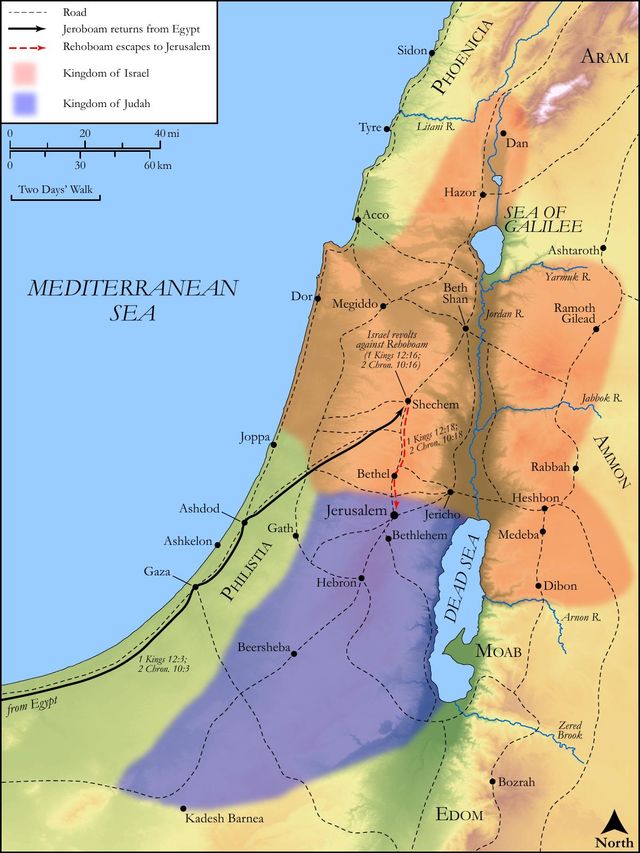
See on the biblical-era map
Study this verse
Public-domain commentary
Matthew Henry
From his Commentary on the Whole Bible. Henry comments on passages, not single verses — this entry covers 2 Chronicles 10:12–19.
We may learn here, 1. That when public affairs are in a ferment violent proceedings do but make bad worse. Rough answers (such as Rehoboam here gave) do but stir up anger and bring oil to the flames. The pilot has need to steer steadily in a storm. Many have been driven to the mischief they did not intend by being too severely dealt with for what they did intend. 2. That, whatever the devices and designs of men are, God is, by all, doing his own work, and fulfilling the word which he has spoken, no iota or tittle of which shall fall to the ground. The cause of the king's obstinacy and thoughtlessness was of God, that he might perform the word which he spoke by Ahijah, Ch2 10:15. This does not at all excuse Rehoboam's folly, nor lessen the guilt of his haughtiness and passion, that God was pleased to serve his own ends by them. 3. That worldly wealth, honour, and dominion, are very uncertain things. Solomon reigned over all Israel, and, one would think, had done enough to secure the monarchy entire to his family for many ages; and yet he is scarcely cold in his grave before ten of the twelve tribes finally revolt from his son. All the good services he had done for Israel were now forgotten: What portion have we in David? Thus is the government of Christ cast off by many, notwithstanding all he has done to bind the children of men for ever to himself; they say, We will not have this man to reign over us. But this rebellion will certainly be their ruin. 4. That God often visits the iniquities of the fathers upon the children. Solomon forsakes God, and therefore not he, but his son after him, is forsaken by the greatest part of his people. Thus God, by making the penal consequences of sin to last long and visibly to continue after the sinner's death, would give an indication of its malignity, and perhaps some intimation of the perpetuity of its punishment. He that sins against God not only wrongs his soul, but perhaps wrongs his seed more than he thinks of. 5. That, when God is fulfilling his threatenings, he will take care of that, at the same time, promises do not fall to the ground. When Solomon's iniquity is remembered, and for it his son loses ten tribes, David's piety is not forgotten, nor the promise made to him; but for the sake of that his grandson had two tribes preserved to him. The failings of the saints shall not frustrate any promise made to Christ their Head. They shall be chastised, but the covenant not broken, Psa 89:31-34.
Continue studying 2 Chronicles 10:17 across the web’s major study libraries — every link below opens this exact verse, chapter, or book on the destination site.
Read & Compare
 BibleGatewayThis verse in more than 200 translations and 70 languages.
 Bible.comThe YouVersion reader — hundreds of translations, reading plans, and highlights.
 ESV.orgCrossway's official English Standard Version reader.
 NET BibleThe NET translation with 60,000+ translators' notes on every rendering decision.
 STEP BibleTyndale House's free study tool — original text, vocabulary, and scholarly resources.
 BibliaLogos Bible Software's free web reader.
 USCCBThe New American Bible (Revised Edition) with the U.S. bishops' study notes.
Commentaries
 BibleHub CommentariesDozens of classic commentaries on this verse, gathered on one page.
 StudyLightMore than 100 commentary sets — the largest collection on the web.
 BibleRefPlain-English commentary on what this verse means, verse by verse.
 Enduring WordDavid Guzik's free commentary on this chapter, widely used by Bible teachers.
 Bible Study ToolsVerse commentary alongside Greek and Hebrew study aids.
Original Language & Research
- BibleHub InterlinearThe verse word by word — original language, transliteration, and English.
- BibleHub LexiconEvery word's original-language definition and Strong's entry.
 Blue Letter BibleDeep-study tools — Strong's numbers, concordance, and word studies.
 SefariaThe Hebrew text with Rashi and centuries of Jewish commentary.
Sermons, Hymns & Audio


TrulyRandomVerse is not affiliated with these sites and doesn’t control their content. They’re linked because they’re genuinely useful.
Summary
2 Chronicles 10:17 precisely delineates the immediate aftermath of the kingdom's fragmentation, clarifying which segment of the Israelite population remained under King Rehoboam's dominion following the dramatic rebellion of the ten northern tribes. This verse unequivocally establishes the geographical and political boundaries of the newly formed southern Kingdom of Judah, revealing the direct and profound consequence of Rehoboam's disastrous leadership and the divine orchestration behind the division of the once-united monarchy of Israel.
Context
ShowHideLiterary Context
This verse serves as a crucial clarification immediately following the climactic moment of national rebellion described in 2 Chronicles 10:16. Having rejected the wise and seasoned counsel of the elders in favor of the foolish and oppressive advice of his younger peers (2 Chronicles 10:8-14), Rehoboam declared his intention to increase the burdens on the people. This declaration provoked the northern tribes to cry out, "To your tents, O Israel!" and to reject the Davidic monarchy. Verse 17, therefore, acts as a vital pivot, specifying which "children of Israel" did not depart but remained loyal to the Davidic king. It effectively sets the stage for the distinct, parallel historical narratives of the now-divided kingdoms of Israel (the northern kingdom) and Judah (the southern kingdom), a separation that will profoundly shape the subsequent historical accounts in Chronicles and Kings.
Historical & Cultural Context
The division of the united monarchy was not a sudden event but the culmination of deep-seated historical, economic, and cultural tensions. Historically, a latent rivalry had existed between the northern tribes and Judah since the time of David, often rooted in distinct tribal identities and perceived favoritism towards Judah. Economically, Solomon's extensive building projects, lavish court, and military expansion had imposed heavy taxes and forced labor on the populace, creating widespread discontent that Rehoboam, with his arrogant pronouncements, failed to alleviate. Culturally, while kingship in Israel was hereditary through the Davidic line, it also traditionally required a degree of popular consent and divine endorsement. Rehoboam's lack of empathy and his tyrannical posturing alienated the vast majority, leading to a schism that, remarkably, fulfilled the prophetic word of God concerning Solomon's apostasy (1 Kings 11:11-13). The "cities of Judah" would have encompassed not only the tribal territory of Judah but also that of Benjamin, which was closely allied with Judah and where Jerusalem, the capital and religious center, was strategically situated.
Key Themes
ShowHideThis verse is pivotal in highlighting several profound theological and narrative themes within the Chronicler's work. Firstly, it powerfully underscores the Consequences of Poor Leadership, demonstrating how a leader's arrogance, inflexibility, and unwillingness to heed wise counsel can lead to catastrophic national division and lasting societal harm. Rehoboam's choices directly fractured the united kingdom painstakingly built by David and Solomon. Secondly, it vividly illustrates Divine Sovereignty amidst human failure; 2 Chronicles 10:15 explicitly states that this seismic division was "from God," fulfilling His prior word of judgment against Solomon's idolatry. This divine orchestration ensures the preservation of the Davidic covenant through the lineage of Judah (2 Samuel 7:12-16), even as the nation is rent apart. Lastly, the verse introduces the crucial concept of a Faithful Remnant (or at least a loyal one); even as the majority of Israel rebelled and formed a separate kingdom, a significant portion of "the children of Israel" remained under the legitimate Davidic king, forming the nucleus of the continuing covenant people and the lineage through which God's promises would ultimately be fulfilled.
Exposition and Analysis
ShowHideKey Word Analysis
ShowHideThis phrase, derived from H1121 (bên) meaning "son" or "child," and H3478 (Yisrâʼêl) referring to Jacob and his descendants, traditionally denotes the entire twelve tribes, the collective descendants of Jacob. Its use here is poignant and somewhat ironic, as it refers only to a portion of the nation, specifically those who remained loyal to Rehoboam. This highlights that despite the political and geographical division, these individuals were still ethnically and covenantally "Israel," even as the name "Israel" would soon primarily designate the northern kingdom.
This participle, derived from H3427 (yâshab), meaning "to sit down," "to dwell," or "to remain," signifies established residence and permanent settlement. It indicates that these were not transient groups or mere visitors, but the settled population within the defined geographical area of Judah, representing a stable and enduring base of support for Rehoboam's truncated reign.
This verb, derived from H4427 (mâlak), is the standard Hebrew term for "to be king," "to rule," or "to ascend the throne." Its application here emphasizes that Rehoboam's kingship, though severely diminished in scope and authority over the broader nation, was still legitimate and formally established over this specific population, thereby maintaining the Davidic line and covenant promises through the southern kingdom.
Verse Breakdown
ShowHide"But [as for] the children of Israel"
The opening "But" (וְאֶת, wə'eṯ) functions as a strong adversative conjunction. It sharply contrasts with the immediate preceding verses that detail the rebellion and departure of the northern tribes. This conjunction shifts the focus from those who rejected Rehoboam to those who remained loyal, specifically identifying the segment of the nation that continued under his rule.
"that dwelt in the cities of Judah"
This clause precisely defines the geographical and political boundaries of Rehoboam's remaining kingdom. "The cities of Judah" encompassed not only the tribal territory of Judah itself but also that of Benjamin, which was inextricably linked to Judah and contained Jerusalem, the sacred capital. This established the Kingdom of Judah as a distinct and defined political entity, separate from the newly formed northern kingdom.
"Rehoboam reigned over them"
This final clause states the direct outcome and new political reality. It confirms that despite the widespread rebellion, Rehoboam's kingship, though no longer over a united Israel, was firmly established and recognized over this southern remnant. This ensured the continuation of the Davidic dynasty in Jerusalem, which was crucial for the fulfillment of God's covenant promises.
Literary Devices
ShowHideThe verse employs several effective literary devices that enhance its impact and convey its profound significance. Contrast is paramount, with the opening "But" sharply distinguishing the loyal remnant from the rebellious majority described in the preceding verse. This immediate juxtaposition underscores the dramatic and irreversible nature of the kingdom's split, highlighting the two distinct paths taken by the people of Israel. The verse also exhibits remarkable Conciseness, using minimal words to convey a monumental historical and theological shift. Despite its brevity, it carries immense weight, succinctly stating the new political reality without unnecessary elaboration. Furthermore, there is an element of Irony in referring to the loyalists as "the children of Israel," even as the broader nation bearing that very name has just rejected their king and fractured into two distinct entities. This highlights the tragic division within the very people who shared a common heritage, covenant, and identity.
Theological and Thematic Connections
ShowHideThe division of the kingdom, as solidified in 2 Chronicles 10:17, serves as a profound theological lesson, illustrating the intricate interplay between human free will and divine sovereignty. While Rehoboam's foolishness and the people's legitimate grievances were the immediate human catalysts, the Chronicler explicitly states that this outcome was "from God" (2 Chronicles 10:15), fulfilling the judgment pronounced against Solomon for his idolatry (1 Kings 11:11). Yet, even in judgment, God's unwavering covenant faithfulness is strikingly evident: the Davidic line, through which the Messiah would ultimately come, was meticulously preserved in Judah (2 Samuel 7:16). This separation, therefore, was not merely a political upheaval but a divinely ordained act that simultaneously punished sin and secured the lineage of promise, demonstrating God's ability to work His purposes even through human disobedience and failure.
Reflection and Application
ShowHideThe account of the divided kingdom, culminating in the stark reality of 2 Chronicles 10:17, offers timeless and profound lessons for both leaders and individuals within any community. For those in positions of authority—whether in family, work, church, or civic life—it serves as a sobering reminder of the critical importance of humility, wisdom, and genuine responsiveness to the needs and legitimate grievances of those they lead. Rehoboam's downfall stemmed directly from his arrogance, his refusal to listen to seasoned, wise counsel, and his desire to dominate rather than serve, leading to devastating and lasting national implications. True leadership, conversely, requires a posture of listening, exercising empathy, prioritizing the well-being of the community over personal power or pride, and seeking counsel that challenges rather than merely affirms. For individuals, this narrative underscores the principle of faithfulness and loyalty, even when the majority chooses a different, seemingly more appealing, path. While the ten northern tribes rebelled, a remnant remained committed to the established order and the Davidic covenant. This calls us to critically consider our own allegiances: are we swayed by popular opinion, the loudest voices, or the path of least resistance, or are we committed to what is right and true, even if it means standing with a smaller, perhaps less popular, group, upholding principles of integrity and covenant faithfulness?
Questions for Reflection
ShowHideFAQ
ShowHideWhy did only Judah and Benjamin remain loyal to Rehoboam?
ShowHideThe tribes of Judah and Benjamin had profound historical, geographical, and spiritual ties to the Davidic dynasty and Jerusalem. Judah was the tribe from which David originated, and the Davidic covenant promised an enduring kingship through his lineage. Benjamin's territory directly bordered Judah and encompassed Jerusalem, the capital city and the site of the Temple, making it a natural and deeply integrated ally. The presence of the Temple and the Ark of the Covenant in Jerusalem solidified its spiritual and political importance for these southern tribes, fostering a strong sense of loyalty to the Davidic throne. The northern tribes, by contrast, had a history of independent leadership and less direct connection to the Davidic line, making them more prone to rebellion when grievances, particularly economic ones, arose.
Was the division of the kingdom God's will or a result of human failure?
ShowHideThe division of the kingdom was a complex event that was simultaneously a result of human failure and an act of divine will. The immediate cause was undoubtedly human sin and folly: Solomon's widespread idolatry and compromise (1 Kings 11:1-8) led directly to God's pronouncement of judgment that the kingdom would be torn from his son (1 Kings 11:11-13). Rehoboam's arrogant, unyielding, and foolish response to the people's legitimate grievances (2 Chronicles 10:1-14) was the direct catalyst for the schism. However, the Chronicler explicitly states that "the turn of affairs was from God" (2 Chronicles 10:15), indicating that God sovereignly orchestrated these human actions to bring about His predetermined plan. God used human sin and folly to both enact judgment on Solomon's house and to preserve the Davidic line through Judah, ensuring the lineage for the coming Messiah.
How did this division impact the future of Israel?
ShowHideThe division into the Kingdom of Israel (north) and the Kingdom of Judah (south) had profound and long-lasting consequences, fundamentally altering the trajectory of God's people. It led to centuries of political instability, frequent conflicts between the two kingdoms, and the establishment of rival religious centers (e.g., Dan and Bethel in the north, contrasting with Jerusalem in the south). The northern kingdom, Israel, quickly fell into deep idolatry and political chaos, leading to its conquest and exile by Assyria in 722 BC (2 Kings 17:7-23). The southern kingdom, Judah, though it experienced periods of both faithfulness and apostasy, endured longer due to the presence of the Temple and the Davidic covenant, but eventually fell to Babylon in 586 BC (2 Kings 25:1-21). This division underscored the fragility of human kingship and the persistent sinfulness of the people, setting the stage for subsequent prophetic warnings and the eventual return from exile, all pointing to the ultimate need for a unified, eternal kingdom under a perfect, divine King.
Christ-Centered Fulfillment
ShowHideThe tragic division of the kingdom, as starkly detailed in 2 Chronicles 10:17, profoundly underscores humanity's deep and abiding need for a perfect King and a unified, eternal kingdom. Rehoboam's abject failure in leadership, marked by arrogance, a disregard for his people's welfare, and a tyrannical spirit, stands in stark contrast to the benevolent, righteous, and humble reign of Jesus Christ. While Rehoboam's kingdom was truncated and eventually dissolved, Christ's kingdom is eternal and ever-expanding, not of this world yet impacting it profoundly (John 18:36). The preservation of the Davidic line through the faithful remnant in Judah, despite the widespread apostasy and political fragmentation, is a powerful testament to God's unwavering faithfulness to His covenant promises. This lineage ultimately culminates in Jesus, the true Son of David (Matthew 1:1), who unites all who believe, transcending tribal, national, and even spiritual divisions into one body, breaking down the dividing wall of hostility (Ephesians 2:14-16). He is the promised Messiah, the Prince of Peace, whose government and peace will have no end, reigning on David's throne forever (Isaiah 9:6-7), fulfilling what no earthly king, not even the best of David's descendants, could ever achieve. His reign brings true unity, perfect justice, and abundant spiritual nourishment to all who submit to Him, establishing a kingdom that will never be divided or destroyed (Luke 1:32-33).