


1 Kings 11:36
Bible text: King James Version (1769 Blayney text) · Public domain
Bible text: King James Version with Strong's numbers · Public domain
Bible text: Berean Standard Bible · Public domain
Bible text: American Standard Version (1901) · Public domain
Bible text: World English Bible, Messianic edition · Public domain
Bible text: Geneva Bible (1599) · Public domain
Bible text: Young's Literal Translation · Public domain
- וְלִבְנוֹve·liv·Noand to his sonH1121Conj-w ¦ Prep-l ¦ N-msc ¦ 3msNoun Singular Masculine Constructוְandלִtoבְנsonוֹhis
- אֶתֵּן'e·TenI will giveH5414V-Qal-Imperf-1csVerb Qal Imperfect 1st Singular common gender
- שֵׁבֶטshe·veta tribeH7626N-msNoun Singular Masculine Absolute
- אֶחָד'e·ChadoneH259N-fsNoun Singular Feminine Absolute
- לְמַעַןle·Ma·'anso asH4616PrtParticle Conditional
- הֱיוֹתhe·yotto belongH1961V-Qal-InfVerb Qal Infinitive Construct
- נִירnira lampH5216N-msNoun Singular Masculine Absolute
- לְדָוִידle·da·vidto DavidH1732Prep-l ¦ N-proper-mNoun Proper MasculineלְtoדָוִידDavid
- עַבְדִּי'Av·dimy servantH5650N-msc ¦ 1csNoun Singular Masculine Constructעַבְדִּservantיmy
- כָּלkalallH3605N-mscNoun Singular Masculine Construct
- הַיָּמִיםhai·ya·Mimthe daysH3117Art ¦ N-mpNoun Plural Masculine Absoluteהַtheיָּמִיםdays
- לְפָנַיle·fa·Nai<to> before meH6440Prep-l ¦ N-mpc ¦ 1csNoun Plural Masculine Constructלְ<to>פָנַbeforeיme
- בִּירוּשָׁלִַםbi·Ru·sha·Limin JerusalemH3389Prep-b ¦ N-properNoun Proper LocationבִּinירוּשָׁלִַםJerusalem
- הָעִירha·'Irthe cityH5892Art ¦ N-fsNoun Singular Feminine Absoluteהָtheעִירcity
- אֲשֶׁר'a·SherwhichH834RelParticle Relative
- בָּחַרְתִּיba·Char·tiI have chosenH977V-Qal-Perf-1csVerb Qal Perfect 1st Singular common gender
- לִיLifor myselfPrep-l ¦ 1csSuffix Personal 1st Singular common genderלִforיmyself
- לָשׂוּםla·Sumto putH7760Prep-l ¦ V-Qal-InfVerb Qal Infinitive Constructלָtoשׂוּםput
- שְׁמִיshe·Mimy nameH8034N-msc ¦ 1csNoun Singular Masculine Constructשְׁמִnameיmy
- שָׁםShamthereH8033AdvAdverb
English is a literal word-by-word gloss of the Hebrew, not the KJV's wording. Why?
This is the original text the KJV's translators worked from — each Hebrew word with its own literal English meaning in this verse, prepared by scholars at Tyndale House, Cambridge. The KJV translates whole sentences, not word by word, so its wording differs: one Hebrew word can become several English words, and the KJV may choose “the LORD” where the gloss reads “Yahweh”. Both are faithful — they answer different questions. For the KJV's own rendering, switch to the KJV text.
Details
See on the biblical-era maps
Study this verse
Public-domain commentary
Matthew Henry
From his Commentary on the Whole Bible. Henry comments on passages, not single verses — this entry covers 1 Kings 11:26–40. His four-level outline is real structure in the source text, so it is rendered as structure.
We have here the first mention of that infamous name Jeroboam the son of Nebat, that made Israel to sin; he is here brought upon the stage as an adversary to Solomon, whom God had expressly told (Kg1 11:11) that he would give the greatest part of his kingdom to his servant, and Jeroboam was the man. We have here an account,
I.Of his extraction, Kg1 11:26.
He was of the tribe of Ephraim, he next in honour to Judah. His mother was a widow, to whom Providence had made up the loss of a husband in a son that was active and ingenious, and (we may suppose) a great support and comfort to her.
II.Of his elevation.
It was Solomon's wisdom, when he had work to do, to employ proper persons in it. He observed Jeroboam to be a very industrious young man, one that minded his business, took a pleasure in it, and did it with all his might, and therefore he gradually advanced him, till at length he made him receiver-general for the two tribes of Ephraim and Manasseh, or perhaps put him into an office equivalent to that of lord-lieutenant of those two counties, for he was ruler of the burden, or tribute, that is, either of the taxes or of the militia of the house of Joseph. Note, Industry is the way to preferment. Seest thou a man diligent in his business, that will take care and pains, and go through with it? he shall stand before kings, and not always be on the level with mean men. Observe a difference between David, and both his predecessor and his successor: when Saul saw a valiant man he took him to himself (Sa1 14:52); when Solomon saw an industrious man he preferred him; but David's eyes were upon the faithful in the land, that they might dwell with him: if he saw a godly man, he preferred him, for he was a man after God's own heart, whose countenance beholds the upright.
III.Of his designation to the government of the ten tribes after the death of Solomon.
Some think he was himself plotting against Solomon, and contriving to rise to the throne, that he was turbulent and aspiring. The Jews say that when he was employed by Solomon in building Millo he took opportunities of reflecting upon Solomon as oppressive to his people, and suggesting that which would alienate them from his government. It is not indeed probable that he should say much to that purport, for Solomon would have got notice of it, and it would have hindered his preferment; but it is plainly intimated that he had it in his thoughts, for the prophet tells him (Kg1 11:37), Thou shalt reign according to all that thy soul desireth. But this was the cause, or rather this was the story, of the lifting up of his hand against the king: Solomon made him ruler over the tribes of Joseph, and, as he was going to take possession of his government, he was told by a prophet in God's name that he should be king, which emboldened him to aim high, and in some instances to oppose the king and give him vexation.
1.The prophet by whom this message was sent was Ahijah of Shiloh; we shall read of him again, Kg1 14:2. It seems, Shiloh was not so perfectly forsaken and forgotten of God but that, in remembrance of the former days, it was blessed with a prophet. He delivered his message to Jeroboam in the way, his servants being probably ordered to retire, as in a like case (Sa1 9:27), when Samuel delivered his message to Saul. God's word was not the less sacred and sure for being delivered to him thus obscurely, under a hedge it may be.
2.The sign by which it was represented to him was the rending of a garment into twelve pieces, and giving him ten, Kg1 11:30, Kg1 11:31. It is not certain whether the garment was Jeroboam's, as is commonly taken for granted, or Ahijah's, which is more probable: He (that is, the prophet) had clad himself with a new garment, on purpose that he might with it give him a sign. The rending of the kingdom from Saul was signified by the rending of Samuel's mantle, not Saul's, Sa1 15:27, Sa1 15:28. And it was more significant to give Jeroboam ten pieces of that which was not his own before than of that which was. The prophets, both true and false, used such signs, even in the New Testament, as Agabus, Act 21:10, Act 21:11.
3.The message itself, which is very particular,
(1.)He assures him that he shall be king over ten of the twelve tribes of Israel, Kg1 11:31. The meanness of his extraction and employment shall be no hindrance to his advancement, when the God of Israel says (by whom kings reign), I will give ten tribes unto thee.
(2.)He tells him the reason; not for his good character or deserts, but for the chastising of Solomon's apostasy: "Because he, and his family, and many of his people with him, have forsaken me, and worshipped other gods," Kg1 11:33. It was because they had done ill, not because he was likely to do much better. Thus Israel must know that it is not for their righteousness that they are made masters of Canaan, but for the wickedness of the Canaanites, Deu 9:4. Jeroboam did not deserve so good a post, but Israel deserved so bad a prince. In telling him that the reason why he rent the kingdom from the house of Solomon was because they had forsaken God, he warns him to take heed of sinning away his preferment in like manner.
(3.)He limits his expectations to the ten tribes only, and to them in reversion after the death of Solomon, lest he should aim at the whole and give immediate disturbance to Solomon's government. He is here told,
[1.]That two tribes (called here one tribe, because little Benjamin was in a manner lost in the thousands of Judah) should remain sure to the house of David, and he must never make any attempt upon them: He shall have one tribe (Kg1 11:32), and again (Kg1 11:36), That David may have a lamp, that is, a shining name and memory (Psa 132:17), and his family, as a royal family, may not be extinct. He must not think that David was rejected, as Saul was. No, God would not take his loving-kindness from him, as he did from Saul. The house of David must be supported and kept in reputation, for all this, because out of it the Messiah must arise. Destroy it not, for that blessing is in it.
[2.]That Solomon must keep possession during his life, Kg1 11:34, Kg1 11:35. Jeroboam therefore must not offer to dethrone him, but wait with patience till his day shall come to fall. Solomon shall be prince, all the days of his life, not for his own sake (he had forfeited his crown to the justice of God), but for David my servant's sake, because he kept my commandments. Children that do not tread in their parents' steps yet often fare the better in this world for their good parents' piety.
(4.)He gives him to understand that he will be upon his good behaviour. The grant of the crown must run quamdiu se bene gesserit - during good behaviour. "If thou wilt do what is right in my sight, I will build thee a sure house, and not otherwise" (Kg1 11:38), intimating that, if he forsook God, even his advancement to the throne would in time lay his family in the dust; whereas the seed of David, though afflicted, should not be afflicted for ever (Kg1 11:39), but should flourish again, as it did in many of the illustrious kings of Judah, who reigned in glory when Jeroboam's family was extirpated.
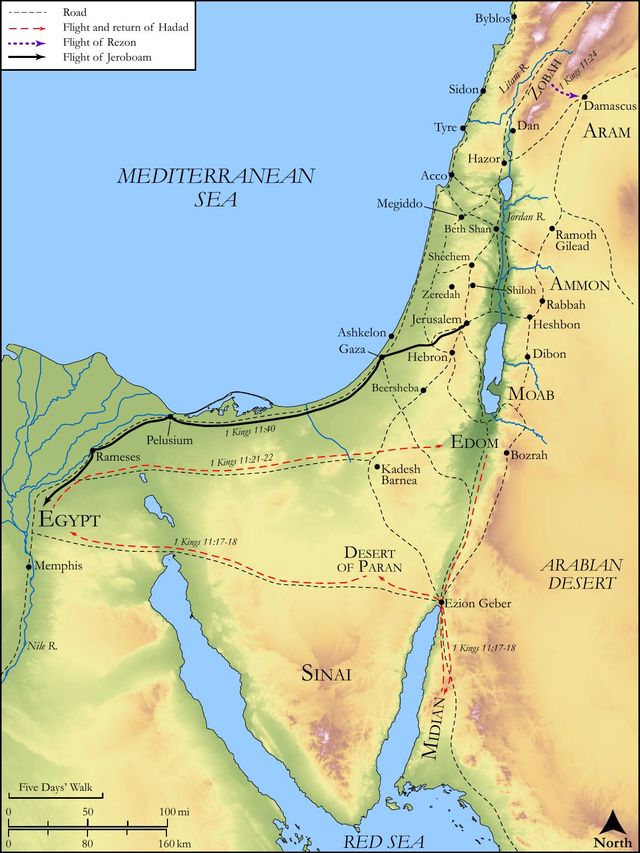
IV.Jeroboam's flight into Egypt, Kg1 11:40.
In some way or other Solomon came to know of all this, probably from Jeroboam's own talk of it; he could not conceal it as Saul did, nor keep his own counsel; if he had, he might have staid in his country, and been preparing there for his future advancement; but letting it be known,
1.Solomon foolishly sought to kill his successor. Had not he taught others that, whatever devices are in men's hearts, the counsel of the Lord shall stand? And yet does he himself think to defeat that counsel?
2.Jeroboam prudently withdrew into Egypt. Though God's promise would have secured him any where, yet he would use means for his own preservation, and was content to live in exile and obscurity for a while, being sure of a kingdom at last. And shall not we be so, who have a better kingdom in reserve?
Historical interpretation
Historical reception
1 surviving comment on this verse from the historical church.
The words “so that David may always have a lamp” refer to that small part of the kingdom which was like the sun in the abundance of its light: “Your throne will be like the sun before me.” Moreover, as we light many firebrands from a lamp, so a large number [of kings] will descend from the royal lineage of David “until he, to whom kingship belongs, comes.”
Continue studying 1 Kings 11:36 across the web’s major study libraries — every link below opens this exact verse, chapter, or book on the destination site.
Read & Compare
 BibleGatewayThis verse in more than 200 translations and 70 languages.
 Bible.comThe YouVersion reader — hundreds of translations, reading plans, and highlights.
 ESV.orgCrossway's official English Standard Version reader.
 NET BibleThe NET translation with 60,000+ translators' notes on every rendering decision.
 STEP BibleTyndale House's free study tool — original text, vocabulary, and scholarly resources.
 BibliaLogos Bible Software's free web reader.
 USCCBThe New American Bible (Revised Edition) with the U.S. bishops' study notes.
Commentaries
 BibleHub CommentariesDozens of classic commentaries on this verse, gathered on one page.
 StudyLightMore than 100 commentary sets — the largest collection on the web.
 BibleRefPlain-English commentary on what this verse means, verse by verse.
 Enduring WordDavid Guzik's free commentary on this chapter, widely used by Bible teachers.
 Bible Study ToolsVerse commentary alongside Greek and Hebrew study aids.
Original Language & Research
- BibleHub InterlinearThe verse word by word — original language, transliteration, and English.
- BibleHub LexiconEvery word's original-language definition and Strong's entry.
 Blue Letter BibleDeep-study tools — Strong's numbers, concordance, and word studies.
 SefariaThe Hebrew text with Rashi and centuries of Jewish commentary.
Sermons, Hymns & Audio


TrulyRandomVerse is not affiliated with these sites and doesn’t control their content. They’re linked because they’re genuinely useful.
Summary
Despite King Solomon's profound apostasy and the divine judgment pronounced upon his kingdom, 1 Kings 11:36 reveals God's unwavering faithfulness to His covenant with King David. This pivotal verse explains God's decision to preserve a remnant of the united monarchy—specifically, one tribe—for Solomon's son, Rehoboam, ensuring the continuation of David's royal line in Jerusalem. This act of mercy, rooted in divine commitment rather than human merit, underscores God's sovereign plan to maintain a "light" for David's dynasty, thereby safeguarding the lineage through which the promised Messiah would ultimately come, even amidst the consequences of human failure.
Context
ShowHideLiterary Context
This verse is situated at a critical juncture in the narrative of 1 Kings, immediately following the detailed account of King Solomon's tragic spiritual decline. Chapters 1-10 depict Solomon's unparalleled wisdom, immense wealth, and the glory of his reign, culminating in the dedication of the magnificent Temple. However, 1 Kings 11 abruptly shifts to chronicle his catastrophic failure. Solomon's numerous foreign wives led him astray, causing him to worship foreign gods and build high places for their idols (1 Kings 11:4-8). This profound apostasy provoked God's fierce anger, leading to the pronouncement that He would tear the kingdom from Solomon's hand (1 Kings 11:11). Yet, out of steadfast love for David, God declared He would not execute this judgment during Solomon's lifetime and would leave one tribe to his son. Verse 36 precisely articulates the divine rationale for this crucial exception, setting the stage for the kingdom's division into Israel (the ten northern tribes) and Judah (the southern kingdom), a central theme of the subsequent chapters in 1 Kings.
Historical & Cultural Context
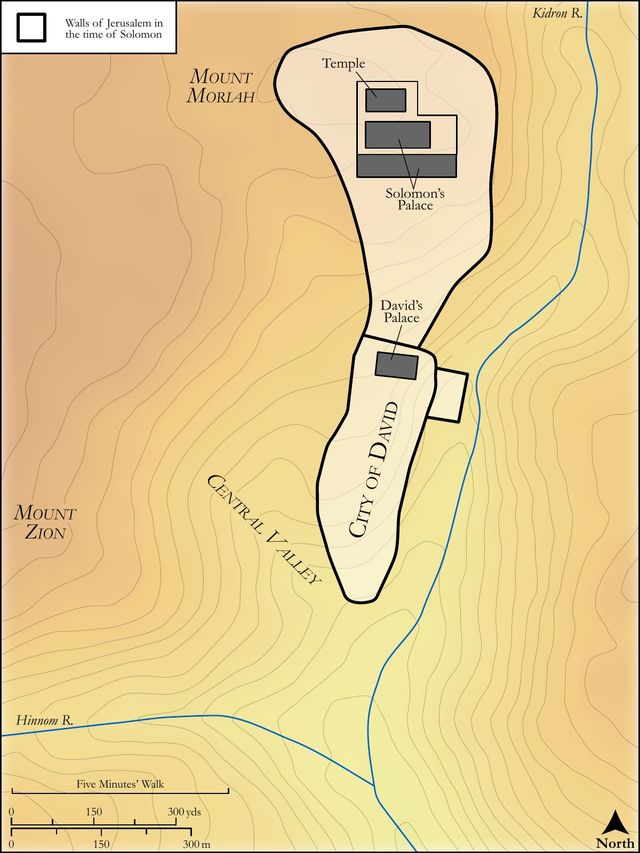
The historical setting is the late period of Solomon's reign, a time characterized by immense prosperity and international influence, but also by growing internal spiritual rot. Solomon's alliances with foreign nations, sealed by marriages to princesses from various peoples, were intended to secure peace and trade, but they directly violated Mosaic law forbidding intermarriage with idolaters (Deuteronomy 7:3-4). In Israel, a king's dynasty was paramount, and the continuity of his "lamp" or "light" (a metaphor for a reigning line, as when David's men swore that he should go no more out to battle, "that thou quench not the light of Israel") was a critical sign of divine favor and stability. The extinguishing of a king's lamp signified the end of his lineage and the collapse of his house. Jerusalem, as the divinely chosen capital and the site of the Temple, held immense religious and political significance. Its status as the city where God "put His name" signified His special presence, ownership, and covenantal relationship with Israel, making the preservation of a Davidic king there crucial for the nation's identity and future hope.
Key Themes
ShowHide1 Kings 11:36 powerfully reinforces several overarching themes central to the Deuteronomistic History. Foremost is God's unwavering faithfulness to His covenant promises, particularly the Davidic Covenant established in 2 Samuel 7, which guaranteed an enduring dynasty for David. Despite Solomon's profound sin and the just judgment it incurred, God's commitment to David's lineage remains intact, demonstrating that divine promises are not contingent on human perfection but on God's own immutable character. Another key theme is the consequences of disobedience; while God's mercy prevails in preserving a remnant, Solomon's actions still result in the tearing away of ten tribes, illustrating that sin has severe repercussions, even for the most favored. The phrase "a light alway before me" highlights the symbolism of the Davidic dynasty as a perpetual lamp, signifying the hope of an unbroken royal line that would eventually lead to the Messiah. Finally, the verse underscores Jerusalem's unique theological status as the city God chose to "put His name there," emphasizing its centrality in God's redemptive plan and its enduring significance as the spiritual heart of the kingdom, even in its fractured state.
Exposition and Analysis
ShowHideKey Word Analysis
ShowHideThis word literally means "lamp" or "light." Throughout the Old Testament, it is a potent metaphor for life, prosperity, and particularly the continuity of a family line or dynasty. To have one's "lamp extinguished" (e.g., 2 Samuel 21:17) meant the end of a lineage or influence. Here, God's promise that David "may have a light alway before me" signifies an unbroken, enduring succession of kings from David's lineage, ensuring that his dynasty would not be completely extinguished despite the current king's failure. This is a direct affirmation of the eternal nature of the Davidic Covenant, emphasizing God's commitment to His promise.
This verb signifies a deliberate, sovereign act of selection. It emphasizes that God's choice of Jerusalem was not arbitrary or based on human merit, but on His divine decree and purpose. God's choice of Jerusalem as the place "to put my name there" signifies His unique presence, ownership, and covenantal dwelling among His people. It highlights Jerusalem's sacred status as the spiritual and political center of the kingdom, a place where God's character and authority are uniquely manifested. This divine election ensures Jerusalem's enduring significance, even as the kingdom faces division, as it remains central to God's redemptive plan.
Verse Breakdown
ShowHide"And unto his son will I give one tribe"
This initial clause reveals the specific act of divine mercy and judgment. Despite Solomon's widespread idolatry, God promises to preserve one tribe for his son, Rehoboam. This "one tribe" typically refers to the tribe of Judah, which would remain loyal to the Davidic dynasty, often including the small contiguous territory of Benjamin. This partial preservation demonstrates God's restraint in judgment, preventing the complete annihilation of the Davidic line as a consequence of Solomon's grievous sin, thereby maintaining a remnant for His greater purposes.
"that David my servant may have a light alway before me in Jerusalem"
This phrase articulates the profound theological reason for God's mercy and the preservation of the single tribe. The continuity is not for Solomon's sake, but for "David my servant," highlighting God's unwavering faithfulness to the Davidic Covenant (2 Samuel 7:12-16). The "light" symbolizes the enduring presence and continuity of David's royal line, signifying that his lamp would not be extinguished. "Alway before me" underscores that this continuity is under God's direct oversight and for His glory, ensuring that a descendant of David would perpetually reign in Jerusalem, maintaining the hope of the promised Messiah.
"the city which I have chosen me to put my name there"
This final clause reaffirms Jerusalem's unique and divinely ordained status. God's "choosing" of Jerusalem and His decision to "put His name there" signifies His special presence, ownership, and covenantal relationship with the city. It is the designated place for His Temple and the center of His worship. This divine election ensures Jerusalem's enduring significance as the spiritual and political capital, even as the kingdom faces internal strife and division, reinforcing its indispensable role in God's unfolding redemptive plan for His people and the world.
Literary Devices
ShowHideThe verse employs several significant literary devices that enrich its meaning and underscore its theological importance. Symbolism is prominently featured in the phrase "a light alway before me," where "light" (נֵר, ner) symbolizes the enduring vitality and continuity of David's royal dynasty. This metaphor evokes the image of a perpetually burning lamp, signifying the unbroken succession of kings from David's lineage, a promise of life and presence in stark contrast to the extinguishing of a lamp which would signify death and the end of a line. The repetition of God's action of "choosing" Jerusalem and "putting His name there" functions as a powerful form of Emphasis or Divine Fiat, underscoring the city's unique and sacred status, not by human merit but by sovereign divine decree. This reinforces Jerusalem's centrality to God's covenantal purposes, even amidst the backdrop of royal failure and impending national division, highlighting its enduring significance as the place of God's special presence.
Theological and Thematic Connections
ShowHide1 Kings 11:36 stands as a powerful testament to the enduring nature of God's covenant faithfulness, even in the face of profound human sin. While Solomon's apostasy justly incurred divine judgment, God's prior commitment to David's lineage superseded the immediate consequences of Solomon's rebellion, demonstrating that God's promises are rooted in His unchanging character, not in human performance. This verse highlights the tension between divine judgment and divine mercy, revealing God's long-suffering patience and His strategic preservation of the Davidic line for the ultimate fulfillment of His redemptive plan. The "light" of David's dynasty, maintained in Jerusalem, serves as a beacon of hope, pointing forward to the ultimate King who would perfectly embody God's rule and establish an everlasting kingdom.
Reflection and Application
ShowHide1 Kings 11:36 offers profound insights for believers today, reminding us that God's faithfulness is not contingent on our perfect obedience, but on His unchanging character and His sovereign plan. Solomon's tragic fall serves as a sobering warning that even those greatly blessed by God can stray, and that unaddressed sin, particularly idolatry and compromise, carries severe consequences that extend beyond the individual. Yet, amidst this judgment, God's unwavering commitment to His covenant with David shines through, preserving a remnant of hope. This should instill in us a deep sense of security in God's promises, knowing that even when we fail, His ultimate purposes will prevail. It calls us to trust in His steadfast love and to recognize that His plans are always bigger than our present circumstances or shortcomings. We are invited to reflect on the enduring nature of God's covenant with us in Christ, which is likewise secured by His faithfulness, not our own merit, offering us an unshakable hope and a call to live in responsive obedience to His grace.
Questions for Reflection
ShowHideFAQ
ShowHideWhat is the significance of "a light alway before me" for David?
ShowHideThe phrase "a light alway before me" (Hebrew: נֵר, ner) is a powerful symbol of the enduring continuity and vitality of David's royal dynasty. In Hebrew thought, a lamp symbolized life, prosperity, and the unbroken succession of a family line. To have one's lamp extinguished meant the end of their lineage or influence. Therefore, God's promise here signifies that despite Solomon's apostasy and the impending division of the kingdom, a descendant of David would always remain on the throne in Jerusalem, ensuring the perpetuation of his royal line. This was a direct fulfillment of the Davidic Covenant, promising an eternal dynasty (2 Samuel 7:16). It maintained the hope that the promised Messiah, who would be a son of David, would eventually come, thereby securing the lineage through which salvation history would progress.
Why did God only give "one tribe" to Solomon's son, Rehoboam?
ShowHideGod's decision to give only "one tribe" (primarily Judah, along with Benjamin) to Rehoboam was an act of both righteous judgment and profound mercy. It was judgment for Solomon's profound idolatry and disobedience, as God had explicitly warned that He would tear the kingdom from him (1 Kings 11:11). However, it was also an act of mercy, specifically for the sake of God's covenant with "David my servant" (1 Kings 11:12-13). By preserving one tribe, God ensured that the "light" of David's dynasty would not be completely extinguished, maintaining the lineage through which the Messiah would eventually emerge. This partial judgment demonstrated God's justice while simultaneously upholding His unwavering faithfulness to His promises, proving that His ultimate redemptive plan would not be thwarted by human sin.
Christ-Centered Fulfillment
ShowHideThe preservation of "one tribe" and the promise of "a light alway" for David in 1 Kings 11:36 finds its ultimate and glorious fulfillment in Jesus Christ. The "light" of David's dynasty, which seemed precarious and diminished after the division of the kingdom and subsequent exiles, ultimately culminated in Jesus, who is the true and eternal "Light of the World" (John 8:12). He is the promised Son of David, born into that very lineage preserved through centuries of turmoil and even apostasy (Matthew 1:1). The covenant God made with David, promising an eternal throne and kingdom (2 Samuel 7:12-16), is perfectly realized in Christ, whose kingdom "will have no end" (Luke 1:33). The "one tribe" of Judah, from which Jesus descended, became the vessel for God's redemptive plan, ensuring that the promise of a king from David's line would culminate not in a mere earthly monarch, but in the divine Son who reigns eternally from the heavenly Jerusalem, the true city where God's name is perfectly glorified and His presence fully realized (Revelation 21:2-3). Thus, 1 Kings 11:36 is a crucial prophetic thread, demonstrating God's meticulous and faithful preservation of the messianic line, even in the darkest hours of Israel's history, pointing all hope to the coming of Christ.