


2 Chronicles 21:7
Bible text: King James Version (1769 Blayney text) · Public domain
Bible text: King James Version with Strong's numbers · Public domain
Bible text: Berean Standard Bible · Public domain
Bible text: American Standard Version (1901) · Public domain
Bible text: World English Bible, Messianic edition · Public domain
Bible text: Geneva Bible (1599) · Public domain
Bible text: Young's Literal Translation · Public domain
- וְלֹאve·lo'and notH3808Conj-w ¦ NegParticle Negativeוְandלֹאnot
- אָבָה'a·Vahhe was willingH14V-Qal-Perf-3msVerb Qal Perfect 3rd Singular Masculine
- יְהוָהYah·wehYahwehH3068N-properNoun Proper Title
- לְהַשְׁחִיתle·hash·Chitto destroyH7843Prep-l ¦ V-Hiphil-InfVerb Hiphil Infinitive Constructלְtoהַשְׁחִיתdestroy
- אֶת'et<obj.>H853DirObjMParticle Object Indicator
- בֵּיתbeit[the] house ofH1004N-mscNoun Singular Masculine Construct
- דָּוִידda·VidDavidH1732N-proper-mNoun Proper Masculine
- לְמַעַןle·Ma·'anon account ofH4616PrtParticle Conditional
- הַבְּרִיתha·be·Ritthe covenantH1285Art ¦ N-fsNoun Singular Feminine Absoluteהַtheבְּרִיתcovenant
- אֲשֶׁר'a·SherwhichH834RelParticle Relative
- כָּרַתka·Rathe had madeH3772V-Qal-Perf-3msVerb Qal Perfect 3rd Singular Masculine
- לְדָוִידle·da·Vidto DavidH1732Prep-l ¦ N-proper-mNoun Proper MasculineלְtoדָוִידDavid
- וְכַאֲשֶׁרve·kha·'a·Sherand <as> sinceH834Conj-w ¦ Prep-k ¦ RelParticle Relativeוְandכַ<as>אֲשֶׁרsince
- אָמַר'a·Marhe had saidH559V-Qal-Perf-3msVerb Qal Perfect 3rd Singular Masculine
- לָתֵתla·Tetto giveH5414Prep-l ¦ V-Qal-InfVerb Qal Infinitive Constructלָtoתֵתgive
- לוֹloto himPrep-l ¦ 3msSuffix Personal 3rd Singular Masculineלtoוֹhim
- נִירnira lampH5216N-msNoun Singular Masculine Absolute
- וּלְבָנָיוu·le·va·Navand to his descendantsH1121Conj-w ¦ Prep-l ¦ N-mpc ¦ 3msNoun Plural Masculine Constructוּandלְtoבָנָיdescendantsוhis
- כָּלkolallH3605N-mscNoun Singular Masculine Construct
- הַיָּמִיםhai·ya·Mimthe daysH3117Art ¦ N-mpNoun Plural Masculine Absoluteהַtheיָּמִיםdays
English is a literal word-by-word gloss of the Hebrew, not the KJV's wording. Why?
This is the original text the KJV's translators worked from — each Hebrew word with its own literal English meaning in this verse, prepared by scholars at Tyndale House, Cambridge. The KJV translates whole sentences, not word by word, so its wording differs: one Hebrew word can become several English words, and the KJV may choose “the LORD” where the gloss reads “Yahweh”. Both are faithful — they answer different questions. For the KJV's own rendering, switch to the KJV text.
Details
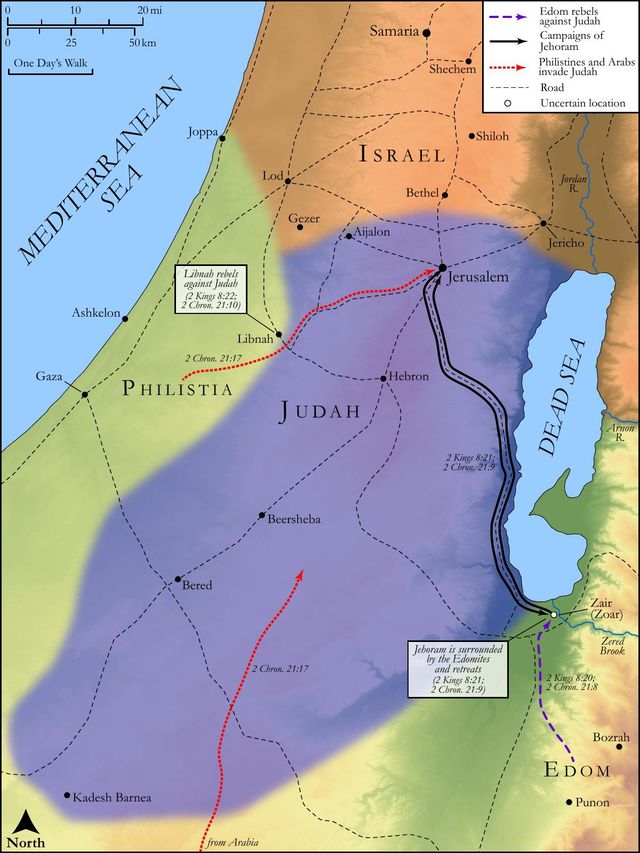
See on the biblical-era map
Study this verse
Public-domain commentary
Matthew Henry
From his Commentary on the Whole Bible. Henry comments on passages, not single verses — this entry covers 2 Chronicles 21:1–11. His two-level outline is real structure in the source text, so it is rendered as structure.
We find here,
I.That Jehoshaphat was a very careful indulgent father to Jehoram.
He had many sons, who are here named (Ch2 21:2), and it is said (Ch2 21:13) that they were better than Jehoram, had a great deal more wisdom and virtue, and lived up to their education, which he went counter to. They were very hopeful, and any of them more fit for the crown than he; and yet, because he was the first-born (Ch2 21:3), his father secured the kingdom to him, and portioned his brethren and disposed of them so as that they would be easy and give him no disturbance; as Abraham, when he made Isaac his heir, dismissed his other children with gifts. Herein Jehoshaphat was very kind and fair to his son, which might have obliged him to be respectful to him, and tread in the steps of so good a father. But it is no new thing for the children that have been most indulged by their parents to be least dutiful to them. Whether in doing this he acted wisely and well for his people, and was just to them, I cannot say. His birthright entitled him to a double portion of his father's estate, Deu 21:17. But if he appeared utterly unfit for government (the end of which is the good of the people), and likely to undo all that his father had done, it would have been better perhaps to have set him aside, and taken the next that was hopeful, and not inclined as he was to idolatry. Power is a sacred thing, with which men may either do much good or much hurt; and therefore Detur digniori - Let him that deserves it have it. Salus populi suprema lex - The security of the people is the first consideration.
II.That Jehoram was a most barbarous brother to his father's sons.
As soon as he had settled himself in the throne he slew all his brethren with the sword, either by false accusation, under colour of law, or rather by assassination. By some wicked hand or other he got them all murdered, pretending (it is likely) that he could not think himself safe in the government till they were taken out of the way. Those that mean ill themselves are commonly, without cause, jealous of those about them. The wicked fear where no fear is, or pretend to do so, in order to conceal their malice. Jehoram, it is likely, hated his brethren and slew them for the same reason that Cain hated Abel and slew him, because their piety condemned his impiety and won them that esteem with the people which he had lost. With them he slew divers of the princes of Israel, who adhered to them, or were likely to avenge their death. The princes of Judah, those who had taught the good knowledge of the Lord (Ch2 17:7), are here called princes of Israel, as before fathers of Israel (Ch2 19:8), because they were Israelites indeed, men of integrity. The sword which the good father had put into their hands this wicked son sheathed in their bowels. Woe unto him that thus foundeth a kingdom in blood (Hab 2:12); it will prove a foundation that will sink the superstructure.
III.That Jehoram was a most wicked king, who corrupted and debauched his kingdom, and ruined the reformation that his good father and grandfather had carried on: He walked in the way of the house of Ahab (Ch2 21:6), made high places, which the people were of themselves too forward to make, and did his utmost to set up idolatry again, Ch2 21:11.
1.As for the inhabitants of Jerusalem, where he kept his court, he easily drew them into his spiritual whoredom: He caused them to commit fornication, seducing them to eat things sacrificed to idols, Rev 2:20.
2.The country people seem to have been brought to it with more difficulty; but those that would not be corrupted by flatteries were driven by force to partake in his abominable idolatries: He compelled Judah thereto. He used that power for the destruction of the church which was given him for the edification of it.
IV.That when he forsook God and his worship his subjects withdrew from their allegiance to him.
1.Some of the provinces abroad that were tributaries to him did so. The Edomites revolted (Ch2 21:8), and, though he chastised them (Ch2 21:9), yet he could not reduce them, Ch2 21:10.
2.One of the cities of his own kingdom did so. Libnah revolted (Ch2 21:10) and set up for a free state, as of old it had a king of its own, Jos 12:15. And the reason is here given, not only why God permitted it, but why they did it; they shook off his government because he had forsaken the Lord God of his fathers, had become an idolater and a worshipper of false gods, and they could not continue subject to him without some danger of being themselves also drawn away from God and their duty. While he adhered to God they adhered to him; but, when he cast God off, they cast him off. Whether this reason will justify them in their revolt of no, it will justify God's providence which ordered it so.
V.That yet God was tender of his covenant with the house of David, and therefore would not destroy the royal family, though it was so wretchedly corrupted and degenerated, Ch2 21:7. These things we had before, Kg2 8:19-22. The tenour of the covenant was that David's seed should be visited for their transgressions, but the covenant should never be broken, Psa 89:30, etc.
Continue studying 2 Chronicles 21:7 across the web’s major study libraries — every link below opens this exact verse, chapter, or book on the destination site.
Read & Compare
 BibleGatewayThis verse in more than 200 translations and 70 languages.
 Bible.comThe YouVersion reader — hundreds of translations, reading plans, and highlights.
 ESV.orgCrossway's official English Standard Version reader.
 NET BibleThe NET translation with 60,000+ translators' notes on every rendering decision.
 STEP BibleTyndale House's free study tool — original text, vocabulary, and scholarly resources.
 BibliaLogos Bible Software's free web reader.
 USCCBThe New American Bible (Revised Edition) with the U.S. bishops' study notes.
Commentaries
 BibleHub CommentariesDozens of classic commentaries on this verse, gathered on one page.
 StudyLightMore than 100 commentary sets — the largest collection on the web.
 BibleRefPlain-English commentary on what this verse means, verse by verse.
 Enduring WordDavid Guzik's free commentary on this chapter, widely used by Bible teachers.
 Bible Study ToolsVerse commentary alongside Greek and Hebrew study aids.
Original Language & Research
- BibleHub InterlinearThe verse word by word — original language, transliteration, and English.
- BibleHub LexiconEvery word's original-language definition and Strong's entry.
 Blue Letter BibleDeep-study tools — Strong's numbers, concordance, and word studies.
 SefariaThe Hebrew text with Rashi and centuries of Jewish commentary.
Sermons, Hymns & Audio


TrulyRandomVerse is not affiliated with these sites and doesn’t control their content. They’re linked because they’re genuinely useful.
Summary
Despite the profound wickedness and idolatry of King Jehoram of Judah, 2 Chronicles 21:7 powerfully asserts God's unwavering faithfulness to His covenant with David. This verse highlights that even in the face of human rebellion and deserving judgment, the LORD would not utterly destroy the Davidic dynasty, but would preserve a "light"—a continuous succession of kings—as He had solemnly promised, ensuring the eventual fulfillment of His redemptive purposes through this royal line.
Context
ShowHideLiterary Context
2 Chronicles 21 opens with the tragic reign of Jehoram, son of the righteous King Jehoshaphat. Immediately preceding this verse, the narrative details Jehoram's egregious sins: he murdered all his brothers (2 Chronicles 21:4), walked in the ways of the kings of Israel (specifically the house of Ahab, 2 Chronicles 21:6), and led Judah into widespread idolatry (2 Chronicles 21:11). God's judgment swiftly followed, including a severe plague (2 Chronicles 21:14-15), an invasion by the Philistines and Arabians who plundered his palace and captured his family (2 Chronicles 21:16-17), and ultimately, his agonizing death (2 Chronicles 21:18-19). Verse 7 stands as a stark contrast to this unfolding judgment, emphasizing God's restraining hand and covenant fidelity amidst Jehoram's deserved punishment. It serves as a theological anchor, explaining why the Davidic line was not completely extinguished despite such profound apostasy.
Historical & Cultural Context
Jehoram's reign (c. 848-841 BC) marked a significant decline for the Southern Kingdom of Judah. His marriage to Athaliah, daughter of Ahab and Jezebel, cemented the corrupting influence of Northern Kingdom idolatry (Baal worship) within Judah's royal court, a stark deviation from the reforms initiated by his father, Jehoshaphat. In Scripture, the concept of a "lamp" or "light" (Hebrew: nîyr) was a potent metaphor for the continuity of a household, dynasty, or even the life of an individual, as in the LORD's purpose that David "may have a light alway before me in Jerusalem." To have one's lamp extinguished meant the complete end of one's lineage or existence. Therefore, God's promise to "give a light" to David and his sons "for ever" was a guarantee of dynastic survival, ensuring that a descendant of David would always occupy the throne, a promise deeply understood by the people of that era as a pledge of enduring royal presence.
Key Themes
ShowHideThis verse powerfully underscores several foundational themes woven throughout the books of Chronicles and the broader Old Testament. Firstly, it highlights God's Unwavering Faithfulness to His divine covenants, particularly the Davidic Covenant, even when human partners are profoundly unfaithful. Despite Jehoram's wickedness, God's commitment to His word superseded immediate punitive justice for the entire lineage. Secondly, it emphasizes the Enduring Nature of the Davidic Covenant, which promised an eternal dynasty and a perpetual "light" or "lamp" for David's house (compare 2 Samuel 7:12-16 and 1 Kings 11:36). This covenant was ultimately unconditional in its ultimate fulfillment, even if individual kings faced judgment. Thirdly, it reveals Divine Preservation Despite Human Sin, demonstrating God's sovereign hand in maintaining the Davidic line, which was crucial for the unfolding of His redemptive plan, ultimately leading to the Messiah. This tension between divine judgment and covenant fidelity is a recurring motif in Israel's history, showcasing God's justice tempered by His steadfast love and ultimate purpose.
Exposition and Analysis
ShowHideKey Word Analysis
ShowHideThis term refers to a solemn, binding agreement established by God, often made by "cutting" (as implied in the root). In this context, it specifically points to the Davidic Covenant, where God unconditionally promised David an enduring house, kingdom, and throne. The use of "covenant" here underscores that God's decision not to destroy David's house was not based on Jehoram's merit, but solely on God's prior, immutable commitment to His word given to David. It highlights God's faithfulness as a defining attribute, demonstrating that His promises are not contingent on human performance for their ultimate fulfillment.
Literally meaning "lamp" or "light," this word functions as a powerful metaphor for the enduring presence and continuity of the Davidic dynasty. In ancient Israelite culture, a burning lamp symbolized life, hope, and the continuation of a family line or household. To "give a light" to someone meant to ensure their descendants would continue to exist and rule. This promise signified that despite the darkness of Jehoram's reign and the threats to the kingdom's survival, God would ensure that a successor from David's lineage would always remain, preventing the complete extinction of the royal line and preserving the hope of the promised Messiah.
This term, while literally meaning a physical dwelling, is used here in a broader, figurative sense to denote the "family" or "dynasty" of David. God's promise to preserve the "house of David" signifies His commitment to the continuity of David's lineage and the royal succession, ensuring that a descendant would always occupy the throne. This preservation was essential for the fulfillment of the Davidic Covenant and the ultimate coming of the Messiah through this specific royal line.
Verse Breakdown
ShowHide"Howbeit the LORD would not destroy the house of David"
This clause highlights God's sovereign restraint and intervention. Despite Jehoram's extreme wickedness, which justly merited the complete annihilation of his dynasty, God chose not to execute such a judgment. This divine decision underscores a principle of divine grace and covenant faithfulness that transcends immediate human deserving. It reveals God's long-term plan overriding the immediate consequences of sin.
"because of the covenant that he had made with David"
This phrase provides the explicit theological rationale for God's forbearance. God's action was not arbitrary but rooted in His prior, solemn, and unconditional promise to King David. The covenant, detailed in 2 Samuel 7, guaranteed an eternal house, kingdom, and throne for David's descendants. This demonstrates that God's character is inextricably linked to His word; He is faithful to His promises even when His people are unfaithful.
"and as he promised to give a light to him and to his sons for ever."
This final clause reiterates the specific nature of the covenant promise being upheld. The "light" symbolizes the continuity of the Davidic line, ensuring that a descendant would always sit on the throne. The phrase "for ever" emphasizes the perpetual nature of this promise, pointing beyond any individual king or generation to an enduring dynasty. This promise was critical for the preservation of the lineage through which the ultimate "light," the Messiah, would come.
Literary Devices
ShowHideThe verse employs several significant literary devices. Contrast is prominent, setting God's unwavering faithfulness against Jehoram's profound wickedness and the deserved judgment. This juxtaposition magnifies God's character. Symbolism is central, with the "light" or "lamp" serving as a powerful image for the continuity and enduring presence of the Davidic dynasty. This metaphor evokes Scripture's own picture of a lamp signifying life, hope, and the perpetuation of a household. Furthermore, the verse utilizes Covenant Language, explicitly referencing the "covenant that he had made with David," which immediately brings to mind the foundational promises of 2 Samuel 7 and its implications for Israel's future and the coming Messiah. The phrase "for ever" also functions as Hyperbole or Divine Guarantee, emphasizing the absolute certainty and perpetual nature of God's promise, extending beyond any single reign or generation to an ultimate, eternal fulfillment.
Theological and Thematic Connections
ShowHide2 Chronicles 21:7 serves as a powerful testament to God's immutable faithfulness and the enduring nature of His covenants. It demonstrates that while God is just and does indeed bring judgment for sin, His ultimate redemptive purposes, anchored in His unconditional promises, will prevail. The preservation of the Davidic line, despite the profound unfaithfulness of kings like Jehoram, was not merely for David's sake, but for the sake of God's broader plan to bring forth the Messiah, the ultimate King. This verse highlights the tension between divine justice and divine mercy, showing how God's mercy, rooted in His covenant, can restrain His justice to accomplish His greater purposes. It reinforces the theological truth that God's character is defined by His steadfast love (חֶסֶד, ḥesed) and His commitment to His word.
Reflection and Application
ShowHide2 Chronicles 21:7 offers profound comfort and a steadfast anchor for our faith in a world often marked by human failure and instability. It reminds us that God's faithfulness is not contingent upon our performance or the righteousness of those around us, but upon His own unchanging character and His unbreakable promises. Even when we stumble, or when leaders fail, or when circumstances seem to unravel, God remains true to His word. This truth provides immense hope, assuring us that God's overarching redemptive plan will be fulfilled, regardless of temporary setbacks or the profound unfaithfulness of individuals. It calls us to greater humility, gratitude for His grace, and unwavering confidence in His sovereign control over history. This passage encourages us to look beyond immediate crises to God's eternal purposes, finding peace in His steadfast love and unwavering commitment to His covenant people.
Questions for Reflection
ShowHideFAQ
ShowHideWhy was the "house of David" so important that God would preserve it despite such wickedness?
ShowHideThe "house of David" was crucial because it was the lineage through which God had promised to bring forth the Messiah, the ultimate King who would establish an eternal kingdom. The covenant made with David in 2 Samuel 7 was foundational to Israel's hope and God's redemptive plan for humanity. God's preservation of this line, even when individual kings like Jehoram were deeply unfaithful, demonstrates His unwavering commitment to His prophetic word and His sovereign control over history to ensure the arrival of the promised Savior. Without the continuity of the Davidic line, the Messianic prophecies could not be fulfilled.
Christ-Centered Fulfillment
ShowHideThe preservation of the Davidic "light" in 2 Chronicles 21:7 finds its ultimate and glorious fulfillment in Jesus Christ. The "light" that God promised to give to David and his sons "for ever" was not merely a succession of earthly kings, but a prophetic foreshadowing of the eternal King who would truly embody that light. Jesus, the Son of David (as affirmed in Matthew 1:1), is the promised heir to David's throne, whose kingdom will have no end (Luke 1:32-33). He is the true "light of the world" (John 8:12), who illuminates the path to salvation and defeats the darkness of sin and death. God's faithfulness to His covenant with David, demonstrated by preserving a "light" through generations of flawed kings, ultimately culminated in the incarnation of Christ, the perfect Son who fully embodies the eternal reign and unfading light promised to David's house, ushering in the new covenant and an everlasting kingdom for all who believe. His resurrection ensures that the "light" of David's house will indeed shine "for ever," not through a human dynasty, but through His eternal, spiritual reign (Revelation 22:5).