


2 Chronicles 21:4
Bible text: King James Version (1769 Blayney text) · Public domain
Bible text: King James Version with Strong's numbers · Public domain
Bible text: Berean Standard Bible · Public domain
Bible text: American Standard Version (1901) · Public domain
Bible text: World English Bible, Messianic edition · Public domain
Bible text: Geneva Bible (1599) · Public domain
Bible text: Young's Literal Translation · Public domain
- וַיָּקָםvai·Ya·komand he aroseH6965Conj-w ¦ V-Qal-ConsecImperf-3msVerb Qal Consecutive Imperfect 3rd Singular Masculineוַandיָּקָםhe arose
- יְהוֹרָםye·ho·RamJehoramH3088N-proper-mNoun Proper Masculine
- עַל'aloverH5921PrepPreposition
- מַמְלֶכַתmam·Le·khat[the] kingdom ofH4467N-fscNoun Singular Feminine Construct
- אָבִיו'a·Vivhis fatherH1N-msc ¦ 3msNoun Singular Masculine Constructאָבִיfatherוhis
- וַיִּתְחַזַּקvai·yit·cha·Zakand he strengthened himselfH2388Conj-w ¦ V-Hithpael-ConsecImperf-3msVerb Hithpael Consecutive Imperfect 3rd Singular Masculineוַandיִּתְחַזַּקhe strengthened himself
- וַיַּהֲרֹגvai·ya·ha·Rogand he killedH2026Conj-w ¦ V-Qal-ConsecImperf-3msVerb Qal Consecutive Imperfect 3rd Singular Masculineוַandיַּהֲרֹגhe killed
- אֶת'et<obj.>H853DirObjMParticle Object Indicator
- כָּלkolallH3605N-mscNoun Singular Masculine Construct
- אֶחָיו'e·Chavhis brothersH251N-mpc ¦ 3msNoun Plural Masculine Constructאֶחָיbrothersוhis
- בֶּחָרֶבbe·Cha·revwith the swordH2719Prep-b ¦ N-fsNoun Singular Feminine Absoluteבֶּwith theחָרֶבsword
- וְגַםve·Gamand alsoH1571Conj-w ¦ AdvAdverbוְandגַםalso
- מִשָּׂרֵיmi·sa·Reisome of [the] leaders ofH8269Prep-m ¦ N-mpcNoun Plural Masculine Constructמִsome ofשָּׂרֵי[the] leaders of
- יִשְׂרָאֵלYis·ra·'ElIsraelH3478N-properNoun Proper Location
English is a literal word-by-word gloss of the Hebrew, not the KJV's wording. Why?
This is the original text the KJV's translators worked from — each Hebrew word with its own literal English meaning in this verse, prepared by scholars at Tyndale House, Cambridge. The KJV translates whole sentences, not word by word, so its wording differs: one Hebrew word can become several English words, and the KJV may choose “the LORD” where the gloss reads “Yahweh”. Both are faithful — they answer different questions. For the KJV's own rendering, switch to the KJV text.
Details
See on the biblical-era map
Study this verse
Public-domain commentary
Matthew Henry
From his Commentary on the Whole Bible. Henry comments on passages, not single verses — this entry covers 2 Chronicles 21:1–11. His two-level outline is real structure in the source text, so it is rendered as structure.
We find here,
I.That Jehoshaphat was a very careful indulgent father to Jehoram.
He had many sons, who are here named (Ch2 21:2), and it is said (Ch2 21:13) that they were better than Jehoram, had a great deal more wisdom and virtue, and lived up to their education, which he went counter to. They were very hopeful, and any of them more fit for the crown than he; and yet, because he was the first-born (Ch2 21:3), his father secured the kingdom to him, and portioned his brethren and disposed of them so as that they would be easy and give him no disturbance; as Abraham, when he made Isaac his heir, dismissed his other children with gifts. Herein Jehoshaphat was very kind and fair to his son, which might have obliged him to be respectful to him, and tread in the steps of so good a father. But it is no new thing for the children that have been most indulged by their parents to be least dutiful to them. Whether in doing this he acted wisely and well for his people, and was just to them, I cannot say. His birthright entitled him to a double portion of his father's estate, Deu 21:17. But if he appeared utterly unfit for government (the end of which is the good of the people), and likely to undo all that his father had done, it would have been better perhaps to have set him aside, and taken the next that was hopeful, and not inclined as he was to idolatry. Power is a sacred thing, with which men may either do much good or much hurt; and therefore Detur digniori - Let him that deserves it have it. Salus populi suprema lex - The security of the people is the first consideration.
II.That Jehoram was a most barbarous brother to his father's sons.
As soon as he had settled himself in the throne he slew all his brethren with the sword, either by false accusation, under colour of law, or rather by assassination. By some wicked hand or other he got them all murdered, pretending (it is likely) that he could not think himself safe in the government till they were taken out of the way. Those that mean ill themselves are commonly, without cause, jealous of those about them. The wicked fear where no fear is, or pretend to do so, in order to conceal their malice. Jehoram, it is likely, hated his brethren and slew them for the same reason that Cain hated Abel and slew him, because their piety condemned his impiety and won them that esteem with the people which he had lost. With them he slew divers of the princes of Israel, who adhered to them, or were likely to avenge their death. The princes of Judah, those who had taught the good knowledge of the Lord (Ch2 17:7), are here called princes of Israel, as before fathers of Israel (Ch2 19:8), because they were Israelites indeed, men of integrity. The sword which the good father had put into their hands this wicked son sheathed in their bowels. Woe unto him that thus foundeth a kingdom in blood (Hab 2:12); it will prove a foundation that will sink the superstructure.
III.That Jehoram was a most wicked king, who corrupted and debauched his kingdom, and ruined the reformation that his good father and grandfather had carried on: He walked in the way of the house of Ahab (Ch2 21:6), made high places, which the people were of themselves too forward to make, and did his utmost to set up idolatry again, Ch2 21:11.
1.As for the inhabitants of Jerusalem, where he kept his court, he easily drew them into his spiritual whoredom: He caused them to commit fornication, seducing them to eat things sacrificed to idols, Rev 2:20.
2.The country people seem to have been brought to it with more difficulty; but those that would not be corrupted by flatteries were driven by force to partake in his abominable idolatries: He compelled Judah thereto. He used that power for the destruction of the church which was given him for the edification of it.
IV.That when he forsook God and his worship his subjects withdrew from their allegiance to him.
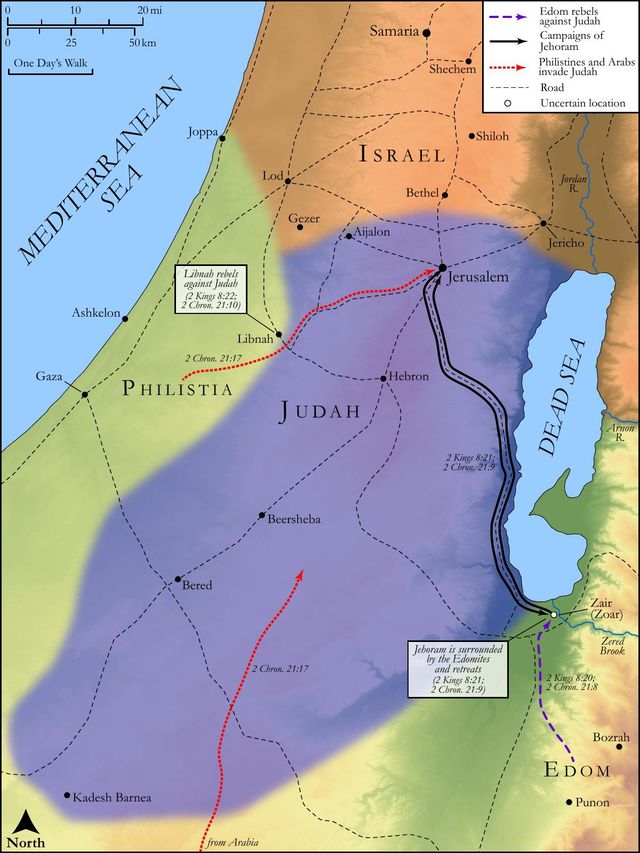
1.Some of the provinces abroad that were tributaries to him did so. The Edomites revolted (Ch2 21:8), and, though he chastised them (Ch2 21:9), yet he could not reduce them, Ch2 21:10.
2.One of the cities of his own kingdom did so. Libnah revolted (Ch2 21:10) and set up for a free state, as of old it had a king of its own, Jos 12:15. And the reason is here given, not only why God permitted it, but why they did it; they shook off his government because he had forsaken the Lord God of his fathers, had become an idolater and a worshipper of false gods, and they could not continue subject to him without some danger of being themselves also drawn away from God and their duty. While he adhered to God they adhered to him; but, when he cast God off, they cast him off. Whether this reason will justify them in their revolt of no, it will justify God's providence which ordered it so.
V.That yet God was tender of his covenant with the house of David, and therefore would not destroy the royal family, though it was so wretchedly corrupted and degenerated, Ch2 21:7. These things we had before, Kg2 8:19-22. The tenour of the covenant was that David's seed should be visited for their transgressions, but the covenant should never be broken, Psa 89:30, etc.
Continue studying 2 Chronicles 21:4 across the web’s major study libraries — every link below opens this exact verse, chapter, or book on the destination site.
Read & Compare
 BibleGatewayThis verse in more than 200 translations and 70 languages.
 Bible.comThe YouVersion reader — hundreds of translations, reading plans, and highlights.
 ESV.orgCrossway's official English Standard Version reader.
 NET BibleThe NET translation with 60,000+ translators' notes on every rendering decision.
 STEP BibleTyndale House's free study tool — original text, vocabulary, and scholarly resources.
 BibliaLogos Bible Software's free web reader.
 USCCBThe New American Bible (Revised Edition) with the U.S. bishops' study notes.
Commentaries
 BibleHub CommentariesDozens of classic commentaries on this verse, gathered on one page.
 StudyLightMore than 100 commentary sets — the largest collection on the web.
 BibleRefPlain-English commentary on what this verse means, verse by verse.
 Enduring WordDavid Guzik's free commentary on this chapter, widely used by Bible teachers.
 Bible Study ToolsVerse commentary alongside Greek and Hebrew study aids.
Original Language & Research
- BibleHub InterlinearThe verse word by word — original language, transliteration, and English.
- BibleHub LexiconEvery word's original-language definition and Strong's entry.
 Blue Letter BibleDeep-study tools — Strong's numbers, concordance, and word studies.
 SefariaThe Hebrew text with Rashi and centuries of Jewish commentary.
Sermons, Hymns & Audio


TrulyRandomVerse is not affiliated with these sites and doesn’t control their content. They’re linked because they’re genuinely useful.
Summary
Upon his ascension to the throne of Judah, King Jehoram immediately embarked on a brutal campaign of power consolidation, ruthlessly eliminating all his brothers and numerous influential princes. This shocking act of fratricide and political assassination marked a dark and violent departure from the generally righteous reign of his father, Jehoshaphat, setting an ominous tone for a period of profound moral and spiritual decline within the Davidic monarchy.
Context
ShowHideLiterary Context
This verse immediately follows the account of King Jehoshaphat's death and burial in 2 Chronicles 21:1-3. The transition is abrupt and stark, moving from a king who "walked in the ways of the Lord" to a son who begins his reign with extreme violence. The Chronicler highlights Jehoram's immediate actions as king, emphasizing that this was a deliberate act of securing his power, rather than a reaction to a specific threat. This initial act of wickedness foreshadows the entirety of Jehoram's reign, which the subsequent verses describe as marked by apostasy, idolatry, and divine judgment, culminating in his ignominious death (e.g., 2 Chronicles 21:12-20). The Chronicler's emphasis on the consequences of unrighteous kingship is a consistent theme, making Jehoram's opening act a crucial narrative pivot.
Historical & Cultural Context
In that day, the elimination of potential rivals, especially siblings, was a grim but not uncommon practice among monarchs seeking to secure their succession and prevent future challenges to their authority. While the Davidic covenant promised a stable dynasty, the actions of individual kings often reflected the brutal realities of power politics. Jehoram's mother was Athaliah, the daughter of King Ahab and Jezebel of Israel, whose family was notorious for their Baal worship and political ruthlessness. Her influence, coupled with the prevailing cultural norms of power consolidation, likely contributed to Jehoram's depraved decision to purge his own family and the leading figures of Judah. This act also reflects a profound disregard for the Mosaic Law and the sanctity of life, which were foundational principles for the people of God, illustrating the spiritual decline that often accompanied political expediency in the region.
Key Themes
ShowHideJehoram's actions in 2 Chronicles 21:4 contribute to several overarching themes in Chronicles. Firstly, it underscores the theme of unchecked power and its corrupting influence. Jehoram's ambition overrides any moral or familial obligations, demonstrating how absolute power can lead to absolute corruption. Secondly, it highlights the moral degeneration within the Davidic line, demonstrating that a godly heritage (from Jehoshaphat) does not guarantee personal righteousness. This contrasts sharply with the Chronicler's emphasis on the importance of righteous kingship and obedience to God, seen in earlier accounts of kings like David and Solomon, and even Jehoram's own father. Finally, this act of violence sets the stage for the consequences of apostasy and divine judgment, a recurring motif throughout the book of Chronicles, as Jehoram's reign would be plagued by foreign invasions and a debilitating disease as a direct result of his wickedness (e.g., 2 Chronicles 21:16-19).
Exposition and Analysis
ShowHideKey Word Analysis
ShowHideThis verb (H2388), often translated as "to be strong," "firm," or "courageous," carries a dual meaning. While it can denote positive resolve (e.g., "strengthen yourself in the Lord"), here it is used in a negative sense, indicating Jehoram's forceful and ruthless consolidation of power. He "made himself strong" not through righteous governance or divine reliance, but through violent means, asserting his authority by eliminating all perceived threats. This reflects an obstinate and self-reliant determination to secure his rule.
This verb (H2026) specifically means "to kill" or "to murder," often with deadly intent. Its use here emphasizes the deliberate and violent nature of Jehoram's actions. It is not an accidental death but a premeditated act of fratricide and political assassination, highlighting the king's profound moral depravity and his willingness to shed blood to secure his position.
Referring to his own brothers (H251), the sons of Jehoshaphat. The term underscores the heinous nature of the act – the shedding of familial blood. This was not merely a political purge but a violation of the deepest familial bonds, a direct affront to the sanctity of life within the covenant community, and a stark betrayal of his own "father's" (H1) legacy.
Verse Breakdown
ShowHide"Now when Jehoram was risen up to the kingdom of his father"
This clause establishes the immediate context of Jehoram's actions. His ascent to the throne was the catalyst for his subsequent violence, indicating that these acts were part of his strategy for establishing and securing his reign. The transition from his father's rule to his own is marked by this pivotal and destructive decision, immediately signaling a departure from the previous era.
"he strengthened himself"
This phrase describes Jehoram's active and intentional effort to consolidate his power. Unlike the positive strengthening in faith or righteous governance, this "strengthening" is achieved through brute force and the elimination of rivals, reflecting a king driven by fear, ambition, and a desire for absolute control, rather than by divine guidance or the welfare of his people.
"and slew all his brethren with the sword"
This is the shocking core of the verse. Jehoram committed fratricide, murdering all his male siblings. This act was designed to eliminate any potential claimants to the throne, ensuring his unchallenged rule. The mention of "the sword" emphasizes the violent and bloody nature of the purge, a direct and brutal act of execution that violated both family ties and divine law.
"and [divers] also of the princes of Israel"
Beyond his own family, Jehoram extended his purge to include "divers" (meaning "various" or "sundry") princes or officials of Judah (the KJV uses "Israel" here, but in the context of Chronicles, it refers to the southern kingdom of Judah). This indicates a broader political cleansing, removing any influential figures who might oppose his rule or challenge his authority, thereby solidifying his tyrannical grip on the kingdom and eliminating any potential sources of internal dissent.
Literary Devices
ShowHideThe Chronicler employs several literary devices in this verse to emphasize the gravity of Jehoram's actions. Contrast is immediately evident, as Jehoram's brutal beginning stands in stark opposition to the generally righteous and God-fearing reign of his father, Jehoshaphat. This highlights the profound moral decline that has suddenly gripped the Davidic dynasty. Foreshadowing is also powerfully present; this initial act of extreme wickedness sets the ominous tone for Jehoram's entire reign, signaling that it will be characterized by further apostasy and ultimately, divine judgment. The phrase "strengthened himself" carries a strong sense of irony, as Jehoram's attempt to secure his power through violence ultimately leads to weakness, instability, and a reign marked by divine disfavor and a painful, ignominious end, demonstrating that true strength comes from God, not from human brutality.
Theological and Thematic Connections
ShowHideThis verse starkly portrays the corrupting influence of unchecked power and the depths of human depravity when leadership is not submitted to divine authority. Jehoram's actions are a chilling demonstration of how fear, ambition, and a desire for absolute control can lead to horrific acts, even against one's own family. The narrative underscores the principle that a godly heritage does not guarantee personal righteousness; individual accountability before God is paramount. Despite Jehoram's attempts to secure his throne through violence, his reign would be marked by instability and divine judgment, illustrating God's ultimate sovereignty over human affairs and His commitment to justice, even when allowing wicked rulers to rise. This passage serves as a powerful reminder that human attempts to secure power outside of God's will are ultimately futile and self-destructive.
Reflection and Application
ShowHideThe chilling account of Jehoram's ascent to power serves as a potent and enduring warning about the dangers of unchecked ambition and the corrupting nature of power when divorced from moral and spiritual principles. It reminds us that true strength does not come from eliminating rivals or asserting control through violence, but from humility, justice, and submission to a higher authority. For leaders today, whether in government, business, or the church, Jehoram's story is a stark reminder that character and integrity are paramount. A legacy built on ruthlessness and self-interest, no matter how seemingly effective in the short term, ultimately leads to spiritual bankruptcy and often, historical condemnation. This passage calls us to examine our own hearts for any seeds of envy, ambition, or a desire for control that might lead us astray, and to actively cultivate virtues of humility, compassion, and service, recognizing that true authority is found in serving others and submitting to God's righteous standards.
Questions for Reflection
ShowHideFAQ
ShowHideWhy did Jehoram kill his own brothers and the princes of Judah?
ShowHideJehoram's actions were a brutal, though not uncommon, tactic among the kings of that day to secure absolute power and eliminate any potential rivals to his throne. By slaying his own brothers, he eradicated any alternative claimants from the direct Davidic line, and by eliminating "divers of the princes," he removed influential figures who might have opposed his rule or challenged his authority. This was a ruthless consolidation of power driven by fear, ambition, and a desire for unchallenged control, rather than a response to any specific rebellion or threat. His actions were a stark departure from the righteous example of his father, Jehoshaphat, and set a dark tone for his entire reign, as described in 2 Chronicles 21.
How does Jehoram's reign compare to his father Jehoshaphat's?
ShowHideJehoram's reign stands in stark contrast to that of his father, Jehoshaphat. Jehoshaphat is largely portrayed as a righteous king who "sought the Lord" (2 Chronicles 17:3-4) and initiated reforms in Judah, despite some compromising alliances. Jehoram, however, immediately upon ascending the throne, demonstrates profound wickedness through fratricide and political assassination. His reign is subsequently described as one marked by idolatry, apostasy, and divine judgment, leading to foreign invasions and a terrible disease (2 Chronicles 21:5-20). This stark difference highlights the individual accountability of kings before God, regardless of their heritage, and underscores the Chronicler's emphasis on the consequences of obedience versus disobedience.
Christ-Centered Fulfillment
ShowHideJehoram's reign, inaugurated by such brutal violence and self-serving ambition, stands in stark contrast to the kingdom of God established by Jesus Christ. Jehoram sought to "strengthen himself" through the death of others, securing an earthly throne through bloodshed and fear. Christ, however, "strengthened" His eternal kingdom not by taking life, but by laying down His own life, demonstrating ultimate humility and self-sacrifice (Philippians 2:5-8). While Jehoram's reign was characterized by terror and the elimination of rivals, Christ's reign is one of grace, truth, and reconciliation, inviting all to become co-heirs with Him, not rivals (Romans 8:17). The Davidic covenant, which Jehoram's actions seemed to threaten with their depravity, finds its true and perfect fulfillment not in any flawed earthly king, but in Jesus, the Son of David, whose kingdom is not of this world (John 18:36) and whose reign is eternal, righteous, and brings life, not death (Revelation 11:15). He is the true King who truly secures His people, not by slaying them, but by saving them through His atoning sacrifice.