


2 Chronicles 21:5
Bible text: King James Version (1769 Blayney text) · Public domain
Bible text: Berean Standard Bible · Public domain
Bible text: American Standard Version (1901) · Public domain
Bible text: World English Bible, Messianic edition · Public domain
Bible text: Geneva Bible (1599) · Public domain
Bible text: Young's Literal Translation · Public domain
- בֶּןben[was] a son ofH1121N-mscNoun Singular Masculine Construct
- שְׁלֹשִׁיםshe·lo·ShimthirtyH7970N-mpNoun Plural Masculine Absolute
- וּשְׁתַּיִםu·she·Ta·yimand twoH8147Conj-w ¦ N-fdNoun Dual Feminine Absoluteוּandשְׁתַּיִםtwo
- שָׁנָהsha·Nahyear[s]H8141N-fsNoun Singular Feminine Absolute
- יְהוֹרָםye·ho·RamJehoramH3088N-proper-mNoun Proper Masculine
- בְּמָלְכוֹbe·ma·le·Khowhen he became kingH4427Prep-b ¦ V-Qal-Inf ¦ 3msVerb Qal Infinitive Constructבְּwhenמָלְכbecame kingוֹhe
- וּשְׁמוֹנֶהu·she·mo·Nehand eightH8083Conj-w ¦ N-csNoun Singular common gender Absoluteוּandשְׁמוֹנֶהeight
- שָׁנִיםsha·NimyearsH8141N-mpNoun Plural Masculine Absolute
- מָלַךְma·Lakhhe reignedH4427V-Qal-Perf-3msVerb Qal Perfect 3rd Singular Masculine
- בִּירוּשָׁלִָםbi·ru·sha·Limin JerusalemH3389Prep-b ¦ N-properNoun Proper LocationבִּinירוּשָׁלִָםJerusalem
English is a literal word-by-word gloss of the Hebrew, not the KJV's wording. Why?
This is the original text the KJV's translators worked from — each Hebrew word with its own literal English meaning in this verse, prepared by scholars at Tyndale House, Cambridge. The KJV translates whole sentences, not word by word, so its wording differs: one Hebrew word can become several English words, and the KJV may choose “the LORD” where the gloss reads “Yahweh”. Both are faithful — they answer different questions. For the KJV's own rendering, switch to the KJV text.
Details
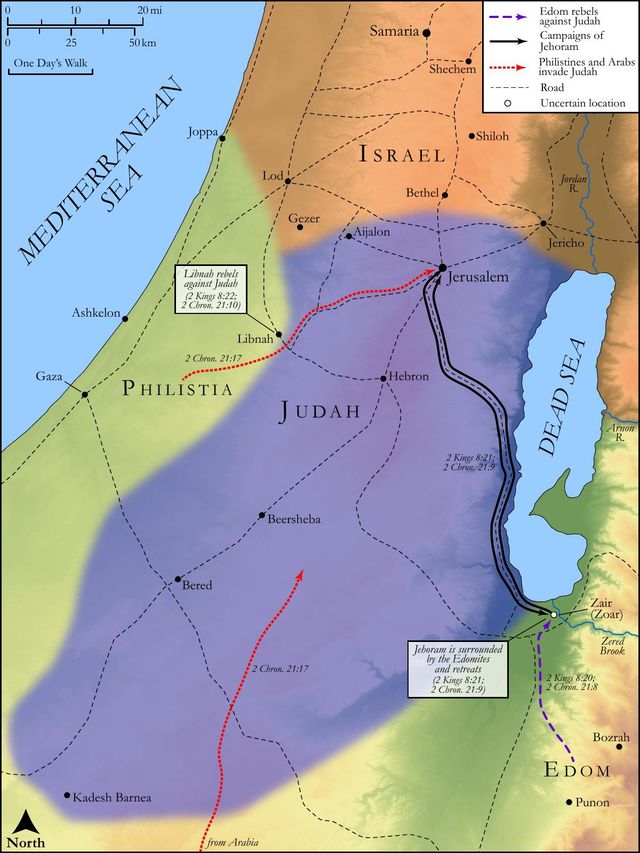
See on the biblical-era map
Study this verse
Public-domain commentary
Matthew Henry
From his Commentary on the Whole Bible. Henry comments on passages, not single verses — this entry covers 2 Chronicles 21:1–11. His two-level outline is real structure in the source text, so it is rendered as structure.
We find here,
I.That Jehoshaphat was a very careful indulgent father to Jehoram.
He had many sons, who are here named (Ch2 21:2), and it is said (Ch2 21:13) that they were better than Jehoram, had a great deal more wisdom and virtue, and lived up to their education, which he went counter to. They were very hopeful, and any of them more fit for the crown than he; and yet, because he was the first-born (Ch2 21:3), his father secured the kingdom to him, and portioned his brethren and disposed of them so as that they would be easy and give him no disturbance; as Abraham, when he made Isaac his heir, dismissed his other children with gifts. Herein Jehoshaphat was very kind and fair to his son, which might have obliged him to be respectful to him, and tread in the steps of so good a father. But it is no new thing for the children that have been most indulged by their parents to be least dutiful to them. Whether in doing this he acted wisely and well for his people, and was just to them, I cannot say. His birthright entitled him to a double portion of his father's estate, Deu 21:17. But if he appeared utterly unfit for government (the end of which is the good of the people), and likely to undo all that his father had done, it would have been better perhaps to have set him aside, and taken the next that was hopeful, and not inclined as he was to idolatry. Power is a sacred thing, with which men may either do much good or much hurt; and therefore Detur digniori - Let him that deserves it have it. Salus populi suprema lex - The security of the people is the first consideration.
II.That Jehoram was a most barbarous brother to his father's sons.
As soon as he had settled himself in the throne he slew all his brethren with the sword, either by false accusation, under colour of law, or rather by assassination. By some wicked hand or other he got them all murdered, pretending (it is likely) that he could not think himself safe in the government till they were taken out of the way. Those that mean ill themselves are commonly, without cause, jealous of those about them. The wicked fear where no fear is, or pretend to do so, in order to conceal their malice. Jehoram, it is likely, hated his brethren and slew them for the same reason that Cain hated Abel and slew him, because their piety condemned his impiety and won them that esteem with the people which he had lost. With them he slew divers of the princes of Israel, who adhered to them, or were likely to avenge their death. The princes of Judah, those who had taught the good knowledge of the Lord (Ch2 17:7), are here called princes of Israel, as before fathers of Israel (Ch2 19:8), because they were Israelites indeed, men of integrity. The sword which the good father had put into their hands this wicked son sheathed in their bowels. Woe unto him that thus foundeth a kingdom in blood (Hab 2:12); it will prove a foundation that will sink the superstructure.
III.That Jehoram was a most wicked king, who corrupted and debauched his kingdom, and ruined the reformation that his good father and grandfather had carried on: He walked in the way of the house of Ahab (Ch2 21:6), made high places, which the people were of themselves too forward to make, and did his utmost to set up idolatry again, Ch2 21:11.
1.As for the inhabitants of Jerusalem, where he kept his court, he easily drew them into his spiritual whoredom: He caused them to commit fornication, seducing them to eat things sacrificed to idols, Rev 2:20.
2.The country people seem to have been brought to it with more difficulty; but those that would not be corrupted by flatteries were driven by force to partake in his abominable idolatries: He compelled Judah thereto. He used that power for the destruction of the church which was given him for the edification of it.
IV.That when he forsook God and his worship his subjects withdrew from their allegiance to him.
1.Some of the provinces abroad that were tributaries to him did so. The Edomites revolted (Ch2 21:8), and, though he chastised them (Ch2 21:9), yet he could not reduce them, Ch2 21:10.
2.One of the cities of his own kingdom did so. Libnah revolted (Ch2 21:10) and set up for a free state, as of old it had a king of its own, Jos 12:15. And the reason is here given, not only why God permitted it, but why they did it; they shook off his government because he had forsaken the Lord God of his fathers, had become an idolater and a worshipper of false gods, and they could not continue subject to him without some danger of being themselves also drawn away from God and their duty. While he adhered to God they adhered to him; but, when he cast God off, they cast him off. Whether this reason will justify them in their revolt of no, it will justify God's providence which ordered it so.
V.That yet God was tender of his covenant with the house of David, and therefore would not destroy the royal family, though it was so wretchedly corrupted and degenerated, Ch2 21:7. These things we had before, Kg2 8:19-22. The tenour of the covenant was that David's seed should be visited for their transgressions, but the covenant should never be broken, Psa 89:30, etc.
Continue studying 2 Chronicles 21:5 across the web’s major study libraries — every link below opens this exact verse, chapter, or book on the destination site.
Read & Compare
 BibleGatewayThis verse in more than 200 translations and 70 languages.
 Bible.comThe YouVersion reader — hundreds of translations, reading plans, and highlights.
 ESV.orgCrossway's official English Standard Version reader.
 NET BibleThe NET translation with 60,000+ translators' notes on every rendering decision.
 STEP BibleTyndale House's free study tool — original text, vocabulary, and scholarly resources.
 BibliaLogos Bible Software's free web reader.
 USCCBThe New American Bible (Revised Edition) with the U.S. bishops' study notes.
Commentaries
 BibleHub CommentariesDozens of classic commentaries on this verse, gathered on one page.
 StudyLightMore than 100 commentary sets — the largest collection on the web.
 BibleRefPlain-English commentary on what this verse means, verse by verse.
 Enduring WordDavid Guzik's free commentary on this chapter, widely used by Bible teachers.
 Bible Study ToolsVerse commentary alongside Greek and Hebrew study aids.
Original Language & Research
- BibleHub InterlinearThe verse word by word — original language, transliteration, and English.
- BibleHub LexiconEvery word's original-language definition and Strong's entry.
 Blue Letter BibleDeep-study tools — Strong's numbers, concordance, and word studies.
 SefariaThe Hebrew text with Rashi and centuries of Jewish commentary.
Sermons, Hymns & Audio


TrulyRandomVerse is not affiliated with these sites and doesn’t control their content. They’re linked because they’re genuinely useful.
Summary
Second Chronicles 21:5 serves as a concise, factual introduction to the reign of Jehoram, son of Jehoshaphat, over the Southern Kingdom of Judah. This verse, characteristic of the annalistic style of the Chronicler, records his age at ascension (thirty-two years old) and the duration of his rule (eight years) from Jerusalem, immediately establishing the temporal framework for a period marked by profound spiritual decline, political instability, and egregious wickedness, a stark and tragic contrast to the piety and prosperity of his father.
Context
ShowHideLiterary Context
This verse immediately follows the summary of King Jehoshaphat's death and burial in 2 Chronicles 21:1. The transition from Jehoshaphat, a king largely commended for his devotion to Yahweh and his extensive reforms (as seen throughout 2 Chronicles 17-20), to his son Jehoram is abrupt and deeply unsettling. While 2 Chronicles 21:2-4 briefly lists Jehoram's brothers and chillingly details his consolidation of power through their murder, verse 5 formally inaugurates his reign. This immediate shift from a righteous father to a murderous, ungodly son sets a deeply ominous tone, with the brevity of Jehoram's reign hinted at as a direct consequence of his impending wickedness, which is explicitly detailed and condemned in 2 Chronicles 21:6.
Historical & Cultural Context
Jehoram's reign occurred during a turbulent period for the kingdom of Judah, marked by significant internal strife and external pressures. While his father Jehoshaphat had fostered a period of relative stability, religious revival, and military strength, Jehoram's rule saw a dramatic reversal of these fortunes. The explicit mention of "Jerusalem" as the seat of his reign underscores its profound significance as the capital, the city of David, and the spiritual center of Israelite worship, making Jehoram's subsequent apostasy and the introduction of foreign idolatry all the more grievous and scandalous. Culturally, the meticulous recording of a king's age at ascension and the length of his reign was a common practice in the records of the kings of Israel and Judah, providing a clear chronological framework for the events that followed. For the Chronicler, writing post-exile, this annalistic style served not merely as a historical record but as a theological commentary, emphasizing that the king's personal righteousness, not merely his Davidic lineage, determined the nation's well-being and the success or failure of his reign, a principle powerfully illustrated by Jehoram's disastrous rule.
Key Themes
ShowHideThe verse, though purely factual, introduces and foreshadows several key themes that permeate the Chronicler's narrative concerning the kings of Judah. Firstly, it highlights the stark contrast between righteous and wicked leadership, setting the stage for Jehoram's ungodly reign in direct opposition to his father Jehoshaphat. This serves as a powerful illustration of the principle that personal choices, even within a godly heritage, profoundly impact one's legacy and the nation's spiritual health (Deuteronomy 28). Secondly, it subtly introduces the theme of divine judgment and consequences for apostasy. The relatively short duration of Jehoram's reign (eight years) compared to his father's twenty-five years (2 Chronicles 20:31) immediately foreshadows the severity of God's displeasure and the swiftness of the consequences for his wickedness, which included the loss of Edom and Libnah, and a severe, divinely ordained plague (as detailed in 2 Chronicles 21:8-19). Finally, the verse contributes to the Chronicler's overarching emphasis on retribution theology, where obedience brings blessing and disobedience brings curses, a pattern consistently and meticulously applied to the kings of Judah.
Exposition and Analysis
ShowHideKey Word Analysis
ShowHideThis name is a theophoric compound, meaning "Jehovah-raised" or "Yahweh is exalted." The profound irony of this name in light of Jehoram's subsequent reign, characterized by idolatry, murder, and blatant apostasy, is striking. His life and actions actively contradicted the very meaning of his name, demonstrating a blatant disregard for the God he was supposedly named to exalt. This linguistic detail serves as a subtle, yet powerful, commentary on his character from the very outset of his reign, highlighting a tragic dissonance between identity and action.
This verb is the standard Hebrew term for "to reign" or "to be king," and inceptively, "to ascend the throne." While seemingly straightforward, its use here emphasizes the formal assumption of royal authority and responsibility. The Chronicler's subsequent narrative meticulously details how Jehoram exercised this authority—not in accordance with divine will, nor for the welfare of his people, but in pursuit of personal gain and wickedness, leading to the downfall of his kingdom and his own ignominious end. The root also carries the nuance of "to take counsel," which is tragically ironic given Jehoram's poor and destructive choices.
The specific mention of the duration of his reign is a standard feature of biblical annalistic records of kings. However, in Jehoram's case, the brevity of his rule (only eight years) stands in stark contrast to the longer, more prosperous reigns of many of his predecessors, particularly his father Jehoshaphat (25 years). This short duration immediately signals a troubled and ultimately unsuccessful reign, hinting at divine displeasure and the severe consequences of his actions, which are soon to be revealed as God's just retribution for his unfaithfulness and cruelty.
Verse Breakdown
ShowHide"Jehoram [was] thirty and two years old when he began to reign,"
This clause provides the precise age at which Jehoram ascended to the throne. At thirty-two, he was a mature adult, suggesting that his subsequent wicked actions were not due to youthful inexperience or immaturity, but rather deliberate and responsible choices. This detail sets the stage for a reign where personal accountability for moral and spiritual decisions will be a central and tragic theme, underscoring that his evil was premeditated.
"and he reigned eight years in Jerusalem."
This clause specifies the total duration of Jehoram's rule and its geographical center. The eight-year reign is notably short, especially when compared to the reigns of more righteous kings in Judah. This brevity, coupled with the mention of Jerusalem (the holy city, the seat of the Davidic covenant, and the place of God's Temple), immediately foreshadows a reign that would be marked by trouble, instability, and divine judgment rather than prosperity, blessing, or national flourishing, directly linking his actions to their consequences.
Literary Devices
ShowHideThe Chronicler employs several literary devices within and around this seemingly simple verse, enriching its meaning and foreshadowing the narrative to come. The most prominent is Annalistic Style, evident in the precise chronological data (age at ascension, length of reign) typical of the royal records of Israel and Judah. This style provides a factual, historical framework, lending credibility to the unfolding theological narrative. Secondly, there is significant Foreshadowing. While the verse itself is purely factual, the brevity of Jehoram's reign (eight years) immediately hints at a troubled and unrighteous rule, especially when implicitly contrasted with his father's longer, more blessed reign. This subtle clue prepares the reader for the grim details of Jehoram's wickedness and the divine judgment that follows in the subsequent verses. Finally, the potent Irony of Jehoram's name ("Yahweh is exalted") juxtaposed with his actions (idolatry, murder, apostasy, leading Judah astray) serves as a profound commentary on his character, highlighting the tragic contradiction between his God-given identity and his chosen path of rebellion against the very God his name proclaims.
Theological and Thematic Connections
ShowHideThe factual details of 2 Chronicles 21:5, while seemingly mundane, carry significant theological weight, particularly when viewed within the broader biblical narrative of kingship and divine sovereignty. This verse underscores the Chronicler's consistent emphasis on the principle that the character and choices of a leader directly impact the well-being and spiritual state of the nation. Jehoram's short and wicked reign, introduced by these basic facts, serves as a powerful counter-example to the ideal king, illustrating that even within the divinely appointed Davidic line, personal apostasy and unrighteousness lead to severe consequences and divine judgment. It highlights God's meticulous oversight of history, even in the details of a king's life and reign, and His unwavering commitment to justice, where disobedience brings swift and painful retribution, manifesting His active governance over His people and their rulers.
Reflection and Application
ShowHideWhile 2 Chronicles 21:5 appears to be a simple historical record, its placement and context imbue it with profound spiritual lessons applicable to all believers. It reminds us that every life, every period of influence, and every leadership role, no matter how grand or humble, is a "reign" before God, with a discernible beginning, a defined duration, and an inevitable end. The brevity and wickedness of Jehoram's rule serve as a stark warning: heritage, privilege, or position does not guarantee righteousness or divine favor. What truly matters are the choices we make, the character we cultivate, and our faithfulness to God during our allotted "reign" on earth. This verse challenges us to consider the legacy we are building, not just for ourselves, but for those we influence, urging us to live lives that genuinely exalt God in thought, word, and deed, rather than betraying the very meaning of our calling as His image-bearers.
Questions for Reflection
ShowHideFAQ
ShowHideWhy does the Bible meticulously record the age and reign length of kings like Jehoram?
ShowHideThe meticulous recording of a king's age at ascension and the duration of his reign (as seen in 2 Chronicles 21:5) serves several crucial purposes within the biblical narrative. Firstly, it provides a precise chronological framework for biblical history, allowing for the dating and sequencing of events and establishing the historical credibility of the accounts. This annalistic style was common in the royal records of Israel and Judah, but the Chronicler imbues it with theological significance. Secondly, these seemingly simple details often serve as subtle yet powerful indicators of divine favor or judgment. A longer, prosperous reign often signified God's blessing on a righteous king (e.g., Jehoshaphat in 2 Chronicles 20:31), while a shorter, troubled reign, like Jehoram's, often foreshadowed or reflected divine displeasure due to wickedness (as detailed in 2 Chronicles 21:6-19). Thus, these seemingly simple facts are integral to the Chronicler's overarching theological message about retribution and the direct consequences of obedience or disobedience to God.
What is the significance of Jehoram's short reign of eight years, especially compared to his father Jehoshaphat?
ShowHideThe brevity of Jehoram's eight-year reign, particularly when contrasted with his father Jehoshaphat's twenty-five years (2 Chronicles 20:31), is highly significant and reflects the Chronicler's theological perspective on divine justice. It immediately signals a reign marked by trouble, instability, and ultimately, divine judgment. As the subsequent verses in 2 Chronicles 21 reveal, Jehoram's rule was characterized by extreme wickedness, including the murder of his own brothers (2 Chronicles 21:4), leading Judah into idolatry and apostasy (2 Chronicles 21:6), and facing severe external and internal calamities (2 Chronicles 21:8-19). The short duration of his reign, culminating in a painful death and an ignominious burial (2 Chronicles 21:19-20), serves as a powerful illustration of God's swift and severe judgment against unrighteous kings who lead His people astray, reinforcing the pervasive biblical theme of divine retribution for disobedience.
Christ-Centered Fulfillment
ShowHideThe brief, factual introduction to Jehoram's reign in 2 Chronicles 21:5, with its subtle hints of a short and wicked rule, ultimately points to the profound and desperate need for a perfect and eternal King, a longing fully fulfilled in Jesus Christ. Jehoram, whose name ironically means "Yahweh is exalted," utterly failed to exalt God, instead leading his people into apostasy, bloodshed, and suffering. His reign, like those of many flawed earthly kings in the Old Testament, underscores the inherent limitations and tragic failures of human leadership, even within the divinely appointed Davidic line. These earthly kings, despite their royal lineage, were temporary, imperfect, and often succumbed to sin and corruption, demonstrating that no human ruler could fully deliver God's people or establish a truly righteous and everlasting kingdom. This continuous cycle of flawed kings and their disastrous reigns, meticulously recorded by the Chronicler, creates a profound longing for the ultimate King, the true Son of David. Jesus, unlike Jehoram, perfectly embodies His name and mission, truly exalting the Father in His life, death, and glorious resurrection. His kingdom is not limited by time or human sin (Luke 1:33), His reign is one of perfect righteousness and justice (Isaiah 9:6-7), and His sacrifice atones for the very sins that plagued kings like Jehoram and their people (Hebrews 9:11-14). Thus, Jehoram's brief and tragic reign serves as a poignant shadow, highlighting the glorious and eternal reality of Christ's perfect kingship, under whom all who believe find true salvation, everlasting peace, and a kingdom that will never end.